You're likely booking this trip because precision matters. A board meeting in Mayfair. A family arrival during a packed social calendar. A one-way hop into London before continuing to the South of France. You want the cabin quiet, the timing exact, and the arrival smooth. What you don't want is a vague quote, the wrong aircraft, or an airport choice that turns a private flight into an expensive ground-transfer problem.
That's where first-time transatlantic charter clients usually get tripped up. They ask for a category, get a headline number, and assume the rest will sort itself out. It won't. A private jet to london is a technical purchase wrapped in a luxury product. If you don't understand range, airport restrictions, customs flow, and hidden repositioning costs, you can overpay for an aircraft that isn't even the right fit for the mission.
Planning Your Private Flight to London
A London charter looks simple until it isn't. You tell a broker your dates, passenger count, and preferred departure city. A quote lands in your inbox. The aircraft sounds right. The cabin photos look polished. Then the key questions start. Which London airport works for your final destination? Can the aircraft fly the route nonstop with your baggage? Are you paying for an airplane that has to come from somewhere else before it even picks you up?

London rewards precision. It's one of the world's busiest private aviation markets. One analysis of 2022 data found that London airports handled over 70,000 private jet movements, or roughly one private flight every eight minutes, according to Greenpeace's review of Civil Aviation Authority data. That volume is exactly why casual planning is a mistake. Busy market means more options, but it also means more room for poor routing, weak sourcing, and airport mismatches.
Start with the trip, not the aircraft category
New clients often say they want a heavy jet, a Gulfstream, or something “similar.” That's the wrong starting point. The mission decides the aircraft, not the other way around.
Ask these questions first:
- Where are you going in London? Knightsbridge, Canary Wharf, Surrey, and the Cotswolds all point to different arrival strategies.
- Is this a same-day business arrival or an overnight recovery trip? That changes cabin priorities.
- How much baggage are you bringing? Fashion week luggage and ski bags change the aircraft pool quickly.
- Is the departure one-way? If yes, pricing can move a lot depending on aircraft positioning.
A polished quote is not the same thing as a well-built flight.
London planning includes the ground segment
A private flight ends at the curb, not the runway. If you're traveling with family, pets, security, or staff, the airport choice matters almost as much as the airplane. If you need a practical non-aviation reference once your wheels are down, your guide to London logistics is useful for thinking through neighborhood access and day-to-day movement around the city.
My advice is simple. Treat this like a mission brief, not a lifestyle purchase. When clients do that, they usually get a faster trip, a better-suited aircraft, and a cleaner invoice.
Deconstructing the Cost of a Private Jet to London
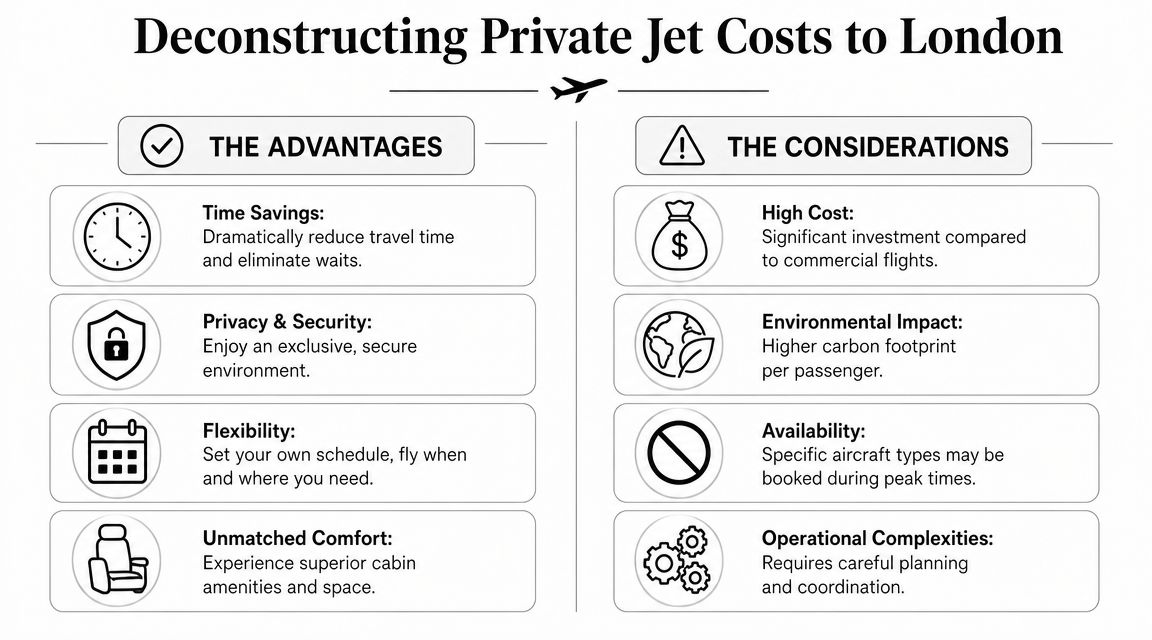
Most buyers ask the wrong pricing question. They ask, “What does a private jet to london cost?” The better question is, “What exactly am I paying for?”
That distinction matters. Two London quotes can look similar on the surface and be built on completely different economics underneath. One may reflect a nearby owner-operated aircraft. The other may include a hidden ferry leg, soft markups, and a broad category substitution if the original plane falls away. If you only compare headline price, you're flying blind.
The hidden line item most clients miss
The biggest pricing trap is repositioning. That's the cost of moving an aircraft empty to your departure city before your trip even begins. It's common, and many first-time clients don't realize it's there until they've already accepted the quote.
According to Sky Access route analysis, traditional brokers and jet card programs can inflate charter pricing by 20 to 40% through repositioning fees. That's a major spread. And it explains why one quote can feel oddly expensive even when the route and cabin class appear comparable.
Why the standard quote model is flawed
The old way of quoting private charter encourages lazy shopping. A client asks for New York to London. The broker grabs available lift from wherever they can find it, wraps it in a broad aircraft category, and sends it over as if the route itself determines the price.
It doesn't.
The drivers are usually these:
- Aircraft starting point. If the plane is already near your departure city, that helps. If it isn't, you may pay to bring it in.
- True one-way versus round-positioned movement. One-way trips can be efficient, or they can become expensive if the aircraft has no logical next leg.
- Exact aircraft, not just cabin class. Two jets in the same broad category can be priced very differently based on operator location and mission fit.
- Operational suitability. If the original option can't support the route profile cleanly, you'll often see substitutions later.
Practical rule: If the quote doesn't show where the aircraft is coming from, you don't have the full picture.
Local sourcing is how serious buyers control cost
Buyer discipline is essential. You want the aircraft sourced near the departure city, not just sourced fast. Local sourcing strips out unnecessary deadhead flying and usually gives you a cleaner number from the start.
That's also why I tell clients to stop obsessing over generic hourly rates. Hourly framing hides too much. A mission-based quote is what matters. If you want a broader breakdown of what charter pricing typically includes, this guide on private jet charter flight cost is a useful reference point.
One model built around this approach is Haute Jets. It sources from 3,500+ owner-operators across 175 countries and is designed to reduce the repositioning problem by finding aircraft based closer to the departure point. That matters more on long-haul missions than most clients realize.
What to ask before you approve any quote
Don't ask for “best price.” Ask for these answers:
- Where is the aircraft currently based?
- Is this quote built on a local aircraft or a repositioned one?
- Am I seeing the exact tail option or a category placeholder?
- What would cause a last-minute aircraft swap?
- Is this still the right aircraft if baggage, passenger count, or runway constraints change?
Clients who ask better questions usually get better aircraft and better pricing. London charter is expensive enough without paying for someone else's empty leg to your departure airport.
Choosing the Right London Arrival Airport
A private jet to london should save time on the ground, not just in the air. That's why airport choice is strategic. If your aircraft lands at the wrong field for your mission, you can lose the advantage you just paid for.
The default mistake is choosing the airport name you recognize. Heathrow and Gatwick sound convenient because they're famous. For most private travelers, they aren't the first choice. The better options are usually Luton, Farnborough, Biggin Hill, or Stansted, depending on where you're going, what aircraft you're using, and how much operational flexibility you need.
London City is closer, but not always better
Clients love the idea of London City because it's close in. Sometimes that's smart. Often it isn't.
London City Airport's runway is 1,508 meters, and that short runway restricts operations to smaller jets and regional aircraft, as explained in Icarus Jet's London operations guide. If you're arriving on a larger cabin aircraft, or you need more baggage and fewer payload compromises, London City can become the wrong answer quickly.
That's why longer-runway airports such as Luton and Farnborough often become the practical choice for long-range arrivals.
Use the airport that matches the mission
Here's the decision framework I use with clients:
- Farnborough suits travelers who want a business-aviation environment and smooth handling.
- Luton works well for a wide range of aircraft and remains a core private jet gateway.
- Biggin Hill is useful for certain London access patterns, especially if your final stop favors that side of the city.
- Stansted can be a strong operational option when availability and runway flexibility matter.
- London City only makes sense if the aircraft qualifies and the shorter ground segment outweighs the restrictions.
For a more detailed look at terminal handling choices, this overview of London FBO options is worth reviewing before you lock in the airport.
London Private Jet Airport Comparison 2026
| Airport | Distance to Central London | Typical Drive Time | Best For | Aircraft Limitations |
|---|---|---|---|---|
| Farnborough | Outside Central London | Varies by traffic | Business aviation arrivals prioritizing privacy and operational ease | Fewer practical limitations for larger private aircraft than London City |
| Luton | Outside Central London | Varies by traffic | Long-range arrivals, broad aircraft compatibility, flexible scheduling | Typically suitable for larger private jets |
| Biggin Hill | Outside Central London | Varies by traffic | Travelers heading to specific parts of London and the south side | Mission-dependent, but generally more flexible than London City |
| Stansted | Outside Central London | Varies by traffic | Operational flexibility and alternate planning | Generally suitable for larger private aircraft |
| London City | Closest of the main options to central districts | Often attractive on paper | Small-cabin arrivals where central access is the top priority | Short 1,508-meter runway restricts many larger jets |
Choose the airport for the full door-to-door result. Not for the map thumbnail.
My recommendation
If this is your first transatlantic charter into London, keep it simple. Unless your operator confirms London City is a clean fit for your exact aircraft and payload, start your planning around Luton or Farnborough. They give you more room operationally, reduce the chance of late-stage changes, and support the kind of aircraft most clients want on a transatlantic mission.
Selecting Your Ideal Aircraft for the Mission
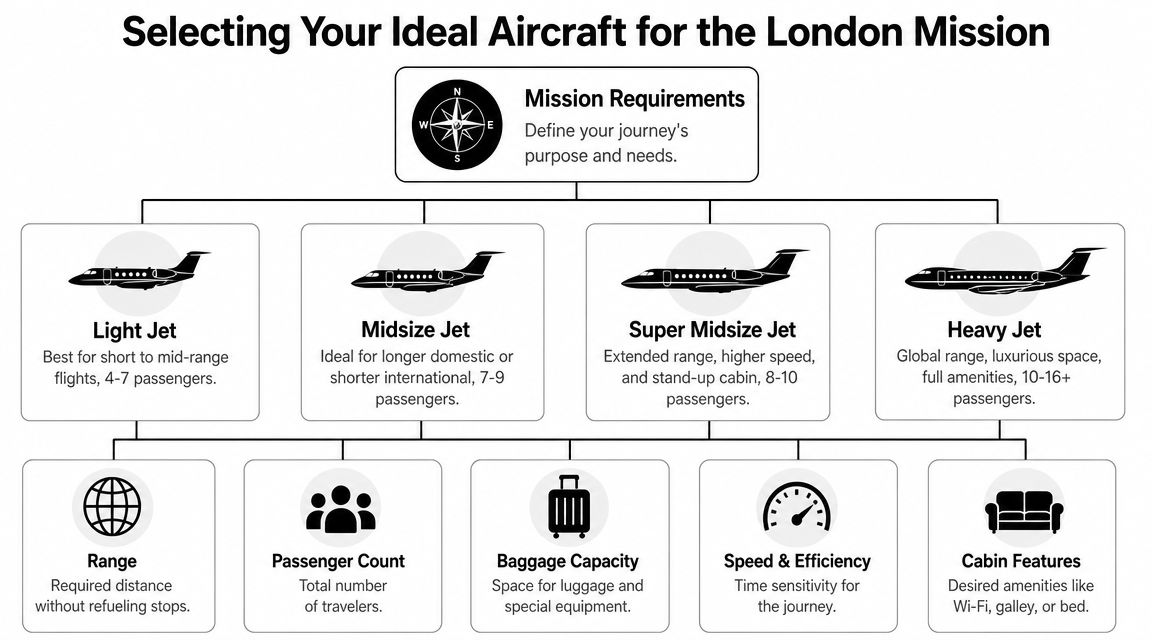
Most charter mistakes happen because clients shop by category instead of mission. “Midsize” sounds efficient. “Heavy” sounds luxurious. Neither term tells you whether the aircraft can perform the trip the way you want it performed.
For a private jet to london, the first question is not cabin finish. It's range. If the aircraft can't complete the mission cleanly with your passenger load and baggage, the rest of the conversation is decoration.
Start with range, then layer comfort
A lot of new buyers assume any midsize or super-midsize aircraft can cross the Atlantic nonstop. That's wrong. The Cessna Citation Latitude has a maximum range of 2,700 nautical miles and a maximum cruise speed of 446 KTAS, according to Textron Aviation's Citation Latitude specifications. That's enough for many domestic missions, but not enough for a standard New York to London mission without tradeoffs.
For this route, charter providers commonly cite aircraft such as the Gulfstream G650 and Dassault Falcon 7X as long-range options. That's the class you should be looking at if you want a proper nonstop transatlantic profile with fewer compromises.
Think like a dispatcher
Use this order of operations when choosing the aircraft:
- Trip distance Your route determines the floor. If range is marginal on paper, treat it as a no.
- Passenger count More people means more weight. More weight can mean less flexibility.
- Baggage profile Garment bags, golf clubs, production gear, and family luggage all matter.
- Preferred arrival airport Airport restrictions can narrow the aircraft pool fast.
- Cabin experience Once the aircraft is operationally correct, then compare Wi-Fi, seating plan, sleeping setup, and cabin age.
Practical aircraft guidance
Here's the blunt version.
- Midsize jet. Fine for many domestic U.S. trips. Not my recommendation for a nonstop New York to London mission.
- Super-midsize jet. Better, but still mission-sensitive depending on winds, payload, and exact city pair.
- Ultra-long-range aircraft. The cleanest answer for clients who want a nonstop transatlantic trip with minimal compromise.
- Heavy cabin choices. Also viable depending on exact model and route requirements.
Don't buy category labels. Buy an exact aircraft that can do the job with margin.
What clients should request
When reviewing options, ask for the exact aircraft details, not a generic category promise.
Request these specifics:
- Year, make, and model
- Confirmed baggage capacity for your actual luggage
- Wi-Fi availability
- Cabin layout
- Whether the routing is planned nonstop or with contingency assumptions
- Any payload or airport restriction that could affect the mission
The right aircraft selection feels uneventful. That's the point. No fuel-stop surprise, no baggage shuffle, no airport downgrade, no call six hours before departure saying the original jet is no longer suitable. For transatlantic travel, boring is the premium product.
Your Arrival The FBO, Customs, and Immigration
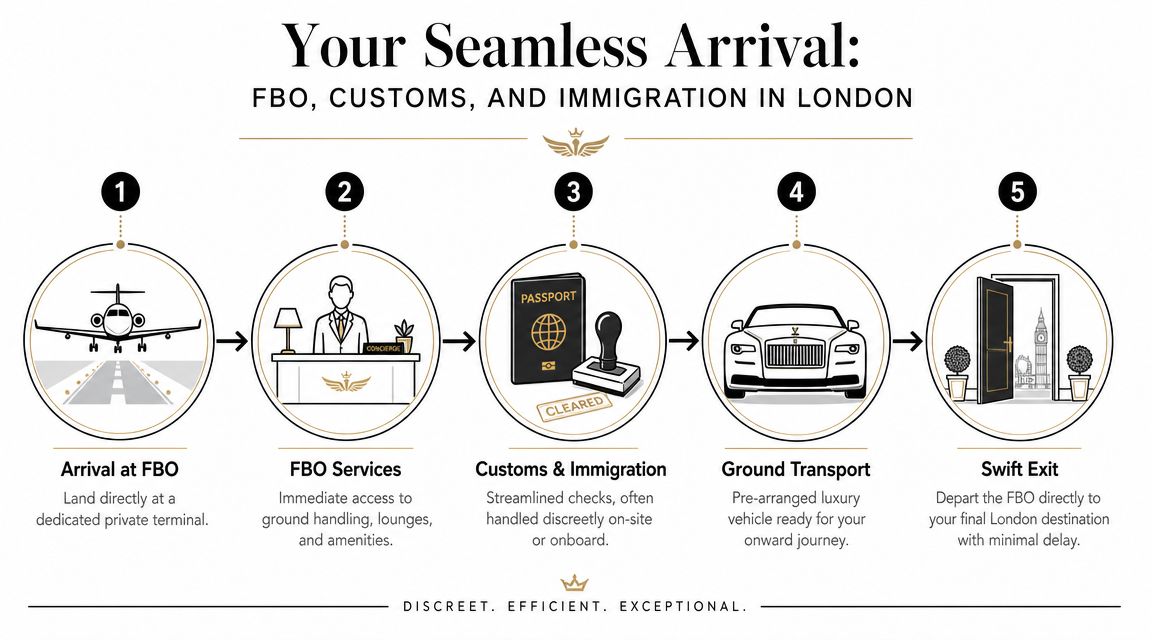
First-time clients often worry about arrival because they're still imagining a commercial terminal. That's not how this works. On a properly handled private jet to london, you arrive through an FBO, which is the private terminal used for business aviation traffic.
The experience is quieter, faster, and more controlled. You're not walking into a public arrivals hall with rolling crowds and long queue lines. You step off the aircraft, move into the private terminal environment, clear the required checks, and leave in your waiting car.
What actually happens after landing
The sequence is usually straightforward:
- Aircraft parks at the FBO rather than a commercial gate
- Ground staff meet the aircraft
- Luggage is handled directly
- Customs and immigration are completed through the private arrival process
- Your driver departs from the terminal side, not a public curb battle
For clients used to airline arrivals, the difference is immediate. There's less noise, less walking, less waiting, and fewer unnecessary touchpoints.
Why this part matters more than people think
The arrival process is where private travel proves its value. Saving time in the air is useful. Saving friction after landing is what clients remember.
If your trip includes family members, elderly travelers, security staff, assistants, or sensitive schedules, the FBO flow matters even more. Everyone stays within a controlled environment. Bags move faster. Ground transport coordination is simpler. The whole arrival feels intentional rather than improvised.
The flight isn't finished when the wheels touch down. It's finished when you're in the car and moving.
What you should confirm in advance
Don't leave arrival details vague. Before departure, make sure your team or charter advisor has confirmed:
- The exact FBO location
- Your customs and immigration handling process
- Driver name and vehicle details
- Any special handling for pets, children, or additional staff
- Whether bags need priority access for a same-day meeting or event
Clients tend to obsess over catering and cabin photos. Fine. But a polished arrival beats premium snacks every time. If you're flying into London for the first time, the private terminal process should feel simple, quiet, and tightly managed. If it doesn't, the trip wasn't planned well enough.
The Strategic Advantage of Empty Leg Flights
You see a London flight posted at a sharp discount and assume you found a simple win. Sometimes you did. Sometimes you just bought dependency on someone else's itinerary.
That is the first rule of empty legs. They are unsold repositioning segments, created because an aircraft has to move for a primary charter. If your timing and route match that movement, the price can be attractive. If the underlying trip shifts, your plan shifts with it.
London produces plenty of these opportunities because traffic is constant and aircraft are regularly repositioned between major business and leisure markets. But don't confuse availability with control. On an empty leg, the operator controls the framework. You are fitting into an existing movement, not building one around your schedule.
When empty legs are actually worth pursuing
I recommend empty legs for travelers who can treat them as opportunistic value, not guaranteed transport.
They make sense for:
- Flexible departure windows
- One-way travel
- Leisure trips with timing cushion
- Clients comparing value against convenience, not certainty
They are a poor choice for fixed meetings, tightly timed event arrivals, or family itineraries with drivers, staff, and multiple handoffs waiting on the ground.
The bigger mistake is assuming an empty leg is always the cheapest answer. It often is not. Traditional brokers and jet card programs may show a discounted segment, then bury the true economics elsewhere through repositioning exposure on the flights you book normally. That is the part many first-time buyers miss. A cheap empty leg can look impressive next to an overpriced full charter that should have been sourced locally in the first place.
The trade-off you need to accept
An empty leg is tied to someone else's paid mission. That is the risk. If their trip cancels, moves, or changes aircraft, your flight can disappear or change with very little notice.
Use this framework:
| Situation | Empty leg fit |
|---|---|
| Fixed morning meeting in London | Poor fit |
| Flexible weekend departure | Good fit |
| One-way leisure travel | Strong fit |
| Multi-car, timed family arrival | Caution |
| Backup option for an existing trip | Smart use |
Book empty legs when flexibility is real, not theoretical.
If you want a practical way to screen these offers, this guide to booking empty leg flights intelligently is a good place to start.
My recommendation for London flyers
Use empty legs as a tactical buy. Never use them as the foundation of a time-sensitive transatlantic plan.
For London, the better long-term strategy is disciplined sourcing. The right advisor looks for local aircraft first, cuts unnecessary repositioning, and shows you where the cost is coming from. That is where the Haute Jets model is stronger than the usual broker pitch or prepaid jet card logic. You get access to empty leg opportunities when they make sense, but the core value comes from avoiding avoidable ferry costs on the rest of your flying.
That is how experienced buyers save money. They do not chase discounts. They remove waste.
The Haute Jets Difference A Smarter Way to Charter
By now the pattern should be clear. London charter gets expensive and messy when buyers accept vague pricing, generic aircraft categories, and airport choices that aren't matched to the mission. Most of the friction comes from opacity. You can't manage what you can't see.
A smarter charter process fixes that in four places. It fixes sourcing, so you're not paying for unnecessary repositioning. It fixes aircraft selection, so the plane matches the route instead of the sales language. It fixes operator standards, so safety and service aren't left to chance. And it fixes pre-flight visibility, so there are no surprises at the terminal.
What a disciplined charter model should include
If I were advising a new high-value client on how to choose any charter provider for a private jet to london, I'd insist on these standards:
- Exact aircraft visibility instead of broad category promises
- Clear sourcing logic so you know whether the jet is local or repositioned
- Strong third-party safety standards
- Confirmed cabin details including Wi-Fi, baggage suitability, and pet policy
- Pre-flight transparency on crew, tail, and handling details
- No pressure into prepaid products if you don't need them
The Haute Jets model is worth understanding on its merits. It sources from 3,500+ owner-operators across 175 countries, focuses on local aircraft sourcing to reduce repositioning exposure, charters only with Wyvern Wingman and Argus Gold/Platinum-rated operators, and gives clients the ability to choose the exact aircraft rather than buying a category. It also provides full flight details 24 hours before departure and operates on an on-demand basis rather than requiring jet cards or annual memberships.
Those are practical features, not marketing fluff. They directly address the weak points that trip buyers up on London missions.
My recommendation for first-time London charter clients
Be demanding early. That's how you avoid problems later.
Here's the operating standard I'd use:
- Choose the airport after reviewing your true final destination
- Choose the aircraft after validating range, baggage, and runway suitability
- Review pricing only after confirming whether repositioning is built in
- Approve the exact aircraft, not a broad category
- Confirm arrival handling before the day of flight
That's how experienced buyers approach a transatlantic charter. They don't get dazzled by cabin photos or distracted by a soft quote. They force clarity.
What matters most
For London, the winning booking usually isn't the cheapest quote or the flashiest aircraft. It's the mission that runs clean. Correct airport. Correct aircraft. Clean sourcing. Predictable arrival. No membership upsell. No invoice shock from hidden deadhead flying.
That's the standard worth paying for.
If you want a private jet to london priced around the actual mission instead of a padded headline quote, talk to Haute Jets. You'll see the exact aircraft options, understand whether positioning is affecting the number, and book on demand without jet cards or annual commitments.