

You're likely making this decision under real pressure. The villa is booked, the yacht itinerary is moving, the children's luggage list keeps growing, and every broker you call gives you a polished quote that somehow still feels vague.
That instinct is correct.
Booking a private jet to Mallorca is straightforward once you know what drives price, aircraft fit, and airport logistics. It gets expensive when you accept category-level quotes without asking where the aircraft is coming from, how much baggage it really holds, and whether the operator is pricing the trip you want or the repositioning they need.
Your Arrival in Paradise Begins Before You Land
You feel the difference the moment the trip starts. Instead of building your day around airline slots, crowded terminals, and summer delays into Palma, you leave on your schedule and arrive ready to use the island, not recover from the journey.

That is the obvious advantage. The more important one is cost control.
Mallorca is a high-volume summer market, and that creates a trap first-time charter clients miss. A quote can look competitive until you ask where the aircraft is coming from. If the jet has to reposition from another city before it collects you, you are often paying for flying time that adds nothing to your trip. Good brokers should address that early. Many do not.
I recommend starting with aircraft already based near your departure point or already rotating through your route. That one decision can reduce deadhead exposure, shorten lead times, and make the whole booking more predictable. It is also why a modern sourcing model matters. Haute Jets compares real operator availability across the market instead of pushing a narrow in-house fleet, which helps surface options that are geographically sensible rather than merely convenient for the seller. If London is part of your itinerary, their Palma de Mallorca to London private jet route page is a practical reference point for planning.
Palma works well because the airport is built to handle serious seasonal private traffic. For owners, families, and principals running a Mediterranean schedule, it functions as an efficient gateway to villas, yachts, and onward island or mainland connections. If you are heading straight to Son Vida, Deià, or the southwest coast, the luxury lies not in the cabin. It is arriving without wasted hours, vague pricing, or ground-side friction.
Use the flight to set the trip up properly, not to absorb avoidable hassle.
If you are pairing air planning with accommodations, Residaro's guide to luxury villas Spain is a useful reference for narrowing the villa side of the trip without wasting time on mismatched inventory.
Typical Routes and Flight Times to Mallorca
A client leaves London after breakfast, expects a simple hop to Palma, then gets hit with a bloated quote because the aircraft is coming in empty from elsewhere. That is the mistake to avoid.
Flight time to Mallorca is usually straightforward. Quote structure is not. On short European sectors, the primary risk is not misjudging block time. It is paying for positioning you did not need.
London is the clearest reference point
London to Palma is one of the most common private routes into Mallorca, and it gives first-time charter clients a useful benchmark. A light jet typically gets you there in roughly two to two and a half hours. A turboprop is slower, but still practical if you are cost-sensitive and traveling light. Analysts at Evojets' London to Palma pricing page show how quickly pricing changes once you move from light jet to midsize and super-midsize cabins.
Use London as a planning reference, but do not stop at the route time. Ask where the aircraft is based before you approve anything. A jet parked near your departure airport is often the difference between a clean quote and an inflated one.
If London is part of your itinerary, Haute Jets' Palma de Mallorca to London private jet route guide is a useful starting point for timing and routing context.
Paris, Geneva, Milan, and Nice are easy Mallorca sectors
From the main Western European gateways, Mallorca is comfortably within light and midsize jet territory. That matters because you usually do not need to jump into a larger cabin just to make the route work. You upgrade because your party size, luggage profile, or onboard expectations justify it.
That distinction saves money.
For a couple heading to a villa for a long weekend, a light jet is often the sensible answer. For a family traveling with multiple cases, golf clubs, or yacht bags, the cheapest quote can become the wrong quote very quickly if baggage space is tight or the cabin feels cramped by the time you board.
Choose aircraft for the route you are actually flying
Short flights expose bad aircraft matching fast. You feel every compromise. Limited baggage, a tight lavatory, or awkward cabin access matters more than many first-time clients expect, especially on a leisure trip where everyone boards with more than a briefcase.
My recommendation is simple:
- Choose a turboprop only if price matters more than speed and you are comfortable with a more functional cabin.
- Choose a light jet for couples, small groups, and straightforward luggage.
- Choose midsize or super-midsize only when you need the cabin space, baggage capacity, or added comfort for a family or group.
Do not pay heavy-jet money for a route that does not need it. Do not accept a light jet just because the headline price looks attractive if your bags, passengers, or expectations say otherwise.
The smart move is to match route time with aircraft position
Mallorca is easy to reach from much of Europe. The harder part is avoiding waste around the edges of the booking. A traditional broker may show you an aircraft that fits the route on paper but starts the day in the wrong city, which can add repositioning time, crew cost exposure, and unnecessary complexity.
A modern sourcing model fixes that by prioritizing aircraft already based near your departure point or already rotating through a sensible routing. That is the practical advantage of using Haute Jets. You see options that make geographic sense, not just options that happen to be available somewhere in the network.
On a Mallorca charter, that discipline matters as much as flight time itself.
Understanding Your Private Jet Charter Costs
You approve a Mallorca quote at what looks like a fair rate. Then the final invoice grows because the aircraft had to come in empty from another city, wait longer than expected, or park through a peak weekend. That is how first-time charter clients overpay.
The price that matters is not the headline hourly rate. The price that matters is the total mission cost, with aircraft positioning made clear before you sign.
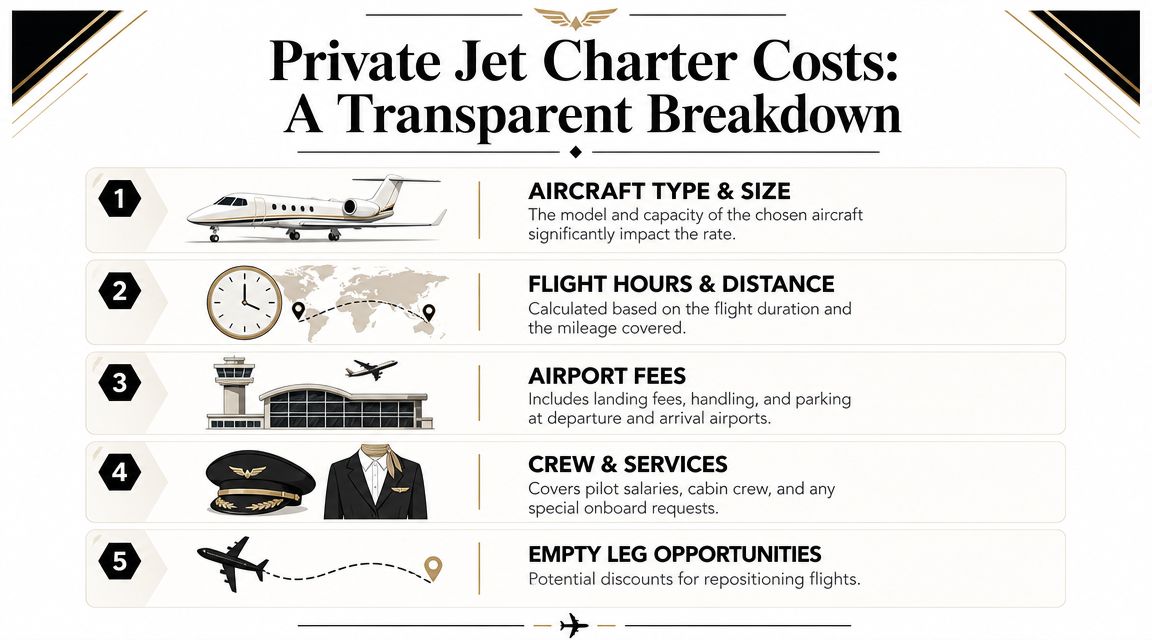
Start with the total trip, not the aircraft headline
Aircraft category still drives the quote. A light jet will usually price lower than a midsize, and a midsize lower than a heavy. But clients fixate on cabin class too early and miss the bigger variable. Positioning can erase any apparent saving.
A cheaper aircraft based in the wrong city often costs more than a better aircraft already sitting near your departure airport. That is the part many brokers gloss over because it is easier to sell a low starting number than a clean all-in figure.
If you want a useful framework, review how to choose the right aircraft for short-haul private flights, then ask where that aircraft is located on the day of travel.
The real cost drivers
A Mallorca charter quote is usually built from a small set of items:
- Aircraft and flight time: The base cost for the jet and the route flown.
- Airport charges: Landing, handling, parking, and local service fees.
- Crew costs: Pilot duty, overnight expense if required, and operating support.
- Trip structure: One-way, same-day return, multi-leg itinerary, or aircraft standby.
- Positioning: Any empty leg needed to bring the aircraft to you or return it to base.
The last line is where waste usually hides.
Peak summer Mallorca flying makes this worse. Aircraft are busy, parking can tighten, and operators price carefully around rotation risk. If your jet starts the day far from your departure point, you are paying for that inefficiency one way or another.
Repositioning fees are the trap
Here is my rule. Never approve a quote until you know the aircraft's base, its previous leg, and whether any empty ferry flying is built into the number.
A traditional broker can technically offer a suitable aircraft while ignoring geography. The jet may fit your route on paper and still be a poor choice economically. Haute Jets solves that problem in a more modern way by prioritizing aircraft already based near your departure city or already flying a sensible rotation. That reduces repositioning exposure before the quote ever reaches you.
Clients feel the difference in two places. The price is cleaner, and the day runs with fewer surprises.
Ask these five questions before you book
Use these on every Mallorca charter:
- Where is the aircraft based today?
- Does this quote include any empty repositioning legs?
- Am I seeing the exact aircraft or a category example?
- What parking, overnight, or waiting charges could still be added?
- Is this structure one-way, round trip, or aircraft stay-over?
Direct questions force direct answers.
If a broker cannot explain the quote in plain English, do not book through them. A proper charter quote should tell you exactly what you are paying for, why you are paying it, and what could still change.
Choosing the Right Aircraft for Your Trip
Most aircraft mistakes happen because clients shop by passenger count alone. That's not enough for Mallorca.
A couple carrying soft weekend bags can fly comfortably on an aircraft that would be a terrible choice for a family with golf clubs, children's gear, and a longer summer stay. Cabin category matters, but baggage space can matter more.
Baggage can decide the trip
One Mallorca airport fleet reference makes the point better than any sales pitch. A Citation CJ2+ offers 65 ft³ of baggage space, while a Citation Ultra has only 26 ft³. That difference can be the deciding factor if you're carrying golf bags or substantial luggage for a summer itinerary (AccAir Charter's Palma de Mallorca Airport aircraft page).
That's why I don't accept “seats up to seven” as a useful answer on its own. Seven passengers with seven weekender bags is one mission. Four passengers with golf equipment, children's items, and villa provisioning requests is another.
Match the aircraft to the traveler
| Aircraft Category | Example Model | Passengers | Best For |
|---|---|---|---|
| Light Jet | Citation CJ2 | Small groups | Couples, short leisure hops, light baggage |
| Light Jet | Citation Mustang | Small groups | Fast Mediterranean positioning with compact luggage |
| Midsize Jet | Citation Latitude | Larger groups | Family travel with more cabin comfort |
| Super-midsize / Large Cabin | Falcon 2000LX | Larger groups | Premium leisure trips with more space and flexibility |
| Turboprop | Pilatus PC-24 | Small to mid-size groups | Short sectors where practicality matters more than cabin prestige |
For a couple's getaway
If you're heading to Mallorca for a long weekend, a dinner schedule in Palma, or a villa stay with minimal luggage, a light jet often makes sense. You'll keep the trip efficient without paying for unused cabin volume.
That said, don't let a broker put you into the smallest available jet just because it's available. Ask for the exact baggage layout and whether your luggage profile has been checked.
For the family holiday
Families should lean toward midsize or larger aircraft when the luggage list grows. More cabin space helps, but a key advantage is operational flexibility. It's easier to board, easier to settle children, and easier to avoid the last-minute baggage reshuffle nobody wants on the tarmac.
If you want a deeper framework for short-haul aircraft selection, this Haute Jets Journal guide on choosing the right aircraft for short-haul private flights is a practical companion.
For the golf or lifestyle-heavy itinerary
Mallorca attracts travelers who don't pack lightly. Golf clubs, extra wardrobes, children's equipment, and longer-stay luggage all push the mission away from the smallest cabins.
The cheapest aircraft that can seat your group is often not the cheapest aircraft that can handle your trip properly.
Choose the aircraft for the mission, not the headcount. That's how you avoid operational compromises disguised as savings.
Navigating Airports and FBOs in Palma
Your Mallorca arrival can feel polished or painfully sloppy. The difference usually has nothing to do with the flight itself. It comes down to where the aircraft is parked, which handler is meeting you, and whether your charter was sourced intelligently in the first place.
Palma de Mallorca Airport is busy in peak season, especially on Fridays, Sundays, and around major summer events. That matters because congestion affects more than runway flow. It can also affect parking availability, handling timing, and, in some cases, whether an aircraft needs to reposition after drop-off. Brokers often gloss over that part. They should not.

What actually happens on arrival
You arrive through the private terminal side of the airport, not the commercial passenger flow. That means faster handling, more privacy, and a far more controlled handoff to your driver.
A well-run arrival usually follows this sequence:
- Touchdown: The aircraft lands and taxis to the private handling area.
- Aircraft steps: You disembark directly into a quiet, restricted-access environment.
- Arrival formalities: Required checks are handled through the FBO process, with far less friction than the main terminal.
- Ground transfer: Your driver is coordinated in advance so you can leave promptly for Palma, Son Vida, Deià, Port d'Andratx, or the marina.
That last point is where poor planning shows. If the handler, crew, and car service are not aligned, you start waiting on the apron for luggage, permits, or a misplaced driver. A good charter setup prevents that before departure day.
Why Palma ground handling affects your charter cost
Clients tend to focus on the hourly flight rate. Fair enough. But airport logistics in Palma can also shape the final bill.
If your aircraft cannot remain positioned efficiently, you may see extra handling, parking, or repositioning charges. That is one reason I prefer a sourcing model that starts with aircraft already based near your departure point and matched realistically to the mission. It reduces the odds of paying for unnecessary ferry legs on either side of the trip.
This is one of the practical advantages in the Haute Jets approach. The goal is not just to get you an aircraft to Mallorca. It is to present options that make operational sense, so your arrival works cleanly and your quote does not swell later with costs that should have been addressed upfront.
If you want more detail on why private terminals matter, this guide to the benefits of private FBO terminals for jet travelers is worth reading.
The Haute Jets Booking Process Step by Step
You should know whether your Mallorca quote is clean before you sign anything. If the booking process does not show where the aircraft is coming from, what is confirmed, and which charges could still change, you are not booking well. You are buying uncertainty.
The right process is straightforward. Define the trip properly, compare real aircraft that are positioned sensibly, lock in the option that fits, and receive a final brief that answers travel-day questions in advance.

Step one gets the mission right
A serious trip request covers more than route and dates. It should include passenger count, luggage profile, pets, preferred departure windows, whether you want the same aircraft for the return, and what needs to happen on arrival.
Hidden cost usually starts here. If your brief is vague, brokers fill in the blanks later with aircraft swaps, extra handling, or repositioning charges that could have been avoided with better sourcing from the start.
Step two should show real aircraft and real positioning
This is the step many clients underestimate.
You should see the specific aircraft being quoted, not just a cabin category. You should also ask a direct question. Is this aircraft already near my departure airport, or am I paying to bring it in empty?
Haute Jets presents actual aircraft options and, as noted earlier, focuses on sourcing planes that are locally available rather than forcing the trip to absorb unnecessary ferry legs. That is the model I prefer for Mallorca charters because it addresses the charge many first-time clients miss. Repositioning can turn an attractive quote into an expensive one very quickly.
A professional quote should make three things easy to verify:
- the exact aircraft being proposed
- where that aircraft is based or currently positioned
- which costs are fixed and which could still change
If any of that stays fuzzy, keep asking.
Step three covers the details that improve the trip
Now handle the practical extras. Catering. Ground transport. Pet arrangements. Cabin requests. Timing refinements.
Keep your requests sensible. Mallorca is often a short Mediterranean sector, not a long-range overnight mission. The goal is a well-run charter, not a bloated service plan that adds cost without improving the experience. If you are still deciding whether to travel in peak summer or slightly outside it, this guide can help you simplify Mallorca August choices.
Step four should remove uncertainty completely
By confirmation stage, nothing important should be left to assumption. You should have the operating carrier, confirmed aircraft, schedule, passenger manifest, FBO details, and local contact information before departure day.
That is where a disciplined charter model earns its keep. Clear final documentation prevents the usual friction points. Late aircraft changes. Confused pickup timing. Last-minute questions about who is operating the flight.
If your booking process leaves those answers until the last minute, it is not good enough.
Pro Tips to Save Money and Avoid Surprises
You are quoted a fair hourly rate for a Mallorca flight. Then the final number climbs because the aircraft is flying in empty from another city. That is the mistake to avoid first.
Repositioning fees are where first-time charter clients get caught. A broker can show you an attractive aircraft and a respectable rate, but if that jet is not already based near your departure airport, you may end up paying for an extra leg you never intended to buy. On a short Mediterranean trip, that can wipe out any apparent savings fast.
Ask one question before you compare quotes: where is the aircraft right now, and where is it based? If the answer is vague, the quote is weak. Serious charter sourcing should start with aircraft already close to your departure city, because local availability usually produces cleaner pricing and fewer moving parts on the day of travel.
Here is what saves money:
- Start with aircraft position, not cabin photos: A nearby jet often beats a prettier option based two countries away.
- Request the full price, not just the flight rate: You want landing fees, handling, crew costs, and any repositioning clearly identified.
- Be smart about your schedule: A little flexibility on departure time can open up better-positioned aircraft and lower the total cost.
- Match the aircraft to your real luggage load: Golf clubs, large cases, and family packing habits can force an expensive last-minute change.
- Use empty legs carefully: They can work well for flexible travelers, but they are unreliable if your plans are fixed.
August makes all of this more important. Demand spikes, airport slots tighten, and the wrong sourcing approach gets expensive quickly. If you are still deciding whether to fly in peak season or shift your dates, simplify Mallorca August choices before you lock the itinerary.
The best Mallorca charter bookings are boring in the right way. No surprise ferry costs. No last-minute aircraft swap because baggage was misunderstood. No inflated quote dressed up as a deal.
That is why the sourcing model matters. Haute Jets is worth reviewing if you want on-demand charter options with exact-aircraft visibility and clearer pre-flight detail, especially if your priority is avoiding the usual pricing fog around repositioning and logistics.