

Most advice on booking a private jet to San Diego is shallow. It treats the trip like a postcard destination and assumes the only decision that matters is aircraft size. That's how clients overpay, land at the wrong airport, and get surprised by avoidable logistics on the day of travel.
A polished charter isn't the same as a smart charter. In San Diego, the difference usually comes down to two decisions most guides barely address: which airport you use, and where the aircraft is based. Ignore those, and the quote you approve can drift well beyond what you thought you were buying.
This piece appears in the Haute Jets Journal because that's where this conversation belongs. San Diego is a premium private aviation market. You need more than hourly rates and generic airport lists. You need the operating reality.
Beyond the Brochure A Smarter Way to Fly to San Diego
San Diego is where expensive charter mistakes hide in plain sight. Clients fixate on cabin class and departure time, then miss the two line items that change the trip: airport selection and aircraft positioning.
That is why a polished quote means very little on its own. A jet into San Diego can look well priced and still carry unnecessary cost if the operator is ferrying the aircraft in from another market or steering you to the airport code that looks familiar instead of the one that fits your schedule and ground plan.
A board arrival in La Jolla, a golf weekend in Rancho Santa Fe, and a same-night return after meetings downtown should not be quoted the same way. Yet they often are. The result is predictable. More ground time, tighter operating windows, and charges that only become obvious after approval.
What sophisticated charter clients check before they approve anything
Experienced travelers start with operating details, not brochure language.
- Where is the aircraft coming from? If the jet is not already positioned near your departure airport, you may be covering a ferry leg before your itinerary even starts.
- Which San Diego airport supports the mission? The right answer depends on arrival time, destination, ground transfer, and operating limits, not habit.
- Are you buying a category or a specific aircraft? A light jet quote is not the same as a confirmed tail with known cabin layout, baggage capacity, and onboard connectivity.
- What has been confirmed in writing? Wi-Fi, catering, pets, baggage access, deicing assumptions, and crew duty timing belong in the trip record, not in a sales conversation.
Practical rule: If a San Diego quote looks unusually clean, inspect the repositioning assumptions and the airport choice first.
San Diego gives you options. That helps only if those options are used with discipline. A market with strong private aviation traffic still punishes lazy planning, especially when travelers default to SAN without reviewing whether Montgomery-Gibbs or another field would save time, reduce friction, or avoid a schedule constraint. If you need a quick reference on terminal access and operating context at SAN, review the San Diego International private terminal details at KSAN.
The primary objective
You are buying control. Control over timing, privacy, routing, baggage handling, ground transfer efficiency, and total trip cost.
That control disappears fast when the aircraft is sourced from outside the local market or when the airport is chosen for name recognition instead of mission fit. San Diego rewards clients who question the quote before they sign it. Everyone else pays for convenience they never received.
Choosing Your San Diego Airport The Logistical Advantage
Airport choice in San Diego isn't cosmetic. It's financial and operational. Most travelers default to San Diego International Airport (SAN) because it's the obvious code. That instinct is understandable. It's also where avoidable mistakes start.
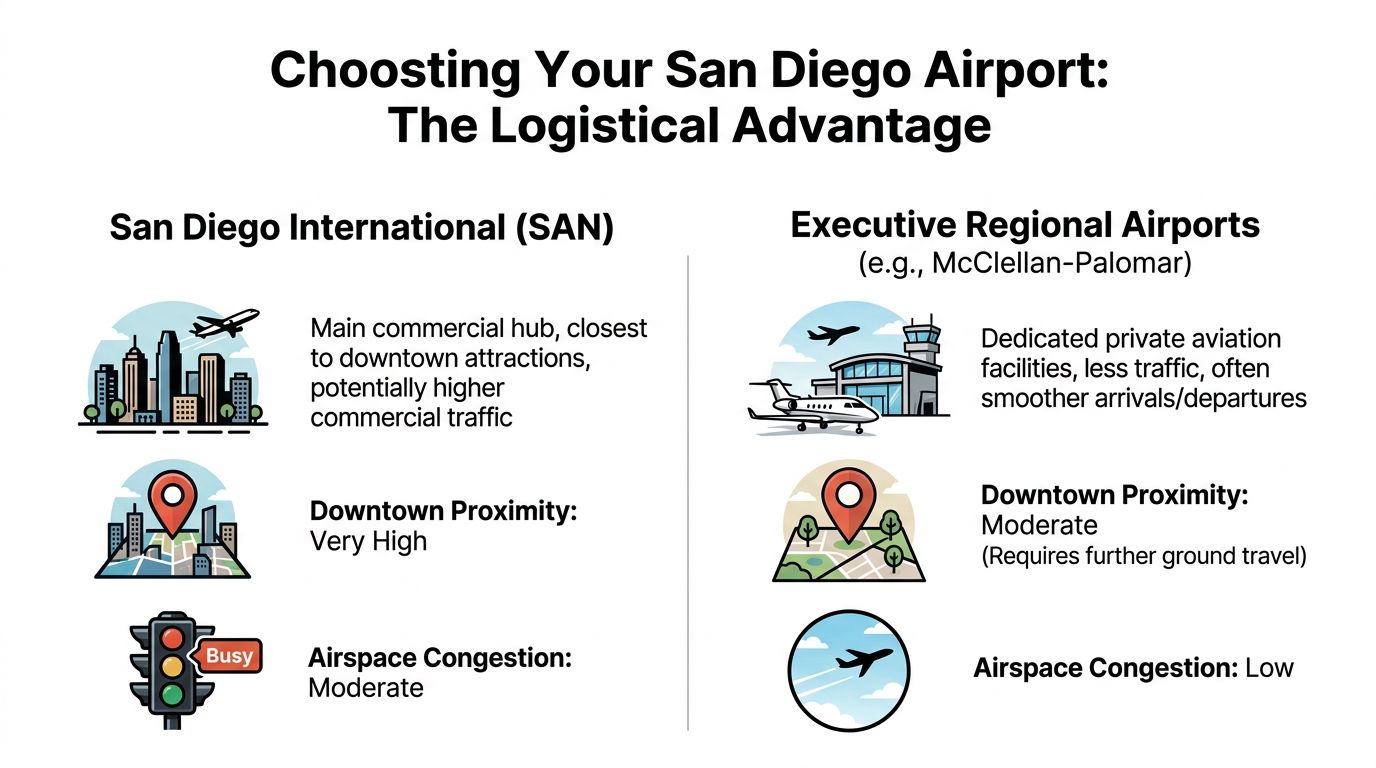
SAN for visibility, MYF for flexibility, CRQ for geography
Here's the short version.
| Airport | Best use | Main advantage | Main drawback |
|---|---|---|---|
| SAN | Downtown meetings, harbor hotels, central arrivals | Closest mainstream access to downtown | More restrictions for late operations |
| MYF | Most core private charter missions | Strong private aviation utility and fewer restrictions | Not the default airport many clients ask for |
| CRQ | North County stays, Carlsbad, Rancho Santa Fe corridor | Better positioning for northern coastal destinations | Less ideal if your day is centered downtown |
Why SAN isn't always the right answer
SAN is convenient, but convenience on a map isn't the same as convenience in operation. One of the most overlooked facts in this market is that existing content fails to explain the trade-off between SAN and Montgomery-Gibbs Executive Airport (MYF), even though SAN's strict noise curfews and 24-hour operational limits often force re-routing for late arrivals. The same analysis notes that MYF can potentially save $2,000 to $4,000 in repositioning fees when flying after 10 PM due to SAN's curfew, as detailed in this San Diego charter airport analysis.
If you're arriving late from the East Coast, SAN can become an expensive assumption. That's when a smart advisor shifts the arrival to MYF and protects both schedule and budget.
If you want a closer look at facilities and access at the main commercial field, review the San Diego International private terminal details.
Ask your advisor one direct question: “If we land after 10 PM, is SAN still the optimal airport?” If the answer is vague, keep asking.
When MYF is the sharper play
Montgomery-Gibbs Executive Airport is where many private flyers should start their planning, not where they reluctantly end up. It works especially well for:
- Late-night arrivals: Fewer operational headaches than SAN.
- Time-sensitive business trips: A private-focused field usually means cleaner execution.
- Trips where quote integrity matters: The wrong airport often triggers avoidable handling and repositioning complications.
MYF is the airport discerning travelers use when they want less friction and fewer surprises.
CRQ for North County clients
McClellan-Palomar in Carlsbad is a strategic airport, not a backup. If you're staying in Carlsbad, heading to a North County corporate campus, or basing near Rancho Santa Fe, CRQ can make more sense than dropping into central San Diego and sitting in a car afterward.
That's the airport many inexperienced brokers miss. They optimize for the city name, not the actual destination.
My recommendation
Use SAN only when downtown proximity clearly outweighs the operational constraints. Use MYF for most private charter missions, especially when flexibility matters. Use CRQ when North County is the reason you're flying in the first place.
The right airport doesn't just save time. It protects the entire trip.
Selecting the Ideal Aircraft for Your Mission
Aircraft selection is where charter clients waste money fastest. The mistake is rarely choosing a jet that is too small. It is paying for cabin, range, and repositioning you do not need, then discovering the aircraft still does not fit the actual mission.
San Diego makes that mistake easy because airport choice and aircraft choice are tied together. A jet that looks sensible into SAN can become an expensive, impractical option if MYF is the better operating airport for your schedule. If the aircraft is not already positioned locally, the wrong choice can also pull in ferry costs that distort the value of the quote.
Start with mission economics, not aircraft vanity
For short flights from Los Angeles, Phoenix, Scottsdale, or Las Vegas, keep your discipline. A turboprop, very light jet, or light jet is often the right answer if the passenger count is modest and baggage is controlled. You save money on hourly cost, and you reduce the odds of paying for unnecessary repositioning from another market.
For nonstop flights from New York, Miami, or Chicago, range and cabin endurance matter more than optics. A super midsize jet is usually the smart middle ground. It gives you transcontinental capability, a more usable cabin for work, and fewer compromises than trying to force a smaller aircraft into a trip it was not built to handle.
If you want a stronger framework for short sectors, review this guide on choosing the right aircraft for short-haul private flights.
Use this order of operations
Approve an aircraft only after you answer these four questions in order:
How far are you flying? Range comes first. Do not start with a brand name or cabin photo.
How many people are traveling? Seat count is a weak filter. Six passengers on paper can still be uncomfortable if two are large adults, one is traveling with a pet, and everyone has luggage.
What is going in the baggage hold?
Golf clubs, garment bags, presentation cases, strollers, and ski gear eliminate aircraft faster than clients expect.What do you need to do onboard?
If the trip requires reliable Wi-Fi, a quiet cabin for calls, or a proper refreshment setup, say it before the quote is built.
That sequence prevents expensive corrections later.
My recommendation by mission type
A dinner turn from Las Vegas to San Diego should stay efficient. Book a light aircraft with quick boarding and low operating overhead.
A two-day executive trip from New York calls for a super midsize jet. That is the category I would target first, assuming standard baggage and a real need to work en route.
A family flight from Aspen with winter luggage should be screened around baggage configuration before anything else. Published seating means very little if the bags do not fit cleanly.
If the trip includes time on the water after arrival, coordinate the aviation side with your ground and leisure planning early. Clients who pair their flight with group boat charter options usually get a better day by lining up passenger count, luggage, and arrival timing in one plan instead of solving each piece separately.
Do not approve a category by itself
“Light jet” is not a buying decision. It is a rough label. Cabin dimensions, baggage access, lavatory style, Wi-Fi quality, and even how comfortable the airplane feels on a one-hour leg can vary sharply within the same class.
Ask for the exact year, make, model, and confirmed cabin configuration before you send funds. Ask where the aircraft is coming from, too. That single question exposes whether you are paying for a sensible local option or absorbing a repositioning leg from another city because a broker started with inventory convenience instead of trip logic.
One practical option is Haute Jets, which sources aircraft from owner-operators and lets clients choose the exact aircraft rather than only a category, while also confirming cabin details before departure. That is an operating distinction, not marketing language.
Choose the aircraft the way an investor evaluates an asset. Fit, location, and total cost matter more than the glossy presentation.
Decoding the Real Cost of a San Diego Charter
The hourly rate is the least interesting part of your quote. It matters, but it doesn't tell you what you're paying in total.
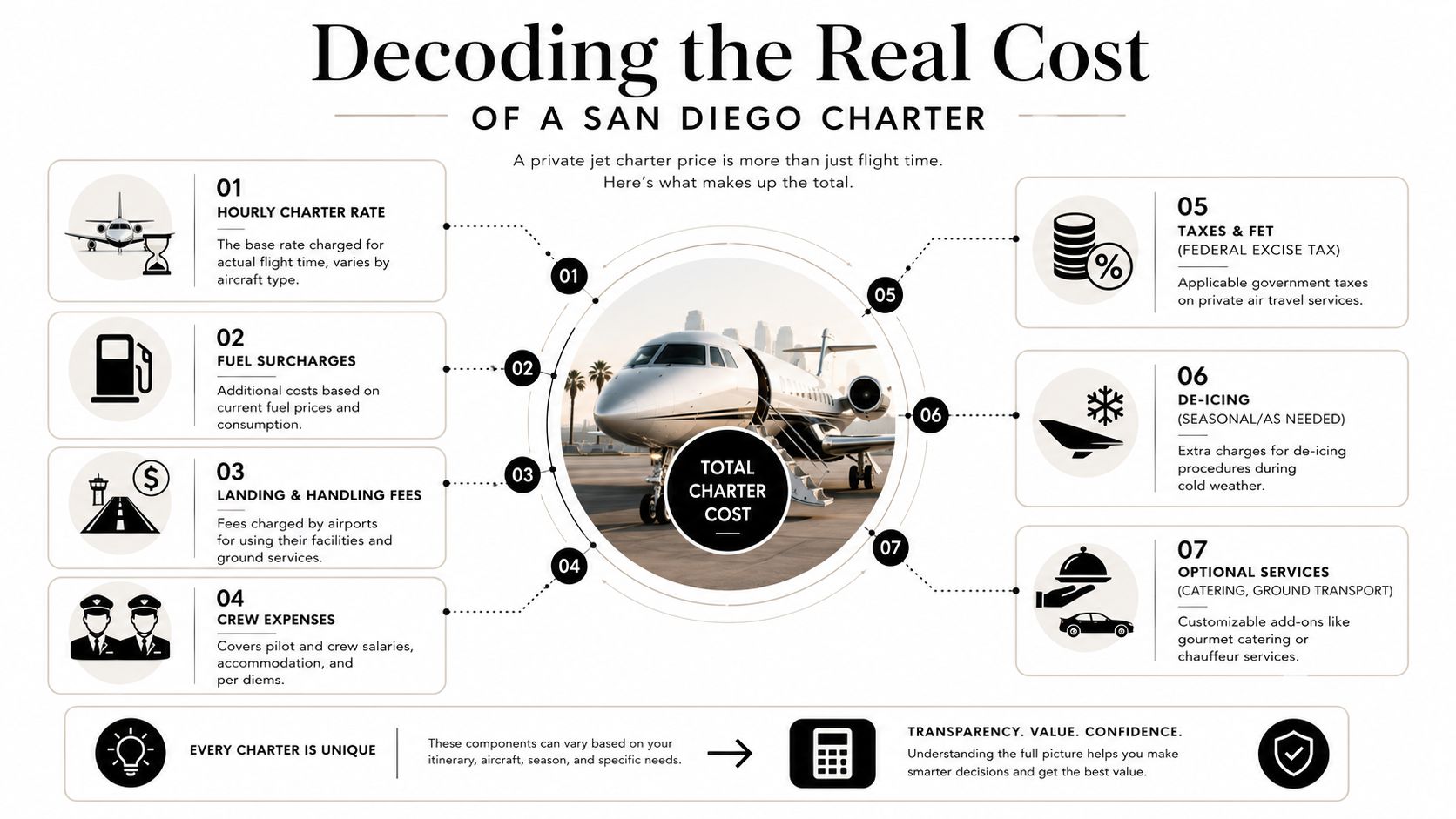
Clients get misled because a broker presents a clean-looking rate and leaves the mess in the margins. The true cost of a private jet to San Diego comes from how the aircraft is sourced, where it's coming from, which airport it uses, and what extras are necessary.
What the baseline looks like
San Diego pricing spans a wide range. According to Fly Travel King's San Diego charter pricing guide, short regional hops from Las Vegas or Phoenix start at approximately $6,000 for a light jet on a 50-minute flight, while transcontinental flights from New York typically range between $32,000 and $40,000 for a super midsize jet on a 5.5-hour journey.
That source also breaks out hourly categories in San Diego, including Very Light Jets at $2,500 to $3,200 per hour, Light Jets at $3,500 to $4,800, Midsize Jets at $4,800 to $6,000, Super Midsize Jets at $6,000 to $7,500, Heavy Jets at $8,500 to $10,500, and Long Range Jets at $12,000 to $15,000 per hour.
Those are useful reference points. They are not your final number.
The charges clients should scrutinize
A serious quote should account for more than airborne time:
- Aircraft positioning: If the aircraft isn't based near your departure point, you may be paying for empty travel before your trip.
- Landing and handling fees: Airport-specific and often glossed over.
- Crew expenses: More relevant when routing or timing creates operational complexity.
- Taxes and Federal Excise Tax: These belong in the all-in quote, not as a surprise.
- Optional services: Catering, ground transport, and cabin-specific requests should be itemized.
If you're planning a leisure weekend after arrival, especially with a larger party, clients often pair the flight with on-water plans. For harbor entertaining or a relaxed post-arrival event, these group boat charter options can be a practical addition to the itinerary.
For a broader framework on quote structure, this article on how much a private jet charter flight costs is worth reviewing.
The hidden premium that matters most
The ugliest line item is often the one you don't see clearly labeled: repositioning.
Local sourcing is the clean fix. When a provider sources an aircraft based near your departure city, it can avoid the empty ferry leg that inflates the charter. That matters in San Diego because the market has enough nearby lift to make local sourcing realistic, not theoretical.
If a quote is attractive but the aircraft is based somewhere else, the rate may be low because the repositioning charge hasn't been explained yet.
My advice is blunt. Don't compare charter quotes by hourly rate alone. Compare them by all-in structure, airport logic, and aircraft origin. That's how you separate a wholesale-style quote from a padded one.
The Seamless Booking Process from Quote to Wheels Up
The booking process should feel controlled, not theatrical. If you're fielding vague promises, broad aircraft categories, and missing operator credentials, you're not getting a premium experience. You're getting salesmanship.
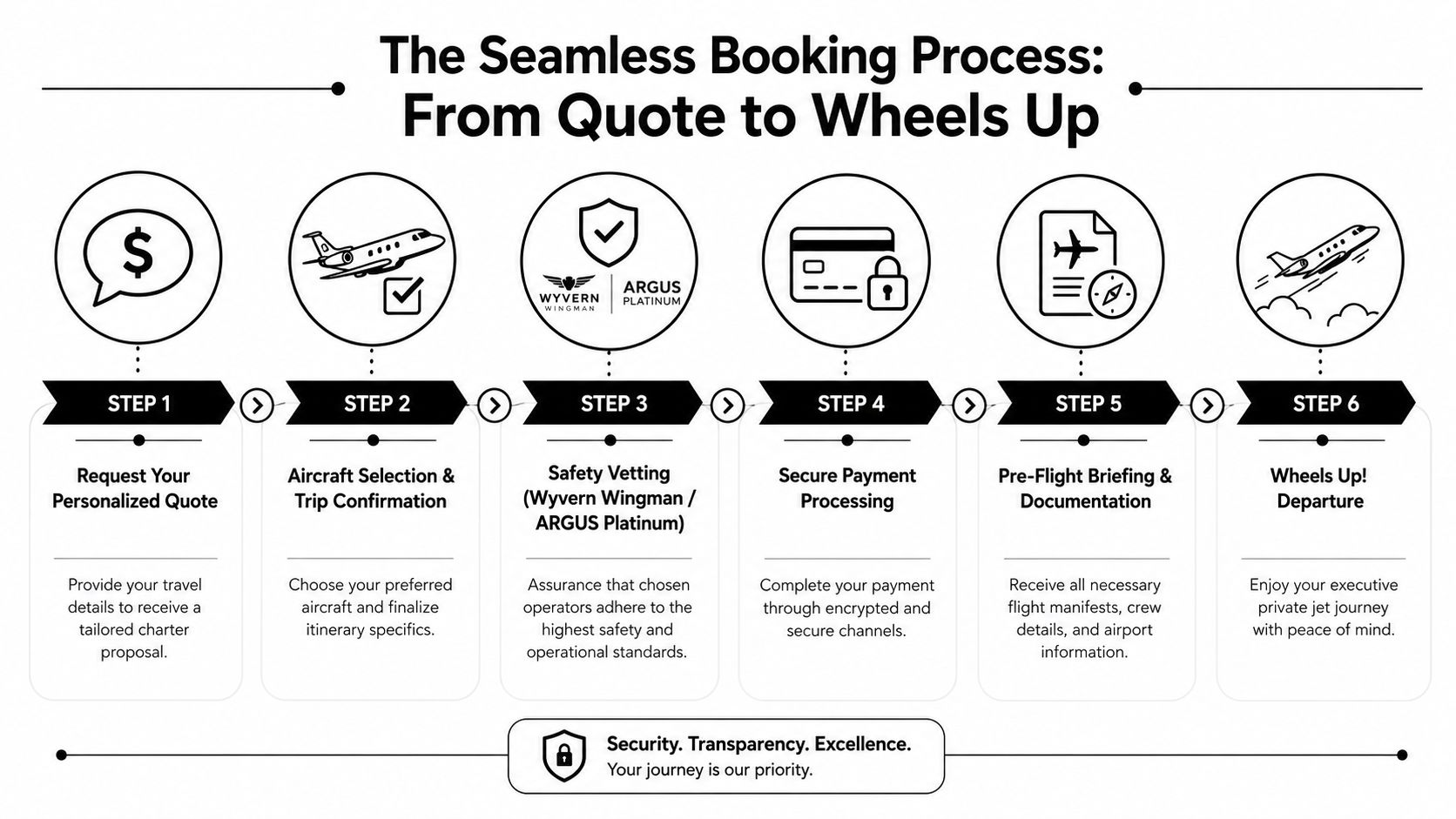
Start with the operator, not the pitch. The process for a San Diego charter should involve identifying owner-operators within a 200-mile radius of San Diego, verifying Wyvern Wingman or Argus Gold/Platinum ratings, and confirming specific cabin layouts and amenities such as Wi-Fi, catering, and pet policies before booking, as outlined in this charter process reference for San Diego flights.
This visual captures the flow cleanly.
Step one and step two are where most errors happen
The first request should include the full mission profile. Not just city pairs. Include preferred airport, timing flexibility, passenger count, baggage type, pets, onboard connectivity needs, and any security or privacy requirements.
Then confirm the specific aircraft, not merely “a light jet” or “a midsize option.” That distinction matters because cabin layout, baggage volume, and onboard feel vary sharply within a category.
Safety screening is not optional
If the operator doesn't hold Wyvern Wingman or Argus Gold/Platinum, move on. Don't rationalize it. Don't let someone talk around it.
Those ratings are the minimum level of third-party safety oversight I'd accept for a high-value charter movement.
A polished app and a fast quote don't replace operator quality.
A short video can help clarify how the charter process should feel from the client side.
What a proper pre-flight package should contain
By the final stage, you should have a concise operating file that includes:
- Tail number: The exact aircraft you're boarding.
- Crew details: Names and background summary.
- Passenger manifest: Final names exactly as they should appear.
- Airport and FBO instructions: So your car doesn't arrive at the wrong terminal.
- Weather and routing briefing: Especially useful for same-day schedule adjustments.
- Final amenities confirmation: Catering, Wi-Fi, pet accommodation, baggage notes.
That's what removes surprises. The flight should be quiet because the planning was precise.
Final Preparations The Executive Traveler's Checklist
The last 48 hours are where premium trips either tighten up or unravel. At this stage, you're not deciding. You're confirming.
One of the major reasons discerning clients still overpay in this market is lack of transparency around aircraft positioning. As noted by SanDiego.com's discussion of charter pricing blind spots, repositioning fees can inflate San Diego charter prices by 20 to 40%, and without that nuance clients can't easily distinguish between genuine wholesale pricing and inflated broker quotes with hidden costs.
That issue should already be settled before this stage. Now the focus is execution.
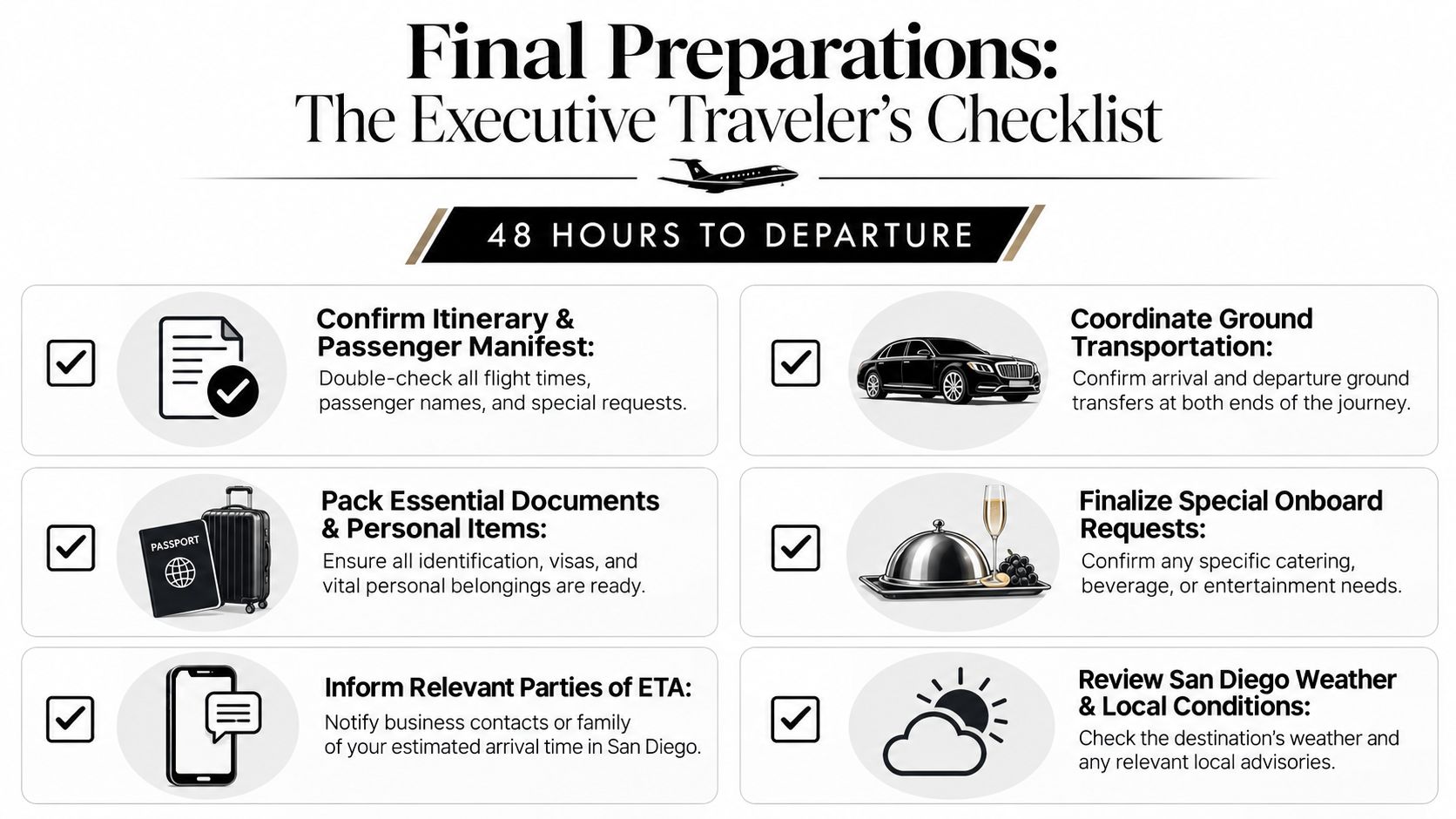
The 48-hour review I use with clients
Run this checklist in order.
- Confirm the final manifest: Names, legal spelling, and any late additions need to be exact.
- Reconfirm airport and FBO: San Diego has multiple workable arrivals. Make sure every driver, assistant, and passenger has the same terminal details.
- Lock in ground transport on both ends: One bad transfer can ruin an otherwise disciplined itinerary.
- Review baggage against the actual aircraft booked: Garment bags, golf clubs, pet carriers, and production cases should never be assumed.
- Finalize onboard requests: Catering, beverage preferences, Wi-Fi expectations, and child or pet accommodations should be settled now.
Coordination with assistants and family offices
The highest-friction trips are rarely caused by aviation. They're caused by communication.
If an executive assistant, family office, security lead, or hotel concierge is involved, give them one clean briefing note with departure time, airport, FBO, passenger list, baggage notes, car arrangements, and arrival ETA. Don't let five people work from three different text threads.
Quiet trips come from loud preparation.
Final judgment calls before departure
Use this short decision table on the day before departure.
| Item | Green light | Red flag |
|---|---|---|
| Aircraft | Exact tail confirmed | Only category confirmed |
| Airport | FBO and driver instructions sent | “We'll sort it out on arrival” |
| Amenities | Catering and cabin requests acknowledged | Verbal-only promises |
| Pricing | All-in quote already settled | Last-minute add-ons appearing |
| Party details | Manifest locked | Unclear passenger changes |
One final point. Don't mistake luxury for looseness. The most effortless private jet to San Diego experience is usually the most disciplined one behind the scenes.
If you want a discreet all-in review of a San Diego charter before you approve it, speak with Haute Jets. A second look at the airport choice, aircraft origin, operator rating, and exact aircraft confirmation can prevent the mistakes that most clients only notice after the invoice is final.