
You're probably coordinating a milestone trip right now, and the pressure shows up in small ways first. One friend wants a cabin with room to stand and toast, another wants the shortest nonstop, and someone else is asking why the quote changed when the aircraft looked identical online. That's exactly where private party jets stop being a luxury search and become a sourcing problem.
The market is bigger and more active than most celebratory planning guides admit. The global private jet fleet is commonly estimated at roughly 22,000 to 26,000 aircraft, with the United States accounting for about 63% to 70% of that total, or roughly 15,000 aircraft in some estimates, and private aviation use ran to about 5.1 million to 5.2 million flight hours in one 2023 estimate, alongside more than 4.3 million private-aviation flights in 2023 in another. Private aviation industry statistics Those figures make one thing clear, on-demand charter is a working transportation system, concentrated in major markets and used heavily for short- and medium-haul trips where timing matters.
The best way to plan a party flight is to think like a charter planner, not a brochure reader. Aircraft choice, local positioning, operator certification, catering, alcohol rules, and guest management all affect the final experience more than glossy cabin photos do. If you want the trip to feel effortless, the planning has to be specific from the start, and the cabin has to match the mission rather than the fantasy.
For a broader primer on cabin categories, see understanding private jet types.
Understanding Private Party Jets Today
A New York-to-Miami celebration can look straightforward until the guest list expands, bags get heavier than expected, and the first aircraft quoted is sitting in another state. Private party jets turn into a logistics exercise fast. Work is matching the trip to an aircraft that is already where you need it, or close enough that positioning does not erase the value of the charter.
For a broader primer on cabin categories, see understanding private jet types.
The practical market reality is that celebratory flying sits inside a busy charter system. Business travelers, sports teams, and ad hoc charter clients compete for the same usable aircraft, so availability can tighten quickly on peak departure days and in popular city pairs. A quote only matters once you confirm where the aircraft is based, whether the operator can cover the route under the right certificate, and how much repositioning gets added before anyone steps onboard.
What the scale means in practice
The useful point is not the raw size of the fleet. It is that private aviation is organized for recurring, time-sensitive trips, which means a party charter is usually a sourcing and timing problem before it is a luxury decision. A weekend departure from a major airport can look open in the morning and become thin on suitable options by afternoon, especially when the same aircraft can be pulled into business demand.
Short hops dominate a lot of private flying, so a celebration trip often needs an aircraft that can handle a fast local sector without waste. The average flight profile reported in Private aviation industry statistics points to what charter planners see on the ground, many trips are mission-specific, tightly scheduled, and sensitive to where the aircraft starts the day. That matters because a well-priced quote can still become expensive if the jet has to be ferried in from the wrong base.
The planning mindset should stay practical. For a birthday, bachelor weekend, wedding shuttle, or reunion, the aircraft must fit the route, the passenger count, the bags, and the airport constraints, not just the cabin photos. A jet with the right styling but the wrong positioning can add unnecessary cost and still leave you checking baggage limits and seating layout at the last minute.
Positioning also changes the operator conversation. Local owner-operators often have better economics when the aircraft is already nearby, but you still need exact-spec confirmation on seating, lavatory setup, baggage volume, and cabin length before you commit. For party flying, those details matter more than marketing descriptions because the wrong cabin layout can make the whole trip feel cramped, even if the aircraft is technically large enough.
Practical rule: start with the route and the group, then verify where the aircraft is based and whether the operator can legally cover the flight.
That approach keeps the trip grounded in reality. It also avoids paying for a beautiful aircraft that is wrong for the mission, or assuming every private jet quote reflects the same aircraft, the same operator, or the same compliance setup. FAA alcohol handling and Part 135 requirements need to be built into the planning timeline early, not handled after the guest list is already set.
Selecting the Right Aircraft and Cabin Layout
The cleanest way to choose a party jet is to stop thinking in cabin aesthetics and start thinking in performance envelopes. For short celebrations, a turboprop or very light aircraft can be the smarter fit, especially when the airport is runway-limited or the group needs efficient point-to-point travel. The benchmark order is simple, mission distance, passenger and baggage mass, runway length and elevation, then cabin layout.
Match the mission before the cabin
The Pilatus PC-12 NGX is a good example of how a mission-capable aircraft can handle short-to-mid trips efficiently. Published specs list a cruise speed of 537 km/h, range of 3,339 km with 4 passengers, service ceiling of 9,144 m, and takeoff distance of 757 m. The DA50 RG is another useful comparison point, with 181 kt TAS max speed, 820 nm max range, 780 ft/min best rate of climb, and 1,335 ft ground roll. Diamond Aircraft DA50 technical specs These numbers show why some aircraft look modest on paper but work extremely well for compact, runway-aware missions.
| Aircraft | Cruise Speed | Range | Takeoff Distance |
|---|---|---|---|
| Pilatus PC-12 NGX | 537 km/h | 3,339 km with 4 passengers | 757 m |
| DA50 RG | 181 kt TAS max speed | 820 nm max range | 1,335 ft ground roll |
A planner should treat cabin photos as the last filter, not the first. Once range fuel is loaded, usable payload drops, and that can mean fewer bags, tighter seat flexibility, or a cabin that feels much smaller in real life than it did online. For a 6-person birthday loop, the better question is not “Which jet looks most luxurious?” but “Which aircraft can legally and comfortably carry the people, bags, and runway requirements without forcing a stop?”
Layout choices that actually matter
Standing-room cabins matter for receptions, mingling, and pre-arrival photos. Seated dining works better when the party is dinner-first or when guests need a quieter setup for a longer flight. A narrow-cabin aircraft can still be the right answer if the mission is quick and the runway is short, while a larger cabin may be overkill if the group is only flying a few hundred miles.
Useful benchmark: if the departure airport is tight, high elevation, or weather-sensitive, check runway and payload before you fall in love with the cabin.
That's the difference between an itinerary that runs on time and one that starts with baggage compromises at the ramp.
Estimating Costs with Local Sourcing and Empty Legs
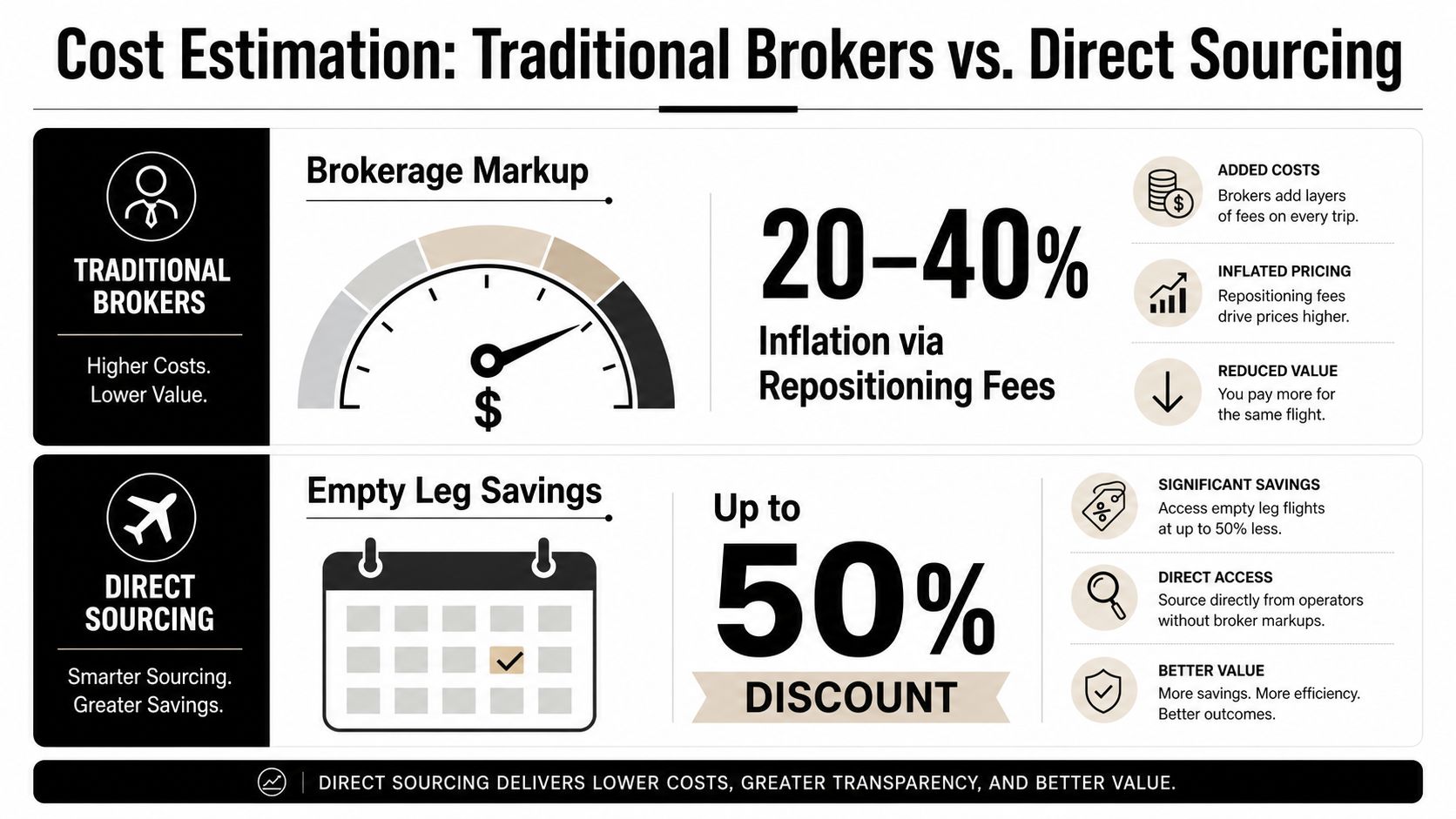
The biggest pricing mistake in party flying is paying for repositioning you didn't ask for. Traditional brokered quotes often hide aircraft movement inside the final number, and in practice that can make a trip look competitive on paper while becoming expensive at checkout. The better procurement move is to source the aircraft near the departure city first, then compare tail number, cabin, and operator details.
Why the tail number matters more than the category
Public aircraft directories make one thing obvious, even inside the same class, aircraft can vary widely in cabin size, seat count, luggage volume, speed, and range. That means the exact tail number, cabin layout, and equipment list can change whether a flight works at all. Aircraft specs and operator comparison If one quote says “midsize jet” and another says “midsize jet,” they still may not be interchangeable for your group or route.
Cost rule: confirm local positioning before you compare class, because a nearby aircraft can be materially cheaper than one that has to be ferried in.
That's also where empty legs fit. They can be useful when the timing happens to align, but they're a secondary savings opportunity, not a core planning strategy. The problem is reliability. A celebration needs a flight that is confirmed, not a bargain that might disappear when the aircraft gets reassigned.
For planners who want a structured way to compare charter options, what an empty leg flight is is worth reading before you treat any discount as fixed.
The practical takeaway is simple. Ask where the aircraft is now, who operates it, and what exact configuration is being offered. That three-part check does more to protect your budget than any generic “luxury” quote sheet ever will.
Booking Logistics with FBOs and Catering
The smoothest party charters are won on the ground, not in the cabin. Departure and arrival should be matched to the right FBO, because the terminal experience controls privacy, handling speed, and how easily the group moves from car to aircraft. For a route like Miami to Turks and Caicos, permits and local handling need to be lined up early so the celebration doesn't stall at the airport counter.
Build the trip around the operator, not just the aircraft
Under U.S. rules, Part 135 covers charter use and requires an FAA Air Carrier Certificate before carrying persons for hire. Part 135 rules That matters because a good-looking aircraft without the right certificate isn't a charter option, it's just a photo. For private use, Part 91 is the other side of the split, but once you're paying for hired carriage, the operator's certification is a firm requirement.
The same logic applies to airport selection. An FBO with good ground handling can make catering load-in, baggage transfer, and guest privacy feel effortless, while the wrong ramp can create bottlenecks before takeoff. If you're coordinating a destination event, a concierge-style planning resource such as concierge travel planning for Spain can be helpful for thinking through how local coordination, transfers, and ground services should fit together.
Keep catering and entertainment aircraft-aware
Catering should be designed around weight, storage, and service timing. Heavy meals, oversized ice setups, and elaborate décor can crowd a small cabin faster than most hosts expect. Music systems, branded napkins, and DJ-style entertainment can work, but only when the operator has approved the setup and the cabin weight margin supports it.
The habit that saves the most time is confirming the exact FBO, the exact aircraft, and the exact operator certificate in the same planning thread. If any of those three change, the rest of the trip may need to change with them. For basic terminal vocabulary and process flow, the FBO guide for private jet travelers is a useful reference before you start sending vendor emails.
Safety and Compliance for Party Charters
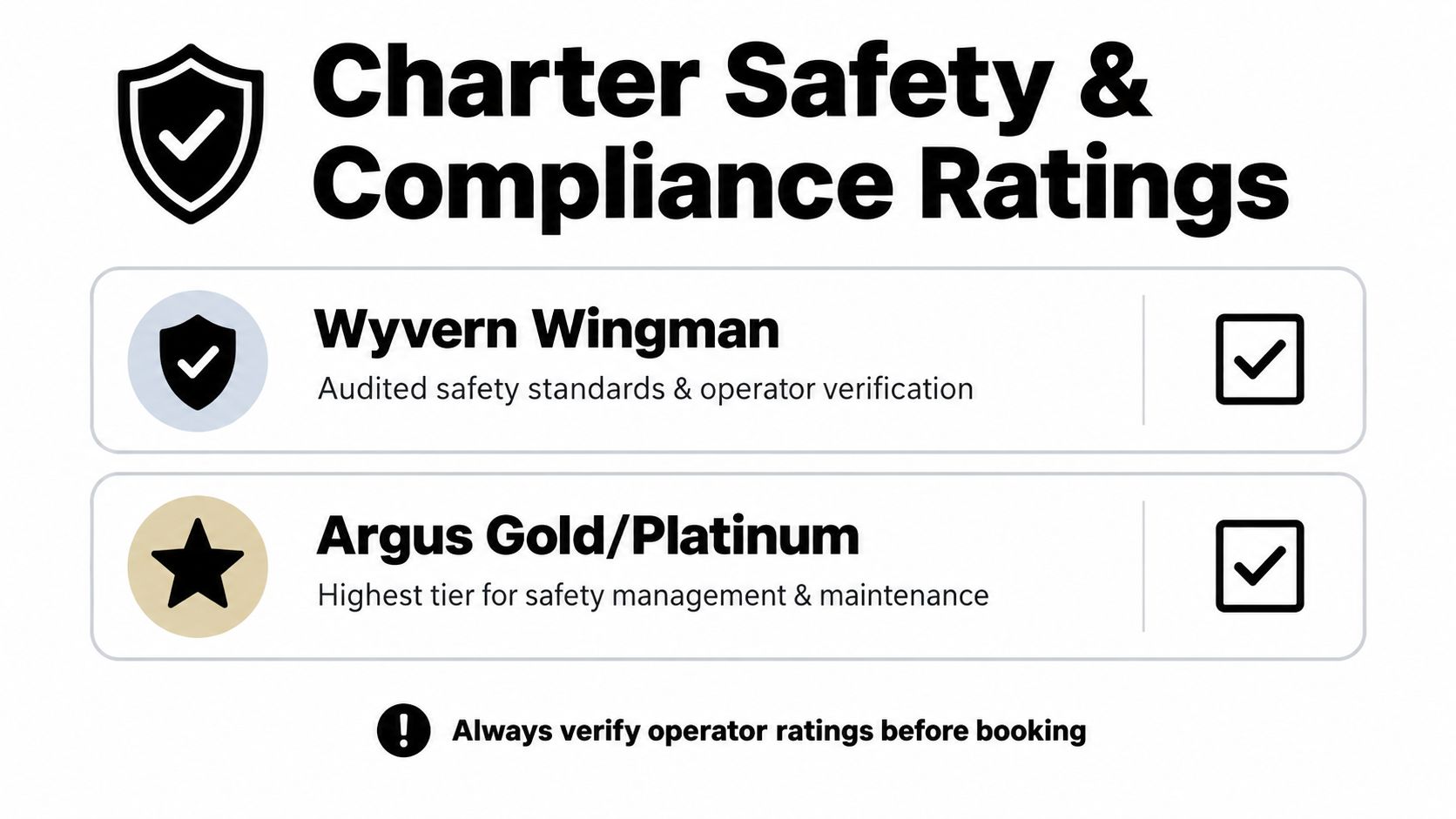
A party charter starts with a tighter safety filter than a standard leisure trip because excited guests, alcohol service, and cabin movement raise the stakes fast. In private aviation, the operator's audit profile matters. WYVERN Wingman and Argus Gold or Platinum are the safety designations worth checking before anything gets signed.
What to check before the first bottle opens
The FAA's alcohol rule is specific. Alcohol brought onto a private aircraft must stay unopened in its original retail packaging, must be more than 24% but no more than 70% alcohol by volume, and is capped at 5 liters per package and 5 total liters per passenger. FAA alcohol and conduct guidance Cannabis is illegal on any flight, including private jets, and boarding someone who appears intoxicated violates FAA regulation 14 CFR 121.575. For the FAA's conduct framework, the rule set in FAA alcohol and conduct guidance is the place to start.
Required: the safest party charter is the one where the operator, the manifest, and guest behavior all stay inside the rulebook.
The operator side matters too. A cited industry safety source reports an NTSB accident rate of 1.049 per 100,000 flight hours for private jets, and it also notes that operators must comply with FAA certification and operate under Part 91 or Part 135 rules. Private jet safety facts That regulatory split is the anchor point for how the flight is run.
A short compliance check keeps problems from showing up at the aircraft door:
- Verify the operator rating: ask for current WYVERN Wingman or Argus Gold/Platinum status.
- Confirm the certificate type: make sure the trip is being flown under the right FAA operating rule.
- Inspect the alcohol load: keep it within the FAA packaging and quantity limits.
- Block prohibited items: cannabis should never be part of the cabin plan.
- Control guest boardings: do not let visibly intoxicated passengers get to the aircraft.
For planners who are also coordinating beverages, a guide to stocking party wines can help you size the cabin bar without overloading service plans or creating avoidable spill risk.
A useful overview of safety ratings and operator verification is embedded in the source material behind the charter safety standards, and it lines up with what serious planners already do, verify first, celebrate second.
Pre Flight Timeline and Host Tips
A clean party charter feels spontaneous to guests because the work started early. The planning window should begin a month out if the trip involves multiple passengers, special catering, or destination handling, then tighten as departure approaches. The goal is to remove guesswork before anyone starts packing a carry-on.
A working timeline for hosts and travel managers
At about 30 days out, lock the route, guest count, and any destination-specific handling needs. At that stage, venue timing, hotel check-in, and ground transport should already be speaking to one another, because the aircraft schedule has to support the event rather than compete with it. If alcohol service is part of the plan, coordinate it with a menu that fits the cabin and the flight length.
By the time you reach the final day before departure, the details need to be real, not assumed. Haute Jets' standard is to confirm the tail number, crew bios, weather briefing, and passenger manifest 24 hours before departure, and that level of confirmation is exactly what reduces last-minute stress. A good travel manager should treat that as the moment to recheck names, seating, and luggage assumptions one last time.
Host decisions that prevent avoidable friction
Pets need to be cleared before the booking is locked, not after the group has already packed kennels and treats. Guest behavior needs to be framed early too, especially if the trip is celebratory and alcohol-heavy. When someone starts to overdo it, the host should be ready to slow service, not negotiate with the cabin once the aircraft is moving.
For wine-heavy celebrations, a practical checklist like guide to stocking party wines can help with selection and quantity planning before anything is loaded onboard. Crypto-forward travelers may also want to ask whether Bitcoin payment is available, but that question belongs in the first booking conversation, not the day before departure.
Travel manager checklist: confirm names, luggage, pet policy, alcohol plan, crew details, and payment method before the final 24-hour signoff.
The last-hour call should feel boring. If it still contains major surprises, the planning started too late or the aircraft was never verified closely enough.
Your Private Party Jet Plan in Motion
A strong private party jets plan starts with four checks: mission fit, local sourcing, operator compliance, and exact-spec confirmation. That is what separates a polished quote from an aircraft that matches the cabin, timing, and service the group needs. If the jet is already near your departure city and the operator is verified, repositioning costs stay easier to control and the trip becomes more predictable.
The market rewards that kind of planning. On-demand charter with no membership fee, no jet card, and no annual commitment lets you book one flight or a series of flights without paying for a model you do not use. For celebration travel, that flexibility matters because party plans shift, guest counts change, and the exact aircraft often matters more than the category name.
Local owner-operators also change the economics. A nearby tail can reduce ferry time, but only if the aircraft is the right fit and the cabin spec is confirmed before anyone commits. I have seen plenty of trips look inexpensive until the positioning leg was added, or until the group learned the jet was a different configuration than the one they expected.
For milestone trips, the best results come from matching the mission to the aircraft, then lining up the operator details, passenger count, and cabin layout before money changes hands. If the celebration involves tasting flights or a bourbon-forward itinerary, bourbon tasting party planning tips can help shape the party concept before the charter is finalized. FAA alcohol rules, Part 135 compliance, and the host's service plan all need to be on the same timeline, because those details affect what can be loaded, when it can be served, and who is responsible onboard.
A thoughtful charter plan keeps the trip practical. It reduces repositioning surprises, confirms the exact cabin requested, and avoids the common mistake of booking a generic aircraft category and hoping the details line up later.
If you're ready to plan a celebration flight with the aircraft, operator, and cabin details confirmed before you commit, visit Haute Jets and start with the route, the guest count, and the exact mission you need covered. Their on-demand charter approach is built for travelers who want local sourcing, verified specs, and a booking process that treats the trip like a real operation, not a guess.