
You're six hours from departure, the passenger wants a restaurant-sourced tasting menu, and the catering call sheet still shows one severe allergy that the local FBO kitchen can't segregate. On a private jet, that isn't a minor menu adjustment. It affects the aircraft, reheating equipment, pack-out time, transfer route, storage space, crew workload, and whether the meal can be served safely at all.
The polished promise of food on private jets often sounds like five-star dining at cruising altitude. In practice, the best meal is the one that fits the galley, survives cold-chain handling, tastes right in a dry pressurized cabin, and arrives with its documentation intact. Private jet catering has become a substantial specialist business, with one estimate valuing the sector at USD 1.42 billion in 2024 and projecting USD 2.35 billion by 2033, while another estimate uses a broader market definition and places the 2024 value at USD 6.619 billion. The definitions differ, but the operational conclusion is the same: this is a serious service line, not an upgraded snack basket. (industry market estimate)
Where Catering Decisions Actually Begin
At 04:30, a charter manager is reviewing a catering call sheet for six passengers on a transatlantic flight. One option is a flown-in tasting menu from a Michelin restaurant. The other is a standard boxed service prepared near the departure airport. The tasting menu looks better on paper, but the local FBO kitchen can't guarantee allergen segregation, and the aircraft's galley has limited reheating capability.
That decision is typical. The menu isn't the first question. The first question is whether the operation can receive, store, reheat, and serve the food without compromising safety or passenger comfort.
The aircraft sets the menu ceiling
A light jet may have a compact galley with cold storage and limited preparation space. A midsize aircraft can offer more room, but it still may rely on a microwave or compact convection oven. Heavy and ultra-long-range aircraft are more accommodating, with larger galley counters, more plating space, and equipment better suited to hot meal service. Industry guidance confirms that galley and cabin space narrow menu choices on light and midsize jets, while larger aircraft can support more elaborate service. (aircraft catering capabilities)
The passenger count matters just as much. Six individual meals with separate sauces, allergy controls, beverage preferences, and serviceware create a different workload from six identical sandwiches. Total block time also changes the plan. A short domestic sector may not justify a meal that takes significant cabin time to assemble, while a long-range mission may require staged service, snacks, and breakfast.
The airport can be more important than the home base
A caterer near the operator's headquarters isn't necessarily the right supplier for the departure airport. The manager has to evaluate local kitchen capability, FBO refrigeration, security procedures, ramp access, driver timing, and the distance between pack-out and aircraft loading.
The critical interval is the gap between kitchen release and door closure. If food leaves the kitchen early and waits at an FBO, the operation needs documented refrigeration and a clear handoff. If the aircraft is delayed, the team needs to know who can approve a replacement or re-pack.
Operational rule: Choose the menu only after confirming the aircraft galley, airport supplier, storage window, passenger count, and expected handover time.
That's why private jet catering is better understood as a logistics puzzle than a luxury flourish. The answer to “what can we serve?” is often determined hours earlier by the people, equipment, and timing available at the FBO.
The Three Catering Styles and When Each One Fits
Private jet catering works better when it's divided by operating method rather than by vague luxury tiers. Three formats cover most requests: gourmet plated service, boxed and cold service, and dietary or certified service.
Gourmet plated service
This is the closest format to restaurant dining. The kitchen prepares composed dishes, separates components where needed, and sends meals designed for controlled reheating and onboard plating. It makes sense on heavy aircraft with capable ovens, sufficient galley space, and missions long enough to justify a more involved service sequence.
A plated menu can work well for a business dinner, a celebration, or a long international sector. It becomes a poor choice when the flight attendant has limited equipment, the aircraft is crowded, or passengers expect to eat immediately after takeoff. Delicate garnishes, crisp fried elements, and sauces that depend on precise finishing are often oversold.
Boxed and cold service
Cold service is the dependable workhorse. A chilled meal box, sandwich selection, salad, fruit, cheese, or composed platter can be loaded quickly, stored predictably, and served without turning the galley into a production kitchen.
This format suits short hops, quick turnarounds, and aircraft with limited cooking facilities. It also works for passengers who prefer to work, sleep, or eat in stages. The trade-off is presentation. A boxed meal can feel less theatrical, but it often delivers better consistency than a hot dish that can't be reheated properly.
Dietary and certified service
Certified meals need their own operating category because the kitchen, paperwork, packaging, and chain of custody matter as much as the recipe. Kosher, halal, vegan, gluten-free, and allergen-isolated meals should come from suppliers that can document ingredients and production controls.
This format is essential when passengers have mixed requirements. One shared platter can't reliably satisfy a severe allergy, a religious certification requirement, and a vegan preference without careful separation. Certified service may also limit last-minute substitutions because an apparently minor ingredient change can invalidate the original approval.
| Catering Style | Best Aircraft Class | Typical Block Time | Service Format | Limitations |
|---|---|---|---|---|
| Gourmet plated | Heavy and ultra-long-range jets | Long sectors | Retractable or staged hot meal service | Needs oven capacity, galley space, crew time, and careful retherm |
| Boxed and cold | Light, midsize, and heavy jets | Short to medium sectors | Chilled individual meals, platters, and snacks | Less theatrical, limited reheating, presentation can deteriorate if poorly packed |
| Dietary and certified | Any class, subject to supplier access | Any duration | Individually sealed, documented meals | Requires advance planning, certification, traceability, and strict handling |
A quick domestic hop usually favors cold service. A long-range international flight can support plated courses if the aircraft and crew are equipped for them. A mixed passenger group may need a combination, such as a certified individual meal for one traveler and a cold platter for everyone else.
Cold-Chain Logistics from Kitchen to Cabin
Food safety begins before the catering vehicle leaves the kitchen. The caterer should know when each item was prepared, when it was sealed, how it was chilled, and how long it can remain in controlled storage before quality suffers.
Industry guidance generally calls for cold food to remain below 4–5°C, or 40–40.5°F, and hot food to remain above 57–60°C, or 135–140°F, with checks at pack-out, loading, and aircraft handover. (private aviation catering safety guidance) Food held in the unsafe temperature range for an extended period can become a serious risk, and one aviation catering expert identifies roughly 90 minutes as an upper limit before the danger increases materially. (aviation catering handling)
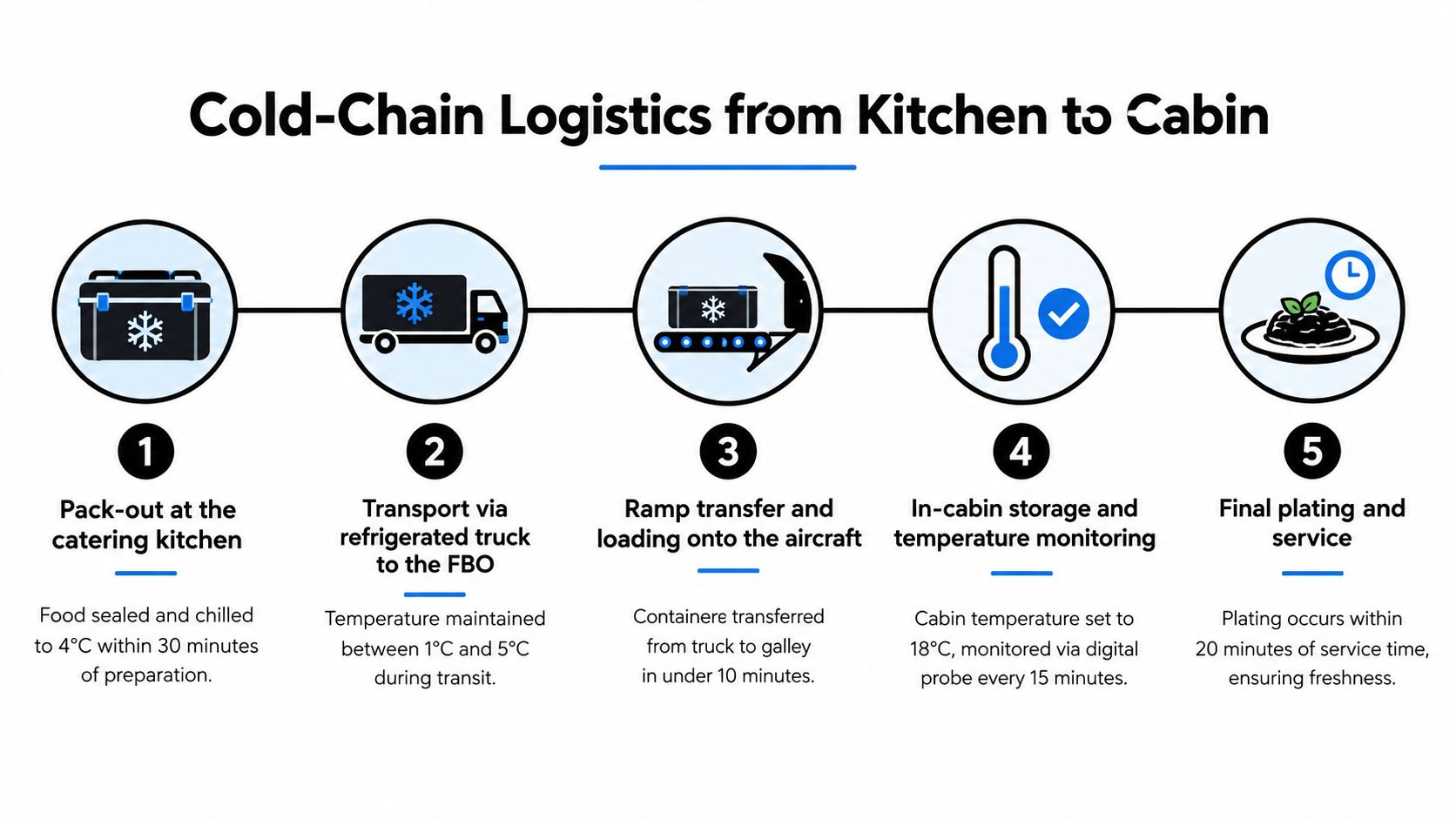
Five handoffs determine the result
- Pack-out: The kitchen seals the food in insulated containers and records the release temperature.
- Transport: Refrigerated transport or validated insulated containers protect the meal on the way to the FBO.
- FBO receipt: Ground staff receive the order, verify seals and paperwork, and move it into suitable refrigeration when the aircraft isn't ready.
- Aircraft loading: The catering cart or containers move from the FBO to the aircraft with as little ramp exposure as possible.
- Cabin service: The crew stores, reheats, plates, and serves according to the meal's hold limits and the flight timeline.
HACCP-style controls, ingredient tracking, temperature monitoring, and security seals on catering carts are common safeguards in professional operations. (inflight food safety controls) If you want broader context on refrigerated transport and handoff discipline, Novocargo's cold chain insights provide a useful logistics reference.
What to ask before approving the order
Ask for the pack-out timestamp, transport method, temperature logs, seal procedure, FBO holding arrangement, and maximum permitted hold duration. You should also confirm whether the aircraft uses a convection oven, microwave, or no hot equipment at all.
A convection oven can reheat food, but it isn't a restaurant kitchen. Items should be cooked to the correct stage before pack-out, with sauces, garnishes, and crisp components separated where necessary. Crew members can reheat and assemble. They generally can't rescue a dish that depended on last-minute cooking, delicate frying, or a service window the aircraft can't support.
For passengers unfamiliar with airport handling, a practical explanation of the facility and handoff environment is available in this guide to what an FBO means in private aviation.
Why Food Tastes Different in the Air
A meal can leave the kitchen perfectly balanced and arrive tasting flat. Cabin conditions change how passengers experience it. Industry aviation sources report that reduced humidity and pressurization can lower the perception of sweet and salty flavors by about 30%, while sour, bitter, and spicy notes are less affected. (aviation dining and taste perception)
The result isn't “season more.” The kitchen has to build flavor in a way that survives reheating, dry air, and a passenger whose sense of taste is temporarily less responsive.
Flavors that hold their ground
Umami-rich ingredients usually perform well. Tomato-based sauces, mushrooms, aged cheeses, broths, roasted vegetables, and properly seasoned proteins retain more character than dishes built around restrained sweetness or subtle salt balance. Acidity also helps. A squeeze of citrus, a sharp dressing, or a pickled component can create contrast without relying entirely on salt.
Spicy ingredients need judgment. Heat may register more sharply than expected, so adding chili after reheating can produce an uneven result. The better approach is controlled seasoning in the kitchen, with optional condiments supplied separately.
Formats that travel predictably
| Usually reliable | Often disappointing |
|---|---|
| Braised meats with separated sauces | Delicate reductions that depend on precise finishing |
| Grain bowls and composed salads | Fried foods that need to remain crisp |
| Roasted vegetables | Crisp garnishes stored against moisture |
| Chilled proteins and wraps | Plates assembled too early |
| Tomato-based pasta and baked dishes | Fine herbs carrying most of the flavor |
Texture is as important as taste. Sauces should often travel separately. Garnishes should be added late. Crisp items need moisture barriers, and foods that dry out during reheating should be replaced with braised, baked, or chilled alternatives.
The cabin itself also matters. Low humidity can make crisp food seem stale and can reduce the impact of aromatic ingredients. Passengers who want a lighter meal should often choose a composed plate, wrap, or chilled protein rather than a dish that needs hot-and-fresh assembly.
For a practical look at the cabin environment behind these sensory changes, see this guide to private jet cabin air and freshness.
Dietary Needs, Allergens, and Certified Kitchens
A passenger with a severe allergy or religious dietary requirement needs more than a polished menu description. “Gluten-free” does not confirm protection from cross-contact, and “halal-style” does not document halal certification. The charter manager needs the exact requirement before ordering.
Provide the ingredient to avoid, reaction severity, cross-contact concerns, and any required certification. That information determines which kitchen can prepare the meal, how it must be packaged, and what the crew should verify at handover.
Verification should be written
For certified or medically restricted meals, request documentation from the kitchen or operator:
- Kosher: The applicable certification and supervising authority.
- Halal: A current halal certificate and confirmation of the production facility.
- Allergen control: Ingredient traceability, preparation controls, package identification, and a clear cross-contact statement.
- HACCP controls: The food-safety plan covering preparation, chilling, transport, and handover.
- Vegan or gluten-free: Ingredient lists and preparation statements, especially where the kitchen handles animal products or wheat.
Shared kitchens carry the greatest practical risk. A substitution made late in the process can introduce an excluded ingredient. Once trays are onboard, a crew galley cannot provide sterile separation between meals. Sealed individual portions, distinct labels, separate utensils, and a documented handoff provide stronger control than verbal instructions.
Ask who checked the meal, when it was sealed, and whether the label matches the passenger's requirement. A certified kitchen still needs accurate passenger information and an uninterrupted chain of custody.
Timing and sustainability are connected
Special meals should reach the operator early. Standard private jet catering is commonly ordered 24 to 48 hours before departure. Complex kosher, halal, or highly specialized meals often need 48 to 72 hours, because certified kitchens may have limited production capacity.
Corporate flight departments also ask suppliers about biodegradable packaging, reduced single-use plastic, sourcing transparency, and digital passenger preference profiles. Put those questions into procurement rather than leaving them to menu design. Confirm whether sustainability claims are documented, whether packaging can be separated for disposal, and whether local sourcing is practical at the departure airport.
Airport filtration and allergen controls do not certify the meal, but they belong in a broader facility review. WipesBlog.com's discussion of filtration compliance for airports provides context for teams comparing facility controls with catering procedures.
What Private Jet Catering Actually Costs
A quote that says “catering included” can hide several different arrangements. The food may be included as a basic allowance, while premium substitutions, restaurant sourcing, transport, special diets, and crew meals appear elsewhere in the charter paperwork.
The price also reflects what the aircraft and airport can support. A cold box collected near the FBO has a different cost structure from a restaurant-sourced menu that requires refrigerated transport, special packaging, ramp delivery, and a carefully timed aircraft handover.
Three practical pricing tiers
Standard boxed catering commonly falls around $50–$150 per passenger. This suits snacks, sandwiches, fruit, drinks, and straightforward chilled meals. Premium plated menus from regional kitchens often run around $150–$400 per passenger, while bespoke or restaurant-sourced experiences can reach $400–$1,200 or more, particularly on long-haul or special-occasion flights.
These ranges are planning bands, not universal tariffs. The same menu can price differently depending on the departure airport, passenger count, minimum order, aircraft, timing, and supplier availability.
| Tier | Price Range Per Passenger | Best For | Typical Lead Time |
|---|---|---|---|
| Standard boxed catering | $50–$150 | Short sectors, light meals, simple refreshments | 24–48 hours |
| Premium plated menus | $150–$400 | Larger aircraft, longer missions, business dining | 24–48 hours |
| Bespoke or restaurant-sourced | $400–$1,200+ | Long-haul, celebrations, highly customized service | 48–72 hours or more |
Where the invoice expands
Common line items include per-leg catering minimums, refrigerated transport, ramp delivery fees, crew meals, special-diet premiums, and disposable serviceware. Special requests can add 20–40% over baseline, particularly when certified kitchens or isolated preparation are involved. (private aviation catering market context)
Some brokers pass catering through with a bundled markup inside the hourly rate. That isn't automatically unreasonable, but you should know whether you're paying for food, coordination, transport, or all three. Ask for an itemized catering summary before approving a high-value request.
Bundling through the operator is usually efficient when the departure airport has an established supplier and the meal is uncomplicated. Independent booking can offer better value when you have a trusted local caterer, a specific restaurant relationship, or a certification requirement the operator's default supplier can't handle. The operator must still approve the packaging, timing, security process, and aircraft compatibility.
Booking and Customizing Your Next Flight Menu
A menu that looks excellent on a brochure can fail in a light-jet galley. Confirm the passenger count, dietary requirements, allergens, cuisine, beverages, and service time with the operator or FBO at least 48 hours before departure. Allow 72 hours for kosher or halal certification, and more time for small airports or international handoffs.
Ask about the aircraft's installed equipment, not its category. A light jet may offer an oven, convection unit, microwave, or only cold storage. Choose a caterer serving the departure airport, then check whether the dishes will survive cold-chain handling, limited galley space, and cabin pressurization, which can dull sweetness and salt by roughly 30%.
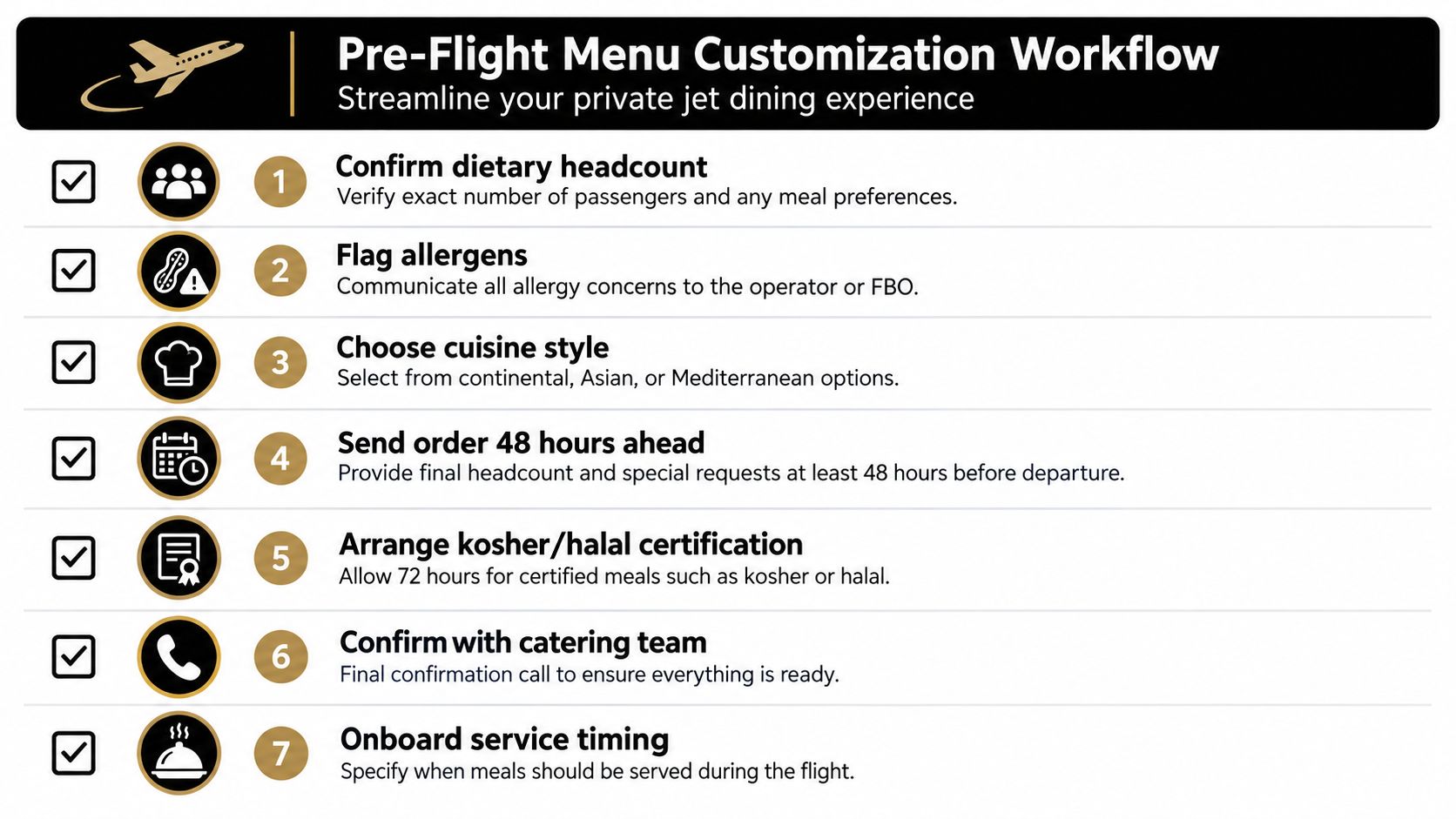
A checklist for the charter manager
- Confirm the headcount: Include passengers, children, crew meals, and anyone eating at a different service time.
- Flag allergies clearly: Name the ingredient, severity, cross-contact risk, and required packaging.
- Choose the service format: Specify boxed meals, individual plated courses, or family-style platters.
- Match food to equipment: Approve dishes the galley can store, reheat, and finish.
- Set the beverage plan: List water, coffee, tea, juices, wine, champagne, mixers, ice, and glassware.
- Confirm disposal: Ask how bottles, packaging, serviceware, and leftovers will be handled.
- Protect the cold chain: Request the pack-out time, driver manifest, temperature records, and substitution contact.
- Verify FBO storage: Confirm early deliveries enter refrigerated holding instead of sitting at room temperature.
- Lock service timing: Tell the crew whether food is served immediately, after departure, between meetings, or in courses.
A concise private jet catering guide helps passengers prepare questions, but the charter team should approve the final specification because it knows the aircraft and departure facility. For a broader view of private jet catering options, compare each menu with the galley capability, not the brochure description.
Record the passenger count, allergies, certifications, cuisine, service format, beverages, ice, equipment, pack-out time, FBO refrigeration, delivery contact, substitution approval, and disposal instructions in the booking file.
Haute Jets can arrange custom in-flight catering through its charter concierge, including gourmet meals, beverages, and dietary requests such as vegan, gluten-free, kosher, halal, and allergy-friendly options. Before approving the menu, ask the team to confirm the aircraft, galley equipment, supplier, certification, and handoff plan.
For your next flight, send Haute Jets the passenger count, dietary requirements, service format, and departure airport early enough to protect the cold chain. Visit Haute Jets to coordinate an on-demand charter and a menu designed for the aircraft you will fly.