
You're probably making the same tradeoff most Las Vegas travelers face. Leave on a commercial schedule and give up half a day to parking, security, boarding groups, and baggage claim, or fly on your own schedule and turn the trip into a clean in-and-out movement. That choice matters even more in Las Vegas, where the right airport can save time and the wrong one can hand it back in traffic.
That's why this guide belongs on Haute Jets Journal. If you want to fly private to Las Vegas, the decision isn't just whether to charter. It's which airport fits your trip, which aircraft fits that airport, and how to avoid congestion when the city is packed for a convention, fight weekend, or a fast corporate turnaround.
Why Flying Private to Las Vegas Changes the Trip
A typical Vegas charter client isn't asking for “luxury” in the abstract. They're usually asking for control.
One client wants to leave Los Angeles after a morning meeting and be checked into a Strip hotel before dinner. Another is bringing a small executive team for a convention and can't afford a delayed arrival. A third wants privacy, a quick tarmac transfer, and no time lost in a public terminal. Those are very different travelers, but they all want the same thing. A trip built around their timing instead of the airline's timing.
What changes on a Vegas trip
When you fly private to Las Vegas, the biggest shift is simple. You stop planning around the terminal and start planning around the destination.
That affects more than departure time. It affects where you land, how close your arrival is to the Strip, whether your aircraft can use a quieter airport, and whether your ground car is waiting at the FBO instead of in a crowded pickup zone.
Las Vegas is a high-volume market, which is exactly why smart planning matters. Harry Reid International Airport handled a record 58,447,782 travelers in 2024 and 613,973 aircraft movements according to Harry Reid International Airport traffic data. The broader Las Vegas market also saw 57.6 million passengers in 2024 in that same source. For private flyers, that scale is useful because the infrastructure supports serious lift, but it also means airport choice isn't cosmetic.
Practical rule: In Las Vegas, private aviation isn't just about getting a jet. It's about choosing the arrival plan that protects your schedule once the city gets busy.
Who benefits most
Private flights to Vegas usually make the most sense for:
- Corporate teams: Tight meeting windows, same-day turns, and event attendance.
- High-profile travelers: More privacy from curb to cabin.
- Groups on short-haul routes: Especially when several people are moving together.
- Convention and event travelers: Schedules tighten fast when the city fills up.
Las Vegas also has durable travel demand over time. Historical airport data shows more than 1.59 billion passengers passed through Harry Reid International from 1970 through the end of 2025, with an annual average of 28.45 million, based on the same airport reference. That long-run demand is why Vegas has multiple viable private-airport strategies instead of just one obvious answer.
How Flying Private to Las Vegas Actually Works
The easiest way to understand charter is to stop thinking about airlines.
A commercial ticket is like buying one seat on a bus route that already exists. An on-demand charter is more like hiring a private car for a specific trip. You choose the departure point, timing, passenger list, and aircraft that fits the mission.
The booking flow in plain English
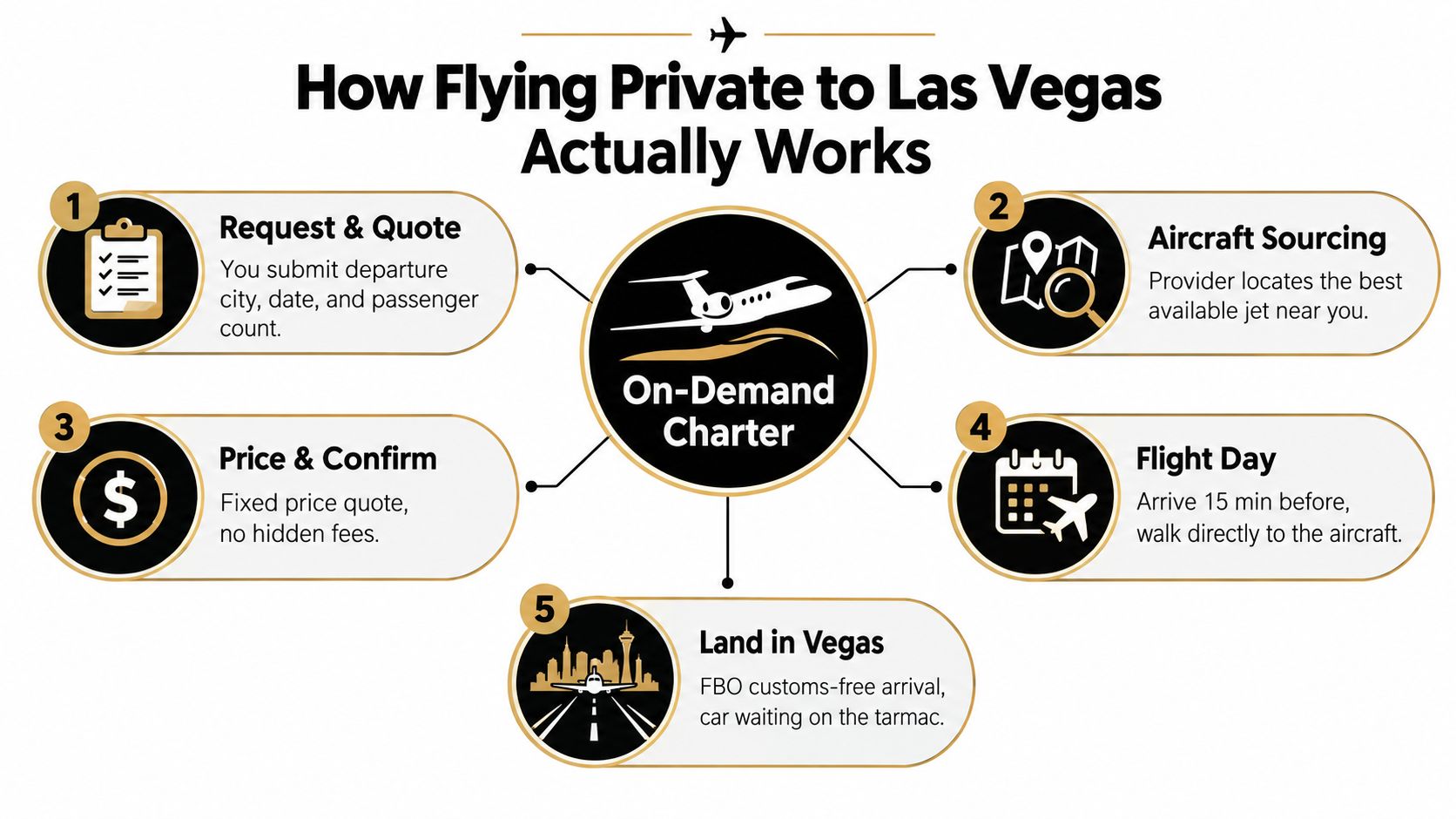
A private Vegas trip usually moves through five simple stages:
Trip request
You send the departure city, travel date, passenger count, and any non-negotiables like pets, golf clubs, Wi-Fi, or catering.Aircraft sourcing
The charter advisor looks for an aircraft that matches the route and is positioned sensibly relative to your departure point. A jet that has to fly in empty before your trip can change the economics.Quote and aircraft review
You review the exact aircraft option, not just a vague category. The make, model, cabin layout, baggage fit, and operator quality all matter.Pre-flight confirmation
The details get locked. That includes handling location, passenger manifest, and timing with the FBO.Flight day
You arrive at the private terminal, usually called an FBO, check in with the handling team, and walk to the aircraft.
Why provider choice affects reliability
New flyers often assume every charter quote represents the same product. It doesn't.
Two trips that look identical on paper can feel very different depending on where the aircraft starts, how clearly the operator confirms details, and whether the quote was built around the right airport from the beginning. Some advisors focus first on availability. Better ones focus first on mission fit.
One practical example is Haute Jets, which already has a Las Vegas charter page covering HND and LAS. That matters because Vegas booking isn't one-airport planning. It's airport selection, aircraft selection, and timing selection working together.
A good Vegas charter plan starts before the wheels leave the ground. If the aircraft, airport, and transfer plan don't match, the schedule risk shows up later.
What confuses first-time flyers
Most confusion comes from three terms:
- FBO: The private terminal and handling facility. You arrive and depart here instead of the airline terminal.
- Repositioning: When the aircraft has to fly empty to pick you up.
- Exact aircraft confirmation: The difference between “a light jet” and “this specific tail with this baggage space and this operator.”
If you're new to charter, ask direct questions early. Which airport is planned? Which FBO? Is the aircraft already near the departure city? What luggage fits? Those questions are simple, and they prevent most Vegas trip friction.
Choosing the Right Las Vegas Airport and FBO
Most Vegas charter decisions get better or worse.
Many articles treat airport choice like a status symbol. In practice, it's a mission-profile decision. Your best airport depends on aircraft size, customs needs, destination in the city, and whether you're arriving during a heavy event window.
Start with the mission, not the runway name
Harry Reid International Airport (LAS) is the primary private arrival point for many travelers. It has a 14,510-foot longest runway, U.S. port-of-entry status, and 24/7 FBO availability according to Signature Aviation's LAS location details. That combination is important for heavy-cabin aircraft, longer-range flights, and international arrivals.
Henderson Executive Airport (HND) is often the cleaner operational choice for private-only itineraries, especially if you're staying in south Las Vegas or Henderson. Industry guides note it has a 6,501-foot runway and two FBOs, and it handles a large share of local private-jet traffic, based on The Jet Finder's Henderson Executive overview.
North Las Vegas Airport (VGT) is the practical alternative people often overlook. It logged more than 220,000 annual aircraft operations in 2025 and has a 5,004-foot longest runway, according to North Las Vegas Airport anniversary information. That makes it useful for light jets and turboprops, but more restrictive for larger aircraft and heavier departures.
Las Vegas Private Jet Airports Compared
| Airport | Runway and FBOs | Best For |
|---|---|---|
| LAS | 14,510-foot runway, dedicated private FBO options, U.S. port of entry, 24/7 FBO availability | Heavy jets, international arrivals, commercial connections, travelers who want full runway margin |
| HND | 6,501-foot runway, two FBOs, dedicated private-aviation environment | Private-only arrivals, south Las Vegas or Henderson stays, event-week planning when you want a less airline-oriented environment |
| VGT | 5,004-foot runway, strong general-aviation profile | Light jets, turboprops, downtown or northwest Las Vegas access, smaller aircraft missions |
How the airport choice affects the trip
Airport choice changes four things immediately:
- Aircraft compatibility: A runway that works for a light jet may not be the right choice for a larger cabin aircraft.
- Ground transfer time: A shorter flight isn't always a faster total trip if the last-mile transfer is worse.
- Customs and international handling: LAS is the straightforward choice when port-of-entry capability matters.
- Congestion profile: A dedicated private-airport environment can feel much smoother during peak citywide demand.
Las Vegas also has multiple dedicated private handling options. LAS uses Signature Flight Support and Atlantic Aviation, while Henderson Executive also supports dedicated private traffic, as noted in this Las Vegas private-airport handling overview. That matters because the FBO experience at a commercial airport and the FBO experience at a dedicated private airport aren't the same operationally.
Airport shortcut: If you need customs, a long runway, or a larger aircraft, LAS is usually the cleanest answer. If you want a quieter private arrival tied to trip purpose and local destination, HND often wins.
For a deeper look at private handling choices, the Las Vegas FBOs guide on Haute Jets Journal is worth reviewing before you lock the airport.
Aircraft Options for Your Las Vegas Mission
Aircraft selection gets easier when you stop asking, “What's the nicest jet?” and start asking, “What aircraft fits this route, this airport, and this passenger load?”
Las Vegas is a good example because the market includes both very short private hops and long domestic or international missions.
Short-haul Vegas missions
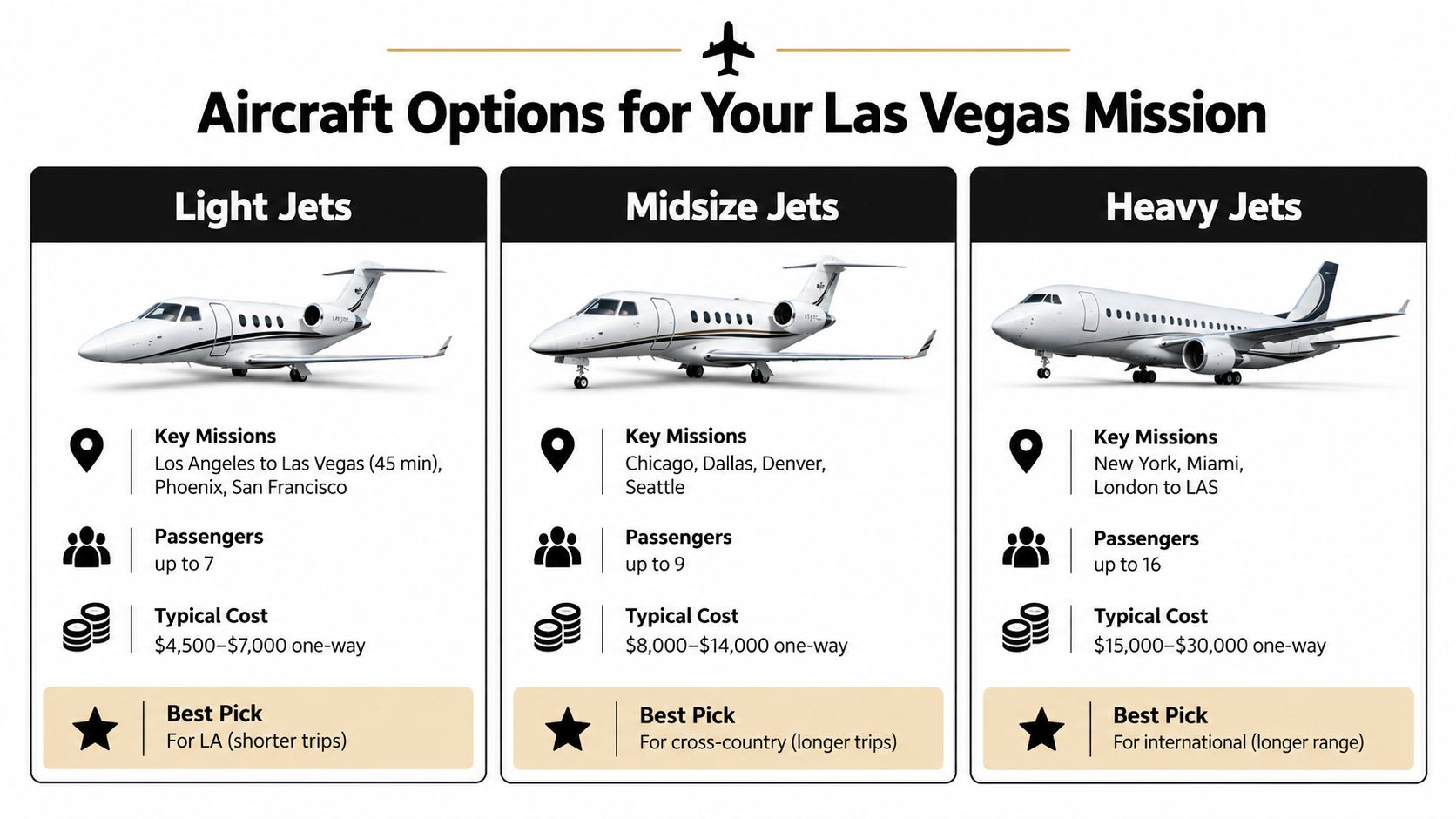
The biggest clue comes from route demand. A 2025 to 2026 business-aviation dataset identified Los Angeles to Las Vegas as the busiest city pair with 28,334 departures, and Las Vegas ranked 10th among cities by observed departure activity in 2025 with 102,958 departures, according to JetFinder's private jet statistics for 2025 and 2026. That tells you something important. Many Vegas private flights are short, frequent, and schedule-sensitive.
For that kind of mission, travelers often consider:
- Turboprops: Useful when runway flexibility and operating efficiency matter more than cabin prestige.
- Light jets: A common fit for short regional trips where speed and simplicity matter.
- Midsize jets: Better when the group, baggage, or comfort requirement starts to stretch a light jet.
Longer domestic and heavy-cabin missions
For flights coming from farther east, or for groups that want more cabin space, the logic changes.
A transcontinental or longer domestic mission usually pushes you toward:
- Super-midsize jets: Strong for nonstop range with a more spacious cabin.
- Heavy jets: Better for larger groups, more luggage, and travelers who want the widest scheduling margin into LAS.
The airport matters here. A light jet may work comfortably into HND or VGT, while a larger aircraft often points more naturally to LAS. VGT's shorter runway can be restrictive, especially once passenger load, luggage, and local operating conditions all enter the picture.
This video gives a useful visual sense of private jet trip planning and onboard expectations for Vegas-bound flying:
A simple matching framework
If you're trying to pick the right aircraft, use this checklist:
- Short route, small group: Look first at turboprops or light jets.
- Regional or longer U.S. trip: Start with midsize or super-midsize options.
- Large group or long-range mission: Heavy cabin aircraft usually make more sense.
- Planning VGT: Confirm runway suitability early, especially if luggage or passenger count is climbing.
- Need LAS for customs or heavier lift: Choose the aircraft with that airport in mind from the first quote.
Don't book by category alone. Ask for the exact year, make, model, cabin layout, and baggage fit before confirming.
What Flying Private to Las Vegas Typically Costs
The right way to think about charter cost is to treat it like a flight plan, not a menu.
There isn't one fixed Vegas price because the quote depends on where the aircraft starts, what aircraft you choose, whether it waits for you, and how busy the city is on your dates. That's why two trips on the same city pair can price differently without either quote being “wrong.”
The main cost drivers
Four variables shape most Las Vegas charter pricing:
- Aircraft type: Larger cabin aircraft generally cost more to operate than smaller ones.
- Positioning: If the jet must fly empty to your departure city, that cost can appear in the quote.
- Trip structure: One-way, same-day round-trip, and overnight return trips often price differently.
- Timing: Event weeks and compressed schedules can tighten availability.
The part travelers miss most often is repositioning. If an aircraft isn't already near your departure point, you may be paying for the empty movement before your trip even begins. That's one reason local sourcing matters.
How to read a quote intelligently
When reviewing a Vegas charter quote, ask:
Where is the aircraft coming from?
This tells you whether empty repositioning is part of the number.Is the quote built around LAS, HND, or VGT?
A cheaper flight into the wrong airport can become a slower and less practical trip.What happens if the aircraft waits versus drops and returns?
Depending on your schedule, one structure may make more sense than another.What's confirmed in writing?
Airport, FBO, baggage fit, and schedule details should all be clear before payment.
One useful baseline is to understand how on-demand pricing works before comparing aircraft options. The private jet charter cost guide from Haute Jets is a practical reference for that.
A better way to think about value
The cheapest quote isn't always the lowest total trip cost.
If a lower number uses an inconvenient airport, a poor aircraft fit, or heavy repositioning, you can lose the savings in ground time, schedule stress, or a last-minute aircraft change. A better test is this: does the quote match the mission cleanly from departure city to FBO arrival?
That's the standard worth using in Vegas.
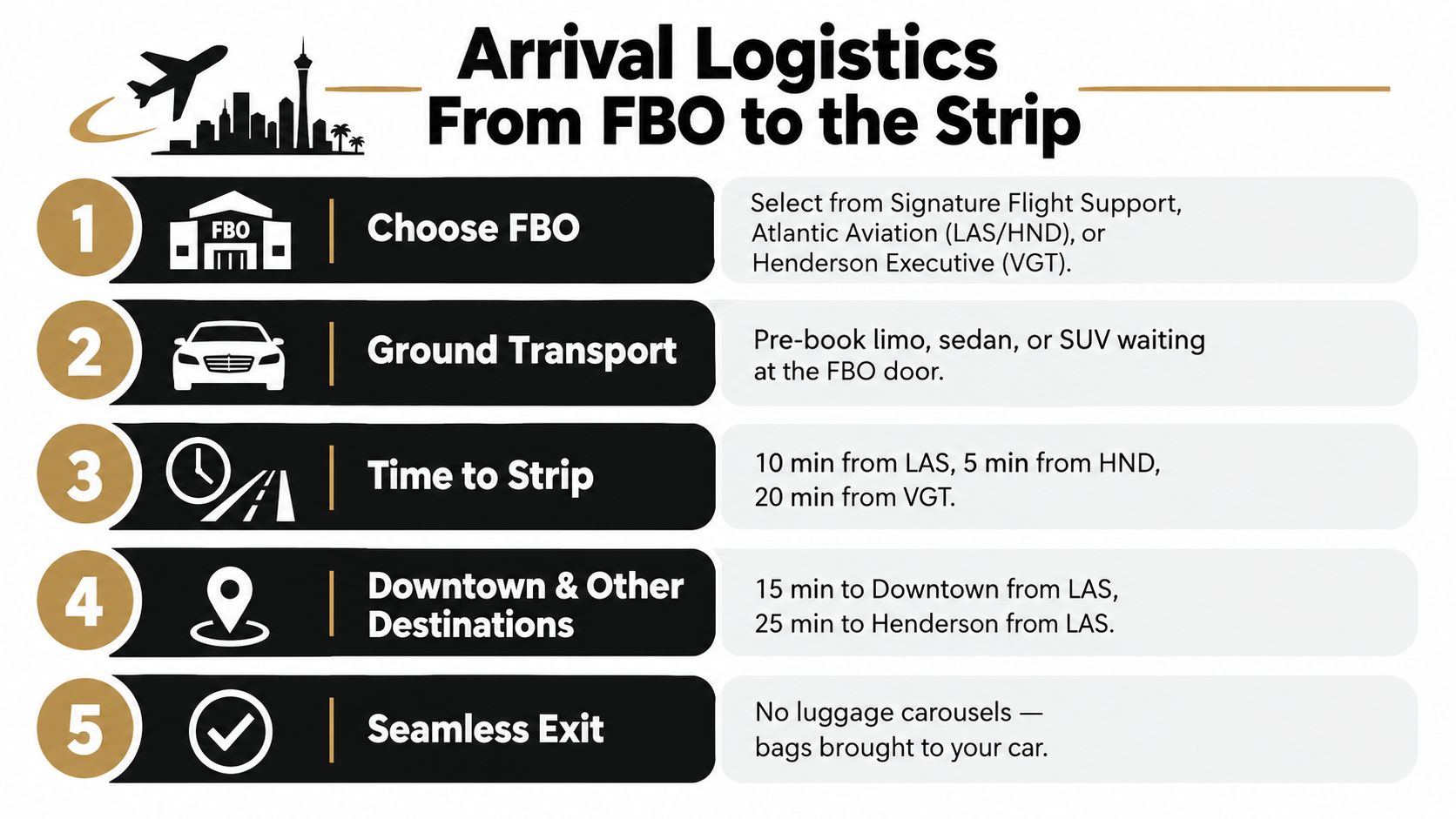
Arrival Logistics From FBO to the Strip
Once the aircraft is parked, the trip isn't over. In Las Vegas, the last mile often decides whether the day feels smooth or messy.
Private arrivals work best when the FBO, vehicle, and destination are connected in one plan. If they aren't, you can land on time and still lose the benefit on the ground.
What happens after touchdown
At a private terminal, your bags are usually unloaded directly to the handling team, and your car can be staged near the FBO exit. That's the part many first-time flyers appreciate most. No baggage carousel, no terminal walk, no rideshare pickup maze.
Ground strategy by arrival area
Your airport should line up with where you're going:
- Strip stay: LAS is often convenient, especially if the trip also involves commercial connections or a larger aircraft arrival.
- South Las Vegas or Henderson hotel, office, or residence: HND can be the cleaner match.
- Downtown or northwest side destination: VGT may reduce unnecessary cross-city driving.
If Henderson is on your shortlist, review the Henderson Executive Airport profile on Haute Jets before booking. It helps clarify when that airport fits better than LAS.
Event-week congestion changes the answer
Vegas gets interesting.
A lot of “fly private to Las Vegas” content talks only about comfort. The more useful question is what happens when the city is hosting an aviation-heavy event or a major convention. NBAA-BACE 2026 is scheduled for October 20 to 22 in Las Vegas, with the main convention at the Las Vegas Convention Center and the aircraft program at Henderson Executive Airport, and official materials say it will draw more than 17,000 industry professionals according to this NBAA-BACE event note.
That creates a very practical planning issue. On those dates, HND may be operationally useful for some travelers but also more exposed to event-driven aircraft activity. LAS may offer better runway and customs capability, but with different congestion patterns. The right answer depends on your meeting location, aircraft category, and how tightly your schedule is built.
During convention weeks, ask two questions before booking: which airport is likely to absorb the traffic best for my aircraft, and which ground route gets me out of the airport area fastest?
Privacy and handoff tips
For travelers who value discretion, simple planning helps more than flashy arrangements:
- Pre-book the car: Have the driver coordinated with the FBO, not just the airport.
- Keep the arrival window realistic: Tight transfers fail when the road plan is vague.
- Share baggage details early: Large items can slow the handoff if the vehicle isn't matched properly.
- Use one point of contact: The smoothest arrivals happen when flight and ground teams are coordinated.
Planning Your Private Flight to Las Vegas With Confidence
The cleanest Vegas bookings follow a simple order.
First, define the mission. Are you flying for a quick Strip stay, a corporate meeting, a convention week, or a longer-range arrival that needs customs and a larger runway? That answer should drive the airport choice before anyone gets attached to a specific aircraft.
The booking checklist that keeps things simple
Use this sequence when you're ready to fly private to Las Vegas:
- Choose the airport by purpose: LAS for heavier lift, customs, or certain connection needs. HND for many private-only arrivals. VGT for smaller aircraft and specific parts of town.
- Match the aircraft to the route: Don't choose by label alone. Confirm the exact make, model, and baggage fit.
- Check event timing early: Citywide demand can change both airport flow and aircraft availability.
- Confirm handling details: FBO, ground car, luggage plan, and passenger manifest should be settled before departure day.
- Ask for the exact flight details in advance: Tail number, crew, and operating specifics shouldn't be a surprise.
The most useful Vegas mindset
The best private flight to Las Vegas usually isn't the most glamorous-looking option. It's the one that removes friction from the entire trip.
That might mean LAS for one mission and HND for the next. It might mean choosing a smaller aircraft that fits the route better. It might mean locking in event-week details earlier than you normally would. Those choices save more time than any cabin photo ever will.
If you're weighing airports, aircraft, and timing together, you're already planning the trip the right way.
Haute Jets arranges on-demand private jet charter with exact aircraft selection, local sourcing to reduce unnecessary repositioning, and pre-flight confirmation that includes the operational details Vegas travelers care about. If you're planning to fly private to Las Vegas and want to compare the right airport and aircraft for your route, visit Haute Jets.