
You're probably looking at the same problem most first-time charter clients face. The jet seems straightforward. The airport doesn't. You want to skip the terminal chaos, cut wasted ground time, and land closer to where you need to be. But then you realize there isn't just one airport option. There are several, and the wrong one can add cost, delay, and friction to an otherwise premium trip.
That's why private plane airports matter more than most clients think.
The aircraft gets the attention. The airport determines the experience. Pick the right facility and your day feels controlled, quiet, and efficient. Pick the wrong one and you'll deal with runway limits, curfews, weak ground handling, customs complications, or a long drive that defeats the point of flying private in the first place.
Haute Jets Journal exists for exactly this kind of clarity. If you understand how private plane airports work, you'll make better charter decisions and get more value from every flight.
Your Gateway to Effortless Travel
Commercial airport stress is familiar. You leave too early because you can't trust traffic. You stand in line to check bags you wish you didn't bring. You watch the board for delays. You walk through a crowded terminal, then wait at a gate with no privacy and no control over timing.
Private aviation removes that rhythm.
With private plane airports, you don't enter the same system commercial passengers do. You arrive at a separate terminal built for smaller groups, direct boarding, and fast turnarounds. Your car pulls up close to the aircraft. Your luggage is handled without the conveyor-belt circus. The crew is ready for you, not for a few hundred strangers rotating through a gate.
What changes immediately
Three things improve the moment you start using the right private airport:
- Time control: You're not budgeting your day around airport congestion.
- Privacy: You avoid crowded checkpoints, packed gate areas, and public boarding lines.
- Direct access: You can often land far closer to your final destination than any airline would take you.
That last point is where experienced travelers save real time. The airport closest to the city center isn't always the best airport. The best airport is the one that matches your aircraft, your schedule, your destination, and your ground plan.
Practical rule: Don't ask, “What's the nearest airport?” Ask, “What's the smartest airport for this mission?”
That's the difference between chartering a jet and using private aviation well.
A seasoned operator looks at the whole trip. Departure access. Arrival drive time. FBO quality. Ramp efficiency. Operating hours. Customs. Noise rules. Aircraft suitability. Those details decide whether your travel day runs cleanly or gets messy around the edges.
Most generic travel advice skips that. It shouldn't. Airport strategy is one of the biggest levers you have for both convenience and cost-efficiency.
The World Beyond Commercial Terminals
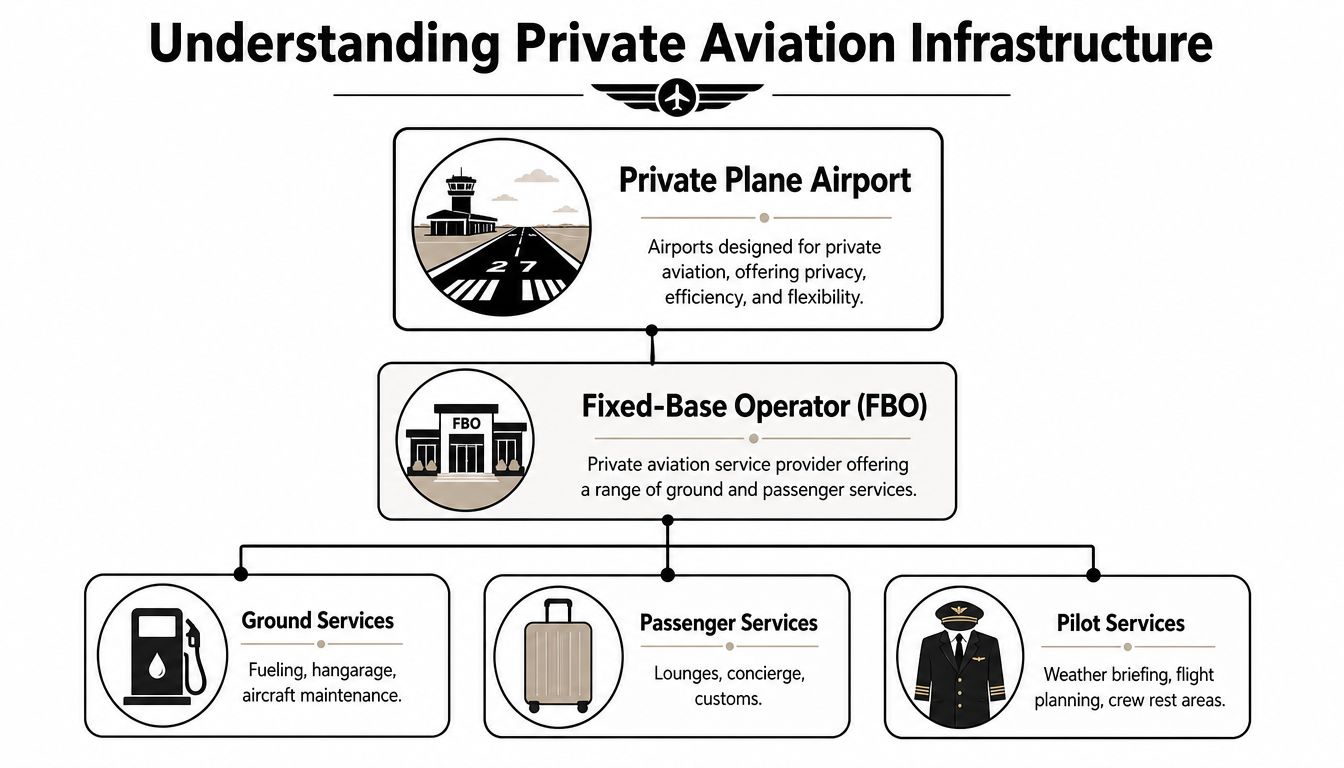
A private plane airport isn't always a fully separate airport reserved only for business aviation. Sometimes it is. Sometimes it's a private aviation facility operating on one side of a larger airport. What matters is the terminal experience and the support infrastructure around your flight.
The center of that infrastructure is the Fixed-Base Operator, usually called an FBO.
What an FBO actually does
Think of an FBO as a private lobby, concierge desk, and pit crew for your aircraft, all in one place. It handles the passenger side and the aircraft side at the same time.
That means an FBO can provide:
- Ground services: fueling, hangar access, marshaling, and maintenance coordination
- Passenger services: lounges, concierge help, customs support where available, and car coordination
- Pilot services: flight planning support, weather access, and crew facilities
If you want a deeper breakdown of how these terminals work in practice, Haute Jets has a useful overview on the benefits of private FBO terminals for jet travelers.
Why airport access changes everything
Private aviation gives you a much wider map than commercial airlines do. According to BlackJet's analysis of private jet landing access, private jets have access to more than 5,000 public airports and as many as 14,000 private airports globally, and in the U.S. private aviation can serve over 5,000 airports compared to only around 500 for commercial jets.
That gap is the entire game.
It means you can often avoid major hub congestion, trim hours off ground transfers, and get into destinations that are not well-served by an airline schedule. It also means you have choices, and choices require judgment. Not every airport with private access is equally useful. Some have better FBOs. Some are easier in and out. Some are cheaper. Some are stricter on hours or aircraft type.
The airport isn't just where the jet lands. It's where your time gets protected or wasted.
That's why clients who focus only on cabin class miss part of the value equation. The airport and FBO setup often matter just as much as the aircraft itself.
The Private Terminal Experience Explained
Your car rolls up to a low-profile building, not a massive terminal. No departure board. No rope lines. No crowds dragging carry-ons across polished floors. A staff member meets you by name, confirms the basics, and takes care of the bags.

Inside, the pace is calm. You sit in a private lounge or conference room. If you need coffee, catering, Wi-Fi, a quiet call, or last-minute ground coordination, the FBO handles it. If your assistant has already sent the manifest and preferences ahead, there's very little left for you to do.
That's the private terminal experience at its best. Efficient, discreet, and built around your schedule instead of the airport's.
What happens from curb to cabin
The process is simple when the operator and FBO are competent:
Arrival at the FBO
Your driver pulls directly to the private terminal entrance.Passenger verification and luggage handling
Staff confirm identity and move bags straight to the aircraft.Short lounge wait, if any
You can step into a lounge, private meeting room, or board almost immediately.Direct escort to the aircraft
You walk through the private terminal area or across the ramp to the jet.Departure on your timeline
Once the crew and handling team are ready, you're airborne.
This model supports real volume, not a niche novelty. According to Amalfi Jets' global private aviation overview, the sector supports an average of 11,500 private jet flights per day, FBO networks serve approximately 24,000 aircraft worldwide, and the industry conducted more than 4.3 million flights globally in 2023.
Why the experience feels so different
The luxury matters, but the primary advantage is operational. You're removing public terminal bottlenecks from the trip.
Common FBO features include:
- Private lounges: quiet seating, refreshments, and space to work
- Conference rooms: useful for executives who need one more meeting before wheels up
- Ramp-side coordination: cars, luggage, catering, and crew all synchronized
- Discreet boarding: no gate agents calling zones, no crowd, no audience
If you're curious how the term itself is used in aviation, this Haute Jets piece on FBO meaning in aviation and what private jet travelers should know is worth reading.
For a broader look at how airports are managed from the operator side, especially when accessibility and wayfinding matter, Waymap's guide for airport operators adds useful context.
A quick visual helps if you've never flown through an FBO before:
Good private travel doesn't feel rushed. It feels prepared.
That's the standard to expect. Not extravagance for its own sake. Clean execution.
Navigating Customs and International Travel
International private travel is smoother than most first-time clients expect, but only if you ask the right question early. Not “Can my jet land there?” Ask, “Can I legally clear there?”
Those are not the same thing.
Some private plane airports are designated ports of entry or airports of entry with customs and immigration capability on site. Others are not. If your destination airport lacks customs clearance, your aircraft may need to make a stop at a designated entry point before continuing to the smaller airport you intend to reach.
How customs usually works on private flights
When the airport supports it, customs and immigration are often handled either onboard or inside a private lounge area within the FBO. That's a very different experience from commercial arrivals. You're not funneled into long public lines or crowded processing halls. The process is still formal and regulated, but it's far more controlled and far less disruptive.
That matters for executives, families, and anyone moving on a tight schedule. It also matters for confidentiality.
Use a pre-trip checklist. Passport validity, visas where needed, customs clearance location, onward transport, and any special declarations should all be confirmed before the flight is locked. If you want a practical traveler-facing checklist, this stress-free international travel guide is a helpful companion.
Questions worth asking before you confirm
Don't leave these points vague:
- Is the arrival airport a port of entry? If not, where will customs be cleared?
- Will clearance happen onboard or inside the FBO?
- Is the airport staffed for your arrival window? Customs availability can be tied to timing.
- If there's a technical stop, what does it add to the day? Even a smooth stop changes crew, fuel, and transfer planning.
International charter goes smoothly when customs is treated as part of airport strategy, not as an afterthought.
For a more detailed walkthrough, Haute Jets provides a solid private jet customs guide explaining the process from a client perspective.
Inexperienced booking teams make avoidable mistakes. They choose the glamorous final airport first and ask customs questions later. Professionals do the reverse. They confirm legal and operational access, then optimize the routing around it.
How to Choose the Right Private Airport
Choosing the right airport is as important as choosing the right jet. Sometimes it matters more.
Clients tend to focus on the airplane because it's tangible. Cabin, range, seating, baggage, Wi-Fi. That's understandable. But airport selection determines whether the aircraft can operate cleanly, whether the schedule is realistic, and whether the trip stays efficient from driveway to destination.
Start with aircraft compatibility
Runway length is not a suggestion. It's a hard operational filter.
According to GlobalAir aircraft performance specifications, a turboprop such as the Pilatus PC-12 may require only 2,500 feet, while an ultra-long-range jet such as the Gulfstream G650 demands 8,000 to 9,000 feet at sea level. If the runway doesn't match the aircraft's certified takeoff and landing needs, you're looking at restrictions, compromises, or a different airport.
That's why “closest airport” can be the wrong answer. A smaller field may be physically nearer to the meeting or estate, but if your selected aircraft can't operate there efficiently, you'll either change aircraft or accept constraints you didn't plan for.
Check hours before you fall in love with the airport
Many travelers assume private aviation means round-the-clock access everywhere. It doesn't.
Some smaller airports close overnight. Some have limited lighting. Some can't support fueling at the hour you need. According to BlackJet's overview of private jet airport limitations, many airports marketed as accessible have 24/7 limitations, and 70% of regional FBOs may present hidden itinerary risks because of restricted hours, night limitations, or fueling constraints.
That's where trips go sideways. The route looks direct on paper. The airport can't support the actual arrival or departure window. Suddenly you're adding a reposition, a second leg, or a longer drive.
Treat curfews and noise rules as mission critical
Noise restrictions are tightening at prominent business aviation airports. That means legal access can depend on your aircraft type and your timing.
International Jet's discussion of private jet access at smaller airports highlights how noise restriction and curfew cliffs are affecting access at major metro private hubs such as Teterboro and Van Nuys, with stricter standards shaping which aircraft can operate during peak periods.
If you're flying an older, louder aircraft into a sensitive market, don't assume flexibility. Verify it.
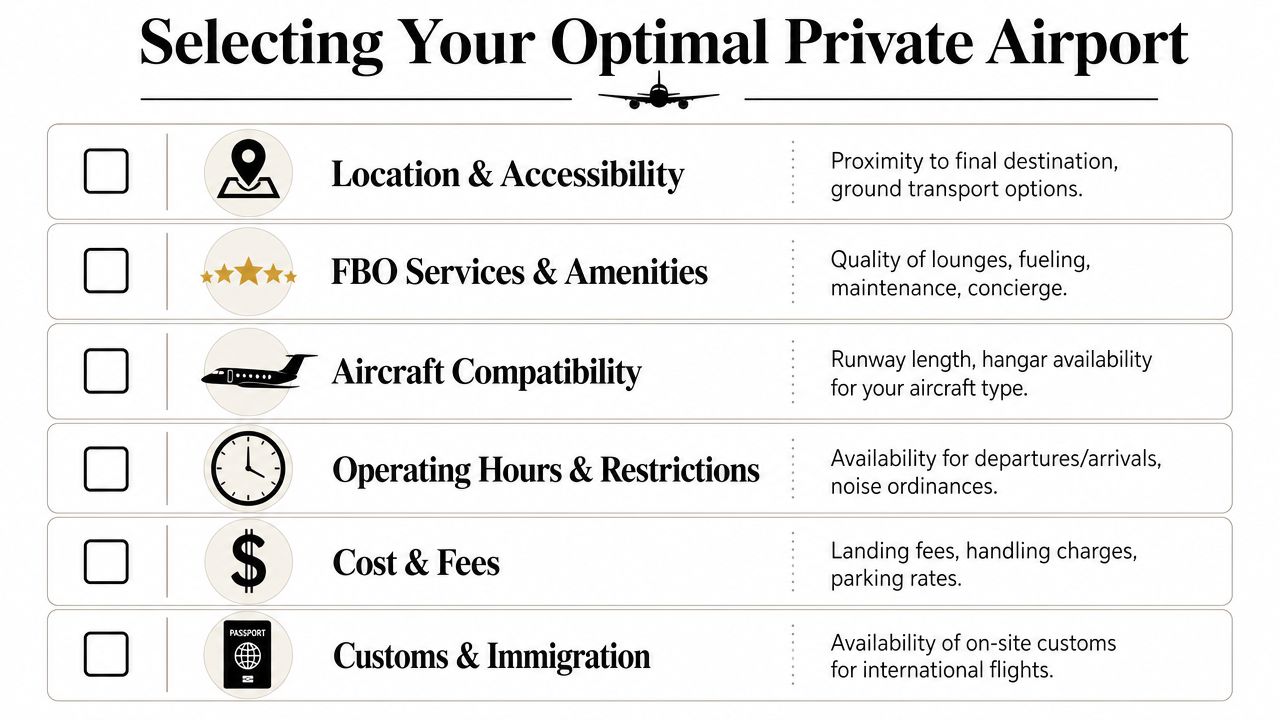
Use this selection framework
Here's the filter I'd use for every trip:
Location and ground access
Don't measure airport quality by straight-line distance. Measure actual drive time, traffic pattern, and pickup reliability.FBO quality
A weak handler can slow baggage, catering, fueling, and departure sequencing. A strong FBO keeps the day tight.Runway and ramp fit
Match the airport to the actual aircraft, not the aircraft category in the abstract.Hours and restrictions
Confirm curfews, late arrivals, early departures, and after-hours support.Customs status
For international travel, verify whether clearance is available and at what time.Airport fees and hidden friction
Lower fees don't always mean lower total cost. A cheaper airport with a bad drive or limited hours can cost more in practice.
The best private airport is rarely the flashiest one. It's the one that protects the whole itinerary.
This is also where cost-efficiency and convenience finally meet. Smart airport selection reduces wasted flight time, avoids unnecessary repositioning, improves schedule reliability, and cuts expensive last-minute changes.
A Curated List of Top Private Jet Airports
A strong airport list is only useful if you understand the use case behind each field. “Best” depends on the mission.
According to this overview of top private aviation hubs, 18 of the 20 busiest airports globally for private jet operations are located in the United States, with Van Nuys, Palm Beach International, and Teterboro ranking as top-tier hubs. That tells you where traffic concentration and service depth already exist.
U.S. airports that consistently matter
| Airport (Code) | Primary City Served | Key Strategic Advantage |
|---|---|---|
| Teterboro (TEB) | New York City | Premier access for Manhattan and North Jersey business travel |
| Van Nuys (VNY) | Los Angeles | Deep private aviation infrastructure and strong access to LA markets |
| Palm Beach International (PBI) | Palm Beach | High-end South Florida access with mature FBO service |
| Dallas Love Field (DAL) | Dallas | Strong business access close to central Dallas |
Teterboro is the obvious New York-area example. It's built around business aviation demand and remains a go-to choice for clients who want to avoid the scale and friction of major commercial fields.
Van Nuys serves a similar role in Los Angeles. It's strategically valuable because it places you close to core LA business and entertainment corridors. But airport choice there still requires discipline. Access and timing need to be checked carefully against operating restrictions and the specifics of the aircraft.
Palm Beach International works well for South Florida clients who want polished service and efficient access to Palm Beach, nearby estates, and seasonal events. Dallas Love Field remains strategically useful for business itineraries where downtown access matters.
International names clients should know
Outside the U.S., certain airports are consistently favored by private travelers because they combine business aviation familiarity with practical access to major markets:
- London Luton (LTN) for London access outside the largest hub environment
- Paris-Le Bourget (LBG) as a long-established business aviation gateway for Paris
- Dubai Al Maktoum (DWC) for flexible access in a major global business and leisure market
These are examples, not automatic answers.
A top airport is valuable because it fits the mission well, not because it appears on a prestige list.
That's the right mindset. Use named airports as strategic models. Then choose based on drive time, restrictions, customs, and aircraft fit.
The Haute Jets Advantage in Airport Selection
Most clients don't need to become airport experts. They need someone who already is.
Airport selection gets technical fast. Runway suitability, operating hours, curfews, customs capability, handler quality, and arrival logistics all shape the outcome. That complexity is exactly why experienced charter planning matters. The right airport can reduce total trip friction. The wrong one can turn a premium booking into a compromised itinerary.
Haute Jets solves that problem with a model most charter buyers should insist on. Instead of pushing a generic aircraft category and absorbing unnecessary repositioning costs, Haute Jets sources from a network of 3,500+ owner-operators across 175 countries, focuses on Wyvern Wingman and Argus Gold/Platinum-rated operators only, and matches the mission to the most practical airport and aircraft combination.
The differentiator is local sourcing. That matters because repositioning is where many clients overpay without realizing it. By finding an aircraft already based near the optimal departure airport, Haute Jets avoids the inflated ferry costs that traditional brokers and jet card structures often pass on. According to Haute Jets, that can eliminate repositioning fees that often increase charter pricing by 20% to 40%.
That's the part most travelers miss. Smart chartering isn't only about getting a jet. It's about getting the right jet, from the right airport, already positioned where it should be.
If you care about convenience and value, that's the standard.
If you want a smarter way to book private flights, Haute Jets helps you choose the right airport, source the right aircraft locally, and avoid the repositioning costs that make too many charters overpriced from the start.