

You're probably dealing with a trip that looks simple on paper and becomes inefficient the minute you price it. A team needs to hit multiple regional offices in two days. A family wants to reach an island airport without losing half the day to connections and transfers. An executive wants to land near the actual destination, not the nearest major airport with a long drive attached.
That's where private turboprop planes stop being the “smaller aircraft option” and start becoming the smarter tool.
Most buyers approach charter backwards. They ask, “Should I get a jet?” The right question is, “What aircraft gets me closest, fastest door to door, with the least waste?” On many short regional missions, a turboprop wins that comparison cleanly.
Why the Smartest Private Flyers Choose Turboprops
A common real-world mission goes like this. You leave early, visit one secondary-city office, continue to a plant or resort area with limited airline service, then return the next day after a final meeting. Commercial service turns that into a logistical mess. A light jet can help, but only if the airport infrastructure lines up with your actual itinerary.
A turboprop often fixes the problem. It gets you into the airport that matters, not the airport with the best marketing.
That's why experienced charter clients stop thinking in terms of aircraft prestige and start thinking in terms of total trip value. Speed matters, but so do ground transfers, repositioning, runway limits, and whether the airplane can handle a practical multi-leg schedule without making the economics absurd.
One industry dataset reports more than 20,000 active private jets worldwide, including 9,584 turboprops in North America alone, while North America accounts for about 67% of the global business-aircraft fleet. That matters because turboprops are heavily used for short-haul, regional, and secondary-airport missions where access and operating economics beat raw speed, especially on routes under 600 to 1,000 miles according to private aviation fleet data and market context.
The smartest private flyers don't buy “faster” if “closer” gets them there sooner.
If you've only looked at private aviation through a jet-first lens, you're missing a category built for practical efficiency. The strongest argument for turboprops isn't that they're cheaper. It's that they often create a better trip.
For a deeper look at that logic, Haute Jets Journal has a useful breakdown of the advantages of a turboprop aircraft.
Understanding Modern Turboprop Aircraft
A lot of travelers hear “propeller aircraft” and picture something dated. That's the wrong frame.
A modern turboprop is a turbine aircraft. The propeller is just how that turbine delivers power most efficiently for this mission profile. It operates similar to a high-performance drivetrain built for control, efficiency, and strong low-speed performance, not just top-end speed on a long straightaway.
How the engine actually works
A turboprop generates thrust by using a gas turbine to spin a propeller through a reduction gearbox. That setup lets the engine operate efficiently at lower airspeeds than a pure jet. In business aviation, that makes turboprops especially effective on short-to-medium routes and from shorter runways, where they can deliver strong takeoff and climb performance while burning less fuel than light jets on comparable sectors, as outlined in this turboprop engine explanation.
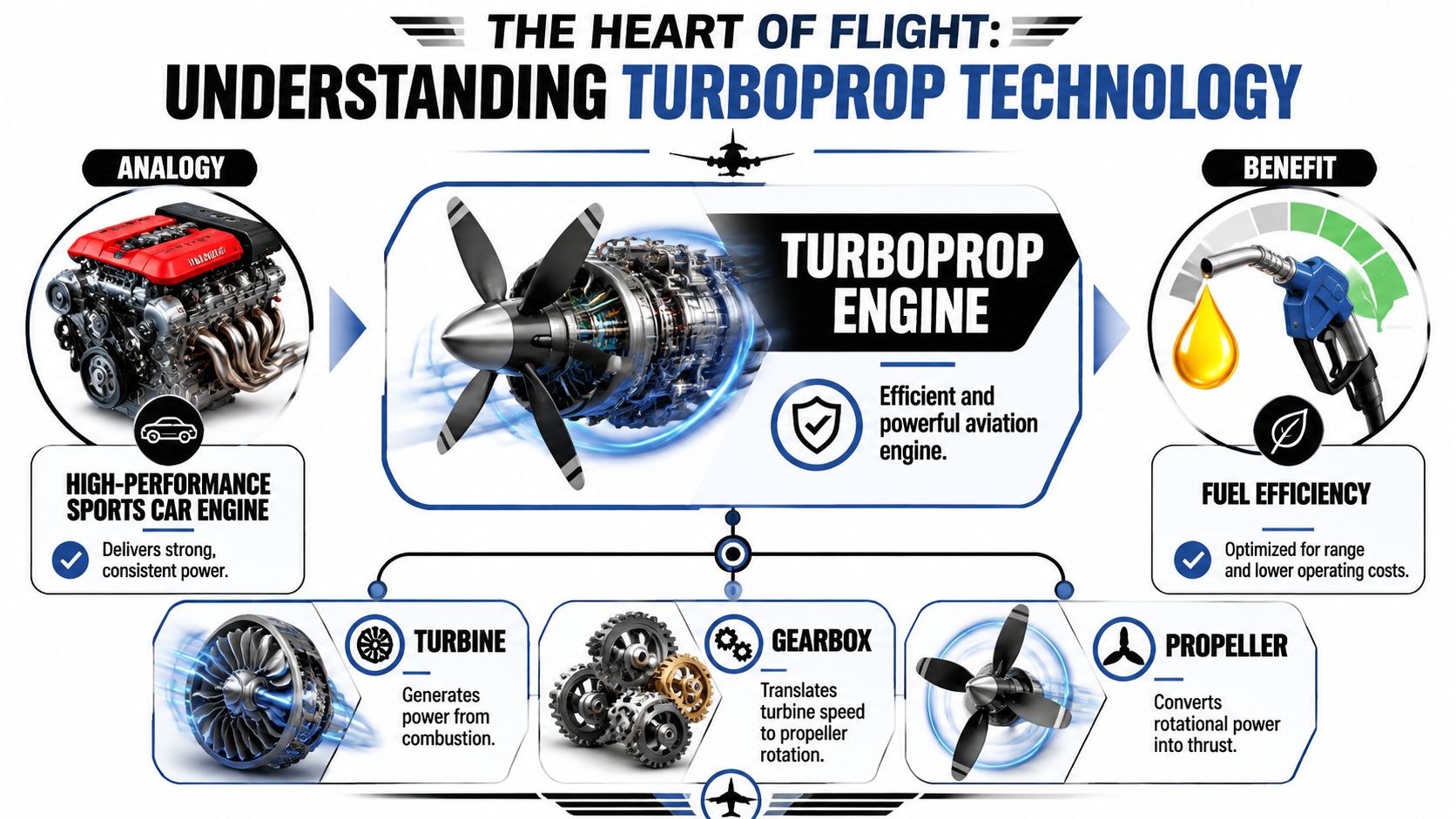
That gearbox matters more than most clients realize. The turbine can run where it's happiest, while the propeller turns at a speed that produces efficient thrust for regional flying. You get usable power where private travelers need it. Climb, descent, shorter sectors, and fields that aren't built for jets.
Why this design works so well for regional charter
Jets shine when distance is long enough for their speed advantage to dominate the trip. Turboprops shine when the mission includes:
- Shorter sectors where climb and descent consume a bigger share of total flight time
- Smaller airports that reward strong short-field performance
- Operational efficiency where fuel burn and total trip cost matter
- Flexible routing for business or leisure itineraries with more than one stop
Practical rule: If your mission is regional and your destination isn't a major hub, don't default to a jet. Match the aircraft to the job.
This is the point many buyers miss. A turboprop isn't a compromise between luxury and utility. It's a specialized answer to a very common charter problem. You're not giving up capability. You're choosing the capability that fits the mission.
Turboprop Performance and Capabilities
If you charter based on brochure speed alone, you'll overpay for a lot of flights.
What matters on regional private trips is a three-part equation. Cruise speed, practical range, and runway access. Turboprops hold up well on all three, especially when the trip is not a long nonstop between major airports.
The numbers that actually matter
For private missions in the 250 to 400 nautical mile range, modern turboprops are commonly cited at about 250 to 330 knots cruise with roughly 800 to 1,800 nautical miles of range. They can also burn up to 50% less fuel than regional-jet alternatives on similar routes, which lowers trip cost and often lowers emissions per seat-mile, according to this turboprop performance overview.
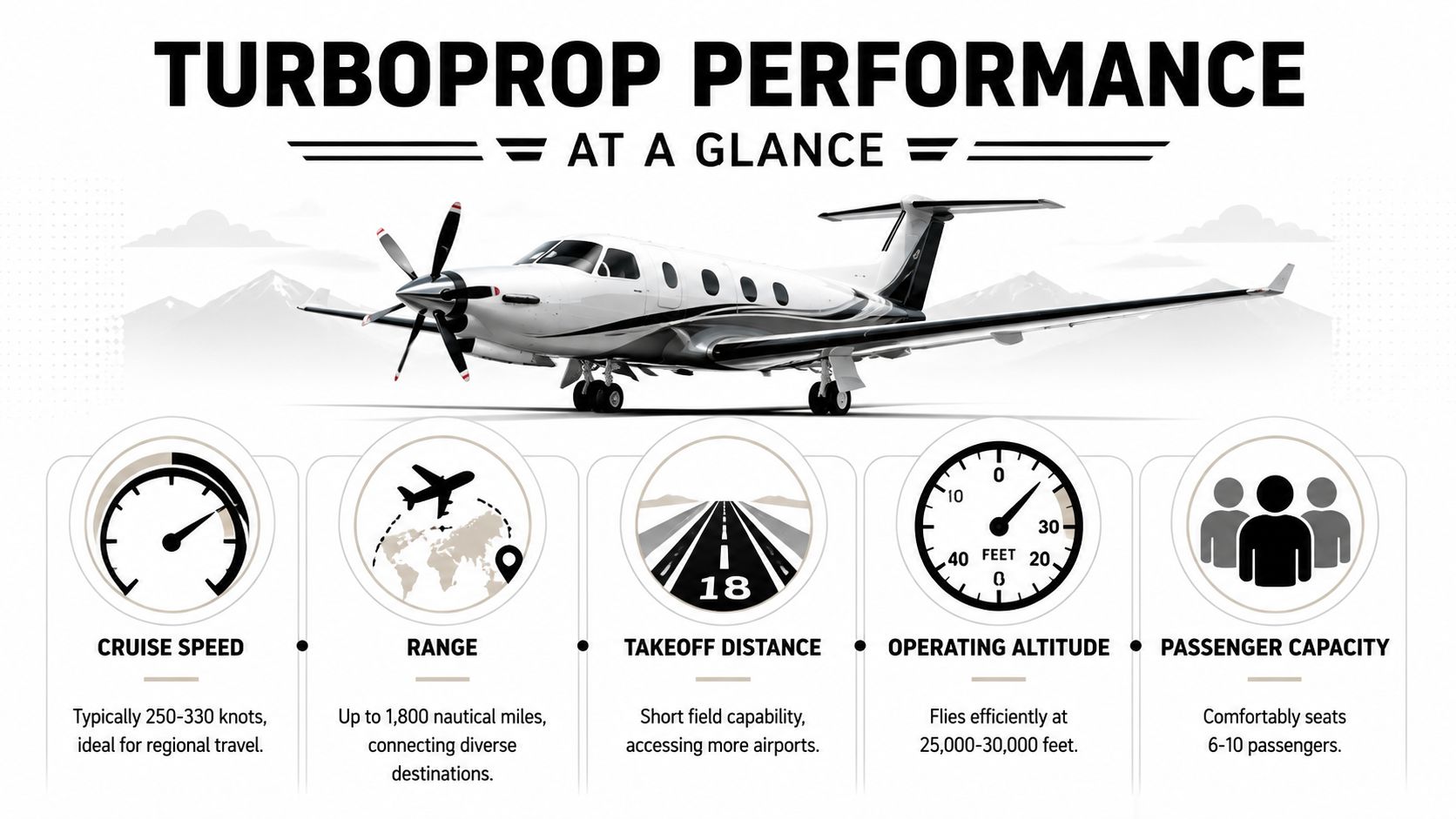
Those numbers tell you something important. On many short regional legs, the turboprop is not meaningfully slow in the way buyers imagine. It's slower in cruise than a jet, yes. But that doesn't automatically make the trip slower.
Door-to-door beats airspeed
Here's the better way to evaluate performance.
| Metric | What it means for you |
|---|---|
| Cruise speed | Fast enough for regional business and leisure missions |
| Range | Plenty for multi-city regional itineraries without forcing a larger aircraft |
| Short-field capability | Access to airports closer to resorts, plants, estates, and islands |
| Fuel efficiency | Lower operating cost on the missions where private flyers use them most |
The runway point is the separator. A jet may beat a turboprop in the air and still lose the day if it has to use a larger airport farther away.
On a regional mission, performance isn't “How fast can this airplane go?” It's “How efficiently can this aircraft complete the whole trip?”
If your destination is a remote lodge, a secondary business market, or an island field, the practical capability of a turboprop changes the trip. You reduce transfer time, simplify scheduling, and avoid paying for speed you can't fully use.
When to Choose a Turboprop Over a Light Jet
This decision is simpler than most charter articles make it sound. Stop comparing aircraft categories as status symbols. Compare them as trip tools.
If the route is regional, the airport is constrained, or the day includes multiple short legs, a turboprop often beats a light jet on value. Not just cost. Value.
The under-two-hour rule
Independent aviation writeups show turboprops are strongest on shorter regional legs and can be about 40% lower cost than a private jet on flights under two hours. The same analysis notes that modern turboprops can use runways as short as 3,200 feet and reach over 7,000 smaller airfields, which materially changes the economics for island, alpine, and secondary-city trips, as explained in this turboprop versus private jet comparison.
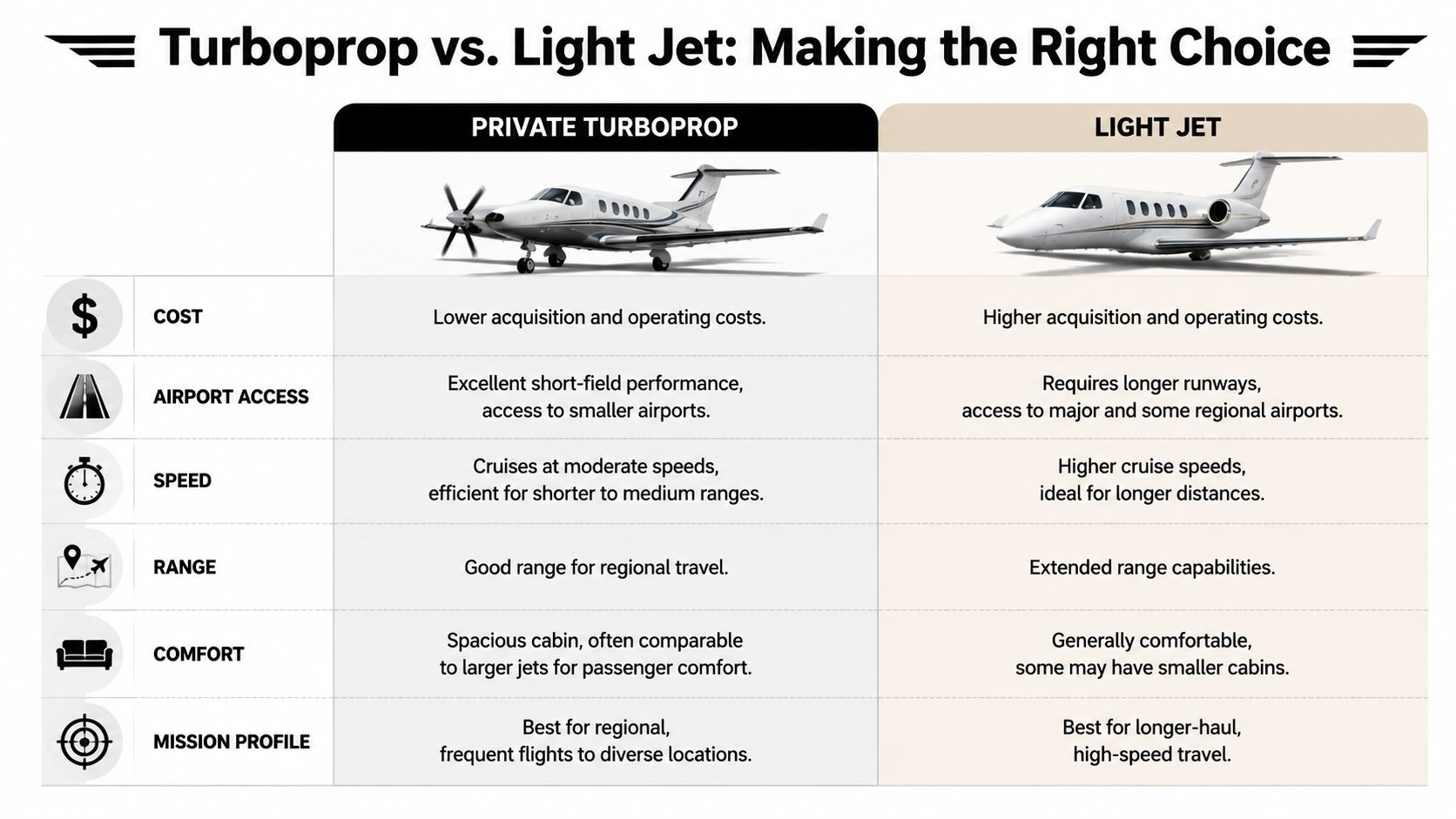
That's why I advise clients to choose a turboprop when the mission fits these conditions:
- Short regional legs: You're flying for utility, not headline speed.
- Airport access matters: Your real destination is not near a major jet airport.
- Multi-stop days: You need efficient turns and practical economics.
- You want lower waste: Fuel burn, repositioning, and unnecessary runway requirements all work against the jet.
A cleaner decision framework
Use this table before you book:
| Trip condition | Better fit |
|---|---|
| Regional mission with smaller destination airport | Turboprop |
| Island, alpine, or secondary-city access | Turboprop |
| Longer nonstop where cruise speed dominates | Light jet |
| You care more about total trip time than airborne speed | Turboprop |
| You want major-airport convenience but not short-field access | Light jet may fit |
The real comparison isn't turboprop versus jet. It's turboprop versus jet plus extra ground transfer, less airport choice, and more wasted spend.
That distinction matters. Buyers often fixate on a faster airplane and ignore the slower transfer attached to it.
When I'd recommend the jet instead
A light jet is still the better call when:
- The route is long enough that faster cruise meaningfully changes the day.
- Your departure and arrival airports are both jet-friendly and close to where you intend to be.
- You prioritize less time in the air, and the economics are secondary.
If you want a side-by-side mission view, this Haute Jets Journal piece on turbo props and light jets is worth reading.
For everything else, especially practical trips under a couple of hours, private turboprop planes deserve to be your default shortlist.
Popular Models and Onboard Experience
The category becomes easier to understand once you stop thinking about “turboprops” in the abstract and start thinking about actual aircraft.
The two names most charter clients encounter first are the Pilatus PC-12 and the King Air family. That makes sense. They're widely recognized because these aircraft solve real missions without making the cabin feel like a downgrade.
What the cabin feels like
Modern private turboprop planes don't feel like commuter aircraft when they're configured for executive charter. They feel private, practical, and purpose-built. You board quickly, sit in a quiet enough cabin to work or talk comfortably, and keep the schedule moving.
Typical expectations include:
- Executive seating layouts suited to small groups and business travel
- Practical baggage flexibility for leisure gear, work materials, or both
- Refreshment setups that fit regional charter norms
- A cabin environment designed for conversation, not endurance
The PC-12 is a good example because clients like its versatility. It's one of the easiest aircraft in this class to understand. Strong utility, executive charter appeal, and a cabin that works for both business and leisure flying.
If you want to look at a concrete aircraft option, the Pilatus PC-12 aircraft page gives you a useful reference point.
Why these aircraft are so common
There's a reason you see turboprops repeatedly in serious charter planning. They're not niche machines. They're a meaningful part of business aviation infrastructure, especially in North America, where turboprops represent a substantial share of active business aircraft according to the fleet data cited earlier.

The onboard experience also benefits from the kind of missions these aircraft serve. Flights are often regional. That means less time obsessing over nonstop long-haul comfort and more value placed on quick boarding, easy loading, and direct access to the right airport.
If your trip is two business meetings, a resort transfer, or a family island arrival, cabin practicality often matters more than jet-image aesthetics.
The buyers who understand this usually become repeat turboprop users. Once they see the time saved on the ground, the category stops needing any defense.
How to Charter a Turboprop with Haute Jets
You need to get six people into a meeting near a secondary airport, be in the car within minutes of landing, and avoid paying jet pricing for time you will never use. That is where a turboprop wins on total trip value. The right booking is the one that lowers your full mission cost while getting you closer to your actual destination.
Earlier market research pointed to the same core advantage. Turboprops use less fuel than comparable light jets and reach many smaller airports that make regional charter more efficient. For short trips, that changes the economics fast. A lower hourly rate matters, but the bigger win is cutting drive time, avoiding unnecessary repositioning, and building the day around the airport that serves your schedule best.
What affects your charter quote
For a turboprop booking, I look at four things first:
- Flight time: On regional trips, efficiency shows up quickly in the final price.
- Airport choice: The best-value airport is often the one closest to your real destination, not the biggest or most familiar field.
- Repositioning: If the aircraft has to come from another city, the savings can disappear.
- Ground planning: The air segment is only part of the trip. Poor pickup timing or a long transfer can erase the advantage of flying private.
Ground coordination matters more than many clients expect. A turboprop can save you time in the air and on the runway, but you only keep that advantage if the handoff on the ground is tight. If you are arranging executive transfers, family pickups, or resort arrivals, MLR Worldwide Service for private aviation is a practical resource to review.
How I'd approach the booking
Haute Jets is useful here for a simple reason. Turboprop charter works best when the broker can source locally, confirm the exact aircraft, and filter operators by serious safety standards such as Wyvern Wingman or ARGUS Gold/Platinum.
My recommendation is straightforward:
- Choose the destination airport first. That is where turboprops often create the biggest time and cost advantage.
- Price the full trip, not just the flight hour. Include repositioning, landing fees, and ground transport.
- Confirm the exact aircraft before you approve the trip. Cabin setup, baggage space, and onboard features vary more than many travelers assume.
- Check the operator, crew, and ratings. Aircraft type matters. Operator quality matters more.
- Build the schedule around the mission. Multi-stop regional days are where turboprops deliver outstanding value.
Clients waste money when they start with a vague request for "a private aircraft." Start with the mission, the airport, and the full door-to-door plan. That is how you charter a turboprop intelligently.
Private Turboprop FAQ
Are turboprops comfortable enough for executive travel
Yes, if you book the right aircraft for the mission. Modern executive turboprops are built for private travel, not airline-style shuttle service. Expect a private cabin, practical seating, and a setup that works well for conversations, light work, and regional trips.
Can I bring skis, golf clubs, or bulky luggage
Often yes, but you should confirm against the exact aircraft and passenger load before booking. Baggage flexibility is one of the reasons travelers choose this category, especially for leisure routes that involve sports equipment or family travel.
Are turboprops as safe as jets
The smarter way to judge safety is by operator standards, crew quality, and audit level, not by assuming one aircraft category is automatically better. If an operator holds Wyvern Wingman or ARGUS Gold/Platinum credentials and the trip is flown by a properly managed charter operation, that's the filter that matters.
Judge the operator first, the aircraft second.
Do turboprops work well for multi-leg same-day flying
They do. In fact, that's one of their strongest use cases. Regional business travel, site visits, and destination-hopping itineraries are exactly where these aircraft tend to make the most sense.
Will I have Wi-Fi and business amenities onboard
Sometimes, but not universally. Ask for the exact aircraft details in writing before you confirm. On private charter, assumptions are expensive. You want the specific answer on connectivity, power, catering, pet policy, and baggage handling before the itinerary is locked.
What's the biggest mistake clients make with turboprops
They compare them to jets by image instead of by mission. If your trip is regional and airport access matters, private turboprop planes often deliver the better result. That's the metric that counts.
If your next trip is regional, involves a smaller airport, or includes more than one stop, don't default to a jet. Start with the mission and price the whole journey. Haute Jets lets you request the exact aircraft, confirm operator standards, and evaluate the actual economics of the trip before you book.