

The Citation X+ can reach about 3,460 nautical miles in its best published configuration, and the NBAA IFR figure with 4 passengers is 3,372 nautical miles. That’s the right starting point if you’re asking about the range of citation x, but it’s only a starting point because the actual range depends on who’s flying, what they’re bringing, the routing filed, and what the weather is doing that day.
If you’re looking at a coast-to-coast trip right now, that distinction matters. A brochure number answers what the aircraft can do in a standardized test environment. A broker’s answer should tell you what the jet can do for your mission, with your passengers, bags, timing, and operational constraints.
That’s exactly where the Citation X earns its reputation. It wasn’t built to be average. It was built to move executives quickly, comfortably, and at a pace few business jets have ever matched. But if you want to use this aircraft intelligently, you need to think beyond one headline figure and start looking at actual mission capability.
The Citation X Promise Speed and Distance
Your team needs to leave the New York area after breakfast and be in Los Angeles with enough margin to walk into a serious afternoon meeting composed, not rushed. That is the kind of mission that keeps the Citation X on charter shortlists.
The aircraft earned its reputation by doing one thing exceptionally well. It cuts time off long domestic trips in a way clients feel. Less day lost in transit. More control over the agenda. That matters far more than a brochure headline.

What matters in charter is not whether an aircraft has an impressive published range number. What matters is whether it can deliver your trip, on your day, with your passenger count, bags, routing, and reserve requirements. The range of citation x is a starting figure. It is not a blanket guarantee for every mission.
That distinction is where experienced trip planning earns its keep. A fast jet with the wrong payload, weather, or routing assumptions can turn a "nonstop" plan into a fuel stop. A well-matched Citation X booking avoids that problem before wheels-up. If you want the broad aircraft profile before we get into the operating realities, review the Citation X aircraft availability and cabin details.
Why clients still ask for it by name
They ask for it because speed changes the economics of the day.
A slower aircraft may still complete the trip. The Citation X can make that same trip more practical for executives who value schedule compression, tight meeting windows, and fewer overnight stays. That is the promise behind the aircraft's reputation, and it is exactly why on-demand charter remains so useful. You are not forced into an airline timetable or a one-size-fits-all schedule. You choose the departure that serves the mission.
Broker’s view: If your priority is reducing block time on a long U.S. leg, start with the Citation X and then pressure-test the mission details.
What the range question really means
Clients asking about range usually want an answer to three operational questions:
- Can this aircraft fly my route nonstop under real charter conditions?
- Can it do that with my passenger load and baggage?
- Can it do it while protecting schedule reliability, comfort, and reserves?
Those are the right questions. They get you to an aircraft decision that works in practice, not one that only looks good on paper.
Understanding the Official Specifications
A client sees a published Citation X+ range figure and assumes the trip is settled. That is how fuel stops get added late.
Official specifications are a starting point. They tell you what the aircraft can do under a defined test profile, with a defined passenger load, at a defined cruise setting. They do not tell you what your charter mission will do on the day you fly.
For the Citation X and Citation X+, the headline specs still matter. You are looking at a very fast super-midsize jet with true long-leg capability, strong high-altitude performance, and the climb to get above weather and traffic efficiently. That matters because speed only pays off if the aircraft can hold onto it in real operations.
What the published numbers actually mean
The range figure attached to this aircraft is usually quoted under NBAA IFR assumptions with a light passenger load. Read that carefully. It is a planning benchmark, not a standing promise for every route request.
The speed figure matters just as much. The Citation X built its reputation on reducing block time, which is why clients keep asking for it by name. If your day depends on compressing travel time, that spec has real charter value. Haute Jets uses it as a filter, not a sales line. We match it against the mission first.
The climb and ceiling figures also deserve practical interpretation. An aircraft that reaches the high flight levels quickly spends less time burning fuel in the lower altitudes, where air is denser, rides are rougher, and routing can be less efficient. For clients, that usually means a better chance of protecting both schedule and comfort.
Why the brochure figure is only the first answer
A single range number hides the assumptions behind it. Passenger count matters. Baggage matters. Catering matters. Cruise strategy matters. Winds matter. ATC routing matters.
That is the part many articles skip, and it is the part that decides whether your trip is nonstop.
You will also see different published range figures across Citation X variants and across different reference sources. That does not mean anyone is being misleading. It means the aircraft can be measured under different payloads, reserve assumptions, and performance methodologies. The right reading is simple: this is the outer edge of capability under a specific setup.
Broker’s view: Use the official spec to qualify the aircraft. Use the actual trip details to decide whether you should book it.
Read the specification sheet like a charter client
Use the official data for three things only:
| What to review | What it tells you in practice |
|---|---|
| Published range | Whether the route is even in the conversation |
| Cruise speed | How much time the aircraft may save on a long leg |
| Climb and ceiling | How quickly it can get to the altitudes where it performs best |
| Seating and baggage assumptions | Whether the published mission resembles your real passenger load |
| Reserve methodology | How conservative the planning basis is |
That is the right way to handle specs. Start with the number. Then pressure-test the mission. That is how Haute Jets helps clients avoid booking a jet for the brochure instead of for the trip.
The Payload vs Range Tradeoff
Here is the practical reality. The Citation X can give you speed and serious reach, but not at maximum levels in every category on the same trip. Full seats, heavy bags, generous catering, and brochure range do not travel together by default.
That is why a published range figure is a starting point, not a guarantee. Payload competes with fuel, and fuel is what buys distance. If your mission sits near the edge of the aircraft’s capability, every extra pound changes the planning.
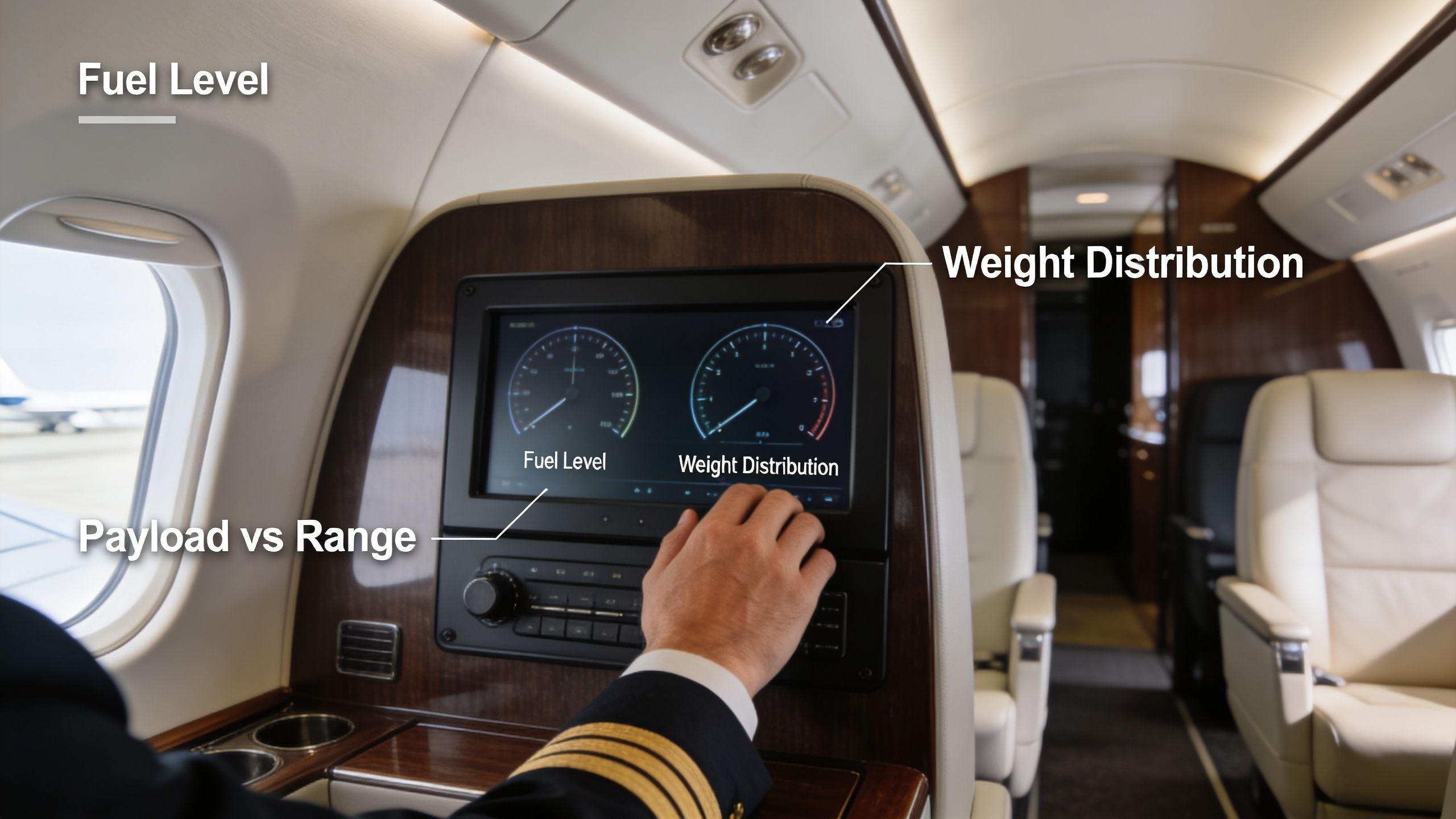
The Citation X+ improved this balance over earlier models, but the client takeaway stays the same. Better performance helps. It does not erase the payload-range tradeoff. A jet still has to stay within its operating limits, and dispatch still has to protect reserves.
A simple way to view the tradeoff
A hiker with a lighter pack goes farther on the same energy budget. Add more weight, and the distance drops.
Aircraft follow the same logic. More people, more baggage, and more cabin items use up allowable weight that could otherwise support fuel. So if you want the longest practical leg, you usually need a lighter load. If you want to bring more, the nonstop margin shrinks.
That is the point many charter clients miss. Range is not one fixed number attached to the airplane. Range changes with the mission you are asking it to fly.
What changes the mission fastest
Passenger count matters, but it is rarely the only issue. True pressure often comes from everything added around the passengers.
- Baggage adds up fast: Golf clubs, skis, garment bags, and hard cases can change the plan.
- Cabin setup has weight: Catering, special equipment, and pet arrangements all affect the fuel window.
- Operational loading still counts: Crew, supplies, and required reserves are part of the equation on every trip.
Practical rule: If your route is close to the aircraft’s limit, stop treating baggage as an afterthought.
A good broker asks for more than headcount. Haute Jets will want the actual passenger mix, baggage profile, and service requests before calling a trip comfortably nonstop. That is how you book the right aircraft for the mission instead of forcing the mission onto the wrong aircraft.
For a client-friendly explanation of how conditions can further tighten that margin, review how weather affects the private jet travel experience.
Here’s a useful visual primer on how operators and pilots think about the aircraft’s capabilities during planning:
My recommendation on payload-sensitive trips
If a fuel stop would disrupt meetings, family timing, or security planning, build in margin from the start. Do not book around the outer edge of the chart.
Instead, do this:
- Confirm the passenger load early.
- Estimate baggage by type, not just by number of bags.
- Decide whether nonstop certainty matters more than squeezing in extra load.
- Use the Citation X only when it fits the mission with room to spare.
That is the standard I recommend to clients. It produces smoother trips, fewer last-minute surprises, and better aircraft decisions through Haute Jets.
How Weather and Routing Impact Your Flight
Even if the payload is perfect, the outside environment still gets a vote.
The biggest variable is wind. A strong headwind can cut effective range because the aircraft burns fuel while making slower progress over the ground. A favorable tailwind can do the opposite and make the same aircraft feel much more capable on the same city pair in the opposite direction.
That’s why outbound and return legs don’t always behave the same way, even when the passenger list is identical.
Wind changes the math fast
Clients often think in miles flown. Operators think in fuel required to complete the mission with reserves.
If the aircraft is flying into a strong headwind, it may still perform exactly as designed, but it will cover the route less efficiently. If ATC also issues a longer routing, the margin tightens further. That’s how a trip that looked clean on paper can move closer to a technical stop in real dispatch planning.
A nonstop trip isn’t determined by distance alone. It’s determined by distance, winds, routing, and reserve requirements together.
For a more client-friendly look at this side of the trip, how weather affects the private jet travel experience is worth reviewing before you lock in a mission-critical departure.
Routing is rarely a perfect straight line
Another common misconception is that the map distance is the flight distance. It often isn’t.
Air Traffic Control may route the aircraft around congestion, weather cells, or flow restrictions. Those deviations can be minor. They can also materially change the trip. The effect is especially noticeable on days when traffic is dense or convective weather is active around major metro corridors.
Here’s how I advise clients to think about routing risk:
- Short domestic legs: Usually forgiving.
- Long domestic legs near the edge of planning assumptions: Less forgiving.
- Time-critical itineraries: Need more margin, not less.
Reserve fuel isn’t optional
Clients sometimes ask why an aircraft with an impressive published range can’t “top off and go.” The answer is reserve planning.
Professional flight planning includes the fuel needed not just for the filed route, but also for the operational contingencies required for safe dispatch. That means some fuel capacity is effectively spoken for before the trip even begins. You should want that. It’s not inefficiency. It’s disciplined aviation.
If your trip matters, don’t demand heroic planning. Demand prudent planning.
Citation X Missions and Competitor Snapshot
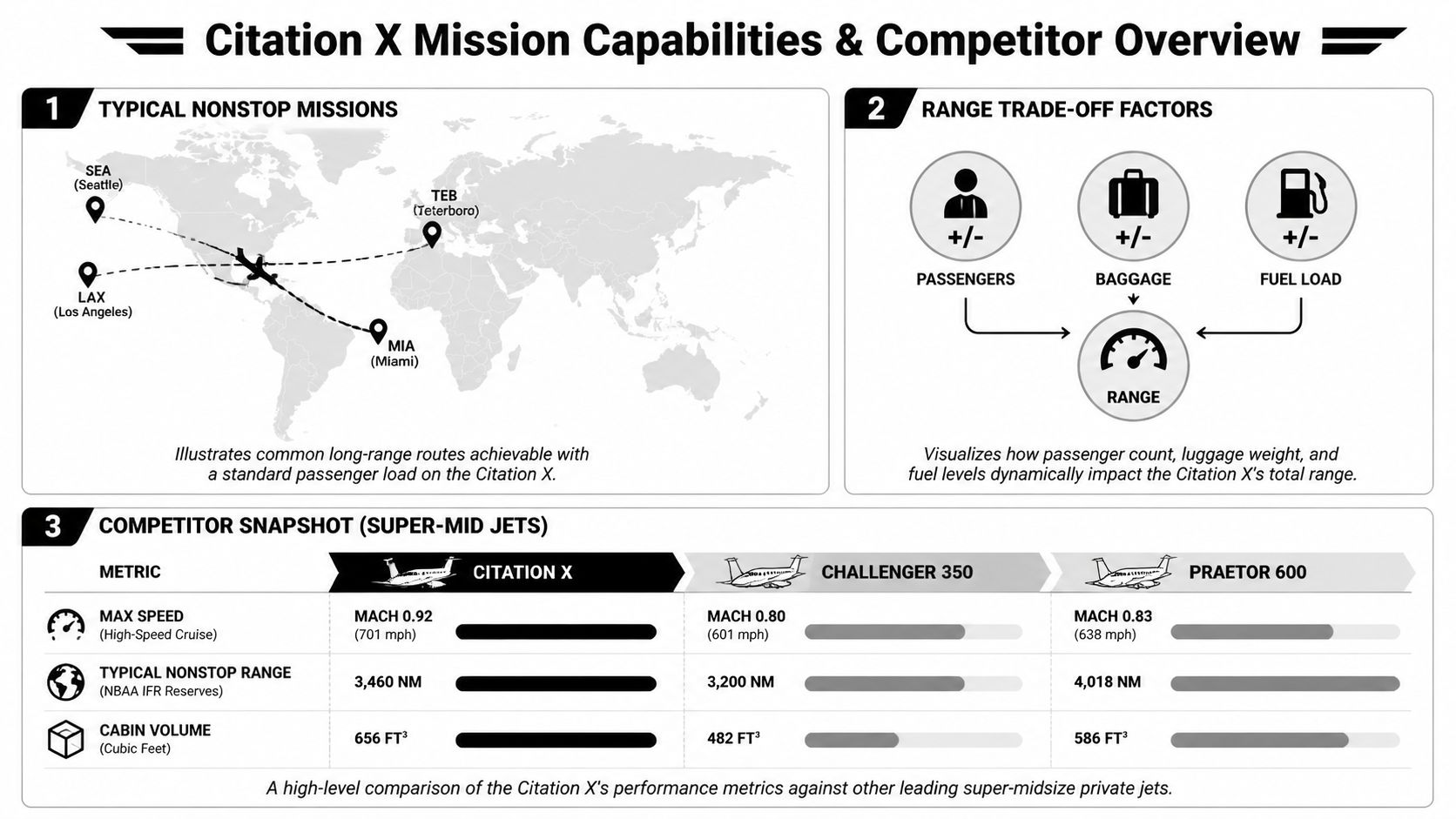
You are leaving Teterboro after a full day of meetings and need to be in Los Angeles tonight, not after an extra fuel stop or a slower cross-country leg. That is the kind of mission where the Citation X earns its place. It gives charter clients real time savings on long domestic routes, provided the payload, winds, and routing still support the plan.
That last point matters. A published range figure gets the aircraft onto the shortlist. It does not confirm the trip.
For U.S. missions, the Citation X is at its best on coast-to-coast and other long domestic sectors where speed has clear value. You are buying shorter block times and a serious performance edge over many midsize and super-midsize options. If the trip is transcontinental, passenger count is moderate, and baggage is reasonable, the aircraft often fits well.
For transatlantic work, I advise more caution. The airplane may handle some city pairs under favorable conditions, but this is not the aircraft I would force onto a mission that needs broad nonstop margin with a fuller cabin and fewer planning constraints. If certainty matters more than outright speed, step up to a jet with more range cushion.
Where it wins and where others may fit better
My advice is straightforward.
- Choose the Citation X+ for long domestic missions where arrival time matters and you want one of the fastest cabins in this class.
- Choose a Challenger 350 when cabin comfort, baggage flexibility, and a broader comfort zone on typical business missions matter more than shaving every possible minute.
- Choose a Gulfstream G280 when the route pushes farther and you want more range margin without moving into a much larger aircraft category.
That is how proper aircraft matching works in charter. The best jet is the one that fits the mission cleanly on the day you are flying.
Super-Midsize Jet Comparison
| Aircraft | Max Range | High-Speed Cruise | Cabin Height | Typical Charter Cost/Hr |
|---|---|---|---|---|
| Citation X+ | 3,460 nm | 527 ktas | 5 ft 8 in | $6,500 to $8,500 |
| Challenger 350 | 3,200 nm | 470 ktas | 6 ft 1 in | $5,500 to $7,500 |
| Gulfstream G280 | 3,600 nm | 482 ktas | 6 ft 3 in | $7,000 to $9,000 |
The table gives you the practical tradeoff. The Citation X+ is the speed leader. The Challenger 350 gives up cruise speed but offers a more spacious cabin feel. The G280 gives you stronger range coverage with a larger-cabin experience, though usually at a higher hourly rate.
My practical advice on choosing against competitors
If your trip is a nonstop domestic mission and every minute has value, the Citation X remains a serious charter tool. If your passengers care more about cabin comfort, or your route sits near the edge of what the airplane can do cleanly under real operating conditions, another aircraft is the better buy.
That is why smart clients do not book from a brochure line. They book from the mission. Haute Jets helps you do exactly that through a disciplined private jet booking process with real aircraft matching.
Speed is the Citation X's selling point. Mission margin decides whether it is the right answer.
Booking the Right Jet for Your Mission with Haute Jets
The right aircraft decision rarely comes from one line on a spec sheet. It comes from matching the mission to the airplane without forcing the airplane to do a job it only might complete under ideal conditions.
That’s the main lesson behind the range of citation x. The published number is real. It’s also conditional. Once you add passengers, luggage, winds, routing, and reserve requirements, the conversation shifts from marketing range to usable range. That’s where experienced charter advice matters.

What smart booking looks like
A disciplined booking process should answer five questions before the aircraft is confirmed:
- What is the actual passenger count?
- How much baggage is really traveling?
- Is the route weather-sensitive on the day?
- Would a technical stop be acceptable if conditions shift?
- Is the client buying speed, cabin comfort, or extra range margin?
Those questions sound basic. They aren’t. They prevent the most common charter mismatch, which is selecting a jet for its headline number rather than its real-world fit.
Why the sourcing model matters
The best charter outcome comes from having real aircraft choice, not from trying to force every trip into the same fleet logic. That’s why on-demand sourcing is so useful for discerning travelers.
Haute Jets sources from 3,500+ aircraft across 175 countries, using only Wyvern Wingman or ARGUS Gold/Platinum-rated operators, and its local sourcing approach helps avoid the 20-40% repositioning fees that can inflate traditional charter pricing (how booking works with Haute Jets). That model matters because some trips call for a Citation X, while others call for a larger cabin, different runway profile, or more range margin.
The best advice I can give is simple. Don’t ask, “What’s the biggest range number I can buy?” Ask, “What’s the right aircraft for this exact trip?”
That’s how professionals book private aviation.
If you want a precise answer for your route, Haute Jets can match your passenger load, baggage profile, and schedule to the right aircraft without locking you into a membership or jet card. Request a trip review, and get the exact jet that fits the mission, whether that’s a Citation X for speed or another aircraft with more cabin or range margin.