You're likely dealing with the same question every time LAX appears on your itinerary. How early do you need to arrive, where will friction happen, and what's the smartest way to stay moving without sacrificing privacy?
That's the right question. Security at LAX airport isn't one line and one checkpoint. It's a chain of controlled spaces, staff decisions, access rules, screening protocols, and timing windows. If you treat it casually, LAX will waste your time. If you treat it like an operation, it becomes manageable.
For readers of Haute Jets Journal, the true distinction isn't just between domestic and international. It's between two very different pathways: the public terminal experience for commercial VIPs, and the private-entry experience used by charter clients and high-profile travelers who don't want exposure, congestion, or improvisation.
Navigating LAX A Masterclass in Efficiency
LAX rewards preparation and punishes assumptions. It handled 76,587,980 passengers in 2024 according to the Los Angeles International Airport overview, which is why the airport often feels less like a terminal and more like a city under pressure.
That scale matters. A minor delay at curbside, a secondary screening check, or a poorly timed arrival can ripple fast when you're moving through one of the world's busiest airports. The old habit of “I'll get there and figure it out” doesn't work here.
What efficient travelers do differently
They make three decisions before leaving for the airport:
Choose the right pathway
Commercial first class, PS, and private jet access are not interchangeable. They produce very different security experiences.Control arrival timing
Too early can create unnecessary waiting. Too late compresses every security variable into a bad gamble.Reduce checkpoint friction
Clean documentation, disciplined baggage, and a realistic view of terminal access save more time than last-minute scrambling.
Practical rule: At LAX, speed comes from reducing variables, not from walking faster once you arrive.
Most airport guides speak to the average traveler. That's not useful if your time has a hard value, your profile draws attention, or your schedule can't absorb terminal chaos. You need a sharper framework. Commercial travelers need to know how to move through TSA with the least resistance. Private clients need to know how to stay outside that system as much as possible.
The rest of the equation starts with a simple truth. Security at LAX begins well before the X-ray belt.
Understanding the Layers of LAX Security
TSA officers aren't the first step in airport security, though it often seems that way when you show your ID. At LAX, that checkpoint comes late in the process. The effective model is layered. You move through perimeter control, terminal access control, and only then passenger screening.
LAX operates under a layered access model where the airport is technically closed to the general public around the clock, with access tied to terminal-specific operations under LAWA's LAX rules and regulations. That matters because open public access is not the default condition. Controlled access is.
Perimeter first
The first security layer is outside the checkpoint lane. Vehicles, curbs, service roads, access doors, restricted corridors, and badge-controlled staff points all sit inside the airport's wider control environment.
That's why some disruptions feel invisible to the average traveler until they suddenly aren't. Extra patrols or access restrictions may affect approach routes, curbside drop-off behavior, or terminal entry rhythms before they affect TSA lines.
Terminal entry is part of the security system
Terminal access is not just a convenience issue. It's a control issue. If access windows narrow, staffing shifts, or terminal doors are monitored more aggressively, passengers and crews can hit delays before screening even begins.
For commercial VIPs, this means your driver, assistant, or protection detail needs a cleaner handoff plan. Don't assume you can linger curbside, reorganize bags, or sort credentials on the sidewalk. LAX is built to keep people moving and to reduce uncontrolled traffic.
For travelers who are especially sensitive about legal or identity complications, a practical primer on airport warrant enforcement gives useful context on how airport screening and law enforcement concerns can intersect. Read it before you travel, not after a problem starts.
Screening is only one layer
Once you understand the system, the checkpoint line stops feeling random. It's the most visible layer in a broader structure that includes monitored doors, intrusion controls, and restricted movement zones. That's also why insider risk remains part of the airport's security conversation. Physical security at an airport this large depends on people, credentials, doors, and timing working together.
If you want a broader private aviation perspective on operator vetting and travel risk, review Haute Jets safety standards before you decide how you want to move through Los Angeles.
Security at LAX airport is designed to filter access in stages. Travelers who respect those stages move faster and attract less attention.
The Commercial Traveler Pathway TSA CLEAR and PreCheck
If you're flying commercial through LAX, your objective is simple. Spend as little time as possible in the public terminal while staying fully compliant. That means building your screening strategy around the tools that change throughput.
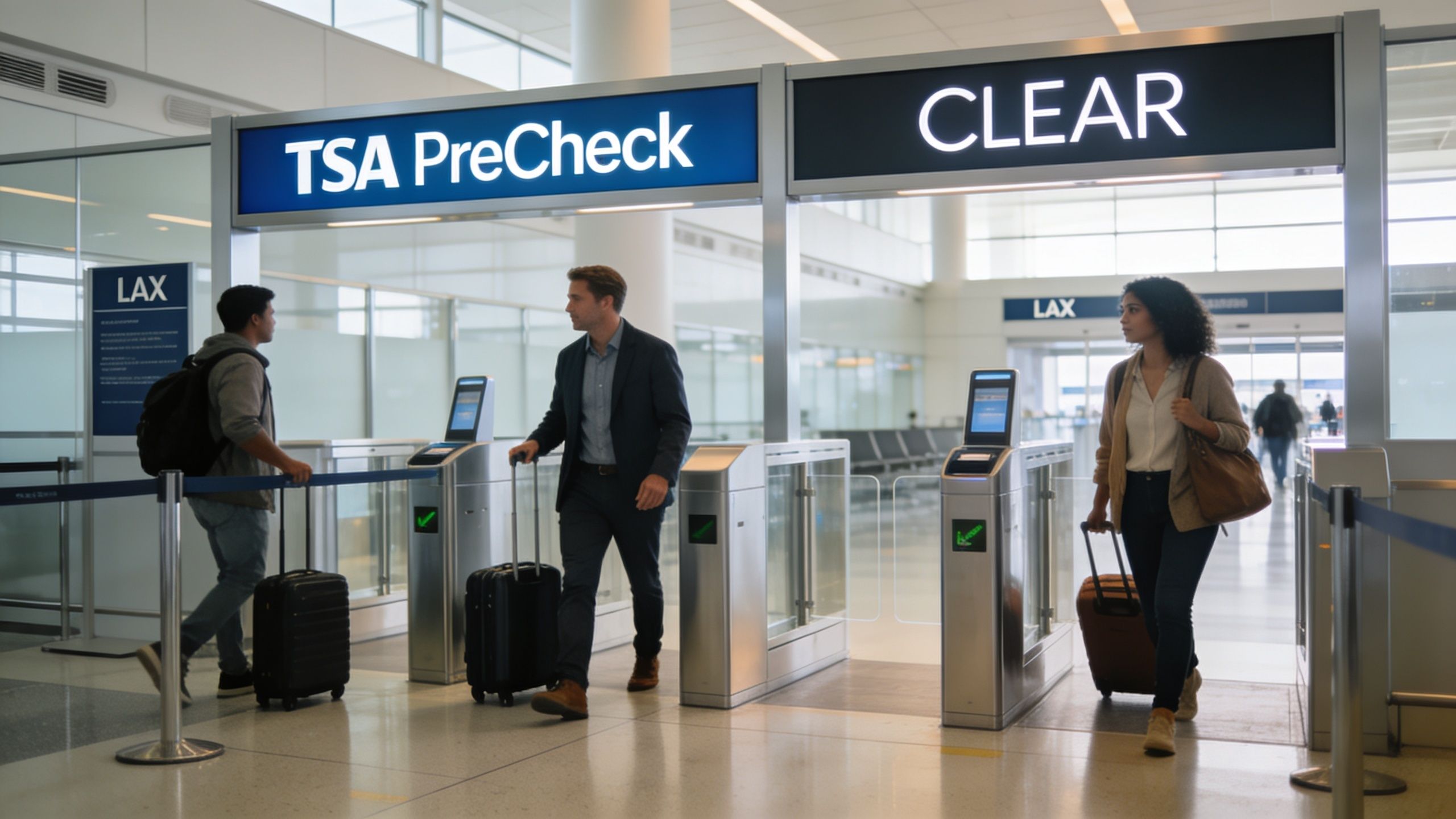
At the Tom Bradley International Terminal, TSA PreCheck was listed at 1 minute while general boarding was 5 minutes on the FlyLAX wait times page when captured. That's enough to make the point. Trusted traveler status isn't a luxury at LAX. It's a time-control tool.
Standard screening is the baseline, not the strategy
The default commercial process is straightforward. Show ID, present your boarding credentials, send your property through screening, and comply with officer instructions. The problem is that the baseline lane exposes you to the widest range of traveler behavior: oversized carry-ons, disorganized trays, alarms, repacking delays, and people who start preparing only when they reach the conveyor.
That line works. It just doesn't respect your time.
Why PreCheck changes the experience
TSA PreCheck lowers friction because the lane is designed for lower-disruption screening. The practical benefit is obvious. Fewer removals, fewer tray complications, and less stop-start movement.
Use PreCheck if your profile allows it. At a place like LAX, the benefit is operational, not theoretical. Less handling means fewer opportunities for delay, lost tempo, and unnecessary exposure in a crowded lane.
If you fly commercial from LAX more than occasionally, not having PreCheck is a self-inflicted problem.
Where CLEAR fits
CLEAR addresses a different bottleneck. It helps move you through identity verification faster, then hands you off to the physical screening process. Used alone, it helps. Used with PreCheck, it creates a cleaner path because you accelerate both the document-check phase and the screening-lane phase.
That's the combination I recommend for executives, talent, family-office principals, and anyone who values predictability. It doesn't eliminate airport friction, but it removes a large portion of avoidable waiting.
If you're traveling with a pet, don't improvise at the lane. Review these airline rules for traveling with animals before departure so your carrier setup and handling process don't trigger preventable delays.
A quick walkthrough can help if you haven't used these lanes recently.
My recommendation for commercial VIPs
Use this hierarchy:
- Best public-terminal option: CLEAR plus TSA PreCheck
- Strong fallback: TSA PreCheck alone
- Baseline only: Standard screening, with disciplined packing and early arrival
If privacy matters, pair that with a curbside plan. Arrive ready. Keep luggage simple. Don't sort electronics, cosmetics, gifts, or chargers in public view. The goal is to pass through security at LAX airport with minimal handling and minimal spectacle.
The Private Aviation Advantage FBO and PS Terminal Security
The public terminal is designed for throughput. Private aviation is designed for control. That distinction changes everything about security, privacy, and timing at LAX.
For high-net-worth travelers, there are usually two serious alternatives to the standard terminal path. One is PS at LAX, which serves commercial passengers who want a private-terminal experience. The other is the FBO route, used by private jet clients departing on charter or owner flights.
What changes when you use PS
PS is for travelers flying commercial who want to avoid the standard terminal experience as much as possible. You still undergo legitimate security processing, but in a far more controlled environment. Less crowding. Less public exposure. Less curbside noise.
That makes PS useful for entertainment clients, public figures, family travelers, and executives who don't want to stand in visible premium-cabin lines despite flying a scheduled airline.
What changes when you use an FBO
The FBO pathway is different in kind, not just degree. You arrive at a private aviation facility, not a commercial terminal. Ground handling is pre-coordinated. Passenger movement is tightly managed. Screening and identity checks happen within a private workflow rather than a mass-public one.
That is the true private aviation security advantage. It replaces congestion with sequencing.
If you're evaluating departure options in the Los Angeles area, this guide to flying private in LA and considering Van Nuys Airport is worth reading because airport choice often matters as much as aircraft choice.
LAX Security Pathways Compared
| Feature | Commercial (First/Business) | PS at LAX (Private Suite) | Private Jet (FBO) |
|---|---|---|---|
| Arrival environment | Public terminal curbside | Private terminal entrance | Private aviation facility |
| Security setting | Standard airport checkpoint flow | Dedicated private-terminal process | Controlled private-flight workflow |
| Privacy level | Limited | High | Very high |
| Exposure to crowds | Constant | Reduced | Minimal |
| Baggage handling feel | Public and procedural | More discreet | Direct and coordinated |
| Ground coordination | Passenger-managed or assistant-managed | Concierge-style | Pre-arranged with operator or broker |
| Best for | Cost-conscious premium flyer | Commercial passenger who wants privacy | Traveler prioritizing control, speed, and discretion |
The recommendation I give clients
If you're flying commercial and need privacy, use PS. If you're flying private, use the FBO route and keep every touchpoint pre-coordinated, including driver timing, credentials, and passenger sequence.
One practical option in that second category is Haute Jets, which arranges on-demand private charter and coordinates the operating environment around the aircraft rather than forcing the traveler through the public terminal model. That's the key benefit. Not glamor. Control.
The cleanest security experience at LAX is the one that keeps you out of the main terminal in the first place.
International Travel Customs and Border Protection at LAX
International travel adds a second bureaucracy to the airport experience. You're no longer dealing only with airport security. You're dealing with border control, identity review, baggage reclaim, and customs clearance.
That's where many otherwise efficient travelers lose momentum. They prepare for departure but not for arrival.
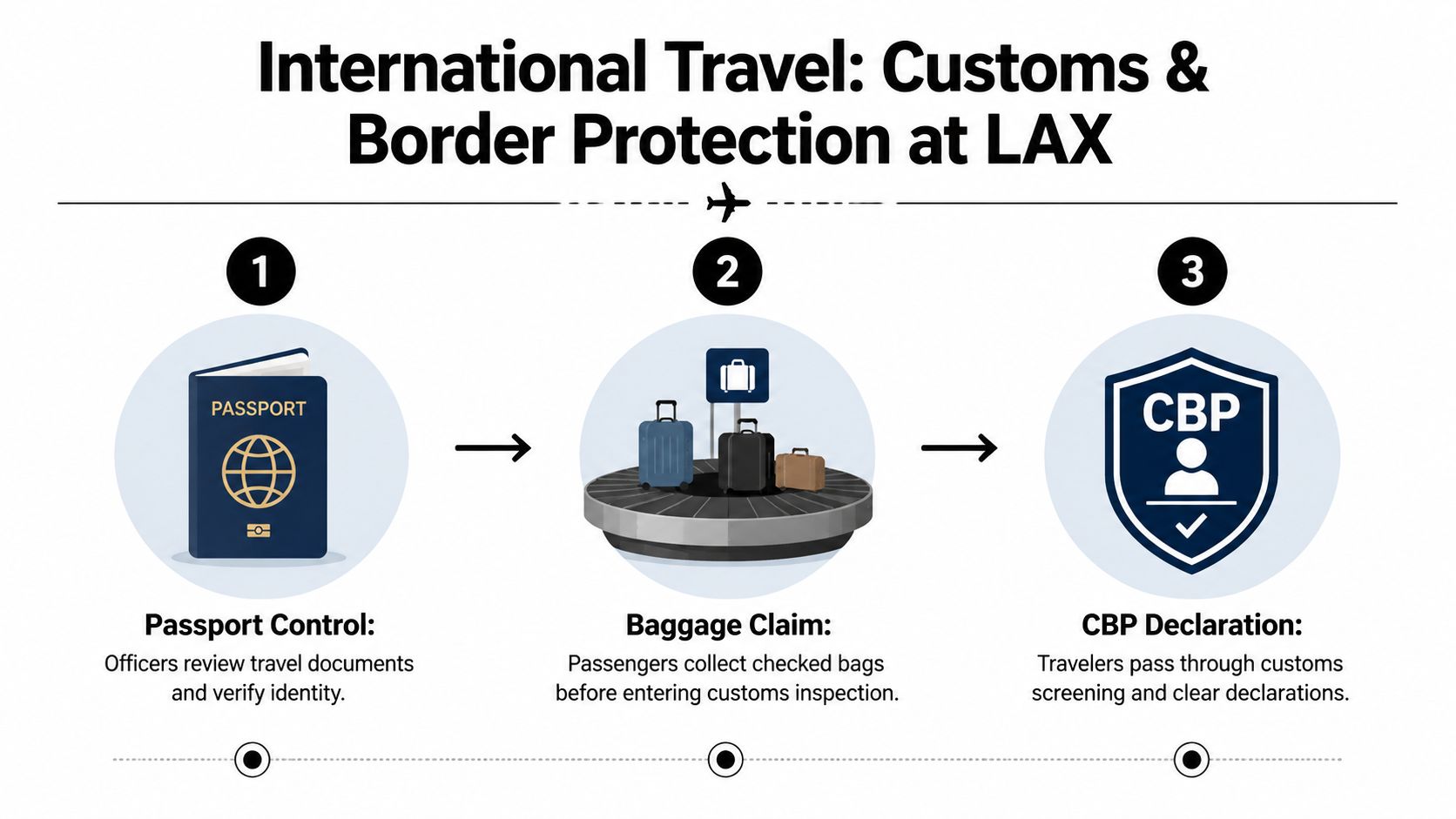
The commercial international arrival sequence
At a high level, the process is familiar:
Passport control
Officers review your identity and travel documents.Baggage claim
If you checked bags, you usually retrieve them before customs inspection.Customs clearance
You complete the declaration process and clear the inspection point.
That sounds routine because it is. The issue is volume, queue management, and traveler readiness. If your passport, declarations, onward details, or baggage plan are sloppy, the process slows immediately.
The tools that save time
For eligible travelers, Global Entry is usually the strongest move because it compresses the immigration side of the process. Mobile Passport Control can also help by reducing paperwork friction and improving your line choice.
My advice is blunt. If you travel internationally with any regularity and still rely on standard immigration lines by default, you're leaving time on the table.
International arrivals punish indecision. Have your passport accessible, your declarations settled, and your transportation plan confirmed before you land.
How private jet arrivals differ
Private arrivals can feel substantially more controlled because customs processing often happens in an environment specific to the flight's handling plan. That doesn't mean you bypass border formalities. It means the experience is usually cleaner, quieter, and less exposed than the main-arrivals hall.
The key variable is coordination. Manifest accuracy, passenger documentation, ground handling, and timing all matter. If one detail is wrong, private convenience disappears fast.
For a more detailed private-flight perspective, review the customs and immigration process when flying overseas in a private jet. It's the right reference if you're comparing international commercial travel against charter.
Departure matters too
Departing internationally from LAX is usually simpler than arriving, but that's no excuse to relax your standards. Passport validity, visa requirements, and airline-specific document review still create delay points. Handle document checks before you leave for the airport, not at the counter.
At LAX, border formalities aren't hard. They're just unforgiving when you arrive unprepared.
Actionable Timelines and VIP Protocols
Your driver reaches the terminal on time, then loses ten minutes in the wrong lane. Your assistant starts digging for IDs at the curb. A checked bag triggers a counter stop you should have handled an hour earlier. That is how LAX gets expensive.
At this stage, execution matters more than intention. Commercial VIPs and private jet clients should not use the same timing rule, the same entry plan, or the same exposure posture.
The baseline rules at LAX are straightforward. FlyLAX Smart Traveler Tips states:
- Travelers 18 and older must present valid government-issued photo ID.
- Carry-on limits allow one carry-on and one personal item.
- Some checkpoint locations close overnight, with operating hours varying by terminal.
My timing recommendations
Use the pathway that matches the trip.
Domestic commercial, standard screening Arrive early enough to absorb traffic, curb backups, bag-drop delays, and checkpoint swings. If you are flying at a peak bank and do not have PreCheck or CLEAR, add more time. LAX punishes optimism.
Domestic or international commercial, VIP profile Arrive with enough margin to avoid rushed curbside behavior. That means documents pre-checked, baggage decisions made before departure from the hotel or residence, and a driver instructed on the exact terminal approach. Your goal is not only to clear security. It is to reduce public exposure while doing it.
Private jet through an FBO Follow the operator's call time exactly. This path works because access, crew readiness, catering, ramp movement, and departure sequencing are coordinated in advance. Arrive too early and you sit unnecessarily. Arrive late and you force the entire chain to react.
Scheduled commercial flight through a private terminal program Treat it as a separate product, not a nicer version of the main terminal. Timing, check-in handling, baggage transfer, and screening flow differ from the standard airline experience. Confirm every step in advance.
What to have ready
Do not let paperwork become the delay point.
Bring these ready for immediate use:
Primary ID Keep it on your person, not in a tote, backpack, or assistant's bag.
Passport and visa materials International travelers should keep documents accessible from curb to gate.
Flight and ground confirmations Airline record locator, charter itinerary, vehicle details, and pickup contacts should be retrievable in seconds.
Companion instructions If you are traveling with family, staff, or security, each person should know who carries documents, who handles bags, and who sets the movement pace.
What slows people down
The pattern is usually obvious.
Overpacked cabin bags More items mean more tray handling and more opportunities for secondary review.
Curbside decision-making Reassigning bags, searching for passports, and discussing lounge plans in public wastes time and draws attention.
Mixed leadership A principal, assistant, driver, and security lead cannot all run the movement. Pick one.
Keep the terminal footprint tight. Move with purpose, speak less, and solve problems before the car stops.
VIP protocol for privacy and exposure control
Commercial VIPs need a crowd-management plan. Private jet clients need a coordination plan. The mistake is assuming both problems are the same.
For commercial travel, control the public moments. Pre-assign the entrance, know the checkpoint strategy, use available priority programs, and shorten curb dwell time. If media attention, celebrity visibility, or active security concerns are in play, avoid improvisation entirely. The public terminal is where exposure happens.
For private aviation, the pressure point shifts. You are not managing a TSA queue in the same way. You are managing sequence integrity. That means exact arrival timing, correct manifest details, baggage coordination, ramp-side readiness, and a driver who knows the correct FBO access point. Privacy is usually stronger on this side of LAX, but only if the trip is tightly run.
Use a disciplined protocol:
Lock the route before departure Confirm terminal or FBO, vehicle approach, drop point, and escort responsibilities.
Assign one lead One person controls movement. Everyone else supports it.
Cut curb time Exit, transfer bags, and move. Do not sort belongings in public view.
Keep documents in hand Security friction increases fast when IDs and confirmations are scattered across multiple people.
Match the protocol to the pathway Commercial clients need speed through public space. Private clients need precision around access and timing.
Security at LAX airport is manageable when the route fits the traveler. Commercial VIPs should focus on reducing exposure inside a crowded system. Private jet clients should focus on disciplined coordination that keeps the controlled environment working in their favor.
The Haute Jets Standard Security Through Service
A rushed arrival at LAX exposes every weak point at once. The wrong curb, a missing ID, an unbriefed driver, a terminal change no one caught. Security problems usually start before the checkpoint.
That is the standard behind Haute Jets. Treat security as an operations function, not a screening moment. The objective is simple: keep exposure low, keep movement tight, and keep decisions off the curb.
For commercial VIP travel, service means controlling the handoff points that create delays and attention. Booking the right terminal, setting the drop location in advance, confirming escort responsibilities, and keeping documents immediately available matter more than any last-minute scramble in front of a crowded entrance. For private jet clients, the service standard is tighter. The team should already have the manifest confirmed, the FBO access point locked, baggage flow assigned, and ground transportation timed to the minute.
The difference is not luxury. It is control.
Prepared clients move through LAX with fewer public pauses, fewer avoidable conversations, and fewer opportunities for a routine airport process to become a visible problem. During higher-alert periods, as noted earlier, that discipline matters even more.
If you want an LAX travel plan built around privacy, precise timing, and direct aircraft access, Haute Jets can help coordinate the flight and ground-side details so you spend less time in public terminals and more time moving on schedule.