
Pre-owned Sikorsky S-76 helicopters average about $5,150,000, with the market stretching from $1.0 million for an older 1997 S-76B to late-model examples above $6.8 million, while charter typically runs $4,000 to $6,000 per hour. If you're shopping for a new one, you're already too late. The S-76D was the final production model, and new production has ceased.
That last point is what most price guides still miss. The Sikorsky S-76 isn't just a helicopter with a sticker price anymore. In 2026, it's a finite asset class, especially if you want a clean VIP configuration, current equipment, and immediate availability. On Haute Jets Journal, that matters more than recycled list prices because a buyer today isn't comparing brochures. A buyer is competing for a shrinking pool of aircraft.
Understanding the Sikorsky S-76 Price Spectrum
More than 880 S-76 helicopters were built worldwide. That sounds abundant until you narrow the field to VIP-configured aircraft with current avionics, clean pedigrees, and immediate availability. In 2026, that subset is tight, and scarcity is doing more to shape Sikorsky S-76 pricing than any old factory list ever did.
That is the first point serious buyers need to understand. The S-76 no longer trades like a current-production helicopter. It trades like a limited pool of usable assets, and the best examples carry a post-production scarcity premium that static price guides routinely miss.
Three pricing lanes matter.
The first is older pre-owned inventory, where attractive asking prices can hide expensive catch-up work on interiors, avionics, records, or maintenance status. The second is premium pre-owned inventory, which is where most VIP buyers should focus if they want a helicopter they can place into service without a long retrofit cycle. The third is charter, which remains the cleanest option for clients who want S-76 capability without tying up capital or taking maintenance risk.
What buyers and charter clients should expect
Use this framework before you look at any asking price:
- Entry-level pre-owned aircraft: Lower-priced S-76s exist, but they are rarely bargains once you account for refurbishment, compliance work, and downtime. Buy these only if you have a very specific operating plan and patience for post-closing expense.
- VIP-ready pre-owned aircraft: This is the strongest part of the market for private buyers. A clean, later-model, well-equipped S-76 with a desirable cabin and current equipment commands a premium because it saves time, reduces launch friction, and is easier to insure, maintain, and resell.
- Last-run S-76D benchmark: Historical factory pricing still matters as background, but it no longer sets the market. Production ended, so buyers are now paying for condition, configuration, and availability, not for a place in a manufacturing queue.
- Charter access: Charter rates remain the practical benchmark for clients who fly selectively or want immediate lift without ownership overhead.
Helicopter pricing also needs to be judged differently from fixed-wing pricing. The mission value is point-to-point access, schedule control, and time saved on the ground. The cost structure is heavier on maintenance planning, parts strategy, and operator discipline. If you want a broader benchmark for that, this overview of understanding private aviation expenses is useful because it frames why access cost and ownership cost are two different decisions.
My advice is simple. Do not shop the S-76 by headline price alone. In 2026, the premium is placed on aircraft that are VIP-configured, properly documented, and ready to work now. Those are the units the market chases, and they do not trade at average-market logic.
Broker view: Pay for readiness, pedigree, and configuration. Cheap S-76s get expensive fast. The right one usually looks expensive before closing and cheaper after a year of operation.
Purchase Price New vs Pre-Owned Models
Only a handful of S-76Ds were delivered at the end of the production run. That matters more in 2026 than any old factory list price.
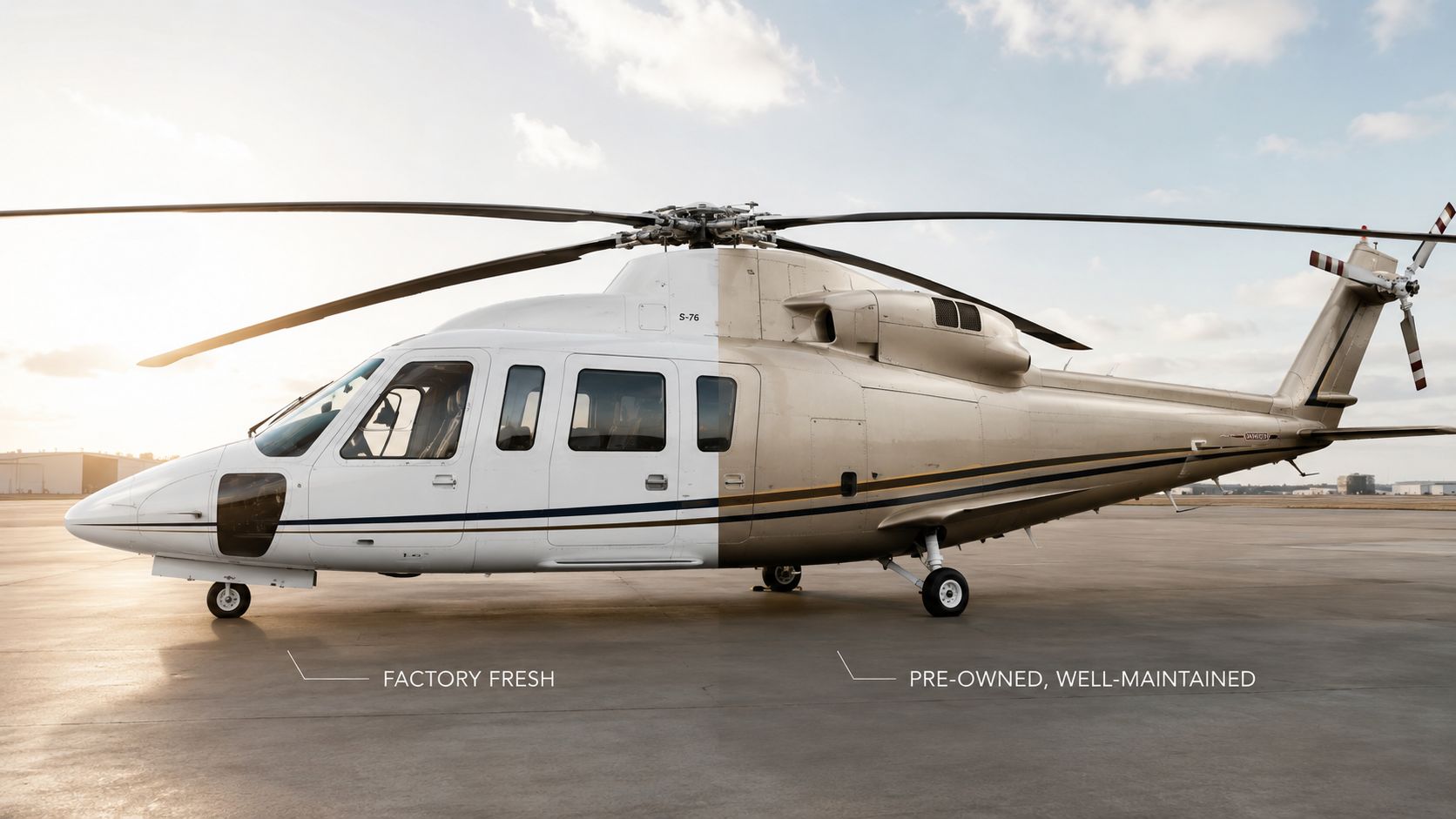
The phrase "new Sikorsky S-76" now describes an almost-new, low-time aircraft from the final run, not a helicopter you can order from an active production line. For a buyer, that changes the deal completely. You are competing for a finite pool of aircraft, and VIP-configured examples carry a scarcity premium that static price guides usually miss.
What "new" meant and why it matters less now
Factory-new pricing still serves as background, especially for the last-run S-76D. It no longer sets the buy-side market. Production ceased, so buyers are no longer comparing fresh delivery positions. They are comparing maintenance posture, cabin quality, avionics standard, records, and how quickly the aircraft can enter service.
That shift has real consequences. A low-time late-production aircraft with an executive interior can command a strong premium because it saves months of sourcing, refurbishment, and certification work. Buyers paying top dollar are usually buying time and certainty.
The Pre-Owned Market Picture
Pre-owned inventory is the market. The useful comparison is not "new versus used." It is "ready now versus project aircraft."
That is why two S-76s that look similar in a search result can trade very differently. One may be an older airframe with deferred upgrades, limited pedigree, and a cabin that needs money. Another may already be configured for VIP transport, have cleaner records, and fit into an operator's certificate with less friction. In 2026, that second aircraft is where the premium sits.
If your mission overlaps with medical, offshore, or utility work, the buying logic changes again because mission fit drives equipment and certification priorities. This guide to air ambulance options is a useful reminder that rotary-wing value follows mission first, not age alone.
My recommendation on where to shop
I divide buyers into three groups.
- Budget-first buyers: Shop older aircraft only if you already have technical support lined up and cash reserved for catch-up work. The low entry number is rarely the final number.
- Value-focused buyers: Target well-kept mid-to-late production examples with solid records and a usable cabin. This is usually the smartest part of the market.
- VIP buyers: Pay up for the right interior, clean history, and immediate availability. Post-production scarcity has pushed a premium onto these aircraft, and fighting that reality usually wastes time.
My advice is blunt. Do not chase the cheapest S-76 on the board, and do not overpay for glossy cosmetics with weak paperwork. In this market, the best buy is the aircraft that can start flying your mission quickly, pass scrutiny cleanly, and avoid a six-figure surprise after closing.
Buy the aircraft that is ready to earn or ready to carry you. Everything else is a refurbishment project dressed up as a deal.
Key Factors That Determine Helicopter Value
Two Sikorsky S-76 helicopters can share a model year and still trade at very different numbers. Buyers who focus only on the ask price usually miss the expensive part of the deal. True value sits in equipment, maintenance position, and cabin usefulness.
Avionics and mission capability
A helicopter with dated avionics may look acceptable on paper and still be the wrong buy. Operators and pilots care about usability, reliability, and how painful the upgrade path will be. A cleaner panel with a modern glass-cockpit feel tends to support value because it reduces friction for both operation and resale.
Mission equipment matters just as much. Floats, VIP equipment, offshore capability, and specialized certification can change the aircraft's appeal dramatically. A well-sorted executive transport aircraft isn't interchangeable with a utility layout just because both wear S-76 badges.
If your use case overlaps with medical transport, offshore support, or other specialized rotary-wing missions, this guide to air ambulance options gives a useful sense of how mission profile changes aircraft selection and value logic.
Engines, time, and maintenance posture
Engine condition is where inexperienced buyers get punished. Total time on airframe, remaining life on major components, and the timing of scheduled events all shape the purchase price. The right question isn't "How much is it?" It's "What am I buying myself into over the next ownership cycle?"
Use this checklist during evaluation:
- Engine status: Ask for clear visibility into overhaul position and maintenance reserves.
- Airframe time: Higher time isn't automatically bad, but deferred maintenance and weak records are.
- Inspection calendar: A lower asking price can mean a major maintenance event is close.
- Damage history: Minor history isn't always a deal-breaker. Poor disclosure is.
A discounted helicopter with ugly maintenance timing isn't a bargain. It's prepaid downtime.
Interior and presentation
VIP buyers often underestimate how much the interior drives value. Leather, soundproofing, seating layout, and executive finish affect not only comfort but also marketability. A standard transport cabin may work operationally, but it won't command the same attention as a bespoke VIP interior.
Three aircraft can all be "flyable" and still appeal to different buyers:
- Utility layout: Practical, harder to position as premium.
- Corporate transport cabin: Better balance of mission flexibility and resale.
- Full VIP presentation: Narrower audience, but stronger appeal when done correctly.
Condition counts here in a simple way. A tired cabin tells every future buyer that corners may have been cut elsewhere.
The True Cost of Ownership Operating and Maintenance
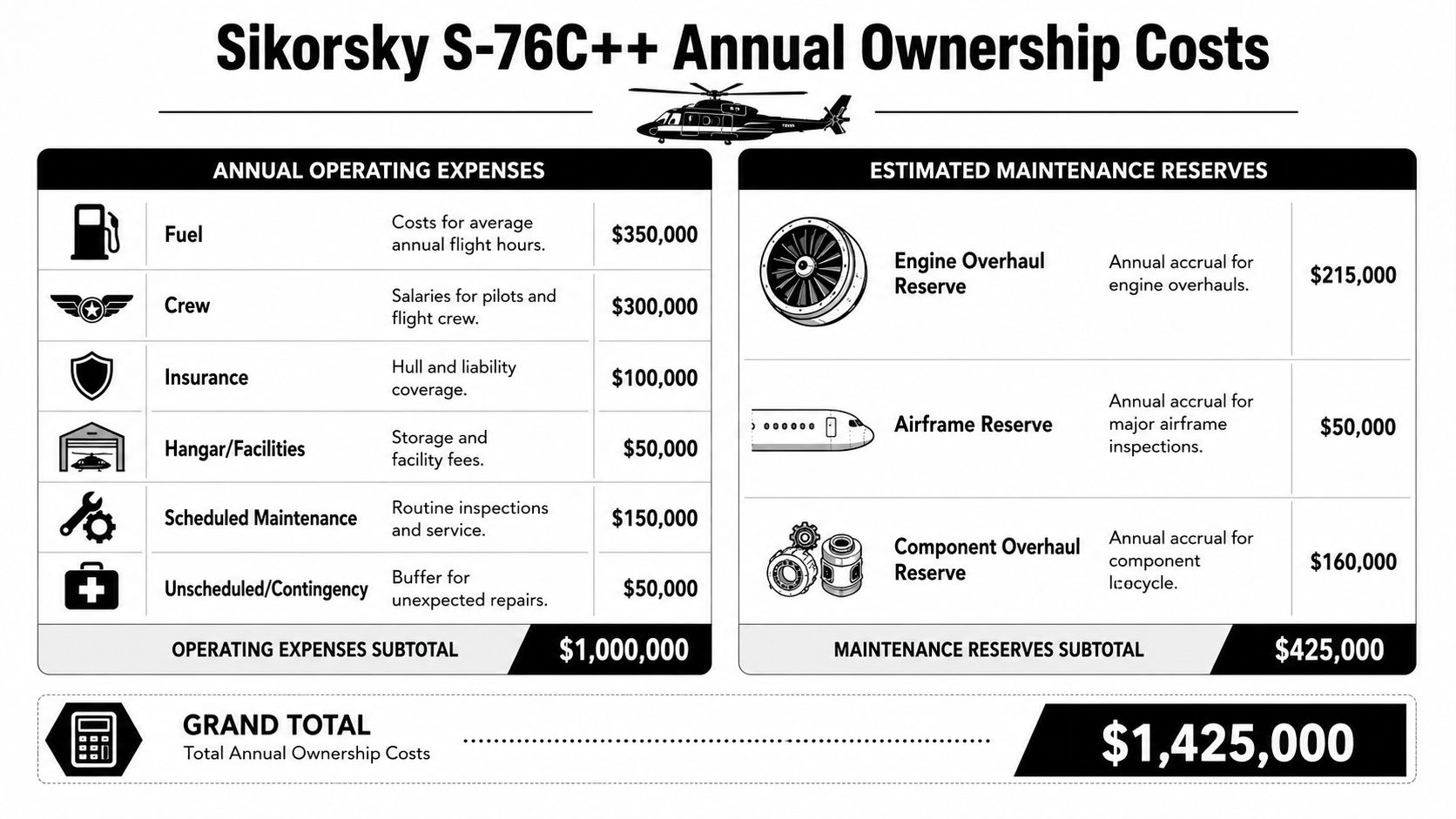
Buying the helicopter is the easy part. Keeping it in service is where discipline matters. If you own an S-76 without a realistic annual budget, you'll end up reacting to maintenance instead of managing it.
What the annual budget actually looks like
For a pre-owned S-76C++ flown 300 hours annually, total variable costs can reach $766,175, while fixed costs add $726,198. That produces a total annual ownership budget of about $1.49 million, or $4,975 per flight hour (detailed owner cost breakdown).
That figure is the one serious buyers should care about. Acquisition gets headlines. Total cost decides whether ownership was smart.
Fixed costs vs variable costs
You should think about S-76 ownership in two buckets.
| Cost bucket | Verified annual figure |
|---|---|
| Variable costs | $766,175 |
| Fixed costs | $726,198 |
| Total annual budget | About $1.49 million |
| Owner cost per flight hour | $4,975 |
Fixed costs stay with you whether the helicopter flies or not. Variable costs rise with utilization, but they don't disappear just because you try to economize for a quarter.
The maintenance side deserves special attention. If you need a refresher on how operators manage inspections, component support, and overhaul planning, this Haute Jets Journal piece on what MRO means in aviation and why it matters for flight safety is worth reading before you buy.
What owners usually underestimate
Most first-time helicopter owners don't underestimate fuel. They underestimate management burden.
Here's where owners get caught:
- Crew oversight: Even if the aircraft can be operated with one pilot in some configurations, ownership still requires disciplined staffing and scheduling.
- Downtime risk: A helicopter that is technically owned but unavailable isn't serving your mission.
- Parts and support: Pre-owned aircraft often look economical until support timing starts disrupting your calendar.
- Capital lockup: The purchase price is only the first check. The annual burn is what tests commitment.
Practical rule: If you don't have repeat demand and internal tolerance for aviation management, don't romanticize ownership.
Sikorsky S-76 Charter Rates Explained
A single hour in an S-76 can cost several thousand dollars on charter. That sounds expensive until you compare it with tying up capital in a post-production aircraft that may sit idle between trips. In 2026, that trade-off matters more because the best VIP-configured S-76s carry a scarcity premium that pushes some clients toward charter even when they could afford to buy.
Typical charter pricing
Expect S-76 charter quotes to sit at the upper end of the light to midsize helicopter charter band, with the final number driven by aircraft variant, operator quality, routing, positioning, and local demand. That is the right way to evaluate the rate. A cheap quote on paper often becomes an expensive day once repositioning, waiting time, and access restrictions are added.
For clients comparing trip economics across aircraft categories, this Haute Jets Journal aircraft charter rates guide gives useful context for how charter operators build pricing.
The practical point is simple. Charter pricing buys access, not asset exposure.
What the hourly rate usually covers
A standard S-76 charter quote usually includes the helicopter, flight crew, fuel for the planned mission, and the operator's routine maintenance and readiness burden. You are paying for a ready aircraft and a crewed operation, not just rotor time.
Read the quote carefully before you sign. The items that change the trip cost are usually outside the headline hourly number:
- Positioning flights: If the aircraft has to come to you, you often pay for that repositioning time.
- Crew standby or overnight charges: Common on multi-leg days, late returns, and resort or yacht movements.
- Landing, handling, and airport fees: These vary widely by location.
- Ground transport, catering, and special handling: Small line items add up fast on VIP itineraries.
- Weather and schedule disruption exposure: Helicopter missions are more sensitive to operational changes than many first-time charter clients expect.
Who should charter instead of buy
Charter is the smart choice for clients with irregular demand, seasonal usage, or frequent changes in routing. It is also the better choice if you want S-76 capability without entering a tight acquisition market for premium cabins.
My advice is direct:
- Charter if you fly occasionally, want flexibility, and do not need the same aircraft on standby year-round.
- Buy if the helicopter supports a repeat mission and schedule control has real business value.
- Stay out of the ownership market if you are chasing an S-76 mainly because you like the platform but do not have consistent utilization.
That last point matters in 2026. Since production ended, buying a clean VIP S-76 is no longer just an aviation decision. It is an inventory fight. Charter lets you use the aircraft without paying the post-production scarcity premium attached to the best examples.
Decoding Value Trends and Resale Potential in 2026
The biggest mistake in the current market is treating the Sikorsky S-76 like a normal depreciating aircraft. That view is stale. Production ended, inventory is finite, and premium configurations don't have easy replacements.
The scarcity premium is real
The verified data point that matters most is this: the end of new S-76 production has created a scarcity premium. Official last-run prices sat around $15 million, but mission-ready VIP civil S-76D configurations are now commanding $20 million to $30+ million in the 2026 market because the available inventory is finite (2026 scarcity-premium market view).
That should completely reset how you think about Sikorsky S-76 price. The old list price is no longer the market price for the right aircraft.
Why static pricing guides fail
A static guide usually tells you what the platform used to cost. It doesn't tell you what a buyer will pay today to avoid delay, retrofits, incomplete equipment, or a compromised cabin. In this segment, scarcity is attached to usefulness.
Three things drive this premium qualitatively:
- Finite supply: Production stoppage turned the best aircraft into limited inventory.
- Mission-ready demand: Buyers pay more for aircraft that don't require a long post-purchase cleanup.
- VIP configuration bias: A properly equipped executive S-76D isn't easy to replicate.
The number on the old brochure doesn't matter if the aircraft you actually want no longer has a factory replacement path.
My view on resale potential
I wouldn't tell a client to buy an S-76 purely as an investment. That's not disciplined aviation advice. I would tell a client that premium, turnkey, VIP-configured examples are likely to behave differently from ordinary used helicopters because replacement risk has changed.
That means resale quality will probably depend less on age alone and more on these traits:
- Documented maintenance discipline
- Current, useful equipment
- High-end interior presentation
- No obvious compromise in mission readiness
In other words, the best S-76s may hold attention because they save the next buyer time, effort, and uncertainty.
Smart Acquisition How to Buy or Charter an S-76
A bad S-76 acquisition can tie up millions in capital and still leave you waiting on upgrades, inspections, and cabin work. In 2026, the primary risk is not overpaying for the platform. It is buying the wrong example in a market where production has ended and the best VIP aircraft are scarce.
Start with a simple rule. Buy an S-76 only if you need consistent access to that exact mission profile and you are prepared to manage the asset properly. Charter if your schedule changes, your routes vary, or you want access without ownership drag.
The buy vs charter decision
Ownership only works when utilization is high enough to justify capital, crew, maintenance oversight, insurance, hangar, and downtime planning. The hourly comparison by itself is not decision-grade analysis. A helicopter can look efficient on paper and still become an expensive distraction if the aircraft enters service with deferred needs or a compromised interior.
Charter is the cleaner choice for many high-net-worth clients. You preserve flexibility, avoid concentration risk in one aging airframe, and sidestep the scarcity premium attached to top-tier VIP-configured S-76s.
Buy if all three conditions are true:
- Your mission is repetitive and time-sensitive
- You want control over availability, crew standards, and cabin presentation
- You can secure a well-kept aircraft with the right records, equipment, and interior from day one
Charter if any of these apply:
- Your usage is seasonal or inconsistent
- Your trips vary by passenger count, range, or destination
- You do not want to oversee maintenance events, staffing, compliance, and resale timing
What disciplined buyers do before signing
The first step is strategic, not mechanical. Read this piece on why you should charter a private jet vs ownership. The same logic applies to helicopters, especially when post-production scarcity is pushing strong S-76 examples above what static guides suggest.
Then do the work that protects your downside.
- Define the mission in writing: Executive shuttle, airport transfer, offshore support, and leisure flying require different equipment, interiors, and dispatch expectations.
- Audit the aircraft, not the brochure: Focus on logbooks, maintenance status, avionics relevance, cabin condition, component exposure, and configuration quality.
- Price the cleanup risk: A cheaper aircraft that needs interior work, overdue maintenance, or avionics correction is rarely cheaper by closing.
- Assess replacement difficulty: In the 2026 market, a properly presented VIP S-76 is harder to replace than many buyers expect.
My advice to clients
Charter first unless your usage pattern is already proven.
That approach gives you real trip data, not assumptions. It also lets you test whether the S-76 is the right long-term fit before you commit to an aircraft that may carry a scarcity premium because it is turnkey, current, and presentable. If your charter pattern becomes dense, predictable, and brand-sensitive, then buy. At that point, you are paying for control and availability, not for the idea of ownership.
The best S-76 buyers are not chasing a badge. They are buying a specific tool, in a constrained market, for a defined mission. Everyone else should keep the balance sheet light and charter.