
You're probably reading this because you've been burned by private jet Wi-Fi before. The cabin looked perfect, the service was polished, and the internet collapsed the moment you tried to join a board call, send a large deck, or let your children stream something without a buffering icon taking over the screen.
That frustration is justified. For years, “Wi-Fi onboard” often meant barely usable connectivity, uneven coverage, and a cabin full of passengers competing for a weak pipe. Starlink for aircraft changes that conversation, but only if you know how to ask for it properly and only if your broker verifies the right aircraft and the right setup for your mission.
This matters on Haute Jets Journal because charter clients shouldn't have to decode telecom jargon just to get a productive flight. You should know what Starlink-equipped service means, what it doesn't mean, and how to avoid booking a jet that promises internet but delivers disappointment.
The End of Unreliable Inflight Wi-Fi
Legacy inflight internet failed in the same predictable ways. It worked passably for messaging, then fell apart when someone opened a video call, uploaded a file, or tried to stream content at the same time as everyone else. On a private jet, that gap feels worse because the rest of the experience is built around control, speed, and privacy.
If your flight is part of a deal process, a family office review, or a high-stakes travel day, weak internet isn't a minor inconvenience. It disrupts work, breaks continuity, and wastes time you specifically paid to protect. That's why charter clients are no longer asking whether an aircraft has Wi-Fi. They're asking what kind.
Why old Wi-Fi language isn't enough
“Wi-Fi available” is now too vague to be useful. You need to know whether the aircraft has a modern inflight system that can support the way you use the cabin.
A better approach is to ask three questions before you book:
- What exact internet system is installed: “Wi-Fi” could mean a legacy setup or Starlink Aviation. Those are not the same experience.
- Is it active for this mission: Hardware alone doesn't guarantee the right service plan or operational setup.
- Can the aircraft support my use case: A cabin meant for email behaves differently from one meant for simultaneous calls, streaming, and large uploads.
If you want a baseline overview of what private jet internet options look like before you narrow the field, this guide on what private jets have Wi-Fi is a useful place to start.
Practical rule: Never book a charter based on “Wi-Fi confirmed” alone. Ask what system is onboard and whether it's suitable for live work in flight.
Starlink Aviation is the first system that has made many charter clients feel like the internet in the air is finally catching up with the rest of private aviation.
What Is Starlink Aviation and Why Is It Different
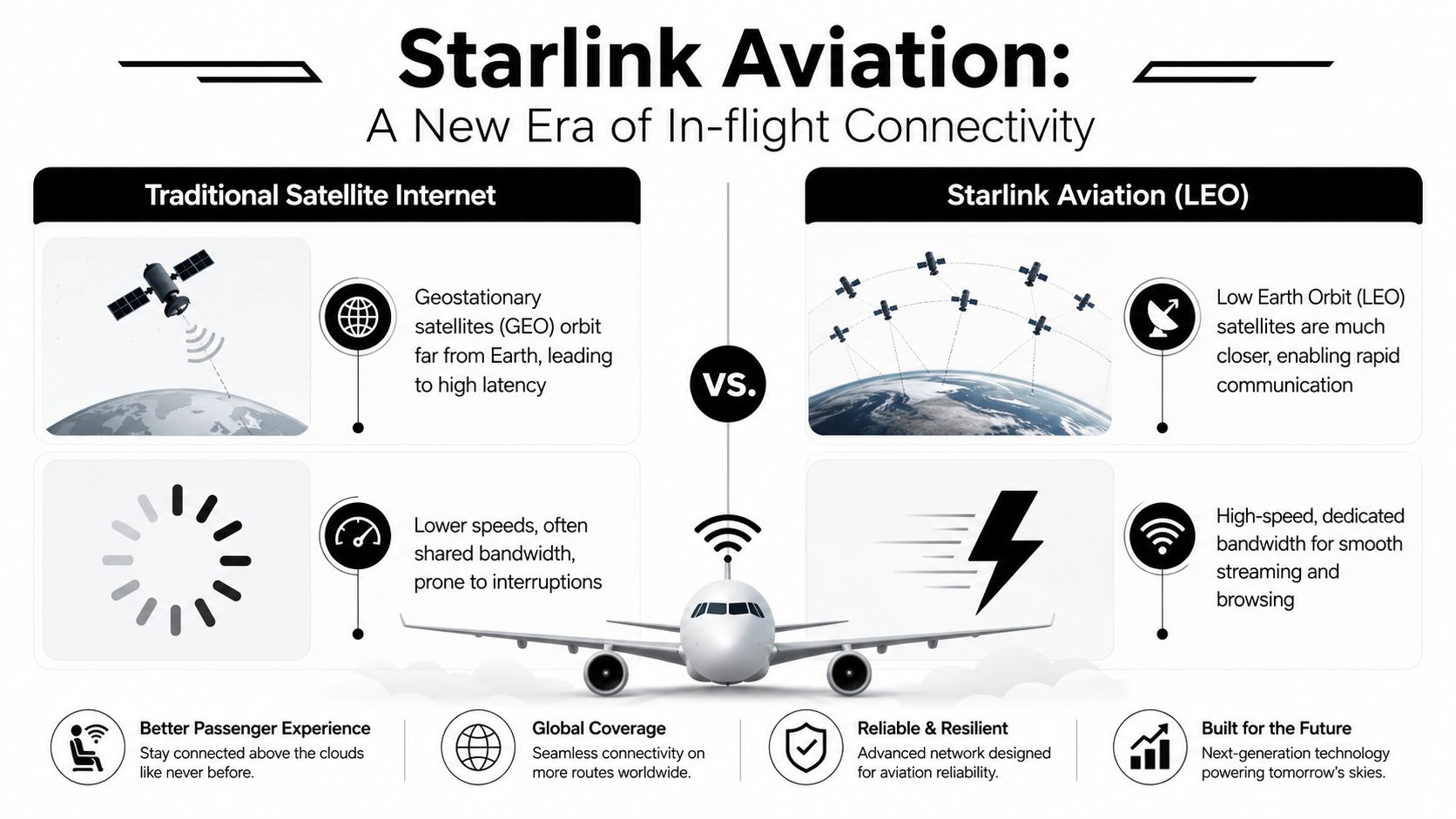
Starlink Aviation is a satellite internet system built on a low Earth orbit network, not the older model that relies on much farther satellites or patchy air-to-ground coverage. That difference is the whole story.
Think of legacy connectivity as relying on a distant road with traffic and long detours. Starlink's low Earth orbit network is more like a dense system of nearby express lanes. The signal travels a shorter path, responds faster, and handles demanding use far better.
Why passengers notice the difference immediately
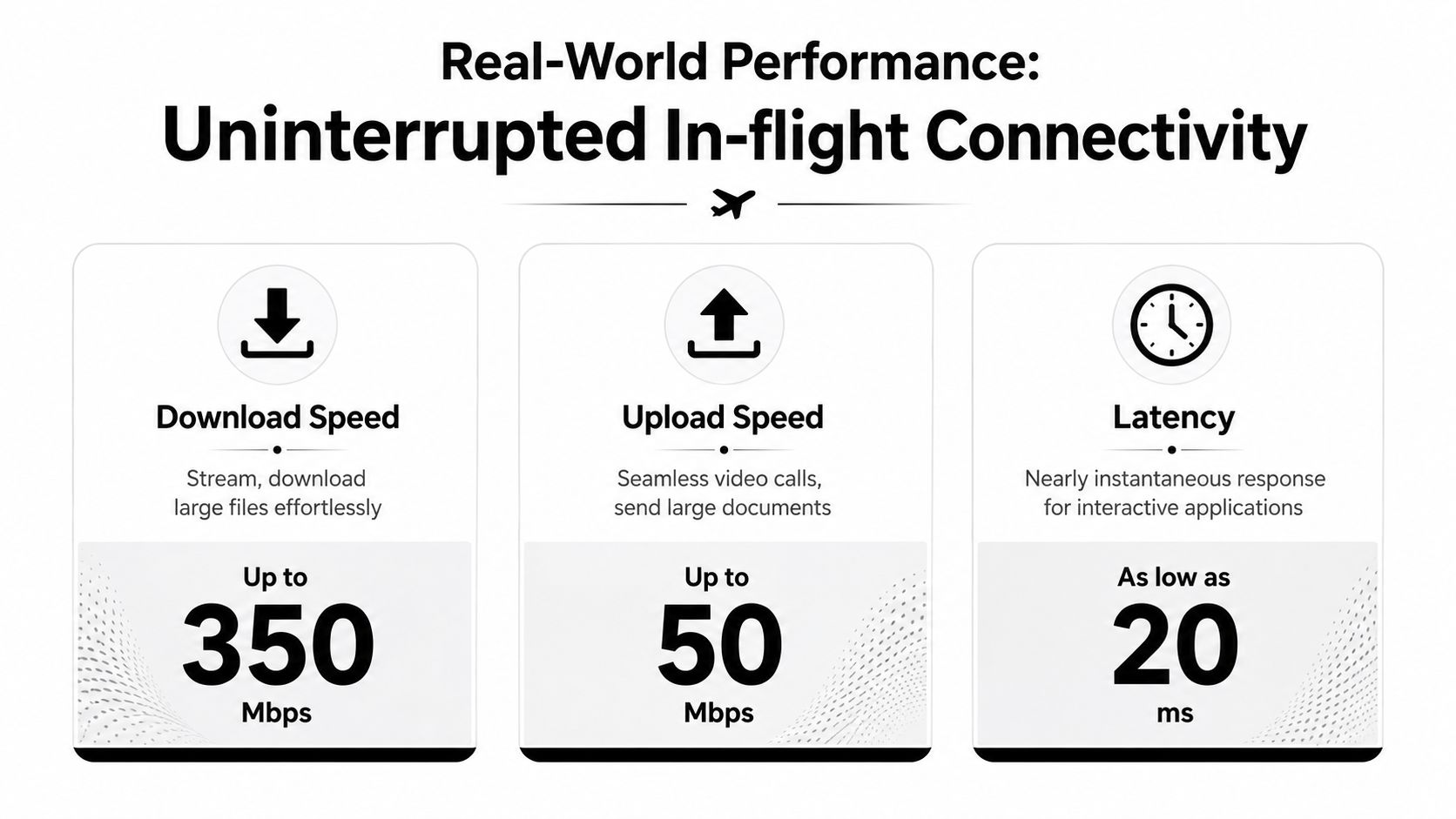
The passenger experience is where this stops being technical and becomes practical. Starlink Aviation delivers in-flight connectivity with speeds up to 310 Mbps and latency under 99 milliseconds, which supports HD video conferencing, 4K streaming, and large file transfers from takeoff to landing, according to flyExclusive's Starlink Aviation announcement.
That same source explains why. Starlink uses low Earth orbit satellites, while Gogo's architecture combines air-to-ground and geostationary elements that usually bring higher latency and weaker oceanic consistency. For charter clients flying over water or moving between continents, that distinction matters more than any marketing phrase.
If you want a clean primer on the mechanics behind satellite internet technology, SwiftNet Wifi has a straightforward explainer that helps make sense of why lower-orbit systems feel more responsive.
What this means in a charter cabin
This is my blunt view. Starlink for aircraft is important because it changes what the cabin is for.
With older systems, the cabin was often a place to disconnect whether you wanted to or not. With Starlink, the cabin becomes usable space for:
- Live meetings: Real-time conversation without the usual lag and audio delay.
- Entertainment that doesn't collapse: Multiple passengers can stream without the entire network choking.
- Ongoing operations: Teams can send files, work in cloud-based documents, and stay in active contact with the ground.
Older inflight internet asked passengers to adapt to the aircraft. Starlink starts to make the aircraft adapt to the passenger.
That shift is why Starlink has become one of the few onboard features worth verifying by name.
The Real-World Performance You Can Expect Inflight
Marketing language is cheap. Performance in a cabin full of devices is what matters.
The strongest current data shows Starlink Aviation terminals providing 100 Mbps to 250 Mbps downlink and 8 Mbps to 25 Mbps uplink, with empirical measurements showing a median user experience of 64 Mbps down and 24 Mbps up, plus latency under 99 ms, according to this Starlink aviation performance analysis on arXiv. The same source notes that Ookla Speedtest data from Q1 2025 showed a median in-flight downlink of 152.4 Mbps, with observed peaks of 370 Mbps at 35,000 feet.
Translate the numbers into cabin reality
For a charter client, those figures matter because they support activities that used to be risky or unrealistic onboard.
- Video calls become practical: Upload speed is the hidden issue in live conferencing. A usable uplink is what keeps your camera, voice, and shared files stable.
- Streaming doesn't monopolize the cabin: Strong downlink gives multiple passengers room to use the network at once.
- Cloud work feels normal: Lower latency means web apps, remote desktops, shared documents, and live messaging respond more like they do on the ground.
If you want a broader benchmark for private aviation connectivity, this page on private jet internet speed gives useful context.
What to expect and what not to expect
You should expect a major leap over legacy inflight Wi-Fi. You should not expect every Starlink-equipped flight to behave identically. Aircraft configuration, network load, route conditions, and onboard usage still affect the experience.
That said, here's the practical takeaway:
If your goal is to work normally, stream normally, and stop planning around cabin internet limitations, Starlink for aircraft is the first inflight system that consistently puts that within reach.
It won't turn every jet into a flying data center. It will, however, eliminate much of the compromise that used to define private jet internet.
Understanding Starlink Costs and Service Tiers
The reason you won't find Starlink on every charter aircraft is simple. Operators have to pay for it, and the pricing structure isn't uniform.
Starlink Aviation offers plans ranging from a $1,000 per month general aviation plan with 50 GB to a $10,000 per month Unlimited jet plan, according to Starlink Business Aviation. That same source highlights the most important nuance clients usually miss: the $250 per month Global Priority plan is capped for in-motion use up to 300 mph, and the standard Aviation plan supports up to 450 mph. That's still slower than many jets used in serious charter service.
Why this matters to charter clients
An operator flying slower aircraft can use lower-cost service structures more comfortably. A high-speed jet doing premium charter work often needs a more expensive plan to avoid speed-related limitations or service mismatches.
That affects the market in three ways:
- Operators that invest in top-tier connectivity usually position it as a competitive advantage.
- Some aircraft may have compatible hardware but not the most suitable service setup for your mission profile.
- Two jets advertised with “Starlink” may not represent the same onboard internet experience from a planning perspective.
Starlink Aviation 2026 Monthly Plan Comparison (Operator Costs)
| Plan Tier | Target Aircraft | Monthly Cost (USD) | Key Feature / Limitation |
|---|---|---|---|
| Global Priority | Slower aircraft and limited in-motion use cases | $250 | In-motion use capped up to 300 mph |
| General Aviation | General aviation aircraft | $1,000 | Includes 50 GB per month |
| Unlimited | High-demand jet operations | $10,000 | Unrestricted data for intensive use |
My advice on pricing claims
If a charter quote makes a vague promise like “premium Wi-Fi included,” treat that as incomplete information. The critical question isn't whether internet is onboard. It's whether the operator is paying for the service tier that matches the aircraft and your expected use.
The expensive part isn't the phrase “Starlink installed.” The expensive part is operating it correctly on the right aircraft.
That's why the best-connected charter aircraft tend to be flown by operators who understand connectivity as part of the product, not a box to tick on a listing.
Installation and Certification Requirements for Private Jets
Starlink for aircraft isn't a portable gadget when we're talking about serious jet charter. It's an aviation installation project, and aviation certification moves at aviation speed.
Most business jets manufactured within the past two decades are compatible with Starlink Aviation installations if the fuselage can support antenna mounting, the electrical system has enough capacity, and the cabin network can integrate with it, according to Elevate Jet's installation guide. That planning work is what separates a clean installation from a messy one.

Why every aircraft doesn't already have it
The answer is certification. For permanent installations, operators need approved paths tied to aircraft type and configuration. Therefore, Supplemental Type Certificates matter.
While business jets from Gulfstream and Bombardier have FAA Supplemental Type Certificates for Starlink installation, there's still a major gap in light general aviation. As of mid-2025, no STC is available for most light piston or turboprop aircraft, and those aircraft make up over 70% of the active GA fleet in the U.S., according to PilotMall's review of Starlink readiness in general aviation.
What charter clients should take from that
This explains why Starlink is appearing first and most credibly on business jets, not across every aircraft category.
- Larger certified platforms move first: That's where installation pathways are clearer.
- Smaller aircraft face a bottleneck: Portable workarounds exist in some contexts, but that's not the same as a certified integrated charter setup.
- Operator claims need scrutiny: “Compatible with Starlink” is not the same as “installed, certified, and active.”
Certification is the filter. It decides which aircraft can offer Starlink as a dependable service and which ones are still in the experimental or transitional stage.
If you charter midsize, super-midsize, and large-cabin jets, you're far more likely to encounter properly integrated systems. If you're looking at smaller aircraft categories, ask harder questions.
How to Charter a Starlink-Equipped Jet
If Starlink matters to your trip, say it at the start. Don't mention it as an afterthought after the aircraft has already been sourced.

A proper request sounds like this: you need a specific route, a specific passenger count, and a Starlink-equipped aircraft that supports real-time work in flight. That language forces the broker to verify equipment, not just amenities.
The hardware itself is increasingly practical for operators. The low-profile Starlink Aero Terminal integrates with minimal drag and was FAA-approved for fleets like United Airlines as of March 2025, while drawing about 25W on average, making it workable across aircraft from turboprops to ultra-long-range cabins without major electrical upgrades, according to Starlink's Aero Terminal support details.
What you should ask before you sign
Most charter clients ask one question about internet. You should ask five.
- Is the aircraft equipped with Starlink Aviation
- Is the service active for this trip
- Will the route profile support the use I care about
- How many passengers are expected to rely on the connection
- What is the fallback if connectivity is interrupted
That last question matters. Even excellent systems can face interruptions, and a serious broker should answer that without scrambling.
A broader booking framework helps too. This guide on how to charter a private jet in 2026 is worth reviewing if you want to tighten your process before confirming an aircraft.
What good broker verification looks like
The best brokers don't stop at “Wi-Fi confirmed.” They verify the exact aircraft, the installed connectivity package, and whether that setup matches your mission. That's especially important when the trip includes executives who need video calls, legal teams handling sensitive files, or families expecting uninterrupted entertainment.
For a quick look at how charter requests are increasingly built around specific onboard expectations, this overview is useful:
My recommendation is simple. If internet quality matters, make it a booking requirement, not a preference.
Security Redundancy and the Future of Inflight Connectivity
If you handle sensitive information, don't treat onboard internet differently from any other network. Use your company VPN, keep device security policies active, and assume the same discipline you'd use in a hotel, office, or conference venue.
That's the practical answer on security. Good connectivity doesn't remove the need for good behavior. It just means the connection is strong enough to support secure workflows without forcing people into awkward workarounds.
Redundancy still matters
No matter how good Starlink for aircraft becomes, prudent travelers still ask what happens if the connection degrades or drops. That's the right instinct.
Ask your flight provider:
- What backup connectivity exists, if any
- Whether the crew has operational procedures for service interruptions
- Whether your critical work can be staged offline before departure
For mission-critical flights, I also advise clients to preload documents, sync key files before wheels up, and define which work absolutely requires live connectivity. The point of redundancy isn't pessimism. It's control.
Fast internet is valuable. Predictable planning is more valuable.
The new baseline for private aviation
The deeper shift is cultural. Reliable inflight internet is no longer a novelty feature for private aviation clients. It's becoming part of the baseline expectation, especially for business travelers and families who live through connected devices.
That doesn't mean every aircraft offers the same quality, and it doesn't mean every operator manages connectivity well. It means the standard has moved. Clients now know what's possible, and they won't tolerate vague amenity claims for long.
My view is straightforward. Starlink for aircraft is the clearest signal yet that premium charter service is being judged not just by cabin finish, catering, and schedule flexibility, but by whether the aircraft keeps your day intact from takeoff to landing.
If you want a private jet with confirmed connectivity, not vague promises, Haute Jets can source the exact aircraft for your mission and verify the onboard details before you fly. That includes the specific jet, operator, cabin configuration, and Wi-Fi setup, so you know what you're boarding before you arrive at the terminal.