
A super midsize jet charter is usually the right call when you need room for 8 to 10 passengers and the range to cover about 3,400 to 4,500 nautical miles without stepping up to a heavy jet. That's why this category has become the private aviation sweet spot for coast-to-coast flying, select transatlantic missions, and premium family or executive travel where nonstop capability matters more than a bigger cabin.
You're probably here because a midsize jet feels a little tight, a heavy jet feels expensive, and you don't want to guess wrong on a trip that actually matters. That's the right instinct. In this category, the mistake isn't usually overpaying for luxury. It's booking by label instead of booking by mission.
A super midsize jet can be perfect for a transcontinental business trip, a multi-stop executive roadshow, or a family itinerary that needs real baggage space and a cabin people can live in for hours. It can also be the wrong aircraft if your route is pushing the edge of range, your passenger count is high, or the departure airport creates performance limits. The category is excellent. The wrong tail number isn't.
Your Guide to Super Midsize Jet Charter
Most first-time buyers come to this category after realizing the middle of the market is where value sits. You want enough cabin space to work, eat, and relax comfortably. You also want the aircraft to move fast enough and far enough that the trip feels efficient, not compromised.
That's exactly where super midsize jet charter earns its reputation. It gives you a stand-up cabin feel, practical long-range performance, and a better cost profile than moving into large-cabin aircraft for trips that don't need one. For many clients, it's the first category that feels like private aviation should feel.
Three questions matter more than anything else:
- Can this aircraft do my trip nonstop: Not the brochure version of the trip. Your actual trip, with your passengers, your bags, and the weather on the day.
- Am I paying for useful capability: Or paying extra for cabin volume and range I won't use.
- Who is matching the airplane to the mission: A real advisor checks airport performance, payload, and repositioning. A lazy broker just quotes a category.
If you're pairing private flying with a broader luxury itinerary, destination planning often matters as much as aircraft choice. Clients arranging villas, yachts, or bespoke air charter arrangements usually get better results when the flight is treated as one part of the trip, not a standalone booking.
Practical rule: If your route is long enough that a fuel stop would ruin the value of flying private, aircraft selection becomes the whole game.
What Defines the Super Midsize Jet Category
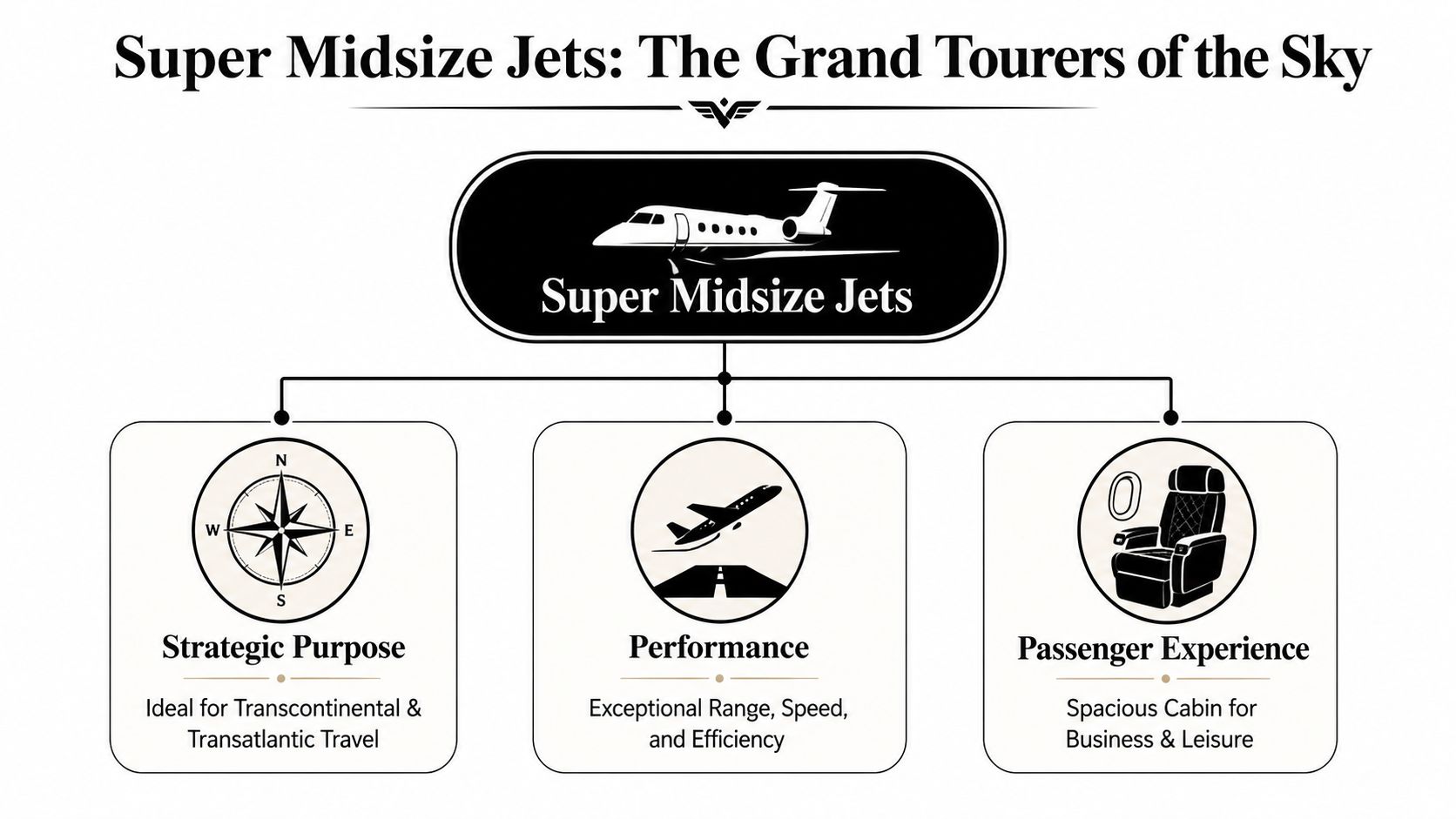
Think of this class as the grand tourer of private aviation. Not the smallest, not the biggest, but built to cover serious distance quickly and comfortably. That's the point of the category.
According to EvoJets' super midsize jet guide, super-midsize jets typically seat 8 to 10 passengers and cover about 3,400 to 4,500 nautical miles, which puts them squarely into true transcontinental and some transatlantic work. The same guide notes that the segment emerged to bridge the gap between midsize aircraft and larger cabin jets by combining longer range with lower operating costs than heavy jets.
What clients actually feel onboard
Specs matter. Cabin experience decides whether you made the right choice.
Most travelers step into this category because it finally starts to feel complete. You're generally looking for:
- A cabin that works for real travel: Enough room for adults to move comfortably during a longer flight.
- An enclosed lavatory: Not a compromise setup hidden behind a curtain.
- A proper service area: Useful for meals, drinks, and a smoother inflight experience.
- Executive-friendly seating: The kind of layout that lets people talk, work, or settle in.
That's why this segment wins so often for mixed-use travel. A founder flying with colleagues, a family heading across the country, and a couple doing a long leisure leg can all find this category sensible without feeling stripped down.
Why this class exists
The super midsize market isn't just bigger midsize flying. It solves a very specific problem. Midsize jets can be excellent, but once your route gets long, your schedule gets tight, or your group needs a better cabin, the trade-offs show up quickly.
Heavy jets solve those problems too, but often at a cost structure many trips don't justify. Super midsize aircraft sit in that useful middle ground. They give you more reach and more cabin credibility without forcing you into the economics of a larger airframe.
Book this category when you need range and comfort. Don't book it just because the label sounds premium.
Typical Performance and Popular Routes
Buyers often get tripped up. They hear “coast to coast” and assume every super midsize aircraft can do every long domestic trip under any conditions. That's not how mission planning works.
Per Elevate Jet's overview of super midsize performance, aircraft in this class show nonstop range of about 3,065 to 4,018 nautical miles and cruise speeds of roughly 536 to 700 mph. In practical terms, that makes them well suited to nonstop U.S. coast-to-coast flying.

Routes that fit the category well
When clients ask me what this class is built for, I think in mission types, not marketing copy.
A super midsize jet charter usually makes sense for trips like these:
- Teterboro to Van Nuys: Classic business aviation mission. Long enough to need real range, common enough that the market knows how to price it.
- Miami to Seattle: A strong example of why cabin comfort matters. That's a long domestic leg, and passengers will feel the difference between “acceptable” and “well chosen.”
- Boston to parts of Western Europe: Possible on the stronger end of the category, but only when the aircraft, payload, and conditions line up properly.
If you follow route demand and airport patterns, Haute Jets' look at the world's most popular private jet routes in 2025 gives useful context on where these aircraft categories tend to make practical sense.
Why published range can fool you
Maximum range is not a promise. It's a planning benchmark.
A route near the top end of the aircraft's published capability can change fast based on operational realities:
- Passenger load: More people usually means less margin.
- Baggage: Golf clubs, ski gear, and family luggage change the equation.
- Runway conditions: Some airports demand different performance than others.
- Weather and winds: A route that works one day may need a stop on another.
That's why experienced buyers ask a better question. Not “What's the range?” Ask, “Can this exact aircraft do my city pair nonstop on the day I'm flying?”
If your mission is close to the edge, assume nothing. Verify payload, runway, and weather assumptions before you sign the quote.
Leading Super Midsize Jet Models
Category shopping is a lazy way to book. Model shopping is better. Tail-specific shopping is best. Still, understanding the common aircraft in this segment helps you narrow the field before you get to exact availability.
One more market reality matters here. Jettly's global fleet overview estimates the world's private jet fleet at about 23,000 aircraft, with the United States accounting for 14,632 jets, or roughly 62.5% of the global total. That concentration matters because availability, pricing, and same-day dispatch are strongest where fleet density is highest.
The models worth knowing
Here's the short version of how I'd frame the usual contenders for a new charter client.
Bombardier Challenger 350
This is the safe pick for buyers who care most about cabin comfort and broad charter availability. It's popular for a reason. Clients like the cabin environment, and charter teams like how often it shows up in major U.S. markets.
Cessna Citation Longitude
A strong choice when you want a modern feel and a very balanced mission profile. It appeals to buyers who don't want to jump to a larger jet but still want credible long-range domestic performance.
Embraer Praetor 600
Often the right aircraft when you want to push the category harder on range. It's one of the first models I'd look at for buyers whose trip starts to blur the line between top-end midsize and true super midsize capability. If you want a closer look at that aircraft specifically, this Praetor 600 charter overview is a useful starting point.
Gulfstream G280
This is the model I think about when airport performance and mission flexibility really matter. It has a strong reputation for being a serious tool, not just a comfortable cabin.
Super Midsize Jet Comparison
| Model | Typical Passengers | Max Range (NM) | Max Cruise Speed (MPH) | Cabin Height |
|---|---|---|---|---|
| Challenger 350 | 8 to 10 | Qualitatively long-range for U.S. transcontinental missions | Qualitatively fast | Stand-up cabin class |
| Citation Longitude | 8 to 10 | Qualitatively long-range for major domestic missions | Qualitatively fast | Stand-up cabin class |
| Praetor 600 | 8 to 10 | Qualitatively among the stronger range performers in the class | Qualitatively fast | Stand-up cabin class |
| Gulfstream G280 | 8 to 10 | Qualitatively strong for long domestic and select overwater missions | Qualitatively fast | Stand-up cabin class |
My recommendation by trip type
- Prioritize the Challenger 350: If comfort, familiarity, and broad market access matter most.
- Look hard at the Longitude: If you want a modern, efficient all-rounder.
- Push toward the Praetor 600: If your route lives near the top of the category.
- Consider the G280: If runway and mission flexibility matter as much as cabin comfort.
Don't get attached to a name too early. The right aircraft depends on the trip, not the brochure.
Understanding Super Midsize Charter Costs
Most clients start with the wrong question. They ask for the hourly rate. That number matters, but on its own it can mislead you.
According to Jetvia's super midsize jet pricing overview, independent broker and industry sources cite hourly charter rates from about $4,000 to $8,000 per hour, with some market examples above $8,500 per hour depending on aircraft model and trip profile. That's useful context, not a final budget.
What actually drives the quote
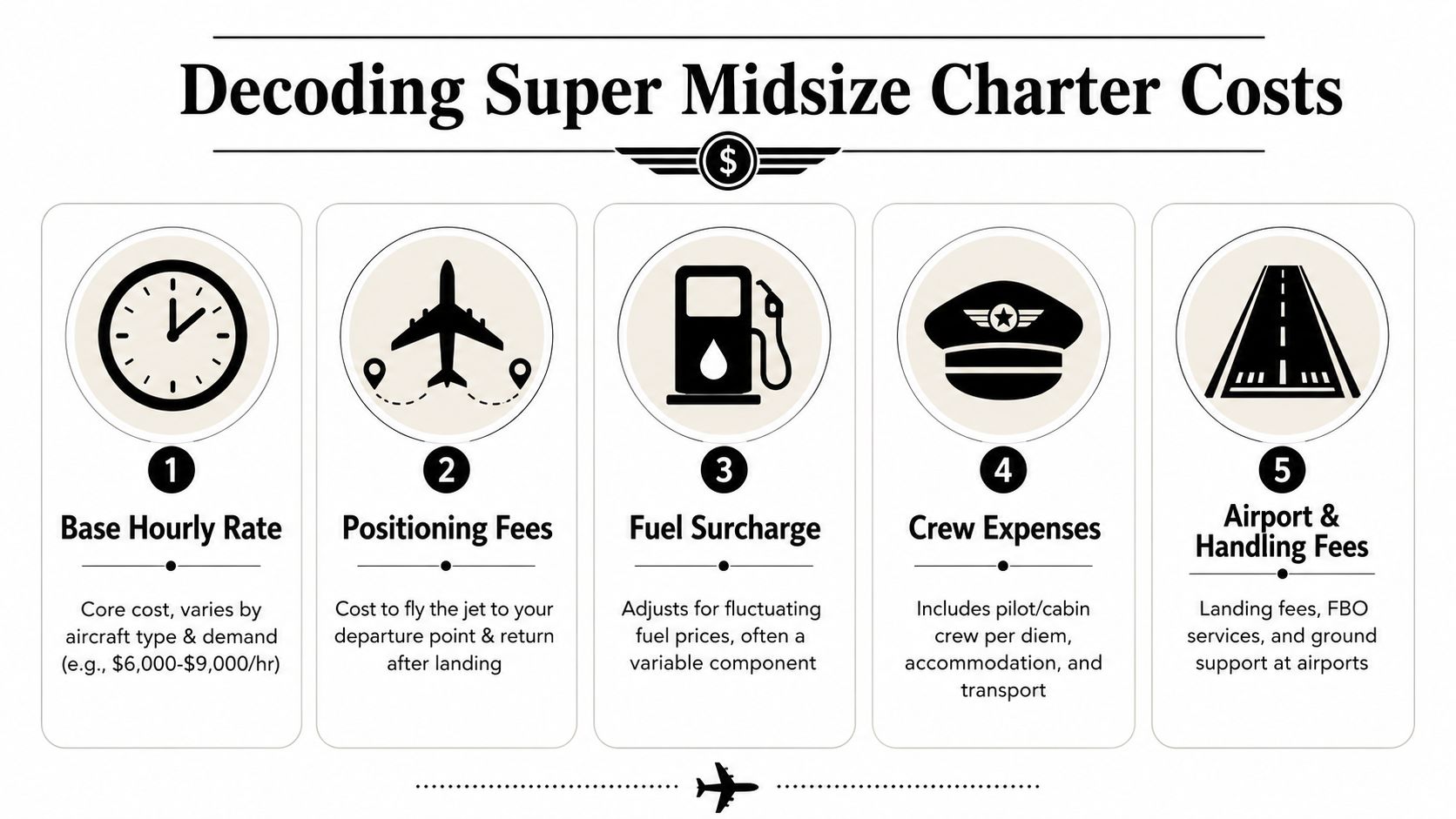
The actual price of a super midsize jet charter usually includes more than the aircraft's flying time.
Key cost layers include:
- Base flight time: The visible number everyone focuses on first.
- Fuel-related adjustments: These can shift with route and operating conditions.
- Landing and handling fees: Airport-specific charges that vary by itinerary.
- Crew expenses: More relevant on certain overnights or multi-day trips.
- Taxes and trip-specific fees: These depend on where and how you're flying.
If you want a broader grounding in how all-in pricing works, this private jet charter cost guide is worth reviewing before you compare quotes.
The fee buyers miss most often
The hidden swing factor is usually repositioning. That's the cost of moving the aircraft to your departure airport before your trip starts, and sometimes moving it again after your leg ends.
Quotes that appear inexpensive can quickly become costly. A jet that isn't local can still be the right airplane, but the economics can change fast. That's why a serious advisor checks where the aircraft is based, where it last flew, and whether the operator is pricing from a realistic starting position.
A lower hourly rate can lose to a higher hourly rate once repositioning enters the picture.
My advice is simple. Don't compare quotes line by line until you know whether each one reflects the same real mission. If one jet is already near your departure city and another has to be ferried in, they are not comparable offers.
How to Book Your Charter The Smart Way
You are flying eight passengers from the Northeast to Aspen for a long weekend. On paper, a super midsize jet sounds right. In practice, the wrong aircraft can turn that trip into a fuel stop, a baggage compromise, or both. Book by mission first. Category comes second.
That is the mistake new charter buyers make most often. They shop for “a super midsize” instead of confirming whether a specific aircraft can fly their route, from their airports, with their passenger count and bags, under the conditions of that day. The category is useful. The tail number is what decides whether the trip works cleanly.
As noted earlier in general industry coverage, buyers usually care about three things: nonstop capability, real baggage capacity, and whether stepping down to a midsize jet would save money without creating problems. Those are the right questions. The distinction is important because two jets in the same category can deliver very different results on the same itinerary.

The booking checklist I'd use
Before you approve a quote, get direct answers to these points:
Exact aircraft, not just category
Ask for the year, make, and model being quoted.Trip-specific payload and range review
Confirm the aircraft can fly your route as planned with your passenger count, baggage, and airport conditions. Do not accept a generic range claim.Departure and arrival airport fit
Runway length, elevation, temperature, and operating restrictions can change what looks possible on paper.Operator quality
Ask who is operating the flight and verify the operator's safety credentials and operating standards.All-in trip price
Get the full number with known fees included, not a headline hourly rate that hides the actual cost.Cabin and baggage details
Check the seating layout, baggage access, Wi-Fi, pet policy, and any oversized items before you sign.
A good advisor should also tell you when a super midsize is the wrong buy. If your trip is short, your airports are easy, and your group is light, a midsize jet may cover the mission for less. If you are flying a long sector with a full cabin into a demanding airport, you may need a stronger-performing super midsize model or a larger class altogether.
What separates a clean booking from a messy one
Clean bookings are built around the exact aircraft and the specific mission. Messy bookings start with a category label and end with surprises. The usual problems are predictable: the aircraft is farther away than you were told, the baggage hold is tighter than expected, or the jet can make the route only if you leave bags behind or stop for fuel.
One practical option in the market is Haute Jets. It states that it sources from a network of owner-operators, focuses on locally available aircraft to reduce repositioning costs, works with Wyvern Wingman or ARGUS Gold or Platinum-rated operators, and allows clients to choose the exact aircraft rather than booking only by category.
That buying method is the right one. Specific asset first, category second. It is the same logic high-end travelers use when choosing a villa, a yacht, or a guide for French Riviera yachting. You do not buy the label. You buy the fit for the trip.
Frequently Asked Questions
Is a super midsize jet always better than a midsize jet
No. It's better when the mission needs the extra capability. If your trip is shorter, your group is smaller, and your airport profile is simple, a midsize jet may do the job more efficiently. Paying for unused range is still overpaying.
How much baggage can we really bring
That depends on the exact aircraft and the route. Soft bags are usually easier than hard cases. Golf clubs, ski gear, strollers, and oversized luggage should always be disclosed before booking. Don't accept a generic answer. Ask for a trip-specific baggage review tied to the actual aircraft being quoted.
Can we bring pets
Usually yes, but policy varies by operator and aircraft. The right way to handle this is upfront. Declare the pet, the breed, the weight, and whether you'll use a carrier. Last-minute pet approvals create avoidable problems.
Is on-demand charter smarter than a jet card for this category
For many travelers, yes. On-demand charter makes more sense when your routes vary, your aircraft needs change by trip, and you don't want to commit capital just to access inventory. Jet cards can fit certain patterns, but they often reduce flexibility when you need a specific aircraft for a specific mission.
Can a super midsize jet fly to leisure destinations beyond major business hubs
Often, yes. That's one of the category's strengths. It gives you long-range capability with access to many airports that support premium leisure travel. If your trip includes sea transfer or a coastal itinerary after landing, destination planning matters too. For travelers pairing air and yacht logistics in the South of France, this guide for French Riviera yachting is a useful companion resource.
What should I ask for before I wire funds
Ask for the exact aircraft, operator identity, safety credentials, baggage assumptions, pet policy if relevant, and confirmation that the quoted mission works as planned. If the answer to any of those is vague, keep shopping.
If you want a clean, tail-specific quote for your next trip, Haute Jets is worth contacting for on-demand charter options that show the exact aircraft, operator details, and mission fit before you book.