

You're probably looking at a calendar that doesn't cooperate with commercial aviation.
A negotiation in Hong Kong moves up by a day. Your return to New York can't slip. You need privacy in the air, proper sleep, secure Wi-Fi, and a cabin where you can work without an audience. Commercial first class won't solve that. Airline schedules, connections, airport queues, and fixed departure banks turn a simple business objective into a logistics problem.
That's where ultra long range aircraft stop being a luxury label and become a practical tool. On the right mission, they compress distance, protect energy, and keep control in your hands. On the wrong mission, though, they can be an expensive overreach. Published range figures look clean on paper. Real charter planning never is.
This guide appears on Haute Jets Journal because clients booking their first intercontinental private flight usually ask the wrong first question. They ask, “What's the longest-range jet?” The better question is, “Which aircraft can fly my route realistically, comfortably, and without a nasty operational surprise?”
The World Without Borders
You leave Manhattan after dinner. By the time most travelers are still staring at a departure board at JFK, you're already airborne, reviewing final talking points with your team in a quiet cabin. You land in Hong Kong ready to work, not recover. Two days later, you're back in New York for a board meeting. That kind of movement is why ultra long range aircraft exist.
For founders, dealmakers, family offices, and public figures, global travel isn't occasional. It's tactical. The trip itself has to support the objective. If the flight drains you, adds unnecessary stops, or exposes private conversations, it undermines the reason you traveled in the first place.

When the aircraft changes the outcome
A standard long-range jet can handle a lot. But once your mission involves intercontinental timing, overnight productivity, or a direct city pair that commercial service handles poorly, the category changes. You're no longer buying a seat. You're buying control over time, rest, routing, and discretion.
Typical missions where this matters include:
- Urgent executive travel: A leadership team needs to cross multiple time zones without losing a business day to connections.
- Global roadshows: Investors, advisors, or talent move across continents on a compressed schedule.
- Private family travel: Families want fewer touchpoints, more privacy, and a cabin where children or older travelers can rest.
- Sensitive itineraries: High-profile passengers need confidentiality from departure through arrival.
Practical rule: If the value of arriving ready exceeds the premium for the aircraft, the jet is doing a job, not making a statement.
Why charter clients get this wrong
Many first-time charter clients assume the biggest jet is automatically the right answer. It isn't. The right answer depends on route, payload, weather pattern, sleep needs, airport constraints, and how hard you plan to use the cabin in flight.
That's the primary advantage of this class. Ultra long range aircraft let you treat geography as a planning variable, not a barrier. Used well, they reshape what a two-day trip can look like. Used badly, they just produce a very expensive fuel stop.
Defining Ultra Long Range Flight
The cleanest practical definition is this. Ultra long-range jets are defined by a nonstop range exceeding 4,600 nautical miles, and top models such as the Gulfstream G800 have a maximum published range of 8,200 nautical miles at Mach 0.85 according to Elevate Jet's overview of ultra-long-range jets.
That threshold matters because it separates aircraft that can manage serious transoceanic flying from aircraft that merely stretch into long-haul territory under favorable conditions.
What the label actually tells you
If a jet sits above that 4,600 nautical mile line, you're in a category built for nonstop intercontinental work, not just premium domestic or transatlantic flying. That changes everything about the airplane's role. Fuel capacity, cabin design, cruise profile, and onboard living space all have to support long sectors where passengers need to work, dine, rest, and sleep in sequence.
That's also why the top end of the market looks different. Once a jet pushes toward the upper end of the segment, you stop thinking in terms of “can it cross the ocean?” and start thinking in terms of “can it do my route with the passengers, baggage, timing, and comfort level I need?”
How to separate ultra long range from merely long range
Use this quick filter when evaluating options:
Check the route first
Start with the city pair, not the aircraft brochure. If your trip routinely spans major oceans or awkward global city pairs, you're likely in ultra long range territory.Think beyond distance
A route that looks possible on paper may become marginal once you add baggage, catering, preferred cruise speed, and reserve requirements.Assess what happens in the cabin
Flights of this length aren't just transportation. They're part office, part dining room, and part sleep environment.
The category matters because the trip changes once the cabin becomes a place you have to live in for much of a day.
For charter clients, that definition is useful only if it sharpens decision-making. My advice is simple. Don't book an ultra long range aircraft because it sounds impressive. Book one when your route, schedule, and need to arrive functional make anything smaller a compromise.
The Engineering Behind 15-Hour Flights
A jet doesn't stay airborne for that long because someone added bigger tanks and called it innovation. The aircraft has to balance fuel efficiency, aerodynamic discipline, altitude capability, and cabin livability at the same time. If one of those pieces is weak, the mission falls apart.
These aircraft also aren't configured like shorter-haul business jets. According to Paramount Business Jets' explanation of the category, they typically carry 13 to 16 passengers in large stand-up cabins with multi-zone layouts for work, dining, relaxation, and sleep, and they can climb to 50,000 ft or higher, with the Falcon 10X reaching nearly 51,000 ft.
Engines that make long sectors viable
Efficient engines are the foundation. On ultra-long missions, small efficiency gains matter because they compound over many hours. Better fuel burn isn't just an operator benefit. It gives planners more room to preserve a nonstop mission without stripping away passenger comfort or payload.
The Gulfstream G650ER is a good illustration. As covered in this Gulfstream G650ER range profile on Haute Jets Journal, the aircraft's reputation comes from pairing long legs with the speed and operating profile clients expect from a top-tier intercontinental jet.
Wings and altitude do more than look elegant
Transonic wing design is where the category earns its keep. At high cruise speeds, poor aerodynamic efficiency punishes range fast. Good wing design reduces drag, supports smoother cruise, and helps the aircraft stay efficient at the altitudes where these missions make the most sense.
Higher service ceilings matter for another reason. They let crews climb above much of the traffic and a meaningful amount of the turbulence that affects lower flight levels. That doesn't guarantee a perfectly smooth ride, but it gives dispatch and the crew better options.
The cabin is part of the engineering brief
On shorter flights, the cabin is mostly an amenity package. On a very long sector, it becomes part of mission performance. If passengers can't move, sleep, eat properly, or work in privacy, the aircraft hasn't solved the core problem.
A strong ultra-long-range layout usually includes:
- A work area: For meetings, calls, and focused laptop time.
- A dining zone: Because proper catering and service matter more on flights this long.
- A lounge space: For decompression between work blocks.
- A sleep area: Because arriving half-rested defeats the point of flying private.
The best ultra long range aircraft don't just fly farther. They protect your usefulness after landing.
That's the engineering story that matters to a charter client. The airplane must cover the route, yes. But it also has to preserve the people inside it.
Meet the Titans of Transcontinental Travel
If you're chartering at the top of the market, a few names dominate the conversation. The differences between them are real, and they matter. Some aircraft win on published range. Some win on cabin flexibility. Some remain favorites because they deliver a proven operating profile that dispatchers and charter buyers trust.
The first aircraft most clients should know is the Bombardier Global 7500. According to NovaJet's range overview, it's recognized as the longest-range private aircraft among business jets, capable of flying 7,700 nautical miles nonstop. The same source notes that the Gulfstream G650ER follows with a range of 7,095 nautical miles.
What each aircraft is really for
The Global 7500 is the cabin-first choice for many clients. If sleep quality, zoning, and room to spread out matter as much as the route itself, it's a strong answer. It's especially appealing when you want a true long-haul living environment, not just a fast transport platform.
The G650ER remains a benchmark because it combines prestige, speed reputation, and a mission profile charter buyers understand immediately. It's often the aircraft clients ask for by name, and not without reason. It has earned its place over time.
The newer names in the segment matter too. The Gulfstream G800 carries a published range of 8,200 nautical miles in the source cited earlier, while the Bombardier Global 8000 is listed with 8,000 nautical miles and the Gulfstream G700 with 7,750 nautical miles in this 2025 to 2026 market video reference. For charter clients, though, availability and mission realism still matter more than brochure hierarchy.
For a broader look at available options, this ultra-long-range jet fleet page is a useful reference point when comparing models by mission type.
Ultra-Long-Range Jet Comparison 2026
| Aircraft | Max Range (nm) | Typical Cruise Speed | Max Passengers | Cabin Zones |
|---|---|---|---|---|
| Gulfstream G800 | 8,200 | Mach 0.85 | Not specified in verified data | Not specified in verified data |
| Bombardier Global 8000 | 8,000 | Not specified in verified data | Not specified in verified data | Not specified in verified data |
| Gulfstream G700 | 7,750 | Not specified in verified data | Not specified in verified data | Four-zone trend noted in verified data |
| Bombardier Global 7500 | 7,700 | Not specified in verified data | Not specified in verified data | Four-zone cabin widely associated with model in verified data |
| Gulfstream G650ER | 7,095 in one verified source, 7,500 in another verified source depending on conditions | Mach 0.85 in verified range condition | Not specified in verified data | Not specified in verified data |
| Dassault Falcon 8X | 6,630 | Not specified in verified data | Not specified in verified data | Not specified in verified data |
My recommendation by traveler type
- Choose the Global 7500 if cabin comfort over a very long mission is your top priority.
- Choose the G650ER if you want a proven, highly recognizable intercontinental platform with serious range.
- Watch the G800 and Global 8000 if you care about the newest published range leaders and your charter source can secure one for your route.
Don't shop this category like a car brochure. Shop it like a mission planner.
Beyond Luxury The Onboard Wellness Advantage
Luxury on a long flight isn't polished wood or a glossy brochure finish. It's landing clear-headed enough to negotiate, present, perform, or go straight to dinner with your family without feeling wrecked.
That's why wellness is the most underrated reason to charter ultra long range aircraft. On a short flight, cabin cosmetics can distract you. On a very long sector, physiology wins.
Why cabin altitude matters more than décor
According to this aviation wellness video reference, aircraft such as the G700 maintain a cabin altitude of 2,840 ft, compared with 8,000 ft in commercial A350s and 787s. That lower cabin altitude reduces hypoxia risk and fatigue. The same source also notes that the move toward four-zone cabins directly addresses the sleep deprivation problem on very long routes.
That difference is not academic. It affects how your body handles a long sector. Less fatigue, less dryness, better rest, and a more stable work rhythm all matter when the flight itself lasts most of a waking day.
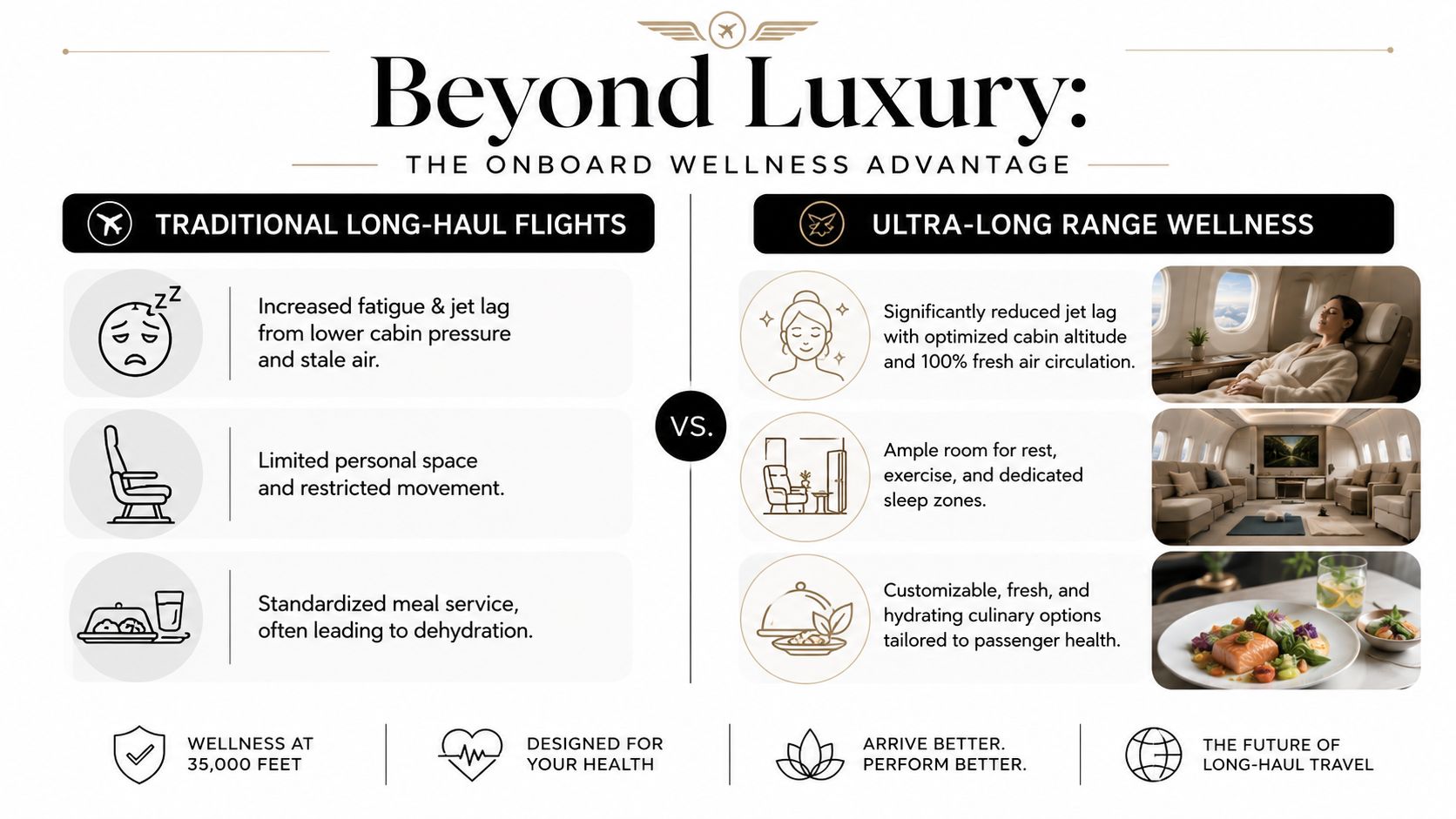
Four zones are not a marketing gimmick
A proper multi-zone cabin changes how you use the flight. You can hold a meeting in one section, eat in another, then step away and sleep in a dedicated area without asking the entire cabin to reorganize around you.
That matters for:
- Work rhythm: You can separate concentration from conversation.
- Meal timing: You eat when your body needs it, not when a fixed service cart appears.
- Sleep quality: You don't try to “rest” in the same seat where you've been taking calls.
- Family comfort: Different passengers can use the cabin differently at the same time.
The onboard experience that actually affects arrival quality
Commercial premium cabins still force compromise. You share airspace, service timing, lighting logic, and noise with hundreds of other people. A ULR private cabin lets the crew shape the environment around the passengers instead of the other way around.
If your flight is long enough to disrupt sleep, hydration, and focus, wellness is no longer a soft benefit. It's operationally important.
When clients ask me whether the premium is worth it, my response centers on this. If your arrival condition affects deal quality, public performance, family ease, or your ability to continue moving the same day, then the wellness advantage is part of the economics, not separate from it.
The Realities of Chartering a ULR Jet
Here's the part many charter buyers only learn after they've already fallen in love with a brochure range chart. Maximum range is not a promise. It's a planning reference built around favorable assumptions.
In live operations, weather, routing, payload, reserves, and airport conditions all start taking bites out of that number. If you ignore that, you'll either end up with an unnecessary stop or with a mission profile that looked elegant until dispatch ran the actual numbers.
The hidden operational tax
One of the better summaries of this issue comes from Stratos Jets' discussion of ultra-range jets. It notes that jets like the G700 may theoretically support missions such as NYC to Sydney, but real-world headwinds and density altitude often require detours or weight reductions, turning a “nonstop” plan into a near-nonstop mission with higher costs.
That's the hidden tax. It doesn't always show up in the headline quote. It appears in the form of route compromises, payload trimming, schedule adjustments, or a stop that wasn't part of the dream scenario.
For additional context on how this affects aircraft selection, this heavy jets and ultra-long-range jet benefits article helps frame where the category makes sense and where expectations need discipline.
What clients should ask before signing off
Don't ask only whether the aircraft can do the route. Ask these instead:
What payload assumptions are being used?
Passenger count, baggage, and catering all matter.How much routing flexibility exists?
Long missions rarely follow the clean line shown on a map.What's the backup plan if conditions deteriorate?
A smart charter brief includes a realistic alternate strategy.Will this mission preserve the reason for flying private?
If a “nonstop” flight requires painful compromises, the mission may be better served by a planned stop or a different aircraft.
My blunt view on first-time intercontinental charters
Clients often overpay because they buy prestige first and mission analysis second. That's backwards. On some routes, the right answer is the top-range aircraft. On others, a slightly different platform or a deliberately planned stop gives you a better overall outcome.
A realistic one-stop plan is better than a fragile nonstop fantasy.
If you're booking your first serious intercontinental charter, insist on route realism. That's what protects both cost and credibility.
Booking Your Global Journey with Haute Jets
You approve a nonstop intercontinental charter, then spend the final 24 hours renegotiating around crew duty limits, baggage weight, catering load, and a possible fuel stop. That is the hidden tax of ultra long range flying. The aircraft may be capable on paper, but your trip only works if the operating plan works too.
A strong charter process locks down the exact aircraft, operator, cabin layout, crew fit, and route assumptions before the schedule gets tight. On a 12 to 15 hour mission, small planning errors turn into expensive problems. A poor aircraft match costs more than money. It can cost sleep, productivity, and confidence in the trip.
What a good charter advisor should handle for you
A good advisor narrows the field quickly and protects you from brochure thinking.
- Aircraft matching: Choose for the mission, not the badge. A Global 7500 may be the better pick when sleep and cabin zoning matter most. A G650ER may suit a route better when dispatch familiarity and airport performance are stronger.
- Operator screening: Safety credentials, maintenance standards, and long-haul operating experience need verification.
- Cost control: The quote should reflect the actual mission profile, not a broad jet category with optimistic assumptions.
- Trip coordination: Long-range charters often connect to hotels, villas, yachts, security, ground transfers, and schedule protection on arrival.
If your itinerary extends well beyond the flight, it helps to see how specialists approach planning luxury journeys with concierge. Aircraft selection is one part of the job. The arrival plan matters just as much.
Haute Jets is one option clients consider for this kind of mission. The company says it sources from a large global fleet and works with Wyvern Wingman or Argus Gold or Platinum rated operators, while giving clients the ability to review the exact aircraft instead of accepting a loose category match.
The value of the advisory process shows up in the short list. You should come away knowing which aircraft can operate the route with margin, which ones become restrictive once passenger count and baggage are finalized, and whether a planned stop is the smarter call.
Before you finalize, watch this quick overview.
Book the mission that works in real operating conditions, gives you a cabin you can live in for 15 hours, and gets you to arrival ready to function.
If you're planning an intercontinental private flight, Haute Jets can help you compare the exact ultra long range aircraft that fit your route, schedule, and cabin priorities, then coordinate a realistic charter plan around the mission rather than the marketing sheet.