A private jet card is a prepaid access product built around fixed or capped hourly rates, with buyers commonly purchasing 25 to 100 flight hours. It trades upfront capital and some flexibility for more predictable booking, service levels, and pricing.
The popular advice is that a jet card is the convenient middle ground between first class and private jet ownership. That description is incomplete. A card is also a liquidity commitment, a contract, and sometimes a premium paid for access to aircraft that the card provider doesn't own.
That distinction matters. The advertised hourly rate may look stable while repositioning, peak-day rules, aircraft-category limits, cancellation terms, and unused-hour policies determine what you pay. A card can be an efficient operating tool for the right traveler, but it can also leave capital trapped in an inflexible program.
The Reality of Prepaid Private Aviation
A private jet card is a prepaid access product first and a travel perk second. You purchase flying in hourly blocks rather than paying for each charter separately, then use those hours under the provider's rules for aircraft categories, service areas, and booking windows. Jet cards commonly use blocks ranging from 25 to 100 hours, with hourly pricing that can vary by aircraft type and market conditions.
The mechanics are simple:
- You commit funds before booking a trip.
- The provider records flight hours or a deposit balance.
- You request an aircraft within eligible categories.
- The operator deducts hours under its billing rules.
- Your access and pricing follow the contract, rather than a new market quote for each flight.
Predictability drives the appeal. A card reduces the need to source an aircraft, arrange repositioning, coordinate schedules, and negotiate a price for every itinerary. It can give a travel manager a defined service level and steadier budgeting. The cost is reduced freedom to compare the full on-demand charter market, where each trip is priced against the aircraft and routing available.
The middle layer between charter and ownership
On-demand charter charges per trip. Fractional ownership connects you to an aircraft share and its ownership economics. A jet card occupies the middle position, providing private aviation access without maintenance, crew, depreciation, or an aircraft asset on your balance sheet. It still requires a meaningful advance commitment. A guide to private jet membership costs helps buyers examine that financial commitment instead of treating membership as a lifestyle upgrade.
The contract is the product. The flight is only one component. Availability guarantees, notice requirements, aircraft categories, service regions, peak-day provisions, cancellation rules, and refund rights can outweigh the headline hourly rate. Repositioning treatment also deserves close attention, because a supposedly predictable program can still impose liquidity costs when aircraft must move to serve your itinerary.
Practical rule: Treat every jet card as a financial agreement with aviation benefits, not as a stack of free-standing flight hours.
Ask what happens when your preferred aircraft is unavailable, a trip falls on a restricted date, you cancel, or the contract ends with unused value. A salesperson who explains the aircraft and pricing rules clearly has passed the first credibility test. Verify the contract terms next. Vague promises about “preferred access” are not a substitute for written rules.
How Jet Card Pricing and Structures Work
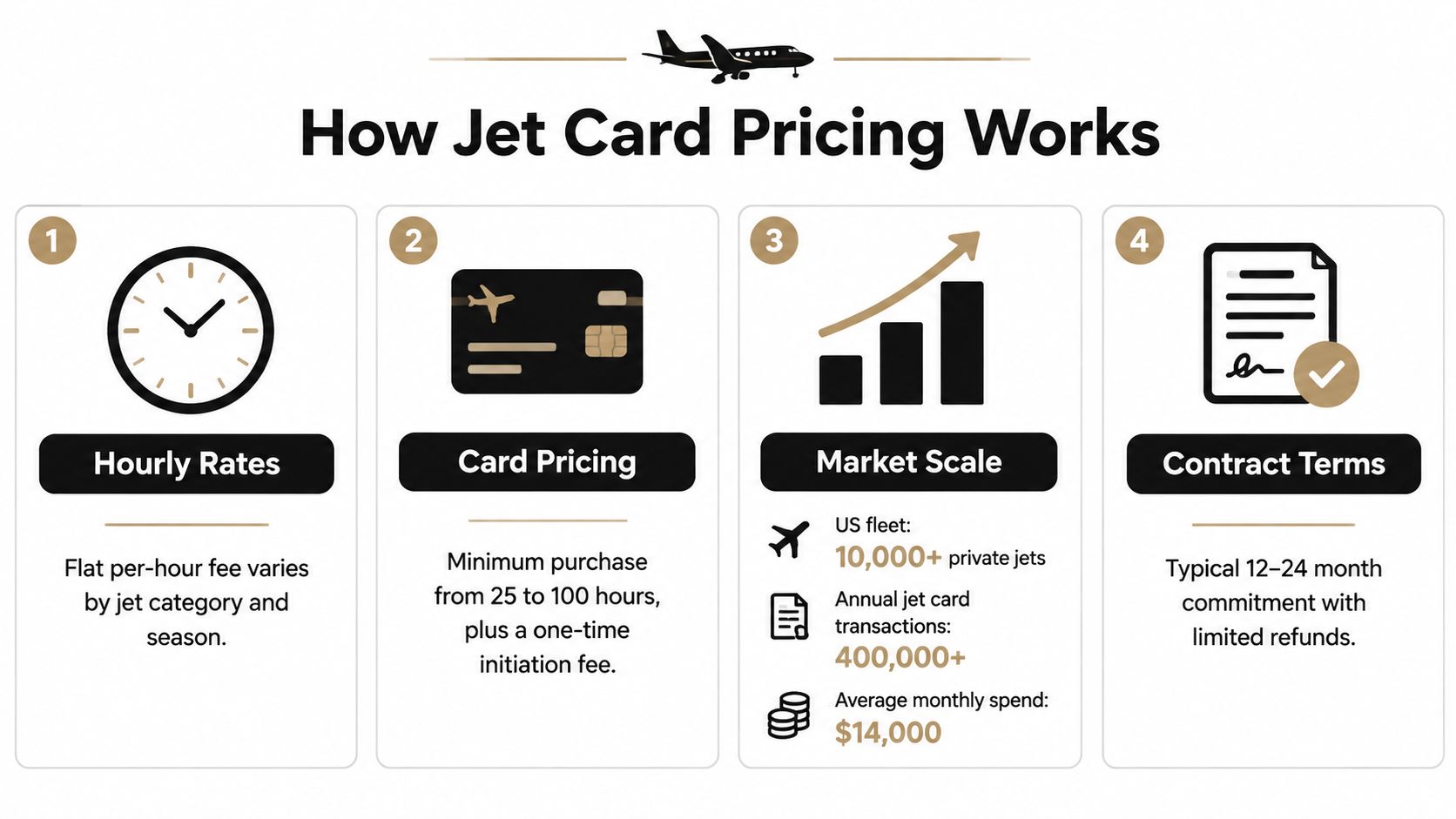
Jet cards sell prepaid access, not flight hours. Programs generally use one of two structures. The first offers a defined block of hours at a fixed or capped hourly rate. The second uses a deposit account, with trip costs deducted according to the provider's applicable rates. SherpaReport's explanation of private jet cards identifies the central trade-off: you commit capital upfront in exchange for priority access and rate protection during the contract term.
Common purchase sizes are 25, 50, and 100 hours, while broader market descriptions cover blocks from 25 to 100 hours. Contract terms commonly run 12 to 24 months, according to industry comparisons of jet cards, charters, and fractional ownership. That time limit can support travel planning, but it can also turn unused hours into stranded value. Match the commitment to your actual flight pattern, not to an optimistic estimate.
Published rates make jet cards appear more predictable than on-demand charter. A charter quote changes with aircraft availability, routing, seasonality, and repositioning. A card replaces some of that movement with a rate schedule, but the schedule only protects your budget within its stated conditions. Review the billing increments, aircraft category, service area, peak-day treatment, and repositioning formula before treating the hourly rate as a usable trip cost.
What the market data tells buyers
The market is large enough to justify disciplined comparison shopping. One 2025/26 market report valued the global jet card segment at about $13.5 billion, representing 28.7% of the broader private aviation membership market. That research also described fixed hourly pricing commonly ranging from about $3,500 to $7,500, depending on aircraft type and market conditions. The market report provides that membership context.
Other estimates use different definitions. DataIntelo's jet card market analysis estimated the global market at $9.4 billion in 2024, while another forecast in the same analysis placed it at $5.98 billion in 2025 and $10.41 billion by 2034. The $9.4B and $5.98B figures reflect different market definitions, one counting total prepaid commitments, the other annual card sales. Treat them as complementary rather than contradictory. Both indicate that jet cards are a substantial commercial access model, not a niche product for occasional luxury travelers.
Rate reporting reinforces the need for current quotes. A 2025 research update reported average jet card hourly rates of $11,273 in Q2 2025, up 1.1% from the prior period. Differences between advertised ranges and reported averages can reflect aircraft class, route assumptions, market coverage, and program design.
One industry source tracks more than 500 programs from over 80 companies and more than 40,000 data points. That breadth makes hourly-rate comparisons incomplete. Buyers should examine the full contract, including billing increments, fuel treatment, taxes, catering, de-icing, landing charges, repositioning, peak-day rules, and unused balances. For a full breakdown of jet card pricing components, review each charge against the trips you expect to fly.
Hidden Costs and Contractual Constraints
The headline hourly price is rarely the complete trip price. Jet cards promise stability, but stability applies only to the costs and circumstances covered by the agreement. The rest can remain variable, capped, excluded, or passed through to the customer.
Common constraints include:
- Blackout dates: Some programs restrict access when demand is highest, precisely when many leisure and corporate travelers value guaranteed availability.
- Peak-day surcharges: A fixed base rate may not eliminate extra charges for holidays, major events, or other high-demand periods.
- Service-area limits: A card can work well in its primary geography while offering weaker economics or availability outside that area.
- Minimum commitments: The customer may need to purchase a defined block or maintain a deposit for a specified term.
- Cancellation rules: Refunds, rebooking rights, and expiration treatment depend on the contract.
- Aircraft-category constraints: A card may guarantee a category, not the exact make, model, year, or cabin configuration you want.
The liquidity cost deserves special attention. With on-demand charter, you pay for a trip after selecting the aircraft and confirming the itinerary. With a card, your money is committed before you know which future trips you'll take, which aircraft will be available, or whether your schedule will change.
Repositioning changes the economics
Many jet-card operators don't own aircraft. They source from the open charter market, which means the provider still has to solve the same operational problem as a broker: finding an aircraft near the departure point and moving it into position when necessary. Independent coverage of jet cards and private aviation memberships notes that this sourcing model can leave card pricing above prevailing market rates despite the promise of predictability.
That's where the difference between a fixed rate and a fixed total cost becomes important. A provider may protect the hourly rate while charging separately for repositioning or other operational elements. You need to ask whether the program includes empty-leg positioning, how the provider bills ferry time, and whether those charges apply differently by aircraft category or route.
Ask for a sample invoice, not a brochure. The invoice should show flight time, minimum billing, repositioning, peak-day charges, taxes, and every pass-through cost.
The contract should also explain what happens when the provider can't offer the requested aircraft category. A “guarantee” that results in a smaller aircraft, a substitute airport, or a different routing may technically satisfy the agreement while failing the actual purpose of the trip.
Comparing Jet Cards to On-Demand and Fractional Models
The right access model depends on what you value most. A jet card prioritizes predictable access. On-demand charter prioritizes transaction-level flexibility. Fractional ownership offers deeper control and a continuing relationship with an aircraft share, but it introduces ownership exposure that a card avoids.
| Access Model | Capital Commitment | Pricing Structure | Aircraft Flexibility |
|---|---|---|---|
| Jet card | Prepaid block of hours or deposit, commonly under a 12 to 24 month contract | Fixed or capped hourly rates under program rules, with possible exclusions and surcharges | Usually limited to eligible categories, with exact aircraft choice subject to availability |
| On-demand charter | No upfront flight-hour commitment | Pay per trip, with each quote reflecting aircraft availability, routing, repositioning, and market conditions | Broadest ability to select the specific aircraft, operator, and itinerary for each trip |
| Fractional ownership | Capital tied to an aircraft share and ongoing ownership obligations | Ownership costs plus operating and management charges | Access is structured around the owned share and the provider's fleet and scheduling rules |
The jet card versus charter comparison from Haute Jets captures the central distinction. A card gives you access under a defined program. Charter lets you evaluate each flight independently, which is valuable when routes, passenger counts, and aircraft requirements change often.
Capital commitment
A jet card makes sense when the value of guaranteed access outweighs the opportunity cost of prepaid funds. That value is strongest for travelers with recurring routes, a dependable schedule, and a clear need to fly during periods when availability matters.
On-demand charter is more efficient for irregular demand. You can compare local aircraft, avoid carrying unused hours, and reject a quote that doesn't make financial sense. The tradeoff is that pricing and availability require active management each time.
Fractional ownership is a different decision altogether. It may suit a consistent high-utilization pattern and a buyer who wants an ownership-style relationship, but the customer must accept asset exposure, depreciation, and long-term obligations. A card avoids those burdens, though it doesn't eliminate commitment risk.
Flexibility and aircraft choice
A jet card commonly promises access to a category, such as a light, midsize, or large-cabin aircraft. That may be enough for routine travel, but it can disappoint when you need a specific cabin layout, baggage configuration, range profile, or onboard equipment.
On-demand charter is the strongest fit when the aircraft itself matters. You can match the aircraft to the mission rather than accepting a category-level substitute. For a short regional trip, that might mean choosing a light jet. For a long international itinerary, it may mean selecting an ultra-long-range cabin with the required range and configuration.
My recommendation is direct. Choose a jet card for recurring, predictable travel where access and budget stability are operational priorities. Choose on-demand charter when flexibility, aircraft selection, and liquidity matter more than a pre-established booking framework. Consider fractional ownership only after reviewing the full ownership economics, not just the hourly operating rate.
Who Actually Benefits from a Jet Card
A jet card benefits a narrow but important group of travelers. The strongest candidate isn't someone wealthy enough to afford private aviation. It's someone whose travel pattern is repetitive, time-sensitive, and expensive to disrupt.
Consider a corporate travel manager coordinating recurring executive trips. The destinations may change, but the company needs a dependable booking process, a known service level, and a budget that finance teams can forecast. A card can simplify approvals and reduce the need to negotiate every trip from scratch. The manager still needs to verify whether the contract covers the actual routes and peak periods the executives use.
A second useful profile is the frequent leisure traveler with a stable seasonal calendar. If the same family travels during periods when aircraft availability tightens, priority access may justify the advance commitment. That only works if the card's availability guarantee applies to the relevant airports, aircraft class, passenger count, and travel dates.
Situations where the tradeoff can work
- Recurring executive travel: A company with regular private flights may value consistent booking rules more than open-market price discovery.
- Peak-season leisure travel: A family that reliably travels during high-demand periods may place a premium on access, provided the contract's peak-day rules are acceptable.
- Multi-user corporate access: Several approved travelers can draw from one account, making the prepaid balance more useful than it would be for a single occasional flyer.
- Time-critical operations: Productions, teams, and executives with costly schedule disruptions may prefer a defined escalation path and priority handling.
The opposite profiles should usually avoid cards. An infrequent traveler can lose value through expiration, unused hours, or a mismatch between the purchased aircraft category and the actual trip. Someone whose destinations change constantly may also find service-area limits and aircraft substitutions frustrating.
A card isn't automatically economical because the customer flies often. The question is whether the customer flies often enough, predictably enough, and under the right contract terms to use the prepaid balance without forcing unsuitable trips. Run the usage forecast before signing, and include schedule changes, canceled trips, and likely aircraft upgrades.
A practical test: If you can't describe your expected routes, aircraft categories, and booking windows with reasonable clarity, keep your capital liquid and use on-demand charter.
The break-even point is personal. It depends on the value of availability, the cost of disruption, and the opportunity cost of unused funds. A buyer should compare the card's complete annual commitment with actual trip-by-trip charter quotes for the routes they expect to fly.
The Wholesale On-Demand Alternative
Travelers who don't want to lock capital into prepaid hours should examine a wholesale, pay-per-flight model. The key advantage isn't a promise that every charter will be cheap. It's the ability to source the aircraft locally, compare the actual trip economics, and avoid paying for a membership structure that may not fit the itinerary.
Haute Jets sources from more than 3,500 owner-operators across 175 countries, according to the publisher's stated network description. The model is designed to locate aircraft near the departure city rather than automatically relying on a repositioned aircraft. That distinction matters because repositioning can become a substantial part of the quote when the selected aircraft isn't already nearby.

The stated publisher model also gives the traveler more control over the aircraft decision. Instead of choosing only a broad category, the customer can request the specific make, model, year, and cabin layout, then confirm details such as Wi-Fi, catering, pet policies, and ground transport. That's a meaningful advantage for travelers whose requirements don't fit a standardized card category.
Safety and operational visibility
The network uses operators with Wyvern Wingman or ARGUS Gold or Platinum ratings, as stated in the publisher information. Those ratings don't remove the need for proper trip review, but they provide a defined safety-screening framework rather than leaving the customer to evaluate an unknown operator alone.
The stated booking process includes full flight details, including the tail number, crew biographies, weather briefing, and passenger manifest, 24 hours before departure. That level of confirmation helps a traveler identify operational changes before arriving at the FBO.
The video below provides additional visual context for arranging an on-demand private flight.
On-demand charter isn't frictionless. You still need to review the aircraft, operator, routing, cancellation terms, and total price for every trip. But that work buys flexibility. You aren't paying for hours you may not use, accepting a category when you need a precise cabin, or relying on a card's rules to determine whether a route is commercially sensible.
For clients who value liquidity and aircraft choice, that's the stronger default. Use a card when its guarantees solve a recurring operational problem. Otherwise, compare the trip directly and pay only for the flight you're taking.
Making the Right Choice for Your Travel Needs
Start with your actual travel pattern, not the sales presentation. List recurring destinations, passenger counts, preferred aircraft categories, seasonal dates, and how much notice you typically have before departure. Then separate essential requirements from luxuries. A guaranteed category may be enough for one traveler, while another needs a specific cabin layout or exact aircraft model.
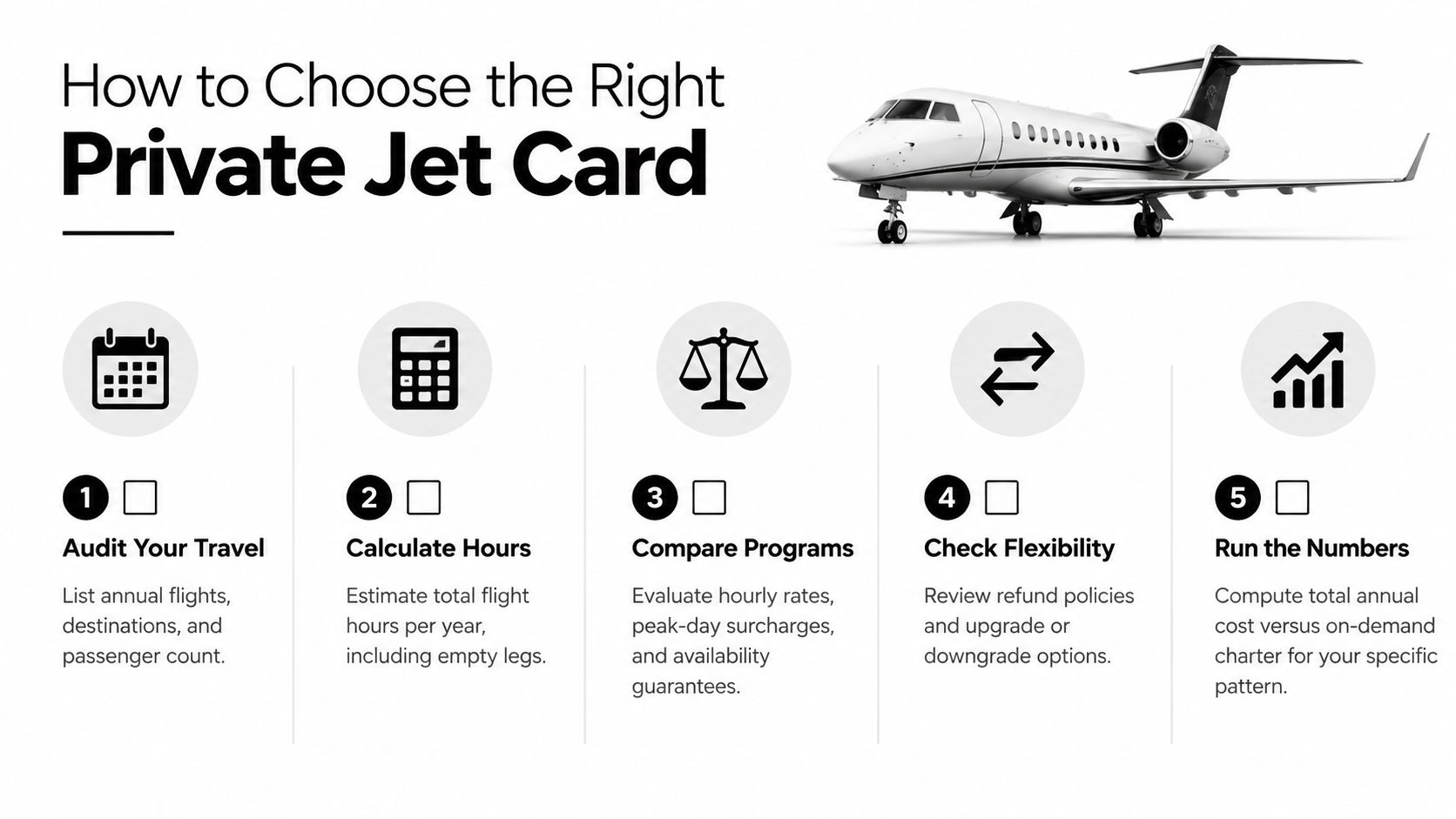
Use this decision sequence:
- Audit your travel: Identify the trips you're likely to take, including peak-season dates and routes outside the provider's core service area.
- Calculate expected hours: Estimate flight time and review how the provider handles minimums, repositioning, and empty positioning.
- Compare total costs: Put the card's prepaid commitment beside trip-by-trip charter quotes, including surcharges, taxes, and pass-through expenses.
- Read the exit terms: Check expiration, refunds, cancellation, downgrades, upgrades, and treatment of unused balances.
- Test the guarantee: Ask what happens when your preferred aircraft category isn't available and whether the provider can offer a specific model.
A jet card is suitable when predictable access has clear business or personal value and your expected usage supports the commitment. On-demand charter is usually the cleaner choice when your schedule changes, your routes vary, or you want the freedom to select the aircraft for every flight.
Don't approve a card from the hourly rate alone. Request a sample invoice, a complete contract, and written answers on repositioning and peak-day charges. Transparency is more valuable than a polished promise of convenience.
Haute Jets offers pay-per-flight charter access through a network of owner-operators, with aircraft selection, operator safety screening, and flight details confirmed before departure. If you want to compare a specific itinerary against the liquidity and restrictions of a jet card, visit Haute Jets and request an on-demand charter evaluation.