
May 7, 2025 is the enforcement date that matters. From that point forward, travelers 18 and older need a REAL ID-compliant driver's license or another accepted ID to board domestic commercial flights in the United States.
If you're reading this while juggling a commercial hop to Teterboro, a same-day connection to an FBO, or a family itinerary that leaves no room for checkpoint drama, the question isn't theoretical. When is Real ID required to fly? It's already required for domestic commercial air travel, and the wrong assumption can derail an otherwise well-built schedule.
For private aviation clients, the confusion gets worse because most online advice is written for the general public standing in TSA lines, not for travelers moving between commercial terminals, private terminals, and international departures in the same day. That's where mistakes happen. You may never see a TSA checkpoint on one leg of your trip, then suddenly need federally acceptable identification on the next.
This is the practical version. No fear tactics. No DMV fluff. Just the rules that matter, the alternatives that work, and the backup options you should avoid if your calendar has real stakes.
Ensuring Seamless Travel in the Real ID Era
A tight itinerary can fall apart over something as basic as identification. A traveler can have the aircraft arranged, crew confirmed, ground transfer waiting, and still lose the day because a domestic commercial segment requires an ID that no longer clears the checkpoint.
That's the operational reality after the May 7, 2025 enforcement date. Adult travelers on domestic commercial flights need compliant identification, and “I thought my regular license was fine” is no longer a harmless misunderstanding. It's a missed meeting, a blown connection, or a charter departure that now has to be rebuilt around a delay.
For clients who value time certainty, treat identification the same way you treat aircraft availability or slot coordination. It isn't admin. It's trip protection.
Where high-value itineraries break
The weak point usually isn't the long-haul private leg. It's the handoff.
A common pattern looks like this:
- Commercial feeder flight first: You fly commercially into a gateway city before boarding a private aircraft.
- Family travel complexity: One traveler has a passport, another relies on a non-compliant state license.
- Assistant-booked itinerary: The flights are secured, but no one verified which ID each passenger will physically carry on the day of travel.
Practical rule: If any part of your itinerary touches a commercial TSA checkpoint, verify the passenger's exact ID document before the trip is ticketed.
That's also why smart travelers increasingly choose the right travel agent service or concierge support that handles document checks as part of itinerary control, not as an afterthought.
The standard to adopt
If you want friction-free travel, build around documents that work everywhere you're likely to go. Don't build around exceptions, assumptions, or airport improvisation.
Use a simple hierarchy:
- Best option: Travel with a valid passport.
- Strong domestic option: Use another federally accepted ID if you already have one.
- Convenience option: Get a REAL ID-compliant state license if you want your everyday wallet ID to work at commercial checkpoints.
That approach protects both your commercial legs and your private aviation schedule.
What Is Real ID and Why Does It Exist
A missed ID detail can derail a tightly timed travel day. That matters even more if your itinerary starts at an FBO, then shifts to a commercial leg later, or the reverse. Private aviation often masks document risk until the moment a passenger hits a federal checkpoint.
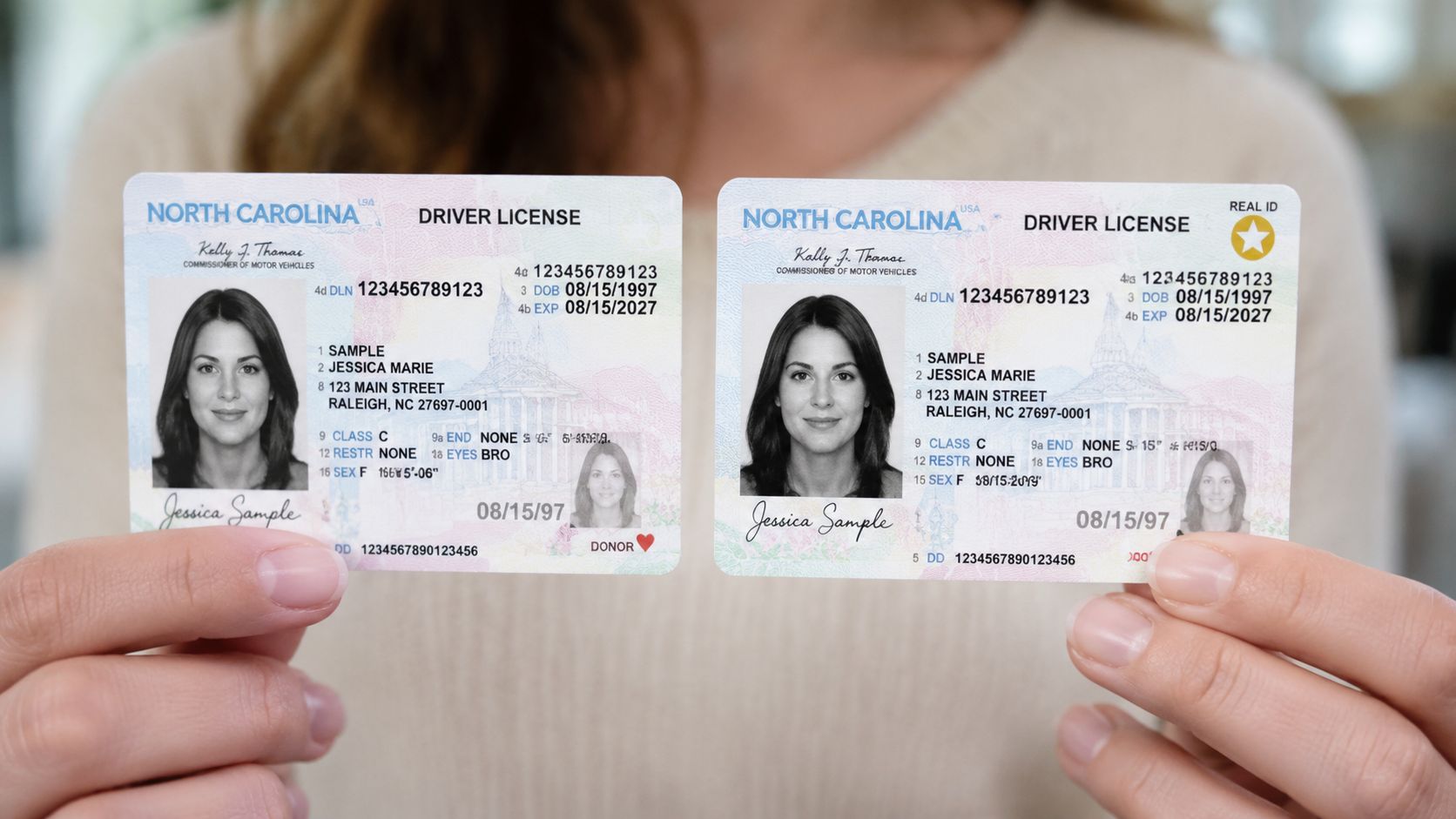
REAL ID is the federal standard for state-issued identification used for certain federal purposes, including domestic commercial air travel. It is not a separate national ID card. It is a stricter version of a state driver's license or state ID, issued only after the state verifies identity documents to a higher federal standard.
The law behind it is the REAL ID Act of 2005. Its purpose was straightforward: tighten the identity verification rules states must follow before their licenses can be accepted at federally regulated access points.
For travelers, the history matters less than the consequence. If you plan to use a state-issued license at a domestic commercial TSA checkpoint, that license must be compliant. If it is not, your options shrink fast.
Why affluent travelers should care
This rule catches people who assume private flying insulates them from public-terminal requirements. It does not.
A private itinerary can still involve a commercial feeder leg, a family member returning separately on an airline, or an assistant booking a backup ticket during irregular operations. In each of those cases, the passenger needs identification that works immediately at a TSA checkpoint. If you want the broadest coverage across both private and commercial touchpoints, review whether you need a passport to fly private domestically and build your document plan around the answer, not around assumptions.
What makes a license compliant
A compliant license usually carries a star or another state-approved marking in the upper portion of the card. That mark is useful, but verification should be deliberate. Physically check the card before travel. Do not rely on memory, a wallet photo, or what someone believes they renewed at the DMV.
A REAL ID license is a convenience document for domestic commercial screening. It does not replace a passport.
That distinction matters for private jet clients. At an FBO, the question is often identity validation, passenger vetting, and operator procedure. At a TSA checkpoint, the question is federal document acceptance. Those are different systems. Treat them that way.
The Key Takeaway for Private Jet Travelers
REAL ID exists to raise the standard for state-issued IDs used in federal screening environments. Its practical value is simple. It reduces the chance that a state license becomes the weak link in an otherwise well-planned trip.
It does not solve every travel scenario, and it should not be your only plan. For time-sensitive travelers, especially those protecting a private charter schedule, relying on fallback identity checks such as TSA's ConfirmID process is poor strategy. ConfirmID can work, but it is a manual exception path, not a premium service. It can add delays, scrutiny, and uncertainty at exactly the moment your schedule has the least room for it.
Use REAL ID for what it is: a cleaner domestic checkpoint credential. Then keep a stronger federally accepted document available whenever your itinerary has any chance of touching commercial aviation.
Real ID Rules for Commercial vs Private Flights
Individuals often make a mistake here. Hearing that REAL ID is “required to fly,” they assume it applies to every flight, every terminal, every aircraft. That's not accurate.
For commercial flights, the rule is direct. If you're going through a TSA checkpoint and relying on a state-issued ID, that state-issued ID needs to be compliant. That's the environment where REAL ID matters most.
For private flights, the operating reality is different. You usually depart through an FBO, not a public terminal. You won't typically stand in a standard TSA screening line before boarding your aircraft. But that doesn't mean identification becomes casual.
Commercial checkpoints are the hard line
At a commercial airport, there's no room for interpretation. The checkpoint officer is applying a federal access rule.
A key misconception also needs to die here: REAL ID is not universally required for every domestic traveler in every circumstance. It applies to state-issued IDs. Federally issued documents like U.S. passports, military IDs, and Global Entry cards remain valid alternatives, meaning up to 40% of U.S. adults who already possess these may not need a REAL ID at all, as noted in the U.S. Travel Association REAL ID guide.
That one point saves people a lot of unnecessary DMV panic.
Private aviation works differently, but not loosely
Private terminals prioritize speed and discretion, not identity shortcuts. Operators still have to know exactly who is boarding. Passenger manifests matter. Identity verification matters. Security procedures still exist, even if they're less theatrical than a public checkpoint.
If you fly privately, especially on trips involving corporate travel, family offices, entertainment clients, or international onward segments, expect your operator to want clean, reliable identification that matches the manifest without friction.
That's why many experienced travelers default to passports even for domestic private flights. A passport removes ambiguity. So do other federally accepted documents.
For a deeper breakdown of domestic private travel documentation, this guide on whether you need a passport to fly private domestically is useful context.
The real private jet takeaway
Use this comparison:
| Travel type | ID reality |
|---|---|
| Commercial domestic flight | REAL ID-compliant state license or accepted alternative is required at TSA |
| Private domestic flight from an FBO | No standard public TSA line, but operator identity verification still applies |
| Mixed itinerary | The strictest leg dictates your document strategy |
Bring the ID that clears every segment of the trip, not just the first one.
That's the difference affluent travelers should focus on. The private leg may feel effortless, but your schedule can still be wrecked by the commercial leg that feeds it.
What I recommend for FBO clients
If you regularly move between airlines, private charters, and international departures, stop thinking in terms of “minimum legal ID.” Think in terms of single-document certainty.
Best practice is simple:
- Carry a valid passport: It works across more scenarios and avoids state-license compliance confusion.
- Keep manifest details aligned: The name on your booking, identification, and operator paperwork should match cleanly.
- Don't rely on airport problem-solving: The more expensive the day, the less tolerance you should have for document ambiguity.
That's how you remove friction at both the terminal and the tarmac.
Acceptable IDs That Guarantee Seamless Travel
Most travelers asking when is Real ID required to fly are asking the wrong second question. They ask, “Do I need to get one?” The better question is, “What document gives me the fewest points of failure?”
For frequent flyers, private aviation clients, and international travelers, a REAL ID-compliant driver's license is often useful, but it's rarely the strongest answer. The strongest answer is the document that works across domestic commercial flights, private terminals, and overseas travel with no mental math required.
The documents that remove doubt
Here's the practical ranking I use for clients:
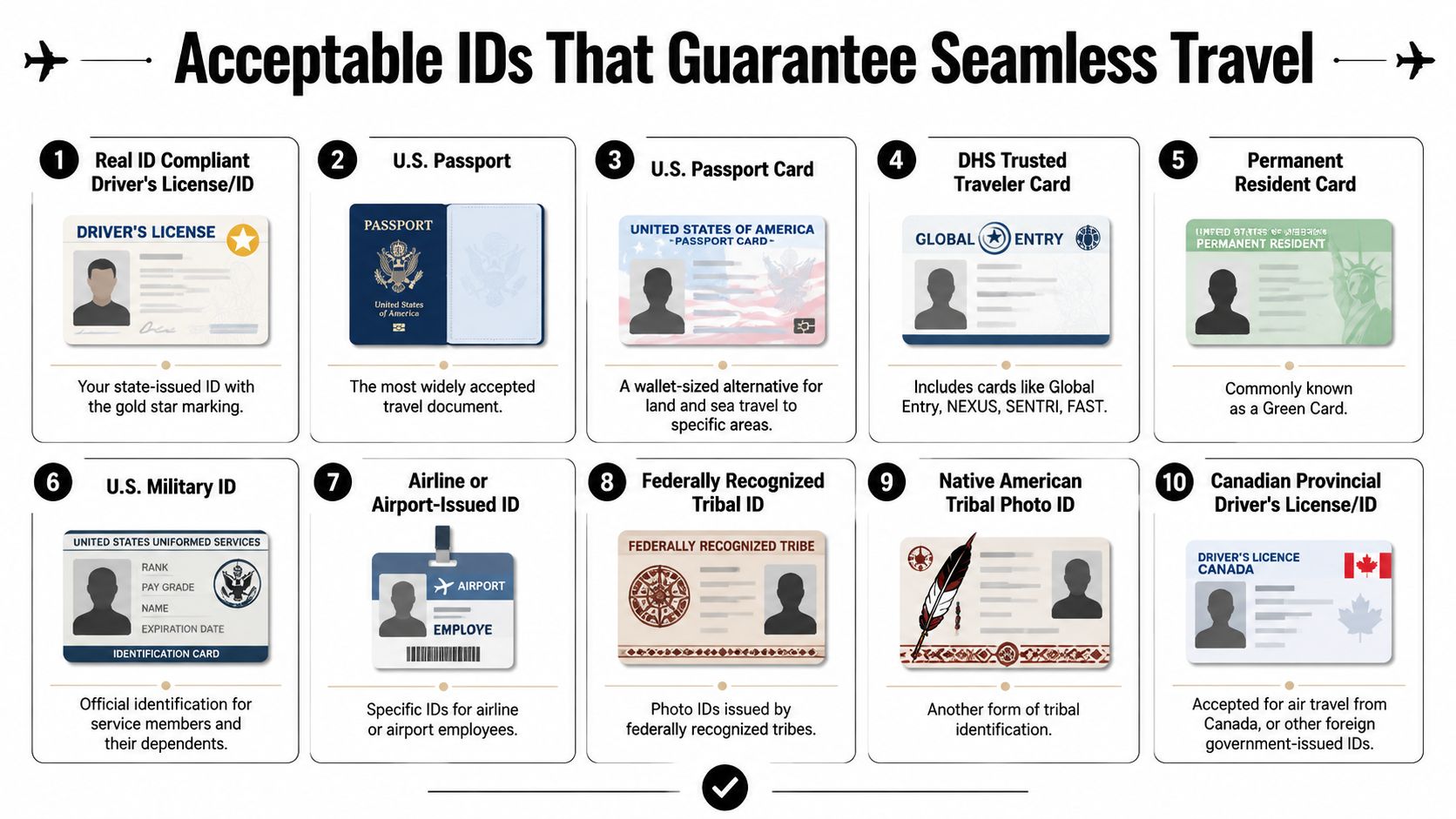
- U.S. passport: The cleanest option. It handles domestic air travel and remains the standard travel document for international movement.
- Passport card: Useful in limited contexts, though not as universally powerful as the passport book.
- Trusted Traveler card: Global Entry and similar cards can serve as accepted identification at checkpoints.
- U.S. military ID: Strong federal credential, widely accepted.
- Enhanced Driver's License: Important for travelers in states that issue them.
- REAL ID-compliant driver's license: Convenient if you want your wallet ID to satisfy domestic commercial requirements.
The broad lesson is simple. You may already have what you need.
Why a passport is still the gold standard
If you own one accepted document that solves nearly every practical travel problem, use it. That document is usually your passport.
A compliant driver's license is good for domestic checkpoint access. A passport does that and far more. It also fits the way affluent travelers move, which is rarely limited to one neat domestic round trip with no changes, diversions, or onward international segments.
Here's a plain decision filter:
| If you already carry | My recommendation |
|---|---|
| Valid U.S. passport | Use it and stop worrying about REAL ID urgency |
| Global Entry or another accepted federal card | You're likely already covered for domestic checkpoint purposes |
| Only a standard non-compliant state license | Fix that before your next commercial domestic flight |
For additional private flight documentation guidance, see what documents are needed to fly private.
A quick visual explainer can help if you're advising family members or staff on what to carry:
What to tell your assistant or family office
Give one instruction, not five.
Travel with a valid passport unless there's a specific reason not to.
That guidance is easy to execute, easy to audit, and far less error-prone than trying to remember which family member has a compliant state license, which one has Global Entry, and which one renewed nothing.
If you still want the convenience of a compliant state license, get one. But don't confuse convenience with the best strategic document. They aren't the same thing.
Navigating Exceptions and High-Risk Contingencies
Your aircraft is waiting at the FBO in Teterboro. Your morning starts with a short commercial hop from Miami because the private leg departs from a different city. You arrive at the checkpoint with the wrong ID, get pushed into identity verification, and the entire day starts slipping. That is how a minor documentation mistake turns into a missed departure slot, crew replanning, and a very expensive scheduling problem.
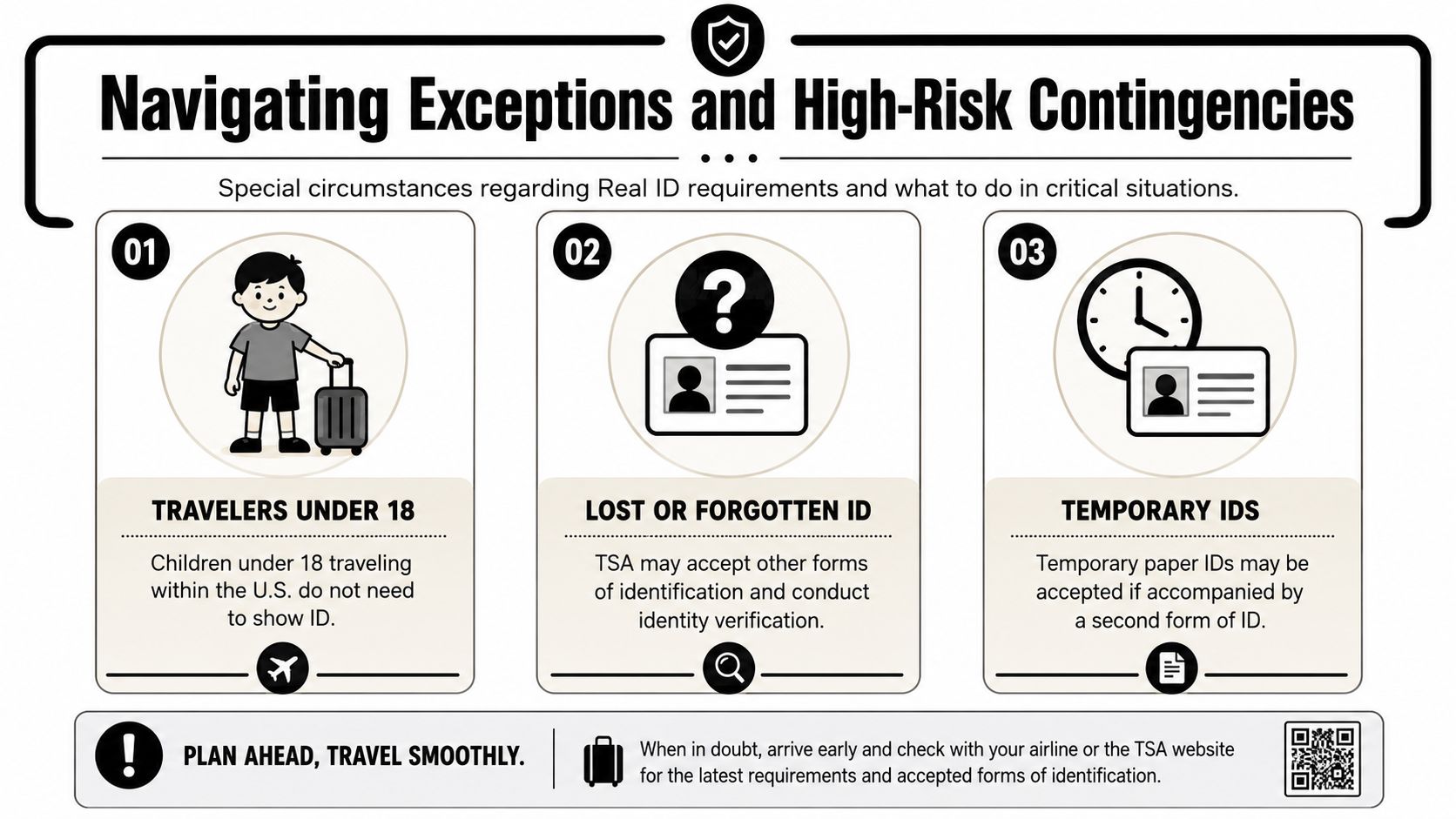
One exception is straightforward. Children under 18 generally are not required to present identification for domestic air travel. Adults should treat that as irrelevant to their own planning. It offers no protection to the principal traveler, the spouse, the executive assistant, or the nanny escorting minors on a mixed itinerary.
ConfirmID is a last resort, not a backup plan
TSA ConfirmID gets mentioned too casually. That advice is sloppy.
According to Airlines for America guidance on REAL ID and ConfirmID, the process carries a fee, has a short validity window, and can involve checkpoint delays long enough to jeopardize a departure. American Airlines security checkpoint guidance also reflects the tighter enforcement posture travelers should expect. For a traveler with a fixed meeting, a connection to an FBO departure, or a same-day international handoff, that is not a workable operating plan.
Use ConfirmID only if the identification side of the trip has already broken down.
Why private aviation clients should care
Private jet travelers sometimes dismiss REAL ID problems as a commercial-terminal issue. That is a mistake. The risk shows up anytime the itinerary includes a commercial feeder leg, a repositioning segment, or an irregular-operations backup that sends you through a standard airport checkpoint.
Actual cost is not the checkpoint delay itself. It is everything attached to it.
- You miss the commercial positioning flight and fail to reach the departure city for your charter.
- You miss the private aircraft's scheduled departure window and force crew, ground transport, and meeting schedules to move around you.
- You break a tightly timed international sequence where customs clearance, handlers, and onward surface transport were arranged to the minute.
If your trip includes cross-border flying, review this guide to customs and immigration procedures for overseas private jet travel. It makes the downstream timing risk very clear.
If you need ConfirmID, your travel prep was not tight enough.
The right way to handle contingencies
Set a document hierarchy and enforce it.
- Primary: Carry a valid passport or another accepted federal credential.
- Secondary: Keep a REAL ID compliant state license if you prefer using it for domestic commercial segments.
- Emergency only: Use ConfirmID after a lost wallet, a damaged document, or another genuine failure point.
That approach keeps your options open if the itinerary changes the night before, weather forces a reroute, or a private segment turns into a commercial one. Relying on checkpoint exceptions is amateur hour. Carry the right document and remove the risk before you leave for the airport.
Your Real ID Action Plan and Decision Guide
By this point, the answer should be clear. If you rely on a state-issued driver's license for domestic commercial travel, that license needs to be REAL ID-compliant. If you already carry a valid passport or another accepted federal credential, you may not need to chase a REAL ID at all.
The mistake is waiting until a trip is imminent to figure out which category you're in.
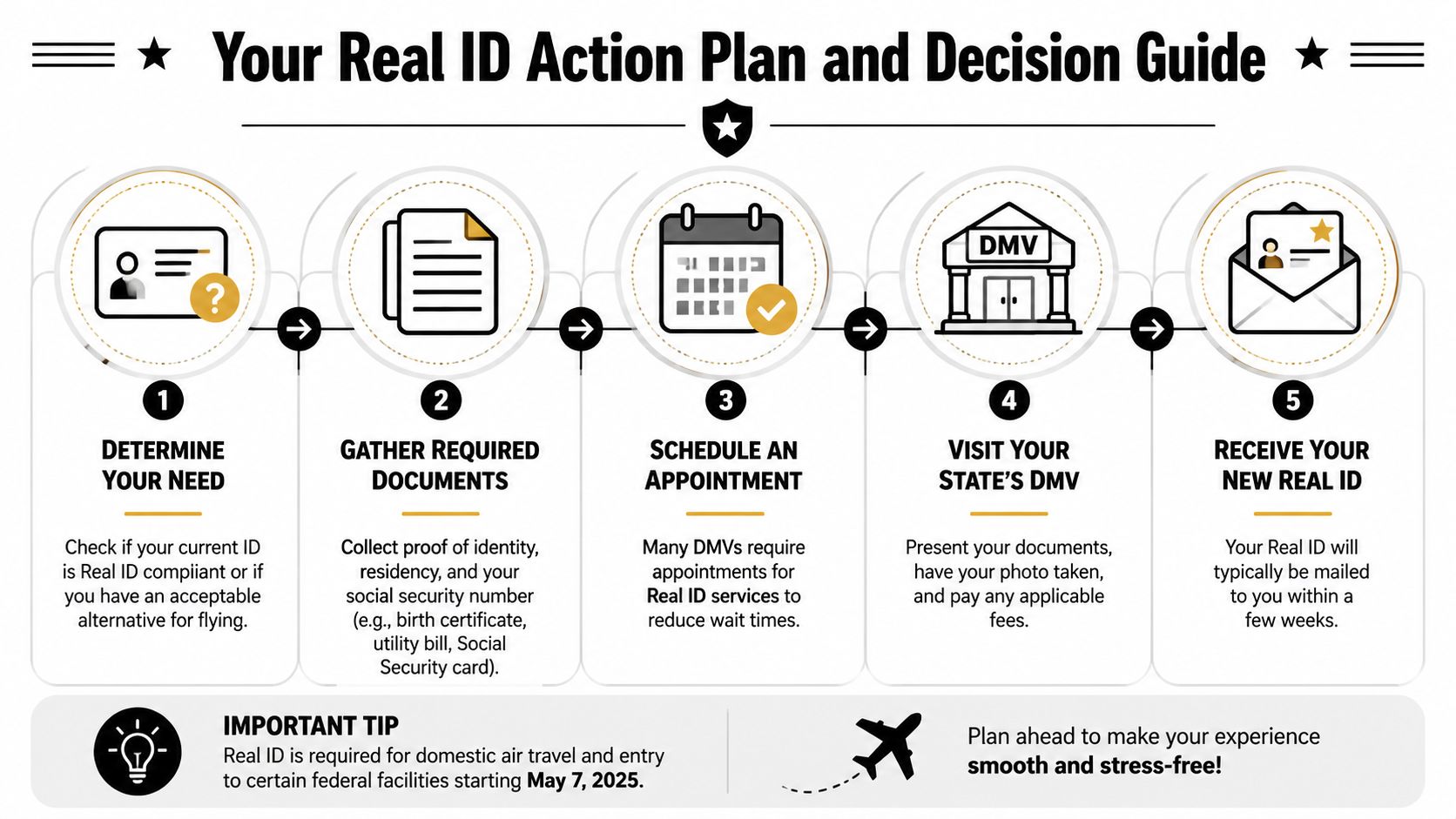
The clean decision path
Use this framework:
- You have a valid passport or accepted federal travel ID: You're in good shape for domestic commercial travel and private aviation use cases.
- You only carry a standard state license: You need to correct that before your next domestic commercial flight.
- You're booking travel for others: Verify the exact document each traveler will physically carry, not the document you assume they have.
The best identification strategy is the one that still works when the itinerary changes the night before departure.
If you need to obtain a REAL ID
The process is simple, but it requires in-person follow-through. In most cases, you should expect to gather original identity documents, proof of residency, and Social Security information before visiting your state DMV.
Keep the process practical:
- Check your current license first: Confirm whether it is already compliant.
- Gather documents in one folder: Don't show up with partial paperwork.
- Book the DMV appointment early: Last-minute scheduling is how routine admin becomes travel risk.
- Update your travel profile: Once issued, make sure your assistant, family office, or travel coordinator knows which ID you'll use.
My direct recommendation
If you travel often, especially across both commercial and private channels, carry a passport. Then decide whether getting a REAL ID-compliant license adds wallet convenience for you.
That keeps the answer to “when is Real ID required to fly” from becoming a recurring issue. You either have the compliant state ID, or you carry a stronger federally accepted document and move on.
If your travel calendar includes commercial connections, private charter, or international onward segments, Haute Jets helps eliminate the operational friction that wastes time and breaks itineraries. When every leg matters, work with a team that understands aircraft sourcing, FBO logistics, and the details that keep high-value travel moving without surprises.