

A private jet from NYC to Miami typically costs $12,000 for a light jet to $35,000 or more for an ultra-long-range aircraft, while super-midsize bookings commonly cluster around $19,000 to $25,000. Distance isn't what creates that spread. Aircraft category, positioning, and scheduling flexibility do.
That makes this route a useful reality check for anyone researching private jet cost NYC to Miami. The flight is short enough for nonstop service in many aircraft classes, yet the invoice can change by more than $10,000 just because you chose a heavier cabin. A smart booking starts by matching the aircraft to your passengers, baggage, and timing, then removing unnecessary repositioning costs.
How Much Does It Cost to Fly Private from NYC to Miami
A one-way charter on this route spans roughly $12,000 to $56,600, depending on aircraft class, availability, and positioning. Published estimates put light jets at $12,000 to $19,990, midsize and super-midsize aircraft at $18,000 to $27,300, and heavy jets at $28,000 to $35,000 or more. Ultra-long-range aircraft can reach approximately $35,000 to $56,600, although that cabin is usually excessive for a New York to Miami trip. See these Haute Jets route estimates for the broad market spread.
For most bookings, a super-midsize aircraft is the practical target. Route estimates commonly place that choice around $19,000 to $25,000 one way, with quoted examples ranging from $17,000 to $27,000, $18,300 to $34,300, and approximately $19,000 to $25,000. The final figure depends on the aircraft offered, its location before departure, and the way the operator builds the quote. You get a more comfortable cabin and greater baggage capacity without automatically paying for a heavy jet.
Why the same route produces different invoices
Block time runs roughly 2 hours 10 minutes to 3 hours, depending on aircraft and routing, so aircraft choice barely changes flight duration. (FlyExclusive route guide, Stratos Jets route information)
The cabin drives the invoice. A light jet burns less fuel and carries lower crew and maintenance costs. A heavy jet provides more space, baggage capacity, and cabin comfort, but its operating costs rise sharply. The route is commonly listed at approximately 1,090 miles, while another guide measures it at about 949 nautical miles. Those measurements show why distance alone does not explain the price. (Hogan Jets)
Broker's rule: Treat the headline quote as a starting point. Ask which aircraft class, positioning assumptions, and fees created it before comparing another offer.
A light jet suits a smaller group with limited luggage. Choose a super-midsize aircraft when comfort and baggage matter. Heavy jets earn their premium only when the cabin solves a specific requirement. The largest savings usually come from finding an aircraft already near New York, because repositioning can create a large markup before your flight even begins.
Private Jet Price Ranges by Aircraft Category
Aircraft category sets the first serious boundary on a New York to Miami quote. The route can land anywhere from roughly $12,000 to $35,000 or more, depending on cabin size, availability, and aircraft positioning. The aircraft already near New York usually offers the cleanest path to the lower end.
| Aircraft Class | Typical One-Way Range |
|---|---|
| Light jet | $12,000 to $19,990 |
| Midsize jet | $18,000 to $25,000 |
| Super-midsize jet | $21,500 to $27,300 |
| Heavy jet | $26,750 to $40,000 |
| Ultra-long-range jet | About $35,000 to $56,600 |
These figures combine published charter estimates. The Haute Jets private jet charter cost guide provides a useful reference point, but the final proposal still depends on the available aircraft and its location. The table uses the commonly booked super-midsize bracket. Broader published spreads can run from $19,000 to $30,000 when different aircraft, operators, and positioning assumptions are included.
Light jets
A light jet is the sensible price choice for a smaller party with modest luggage. Published route estimates place this category around $12,000 to $19,990, with other tables showing figures near $13,000 to $19,800 or $14,750 to $19,990. Global Charter places light-jet pricing in this same general band and lists heavy-jet estimates reaching $40,000, making the class difference clear in one route comparison. (Global Charter route pricing)
Midsize and super-midsize aircraft
Midsize jets generally sit around $19,150 to $24,400. Super-midsize aircraft commonly fall near $21,500 to $27,300, while broader quotes may extend beyond that bracket when positioning and aircraft availability change. These categories make the strongest financial case when you want more seating flexibility, baggage capacity, and cabin room without paying heavy-jet rates.
Heavy and ultra-long-range aircraft
Heavy jets typically begin around $26,750 to $33,000, with practical quotes reaching $28,000 to $40,000. Ultra-long-range options can climb to $56,600. That premium buys a larger cabin and greater range capability, but extra range does not improve a roughly three-hour domestic mission by itself.
The aircraft with the highest price is not automatically the right aircraft for the trip.
A Citation Latitude can suit a smaller party, while a Gulfstream G550 may provide capability the route does not require. Compare usable cabin space, luggage capacity, passenger count, and aircraft location. A locally sourced aircraft can remove the largest avoidable markup before the quote reaches the invoice.
The Hidden Cost Driver Behind Charter Invoices
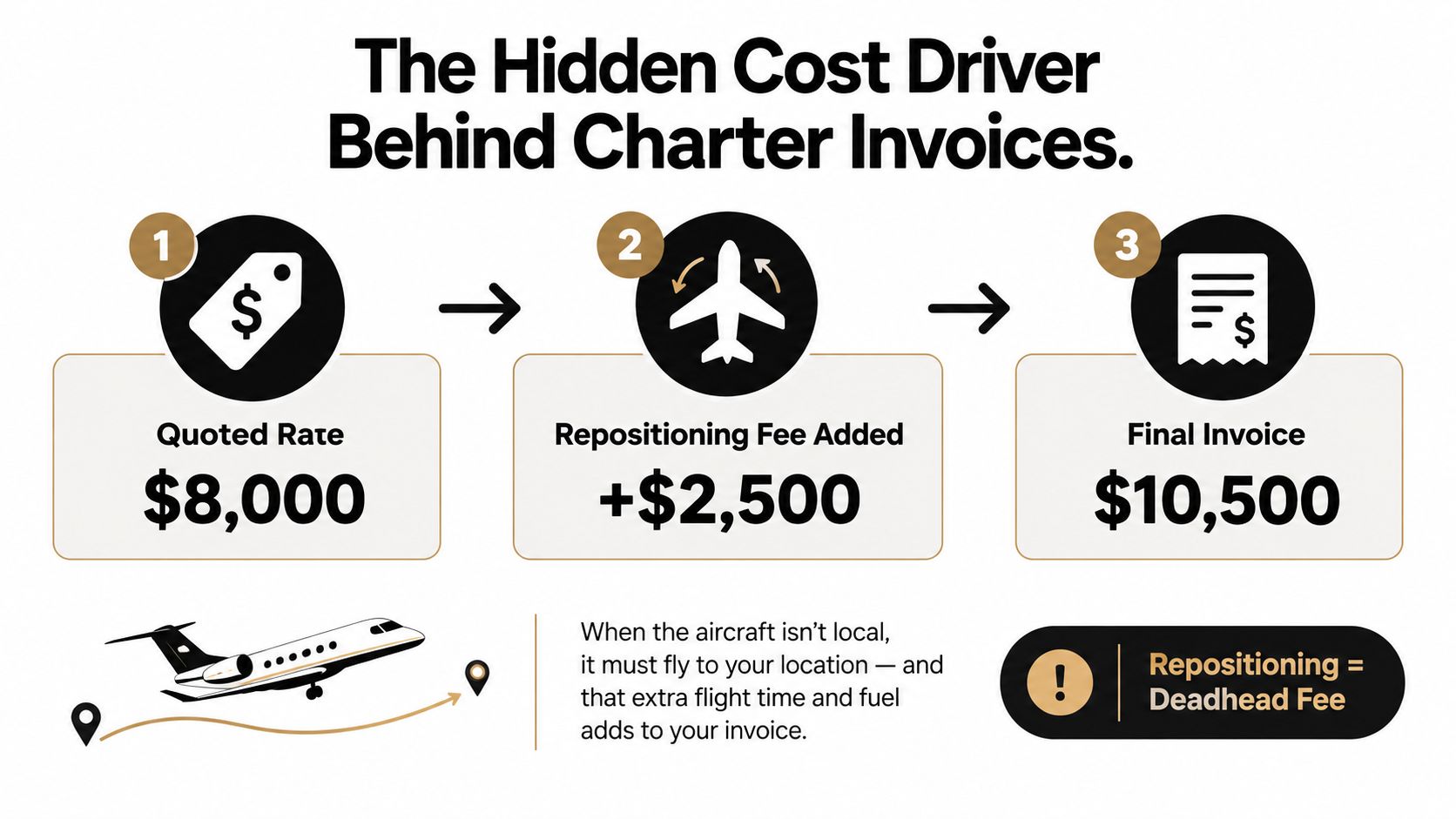
The most overlooked line item is repositioning. Also called a deadhead or ferry segment, repositioning occurs when the aircraft must fly empty to reach your departure airport or return to its next assignment. You pay for that non-productive movement because the operator still incurs fuel, crew, maintenance, and airport costs.
If the aircraft isn't already near New York or Miami, an empty ferry segment can add roughly 20% to 40% to the trip cost. Some operators bill deadhead legs at the full hourly rate, producing a potential 30% to 100% uplift on the final invoice. (AirTraveler explanation of charter invoice markups)
How the markup appears
A quote may look attractive because it highlights only the occupied flight. The final proposal can then include aircraft positioning, crew costs, landing charges, catering, and other trip-specific items. Two identical aircraft can therefore produce materially different totals, even when they fly the same route at the same speed.
The problem isn't that repositioning exists. It's that buyers often compare a clean headline number with an all-in quote and assume the aircraft or broker is overpriced. The correct question is whether the aircraft's location creates an avoidable empty leg.
What to ask before accepting a quote
Ask for a written breakdown that identifies:
- Aircraft location: Where is the aircraft before departure?
- Positioning segments: Is an empty ferry leg required before or after your flight?
- Billing method: Are deadhead hours charged at the same rate as occupied hours?
- All-in total: Which fees are already included, and which remain variable?
The aircraft's starting position can matter more than a modest difference in hourly rate. A lower hourly figure doesn't help if the aircraft must travel a long distance empty before collecting you.
How Local Sourcing Lowers Your Private Jet Charter Cost
Local sourcing attacks the markup created by aircraft repositioning. Ask the charter team to search first for aircraft already based near New York or Miami, rather than accepting the first available aircraft elsewhere. The aircraft's starting location can move a quote by thousands because you may otherwise fund an empty ferry segment before departure.
Removing a single deadhead segment can eliminate the 20% to 40% repositioning uplift identified earlier. On a $19,000 super-midsize quote, that represents roughly $4,000 to $7,600. The saving comes from removing non-productive flight time, not from negotiating a lower hourly rate.
A better sourcing process
Start with your actual departure airport and preferred time. Have the broker search outward from that location before you specify a favorite aircraft model. A comparable aircraft nearby can cost less than a preferred model that must fly empty into position.
Give the sourcing team clear operating requirements:
- Cabin need: Specify whether you need a light, midsize, or super-midsize cabin.
- Passenger details: Provide the number of travelers and expected baggage.
- Aircraft standards: Request the year, make, model, and cabin layout before approval.
- Operational details: Confirm Wi-Fi, catering, pets, and ground transport in writing.
Owner-operator networks can expand the available aircraft pool beyond what a traditional broker can immediately access. Haute Jets connects buyers with owner-operator aircraft and provides route-specific quotes. Its network uses Wyvern Wingman and Argus Gold or Platinum-rated operators, allowing you to review aircraft selection, safety credentials, and positioning in the same quote.
The commercial logic is direct. Fewer empty legs mean fewer non-productive hours to fund. Local sourcing does not guarantee the lowest quote, since aircraft availability and departure timing still affect the total, but it targets the largest hidden markup on this route.
Ask for two versions of the proposal: one using the closest suitable aircraft and one using the aircraft initially offered. Compare the positioning segments, deadhead hours, and all-in totals. That comparison shows whether the apparent aircraft preference is worth the added cost.
For a visual explanation of how a charter team can match aircraft location with client requirements, review the following media:
Empty Legs and Flexible Scheduling Discounts
An empty leg is a repositioning flight an aircraft must operate without its original charter passenger. If your trip matches that movement, the operator can sell the cabin instead of flying it empty, creating the largest potential discount on this route.
Reported one-way empty-leg fares near $3,800 represent savings of roughly 75% or more against full-charter rates of $15,000 to $28,000. Typical savings are often closer to 25% to 50%, because the aircraft, timing, and route must align. The low fare reflects unused positioning capacity, not a standard price for every New York to Miami booking.
For a clear explanation of the operating limits, read this guide to empty-leg flights and their practical trade-offs.
When an empty leg is a good fit
Empty legs reward schedule flexibility. Departure time can shift, the opportunity can disappear if the original charter changes, and the aircraft may not be available for a return that matches your itinerary. You accept those constraints in exchange for a lower fare.
Use this filter:
- Flexible departure: Choose an empty leg when you can wait for a suitable movement.
- Fixed meeting: Book a standard charter when arrival time matters more than savings.
- One-way travel: Empty legs suit travelers who do not need the same aircraft for the return.
- Large baggage load: Confirm luggage capacity before choosing a smaller aircraft because the fare looks attractive.
Treat an empty leg as an opportunity, not a guaranteed booking method. A low price has little value if a schedule change disrupts a board meeting, event, or onward connection.
The strongest savings come from combining flexible timing with disciplined aircraft selection. Accept a broader departure window, then choose the smallest cabin that fits the group and baggage. That approach attacks both major sources of waste: paying for an oversized aircraft and paying to reposition one from elsewhere.
Making the Right Aircraft Choice for Your Trip
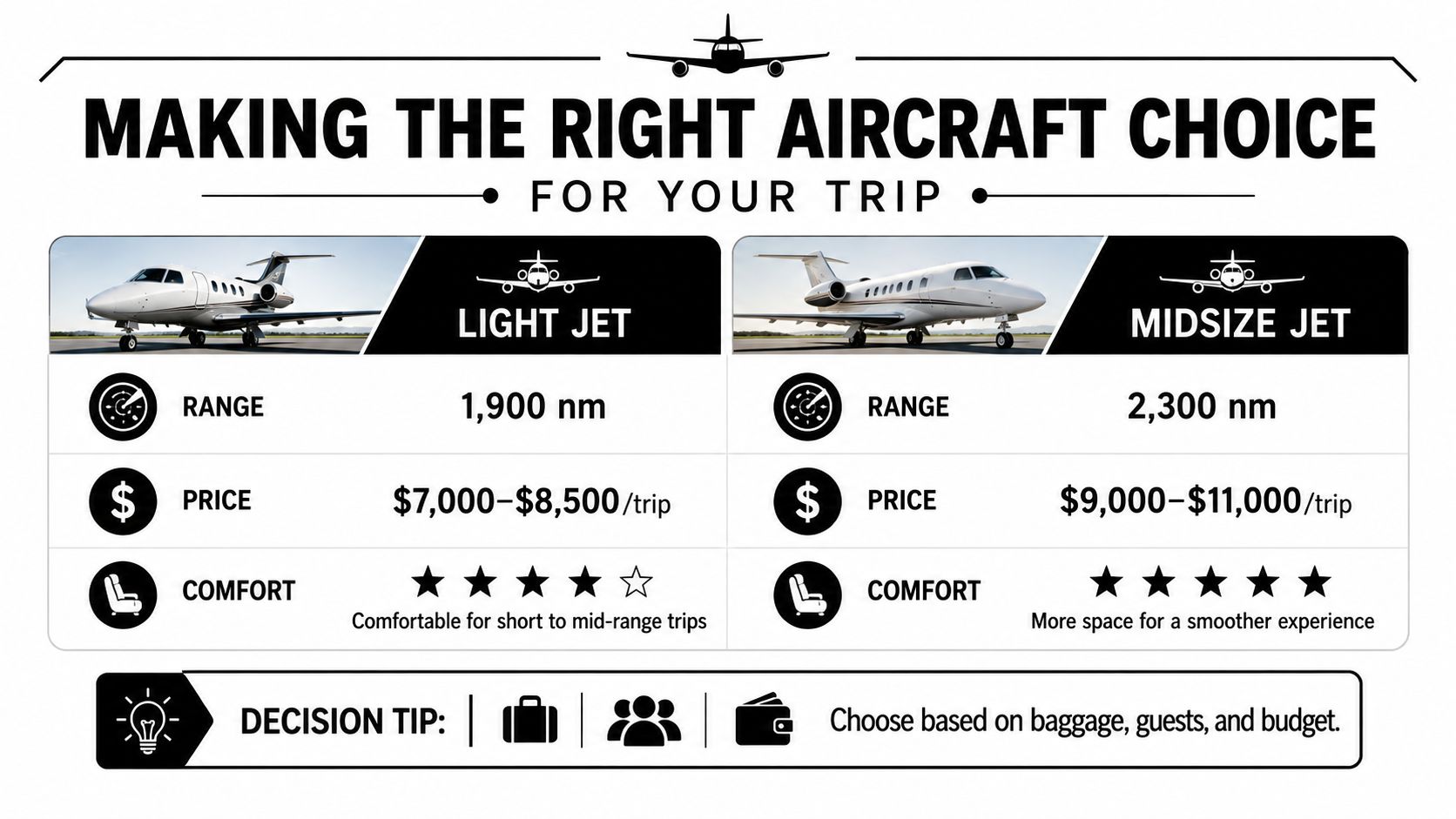
The right aircraft is the smallest cabin that comfortably handles your people, luggage, and expectations. For this route, many aircraft complete the flight in a similar time, so paying for a larger cabin purely to shorten the journey usually isn't rational.
A light jet can work when the group is small and baggage is restrained. A midsize or super-midsize aircraft becomes more sensible when travelers need additional seating flexibility, room for luggage, or a more comfortable working environment. A heavy jet earns its premium only when the cabin requirement is genuine.
Match the cabin to the mission
A Citation Latitude may suit a smaller party that values a credible midsize cabin without stepping into heavy-jet pricing. A Challenger 350 or another super-midsize option can offer a stronger balance when passengers want more space and baggage flexibility. A Gulfstream G550 can be appropriate for a large group or a client who specifically requires its cabin, but the route itself doesn't justify that aircraft for every traveler.
The price difference becomes easier to judge when you separate comfort from prestige:
- Choose light: Keep the total cost controlled when passenger and baggage needs are modest.
- Choose midsize: Add cabin utility when comfort matters but a heavy aircraft would be excessive.
- Choose super-midsize: Prioritize space and luggage capacity for a more relaxed trip.
- Choose heavy: Pay for the aircraft only when its cabin and operational capability solve a defined need.
A realistic booking scenario
Two clients can fly NYC to Miami on the same day and receive very different invoices. One accepts a light jet already positioned near New York and keeps the schedule flexible. Another requests a heavy jet at a fixed time, and the aircraft must reposition before departure. The route hasn't changed, but aircraft category, local availability, and schedule rigidity have.
That is the core buying lesson. Don't ask only, “What does a private jet cost from NYC to Miami?” Ask which cabin you need, where that aircraft is located, and how much control you're willing to trade for a lower price.
Haute Jets offers on-demand charter quotes, access to aircraft from owner-operators, and route-specific sourcing designed to reduce avoidable repositioning costs. Visit Haute Jets to request an aircraft matched to your passengers, baggage, schedule, and preferred cabin.