
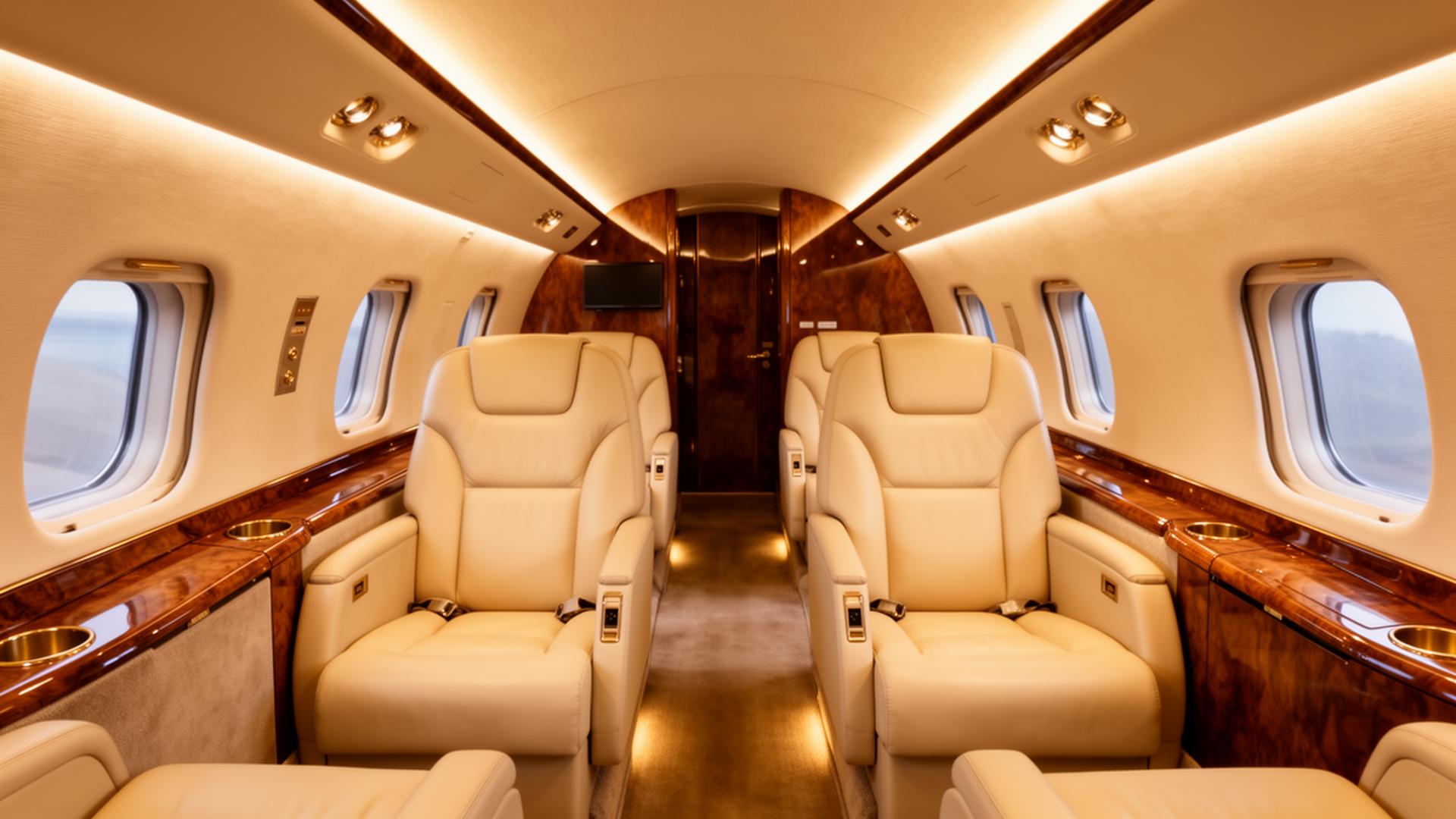
The secret to finding the cheapest private jet charter isn't about cutting corners on safety. It's about outsmarting the system. The most straightforward way is to book on-demand and find an aircraft already based at or very near your departure airport.
This one simple strategy eliminates repositioning fees—a frustrating hidden cost that quietly inflates quotes from traditional brokers and many jet card programs by 20-40%. Smart booking is how you unlock affordable private travel without compromise.
The Truth About Affordable Private Jet Travel

Let's be clear: "cheap" private jet travel doesn't mean flying on a questionable aircraft. It means you've booked intelligently. The charter market has changed dramatically, opening up access far beyond the old-school, exclusive models. It's now a practical tool for anyone who values their time and efficiency.
This shift is fueled by technology that connects you more directly with the aircraft owners themselves. Instead of being locked into rigid, prepaid programs, you can now tap into a live global network of available jets, paying only for the trips you actually take. It's a pay-as-you-go approach that completely changes the economics of flying private.
The Power of On-Demand Charters
The real beauty of the on-demand model is how it slashes unnecessary costs. When you request a flight, the system finds an aircraft already positioned at or near your departure city. From experience, I can tell you this local sourcing is the single most powerful lever for bringing down your final price.
Contrast that with older models, like many jet card programs, which often use a "floating fleet." If you need to fly from Miami to New York but their designated jet is sitting in Chicago, you're the one paying for it to fly empty all the way to Florida to pick you up. We call these repositioning or "ferry" fees, and they can be brutal.
By sourcing aircraft directly from local operators, you bypass the hefty 20-40% repositioning fees baked into many traditional jet card programs and broker quotes. This direct approach provides superior value without compromising quality.
This more efficient model isn't just a niche trend; it reflects a massive market shift. The private jet charter industry is seeing incredible growth, with projections showing an expansion from $24.12 billion in 2025 to $27.38 billion in 2026—a compound annual growth rate (CAGR) of 13.5%.
This boom shows a clear demand for smarter, more flexible solutions. If you want to dive deeper, you can read the full research about these global market trends to see exactly where the industry is heading.
How Different Charter Models Affect Your Price
To truly get the best deal, you have to understand how the different booking models impact your wallet. Each one has a different financial structure, and what works for a frequent flier might be overkill for someone else.
The table below breaks down why the on-demand model consistently delivers better value for most travelers.
| Charter Model | Typical Upfront Cost | Hourly Rate Reality | Common Hidden Fees |
|---|---|---|---|
| On-Demand Charter | Request a quote | Market-based; you see the real price for each trip. | All-inclusive pricing is common; very few surprises. |
| Jet Card | Request a quote | Fixed, but often inflated to cover repositioning costs. | Fuel surcharges, peak day fees, taxi time, international fees. |
| Fractional Ownership | Request a quote | High, plus monthly management fees, regardless of use. | Management fees, occupied hourly rates, repositioning fees. |
As you can see, on-demand offers the most direct and transparent path. You pay for what you use, without the massive upfront deposits or the murky "fixed" rates that often conceal other costs. It's almost always the most cost-effective approach for anyone flying less than 25 hours a year.
Jet cards, requiring you to buy flight hours in blocks of 25, 50, or 100, offer some predictability but at a premium. Fractional ownership is a whole other level of commitment, making financial sense only for those flying well over 100-150 hours annually.
Breaking Down Your Private Jet Charter Costs
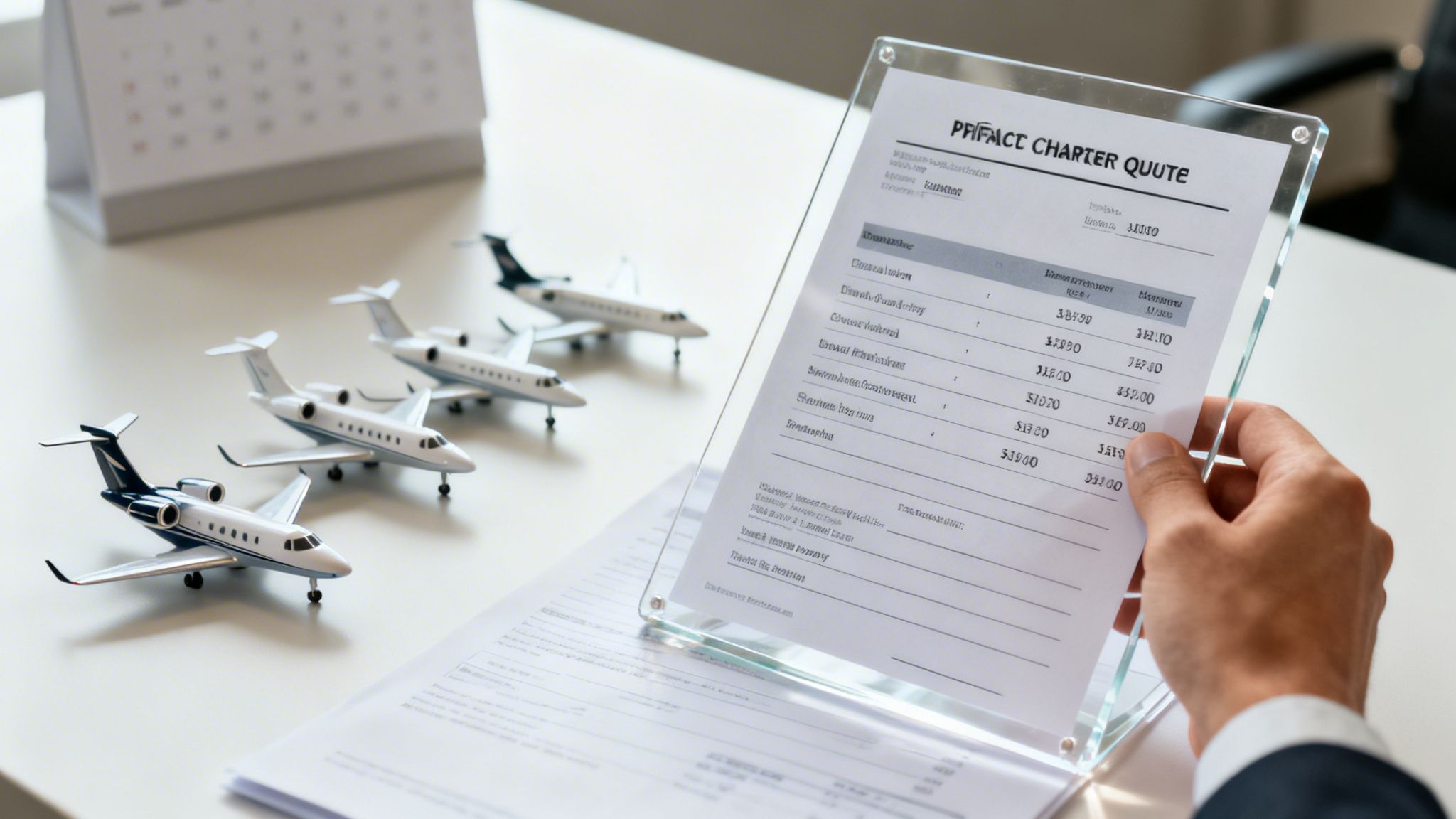
If you want to find the best deal on a private jet, you first need to know how to read a charter quote. A quote isn't just one big number—it's a puzzle of different costs that all add up. Once you understand the pieces, you can spot value, ask the right questions, and know for sure you're not overpaying.
It all starts with the aircraft's base hourly rate, which is the biggest chunk of your bill. This rate is tied directly to the jet's size, age, and what it's capable of. But that hourly rate is just the beginning of the story.
Aircraft Type and Flight Duration
The single biggest line item on your quote will always be the aircraft itself. It makes sense: a bigger, faster jet costs more to fly. But a common mistake I see clients make is automatically picking the plane with the lowest hourly rate. This can seriously backfire.
Think about a flight from New York to Los Angeles. A midsize jet might look cheaper on paper than a heavy jet, but it will almost certainly need a fuel stop. That stop adds landing fees, more flight time, and ground delays. Suddenly, your "cheaper" option ends up costing you more time and money. The key is to always match the aircraft's range to your mission.
The cheapest private jet charter isn't the one with the lowest hourly rate. It's the one that's most mission-appropriate—balancing size, range, and passenger count to operate efficiently without unnecessary stops or oversized capacity.
To give you a better feel for it, here's how the different aircraft categories typically stack up:
- Light Jets (e.g., Phenom 300): Perfect for short trips of 1-3 hours with up to 6 people. Think regional flights like Miami to Atlanta. They're incredibly cost-effective for these kinds of routes.
- Midsize Jets (e.g., Citation XLS): These offer a step up in comfort and range (3-5 hours), making them great for coast-to-coast flights that might require a quick fuel stop. They usually seat 7-8 passengers comfortably.
- Heavy Jets (e.g., Gulfstream G450): Built for the long haul. These are your go-to for non-stop international flights with 10-14 passengers. They offer maximum space and amenities, but also come with the highest hourly cost.
If you want to dig even deeper into how these numbers are put together, our guide to calculating private jet cost per hour breaks it all down.
Airport Fees and Ancillary Charges
Beyond the aircraft, your quote will have several other operational costs. A transparent broker won't hide these—they're just the standard, unavoidable costs of flying.
Airport landing fees, for instance, can vary wildly. Choosing secondary airports is one of the easiest ways to trim your final bill.
You'll also see a few other standard charges itemized on any good quote:
- Federal Excise Tax (FET): This is a 7.5% tax on all domestic flights in the U.S. It's unavoidable.
Finally, you have the extras. While most jets come with complimentary snacks and drinks, if you want specific high-end catering, that's an additional charge. The same goes for in-flight Wi-Fi, de-icing services in the winter, and any ground transportation you need arranged. A reputable charter provider will always list these anticipated costs upfront so there are no surprises when the final bill arrives.
Proven Tactics for Finding Lower Private Flight Prices
Knowing what drives the cost of a private charter is one thing. Actually bringing that price down is a completely different game. This is where we move from theory to the practical, boots-on-the-ground strategies I've seen work time and time again to secure the best possible rates.
These aren't complicated tricks. They're simple, powerful techniques that reward flexibility and a bit of planning. By capitalizing on how the charter market actually operates, you can put yourself firmly in control of the final price.
Hunt for Empty Leg Flights
Let's start with the holy grail of private jet deals: the empty leg flight. This is, without a doubt, the single greatest opportunity for a deep discount.
An empty leg happens when a jet completes a one-way booking and has to fly back to its home base—or to another airport for its next client—completely empty. The operator has already booked the revenue-generating flight, so their goal for this return leg is simply to cover costs. They would rather sell that empty flight for something than get nothing at all.
Just how much can you save?
- Fixed Itinerary: The departure and arrival airports are locked in. You can't change them.
- Time Sensitivity: You might have a small window for the departure time, but you have to be ready to go when the aircraft is.
- Risk of Cancellation: This is the big one. If the original, full-price charter that created the empty leg gets canceled, your flight is canceled too.
Despite the catches, empty legs offer unbeatable value if your plans are spontaneous and you only need a one-way trip. The best ones get snapped up in hours, so you have to be watching. To get a jump on the competition, I highly recommend reading our insider's guide to booking empty leg flights for a deeper dive into finding and securing these deals.
Embrace Shared Flights and Per-Seat Booking
Another powerful way to get into a private jet for less is to simply not book the whole plane. The industry has seen a major shift toward making private aviation more accessible, moving beyond the traditional full-charter model. As manufacturers push the envelope with lighter materials and more luxurious interiors, new ways to share these incredible aircraft have emerged. This evolution is a direct response to a market hungry for more flexible options, a trend that continues to reshape the global private aircraft industry.
This has opened up two fantastic cost-saving avenues:
- Shared Charters: Find another group flying to the same destination and split the cost. It takes a little coordination, but it can literally cut your bill in half.
- Per-Seat Booking: A growing number of operators now run scheduled "shuttle" flights on popular routes like New York to Miami or Los Angeles to Las Vegas. You book just one seat, like on a commercial flight, but get the full private terminal and aircraft experience.
Real-World Scenario: A team of four executives needs to fly from Chicago to a conference in Scottsdale.
Be Smart About Your Schedule
Finally, one of the most reliable ways to lower your charter cost is simply to be flexible with your timing. Private jet pricing is all about supply and demand, just like commercial airlines.
Flying on a Tuesday, Wednesday, or Thursday is almost always cheaper than on a peak-demand Friday or Sunday. The difference can easily be 10-20%, as more aircraft are available mid-week.
The same logic applies to holidays. If you can avoid flying during major peak periods like Thanksgiving, Christmas, or Spring Break, you'll sidestep the surge pricing that inevitably kicks in. Sometimes, even flying at off-peak hours—very early in the morning or late at night—can unlock a better rate from an operator looking to optimize their fleet's schedule.
Cost-Saving Tactics at a Glance
To help you decide which approach is right for you, here's a quick breakdown of the potential savings and the level of flexibility required for each tactic.
| Tactic | Potential Savings | Flexibility Required |
|---|---|---|
| Empty Leg Flights | Varies | Very High (Fixed route, date, and time) |
| Shared Charters | 40% - 60% | Medium (Need to align with another group's plans) |
| Off-Peak Scheduling | 10% - 20% | Low (Flying mid-week or at off-hours) |
| Per-Seat Booking | 70% - 90% (vs. full charter) | Medium (Limited to popular, scheduled routes) |
As you can see, the more flexible you are, the more you stand to save. Even a small adjustment, like shifting your trip from a Friday to a Thursday, can yield significant savings without any major compromises.
How to Book Smart and Avoid Hidden Charter Fees
That low hourly rate you saw advertised? It's almost never the full picture. I've seen countless flyers get excited by a great initial number, only to be hit with a final invoice that's thousands of dollars higher. Finding the cheapest private jet charter isn't about grabbing the lowest base price—it's about understanding the total cost before you sign anything.
The real trap is in the ancillary charges, the little line items that can quickly double the cost of your flight. A trustworthy broker will always provide a detailed, itemized quote. Your job is to know what those items mean and to be ready to question anything that looks off.
Decoding the Charter Quote
Let's break down what you should be looking for in a quote. Don't just glance at the total; dig into the details. A transparent quote will always separate the core flight cost from all the other taxes and fees. If a provider gives you one single, opaque number, that's a major red flag.
Here are the most common fees that can catch people by surprise:
- De-icing: This is the big one, especially in winter.
- International Handling & Permits: Flying across borders means dealing with customs, immigration, and permits. Make sure they are clearly estimated in your quote.
- Catering: Standard snacks and drinks are usually part of the deal, but custom catering is notorious for high markups.
- Wi-Fi: Never assume inflight Wi-Fi is free. Some operators charge by the megabyte, which can result in a shocking bill after a few hours of use. Confirm the cost—if any—before you take off.
The best charter quotes are "all-in," meaning they include solid estimates for every predictable expense like landing fees, federal excise tax, and crew overnights. If a quote looks too good to be true, it's probably because it's missing these crucial costs.
Scrutinizing the Charter Agreement
Once you've found a quote that makes sense, the next step is a deep dive into the charter agreement. This is your contract. Reading it carefully is the single best way to protect yourself from any last-minute surprises or disputes.
Pay special attention to the cancellation policy. There isn't one single industry standard, so you need to know exactly what you'll forfeit if your plans change. What happens if you cancel 30 days out? 14 days out? Or within 48 hours? Also, check the operator's cancellation clause—they should only be able to cancel for legitimate safety, mechanical, or weather-related issues.
This is also a great time to think about your broader cost-saving strategy.
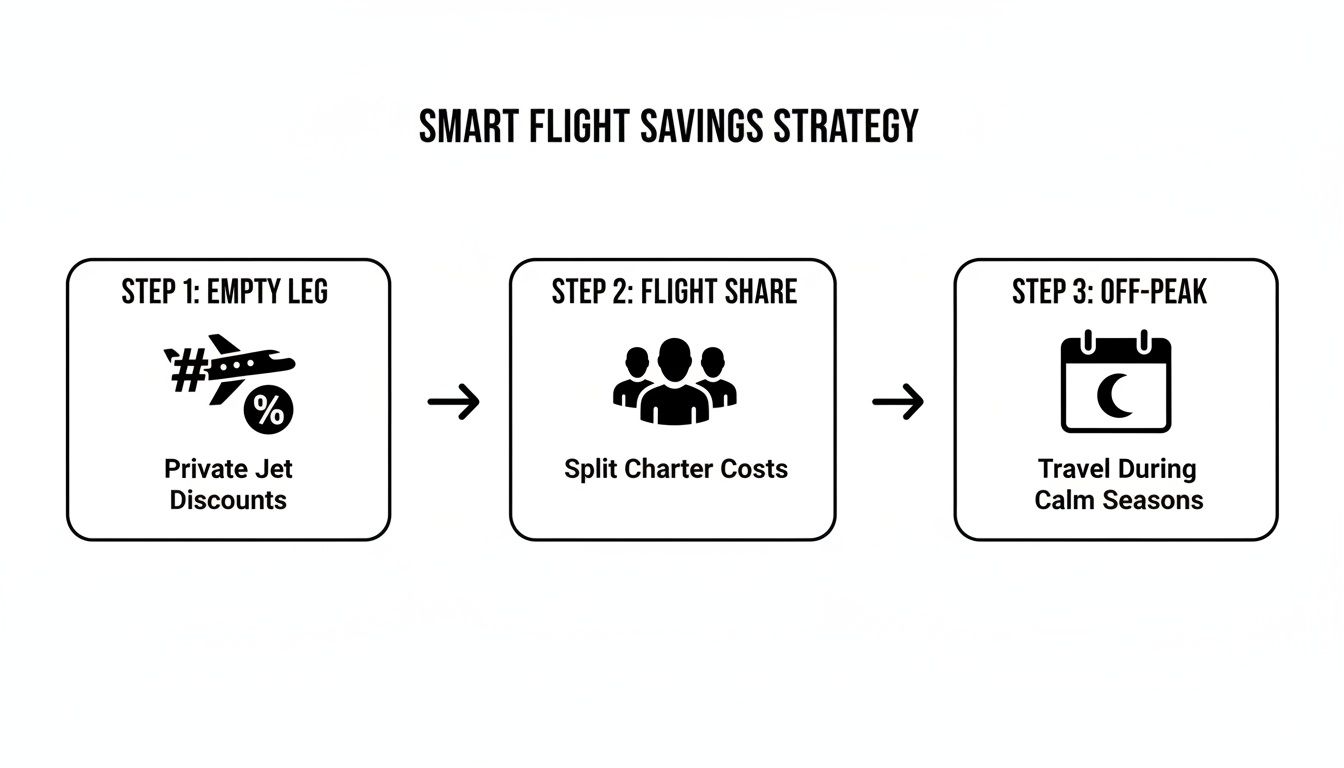
As the visual shows, combining tactics like booking empty legs, sharing a flight, and traveling during off-peak times can dramatically lower your final price.
Prioritizing Safety Above All Else
While you're hunting for a deal, there is one area where you absolutely cannot compromise: safety. Ensuring your aircraft and operator have been independently vetted by a third-party safety auditor is the most important decision you will make.
In private aviation, there are two gold standards for safety ratings: Wyvern and ARGUS.
- Wyvern Wingman: This certification involves a rigorous audit of an operator's maintenance history, safety culture, and operational procedures. It's a sign of a top-tier safety program.
- ARGUS Gold/Platinum: The Platinum rating is the highest possible certification, awarded only after a thorough, on-site audit that confirms an operator's deep commitment to best practices.
I can't stress this enough: never fly with an operator who doesn't hold at least one of these ratings. Any reputable broker will only source aircraft from this pool of certified operators. This ensures that even the most affordable flight option still meets the highest safety benchmarks in the industry. For a deeper look at all the potential costs, our charter pricing guide is a great resource.
On a final note, the payment process is also evolving. While wire transfers and credit cards are still common, a growing number of forward-thinking brokers now accept cryptocurrency. For those who use it, this can add another layer of convenience and privacy to the booking process.
When the Mission Outweighs the Price Tag: Charters for Business and Production
Let's be clear: hunting for the absolute rock-bottom price isn't always the main goal. For certain trips, a private charter stops being a luxury and becomes the only practical way to pull off a complex mission. When you're a corporate travel manager trying to get executives to three cities in one day, or a production coordinator moving a film crew and a mountain of gear, the conversation changes.
It's no longer about finding the cheapest seat; it's about finding the most efficient, secure, and capable aircraft for the job. The real value comes from leveraging private aviation to do things that are simply impossible with commercial airlines.
The Corporate Roadshow and the Multi-City Blitz
For any company's leadership, time is the one resource you can't get back. This is where on-demand charters really shine for corporate travel. I've seen executive teams pull off three-city factory tours in two days—a schedule that would be a week-long logistical nightmare on commercial flights, bogged down by connections and hotel stays.
With a private jet, that entire itinerary becomes a seamless, productive bubble. Instead of burning hours in security lines and airport lounges, your team can hold confidential meetings in the cabin, stay connected with high-speed Wi-Fi, and land at smaller executive airports just minutes from their destination. They step off the plane refreshed and ready to go.
A band on tour needed to play shows in Austin, Nashville, and Atlanta over a 48-hour period. With commercial flights, this schedule would be impossible due to flight times and connections. A chartered midsize jet allowed them to fly immediately after each show, sleep on the plane, and arrive in the next city ready to perform, all while keeping their instruments and gear securely with them.
This focus on efficiency is why business travel has roared back, overtaking leisure as the primary driver for private flights. The data shows that most business charters are for those crucial short-to-mid-range trips of two to four hours. While overall rates are certainly higher than they were a few years ago, you can still find incredible value, especially when you understand the latest private aviation industry trends and how they affect pricing.
For Productions, Teams, and Touring Groups
Film crews, sports teams, and touring artists have their own unique brand of logistical chaos. Their travel isn't just about moving people; it's about moving extremely valuable, often oversized equipment on a razor-thin schedule—all while keeping a low profile.
When you're booking for one of these groups, a few details become non-negotiable. Get these wrong, and the whole trip can fall apart.
- Cargo and Baggage: You have to get a guarantee on the baggage hold. Don't just ask if it's "big enough." Get the exact dimensions and weight limits to make sure every camera case, equipment trunk, and uniform bag will fit.
- Payload vs. Range: Remember this simple rule: a heavier plane can't fly as far. You need to confirm that the aircraft can handle the full weight of your passengers and all that gear and still make the flight non-stop.
- Absolute Privacy: For high-profile talent or athletes, avoiding the main terminal is the whole point. Flying through a private FBO (Fixed-Base Operator) ensures a completely discreet, secure, and controlled experience from the moment they arrive at the airfield.
- Onboard Essentials: On a long-haul flight with a team, amenities like lay-flat seats for rest and reliable Wi-Fi for staying in touch aren't just perks; they are mission-critical tools for performance and morale.
In these situations, the "cheapest" flight is the one that gets the job done flawlessly. It's a costly failure that can derail a multi-million dollar project. A good broker understands this and will focus on finding the most cost-effective aircraft that meets all your requirements, not just the one with the lowest price tag.
Answering Your Questions About Affordable Charters
Even with the best strategy, you're bound to have questions. After years in this business, I've noticed the same ones pop up time and again when clients are looking for the smartest way to charter a jet. Let's clear up the common points of confusion so you can book your next flight with total confidence.
Is an Empty Leg Flight Really the Cheapest Way to Fly?
On paper, absolutely. For a one-way trip where your schedule is wide open, you won't find a better deal.
But that incredible price comes with a major trade-off: you have zero flexibility. The departure airport, destination, and timing are completely locked in. More importantly, if the original charter flight that created that empty leg gets canceled—which happens—your flight vanishes right along with it.
Empty legs are a fantastic gamble for spontaneous, one-way travel. But for reliable, mission-critical trips, a well-sourced on-demand charter will always provide the best balance of value and certainty.
How Can I Be Sure a "Cheap" Jet Is Safe?
This is, without a doubt, the most important question. The answer is simple: cost and safety should never be connected. A "cheap" private jet must be just as safe as the most expensive one. Your focus should never be on the price tag, but on the operator's credentials.
Before you even think about booking, you must verify the operator holds a current, third-party safety audit. There are two names you need to know:
- Wyvern (look for the Wingman rating)
- ARGUS (look for a Gold or Platinum rating)
These ratings are the gold standard in aviation safety. They are non-negotiable. They prove that an operator has passed an exhaustive, independent review of their maintenance, crew training, and overall safety culture. Any reputable broker will refuse to work with operators who don't hold these ratings, ensuring that even the most affordable options meet the industry's highest safety benchmarks.
What Is the Difference Between On-Demand and a Jet Card?
The real difference comes down to the payment model and commitment. Think of an on-demand charter as pay-as-you-go; you source and pay for each trip individually, with no strings attached.
A jet card, on the other hand, is a pre-paid program. You make a significant upfront investment—often $150,000 or more—to buy a block of flight hours at a fixed hourly rate. While that rate seems predictable, it's often inflated to cover the card provider's overhead and is still subject to fuel surcharges and peak-day restrictions. For anyone flying less than 50 hours per year, on-demand chartering almost always delivers a better all-in price because you're paying for the specific aircraft you need, when you need it.
How Far in Advance Should I Book for the Best Price?
This really depends on when and where you're going. For a standard trip during a non-peak period, booking 2-4 weeks in advance usually hits the sweet spot. This gives you a great selection of available aircraft without the last-minute price jump.
However, if you're flying during a major holiday or to a huge event like the Super Bowl, you need to think further ahead. I always advise my clients to book 30-60 days out for these high-demand dates to lock in an aircraft before inventory disappears. The only exception is for empty legs—those incredible deals are a game of patience, often appearing just 72 hours before departure.
Ready to see how affordable your next trip can be? At Haute Jets, we connect you directly with a network of 3,500+ safety-audited aircraft, ensuring you get the perfect jet at the best possible price—with no repositioning fees or membership costs. Get your instant charter quote today.