
VistaJet typically costs $12,000 to $20,000 per flying hour, and its 2026 VJ25 option requires a minimum 25 hours per year for three years, with a Challenger 350 starting around $15,000 per hour. That puts it squarely in the premium, membership-based end of private aviation, which means the primary question isn't just the hourly rate. It's what you're committing to.
Most buyers I speak with aren't trying to decide whether VistaJet is luxurious. It is. They're trying to decide whether the total cost of access makes sense for the way they fly. That's a different question, and it's the one that matters.
A corporate executive with uneven travel patterns, a family that flies heavily one season and lightly the next, or an entrepreneur who needs route flexibility more than brand consistency can easily overpay when they focus on the glossy hourly number and ignore the structure behind it. If you're researching 20. VistaJet cost, you need to look past the marketing language and examine the check you'll really write over time.
Understanding the All-In Cost of Flying Private
A common scenario goes like this. You've outgrown first class. You need private aviation because your schedule is tight, your team travels on short notice, and losing half a day in commercial terminals is no longer acceptable. VistaJet shows up as an obvious option because the brand is polished, global, and easy to recognize.
Then the confusion starts.
You see a premium hourly rate. You hear about guaranteed access, fleet consistency, and a membership structure designed to remove the headaches of ownership. On paper, that sounds clean. In practice, many travelers still struggle to answer one basic question. What does a year of flying cost once your travel pattern meets the contract structure?
That's where people go wrong. They compare private aviation products the way they compare hotel rates. They look at the headline number, not the buying model.
If you haven't already broken down the broader economics of charter, start with this deeper look at private jet cost breakdowns. It helps frame the larger issue. The aircraft rate matters, but the surrounding structure often matters more.
Why the hourly rate is only the starting point
Two clients can pay the same published hourly rate and have completely different outcomes.
One flies enough to justify a committed program and values repeatability above all else. The other has volatile travel needs, changes airports frequently, shifts between short domestic hops and long international sectors, and doesn't want to carry a multi-year obligation just to preserve access. The second traveler usually cares less about a branded fleet and more about buying the right aircraft at the right time for the right mission.
The expensive part of private aviation usually isn't the cabin. It's paying for a model that doesn't match how you travel.
That's the lens you should use for VistaJet. Not “Is it premium?” It is. Ask instead, “Do I fly in a way that benefits from a premium membership structure?”
Decoding the VistaJet Pricing Structure
VistaJet sells access in a way that appeals to travelers who want predictability and don't want to own an aircraft. Its charter pricing typically ranges from $12,000 to $20,000 per flying hour, depending on aircraft type and membership path, according to Elite Traveler's review of VistaJet pricing.
That number sounds straightforward, but the structure behind it matters more than the range itself.
The Program model
The Program is the core VistaJet proposition. It functions as a high-end leased access model for private aviation. You're not buying the jet. You're buying committed access to a service standard, a fleet type, and an operating system built around fixed membership terms.
VistaJet promotes that model as a pay-as-you-fly alternative to ownership. For the right traveler, that can be sensible. You avoid the burden of holding a depreciating asset, handling crew management, and dealing with maintenance exposure. You get a premium service layer and global network logic built into the experience.
That said, it's still a commitment product. It's not the same as casual chartering.
The Direct option
VistaJet also offers Direct bookings for travelers who aren't in the full program structure. That's closer to a traditional charter relationship, though still wrapped in the VistaJet brand and operating style. It can be useful when someone wants occasional access or is looking at a one-off trip.
The key distinction is simple:
- Program buyers are purchasing structured access with commitment.
- Direct buyers are purchasing individual trips without stepping fully into the membership model.
If you're comparing options broadly, this guide to private jet memberships is useful because it shows how card, membership, and on-demand structures differ in real-world use.
A simpler way to think about it
VistaJet Program is like having a luxury chauffeured mobility contract. You commit because you value consistency, availability, and a controlled experience.
On-demand charter is more like using a top-tier car service that sources the exact vehicle you need for the trip at hand. You don't pre-commit to one ecosystem. You buy what fits the mission.
Practical rule: If you love fixed frameworks and your travel volume is consistent, a membership can work. If your flying pattern changes quarter to quarter, commitment becomes a cost, not a benefit.
That's the core trade-off. VistaJet sells certainty. The price of that certainty is usually a premium rate and a tighter framework around how you buy access.
Key Factors That Determine Your Final Quote
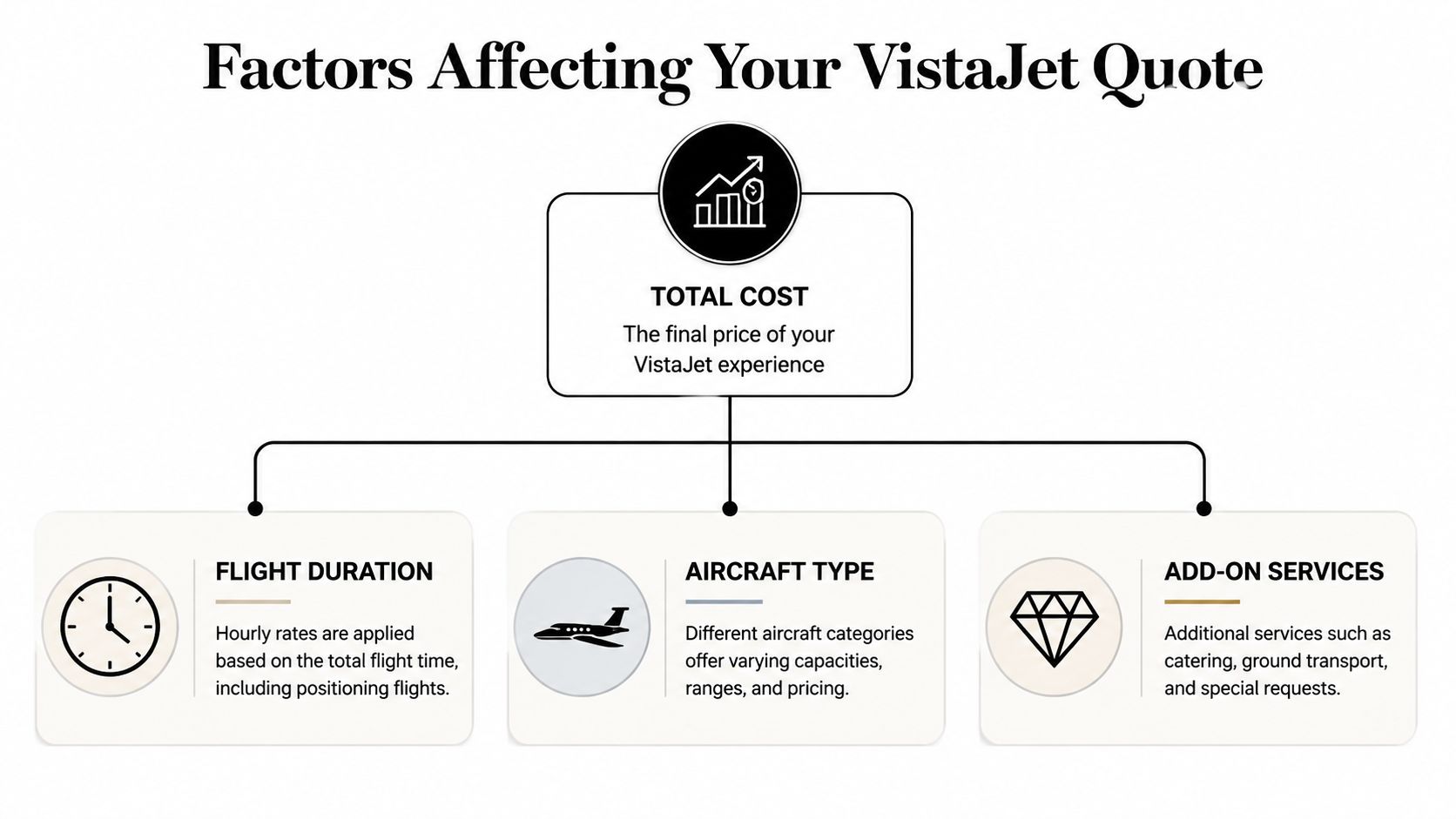
The final VistaJet invoice isn't shaped by one number. It's shaped by several moving parts that determine whether the model feels efficient or expensive for your use case.
Aircraft category changes the economics
The first cost driver is aircraft selection. A traveler booking a Challenger 350 is buying a different mission profile than someone needing a long-range Global aircraft. That sounds obvious, but many buyers underestimate how often their route map shifts them into a larger cabin category.
If most of your travel is regional or domestic, using a premium fleet structure can mean you're regularly paying for more aircraft than the mission requires. That's one of the most common forms of silent overspending in private aviation.
Contracted hours shape the real annual spend
Membership products reward predictable usage. If you know you'll fly consistently and can use your contracted hours efficiently, the structure can feel organized. If your schedule softens, reroutes, or compresses into fewer months, the fixed commitment starts working against you.
Many buyers need discipline here. They should model the year they're likely to have, not the year they hope to have.
Small differences in flying frequency can change whether a program feels efficient or financially heavy. The issue isn't just hourly cost. It's whether your real usage fits the obligation you signed.
Operational variables still matter
Even in a system designed for cleaner pricing, the route itself still affects what you pay. International flying, airport complexity, special service requests, and trip timing can all influence the final total. Anyone evaluating private flight options should understand the broader operating context, including how jet fuel affects private jet pricing.
Some buyers assume a premium membership means every variable has been neutralized. It hasn't. The structure may smooth some pricing friction, but it doesn't make aircraft economics disappear.
Questions smart buyers ask before they sign
Use these questions before treating any quote as “all in”:
- Which aircraft will I use most often? Don't buy around aspirational long-haul trips if your real pattern is shorter regional flying.
- How stable is my annual flight volume? A committed program fits stable demand much better than erratic demand.
- Do I value fleet consistency enough to pay for it? Some travelers do. Many need reliable lift on the right aircraft.
- Will my routes stay similar over time? If your city pairs change often, flexibility becomes more valuable than standardization.
The right answer depends less on status and more on fit. VistaJet works best when your flying profile is steady, premium, and global enough to justify its structure.
Sample VistaJet Cost Scenarios in 2026
A buyer signs up expecting 25 hours of polished, predictable private flying. Six months later, the travel pattern changes, a few trips move to shorter routes, and the primary question is no longer the hourly rate. It is whether the program still makes financial sense.
As noted earlier, the 2026 VJ25 program starts with a 25-hour annual commitment over three years, with Challenger 350 pricing starting around $15,000 per hour and global fleet flying commonly discussed in the $18,000 to $25,000 per hour range. Those numbers matter. The bigger issue is what happens when your actual usage, mission profile, or aircraft needs drift away from the plan you bought.
Scenario one, the disciplined domestic flyer
Start with a client whose flying is mostly U.S. business travel and who expects a Challenger 350 to cover the year. On paper, this is one of the cleaner VistaJet use cases. The traveler values consistency, expects to use the contracted hours, and prefers one service standard instead of shopping every trip.
The problem shows up when real life interrupts the spreadsheet.
If that client flies less than planned, postpones meetings, or shifts part of the travel calendar to commercial first class, the membership structure does not get cheaper. The committed spend is still there. That is the actual cost of access. You are paying for reserved availability and brand consistency, not just occupied flight time.
For a buyer with stable demand, that trade can work. For a buyer with uneven demand, it is expensive discipline.
Scenario two, the international executive
Now look at a traveler using VistaJet for long-range missions. This buyer wants large-cabin access, global reach, and one provider relationship for repeated international flying. In that lane, VistaJet is selling simplicity and standardization as much as lift.
That has value. It also carries a premium.
If several of those trips could be handled just as well through on-demand charter, the difference gets hard to ignore. An on-demand model lets you source the right aircraft for each mission instead of paying for program economics across the full relationship. One trip may justify a top-tier long-range jet. The next may not.
That is where buyers overspend. They buy a platform for every trip when only some trips need it.
Here's a useful brand video if you want to see how VistaJet positions the experience itself:
What these scenarios actually show
The cleanest way to read these examples is to focus on fit, not branding.
| Traveler profile | Likely fit with VistaJet |
|---|---|
| Predictable annual flying and repeat routes | Stronger fit |
| Inconsistent schedule and changing mission size | Weaker fit |
| High value placed on standardized experience | Stronger fit |
| Buyer who wants trip-by-trip aircraft and pricing flexibility | Weaker fit |
VistaJet can make sense for clients who fly enough, fly consistently, and want one polished system. Everyone else should be careful.
If your flying schedule changes often, your routes vary, or your aircraft needs swing from light jet to heavy jet throughout the year, an on-demand model is usually the smarter buy. Haute Jets is often the better answer in that situation because you pay for the mission in front of you, not for a membership structure you may or may not fully use. That is a better way to control total cost.
VistaJet Program vs On-Demand Wholesale Charter
Buyers need to be honest here. VistaJet's model is polished and premium, but it is not automatically the smartest buying model. Often, it isn't.
The biggest mistake in this market is comparing a membership rate to an on-demand quote as if they were the same product. They aren't. One is a structured access contract. The other is a trip-by-trip purchase model.
The real difference is commitment
VistaJet Program is best understood as an access subscription for private aviation. You commit because you want predictability and are willing to pay for it.
An on-demand wholesale charter model works differently. You buy each mission based on actual need, actual route, and actual aircraft availability. That means you can choose a light jet for one flight, a super-midsize for the next, and a long-range aircraft later without forcing every trip into one branded framework.
That flexibility is more valuable than most first-time buyers realize.
Fixed premium versus market-driven sourcing
A branded fleet model carries its own internal overhead. You're paying for consistency, infrastructure, and the simplicity of a centralized platform. There's nothing wrong with that, but buyers should stop pretending it comes free.
An on-demand wholesale model can often be smarter financially because it starts with the mission rather than the membership. The aircraft is sourced to fit the trip, not to justify the program.
The Haute Jets position is straightforward. It sources from 3,500+ aircraft across 175 countries and focuses on locally based aircraft to avoid repositioning fees that can inflate costs by 20 to 40 percent, based on the publisher background provided for this article. That advantage is practical, not theoretical. When you remove unnecessary ferry cost and avoid prepaid membership obligations, many trips become easier to price and easier to justify.
Side-by-side comparison
| Feature | VistaJet Program | Haute Jets On-Demand |
|---|---|---|
| Membership commitment | Required for best program structure | None |
| Hour commitment | Minimum commitment applies in program formats | No prepaid hours |
| Pricing model | Premium fixed-rate structure | Per-flight market pricing |
| Aircraft choice | Tied to program and fleet structure | Exact aircraft selected for the mission |
| Flexibility | Best for predictable users | Best for variable users |
| Repositioning approach | Structured within the VistaJet system | Local sourcing designed to reduce unnecessary repositioning cost |
| Best use case | Frequent flyer who values standardization | Buyer who wants transparency and trip-by-trip optimization |
Where VistaJet wins
VistaJet wins when the buyer values a controlled product and flies enough to justify a long-term relationship. If you want one branded experience, repeatable cabin standards, and global reach under a single umbrella, the appeal is obvious.
That doesn't mean it's cost-efficient for most users. It means it's coherent for a certain type of user.
Where on-demand wholesale usually wins
On-demand charter is usually the better move when your flying pattern changes, your mission size varies, or you care more about buying smart than buying branded.
A private flight buyer should pay for the trip they need, not for a system they might use.
That's why many experienced charter clients eventually move away from rigid membership structures. They realize that flexibility is its own form of value. So is transparency. So is choosing the exact aircraft instead of accepting whatever best fits a prepackaged framework.
If your flying is uneven, domestic-heavy, or opportunistic, a no-membership model is often the more rational choice financially and operationally.
Is a VistaJet Membership Your Best Option
VistaJet is a legitimate premium product. For the right buyer, it works. If you fly often, value consistency more than price optimization, and want a global private aviation relationship instead of trip-by-trip shopping, the model has a clear place.
But most buyers shouldn't default to it.
Who should seriously consider VistaJet
VistaJet makes the most sense for travelers who meet most of these conditions:
- Consistent flying volume: You're confident you'll use committed hours without strain.
- Global route needs: Long-haul and international flying are regular parts of your schedule.
- Service standard matters more than aircraft-by-aircraft shopping: You want repeatability and don't want to compare operators each time.
- You're comfortable with a multi-year commitment: Flexibility matters less to you than system continuity.
Who should think twice
A lot of private flyers admire VistaJet more than they need it.
If your travel pattern is inconsistent, if some years are heavier than others, if many trips could be handled more efficiently on aircraft outside a branded fleet structure, or if you want pricing that reflects the market at the time of booking, you'll usually do better with on-demand charter.
The best private aviation model is the one that fits your travel behavior without forcing you to subsidize a format you don't fully use.
That's the cleanest conclusion here. 20. VistaJet cost isn't just about whether the hourly rate is high. It's about whether the membership architecture produces value for your specific flying life. For a narrow group of high-frequency, consistency-first travelers, it can. For everyone else, a flexible no-membership approach is often the smarter financial decision and the easier operational one.
If you want a clearer way to buy private flights, Haute Jets offers on-demand charter without memberships, prepaid hours, or jet cards. You can request a no-obligation quote, compare the exact aircraft for your route, and see what transparent trip-by-trip pricing looks like before committing to a long-term aviation program.