
You're probably dealing with this decision because your travel has become too important for guesswork.
A board meeting moves. A family trip turns into a multi-city itinerary. An international connection suddenly matters more than the original outbound leg. At that point, the question isn't whether to fly private. It's whether you should prepay into a jet card or keep control with on-demand charter.
Most articles stop at a lazy summary: jet cards offer predictability, charter offers flexibility. That's incomplete. The key decision is about capital lock-up, operational control, and hidden repositioning costs. If you ignore those, you can make an expensive mistake before the wheels ever leave the runway.
Choosing Your Private Aviation Model
A common client situation looks like this. You flew private a few times last year, enough to value the convenience, but not enough to feel confident about committing to a prepaid program. You liked the idea of fixed hourly pricing. You didn't like the idea of wiring a large sum upfront, then discovering your actual travel pattern didn't match the brochure.
That's where the jet card versus on-demand charter decision gets real.
A jet card gives you a structured product. You prepay for hours, accept the provider's terms, and buy a cleaner budgeting experience. An on-demand charter keeps each trip separate. You book aircraft as needed, price each mission based on the market, and avoid prepaid lock-in.
The mistake I see most often is treating this as a luxury preference. It isn't. It's a purchasing model decision, and the wrong one can distort your annual travel spend.
Here's the practical lens I use with private clients:
- If your flying is irregular, don't prepay for certainty you may never fully use.
- If your routes change frequently, don't assume a fixed program will be more efficient.
- If you care about total trip cost, focus on aircraft positioning, not just hourly rate.
- If you need short-notice lift consistently, then service guarantees matter more.
That last point is where jet cards earn their keep. But for many buyers, the hidden issue isn't availability. It's that they're paying for an aircraft to come to them, and they often don't realize how much that repositioning adds until after they've committed.
Understanding Jet Cards and On-Demand Charter
The cleanest way to think about these two models is simple.
A jet card is a prepaid access product. On-demand charter is a per-trip purchase.
How a jet card actually works
With a jet card, you buy a block of hours in advance. In exchange, you usually get fixed or structured hourly pricing and some level of availability commitment. That certainty is the appeal.
The tradeoff is cost. Jet card pricing typically runs 5% to 10% higher than comparable on-demand charter rates, and 25-hour cards can cost from about $150,000 for a light jet to over $300,000 for a heavy jet according to Stratos Jets' comparison of on-demand charter and jet card pricing.
That means you're not just buying lift. You're buying convenience in advance, and funding it upfront.
For some travelers, that works. If you're flying often enough and value predictable access over shopping the market, a card can simplify life. If you're still testing your real travel pattern, it can become an expensive assumption.
If you're comparing broader prepaid access models, it also helps to review how a private aviation membership structure works.
How on-demand charter works in practice
On-demand charter is simpler and, in many cases, more honest. You source the aircraft trip by trip. The market sets the rate. You don't fund a provider in advance, and you don't carry unused hours on your balance sheet.
That doesn't mean pricing is static. It isn't. Charter rates can move based on aircraft type, route, timing, and where the aircraft is positioned. But that variability cuts both ways. If the right aircraft is already near your departure point, you can avoid paying built-in premiums that prepaid programs often hide inside the offering.
You should only prepay for private aviation when your actual usage justifies it, not when the sales pitch makes it sound tidy.
The practical difference
This is the core split.
| Decision Point | Jet Card | On-Demand Charter |
|---|---|---|
| Capital commitment | Prepaid hours required | No upfront commitment |
| Pricing model | More predictable | Market-based per trip |
| Access model | Program terms and service area rules | Broad trip-by-trip sourcing |
| Financial risk | Unused credit and locked capital | No prepaid exposure |
| Best fit | Repeated, structured private flying | Irregular, varied, or evolving travel patterns |
My view is straightforward. If you value transparency and optionality, on-demand charter usually puts you in a stronger position. If you value administrative simplicity and guaranteed access, a jet card may justify its premium.
A Detailed Comparison of Key Decision Criteria
You charter a jet for a 90-minute flight. The quote looks competitive. Then the aircraft has to come in from another market, and the bill jumps by several thousand dollars before your passengers even arrive at the airport. That is the decision point that matters most.
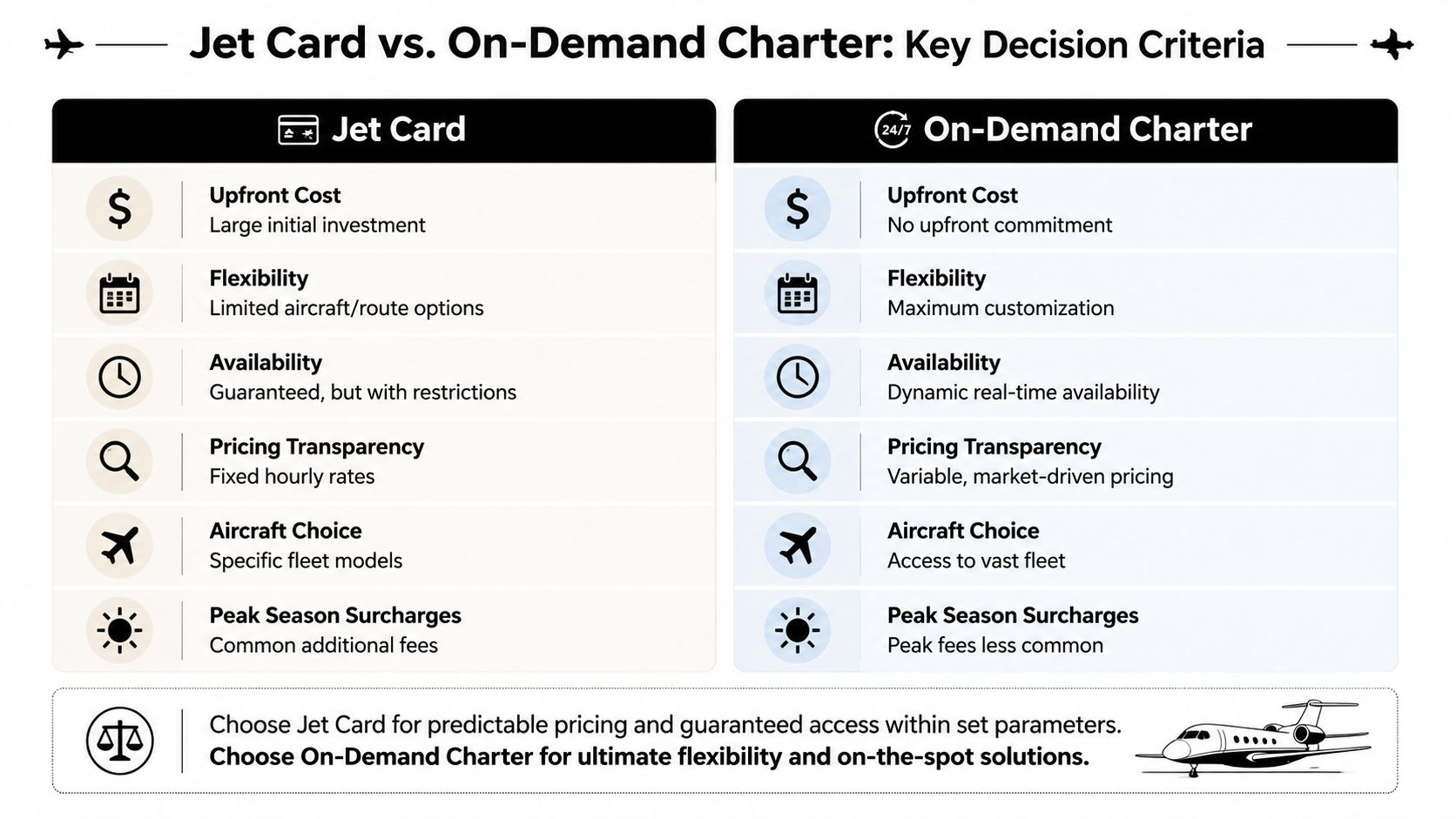
This comparison is less about fixed pricing versus flexible pricing and more about who controls positioning cost, aircraft selection, and unused capital.
| Criterion | Jet Card | On-Demand Charter |
|---|---|---|
| Upfront cost | Large prepaid commitment | No prepaid capital required |
| Pricing style | Fixed or structured hourly pricing | Variable market pricing |
| Availability | Access guarantees with program rules | Depends on live market supply |
| Repositioning exposure | Often embedded in the program economics | Can be reduced if the aircraft is sourced near departure |
| Aircraft choice | Limited by provider program and category rules | Wider trip-specific selection |
| Budget certainty | Stronger on paper | Requires quote review on each trip |
| Best use case | Frequent, consistent flyers with rigid service needs | Buyers who want control, price transparency, and route-specific efficiency |
Pricing and hidden fees
In this situation, buyers either protect their budget or overpay.
A jet card gives you a rate structure. It does not guarantee the best trip economics. Part of the premium pays for access promises, service infrastructure, and the provider's need to cover aircraft availability across a wider network. On-demand charter exposes pricing more directly, especially if the aircraft is already in your departure market.
The key cost question is simple: are you paying only for your mission, or also paying to reposition an airplane that was never local to begin with?
That is why local sourcing matters so much. A broker or charter advisor with broad operator access can often find an aircraft already near your departure airport and avoid unnecessary ferry cost. If you want a clearer baseline for how hourly pricing works before repositioning and taxes get layered in, review this guide to private jet cost per hour.
My recommendation is direct. Ask every provider to separate occupied flight time from repositioning time. If they will not show that clearly, assume you are subsidizing inefficiency.
Availability and service guarantees
Jet cards are built to sell certainty. If you fly on short notice, on repeat routes, and during peak periods, that has value.
Programs are commonly marketed around guaranteed access with as little as 24 hours' notice, according to 5 Star Jets' review of jet card and charter availability dynamics. The tradeoff is straightforward. You are paying for that guarantee whether you use it often or not.
For many clients, that premium is overstated. If your schedule is planned even a few days ahead, on-demand charter often gives you enough access without forcing you into prepaid hours and program restrictions.
Aircraft choice and route fit
Aircraft fit drives cost just as much as hourly rate.
Jet cards usually sell by cabin category. That is convenient, but categories can hide meaningful differences in range, baggage capacity, cabin layout, Wi-Fi quality, and runway performance. On-demand charter lets you match the aircraft to the actual mission instead of accepting whatever fits the program definition.
That matters on complex trips. A family ski weekend, a multi-city executive itinerary, or a one-way coastal hop all call for different sourcing logic. The more specific the mission, the stronger the case for trip-by-trip aircraft selection.
Safety standards
Safety should be evaluated at the operator level, not the payment model level.
A jet card does not make an operator safer. An on-demand quote does not make one riskier. What matters is who operates the aircraft, what third-party audit standards they meet, and whether your advisor can tell you exactly which operator and tail number you are approving.
Serious buyers should insist on that visibility every time.
Cost Analysis with Real-World Flight Scenarios
You get two quotes for the same Friday trip. One looks cheaper on the hourly rate. The other looks higher until you ask where the aircraft is coming from. That second question is where real private aviation economics start.
This decision is won or lost on positioning. A jet card can simplify booking, but prepaid rates often mask the actual cost of aircraft movement across your flying pattern. On-demand charter exposes the trip economics more clearly, especially when the aircraft is sourced near your departure airport instead of ferried in from somewhere else.
Three common trip types
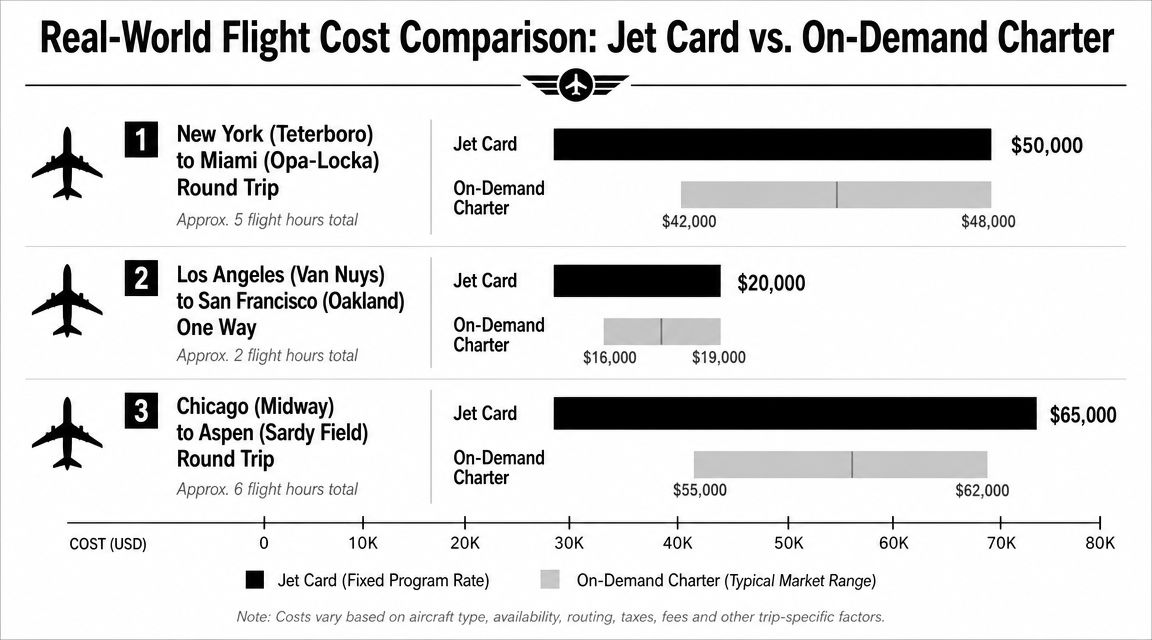
Use the chart as a pricing pattern, not a fixed rate card. The lesson is simple. The more aircraft movement required before or after your leg, the more likely you are to overpay.
- Round-trip business travel can go either way. If the aircraft can wait and return efficiently, the pricing may be close. If the operator has to reposition twice, the gap widens fast.
- One-way short-haul flights often favor on-demand charter. A locally available aircraft can turn a costly mission into a very efficient one.
- Mountain, holiday, and major event routes punish buyers who ignore repositioning. Card holders on these routes often assume they are protected, then discover the premium was baked in long before the trip was booked.
If you want to see how flight time, minimums, taxi time, and billable structure convert into an actual invoice, review this guide to calculating private jet cost per hour.
What to look for in the quote
The headline hourly rate is the least useful number on the page. Ask harder questions.
- Aircraft origin: Is the jet already local, or is it flying in empty before you ever board?
- Trip structure: Does the quote assume a same-day turn, crew overnight, or an empty repositioning leg home?
- Airport fit: Is this aircraft right for the runway, baggage load, passenger count, and weather profile of the trip?
- Pricing transparency: Are you seeing a specific aircraft solution, or just a category price that hides operating differences?
- Replacement exposure: If the original aircraft falls through, what happens to the price and timing?
For buyers, the outcome is either saving real money or donating it. An attractive quote can become expensive once ferry time, daily minimums, and overnight costs show up. A higher initial quote can be the better buy if the aircraft is already in market and the mission is clean.
In private aviation, the cheapest hour is often attached to the most expensive trip.
My read on the scenarios
For most clients with varied domestic flying, on-demand charter is the sharper financial choice. You keep your capital, you price each mission on its own merits, and you can source aircraft locally instead of paying program pricing built around broad guarantees.
Jet cards still fit a narrow use case. If you fly frequently, book late, repeat the same routes, and are willing to pay a premium for operational certainty, a card can work.
Everyone else should focus on all-in trip cost. Ask where the airplane is based, how many empty miles are built into the quote, and whether a local aircraft can cover the mission. That is the difference between a convenient booking process and a smart buying decision.
The 25-Hour Rule A Framework for Your Flight Profile
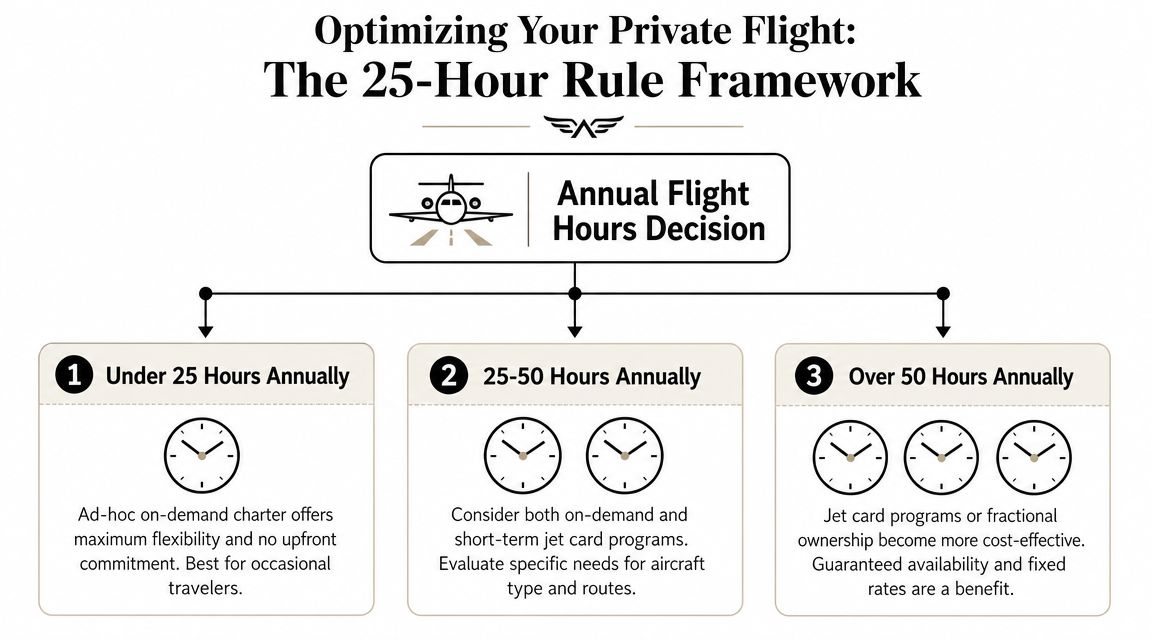
There's one benchmark in private aviation that still holds up. Travelers flying less than 25 hours annually typically get better value from on-demand charter, while 25 to 75 hours per year is the common range where jet cards are positioned, according to BlackJet's overview of jet card versus charter usage patterns.
That rule is useful. It isn't enough on its own.
Under 25 hours annually
This is the easy call. Don't prepay.
If you're flying occasionally, the economics usually favor on-demand charter because you avoid locking up capital and you retain full trip-by-trip flexibility. You also avoid the common problem of buying a block of hours based on intention rather than actual use.
Between 25 and 75 hours annually
Here, sales teams push jet cards hardest, and sometimes fairly.
If your flights are predictable, your departure windows are tight, and you consistently value immediate access over price shopping, a jet card can fit. But frequency alone doesn't settle it. If your routes vary widely, if you regularly change aircraft needs, or if you move between domestic and international missions, on-demand can still be the smarter model.
The mistake is assuming the 25-hour threshold automatically means “buy the card.” It doesn't. It means you've entered the range where you should compare carefully.
Frequent flyer with inconsistent missions
Some executives fly enough to justify a structured program in theory, but their actual missions argue the opposite. One week it's a short regional hop. The next it's a family leisure trip. Then a multi-city investor tour. Then an international cabin requirement.
That traveler often benefits more from precise aircraft selection than from prepaid standardization.
Rule of judgment: annual hours matter, but route consistency matters just as much.
If your schedule is repetitive, a card can work. If your flying profile changes by season, passenger count, or airport type, on-demand charter often keeps you from overpaying for the wrong kind of certainty.
Why On-Demand Charter Is the Modern Choice

The modern buyer wants control. Not another prepaid commitment.
That's why I generally favor on-demand charter for most high-net-worth travelers and corporate principals. You keep your capital. You choose the aircraft for the trip in front of you. You aren't forced into a generic category decision months before your schedule is clear.
Transparency beats lock-in
A locally sourced, trip-by-trip model aligns better with how many clients travel today. Their schedules are less repetitive, their route mix is wider, and their aircraft needs change with the mission.
That's especially relevant if you're traveling across emerging luxury corridors or combining business and leisure patterns. Broader destination demand is shifting, and resources like this Northern Spain Travel market analysis are a useful reminder that luxury travel doesn't move in neat, repetitive lanes anymore.
One operational option in this category is Haute Jets' on-demand charter model, which focuses on sourcing aircraft near departure rather than steering clients into prepaid card structures.
What modern private aviation should look like
It should look like this:
- No prepaid pressure
- Specific aircraft selection
- Clearer quote logic
- Operator vetting that the client can verify
- Trip-by-trip buying discipline
That's a better fit for how discerning travelers move now.
For a closer look at the service side of private aviation, this video adds useful context.
My recommendation is simple. If you're not flying on a rigid, repeatable pattern with constant short-notice pressure, stay with on-demand charter. It's cleaner, usually more transparent, and far less likely to leave you defending a sunk cost.
Frequently Asked Questions About Charter Models
How do you secure last-minute availability with on-demand charter
You secure it with network depth and disciplined sourcing, not with a brochure promise.
A strong on-demand process means searching a broad operator network, prioritizing aircraft already near your departure city, and confirming the exact aircraft quickly. A jet card may offer a formal access guarantee, which is useful, but many last-minute problems are solved the same way in practice: by finding the closest suitable aircraft and locking it fast.
Which model is better for complex international trips
For most complex international missions, I prefer on-demand charter unless your travel pattern is highly repetitive and your card program is specifically built around those routes.
International travel magnifies aircraft fit, crew logistics, positioning, and schedule changes. That makes flexibility valuable. You want the right aircraft for the actual mission, not the nearest category match under a prepaid program.
What happens if the on-demand aircraft becomes unavailable
A serious charter advisor doesn't treat a confirmed aircraft as the end of the job. They maintain backup options.
If an aircraft becomes unavailable because of maintenance, operational change, or crew issue, the next step is to source a replacement aircraft that matches the mission requirements as closely as possible. The quality of the recovery depends on the strength of the operator network and how quickly alternatives can be presented.
When evaluating any charter solution, ask one direct question: what is your replacement process if the confirmed tail cannot operate?
That answer tells you more than the sales deck ever will.
If you're weighing a jet card against on-demand charter, the smartest next step is to review your last year of flying, your real route mix, and how often you need short-notice departures. Then compare that against a trip-by-trip model from Haute Jets, where you can evaluate aircraft choice, pricing transparency, and charter options without committing capital upfront.