
An FBO, or Fixed Base Operator, is the airport business that serves private and general aviation, and in the U.S. there are nearly 3,000 locations. For a private flyer, it's the private side of the airport where your trip begins and ends, part luxury lounge, part concierge desk, and part pit crew for the aircraft.
If you're new to charter, this is usually the first airport term that causes confusion. You know where airline passengers go. They head to the main terminal. Private flyers don't. They typically arrive at an FBO, where the experience is quieter, faster, and far more suited to the aircraft and the traveler.
That matters because the FBO isn't just a building with nice seating. It directly affects how smoothly your departure runs, how discreet your arrival feels, and how efficiently the aircraft is serviced between flights. On Haute Jets Journal, that's the angle worth understanding. The FBO is one of the ground-level decisions that shapes the quality of your entire trip.
Your Exclusive Gateway to Private Aviation
An airport often brings to mind check-in counters, security lanes, gate changes, and crowded waiting areas. Private aviation works differently. If you're taking a charter flight, you'll usually drive to a separate facility on airport property, walk into a calm lounge, confirm your details with staff, and board through a private access point close to the aircraft.
That facility is the FBO.
The easiest way to think about it is this. An FBO is the private aviation version of an airport terminal, but built for non-airline traffic. It handles the ground side of the trip for business jets and other general aviation aircraft, including passengers, crew, and the aircraft itself. A private flyer experiences it as a refined lounge and departure point. The operator experiences it as the on-airport service hub that keeps the flight moving.
Why readers often get confused
Many travelers hear “private terminal” and assume that's the full definition. It isn't. The terminal-like space is only the visible part. Behind the lounge, the FBO team may be coordinating parking, fueling, baggage handling, power support, and ramp access.
A useful shortcut is to think of the FBO as your trip's ground command center.
That's why your experience at one airport can feel very different from another, even if the aircraft category is similar. Some FBOs feel ultra-polished and highly personalized. Others are more functional. The airport may be the same, but the operator, facility standards, and service style can differ.
What it means for a charter client
For a first-time private flyer, the practical takeaway is simple:
- You won't use the main airline terminal: Your driver takes you to the FBO address, not the commercial departures hall.
- You'll spend less time navigating the airport: Staff are focused on private flight movements, not mass passenger flow.
- Your aircraft and your ground experience are connected: The quality of aircraft handling often shows up in how smooth your departure feels.
If you've ever wondered where private jets “go” at an airport, this is the answer.
Defining the FBO More Than Just a Private Terminal
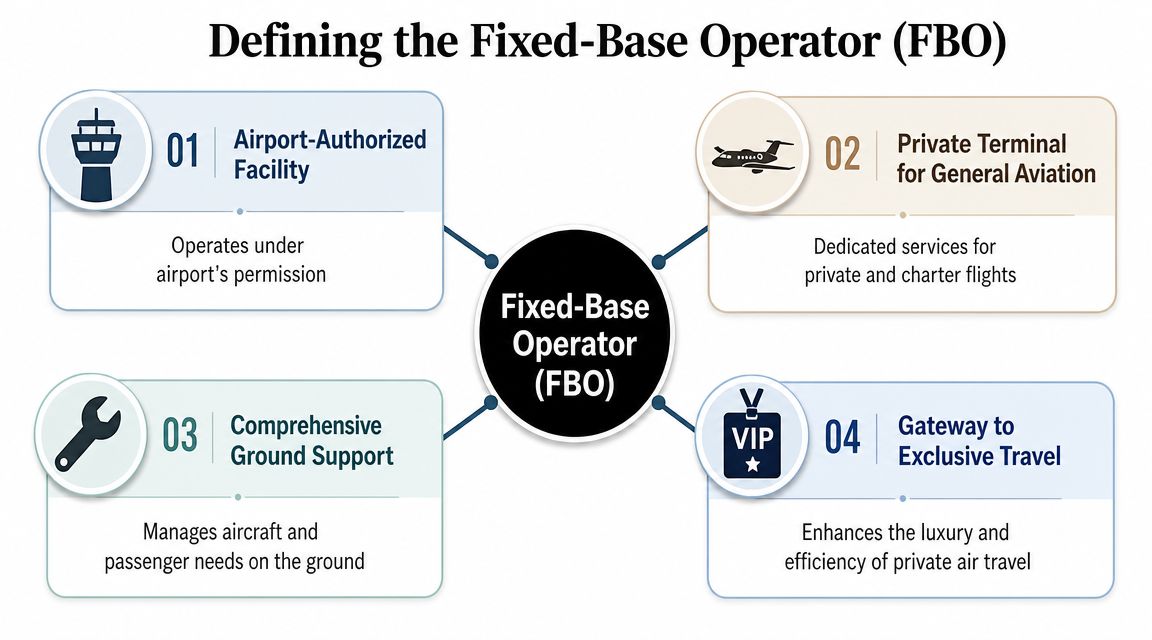
A Fixed Base Operator is an airport-based business that has been authorized to provide aviation services to general aviation users. Historically, the term came from early aviation, when it helped distinguish permanent, reputable operators from more transient flying operations. Today, it refers to the businesses that provide services such as fuel, parking, and passenger facilities at the airport, as described by FLYING's explanation of what an FBO is.
The business, the building, and the service
People tend to mix up three different things:
The operator
The company that holds the airport authorization or lease and provides the services.The facility
The building you enter, often with a reception desk, lounge, meeting rooms, and crew areas.The service package
Everything happening around your flight on the ground, from vehicle coordination to ramp support.
When someone says, “Meet me at the FBO,” they usually mean the building. When a trip coordinator says, “We selected the FBO,” they usually mean the operator and service setup. Both uses are common.
The best analogy
An FBO works like a VIP lounge plus a race team pit crew.
For passengers, it provides privacy, comfort, and personal assistance. For the aircraft, it coordinates the essentials that keep the trip on schedule. Those two roles happen at the same time. That's why an FBO sits at the center of the private flight experience rather than at the edge of it.
Practical rule: If the aircraft is the vehicle, the FBO is the support team that makes the vehicle usable at the airport.
Even small details reflect that role. If you need to get work done before departure, airport connectivity can matter. Travelers who want to review local access options at a commercial airport can compare resources such as Gerald R Ford International Airport Wi-Fi, though private flyers typically rely on the FBO's own passenger and crew amenities rather than the main terminal's setup.
A Look Inside The Full Spectrum of FBO Services
Your time at an FBO is shaped by two teams working in parallel. One team takes care of you. The other takes care of the aircraft. When both sides do their job well, the trip feels calm, private, and well-timed from the moment your car pulls up.
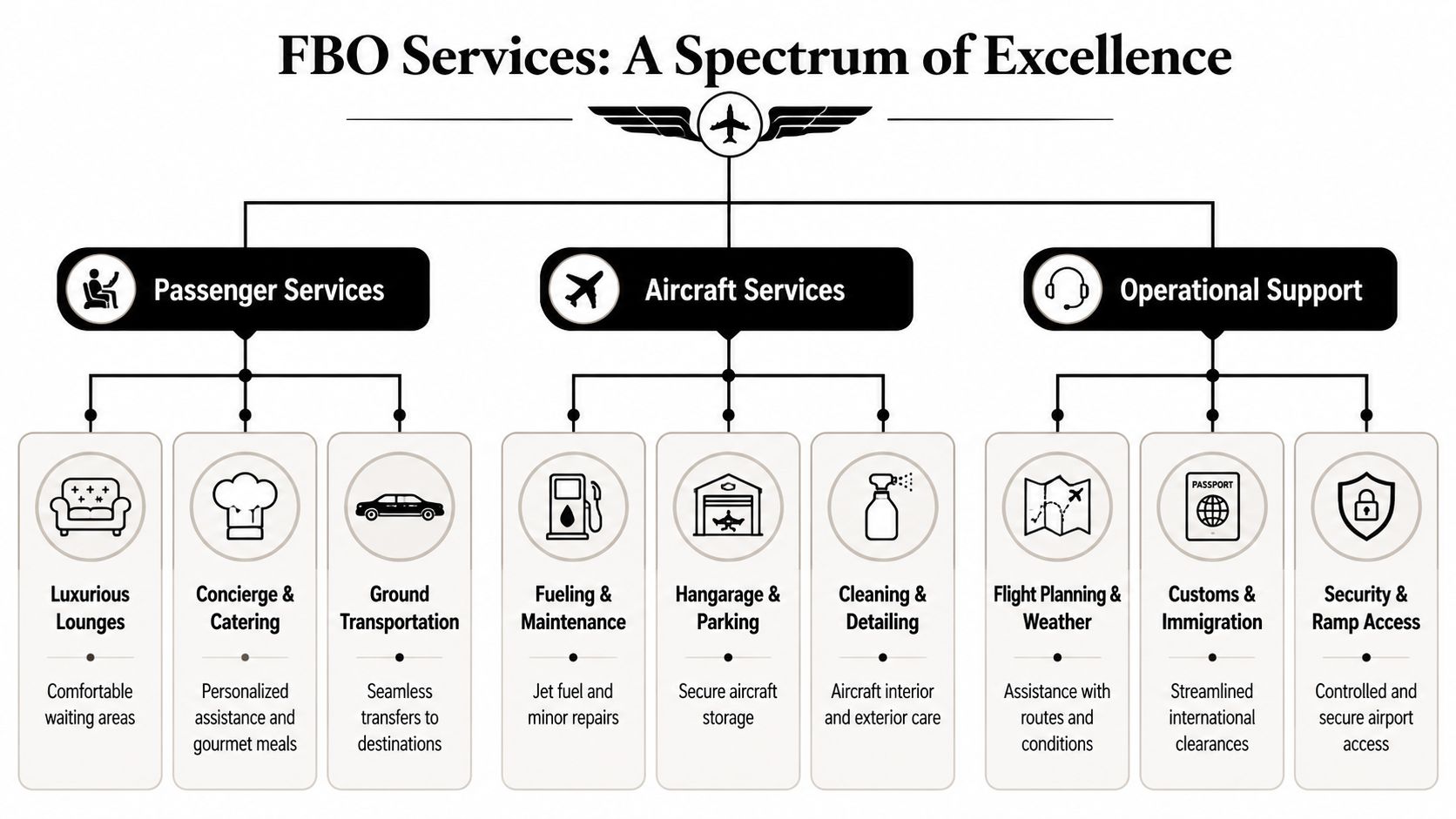
That is why the FBO matters so much to the client experience. It is not only a place to wait. It is the ground operation that protects your privacy, shortens idle time, and keeps small details from turning into delays. If you want a traveler-focused explanation, Haute Jets Journal also covers the benefits of private FBO terminals for jet travelers.
The National Air Transportation Association describes FBOs as airport businesses that support general aviation with services such as fueling, hangar space, maintenance, and passenger amenities, as outlined in NATA's guide to what FBOs do. For a charter client, the easier way to read that is simple. An FBO works like a VIP lounge paired with a race car pit crew. You see the quiet lobby and concierge help. Behind the scenes, another team is fueling, positioning, servicing, and preparing the aircraft for its next move.
Passenger-facing services
This is the side you feel first, and it often sets the tone for the whole trip.
- Private reception and lounge areas: A controlled environment where you can wait comfortably without the exposure of a public terminal.
- Concierge coordination: Staff can arrange catering, ground transportation, hotel communication, and special handling requests.
- Meeting rooms and workspaces: Useful for travelers who need a private place to take calls, review documents, or hold a quick discussion before departure.
- Baggage and guest assistance: Staff can receive guests, move luggage, and coordinate the timing of your boarding so you are not standing around waiting.
Good passenger service saves minutes, but it also removes friction. You arrive, check in smoothly, and move toward the aircraft when everything is ready.
Aircraft support on the ground
Passengers may not watch this part happen, but it often decides whether the day stays on track.
- Fueling: The aircraft is topped off with the correct fuel type and quantity for the next leg.
- Parking and ramp positioning: The aircraft is parked, staged, and moved as needed for arrivals, departures, or overnight stays.
- Ground services: Power, water, lavatory service, and other ramp needs are handled so the cabin and cockpit are ready.
- Turnaround coordination: Ramp staff, pilots, dispatch, and drivers all need to be aligned to keep the departure window intact.
A polished private flight usually depends on work you never see.
Good FBO service feels almost invisible. Your bags are handled correctly, your car is ready at the right moment, and the aircraft is prepared without anyone scrambling in front of you.
Aircraft care and longer-stay support
Some trips involve more than a quick arrival and departure. Weather changes. Aircraft stay overnight. A multi-leg itinerary may need cleaning, troubleshooting, or hangar space between segments.
| Service area | What it supports |
|---|---|
| Hangar space | Protection for the aircraft during weather exposure, overnight parking, or extended stays |
| Maintenance coordination | Inspection support, minor repairs, troubleshooting, and arranging technical service |
| Cleaning and detailing | Cabin refresh, exterior cleaning, and presentation for the next departure |
For clients, these services matter because they protect the schedule and the onboard experience. For Haute Jets, this is one of the practical reasons FBO selection matters. The right facility does more than receive the aircraft. It helps keep the entire trip private, comfortable, and on time.
FBO vs Commercial Terminal A World of Difference
The contrast between an FBO and a commercial terminal isn't subtle. It changes how you arrive, how long you wait, how much privacy you have, and how close you are to the aircraft.
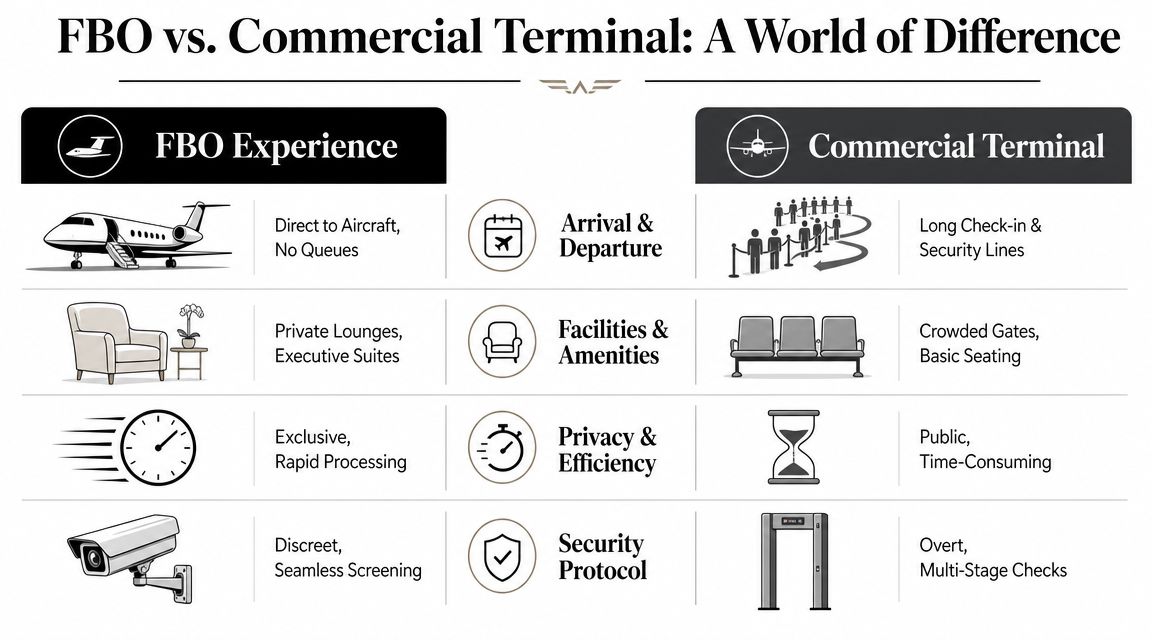
In a commercial terminal, the airport is designed to move large volumes of passengers through standardized processes. In an FBO, the setup is designed around a much smaller number of travelers and a highly specific aircraft movement. That's why the private side feels less like public transportation and more like a coordinated handoff.
Side-by-side experience
| Experience area | FBO | Commercial terminal |
|---|---|---|
| Arrival | Direct arrival at a private facility | Arrival into a public terminal complex |
| Waiting environment | Quiet lounge atmosphere | Shared gate and concourse space |
| Boarding flow | Close coordination with the aircraft and crew | Multi-step airport processing before boarding |
| Privacy | Limited public exposure | High public visibility |
| Ground support | Built around the specific aircraft mission | Built around airline schedules and passenger volume |
One environment is built for throughput. The other is built for control.
Here's a visual example of the broader private terminal experience:
Why this difference matters
People often assume private aviation is only about the aircraft. In practice, the ground experience does a lot of the heavy lifting. If the terminal side feels chaotic, exposed, or slow, the value of flying private gets diluted.
That's why private flyers pay attention to where they'll depart from, not only what they'll fly on. For a closer look at that world, Haute Jets Journal has a useful guide to the world's most exclusive private jet terminals.
The aircraft gets you there. The FBO determines how the trip feels before you ever leave the ground.
The Haute Jets Advantage How FBO Choice Shapes Your Journey
You can charter the right aircraft and still have a disappointing airport experience if the wrong FBO is handling the trip.
At a busy airport, one private facility may move you from curb to cabin in a calm, discreet way. Another may feel cramped, exposed, or poorly coordinated at the exact moment you expected private travel to save time. That is why FBO choice is part of the trip strategy, not just a line item in the ground handling plan.

An FBO works like two things at once. It is your private gateway into the airport, and it is the pit crew supporting the aircraft behind the scenes. Clients usually notice the first part right away. The second part matters just as much, because a well-run facility helps keep the departure organized, the baggage flow clean, and the handoff between driver, staff, and crew on track.
What changes when the right FBO is selected
The difference shows up in practical ways:
- More privacy: Some facilities offer a quieter arrival flow with less public visibility from curb to aircraft.
- Less wasted time: Better coordination between the FBO, crew, and ground transportation reduces waiting and last-minute confusion.
- A better preflight environment: Lounge comfort, meeting space, staff attentiveness, and overall pace vary widely from one operator to another.
- Stronger operational support: Fueling, catering coordination, baggage handling, and aircraft positioning are handled more efficiently when the facility is a good fit for the mission.
This is where experience matters. Two FBOs at the same airport can produce very different travel days for the same client.
What a client should expect
If you are booking a private jet with Haute Jets, the FBO is typically chosen around your itinerary, aircraft requirements, arrival timing, and personal preferences. For a first-time charter client, that planning may feel invisible. That is usually a good sign. The goal is for the airport portion of the trip to feel simple because the details were handled in advance.
On the day of travel, the flow should be clear:
- You receive the correct FBO address and arrival instructions.
- Your driver goes to the private facility, not the commercial terminal.
- Staff greet your party, confirm the flight, and coordinate baggage and boarding.
- The aircraft and ground team are already aligned on timing, servicing, and departure flow.
The best FBO choice protects the three things private flyers care about most. Privacy, time, and comfort.
That is the core value Haute Jets manages here. The aircraft is only part of the experience. The right FBO helps make the entire journey feel controlled, quiet, and easy from the moment you arrive at the airport.
FBO Frequently Asked Questions
Can I choose my own FBO
Sometimes, yes. At airports with multiple operators, clients may have a preference based on privacy, amenities, location on the field, or previous experience. In other cases, the aircraft operator or airport setup may make one choice more practical than another.
If you do have a preference, bring it up early. FBO selection can affect both ground flow and handling quality.
Is the FBO cost included in my charter quote
Usually, FBO-related handling is part of the broader trip economics, but the structure can vary by airport, operator, and itinerary. The smart move is to ask for clarity on what's included and what may be passed through as a separate airport or handling charge.
The key point is transparency, not assumptions.
Are all FBOs the same
No. Quality, service level, facility design, access rules, and pricing can vary widely. A common point of confusion is whether an FBO is a building or a service. It's both, and the term can refer to the operator, the physical facility, and the service package, as explained by the Aviation Employment Network discussion of what an FBO is.
What should I remember as a first-time private flyer
Keep it simple:
- Go to the FBO address, not the airline terminal
- Expect a quieter, more direct airport experience
- Ask who selected the FBO and why
- Treat FBO quality as part of the flight experience, not an afterthought
If you're planning a charter and want clear guidance on the aircraft, the airport, and the FBO experience that fits your trip, Haute Jets can help you review the options before you fly.