
You're probably not deciding between private jet and first class for a random leisure weekend. You're deciding because the trip matters. A board meeting moved up. A family office team needs to hit two cities in one day. A child, parent, or client needs you there on your schedule, not the airline's.
That's why most articles on 29. private jet vs first class get the question wrong. They compare a seat price to an hourly charter rate and stop there. That's lazy analysis. If your time carries real economic value, the right comparison is door-to-door efficiency, schedule control, privacy, and group economics.
First class is excellent. On the right route, it's the sensible choice. But private aviation isn't just a more luxurious seat. It's a different operating model entirely. If you value time, confidentiality, and control, private charter often delivers the stronger outcome even when the invoice is higher.
Beyond the Ticket Price
The decision isn't luxury versus luxury. It's shared infrastructure versus controlled logistics.
A first-class ticket buys the top experience available inside a commercial system. You still work around airline schedules, major airport terminals, fixed routing, boarding windows, and the inefficiencies that come with moving hundreds of passengers at once. You may sit beautifully. You still travel on someone else's timeline.
A private charter does something else. It compresses friction. It lets you choose the departure time, the airport, the cabin environment, the passenger list, and the pace of the day. For a high-net-worth traveler or executive team, that difference matters more than champagne quality or seat width.
Practical rule: If the trip is time-sensitive, reputation-sensitive, or schedule-sensitive, stop judging the decision by fare price alone.
Here's the framework I use with clients:
| Decision factor | First class | Private jet |
|---|---|---|
| Best for | Solo premium travel on major routes | Time-critical travel, groups, complex itineraries |
| Pricing model | Per seat | Per aircraft |
| Schedule control | Limited | High |
| Airport access | Major commercial network | Wider access to private-capable airports |
| Privacy | Partial | Strong |
| Multi-stop efficiency | Weak | Strong |
| Door-to-door speed | Often slower | Often faster |
The wrong way to buy premium air travel is to ask, “Which one is cheaper?” The right question is, “What does arriving late, tired, exposed, or off-schedule cost me?”
For some trips, first class wins easily. For others, private aviation isn't indulgence. It's operational discipline.
Buying a Seat vs Chartering Your Own Sky
Most travelers still compare these options as if they're versions of the same product. They aren't.
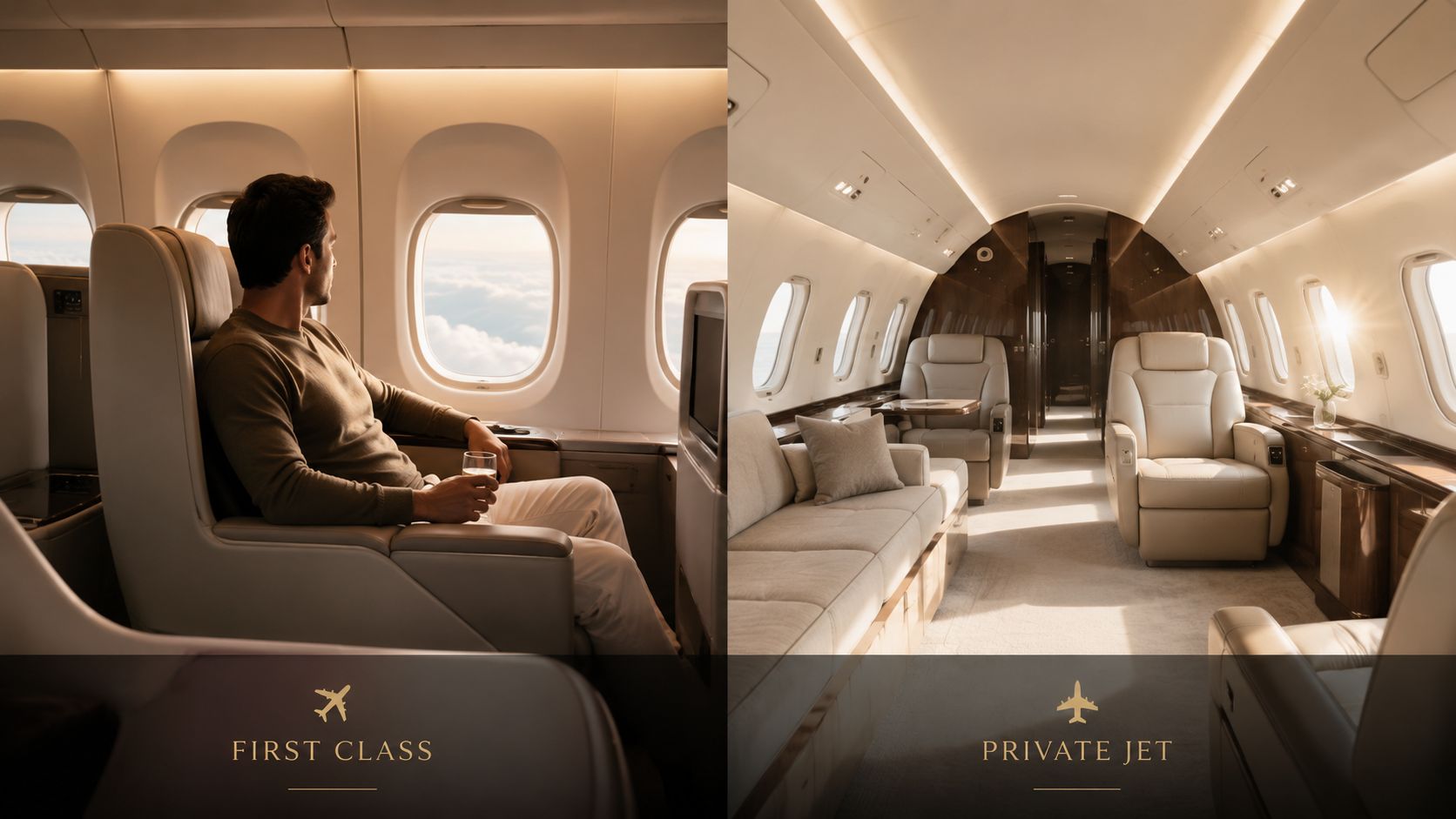
First class is a premium product inside a mass system
First class gives you the best seat, the strongest service tier, and a far better airport experience than the rest of the aircraft. That matters. On a long nonstop route between major cities, it can be the smart buy.
But you're still buying access to a scheduled network. The airline decides when you leave. The airline decides where you connect. The airline decides how long you wait if something shifts. Even at the top cabin, you're still one passenger inside a giant machine.
Private charter is a transport service built around you
A private jet is not just a nicer cabin. It's a custom flight operation. You aren't selecting seat 2A on a prebuilt schedule. You're commissioning an aircraft to perform a mission around your needs.
That changes everything:
- Departure timing: You choose the time window.
- Airport strategy: You can use airports that better fit your origin and destination.
- Passenger control: Everyone onboard is there because you want them there.
- Cabin function: The aircraft can be a boardroom, a family space, or a quiet recovery environment.
First class sells comfort within constraints. Private aviation sells freedom from constraints.
That's why the usual “private jet vs first class” debate misses the point. The seat is not the product. The product is control.
Why wealthy travelers misjudge this decision
Many buyers focus on visible luxury because it's easy to compare. They ask about catering, bedding, and cabin finishes. Those things matter, but they aren't the main drivers of value.
Advantages of private aviation show up before and after the flight. No major-terminal churn. No shared boarding environment. No wasted afternoon because the only practical departure was too early or too late. No redesigning your day around an airline timetable.
If your trip has no urgency, no confidentiality concerns, and no routing complexity, first class is often enough. If the trip has consequences, charter changes the economics by changing the operating model.
A Comprehensive Cost Breakdown
Start with the right frame. You are not buying a better seat. You are deciding whether to pay for an airline product or for control of an entire trip.
For one traveler, first class usually wins on cash price. American Express notes that domestic first class can run from a few hundred dollars into the low thousands, while international first class often climbs much higher depending on route and carrier, as outlined in its guide to how much first class flights cost. Charter pricing works differently. Air Charter Service explains that private jet costs are typically quoted by aircraft type and flight time, not by seat, in its overview of private jet charter prices.
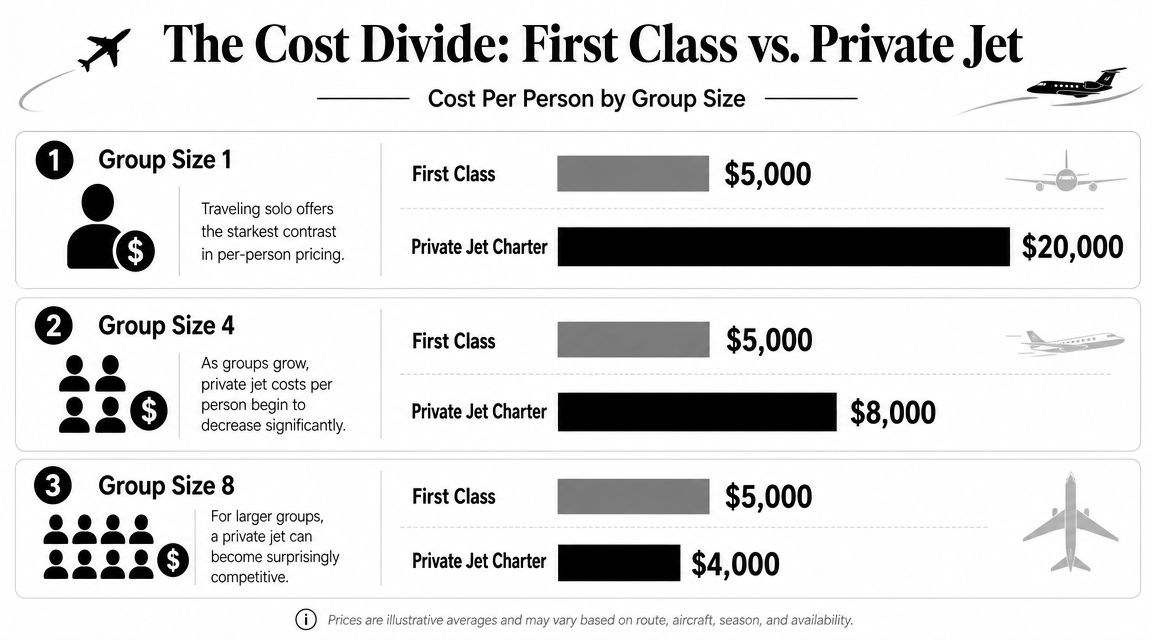
The real pricing difference
First class is a retail purchase. Private charter is an aircraft mission.
That distinction matters because private aviation cost is shared across the group. Add more passengers and the per-person number can move quickly. First class usually scales in the opposite direction. Every additional traveler means another full fare, and often another set of schedule constraints.
Here is the practical read:
| Traveler profile | Likely value winner |
|---|---|
| Solo flyer on a major city pair | First class |
| Couple on a standard route | First class |
| Family or small business group on a short route | Depends on time sensitivity and airport access |
| Team travel with several passengers | Private charter often makes better economic sense |
Long-haul is a different decision
On transatlantic and ultra-long-range trips, private aviation is usually not the lower-price option. It is the higher-control option. Industry pricing snapshots from PrivateFly's private jet cost guide show how sharply aircraft costs rise as range and cabin size increase.
If you are flying alone from New York to London, first class is the rational purchase on fare economics. If you are moving principals, advisors, and family members on a fixed schedule with confidentiality requirements, the math changes because the trip itself has higher stakes.
The costs that distort the comparison
Many buyers often get lazy. They compare airfare to charter quote and ignore the rest of the trip.
Those hidden costs are often more expensive than the cabin difference:
- Positioning to the airline network: You may need to start from a larger airport that adds drive time and friction.
- Hotel nights created by schedule gaps: A bad timetable can turn a one-day trip into two.
- Executive time lost in the middle of the day: A delayed meeting, missed site visit, or dead airport block has a real cost.
- Team fragmentation: Separate bookings, separate arrivals, and misaligned schedules create coordination waste.
For a more detailed look at how aircraft category, routing, and operating variables affect charter pricing, see this private jet cost breakdown.
My recommendation on cost
Use first class if you are traveling alone or as a pair, your route is well served, and the airline schedule already fits your day.
Choose private charter when time has measurable value. That usually means a growing group, a tight itinerary, inconvenient commercial airports, or a trip where losing half a day costs more than the charter premium.
That is the right way to price this decision. Start with total mission cost, then assign a value to the hours saved. For high-net-worth travelers and executives, private aviation often stops looking expensive once you count the day properly.
Comparing Door-to-Door Travel Time
Time is where private aviation makes its strongest case.
According to ACC Aviation's comparison of private charter and first class, commercial airlines serve around 550 airports worldwide, while private jets can use more than 5,000 airports. The same source states that private charter check-in and security can take only 5 to 6 minutes on average. That is not a cosmetic improvement. It changes the structure of the day.
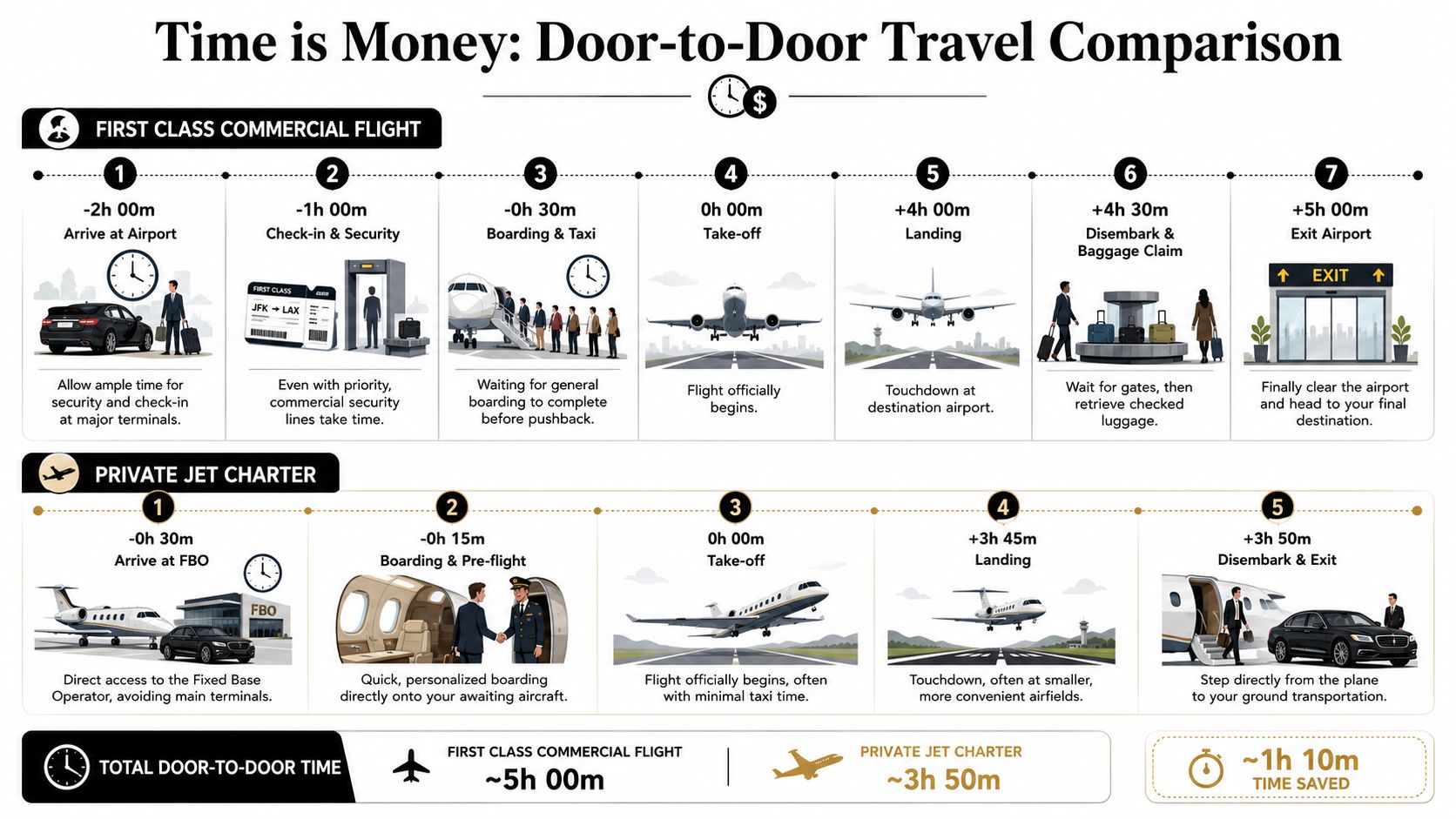
What a commercial first-class day actually looks like
For a typical major-airport commercial trip, the flight itself is only part of the clock. The rest is terminal process, access friction, waiting, and post-arrival drag.
A normal first-class timeline often looks like this:
- Ground transfer to a major airport
- Early arrival for check-in and security
- Lounge or gate waiting
- Boarding and taxi
- Flight time
- Deplaning
- Baggage and exit process
- Ground transfer from a major arrival airport
Even when each piece works well, the total day expands.
What the private charter day removes
Private charter reduces the dead zones. You don't need the major terminal ritual. You use an FBO, board quickly, and leave from an airport that may be much closer to your present location. On arrival, you often land closer to your destination.
That's where the extra airport access matters. The bigger network of private-capable airports doesn't just give you more options. It reduces surface travel and helps you avoid airline-hub inefficiency.
For travelers who haven't used one, this explanation of private FBO terminal benefits for jet travelers captures why the ground experience feels distinctly different.
Here's a simple side-by-side view:
| Journey element | First class commercial | Private charter |
|---|---|---|
| Airport choice | Airline-served hubs | Broader airport access |
| Preflight process | Longer terminal flow | Very short FBO flow |
| Boarding | Shared and phased | Direct and fast |
| Arrival process | Terminal exit sequence | Rapid aircraft-to-car transition |
| Ground travel burden | Often higher | Often lower |
This video shows the contrast in a more visual way:
Why time saved is the real premium
If your time is worth a great deal, then the comparison changes from travel spend to time recovery. Recovering even part of a business day can matter more than upgrading the food and seat on a commercial flight.
The most expensive part of premium travel is often not the fare. It's the hours you surrender to a system that doesn't care what your day is worth.
This is especially true for:
- Multi-meeting days: You can depart after the last meeting, not when the airline schedule allows.
- Family travel: Less waiting means fewer moving parts and less stress.
- Remote destinations: The right airport can strip out a long drive on both ends.
- Confidential work: You stay in a controlled environment from departure to arrival.
If you only compare in-air experience, first class competes well. If you compare elapsed life time, private aviation usually wins decisively.
Service Privacy and Customization
First class can be polished. Private aviation can be personal. Those are not the same thing.
Privacy
On a commercial flight, even in first class, you remain in public. You move through a public terminal, sit in a lounge with other travelers, board with other passengers nearby, and spend the flight with people you didn't choose. The service may be discreet, but the environment is not private.
On a private jet, privacy begins before takeoff. You arrive through a private terminal environment, board directly, and share the cabin only with the people you invited. For executives, public figures, legal teams, and families handling sensitive matters, that's often the deciding factor.
A private cabin also functions differently. It can be a quiet room, a secure discussion space, or a place to decompress without observation. First class can't give you that, no matter how good the airline is.
Service
Airline first-class service is usually excellent, but it's still standardized. The crew works within a fixed product, a fixed galley setup, and a fixed service flow. That's the nature of commercial aviation.
Private aviation shifts from premium hospitality to bespoke execution. If you want a specific catering profile, a particular cabin temperature, a pet-friendly arrangement, a preferred beverage setup, or a quieter onboard rhythm, those requests are part of the brief. The experience is shaped around the passenger, not around a cabin service manual.
Good first class makes you comfortable. Good private aviation makes you feel expected.
Customization
Here, the difference becomes impossible to ignore.
With first class, you choose among what the airline already decided to offer. With private charter, you shape the trip around your needs. That includes practical details many commercial passengers underestimate:
- Traveling with children: Easier pacing, fewer public transitions, and a more controlled environment.
- Traveling with pets: Simpler and more humane than the airline process.
- Special gear or wardrobe needs: More manageable than navigating commercial restrictions.
- Last-minute schedule changes: Often possible in ways commercial airlines can't match.
The executive view
If you need sleep on a long nonstop route and nothing else is complicated, first class does the job well.
If you need confidentiality, control over the environment, or a cabin that supports work and decision-making, private aviation is in a different category. It doesn't just improve the journey. It changes what you can accomplish during the journey.
When to Choose a Private Jet
You finish a breakfast meeting in Manhattan, need to be at a plant two states away by lunch, and back for a dinner with investors that evening. First class can look luxurious on a booking screen. It still ties you to airline schedules, hub connections, terminal congestion, and hours of dead time. Private aviation starts to make sense the moment your calendar is worth more than the fare difference.
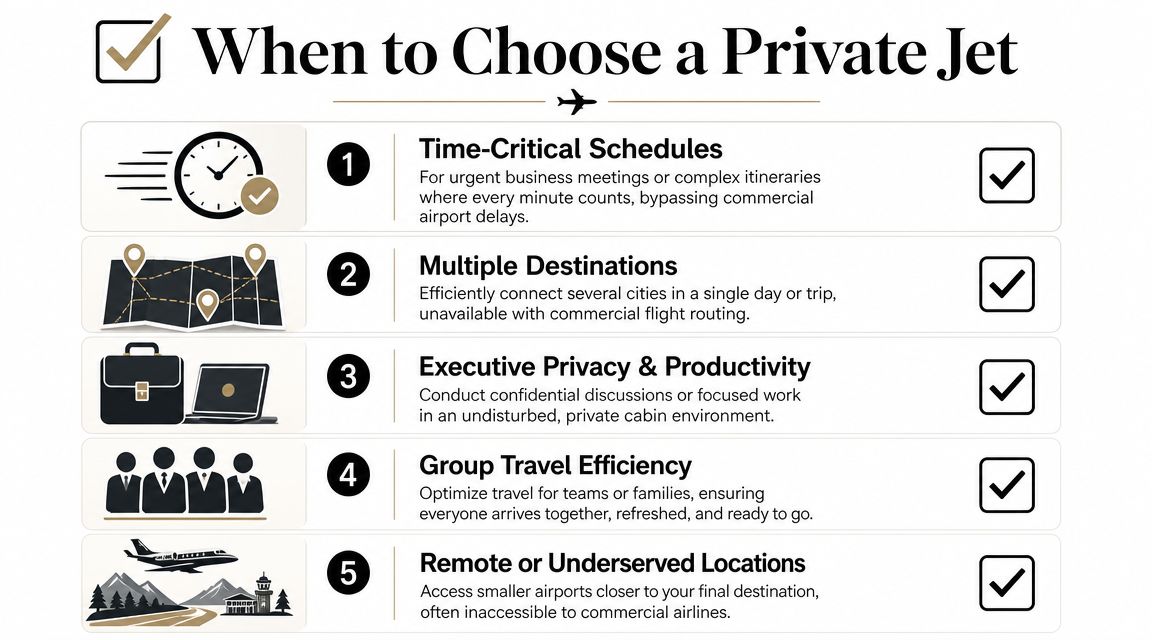
Choose private when time has a clear dollar value
This is the dividing line.
If a delayed arrival affects a transaction, a site inspection, a court appearance, a fundraising process, a production schedule, or family coordination, private flying is not a luxury upgrade. It is a tool for protecting the day. The relevant question is simple: what is the value of arriving on your terms instead of the airline's terms?
For many executives and principals, saving four to six hours door-to-door is worth far more than the price gap between first class and charter.
Choose private when one trip includes several objectives
A multi-stop day exposes the weakness of commercial travel fast. One missed connection or one rigid departure bank can force an overnight stay, push a meeting, or cut a stop entirely.
Private charter lets you build the trip around the work. You can visit two or three locations in a day, use smaller airports closer to the actual destination, and return home instead of losing another half day to hotel time and repositioning on commercial routes.
Choose private when privacy is a primary requirement
Some trips should not happen in a public terminal or a shared cabin.
That applies to CEOs in an active deal, investors discussing allocations, legal teams handling sensitive matters, public figures avoiding exposure, and families dealing with medical or personal issues. In those cases, privacy is not about status. It is about control, discretion, and risk reduction.
Choose private when the group changes the math
Group travel can move charter from expensive to rational very quickly, especially on short and mid-range routes where everyone would otherwise buy high-fare premium tickets and lose additional time in commercial processes.
The exact break-even point depends on route, aircraft size, airport pair, and how close to departure you book. Do not rely on a generic rule like "private works at seven to nine passengers" unless the source is current and the trip profile matches yours. Price the mission, not the headline. If you want a practical framework, start with this guide on how to charter a private jet in 2026.
Choose first class when efficiency is already good enough
Be disciplined. First class is the right buy when the route is nonstop, the airline schedule already fits your day, you are traveling alone or as a couple, and there is no real penalty for fixed departure times.
Use first class for comfort.
Use private aviation for control, speed, and schedule protection.
My recommendation
Buy first class when the trip is simple and the airline can deliver the day you need.
Charter the aircraft when the trip involves urgency, multiple stops, a larger group, sensitive discussions, or poor commercial access. At that point, ticket price is the wrong metric. The better metric is total time saved, productive hours recovered, and the cost of friction you avoided.
Booking Logistics First Class vs On-Demand Charter
A first-class booking is a retail transaction. You pick a flight, confirm the fare, and you are done. That works well when the airline schedule already fits your day and the commercial airport is close enough to your actual destination.
Charter is different. You are not buying a seat. You are buying a flight operation built around your schedule, your airport pair, your ground timing, and your privacy requirements. That added complexity is not a drawback if time has real economic value to you. It is the price of control.
The mistake I see repeatedly is simple. Successful travelers apply an airline-booking mindset to a custom aviation purchase, then wonder why they overpay, accept the wrong aircraft, or lose the time advantage they were trying to buy.
The older private aviation models
Fractional ownership and jet cards can make sense for travelers with highly predictable annual usage. For many buyers, they create commitment before the travel pattern justifies it. You can end up paying for access you do not fully use, while still working within program rules, peak-day limits, or category substitutions.
On-demand charter is usually the better fit if you want flexibility and clear trip-by-trip decision-making. It lets you price each mission on its own merits and match the aircraft to the actual job.
What to look for when booking charter
Focus on five points:
- Operator quality: Confirm the operator meets recognized third-party safety standards.
- Exact aircraft fit: If cabin layout, baggage space, Wi-Fi, or range matters, get the specific aircraft details before you approve the trip.
- Full pricing clarity: Ask for a clear breakdown of base flight cost, repositioning, crew expenses, de-icing exposure, catering, and ground transport coordination.
- Airport logic: Verify the aircraft is positioned sensibly for your route. A cheap-looking quote can become expensive once ferry time is added.
- Pre-departure visibility: You should have the tail, crew information, timing, and operating plan before wheels up.
If you want a practical walkthrough, this guide on how to charter a private jet in 2026 explains the process clearly.
Haute Jets is one example of an on-demand charter provider in this market.
The practical takeaway is straightforward. First class is easy to book because the airline has already standardized the product. Charter requires judgment because you are buying operational efficiency, not just transportation. Handle it correctly and you get more than a better cabin. You get tighter scheduling, less wasted ground time, and a trip that protects the value of your day.