
You're not booking a flight. You're orchestrating the first controlled moment of the wedding weekend.
That distinction matters. If you're planning a destination celebration in St. Barts, Aspen, the Bahamas, or along the Mediterranean, commercial travel turns your highest-value guests into a logistics problem. Delays split arrivals. Checked bags disappear. VIP family members land at different times. The wedding starts with stress instead of momentum.
A private jet wedding charter fixes that, but only if you treat it as part of the event design, not a last-minute transport add-on. The right aircraft, timed correctly, sets the tone before anyone reaches the villa, resort, or marina. The wrong one creates avoidable friction, overspending, and ceremony-day risk.
Envisioning Your Sky-High Celebration
You're likely in one of two positions right now. Either you've chosen the venue and realized the travel is more complicated than the wedding itself, or you're still choosing between destinations and know access will shape the guest experience.
That's exactly where private charter becomes useful. Not as a flashy line item. As control.
A wedding flight should function like an extension of the celebration. The couple boards with their inner circle. Parents avoid airport chaos. The dress, tuxedo, welcome gifts, and key personal items stay within your control. The arrival feels intentional, not improvised.
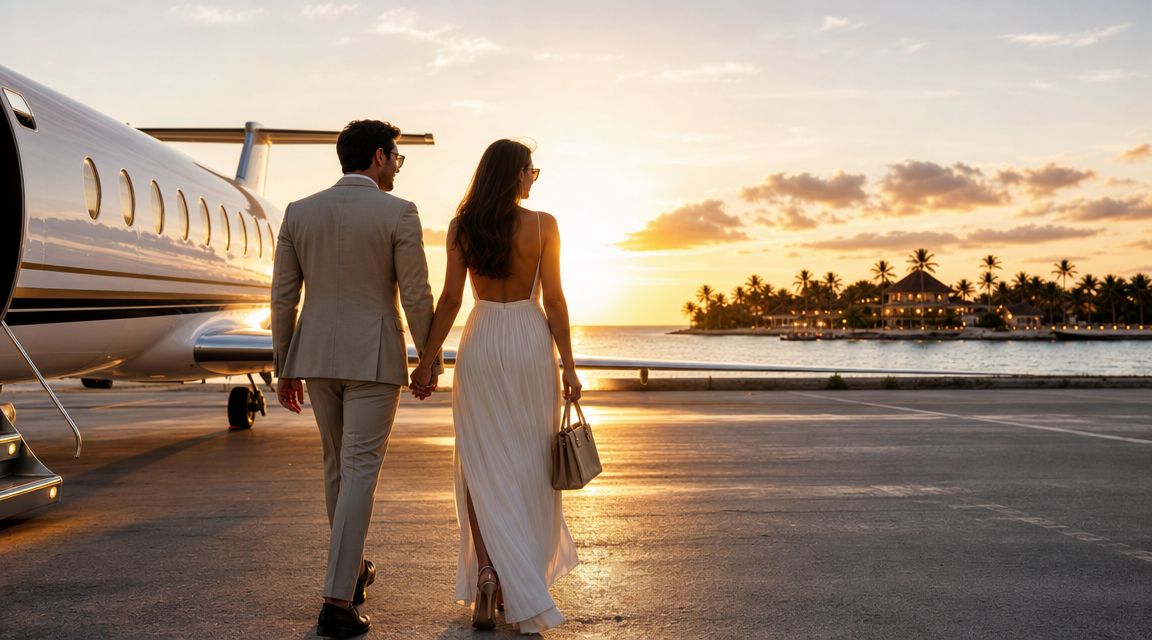
The charter is the opening scene
I advise clients to think about the flight the same way they think about the rehearsal dinner. It has a guest list, a mood, a service plan, timing pressure, and no room for confusion.
A well-run wedding charter can include:
- A defined guest mix that keeps the right people together, such as the couple with immediate family or the bridal party on a separate leg
- A planned arrival sequence so cars, security, planners, and hotel teams are waiting in the right order
- An onboard atmosphere that feels celebratory without becoming chaotic
- A baggage strategy that protects fragile, formal, or irreplaceable items
Practical rule: If the flight schedule affects hair, makeup, rehearsal timing, photography, or a welcome event, it belongs inside the wedding production plan.
The appeal isn't theoretical. Wedding private jet demand has risen, with one source noting more than 10% year over year, and it identifies the Adriatic and Mediterranean coastlines as especially popular destinations for this kind of travel because charter helps solve access challenges for remote venues and coastal event locations (wedding private jet demand and destination access).
Why affluent couples get this wrong
They assume luxury automatically means simplicity. It doesn't.
A private jet can absolutely simplify the weekend. But only when someone builds the flight around the event timeline, the venue constraints, the baggage profile, and the guest experience. If you just request “a nice jet for the wedding,” you're buying category language, not a working solution.
The difference between a smart charter and an expensive mistake usually comes down to one thing. Someone has to integrate aviation into the wedding itself.
The Foundation Your Wedding Charter Blueprint
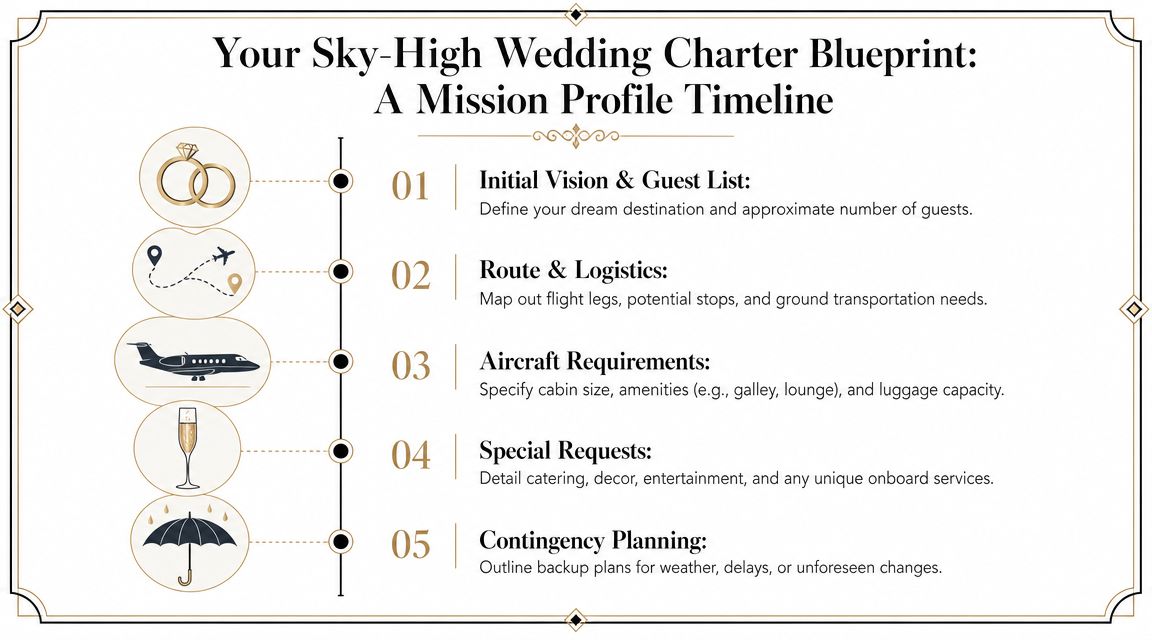
The first serious move is building a mission profile. That's aviation language, but it's exactly how you should think. Before you ask for quotes, define the trip with the same rigor you'd expect from your planner, security team, or estate manager.
Wedding charters go sideways when clients shop too early, with too little detail. They ask for pricing before they know who's flying, what's being carried, where the aircraft can land, and how the arrival ties into the event schedule.
Build the flight around facts, not assumptions
One aviation source says the average party size is about 4.1 passengers per flight, and that most charter aircraft accommodate 4 to 19 passengers depending on type and layout. The same source also cites rates of roughly $1,500 to $15,000 per flight hour, which is why group size is the first real budget lever for wedding travel (private jet capacity and hourly charter rates).
That should immediately change how you plan. Most wedding flights are not “move everyone together” missions. They're usually better handled as a small-group, high-flexibility operation with carefully chosen passengers on each leg.
Start with these questions:
Who must be on the aircraft?
Not who would enjoy it. Who needs to be on it because their timing matters.What must travel in-cabin or under direct control?
Wedding attire, personal styling kits, documents, gifts, medications, delicate accessories.What is the exact airport pair?
Not just city to city. Which departure airport works for your guests, and which arrival airport supports the venue plan?What happens after landing?
Cars, escorts, villa access, marina transfer, hotel check-in, security clearance, photo timing.
If your planner can't tell you where each passenger is sleeping the night of arrival, the flight plan is still premature.
The mission profile I'd want on my desk
I prefer a concise planning sheet before any quote request goes out. It should include:
- Passenger count by leg
- Full names exactly as they'll appear on manifest
- Departure airport and backup airport
- Arrival airport nearest the actual venue
- Luggage notes, especially garment bags, formalwear, oversized cases, and vendor equipment
- Catering preferences
- Ground transport contact
- Hard timing constraints, including rehearsal, welcome dinner, photography, or ceremony dependencies
This is also the right time to tighten the wedding budget overall. If you're balancing air travel against venue, hospitality, and production spend, these wedding and party budget tips are a useful planning reference because they force cleaner line-item thinking before luxury costs drift.
Good planning saves money before negotiation starts
Cost control is commonly thought to begin when quotes arrive. It starts earlier.
If your group is vague, your routing is loose, or your luggage profile is guessed rather than confirmed, you'll get broader pricing, weaker aircraft matches, and more change risk later. The disciplined client nearly always buys better because the operator can price an actual trip instead of a moving target.
Selecting Your Aircraft Beyond the Cabin Category
“Light jet,” “super-midsize,” and “heavy jet” are useful labels for marketers. They're not enough for a wedding.
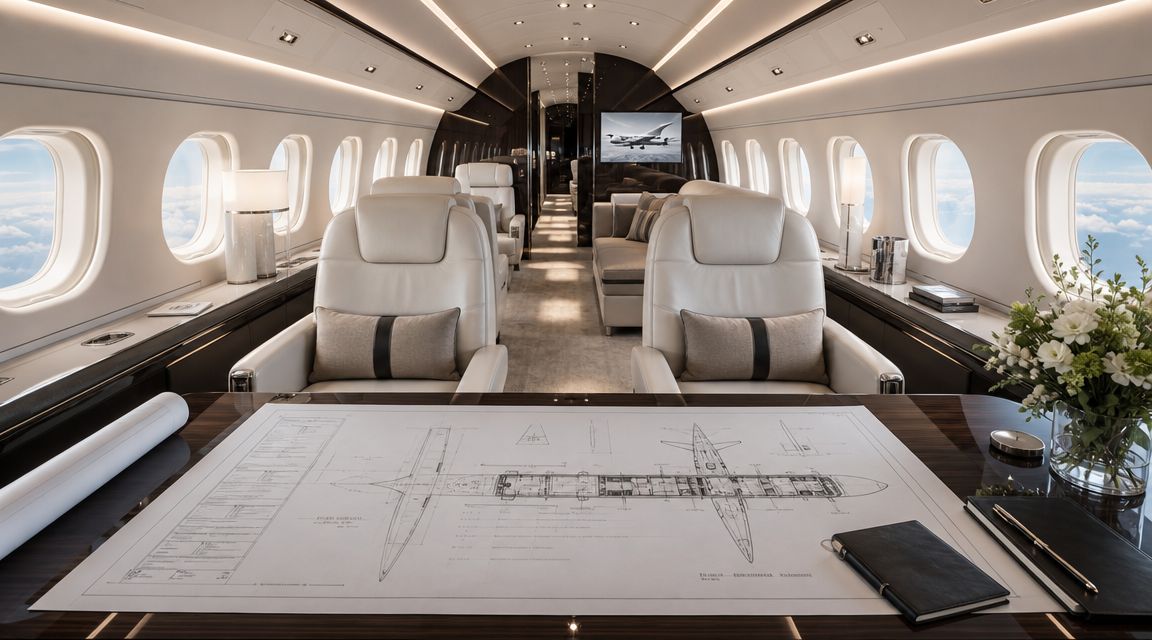
You need to know the exact aircraft fit. Not just whether there are enough seats, but whether the cabin layout supports the kind of trip you're flying. Social interaction, privacy, aisle flow, baggage usability, and airport compatibility matter more than the category name.
Cabin geometry matters more than brochure language
I've seen clients focus on glamour and ignore layout. That's backward.
A wedding group doesn't use an aircraft the way a standard business trip does. People are dressed differently, carrying more personal items, and often trying to relax together before a highly scheduled weekend. A cabin that looks elegant in photos may function badly if the aisle is tight, the seating isn't conversational, or baggage access is awkward.
Here's how I'd evaluate the choice:
| Priority | Better fit |
|---|---|
| Couple plus a few VIPs | Smaller aircraft with strong privacy and fast boarding |
| Wedding party feel | Cabin layout that supports interaction, not just seat count |
| Formalwear and extra bags | Aircraft with practical baggage capacity and cleaner cabin flow |
| Remote venue access | Aircraft that can match the destination airport, not just the route distance |
| Schedule protection | Specific aircraft confirmation, not a vague category promise |
A neutral booking guide reinforces the right process. A reputable provider should treat the charter contract as a binding document that explicitly lists the aircraft details, operator name, cancellation terms, flight times, and full cost breakdown, and that structured requirements audit is the primary way to avoid surprises on the day of travel (charter contract and aircraft selection guidance).
One jet or two coordinated flights
For weddings, this is often the most important aircraft decision.
One larger aircraft sounds cleaner. Sometimes it is. But if your group includes different departure points, uneven baggage loads, or guests who need different arrival timing, splitting into coordinated flights can be smarter. It can also preserve the guest experience. The couple doesn't always want to travel with the full social energy of the wedding party.
What matters is matching the aircraft plan to the event design.
If you want a deeper comparison of cabin classes, range, and layout tradeoffs, Haute Jets Journal has a solid primer on understanding private jet types.
Don't accept category-only selling
Ask for the specific year, make, model, and layout. That's where the key decision lives.
The wrong cabin geometry can reduce usable seating, make service clumsy, and create a less elegant experience than a smaller but better-configured aircraft. For wedding travel, exact match beats oversized category every time.
A quick visual comparison helps if you're weighing cabin expectations against trip style:
The Onboard Experience Crafting a Memorable Journey
The flight should feel like the first hosted event of the weekend. Not a dead zone between home and venue.
That means designing it with intention. The mistake most first-time charter clients make is assuming the aircraft alone creates the experience. It doesn't. Service design does.
Make the cabin feel like part of the wedding
The strongest wedding charters carry a consistent tone from ground transfer to wheels down. If your celebration is formal and restrained, the flight should reflect that. If the weekend is coastal, relaxed, and social, the onboard setup can lean warmer and more convivial.
I usually recommend choosing only a few touches and executing them well:
- A focused catering plan rather than a crowded menu
- A custom beverage service that feels aligned with the wedding style
- A boarding sequence that protects privacy and keeps timing smooth
- A clean arrival handoff with cars staged before landing
If you're refining the menu and service piece, this guide to private jet catering and in-flight dining is a useful reference for setting realistic expectations around onboard food execution.
The most memorable flight isn't the one with the most amenities. It's the one where every detail feels deliberate.
Manage guests like a host, not a dispatcher
A wedding manifest is emotional. Family politics, late changes, plus-ones, and VIP sensitivities all show up here.
Handle that early. One person should own the final manifest. One person should own guest communications. One person should confirm who is arriving at the FBO and when. When everyone owns it, no one owns it.
Good charter execution also depends on what happens outside the aircraft:
- FBO arrivals should be staggered enough to stay calm, but tight enough to avoid waiting
- Ground transportation should match each passenger cluster, not just total headcount
- Venue teams should know the exact landing sequence and estimated drive time
- Personal staff should know what items remain with the principal passenger
Keep the mood elegant, not theatrical
You don't need to overproduce the flight. In fact, that usually cheapens it.
Skip gimmicks. Focus on privacy, comfort, timing, and polish. A beautifully chosen bottle, a restrained floral accent if permitted, well-briefed cabin service, and smooth arrival logistics will do more for the guest experience than trying to turn the aircraft into a nightclub or photo set.
The charter works best when guests step off feeling taken care of, not managed.
Booking and Vetting Ensuring Safety and Value
A wedding charter can fail long before departure. It fails when the wrong operator gets approved, when the aircraft is sourced from the wrong market, or when the contract ignores how tightly the flight is tied to the event schedule.
Treat booking as event infrastructure, not air transport procurement. The aircraft has to support the ceremony timing, guest arrivals, photography windows, security profile, baggage plan, and backup options if weather or airport flow changes the day. Price matters, but only after the operating standard and sourcing logic are right.
Safety standards you should insist on
Start with the operator, not the cabin photos. Use carriers with Wyvern Wingman or ARGUS credentials, verify Part 135 status where applicable, and confirm the exact operator before any funds are released. A polished proposal proves nothing by itself.
If you want a clearer explanation of those benchmarks, review this analysis of Wyvern and ARGUS private aviation safety ratings before signing.
A simple rule applies here. You should know the operating carrier, tail-specific aircraft details, and the operator's safety standing before deposit, not after.
Value comes from sourcing discipline
Wedding clients often focus on hourly rate and miss the primary budget driver. It is usually repositioning.
If the aircraft has to come from another region just to pick you up, you are paying for deadhead time that adds no value to the event. For a wedding, that is especially wasteful because your travel dates are fixed, your schedule is public to multiple vendors, and delay tolerance is low. Smart sourcing solves more than cost. It also reduces exposure to knock-on timing problems tied to crew duty, late arrivals from prior legs, and unnecessary complexity in the operating day.
That is why local aircraft selection matters. The practical goal is to source the nearest suitable aircraft with the right operator credentials, cabin setup, and schedule fit. Haute Jets is one example of that model. It states that it sources from owner-operators and focuses on nearby aircraft selection to reduce repositioning while allowing clients to choose the exact aircraft rather than only a broad cabin category.
Private aviation capacity is finite and unevenly distributed. On peak wedding weekends, that matters fast. The right move is early sourcing with strict operator vetting, not paying a premium for a poorly placed aircraft because the photos look good.
What I'd review before signing
Review the contract the same way you would review a venue agreement. Every vague line item becomes your problem later.
Approve the charter only after these points are clear:
- Exact aircraft identified, including make, model, year, and layout details where available
- Operating carrier named plainly, not buried in the fine print
- Cancellation and recovery terms defined, especially around weather, airport restrictions, and client schedule changes
- Full pricing broken out, including repositioning, overnight charges, de-icing exposure, catering, and ground transport coordination if included
- Departure and arrival times matched to the wedding run-of-show, not just airport slot availability
- Baggage assumptions confirmed, especially for formalwear, garment bags, gift items, and vendor equipment
- Communication chain assigned, with one decision-maker authorized for day-of changes
- Contingency plan documented, including substitute aircraft process and response time
Cheap ambiguity turns expensive very quickly in private aviation. On a wedding movement, it can also disrupt the event itself.
Itineraries and Final Checks Your Wedding Flight Checklist
The strongest wedding charter plans are elegant because they're realistic. They don't fight geography. They use private aviation to make difficult access manageable, then tighten every handoff around the event schedule.
That's why remote coastal and island weddings are such a natural fit. As noted earlier, demand has risen for wedding private jets, and destinations along the Adriatic and Mediterranean stand out because charter can solve the access problem that commercial service often leaves half-finished. The aircraft gets you close. The ultimate skill is in how you finish the route.
Two itinerary styles that work well
A coastal European wedding often works best with a primary charter into the nearest practical airport, followed by a short chauffeured transfer or marina handoff. That usually beats forcing a larger aircraft toward a more constrained airfield just because it appears closer on paper.
For Caribbean or Bahamas weddings, the winning approach is often even simpler. Keep the airborne leg clean, keep bags under tight control, and have ground or resort transfer teams staged before touchdown so guests move straight into the hosted experience.
A good wedding itinerary doesn't chase the closest runway. It protects the whole arrival sequence.
Wedding Charter Finalization Checklist
| Timing | Action Item | Details |
|---|---|---|
| As soon as dates are fixed | Confirm the travel core | Identify who must fly privately, which legs matter most, and which guests can travel separately |
| Before requesting quotes | Finalize mission profile | Lock passenger count, airport pairs, luggage notes, catering preferences, and venue timing dependencies |
| Before contract signature | Verify aircraft and operator | Confirm exact aircraft, operating carrier, schedule, cancellation terms, and full cost breakdown |
| After booking | Build the manifest correctly | Use legal passenger names, note special handling needs, and assign one decision-maker for all changes |
| In the weeks before departure | Confirm ground logistics | Match cars, security, planner contacts, and venue arrival windows to each flight leg |
| In the final days | Reconfirm special items | Wedding attire, gifts, personal staff bags, onboard catering, and any sensitive personal requests should be checked again |
| 24 hours before departure | Review final flight package | Confirm tail number, crew details, passenger manifest, airport instructions, and timing for FBO arrival |
| Day of departure | Keep communications centralized | One lead should manage guest questions, planner updates, and any timing changes with the charter team |
My final advice
Keep the private jet focused on the people and moments that need protection. Don't use it to impress the guest list. Use it to remove uncertainty from the wedding's most time-sensitive movements.
That's how a private jet wedding charter earns its place in the budget. It doesn't just look expensive. It performs.
If you want a wedding charter built around exact aircraft selection, local sourcing, and clean pre-flight coordination, speak with Haute Jets. The right brief will save you time, protect the event schedule, and keep the flight integrated with the celebration instead of floating outside it.