
Private aviation's sustainability discussion changed once the numbers became harder to ignore. One analysis estimated that global private-jet greenhouse gas emissions rose 25% over the past decade, and the FAA projects that U.S. private jets will emit 28 million tonnes of CO2 in 2044, a 70% increase from 2023 levels (ICCT analysis and FAA projection). For clients who fly frequently, that shifts sustainable aviation fuel from a public-relations talking point into a practical planning issue.
If you've searched for answers on 35. Sustainable Aviation Fuel Private Jet, you've probably found two kinds of explanations. One is highly technical. The other is so broad that it doesn't help you book a real trip. Most private flyers need something in the middle. They want to know what SAF is, whether it's safe, whether it changes the flight experience, how much environmental benefit it can deliver, and what can be arranged on a charter itinerary today.
That's where the conversation gets useful. SAF isn't a future aircraft concept. It's a current fuel option with real operational constraints, real emissions implications, and real sourcing challenges. For a charter client, the key question isn't whether SAF matters. It's how to use it intelligently.
The Growing Case for Sustainable Private Aviation
Private aviation is under more pressure to show measurable emissions progress, and that pressure is no longer limited to headlines. Corporate flight departments, family offices, and frequent charter clients are being asked a more practical question: what can you change now without disrupting how you travel?
One figure helps explain the shift. Analysts at the International Council on Clean Transportation found that global private jet greenhouse gas emissions rose 25% over the past decade, and the FAA projects much higher U.S. private jet CO2 output by 2044 (ICCT report). The same report notes that industry roadmaps expect SAF to provide a large share of aviation's path toward lower net emissions by 2050.
For a charter client, that matters because private aviation has only a short list of options that work with aircraft already flying today. Electric aircraft serve very different mission types. Hydrogen remains a longer-term technology. SAF gets attention because it can be used within today's fuel and operating framework.
That makes the discussion less philosophical and more operational.
Why clients are paying closer attention
For many travelers, sustainability decisions used to happen mostly on the ground. They might choose efficient vehicles, combine meetings into one trip, or review broader sustainable transportation options across the rest of the journey. Now aviation is part of that same review, especially for organizations that measure travel emissions and report them internally or publicly.
Private jet clients usually come to SAF from one of four directions:
- Corporate reporting requirements that put flight emissions under closer review
- Investor, client, or board expectations around responsible travel decisions
- Personal priorities for lowering impact where it is realistically possible
- Procurement standards that ask for actions that can be documented, not just promised
A simple way to view SAF is as the most usable emissions-reduction tool currently available for many charter trips. It does not solve every environmental question tied to private aviation. It does give clients a concrete option they can request, price, and verify through the booking process.
That practical mindset is what matters most. Clients are not asking whether sustainability sounds good in theory. They are asking what can be arranged on a real itinerary, at which airports, at what added cost, and with what expected emissions benefit. That is also why the broader shift toward the rise of sustainable luxury eco-friendly jet travel has become a planning issue, not just a branding theme.
Understanding Sustainable Aviation Fuel
The simplest way to understand SAF is this: think of it as renewable diesel for jets. It isn't one single fuel made one single way. It's a category of aviation fuels made from non-fossil sources and designed to work within the aviation fuel system.
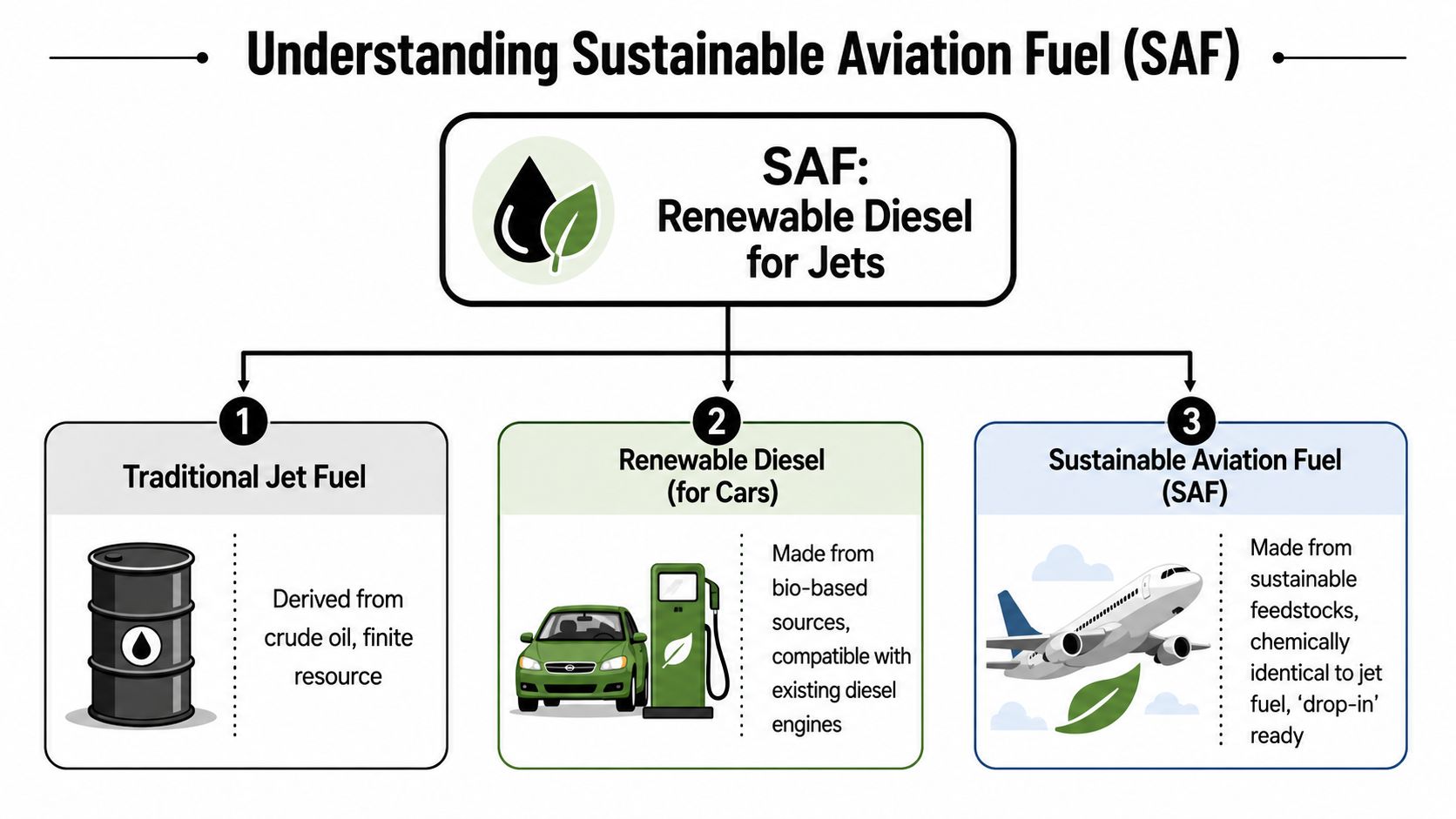
That comparison helps because many people assume SAF is some experimental green liquid that requires a special aircraft. It doesn't. The entire point is compatibility. SAF is produced so it can replace a portion of conventional jet fuel while meeting strict aviation requirements.
What SAF is made from
SAF can come from several kinds of feedstocks and production pathways. In plain language, that means the starting material and the process used to turn it into jet fuel.
Common categories include:
- Waste oils and fats, such as used cooking oil
- Agricultural residues and other biological waste streams
- Municipal solid waste in some pathways
- Synthetic fuels, sometimes called e-fuels, made using captured carbon and renewable electricity
These different pathways matter because they affect scalability, commercial maturity, and environmental performance. Some are established and available today in limited volumes. Others may offer stronger long-term decarbonization potential but aren't yet widely available for routine uplift.
Why SAF isn't just “biofuel”
Readers often get tripped up when SAF is sometimes described casually as biofuel, which can be misleading. Some SAF does come from biological sources. Some doesn't. Synthetic pathways can also qualify.
SAF is best understood as a standards-based aviation fuel category, not a single raw material.
That distinction matters when someone asks, “How green is SAF?” The answer depends on how it was produced, what it was made from, and how much of it is in the blend used for a given flight.
For private jet clients, the takeaway is straightforward. You don't need to become a refinery expert. You do need to understand that SAF availability and environmental value can vary from one supply source to another.
Operational and Safety Considerations for Private Jets
The first client question is usually the right one. Is SAF safe for the aircraft? The short answer is yes, when it's certified and supplied within approved standards.
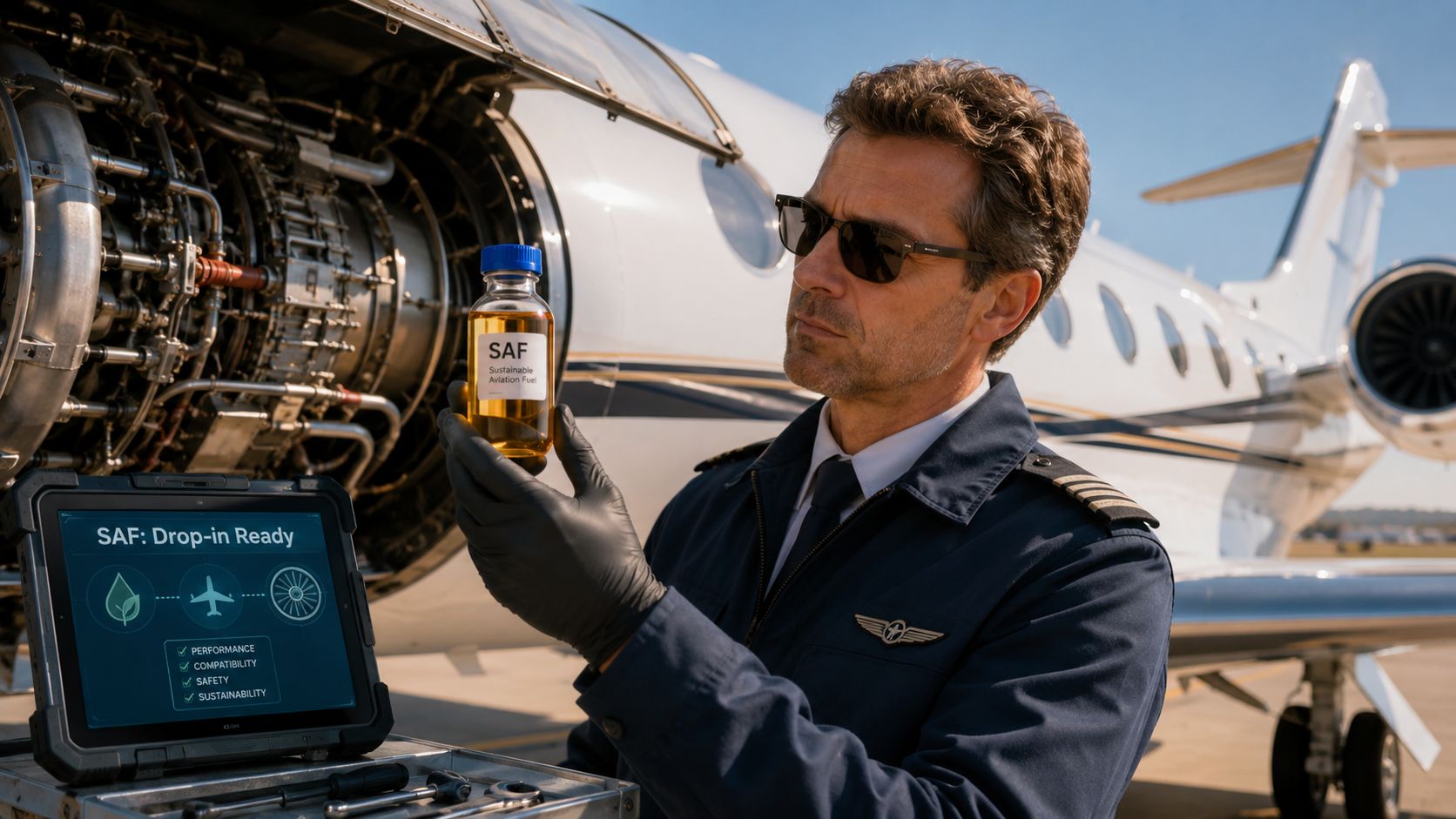
For private jets, SAF is operationally a drop-in fuel. ASTM D7566 governs its use, and approved SAF is typically blended with conventional Jet A or Jet A-1. Common certified blend limits reach 50% for several pathways, while co-processing routes are limited to 5% (U.S. Department of Energy alternative fuel guidance). For the client, the practical meaning is simple. The aircraft doesn't need an engine modification or an airframe change to use an approved SAF blend.
What “drop-in” actually means
“Drop-in” gets repeated so often that it can start to sound like marketing shorthand. In operational terms, it means the fuel is intended to fit into existing aviation systems without changing the aircraft's fundamental hardware.
From a passenger perspective, a SAF-blend flight should feel the same as any other charter flight:
- Same aircraft performance expectations
- Same fueling process at the airport
- Same flight deck procedures
- Same cabin experience
Pilots and maintenance teams don't treat certified SAF as a novelty item. They treat it as fuel that must meet the required specification.
What doesn't change and what does
SAF doesn't turn a private jet into a different machine. It won't make the cabin quieter, increase range in a way the passenger can feel, or create a visible tailpipe difference during the trip. The meaningful change happens upstream in the fuel's production profile, not in the in-flight experience.
That's why clients should focus on procurement and verification rather than onboard expectations.
A short explainer on the broader fuel context is helpful here:
If the SAF is properly certified and correctly blended, the operational question isn't “Will my jet handle it?” It's “Can my trip source it where and when I need it?”
That distinction saves a lot of confusion during trip planning.
The Real Impact on Emissions and Charter Costs
The environmental value of SAF is often misunderstood because people focus on the wrong part of the flight. SAF's main advantage is lifecycle emissions reduction, not a dramatic change at the tailpipe.
A useful analogy is electricity. An electric car's climate impact depends heavily on how the electricity was generated. The same logic applies here. A private jet using SAF still burns fuel in a jet engine, but the carbon intensity of the fuel's production pathway can be much lower than fossil kerosene.
Where the emissions benefit comes from
Reported lifecycle reductions range from about 20 to 25% for blended fuel to as much as 80%, and even up to 100% for certain renewable-synthetic or waste-based pathways, depending on feedstock and production route (4AIR SAF overview). For a charter client, that means the climate benefit isn't one fixed number. It changes with the blend ratio and the type of SAF being sourced.
Here's a practical comparison.
| Attribute | Conventional Jet A | Sustainable Aviation Fuel (SAF) Blend |
|---|---|---|
| Primary source | Fossil-derived kerosene | Renewable or non-fossil feedstocks blended with Jet A |
| Aircraft compatibility | Standard aviation fuel | Drop-in use when certified and blended appropriately |
| Tailpipe experience | Standard jet operation | Broadly comparable in normal operation |
| Main environmental distinction | Higher fossil carbon intensity upstream | Lower lifecycle carbon intensity upstream |
| Sourcing reality for charter | Widely available | Limited by airport access and supply chain availability |
A related perspective appears in Haute Jets' article on the environmental impact of private jets and sustainable solutions, which helps frame SAF as one part of a broader decision set.
Why the price conversation is tricky
Clients often ask for a simple answer on cost. The honest answer is that pricing is usually situational. It can vary by airport, supplier, timing, logistics, and whether you're arranging physical uplift or using a book-and-claim structure.
What can be said confidently is qualitative. SAF usually costs more than conventional jet fuel because supply is still limited, approved production pathways are still scaling, and distribution into airport fueling networks remains uneven. That extra spend shouldn't be viewed as a generic fuel surcharge. It's closer to paying a premium for lower-carbon fuel procurement in a market that's still immature.
Client perspective: If you choose SAF, you're not buying a different seat or a different aircraft. You're funding a cleaner fuel pathway for the mission.
That framing helps travel managers and principals decide whether the added cost belongs in the trip budget, the sustainability budget, or both.
Navigating SAF Availability and Supply Constraints
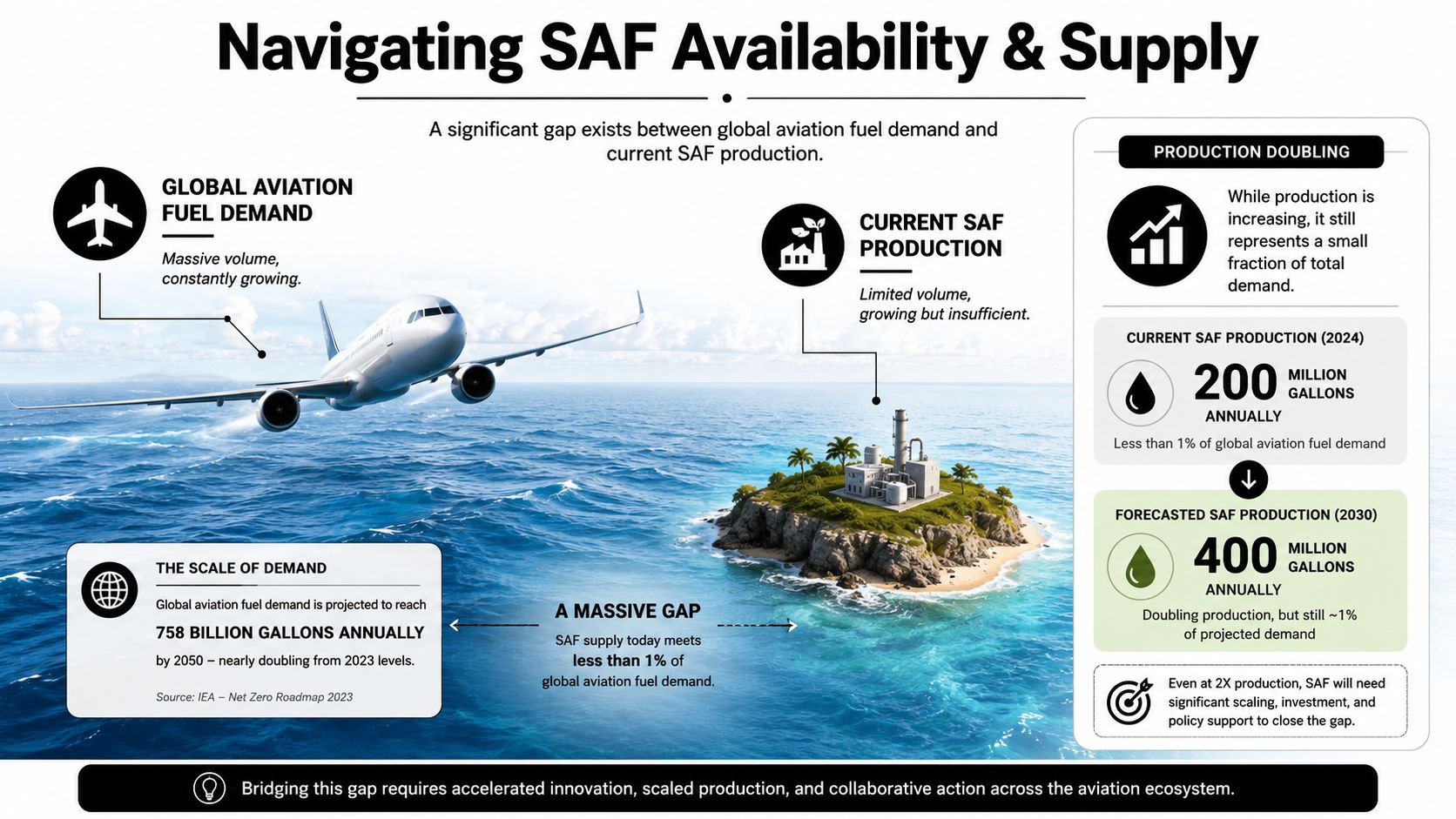
SAF is real. It's also scarce relative to total aviation fuel demand. That tension explains most of the frustration clients encounter.
In 2025, global SAF output reached approximately 2.4 billion litres, yet it still accounted for only 0.6% of total airline fuel consumption (Air Transport Action Group SAF overview). So when a client asks why SAF isn't available on demand at every private terminal, the answer is that the market is still tiny compared with the volume aviation consumes every day.
Why airport access is uneven
Fuel availability in private aviation depends on more than whether an FBO wants to offer SAF. The fuel has to be produced, certified, transported, blended where required, and delivered through an airport supply chain that can handle it.
That creates a fragmented map:
- Some airports have access through established supplier relationships
- Some airports can offer it only intermittently
- Many airports still can't provide physical SAF uplift at all
- Short-notice trips face the most limitations
This is why planning matters more than ideology. A client may be fully willing to use SAF, but the trip still depends on whether the departure airport or uplift location can source the fuel in time.
What this means for charter planning
If you're booking a private flight and want SAF, early notice helps. So does route flexibility. In some cases, a nearby airport may have better access than your first-choice departure point. In others, a broker or operator may need to look at alternatives beyond physical uplift.
A useful background read here is Haute Jets' piece on green initiatives in private aviation, which puts supply limitations in the wider context of business aviation's sustainability efforts.
Scarcity doesn't mean SAF is a gimmick. It means fuel sourcing has become part of trip design.
That's a meaningful shift for private charter clients. Fuel used to be invisible. With SAF, it becomes a planning variable.
How to Request SAF for Your Private Charter
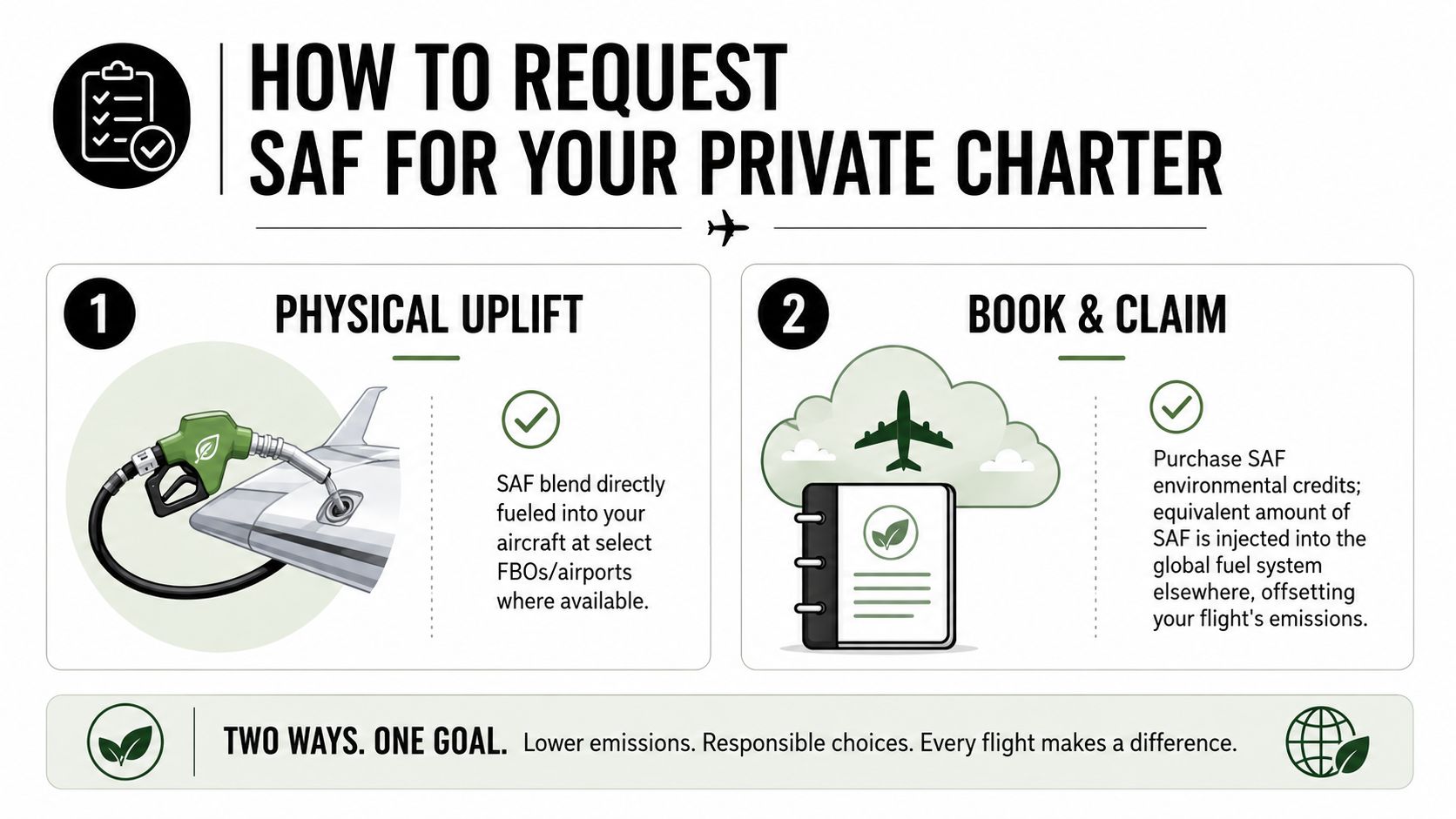
Most clients don't need a lecture on refining chemistry. They need a clear request process. In private charter, there are typically two ways to engage with SAF: physical uplift and book and claim.
Physical uplift
This is the most intuitive option. A SAF blend is physically pumped into the aircraft at an airport where that fuel is available. If your organization wants the strongest operational link between your flight and your fuel choice, this is usually the preferred route.
It also has the clearest constraint. Physical uplift depends on real airport supply.
Ask these questions early:
- Is SAF physically available at the departure airport?
- What blend is being supplied under the airport's fuel program?
- Can the fuel be confirmed for the date and time of departure?
- Will documentation be available for internal reporting or sustainability records?
Book and claim
Book and claim is less intuitive at first, but it solves a major logistics problem. In this model, you pay for the environmental attributes of SAF even if that exact fuel isn't physically loaded onto your aircraft. Instead, an equivalent amount of SAF enters the broader fuel system elsewhere, and the associated emissions benefit is allocated through a verified accounting framework.
This approach is often useful when your trip departs from an airport with no direct SAF access.
Book and claim doesn't recreate the same fueling event. It addresses the same market problem by supporting SAF demand and recognized emissions accounting where physical delivery isn't practical.
What to tell your broker or flight team
A good request is specific. Don't just say you want a “green flight.” Say what you mean.
Use language like this:
- “Please check for physical SAF uplift at departure and arrival options.”
- “If physical SAF isn't available, show me a book-and-claim alternative.”
- “Include any available documentation for sustainability reporting.”
- “Let me know if airport choice affects SAF access.”
If you're booking through a broker, this is one area where process matters. Haute Jets, for example, can help clients check operator and airport options for SAF use within its charter sourcing workflow, then discuss book-and-claim or other lower-impact alternatives if physical supply isn't feasible.
Flying Greener with Haute Jets
By this point, the picture is clear. SAF is not speculative. It's already in commercial use. It's safe for private jet operations when certified and properly blended. It can materially lower lifecycle emissions. But it's also limited by production scale, airport distribution, and trip timing.
That combination is exactly why clients need practical guidance rather than broad slogans. The right question usually isn't “Is SAF good?” The right question is “What can be arranged for this specific mission?”
What matters most on a live trip
For an actual charter booking, the decision usually comes down to a few points:
- Your departure airport may or may not have physical SAF available
- Your schedule affects whether fuel can be arranged in time
- Your reporting needs may favor documented physical uplift or a book-and-claim structure
- Your budget determines how much premium you're willing to assign to lower-carbon fuel procurement
A broker's role here is logistical, not rhetorical. Someone has to call the airports, check suppliers, confirm the aircraft option, and line up documentation where available.
A practical way to think about greener private travel
If SAF is available for your mission, it's one of the most direct ways to reduce the lifecycle emissions associated with private flying using today's aircraft and infrastructure. If it isn't available, the conversation doesn't have to end there. You can still evaluate routing, aircraft choice, and credible market-based alternatives.
Better sustainability decisions in private aviation usually come from better trip design, not from one magic product.
For clients who want to align private travel with sustainability goals, the most useful partner is the one who can translate a complex fuel market into concrete booking choices.
If you'd like help evaluating SAF availability for an upcoming trip, comparing physical uplift with book-and-claim, or sourcing a charter that matches your schedule and sustainability priorities, contact Haute Jets.