
The cheapest charter quote is usually the most expensive mistake. If the aircraft has to be ferried in from another city, you're already paying for a trip you didn't ask for, and that repositioning can distort the whole deal. In private aviation, the question is never just “what's the hourly rate,” it's “who owns the aircraft, where is it parked, and what am I paying for?”
That's why a serious air charters guide should start with sourcing, not glossy cabin photos. The market itself is not small or boutique anymore, it's a global aviation category with billions in annual spend and steady growth. One widely cited estimate places the market at USD 32.2 billion in 2024 and projects USD 55 billion by 2034 at a 5.6% CAGR (Grand View Research). Another forecast pegs it even higher in the near term, which only reinforces the same point, charter is a mature, competitive market, not a novelty.
Why Most Air Charter Bills Are Inflated Before You Board
Repositioning is the silent bill on most traditional charter quotes, and it can inflate the price by 20 to 40% when the aircraft isn't already near your departure airport. That's not a minor line item. It's the difference between paying for the aircraft you chose and paying for someone else's supply problem.
The quote you see is rarely the trip you take
Traditional brokers often start with an hourly rate, then layer on the costs of getting the jet to you, getting it back, and absorbing whatever operational drag your route creates. Jet card programs can do the same thing, just in cleaner language. The problem is simple, the aircraft may be “available,” but it wasn't sourced for your mission.
A first-time client should think like an operator, not a shopper. If the aircraft is based in another city, you're funding a ferry leg before your trip even starts, and maybe another after you land. That's where money leaks happen, not in the cabin.
Why sourcing changes everything
Local sourcing matters. A network built around 3,500+ owner-operators across 175 countries changes the economics because it looks for aircraft already positioned near your departure city, instead of forcing you to buy repositioning time. Haute Jets is built around that model, and it exists for a reason: the default market tends to push costs up when the aircraft isn't sourced intelligently.
Practical rule: if the aircraft isn't already close to your departure airport, treat the quote as incomplete until the ferry legs are spelled out.
The rest of this guide is about reading the market the way an insider does. Air charter is not a commodity product. The aircraft, the operator, the airport pair, and the contract language all matter, and the cheapest headline quote is often the least honest one.
What Air Charter Actually Means in 2026
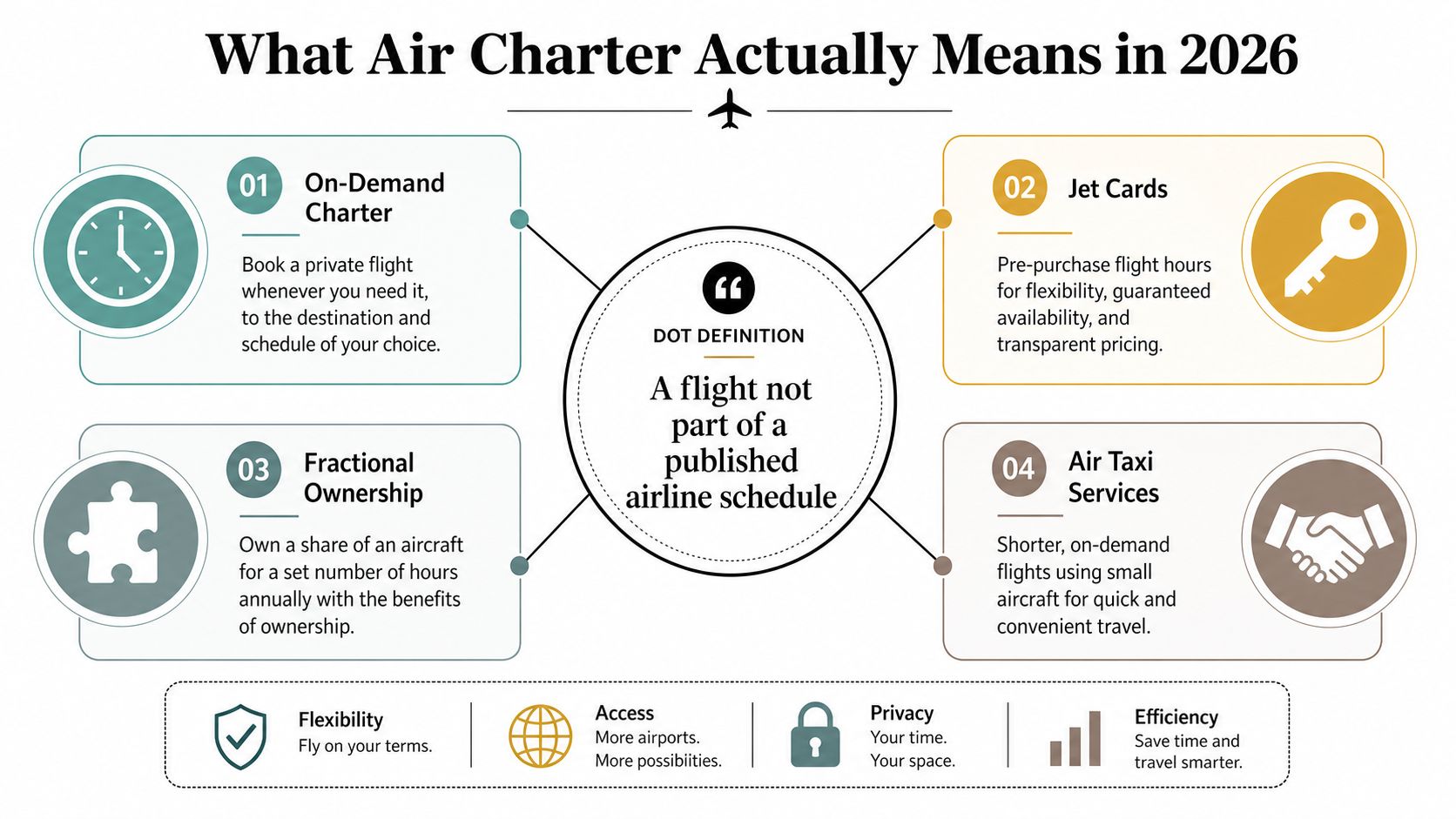
A charter flight is, in plain government language, a flight not part of a published airline schedule. That definition matters because it separates on-demand private flying from commercial airline service. It also explains why charter can be so flexible, the operator is selling access to an aircraft for your itinerary, not a seat on a fixed route.
Think of the buying models like hospitality. On-demand charter is the boutique hotel booked per night. Jet cards are a prepaid membership. Fractional ownership is a timeshare with aviation complications. Whole-aircraft ownership is buying the building and hiring staff to run it.
The four ways buyers access private flying
On-demand charter is the cleanest entry point for most first-time HNW travelers and corporate teams. There's no capital tied up, no annual fee to justify, and no need to guess how much you'll fly next year. The global market around it is already large, with the individuals and corporates segment alone generating over USD 17.4 billion in 2024 (Grand View Research).
Jet cards and fractional programs still have a place, but they're commitment products. They make sense for some flying patterns and frustrate others. On-demand charter gives you the aircraft when you need it, without forcing you into a fleet category or a long-term balance-sheet decision.
Why 2026 buyers care more about flexibility than ownership
For leisure travel, business trips, team movement, and event travel, the point is control. You want the right aircraft, the right date, the right airport, and the right contract. You don't want to own inventory you're not using.
The practical comparison most buyers care about comes down to four things, aircraft type, pricing mechanics, safety verification, and booking workflow. Those are the levers that determine whether a quote is efficient or padded.
On-Demand Charter Versus Jet Cards and Fractional Ownership
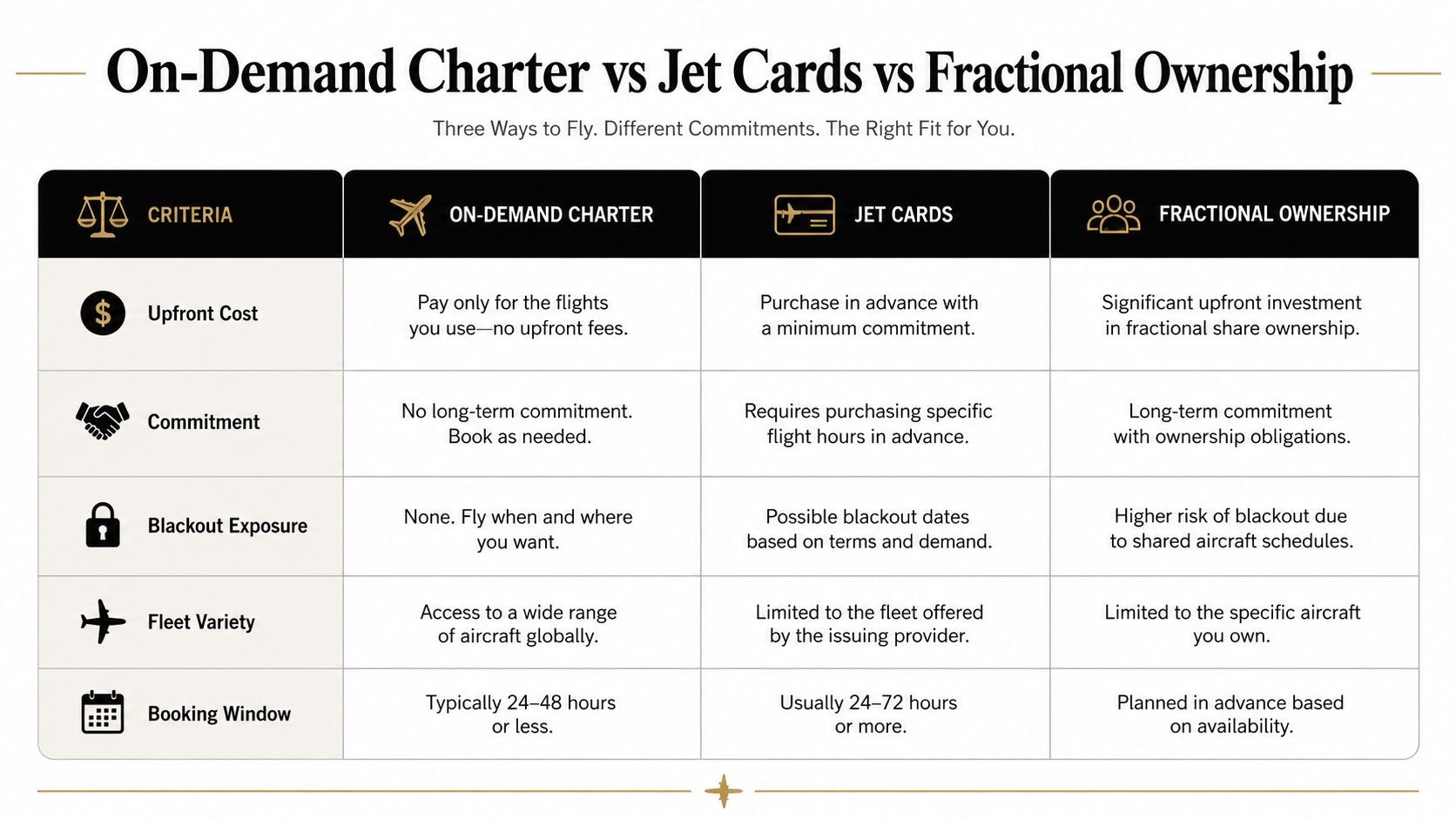
Here's the cleanest way to compare the four models.
| Criterion | On-Demand Charter | Jet Cards | Fractional Ownership | Whole Ownership |
|---|---|---|---|---|
| Upfront cost | None beyond the trip | Prepaid commitment | Equity buy-in | Highest capital outlay |
| Commitment | Per flight | Contractual | Long-term | Full-time asset burden |
| Blackout exposure | Low if sourced well | Possible | Program dependent | None, but operational risk is yours |
| Price per flight | Variable, route-driven | More predictable | High fixed costs | Dependent on utilization |
| Best fit traveler | Inconsistent routes | Frequent flyers wanting simplicity | Heavy annual flyers | Ultra-regular users with in-house aviation |
On-demand charter wins when you value flexibility over habit. Jet cards win when you want price consistency and you fly enough to tolerate the tradeoffs. Fractional only starts to make sense at very high utilization, and it ties you to an aircraft interest you can't easily unwind.
If you fly fewer than 25 trips a year on inconsistent routes, on-demand charter almost always wins on total cost of ownership.
That's the jet card vs on-demand answer, and it's usually the one sales teams dodge. The same is true for charter vs fractional. Fractional can look elegant on paper, but if your schedule is irregular or your destinations vary, you'll pay for structure you don't need.
For a fast decision at 11 p.m., use this rule. If your routes change, choose on-demand. If your routes repeat and your hours stack up, compare the prepaid products hard before you sign anything. For a deeper side-by-side, see this comparison of private jet cards versus charters.
How Charter Pricing Really Works
[iframe width="100%" style="aspect-ratio: 16 / 9;" src="https://www.youtube.com/embed/zO4gDki-x54" frameborder="0" allow="autoplay; encrypted-media" allowfullscreen][/iframe]
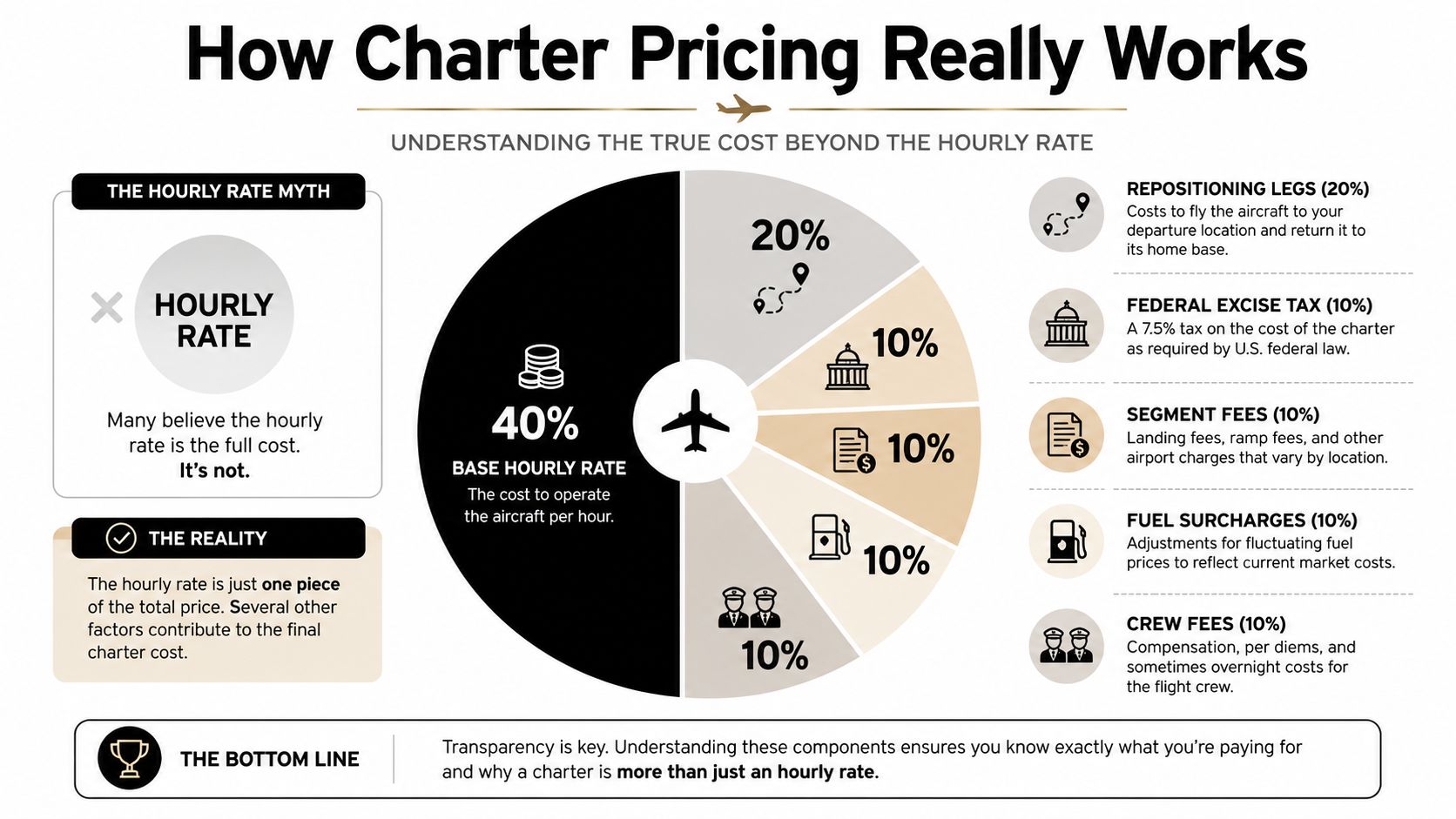
The published hourly rate is only the opening number. A real invoice can include repositioning, fuel-related charges, taxes, airport fees, deicing, catering, ground handling, Wi‑Fi, crew overnights, and international handling. If the quote doesn't itemize those pieces, you're not looking at a finished price.
The route matters more than the cabin class
Sherpa Report's published bands show the spread clearly, with turboprops roughly from $1,200 to $2,750 per hour and heavy jets at $6,000 to $13,000+ per hour (Sherpa Report). But the hourly band is only the starting point. Two flights in the same cabin class can land at very different totals if one aircraft is already near your departure airport and the other has to ferry in from elsewhere.
That's why a Citation Latitude from Teterboro to Miami is not a simple “one rate” story if the aircraft is based in West Palm Beach. You're buying a positioning ferry on top of the mission. If the operator sources a comparable aircraft already in Teterboro or White Plains, the total can fall materially because the empty legs disappear.
What to demand on every quote
A serious quote should spell out the following, in writing:
- Base aircraft rate, so you know what the flight itself costs.
- Repositioning or ferry charges, if any aircraft movement is needed.
- Taxes and segment fees, so the bill doesn't surprise you later.
- Airport and handling charges, especially at busy FBOs.
- Crew overnights and international handling, when the itinerary requires them.
- Catering and Wi‑Fi add-ons, if they aren't included.
- Cancellation terms, because the cheapest quote often hides the harshest rules.
The fundamental decision question is simple. What's the all-in landed cost for my specific route and date? Not what's the headline rate. That's the number that should drive the booking.
Safety Ratings and Operator Verification
Safety is not a slogan. It's a verification process, and the buyer has to do part of the work. The two third-party standards serious travelers should ask for are Wyvern Wingman and ARGUS Gold or Platinum, because they review operational history, pilot records, maintenance programs, and safety management practices. For a deeper read on the standards, see this guide to Wyvern and ARGUS safety ratings.
What the audits actually tell you
A Wingman or ARGUS badge is not a sticker for marketing decks. It tells you the operator has gone through a structured safety review, and that matters more than cabin photos or celebrity endorsements. Haute Jets uses those ratings as a network benchmark, which is the right baseline for any buyer who values diligence.
The other half of the job is operator verification. The U.S. Department of Transportation defines charter flights as flights not on a published airline schedule, and FAA and NATA guidance points buyers toward certificate checks and fraud-warning resources to avoid illegal charter operations (U.S. Department of Transportation).
The questions that protect you
If your broker can't answer these clearly, don't pay:
- What is the air carrier certificate number?
- Is the specific tail number authorized for charter?
- Who are the crew members?
- Which third-party safety audit does the operator hold?
- Can you confirm the aircraft before departure?
The cheapest quote is often the riskiest quote because unauthorized operators can undercut vetted networks by 15 to 25%. That delta is exactly why buyers get tempted, and exactly why they get burned.
If the broker won't name the tail number, carrier certificate, and crew 24 hours before departure, walk away.
That's not overcautious. That's standard practice for anyone who cares about compliance and doesn't want a terminal problem at the worst possible moment.
Aircraft, Routes, and What Actually Flies Where
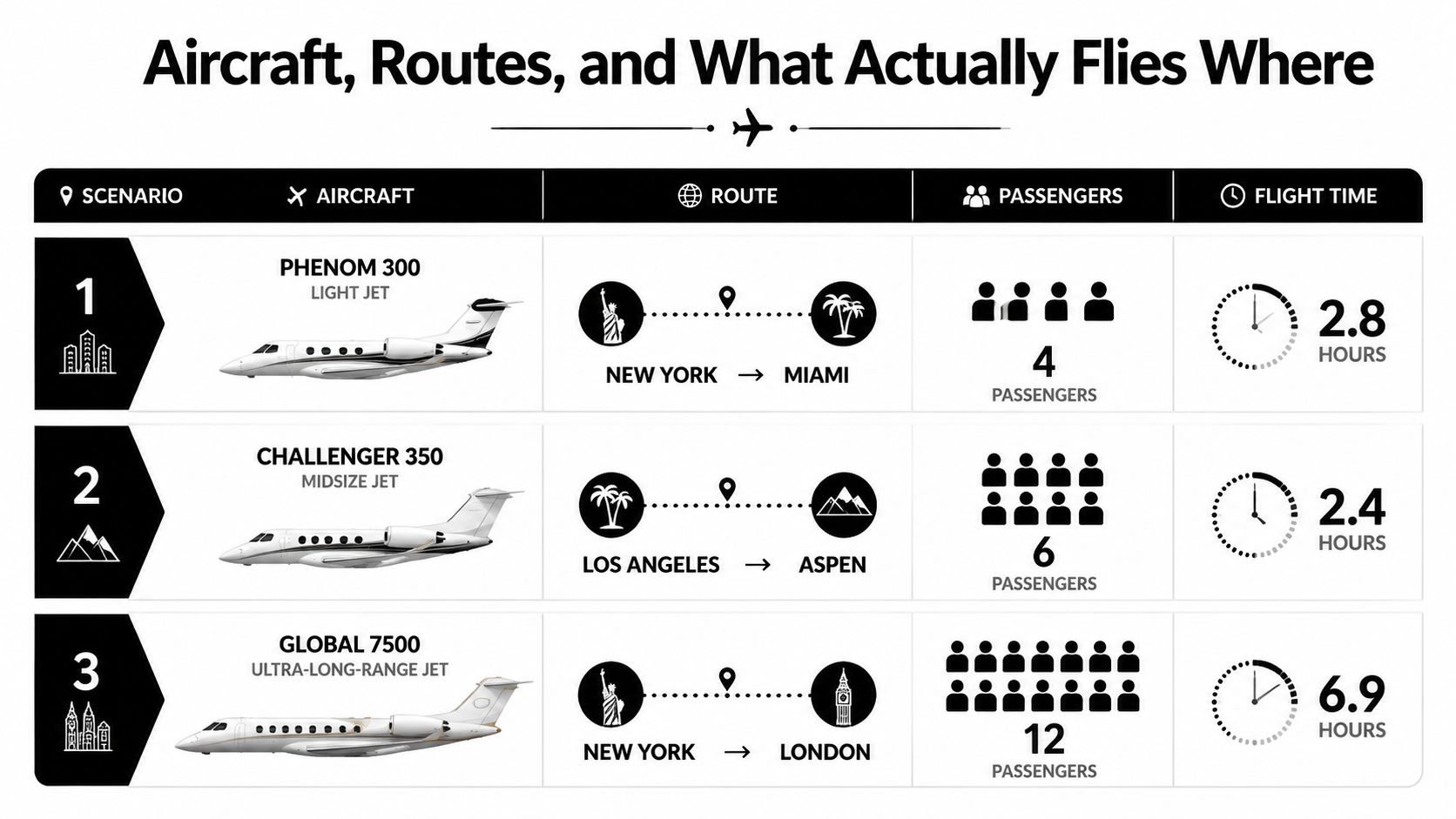
The right jet is not the biggest jet. It's the one that fits the route, the runway, the baggage load, and the passenger count without wasting money. The FAA's Aircraft Characteristics Database ties aircraft types to performance and airport planning data, which is why one airframe can operate a mission that another cannot (FAA Aircraft Characteristics Database).
Three routes that show the logic
A Phenom 300 works for a New York to Miami hop with four passengers because it's a smart light-jet fit, not because it's glamorous. It's efficient for shorter missions and small groups, and it avoids paying for capacity you won't use. It is not the aircraft for New York to London.
A Challenger 350 is the better answer for Los Angeles to Las Vegas when the group needs a stand-up cabin, usable workspace, and better in-flight comfort than a smaller jet can offer. It gives you room to work without jumping into an oversized cabin you don't need.
A Gulfstream G550 belongs on New York to London. That mission needs range, cabin comfort, and the kind of long-haul capability that makes sense for intercontinental travel. It's overkill for New York to Miami, and paying for that kind of aircraft on a short hop is exactly how buyers burn money.
Routes that move fast in warm weather markets
Some corridors repeat because the demand is obvious. Miami to the Bahamas, Miami to Turks and Caicos, and Miami to Aspen all come up often because the use cases are clear, leisure, seasonal, and time-sensitive. Those trips reward aircraft sourcing that matches the airport and the passenger count, not just the prestige of the model.
Here's the rule I'd give any travel manager. Start with the airport pair, then the passenger count, then the cabin requirement. The aircraft should be the answer, not the starting point.
Booking, Contracts, and How to Pay
The booking process should be boring and precise. That starts with the quote request. NBAA says charter brokers should collect the date or dates, passenger count, city destination, cabin-amenity needs, special requests, and aircraft type or size preferences, then issue a written contract that names the aircraft make and model, tail number, departure and arrival airports, estimated en-route time, included and excluded charges, and cancellation terms (NBAA best practices). That is the baseline. Anything looser creates room for dispute, surprise charges, and bad aircraft substitutions.
What the day-before confirmation should include
A serious operator sends the flight details 24 hours before departure. That packet should include the tail number, crew names, weather briefing, and passenger manifest. If those items are missing, the operator is not treating the charter like a controlled mission.
Travelers who use advisors should expect the same coordination standard that premium travel agents bring to complex bookings. MyPerfectStay explains how travel agents coordinate premium bookings in a way that makes the value obvious, especially when several vendors and moving parts have to line up.
Payment methods that actually show up
Most serious charter bookings still settle by wire transfer or ACH. Major credit cards are common too, although surcharges can apply. Crypto also shows up in parts of the market, including Bitcoin and other digital assets for travelers who prefer that route.
The money leak is usually in the quote structure, not the payment rail. If the aircraft has to reposition, that cost needs to be visible before you sign. If it is buried, you are buying a cheaper headline and a more expensive trip.
Corporate travel makes the contract even more important. Multi-leg itineraries, team movements, recurring routes, and event-driven demand all need a clean paper trail and fast confirmation. Supply tightens fast around major event periods, and the worst bills show up when a broker has to source the wrong airplane from the wrong base at the last minute. For a practical booking walkthrough, see how Haute Jets handles private jet bookings. The point of pay-per-flight pricing is simple. You avoid memberships, jet cards, annual fees, and prepaid hours you later have to defend.
Your Pre-Flight Checklist Before You Click Book
Print this. Save it. Use it every time.
Operator
- Wyvern Wingman or ARGUS Gold/Platinum confirmed
- Air carrier certificate verified
- Tail number authorized for charter
Aircraft
- Exact year, make, model, and cabin layout confirmed
- Wi‑Fi tested
- Pet policy confirmed
- Catering and special requests logged
Logistics
- Departure and arrival FBOs named
- Ground transport confirmed at both ends
- Weather briefing reviewed
- Passenger manifest accurate
Money
- All-in landed quote with line items
- Payment method confirmed, including crypto if applicable
- Cancellation and rebooking terms in writing
Twenty-four hours before wheels-up, the tail number, crew bios, weather briefing, and manifest should already be in your inbox. Anything less is a red flag, not a minor delay.
The cheapest quote can be the riskiest one, but a well-sourced, fully vetted, exact-aircraft charter at a transparent all-in price is one of the cleanest purchases in luxury travel.
Air charter in 2026 is a global category, and the tools to do it right are no longer reserved for insiders. The buyers who win are the ones who ask for the exact aircraft, verify the operator, and refuse to pay for repositioning they didn't choose.
If you want a charter quote built around the exact aircraft, exact route, and exact departure city, Haute Jets can source from a global owner-operator network and return the all-in options instead of padded guesses. Send the trip details, and ask for the tail number, the operator rating, and the landed price before you book.