
You're probably in one of two situations right now. Either you've never booked a private aircraft before and the market feels oddly hard to decode, or you've already requested a few quotes and can't figure out why the same trip seems to produce very different prices, aircraft options, and levels of confidence.
That confusion is normal. Private charter is sold as simple, but the buying process often isn't. One company talks about access. Another talks about memberships. A third promises the “lowest rate” but won't tell you which operator is flying the trip until late in the process. If you're spending serious money, that lack of clarity should bother you.
The aircraft charter broker steps in. At their best, brokers reduce complexity, widen your options, vet operators, and help you avoid expensive mistakes. At their worst, they add another layer between you and the aircraft, making it harder to understand what you're paying for.
On Haute Jets Journal, the useful question isn't just “what is a broker?” It's “what kind of broker model protects the client?”
Navigating the World of Private Jet Charter
You ask for what sounds like a simple trip. Teterboro to South Florida on Friday morning. Six passengers, golf bags, one dog, and a Sunday return. Within an hour, three quotes arrive. The aircraft types are different. The prices are far apart. One seller sounds precise about the operator and schedule. Another sounds vague but cheaper.
That gap is what confuses first-time charter clients. The trip is the same. The commercial path behind each quote is not.
Private charter looks opaque from the outside because the market is fragmented. Aircraft are controlled by many separate operators. Availability changes by the hour. The actual cost of a trip depends on more than flight time. Positioning the aircraft, crew duty limits, airport restrictions, overnight charges, and the number of intermediaries involved can all change the number on the proposal.
Why the market feels harder than it should
A quote can come from several places. It may come directly from the operator that will perform the flight. It may come from a broker with direct access to operators. It may also come through one or more sub-brokers, where each layer touches the deal before it reaches the client.
That matters for one reason. Every extra layer can reduce clarity on both price and aircraft sourcing.
A private jet quote works less like a retail shelf price and more like a custom logistics bid. Two offers for the same route can differ because one aircraft is already nearby, while another has to fly in empty before your passengers ever board. That repositioning flight is often one of the biggest hidden cost drivers in charter. The client sees one itinerary. The operator prices the full aircraft movement required to complete it.
The result is a market where a lower headline quote is not always the lower real cost, and a larger broker network does not automatically mean better sourcing discipline.
In private charter, the key question is not only “Can this company find an airplane?” It is “How directly are they sourcing it, and how clearly are they showing the economics?”
Where clients usually get tripped up
Confusion usually starts in a few predictable places:
- Aircraft fit: Several jets may appear suitable until details like baggage volume, passenger height, runway length, Wi-Fi expectations, and pet accommodations narrow the field.
- Price structure: A quote may look competitive until you account for repositioning, de-icing, crew expenses, peak-day surcharges, or other trip-specific charges.
- Seller versus operator: The company sending the quote is not always the company flying the aircraft, which affects how clearly responsibility is disclosed.
- Availability language: “Available” can mean the aircraft is theoretically open, not that it is being held for your trip at that price.
Experienced buyers learn to read charter proposals the way a shipper reads a freight quote. They look past the top-line number and ask what had to happen operationally to make that trip possible.
Once you see the market through that lens, private charter becomes much easier to evaluate. The process is still specialized, but it is not mysterious. It rewards clients who ask where the aircraft is coming from, who controls it, and whether the quote reflects the full trip economics rather than just an attractive starting number.
The Core Role of an Aircraft Charter Broker
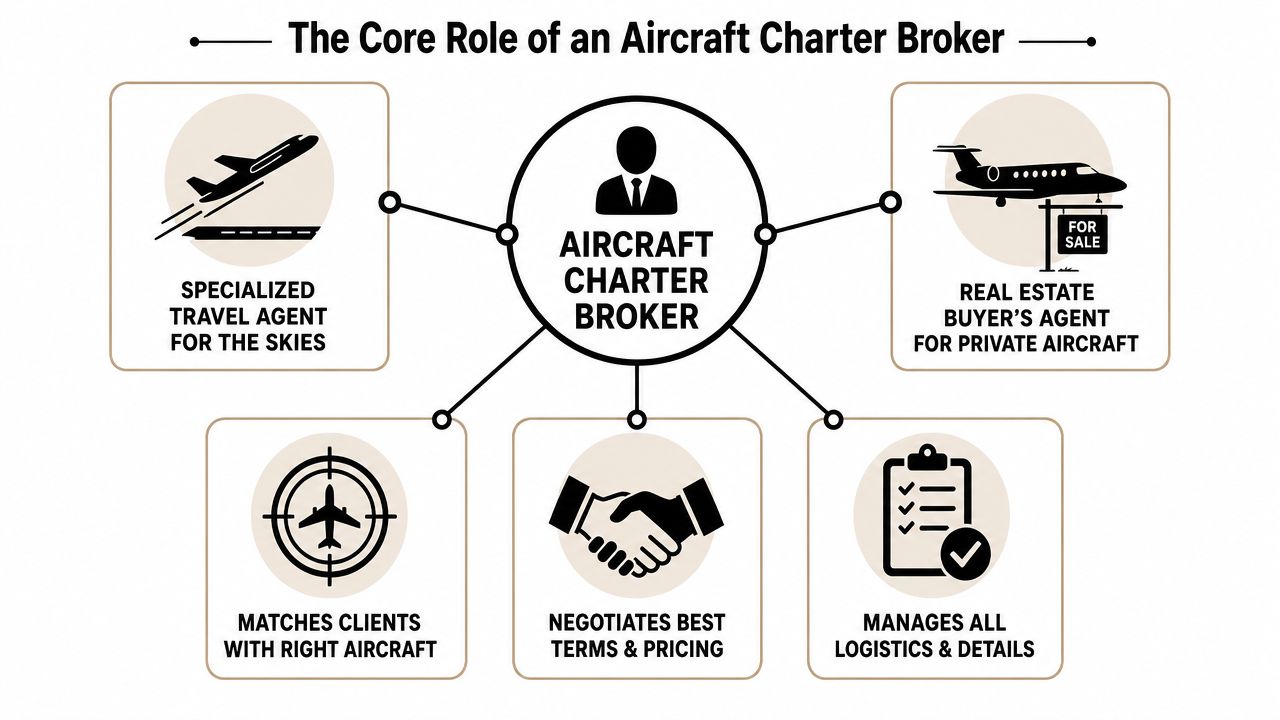
An aircraft charter broker is an intermediary. The broker doesn't typically operate the aircraft. The broker matches your trip to a licensed charter operator that can fly it.
Think of the role less like a concierge and more like a buyer's representative in a fragmented market. You tell the broker what matters for the mission. Departure city, arrival airport, passenger count, luggage profile, pet policy, cabin expectation, preferred departure window, and any absolute requirements. The broker then searches operator options that fit those requirements.
What the broker actually does
A competent broker usually handles several jobs at once:
- Aircraft sourcing: Finding aircraft that are appropriate for the route, passenger load, airport limitations, and schedule.
- Operator matching: Connecting the trip to the charter company that will conduct the flight.
- Commercial comparison: Sorting through aircraft options that may look similar but price differently for operational reasons.
- Trip coordination: Managing details such as catering requests, ground transport coordination, and schedule updates.
- Documentation and disclosures: Presenting the contract structure and the information you need before approving the trip.
The role exists because the brokerage side of the industry is large enough to be a real market, not just an informal service category. The global air charter broker market was estimated at USD 1,769.5 million in 2023 and is projected to reach USD 2,496.1 million by 2033, implying a 3.5% CAGR over 2024 to 2033, according to Market.us coverage of the air charter broker market.
The part many clients misunderstand
The broker sells expertise in access, evaluation, and execution. The operator sells the flight itself.
That distinction matters because brokers and operators sit in different roles. A broker may know where to find the right aircraft on short notice. The operator controls the aircraft, crew, and the legal authority to perform the charter.
Practical rule: Ask yourself whether you're paying this broker for real market access and sharper sourcing, or just for another layer of communication.
Why that matters to your outcome
When the model works well, a broker saves you time and helps you avoid poor-fit aircraft, weak operators, and misleading quotes. When the model works badly, you end up with vague pricing, delayed confirmations, and little visibility into who is flying you.
That's why choosing a broker isn't really about finding someone who can “book a jet.” Many people can do that. Their value is whether they can source intelligently, disclose clearly, and stay disciplined when the market gets messy.
Broker vs Other Private Aviation Models
A client who flies six times a year, often to different cities, usually needs a different buying model than a company shuttle team flying the same route every Monday. Private aviation is not one product. It is a set of access models with different economics, different limits, and different ways of hiding cost.
That last point matters more than many buyers realize.
A brokered charter quote, a jet card rate, and a fractional program can all look polished on the surface. Underneath, they work very differently. A deeper comparison is not just convenience versus commitment. It is how each model handles aircraft sourcing, flexibility, and the number of commercial layers between you and the operator.
A practical way to compare the options
| Model | Best for | Main upside | Main limitation |
|---|---|---|---|
| On-demand charter through a broker | Buyers who want flexibility trip by trip | Access to multiple operators and aircraft types | Value depends on how directly the broker sources the flight |
| Direct with an operator | Buyers who already trust a specific operator | Fewer intermediaries and clearer accountability | Limited to that operator's fleet, coverage, and availability |
| Jet card | Buyers who want a pre-arranged program structure | Standardized booking rules and simpler repeat use | Prepaid structure can reduce flexibility and mask route-specific pricing inefficiencies |
| Fractional ownership | Frequent flyers who want long-term access with ownership features | High availability and a defined service framework | Large financial commitment, ongoing complexity, and less mission-by-mission flexibility |
On-demand charter through a broker
This model works best when your flying pattern changes from trip to trip. You are buying access to the market rather than committing to one fleet or one prepaid program.
A good broker acts like a skilled wholesale buyer in a fragmented market. The value is more than finding an airplane. It is finding the right airplane from the right operator, in the right place, with as few unnecessary layers as possible. That distinction affects both price and visibility.
The weak version of this model is a broker who passes your request down a chain of other brokers until someone eventually reaches an operator. Each added layer can increase cost and reduce clarity. The strong version is a broker with direct operator relationships, disciplined sourcing, and a willingness to explain where the aircraft is coming from and why it was selected.
If you are comparing this option with prepaid programs, Haute Jets offers a useful overview of private jet cards vs charters.
Booking directly with an operator
Direct booking can be the cleanest option if you already know which operator you want and that operator regularly serves your routes. Communication is simpler because the company selling the trip is also responsible for operating it.
But direct does not always mean cheaper.
An operator can only sell aircraft it owns or controls. If its fleet is not well positioned for your itinerary, the quote may still include empty positioning cost. You also lose the ability to compare that option against other aircraft nearby. It is the aviation equivalent of shopping at one store. If that store has exactly what you need, great. If not, you may pay more for convenience without realizing there was a better fit across the market.
Jet cards
Jet cards are designed for buyers who want a defined program with fewer decisions each time they fly. You prepay or commit to a set structure, and in return you get easier booking rules, known service terms, and a more standardized customer experience.
That simplicity appeals to many busy travelers. It also changes how pricing works.
A card can reduce day-to-day quote shopping, but it may distance you from the live market. On some routes, that can be a fair trade. On others, it can mean you are using a fixed program price when a trip-specific charter solution would have been more efficient. Card programs can also include peak-day limits, service area rules, upgrade charges, or aircraft substitution language that only becomes important when your schedule changes.
Easy to buy does not always mean cost-efficient to use.
Fractional ownership
Fractional ownership is closer to an aviation asset strategy than a booking method. You are purchasing a share-based access model with management agreements, scheduled costs, and long-term obligations that resemble ownership more than charter.
For flyers with heavy, predictable usage, that can make sense. For everyone else, it can solve the wrong problem.
If your missions vary by passenger count, stage length, or destination, a fixed ownership structure can become restrictive. You may have access, but not always to the most economically sensible aircraft for that trip. Flexibility often matters more than prestige here. Buying a slice of a plane is very different from buying the best aircraft for each mission.
The practical takeaway
The smartest choice depends on your pattern of use, but the evaluation method is consistent. Ask which model gives you the right aircraft with the clearest pricing and the fewest unnecessary commercial layers.
For occasional or irregular flyers, brokered on-demand charter often makes the most sense. For travelers who value a preset program and use private aviation often enough to justify it, cards or fractional arrangements may deserve a close look.
Do not judge the options by branding alone. Judge them by sourcing discipline, transparency, and how clearly they expose the actual economics of the trip.
Understanding Broker Fees and True Flight Costs
Most clients ask the wrong opening question. They ask, “What's the hourly rate?” That sounds sensible, but it rarely tells you what the trip will cost.
A charter quote is a package of aircraft cost, routing realities, and commercial markup. If you only compare the headline number without understanding the structure underneath it, you can make a bad decision very quickly.
Why two quotes for the same route can differ
Aircraft positioning is one of the biggest drivers. If the selected aircraft isn't already near your departure airport, someone has to pay for the plane to fly empty to pick you up. Industry analysis notes that some quotes can be 20 to 40% higher for the same route because the aircraft must reposition before your trip, according to ACC Aviation's discussion of charter pricing and aircraft positioning.
That's why a quote that looks expensive may be operationally honest, while a cheap quote may rest on assumptions that don't hold up once the trip is finalized.
What a careful buyer should look for
A broker's compensation can come through a commission, a margin on the operator's price, or a broader service markup embedded in the quote. You don't need every internal commercial detail to evaluate the quote, but you do need clarity on what the price includes and what could change.
Key questions include:
- Is the aircraft already near my departure point?
- Is this a direct operator quote or has another broker been added in the chain?
- Are taxes, airport charges, parking, handling, and similar trip costs already reflected?
- Is the aircraft merely shown as available, or being held for my trip?
For clients trying to understand market ranges before requesting flights, Haute Jets maintains a private jet pricing page that outlines common charter cost scenarios.
The hidden layer problem
One of the least discussed issues in this market is sub-brokering. Independent commentary has pointed out that some brokers source through other intermediaries, which can add cost and delay, and that published availability doesn't always mean the aircraft is secured for you, as discussed in Mach Point's commentary on broker transparency and hidden markup issues.
That doesn't mean every extra layer is improper. Sometimes it's operationally necessary. It does mean the buyer should ask direct questions about the chain.
If a broker can't explain what you're paying for, you're not looking at a finished quote. You're looking at a starting point.
What transparency looks like in practice
A good quote should help you understand the trip, not just sell it. You should know whether the pricing depends on repositioning, whether the named aircraft is confirmed for the flight, and whether the listed operator is the one expected to perform the flight.
That level of specificity often tells you more about the quality of the broker than the headline price does.
The Non-Negotiable Standard of Aviation Safety
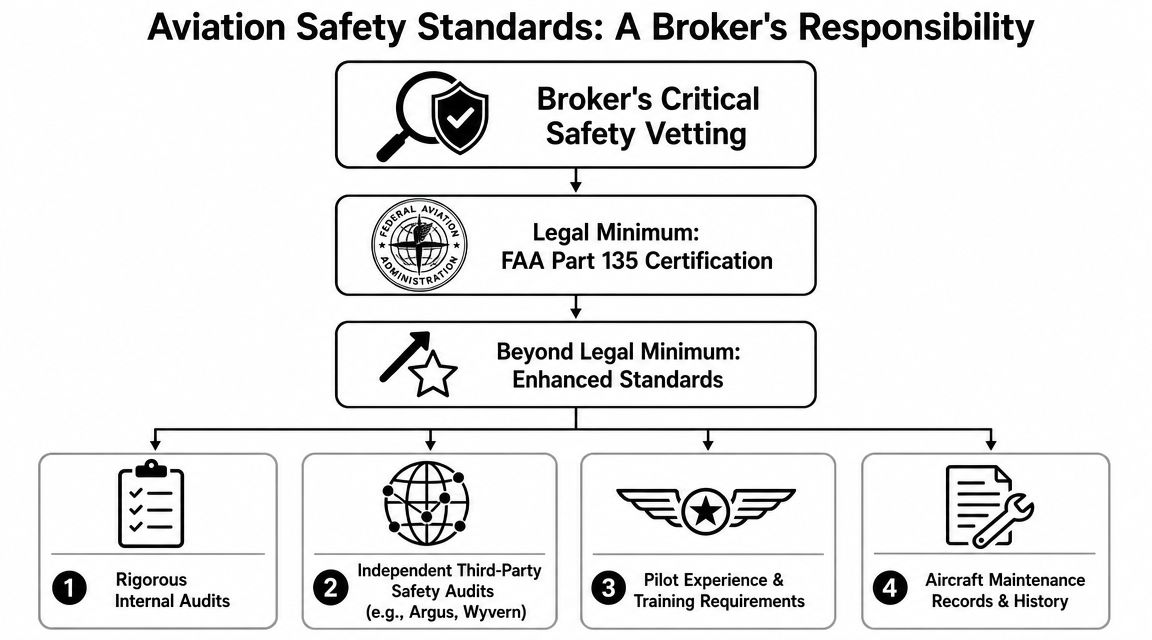
Because the broker usually isn't the operator, the broker's most important job is vetting. Safety isn't the decorative part of the sales process. It's the central filter.
A private charter flight in the U.S. must be operated by a properly authorized air carrier under the applicable rules. But an experienced buyer shouldn't stop at the legal minimum. Legal eligibility tells you an operator can perform charter. It doesn't tell you how disciplined the operator is in daily practice.
What a serious vetting file includes
Government procurement guidance gives a useful view into what thorough broker review should look like. It requires charter brokers to maintain and produce a 7-year aircraft accident history, third-party safety ratings such as Wyvern or ARG/US, operational control and insurance details, fleet information, and pilot qualification records including type ratings, according to the GSA's air charter service broker guidance.
That list matters because it moves the conversation away from generic “safety first” promises and toward verifiable diligence.
What to ask beyond basic certification
When vetting a broker, ask for the screening logic they apply to operators. A strong answer should address:
- Third-party ratings: Whether the operator carries a current Wyvern or ARG/US rating.
- Accident and incident review: Whether the broker checks historical safety records over time.
- Pilot qualification details: Whether the trip crew is appropriate for the aircraft and mission.
- Operational control: Who is making flight release decisions and under what authority.
- Insurance visibility: What liability coverage information can be shared before you commit.
A broker who can answer these questions cleanly is usually operating with a real compliance process, not just a sales script.
For readers who want a broader look at how operator review works in private aviation, Haute Jets publishes a private jet safety overview.
Why this is the line you shouldn't blur
Some buyers treat safety as a background check box and focus most of their energy on price and cabin style. That's backwards. The aircraft, operator, crew, and oversight structure determine the integrity of the trip.
The right standard isn't “Can someone fly me?” It's “Which operator would a disciplined broker be willing to stand behind?”
A polished quote and a nice cabin photo don't tell you that. Documentation does.
How to Choose the Right Aircraft Charter Broker
By the time you're comparing brokers, the challenge is no longer finding someone who can answer the phone. It's finding someone who will answer hard questions without hedging.
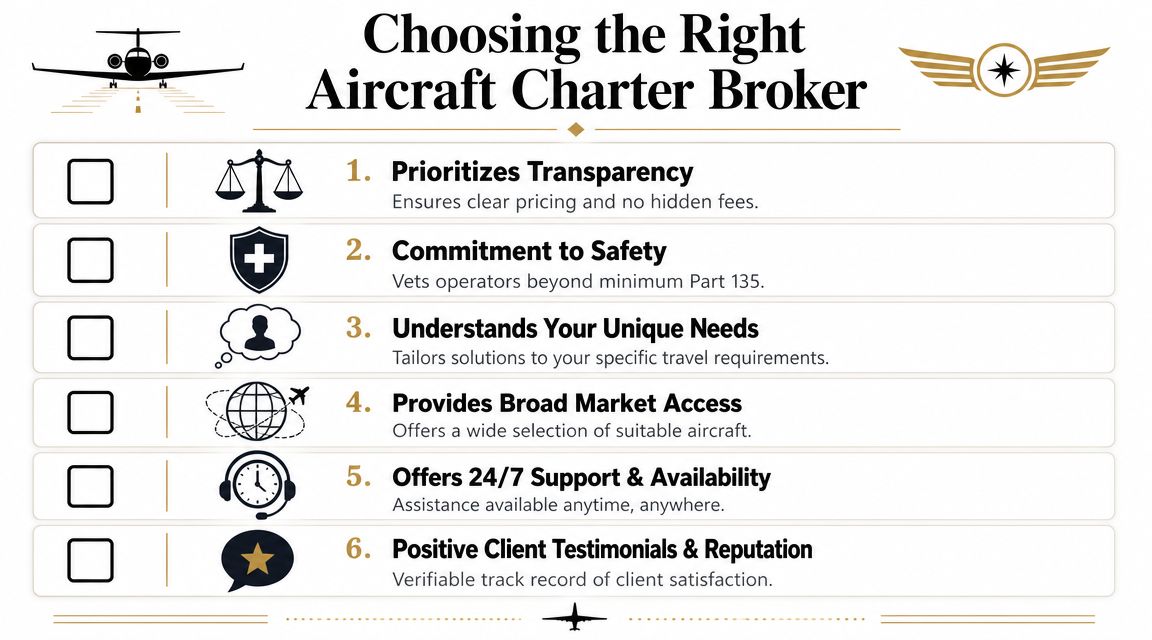
The fastest way to separate a disciplined broker from a sales-driven one is to ask narrow, verifiable questions and listen for specifics.
Start with disclosure and control
Under U.S. DOT and FAA Part 295, an air charter broker must disclose the operating carrier's legal name, the broker's role in the contract, any broker liability insurance and limits, the total flight cost, and known or estimated third-party fees. That disclosure framework gives clients the right to ask direct questions before they sign, as explained in this summary of Part 295 charter broker disclosure requirements.
That means transparency isn't just a preference. It's part of the transaction standard.
The questions worth asking
Use questions like these:
Who is the operating carrier?
Ask for the legal name early, not after payment.Is the aircraft sourced directly or through another broker?
This gets to the heart of hidden layers and potential markup.Is the quote fully itemized?
You want the total trip cost and any known or estimated outside charges.Is the aircraft being held for my trip? “Available” and “secured” are not the same thing.
What safety file do you review before offering an operator?
The answer should include more than generic references to compliance.When do I receive final trip details such as aircraft identification and operating information?
A broker should be comfortable explaining the timeline.
Here's a short video that helps frame what buyers should watch for when evaluating charter options:
What a red flag sounds like
Watch for language that stays broad when your question is specific. “We work with top operators” is not the same as naming the operator. “The aircraft should be available” is not the same as confirming it is being held. “Pricing may vary slightly” is not the same as listing known cost variables.
Ask for documents, names, and timing. Vague confidence is cheap. Operational clarity is harder to fake.
The selection principle that matters most
Choose the broker who makes the transaction easier to audit. That usually means clearer sourcing, cleaner disclosure, and more willingness to explain why this specific aircraft is being proposed for this specific mission.
If the process leaves you with less visibility as you get closer to payment, you're moving in the wrong direction.
The Haute Jets Difference a Modern Broker Model
The problems in this market are consistent. Clients overpay for repositioning they didn't realize was built into the quote. They get broad aircraft categories instead of a clearly identified aircraft. They receive polished pricing without enough visibility into sourcing and operator details.
A modern broker model should solve those points directly.
One example is Haute Jets, which states that it sources from 3,500+ owner-operators across 175 countries, focuses on local sourcing to reduce repositioning exposure, and limits its network to Wyvern Wingman or Argus Gold/Platinum-rated operators, based on the publisher information provided by the company. The model also emphasizes showing clients the exact aircraft options rather than only a general class description.
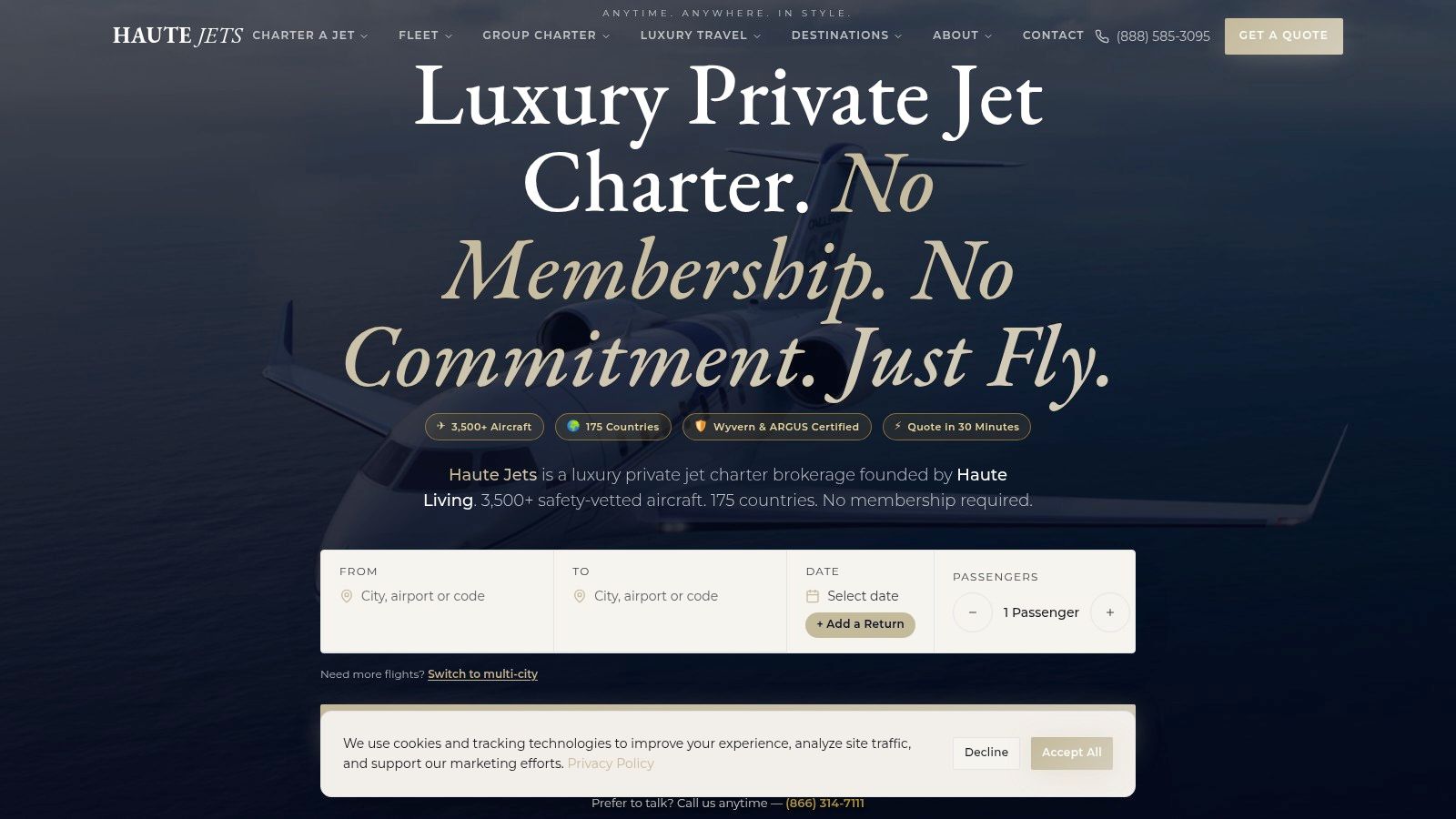
That approach is notable because it lines up with the issues discerning buyers care about most. How close is the aircraft to me? Am I seeing the actual operator structure? Can I choose the aircraft with enough specificity to know what I'm buying? Will I get operational details before departure without chasing for them?
Those aren't marketing extras. They're the details that determine whether a broker improves the purchase or only intermediates it.
If you're evaluating an aircraft charter broker and want a clearer view of sourcing, operator transparency, and exact-aircraft options, Haute Jets offers an on-demand charter model built around those criteria.