
A familiar call comes in after a busy quarter. The company has outgrown ad hoc charter, the travel pattern is now predictable, and leadership wants an aircraft available on its schedule, with its branding, its standards, and none of the capital hit that comes with a purchase. Or a family office has reached the same point for different reasons. They want consistency, privacy, and control, but they don't want to own a depreciating asset outright.
That's where aircraft dry leasing starts to make sense.
It also starts to get dangerous if it's treated like a dressed-up charter. A dry lease can be a legitimate, efficient structure. It can also become a regulatory trap if the paperwork says “lease” but the facts on the ground say someone else is still running the operation. For a new private jet owner or flight department manager, that distinction matters more than the headline economics.
The Strategic Appeal of Aircraft Dry Leasing
Dry leasing sits in the middle ground between full ownership and trip-by-trip charter. It gives the lessee dedicated access to a specific aircraft, but without committing capital to buy the airframe. For operators that want continuity, cabin consistency, and direct control over scheduling, that's a serious strategic advantage.
This isn't a niche corner of aviation finance. Fortune Business Insights states that the global aircraft leasing market was valued at USD 194.40 billion in 2025, is projected to rise to USD 210.57 billion in 2026, and could reach USD 377.90 billion by 2034 at a 7.60% CAGR, with the dry lease segment expected to hold 58.68% of the market in 2026. That tells you two things. First, leasing is central to modern fleet strategy. Second, dry leasing is the dominant structure within that market.
Why sophisticated operators choose it
A dry lease works best when the user doesn't just want lift. The user wants control.
That usually means control over:
- Scheduling discipline: The aircraft serves your operation, not a charter operator's fleet rotation.
- Cabin and equipment choices: Connectivity, interiors, onboard supplies, and operating preferences can match your standard.
- Operating identity: The aircraft flies under the lessee's structure, not under a third party's commercial service model.
- Capital preservation: You keep flexibility instead of tying cash into a purchase.
In practice, this structure often fits a company that already has repeat mission profiles or a principal who flies enough to justify a dedicated solution but doesn't want the balance sheet and residual value exposure of ownership.
Why the complexity is worth understanding
A dry lease looks simple on paper. One party provides the aircraft. The other takes responsibility for operating it. But once the aircraft enters service, the key questions begin. Who hires or selects pilots? Who controls maintenance decisions? Who carries insurance? Who decides whether a particular flight goes?
Those aren't side issues. They're the legal core of the arrangement.
Practical rule: If you want the benefits of a dry lease, you have to accept the burdens of being the operator.
That's also why flight departments often spend time reviewing technical systems and support architecture before they sign. If you're responsible for operating the aircraft, reliability and oversight matter at a systems level, including the kind of high-reliability embedded systems that support modern aerospace platforms and operational resilience.
Dry vs Wet vs Damp Lease Unpacked
A client signs what he believes is a dry lease on Friday, flies on Sunday, and by Monday the arrangement looks a lot like charter. The owner sourced the crew, the owner's team handled scheduling, and the owner decided whether the trip could launch. That is the line that matters.
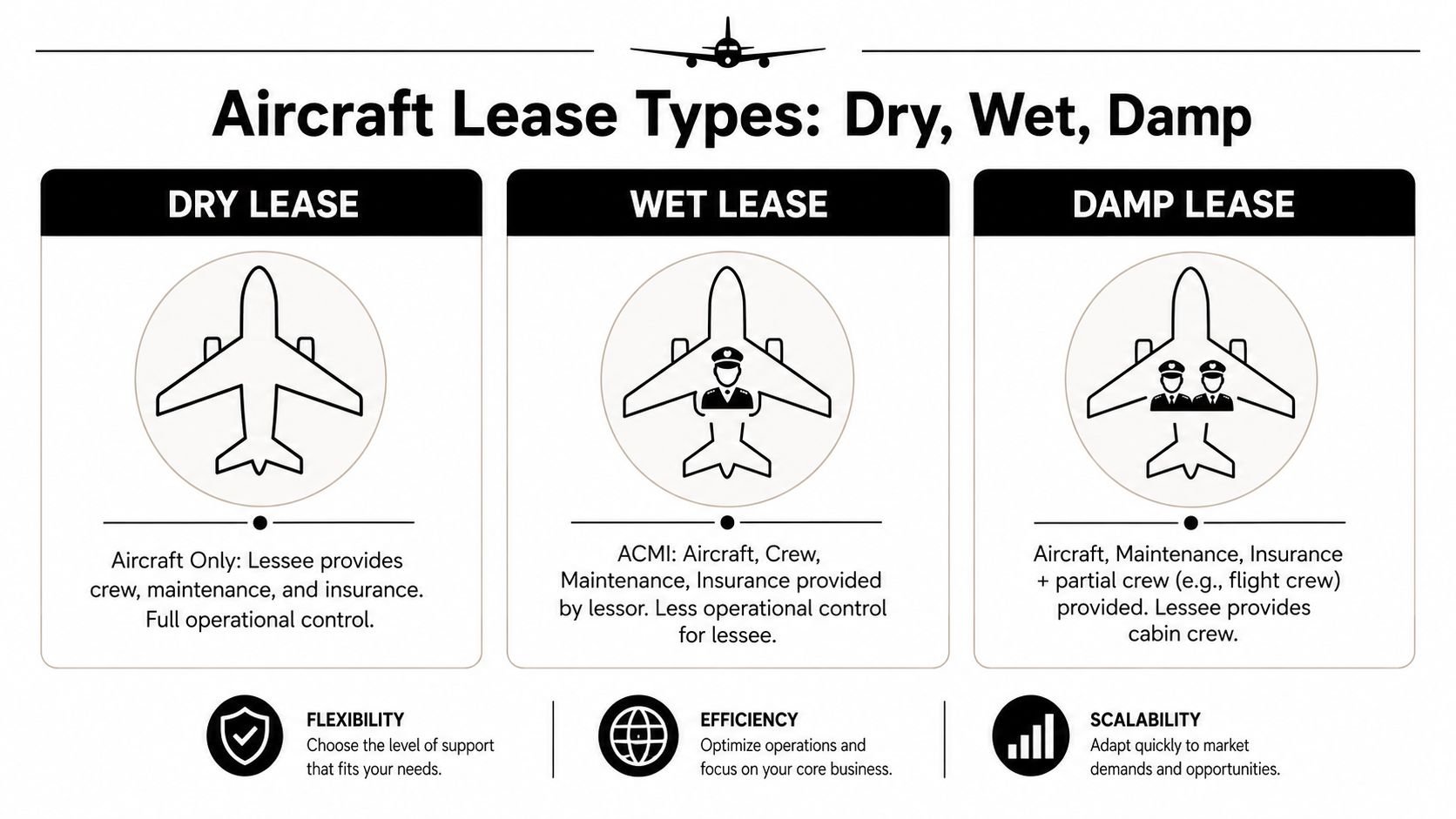
A dry lease gives the lessee the aircraft, then places the operating burden on the lessee. A wet lease gives the customer transportation with the aircraft and the operating package attached. A damp lease sits in between, which is why it deserves extra caution. Partial crewing or shared support can blur responsibility fast if the documents and day-to-day practice do not match.
What each structure really means
The legal and economic split usually looks like this:
| Lease type | Aircraft | Crew | Maintenance | Insurance | Operational control |
|---|---|---|---|---|---|
| Dry lease | Lessor provides | Lessee provides or arranges | Lessee oversees | Lessee carries or arranges | Lessee |
| Wet lease | Lessor provides | Lessor provides | Lessor provides | Lessor provides | Usually lessor |
| Damp lease | Lessor provides | Shared or partial arrangement | Usually lessor or shared by contract | Usually lessor or shared by contract | Mixed and contract-sensitive |
The shorthand for a wet lease is ACMI: aircraft, crew, maintenance, and insurance. If the provider is delivering all four, the customer is buying lift, not taking on the role of operator.
That distinction is where private aviation clients get into trouble. Many want the convenience of charter with the tax or access benefits of a lease structure. The risk starts when the paper says “dry lease” but the lessor still controls the practical operation of the aircraft. That is the profile the FAA studies closely in sham dry lease cases.
A true dry lease is a transfer of possession and operating responsibility. It is not a dressed-up transportation sale. If the lessee does not want to source or direct crew, oversee airworthiness decisions, arrange insurance, and make go or no-go calls through its own structure, charter is usually the cleaner answer. This guide on what a chartered jet is and how charter service works is useful because many buyers are deciding between those two paths.
Damp leases deserve special caution because they often look efficient in the short term. Shared crew or support can solve an immediate problem, especially during transitions, maintenance events, or staffing gaps. But from a regulatory standpoint, “shared” functions often mean disputed control. If a deal starts to feel like someone else is still running the airplane for your benefit, it needs to be reworked before first flight.
One practical rule helps. The more the lessor supplies beyond the airframe itself, the harder it becomes to defend the arrangement as a true dry lease.
The Four Pillars of Operational Control
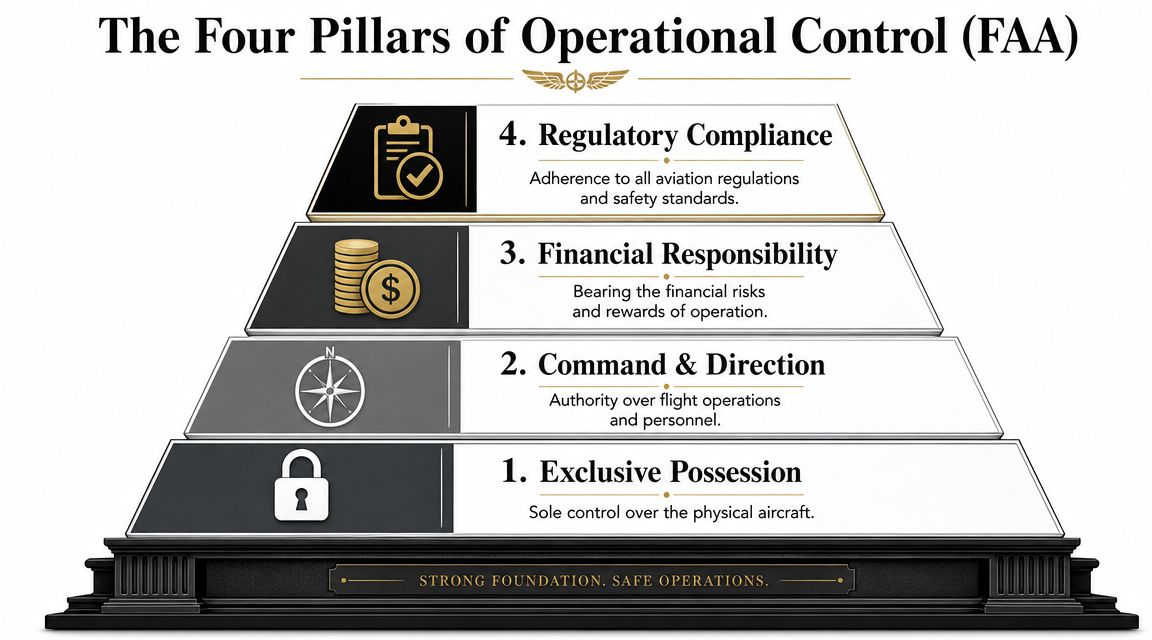
If you remember only one concept in aircraft dry leasing, make it this one. The FAA doesn't care much about what the cover page says if the facts show someone else is operating the aircraft. The test is operational control.
The FAA defines that concept in practical terms. The operator is the party responsible for initiating, conducting, and terminating a flight. In a true dry lease, that responsibility shifts to the lessee. For aircraft over 12,500 lbs. MTOW, the FAA adds concrete truth-in-leasing requirements, including filing the lease with the Aircraft Registry within 24 hours, keeping a copy aboard the aircraft, and notifying the local FSDO 48 hours before the first flight under FAA Advisory Circular AC 91-37B.
Crewing
The first pillar is crew authority and selection. If the lessor picks the pilots, disciplines them, controls their schedule, or presents them to you as part of the package, the FAA may see the lessor as the true operator.
That doesn't mean the lessee has to run a pilot recruiting department from scratch. It means the lessee must retain genuine authority over who flies the aircraft and under what standards. Many lessees use management support, outside recruiting help, or third-party vetting. That's fine if the lessee still makes the decision and can reject, replace, or direct those crew arrangements.
A practical benchmark is simple. Ask who can say no to a pilot assignment. If the answer is not the lessee, the structure is already drifting.
Maintenance and airworthiness
Maintenance is where many otherwise careful deals become sloppy. A lessee under a dry lease can't treat maintenance as “someone else's back-office function” while still claiming operational control.
The lessee needs a real process for:
- Maintenance oversight: Someone must track inspections, intervals, deferred discrepancies, and required corrective action.
- Vendor authority: The lessee should have authority to approve the maintenance provider or maintenance program structure.
- Airworthiness decisions: The aircraft should not be dispatched because the lessor wants utilization. It should be dispatched because the lessee's operating structure considers it airworthy and available.
- Record access: Complete technical records have to be available, reviewable, and contractually deliverable.
A dry lease fails in substance when the lessee signs the papers but the lessor still makes the operating calls.
Insurance and financial responsibility
Insurance is another tell. In a legitimate dry lease, the lessee doesn't merely appear on a certificate. The lessee bears the operating risk appropriate to being the operator.
That usually means the lease should clearly allocate responsibility for hull coverage, liability structure, additional insured status, and who bears deductibles or uninsured losses. If the documents leave the lessee exposed but powerless, that's bad contracting. If they leave the lessor carrying the full operating burden while the lessee remains passive, that's a warning sign on control.
For a private flight department, this is also the point to involve your broker early. Insurance language often reveals whether legal drafting and real operations are aligned.
Documentation and compliance discipline
The final pillar is compliance. Dry leases don't survive FAA scrutiny on vibes. They survive on records, conduct, and consistency.
A disciplined lessee should be able to show:
- A signed lease that reflects actual practice
- Truth-in-leasing filings and onboard copies where required
- Crew selection records and operational procedures
- Maintenance oversight documentation
- Insurance that matches operator responsibility
- Dispatch and trip records showing who exercised control
A lot of private operators also use independent safety screening as a governance check, especially when outside providers support crew or maintenance functions. Haute Jets' own discussion of Wyvern and ARGUS safety ratings is useful background because those ratings don't replace legal compliance, but they can help a lessee assess operator discipline and vendor quality.
Strategic Use Cases for Dry Leasing
A principal gets tired of charter variability and asks for "our own aircraft, without buying one." That can be a sound dry-lease use case. It can also become an illegal charter setup if the lessee wants dedicated lift but never effectively takes control of the operation.
Airline fleet growth
For airlines, dry leasing is usually a capacity and balance-sheet decision. The aircraft joins the lessee's operation, under the lessee's certificate, procedures, crew structure, and network planning. That is why airlines use dry leases for medium- to long-term fleet development rather than short-term operational patchwork.
The regulatory line is also cleaner in that setting. A certificated airline already has the internal systems to dispatch, crew, maintain, and supervise the aircraft as its own operation. The lessor provides the asset. The airline runs the flying.
That distinction matters outside the airline world because many private lessees want the economic benefit of a dry lease while expecting the lessor or manager to keep acting like the operator. That is where FAA trouble starts.
Corporate flight department continuity
A corporate flight department often turns to dry leasing after charter stops feeling efficient. The cost is not just hourly price. It is lost predictability, inconsistent cabin configurations, variable crew standards, and repositioning limits that interfere with executive schedules.
A dry lease can solve that problem if the company already has the people and discipline to act like an operator. That usually means an aviation manager, access to qualified crew hiring or contracting channels, maintenance oversight, insurance coordination, and trip approval procedures that are more than a formality.
For companies comparing structures, a broader private jet leasing guide for corporate and owner planning can help frame where dry leasing fits against ownership, charter, and managed solutions.
The key legal point is simple. If the company wants reliable access and brand-level control over the travel experience, dry leasing can work well. If it wants turnkey transportation with someone else making the operational decisions, charter is the cleaner product.
Family office and principal travel
Family offices are often drawn to dry leases for privacy, recurring mission patterns, and control over who has access to the aircraft. Those are legitimate reasons. They do not excuse a weak structure.
I have seen the risk appear in familiar ways. The principal insists on using the lessor's preferred crew, the management company decides which trips go, and maintenance decisions happen in the background with little lessee input. On paper, the family entity is the lessee. In practice, someone else is still running the aircraft. That is the fact pattern regulators examine when they suspect a sham dry lease.
A well-run family office can use a dry lease successfully. The office needs decision-makers who will approve crews, oversee vendors, and accept that operational control is a real job, not a box to check.
Boardroom test: If the client wants guaranteed aircraft access but will not accept the work and liability that come with being the operator, dry leasing is the wrong structure.
When dry leasing is the wrong tool
Dry leasing is a poor fit for irregular flyers, thinly staffed flight departments, and owners who mainly want convenience. It is also the wrong answer where everyone in the chain informally expects the lessor, manager, or crew provider to "handle everything."
In those cases, the better answer is often a charter arrangement, a jet card, or a management structure that matches how the flights will be conducted. A legal structure only helps if the operation follows it. In dry leasing, that point is not academic. It is the line between a valid private operation and an enforcement problem.
Anatomy of a Dry Lease Agreement and Pricing
Most dry-lease disputes don't start with a dramatic breach. They start with a term sheet that looked straightforward until the aircraft needed maintenance, a redelivery inspection began, or the lessor and lessee realized they had different assumptions about what “good condition” meant.
A dry lease agreement is a risk allocation document. The monthly rent matters, but the underlying economic exposure often lives elsewhere.
The clauses that deserve the hardest review
Start with the lease rate, then move quickly beyond it.
The clauses I'd read with the most suspicion are:
- Maintenance reserves: These provisions can shift major future cost exposure onto the lessee. The key question isn't just whether reserves are required. It's how they're calculated, whether they're refundable, and what maintenance events trigger application or release.
- Return conditions: Redelivery language is one of the biggest sources of conflict. “Return in good operating condition” sounds harmless until one side interprets it as baseline serviceability and the other interprets it as near-shop standard.
- Insurance covenants: The agreement should match the actual operating structure. If the lease allocates operator obligations to the lessee but keeps insurance control elsewhere, the paper and the operation may not line up.
- Default provisions: Look for cross-defaults, cure periods, repossession rights, quiet enjoyment language, and what happens if the aircraft is grounded for technical reasons.
- Use restrictions: Geographic limits, sanctioned jurisdictions, approved airports, sublease prohibitions, and maintenance base requirements can affect real usability more than the rent number does.
Pricing is rarely about one number
Readers often ask, “What should the monthly dry-lease price be?” The better question is, “What drives the full cost of this aircraft over the life of the lease?”
The answer usually turns on a handful of factors:
| Cost driver | Why it matters |
|---|---|
| Aircraft age and condition | Older aircraft may carry more maintenance uncertainty and different reserve assumptions |
| Engine and component status | Upcoming events can turn a cheap lease into an expensive one |
| Market demand for the type | Popular aircraft can command tighter terms and less flexibility |
| Credit quality of the lessee | Better credit can improve security and payment terms |
| Lease duration | Longer commitments can change economics and redelivery exposure |
A low headline rent with aggressive reserves, restrictive use terms, and punishing return conditions is often more expensive than a higher rent with balanced risk sharing.
What works in negotiation
Good dry-lease negotiations focus on three things. First, get technical records reviewed by someone who knows the type. Second, define return conditions in engineering language, not broad adjectives. Third, make sure the operational structure matches the contract from day one.
For readers comparing leasing structures more broadly, Haute Jets' private jet leasing guide gives helpful context on where dry leasing fits among other access models.
“The cheapest lease is often the one with the cleanest maintenance history and the fewest surprises at redelivery.”
Questions to put on the table early
Ask these before a draft gets too far along:
- Who controls maintenance planning and provider approval
- What condition reports and records are delivered at acceptance
- How are reserves handled at return
- What technical standard defines redelivery
- What remedies apply if the aircraft is unavailable for service
- Who carries each category of insurance and on what terms
If those answers stay vague, the deal isn't ready.
The Executive Checklist for Dry Leasing
Most bad dry leases don't look bad on signature day. They look efficient, quick, and commercially convenient. The trouble appears later, when the FAA asks who controlled the operation or when a dispute exposes that the lessee never really took on the operator role it claimed to have.
NATA's guidance is particularly useful on that point. The FAA looks beyond the contract label and examines who controls maintenance, insurance, fuel, and other operating decisions. NATA also warns that reimbursement or cost sharing can push the arrangement toward a commercial operation, and that a lessor involved in crew selection can create reclassification risk in its dry leasing guide.
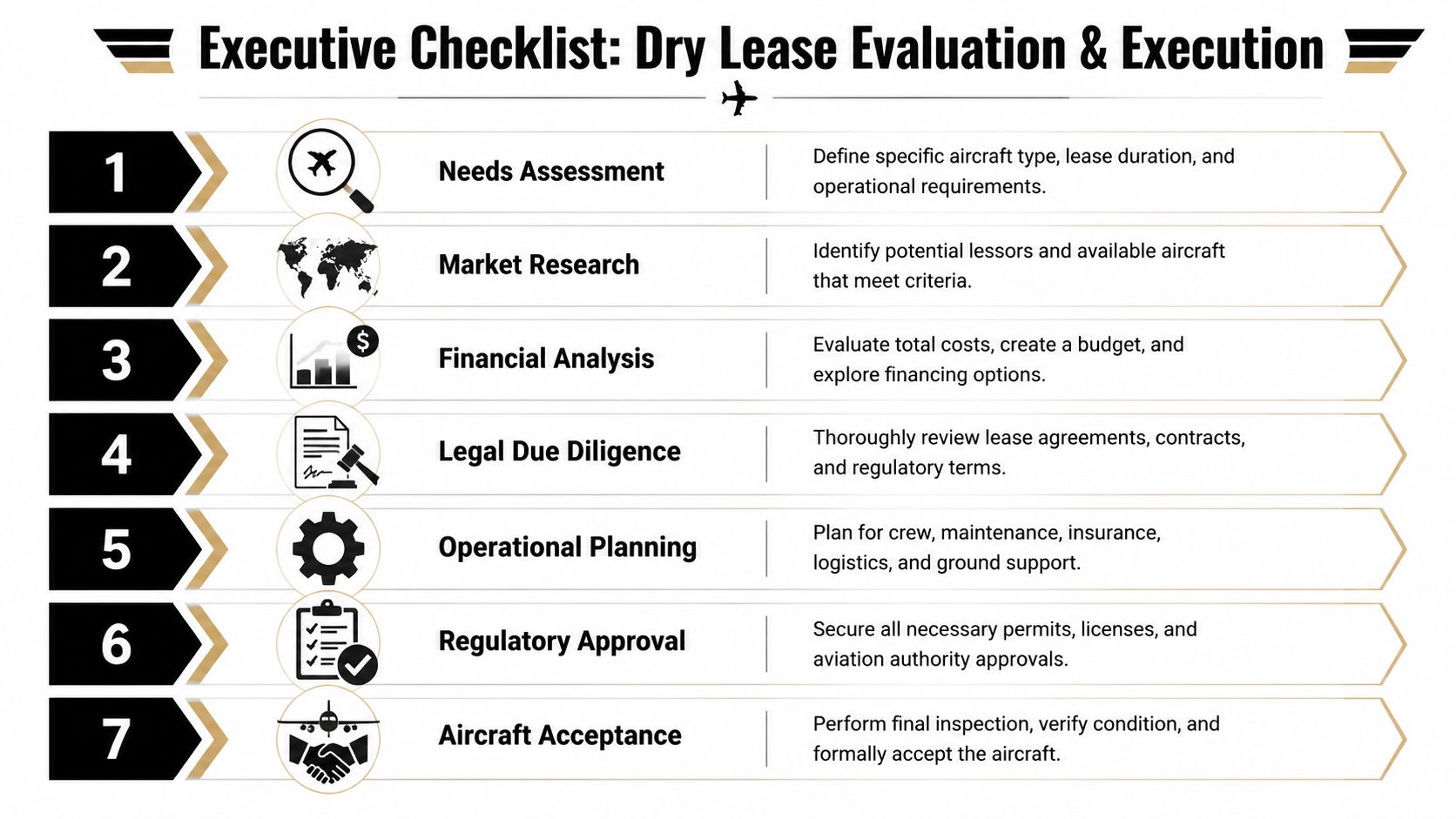
Step one through three
Start with discipline before drafting.
Define the mission clearly
Specify the aircraft class, expected routes, passenger loads, baggage profile, duration of need, and whether the structure is meant to support a corporate department, a principal, or a broader affiliated-user model.Investigate the aircraft and lessor
Review maintenance status, damage history, records completeness, title and registration issues, and the lessor's reputation for technical cooperation and end-of-lease conduct.Model the full operating cost
Build a real budget that includes crew, training, maintenance oversight, insurance, hangar, subscriptions, navigation services, and compliance costs. Dry leasing stops being attractive when the user prices only the rent and ignores the operation.
Step four through seven
The next steps are where sham-lease prevention becomes real.
- Legal structure review: Counsel should test whether the proposed arrangement transfers genuine operational control or merely says it does.
- Crew authority setup: The lessee must have a documented process for selecting, approving, and overseeing flightcrew. If the lessor is effectively handing over a ready-made crew package with no meaningful lessee discretion, stop there.
- Maintenance and dispatch governance: Build written procedures that show who authorizes maintenance, who determines readiness for service, and who controls dispatch decisions.
- Insurance and compliance closeout: Confirm that the insurance program, lease terms, onboard documents, and operating practices all say the same thing.
The sham-lease warning signs
These are the indicators I'd treat as immediate escalation points:
- The lessor chooses the pilots and expects you to accept them
- The lessor controls dispatch or day-to-day scheduling
- The aircraft is marketed or used like charter while labeled as a lease
- The lessee receives reimbursement that starts to resemble carriage for compensation
- The paperwork is detailed, but the operational procedures are missing
If the lessee cannot explain who initiates, conducts, and terminates each flight, the dry lease is not ready for use.
A legitimate dry lease should survive two tests. It should make sense in the contract, and it should make sense to an inspector watching the aircraft operate.
Market Outlook and Managing Risk in 2026
The market backdrop matters because leasing decisions never happen in a vacuum. Asset values move. Financing conditions change. Insurance markets tighten or loosen. Sustainability expectations increasingly shape fleet choices, especially for operators thinking about long-horizon aircraft selection and fuel strategy.
What doesn't change is the core appeal of dry leasing. It offers dedicated access, fleet flexibility, and operational control without the full capital burden of ownership. That's why it remains so important in aviation finance and fleet planning. But the same feature that makes it attractive also creates risk. The lessee doesn't get to borrow the benefits of operator status while outsourcing the substance of operator responsibility.
The practical outlook for 2026
In 2026, the better dry-lease deals will likely be the ones built with conservative assumptions and cleaner governance. That means tighter technical diligence, clearer redelivery standards, and stronger alignment between lease language and flight operations. It also means being realistic about whether your organization can run the aircraft compliantly.
From a risk perspective, dry leasing should be evaluated the same way any serious operating commitment is evaluated. Legal risk, commercial risk, technical risk, and counterparty risk all interact. If you want a broad framework for that mindset, this overview of understanding commercial risk is a useful companion read because it reinforces the discipline of identifying exposure before it turns into loss.
The bottom line
Aircraft dry leasing is neither a loophole nor a shortcut. It's a legitimate structure for users who need stable access to an aircraft and are prepared to act like the operator in every meaningful sense.
If that's your objective, a dry lease can be an excellent tool.
If what you really want is turnkey lift with someone else carrying the operating burden, choose that instead.
If you're weighing dry leasing against charter, aircraft management, or other access models, Haute Jets is a practical place to compare those options in plain language and understand which structure fits your travel pattern, control requirements, and compliance tolerance.