
The popular advice is simple: look for the 16g label and assume the seat is safe. That shortcut misses most of the engineering work. A seat can meet the central crashworthiness test and still create problems through poor restraint geometry, unsuitable materials, difficult evacuation, or dimensions that exclude passengers.
Aircraft seat design requirements begin with impact protection, but they don't end there. A certifiable seat must work as part of the cabin, the aircraft structure, the restraint system, and the evacuation plan. It must also support real passengers with different body sizes and mobility needs. This guide appears on Haute Jets Journal and approaches the subject as an aviation safety instructor would: start with the rule, understand the reason, then examine how the requirement affects the final cabin.
Why an Aircraft Seat Is More Than a Chair
Calling an aircraft seat a chair is convenient, but technically wrong. A domestic armchair mainly needs to support a person comfortably. An aircraft seat must manage crash loads, restrain the occupant, remain attached to the aircraft floor, avoid dangerous projections, and form part of a certified interior installation.
The distinction matters because the seat isn't tested as an isolated object. FAA guidance requires a representative production configuration, including the seat, restraint system, cushions, armrests, and nearby interior, to be used for dynamic evaluation. Manufacturing must then follow the approved specifications. A change in foam density, recline hardware, or track attachment can affect the certification basis, even when the alteration looks minor.
Four layers of seat design
A useful way to understand the requirements is to separate them into connected layers:
- Structural protection: The frame, fittings, tracks, and energy-absorbing features must handle defined crash loads.
- Occupant control: Belts and cushions must manage how the body moves during deceleration.
- Human factors: The seat must support posture, reach, comfort, and a declared passenger range.
- Cabin survivability: Materials and trim must limit fire contribution and dangerous debris.
The seat also operates inside a larger evacuation system. Armrests, footrests, tables, restraints, aisle clearances, and nearby structures can either help or obstruct movement. A design that protects a seated occupant but delays access to an exit creates a different safety problem.
Practical rule: Treat the seat as a complete occupant-protection system, not as upholstery attached to a metal frame.
This broader view is especially important in private aircraft interiors. A bespoke cabin may include opposing club seats, divans, berthable furniture, or conference arrangements, but customization doesn't remove the need to account for loads, restraints, fire performance, and emergency movement. Haute Jets' private aircraft interior design overview illustrates why cabin appearance and functional layout must be considered together, although a design presentation alone isn't evidence of certification.
The 16g Dynamic Test and Why It Matters
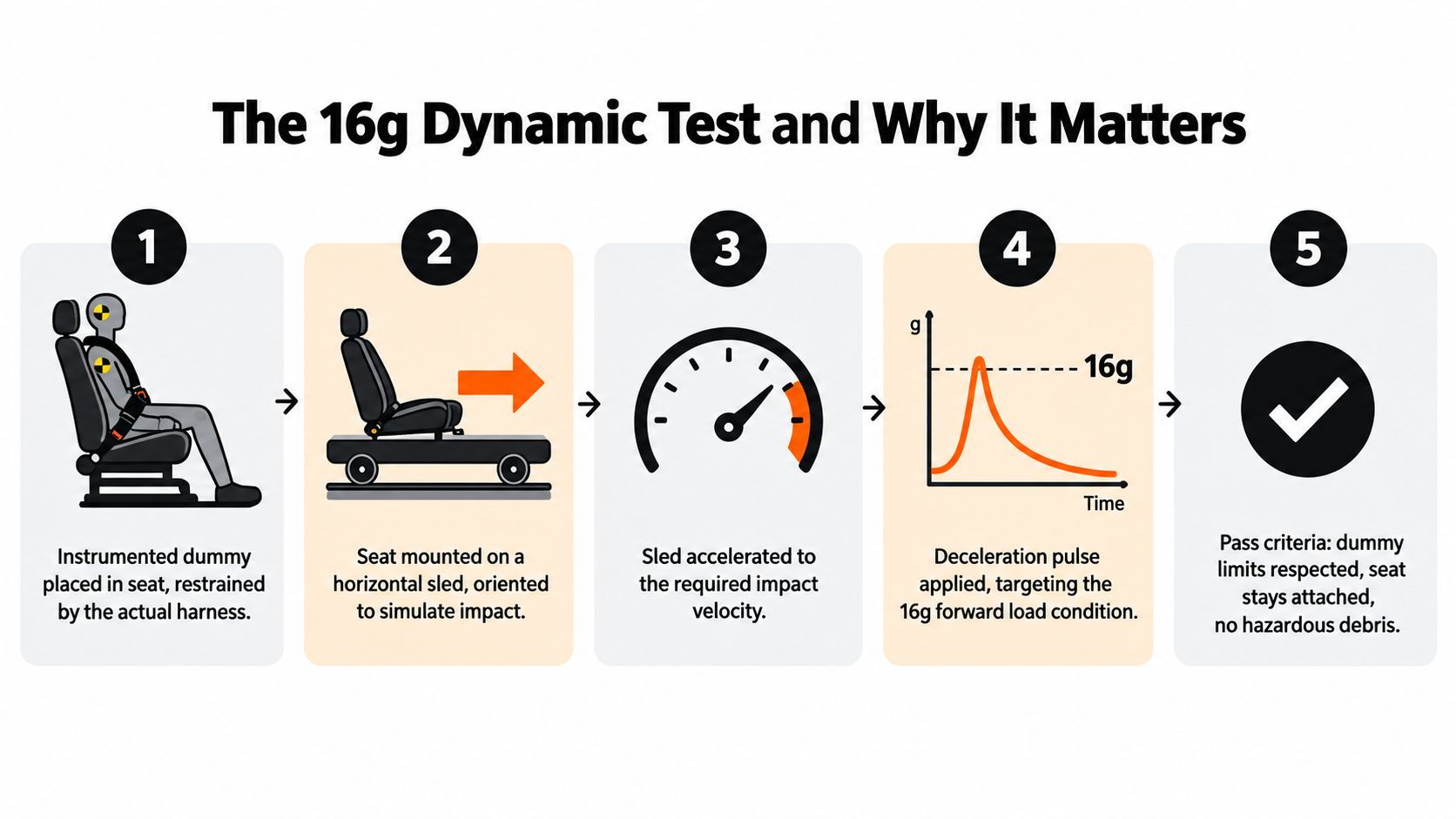
The 16g dynamic test is the foundation of modern transport-category seat crashworthiness. In simple terms, engineers mount a representative seat and restraint system on a test sled, place an instrumented anthropomorphic test device in the seat, and apply a controlled deceleration pulse that represents a severe forward crash condition.
The “g” describes acceleration relative to normal gravity. A 16g forward condition therefore exposes the seat and occupant surrogate to a very demanding load environment. The purpose isn't to recreate every accident. It is to demonstrate that the complete installation can protect an occupant in defined survivable crash scenarios.
What engineers look for
The test asks several questions at once:
- Does the seat remain attached? The frame and fittings must preserve the load path into the tracks and floor structure.
- Does the restraint control the occupant? The belt must carry crash loads without creating unacceptable injury risk.
- Does the structure deform in a useful way? Permanent deformation can absorb energy, provided the seat still retains the occupant and stays attached.
- Does the occupant surrogate stay within injury limits? Measurements address areas such as the head, neck, torso, femur, and pelvis.
- Does the interior remain safe? Broken components or hazardous projections must not create additional injury or evacuation hazards.
EASA describes CS-25 and FAR Part 25 paragraph 25.562 as requiring dynamic seat testing with acceleration levels up to 16 g in the forward longitudinal direction, alongside occupant-protection criteria such as the Head Injury Criterion, or HIC. The same certification framework is used across major aviation markets, particularly the United States and Europe, as described in EASA's dynamic seat testing material.
The history explains why the test carries so much weight. After World War II, early metal-frame seats were required to withstand crash testing at 6 g. In 1988, regulations increased the requirement to 16 g, a nearly threefold rise in the required crashworthiness level, as documented by Virgin Atlantic's history of aircraft seats.
The test also isn't limited to a single forward scenario. Related documentation includes combined vertical and longitudinal cases, with downward structural load cases around 14 g and forward crash conditions around 16 g. That combination reflects two distinct concerns: protecting the spine from vertical loading and keeping the seat-floor attachment intact.
FAA guidance calls for at least two dynamic tests, using an anthropomorphic test device representing approximately the 50th percentile male occupant. FAA Advisory Circular AC 20-146A explains how those tests evaluate the seat, restraint system, and related interior systems together.
Mapping the FAA and EASA Rule Framework
Aircraft seat certification doesn't come from one standalone rule. It comes from a connected set of regulations and approval documents. Each document answers a different question, so reading only the 16g requirement can leave a misleading gap in the compliance picture.
A practical way to map the framework is to ask what each reference controls:
- 14 CFR 25.561 addresses general emergency landing conditions and structural strength.
- 14 CFR 25.562 establishes the dynamic seat and restraint test conditions.
- 14 CFR 25.785 covers seat, berth, and safety-belt installations, including occupant protection and hazardous projections.
- 14 CFR 121.311 applies operating-rule requirements to seats, berths, safety belts, and shoulder harnesses for Part 121 operations.
- AC 20-146A provides FAA guidance for demonstrating compliance with dynamic seat requirements.
- TSO-C127 and its revisions connect seat approval to technical standard order performance requirements.
FAA materials also identify the broader regulatory framework as 14 CFR 25.561, 25.562, 25.785, and 121.311. They state that seat and belt attachment fittings must have strength equal to 1.33 times the specified ultimate loads, except in the sideward direction, as shown in FAA seat certification presentation material.
| Document | Agency | Scope |
|---|---|---|
| 14 CFR 25.561 | FAA | General emergency landing loads and structural strength |
| 14 CFR 25.562 | FAA | Dynamic seat and restraint crash testing |
| 14 CFR 25.785 | FAA | Seat, berth, belt installation, occupant protection, and projections |
| 14 CFR 121.311 | FAA | Seat and restraint operating requirements for Part 121 carriers |
| AC 20-146A | FAA | Accepted guidance for dynamic seat compliance |
| TSO-C127 series | FAA | Technical performance standards for aircraft seats |
| CS-25 | EASA | European transport-category certification requirements |
AC 20-146A states that dynamic seat certification can demonstrate compliance with 14 CFR 23.562, 23.2270, 25.562, 27.562, and 29.562, as well as TSO-C127, C127a, C127b, and C127c. This shows that the approval path can involve both aircraft certification rules and technical standard orders.
EASA follows the same broad logic through CS-25 and related acceptable means of compliance. The exact document names differ, but the engineering sequence remains recognizable: define the load, test the complete installation, measure occupant response, and control production configuration.
Human Factors and Ergonomic Dimensions
Once crashworthiness is settled, the next question is whether the seat can be used safely throughout the flight. Human factors determine whether people can use that seat safely and tolerably during normal operations. A seat that passes a dynamic test still needs dimensions, controls, cushions, and reach zones suited to the passengers identified in its certification and cabin specification.
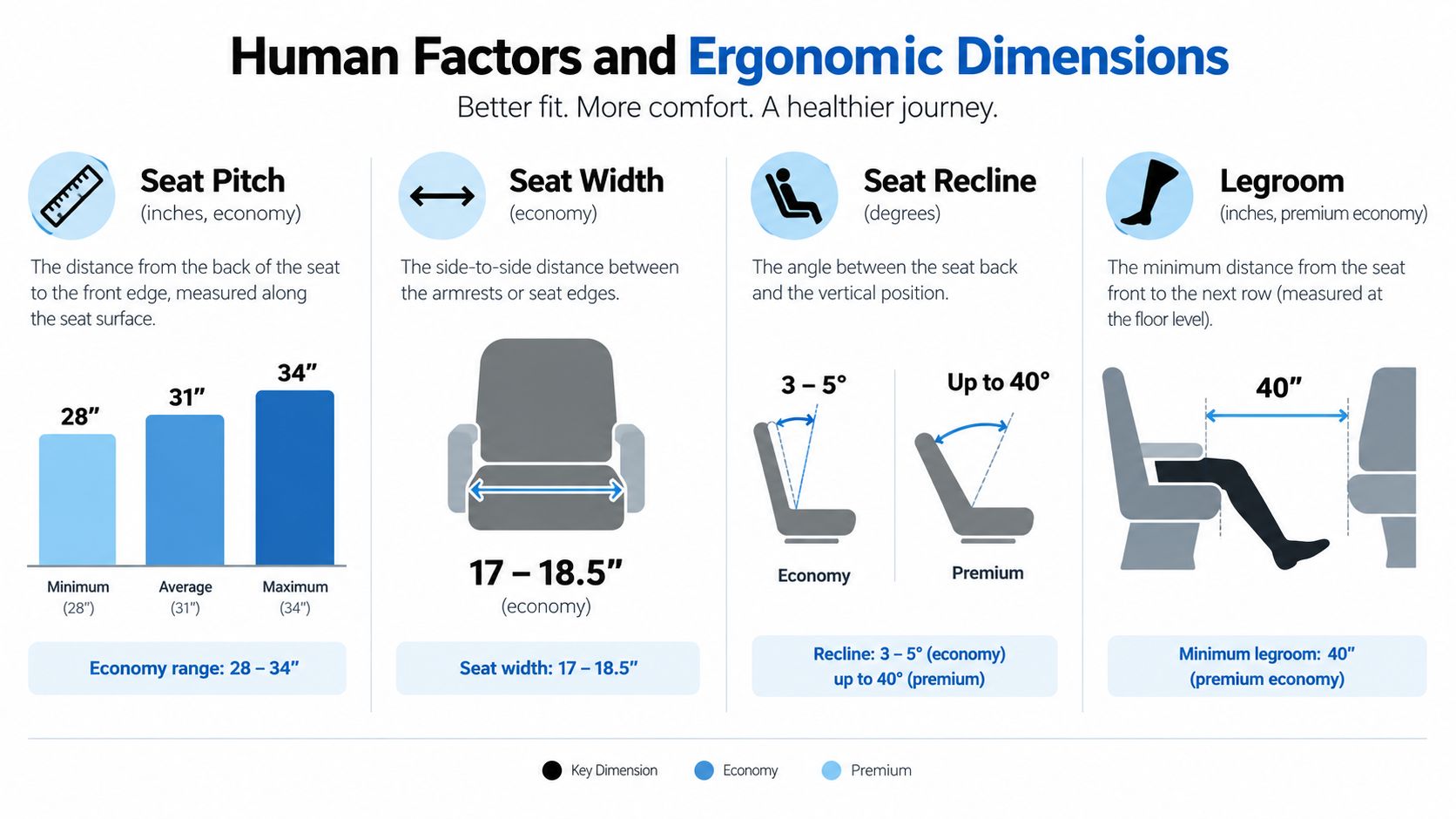
Seat pitch offers a clear example. Economy layouts commonly use a pitch of 28 to 34 inches, while seat width is often discussed in the range of 17 to 18.5 inches. These figures describe common cabin practice, not universal FAA minimums, so they should not be treated as automatic certification thresholds. Pitch affects knee clearance, access to the restraint, and movement toward the aisle. Width affects pressure distribution, arm position, belt routing, and usability for larger occupants.
Designing for the body, not the drawing
Engineers examine how the occupant and seat interact:
- Cushion shape: Load should spread across the body instead of concentrating at the pelvis or thighs.
- Lumbar support: The backrest should support the lower spine without forcing a posture that interferes with restraint fit.
- Headrest geometry: The headrest should support the head while avoiding hazardous edges and unwanted contact during impact.
- Reach envelopes: Passengers must be able to find and release belts, operate controls, and access tables without awkward movement.
- Recline behavior: Recline changes knee clearance, head position, restraint geometry, and the space behind the seat.
Economy recline is commonly around 3 to 5 degrees, while premium seating can reach 40 degrees, and premium economy layouts may provide at least 40 inches of legroom. These are cabin design examples. The applicable aircraft, seat model, and approval basis must confirm whether a configuration is acceptable.
A seat may meet dynamic injury criteria yet remain unsuitable for its declared passenger range. Human-factors research emphasizes distributing load across the body, accommodating different body sizes, and avoiding hard cushioning that creates pressure points. The same principle applies to child restraint geometry and larger-bodied passengers. The private-jet seat design guide is a practical cabin resource, not an FAA or EASA regulatory publication, so it should be read alongside approved seat data rather than used as a substitute for it.
Comfort isn't separate from safety. Poor belt access can affect restraint use, excessive pressure can encourage posture changes, and tight clearances can slow movement. Before submitting an installation for review, the designer should verify belt-reach distance, cushion pressure distribution, and headrest clearance against the approved anthropometric envelope.
Materials, Flammability, and Fire Performance
A seat can perform well in a crash and still introduce unacceptable fire risk. Aircraft cabins are enclosed environments, so designers control how upholstery, foam, fire-blocking layers, belts, plastics, and trim react to flame, heat, smoke, and combustion.
Under FAR 25.853 Appendix F, material qualification can include vertical burner testing, oil-burner testing for seat cushions, heat-release testing, and smoke-density evaluation. EASA's CS-25 framework provides corresponding European requirements. The important point is that the approval target is often the complete seat assembly, not just the decorative fabric.
A typical cushion therefore uses a layered construction. The outer cover provides the visible finish, while a fire-blocking layer sits between the cover and the foam. That barrier helps prevent the cushion core from supporting combustion after the outer material is exposed. Trim choices remain controlled because changing the cover, foam, adhesive, or backing can change the performance of the tested assembly.
| Test standard | What it measures | Typical pass threshold |
|---|---|---|
| FAR 25.853 Appendix F vertical burner | Flame spread, burn length, after-flame behavior, and dripping | Must remain within the applicable regulatory limits |
| Oil-burner seat-cushion test | Performance of the complete cushion assembly under intense flame exposure | Flame spread and weight loss must remain within applicable limits |
| OSU heat-release test | Heat released by cabin interior materials | Part IV includes a peak heat-release limit of 65 kW/m² and a total heat-release limit of 65 kW/m², as described in the provided technical reference |
| Smoke-density testing | Visibility loss from smoke during combustion | Must remain within applicable limits |
| Smoke and toxicity evaluation | Harmful combustion products from interior materials | Must satisfy the applicable regulatory and technical specifications |
The 65 kW/m² heat-release figures above come from the supplied research reference, flame-retardant aviation seat fabric analysis. Smoke and toxicity requirements add another layer because dense or hazardous smoke can impair evacuation even when flame spread is controlled.
Material maintenance matters too. Cleaning agents, abrasion, ultraviolet exposure, and repeated service can alter a material's condition. Before specifying a surface treatment for leather or trim, teams can consult Titan Coatings interior protection tips as a maintenance-oriented resource, then confirm that any selected treatment is compatible with the approved material system.
For a broader view of how finishes fit into a private cabin, see this private plane interiors guide. A finish isn't airworthy because it looks durable. It must remain consistent with the tested and approved configuration.
Accessibility, Evacuation, and Inclusive Design
A crashworthy seat protects an occupant in a defined event. An inclusive cabin must also let passengers board, sit, release restraints, and evacuate without unnecessary barriers. Those objectives overlap, but they aren't identical.
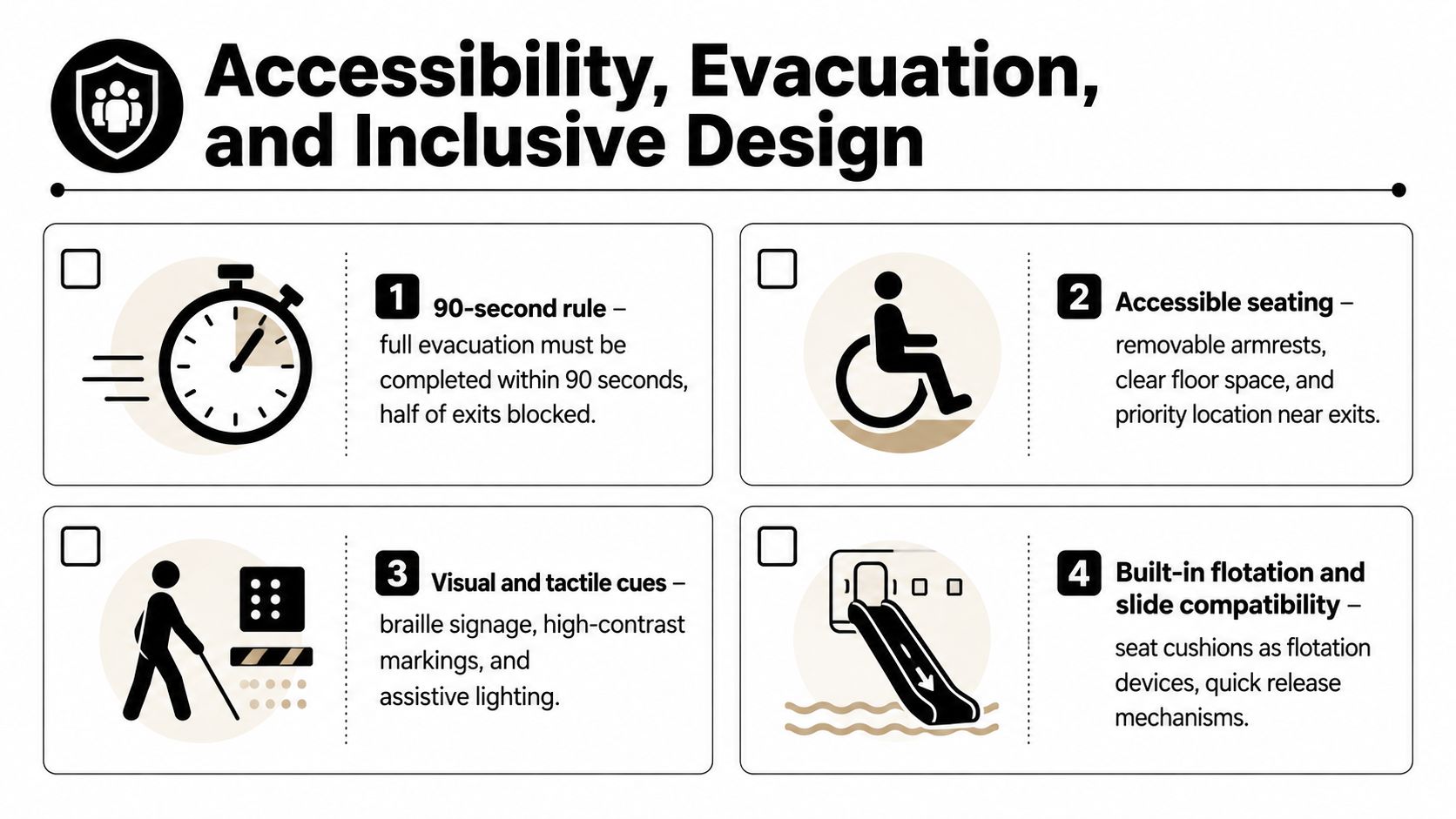
Evacuation testing is a useful starting point. The transport-category benchmark requires a fully loaded aircraft to evacuate within 90 seconds with half of the exits blocked, as described in the supplied aviation guidance. That requirement influences aisle geometry, seat spacing, armrests, footrests, table storage, and the release mechanisms passengers or crew may need to operate.
The evacuation consequence of small details
A seat designer must examine more than the cushion:
- Armrests should not create avoidable obstacles in an aisle or block transfer paths.
- Footrests and tables need stowage or release arrangements that don't trap the legs.
- Restraints must be easy to locate, use, and release.
- Seat spacing must support movement toward exits without creating unnecessary pinch points.
- Nearby projections mustn't injure occupants or impede evacuation.
Accessibility introduces another set of questions. Larger-bodied passengers may need better load distribution and usable belt geometry. Passengers with reduced mobility may need transfer assistance, clear floor space, removable armrests, and seating arrangements that support dignified movement. People with vision or hearing impairments may depend on visual, tactile, or assistive cues.
Modern FAA materials focus on serious-injury protection and the removal of hazardous projections, while older human-factors research stresses fit across body sizes and avoidance of pressure points. Those sources lead to a contrarian conclusion: passing a crash test doesn't prove that a seat works well for every passenger.
Accessibility reporting in 2026 highlighted progress toward viable onboard wheelchair use and safer movement for passengers with vision or hearing impairment. That development points toward a wider design expectation, but it doesn't automatically establish a universal certification rule for every aircraft or seat.
For teams reviewing visual and tactile communication in a cabin, an accessibility in design guide can provide useful general design context. Aircraft-specific solutions still require review against the applicable approval basis, evacuation demonstration, and operator procedures.
What Changes for Private and Corporate Cabins
The underlying safety logic doesn't disappear when an aircraft becomes smaller or more exclusive. What changes is the regulatory pathway, the operating category, the cabin layout, and the way the final installation reaches approval.
A Part 91 private operation and a Part 135 on-demand commercial operation don't sit in the same operating framework as a Part 121 airline. The exact aircraft certification basis and modification history determine which requirements apply, and a completion centre may have to coordinate the seat manufacturer, aircraft OEM, supplemental type certificate holder, and operator.
Bespoke layouts still carry familiar obligations
Business aircraft often use double-club arrangements, club-four groupings, divans, conference tables, and seats that convert into berths. Those features create design questions that are less prominent in a uniform airline cabin:
- How does a passenger remain restrained in a reclined or berthable position?
- Does the restraint geometry protect the pelvis and upper body?
- Can the seat or divan transmit crash loads into the aircraft structure?
- Does the cushion include the required fire-blocking construction?
- Can passengers and crew move around the furniture during an emergency?
A private cabin may have fewer seats near each exit, but that doesn't make evacuation irrelevant. The layout can reduce some density pressures while introducing large furniture, complex movement paths, and convertible mechanisms. Each mechanism must be assessed in its intended configuration, including takeoff, landing, turbulence, and emergency use.
Business aviation also creates a temptation to treat comfort as the main design criterion. A wide leather seat, an electrically adjustable recliner, or a conference arrangement may be attractive, but the final installation still needs traceable engineering data. A completion centre may use an approved seat, an STC, an OEM service bulletin, or another accepted approval path. The paperwork matters because the tested article and the installed article must correspond.
For charter operators, the aircraft's listed seat count and cabin layout should therefore be treated as operational information, not just marketing language. A seat arrangement that looks similar across two aircraft can have different approval histories, restraint systems, and installation constraints.
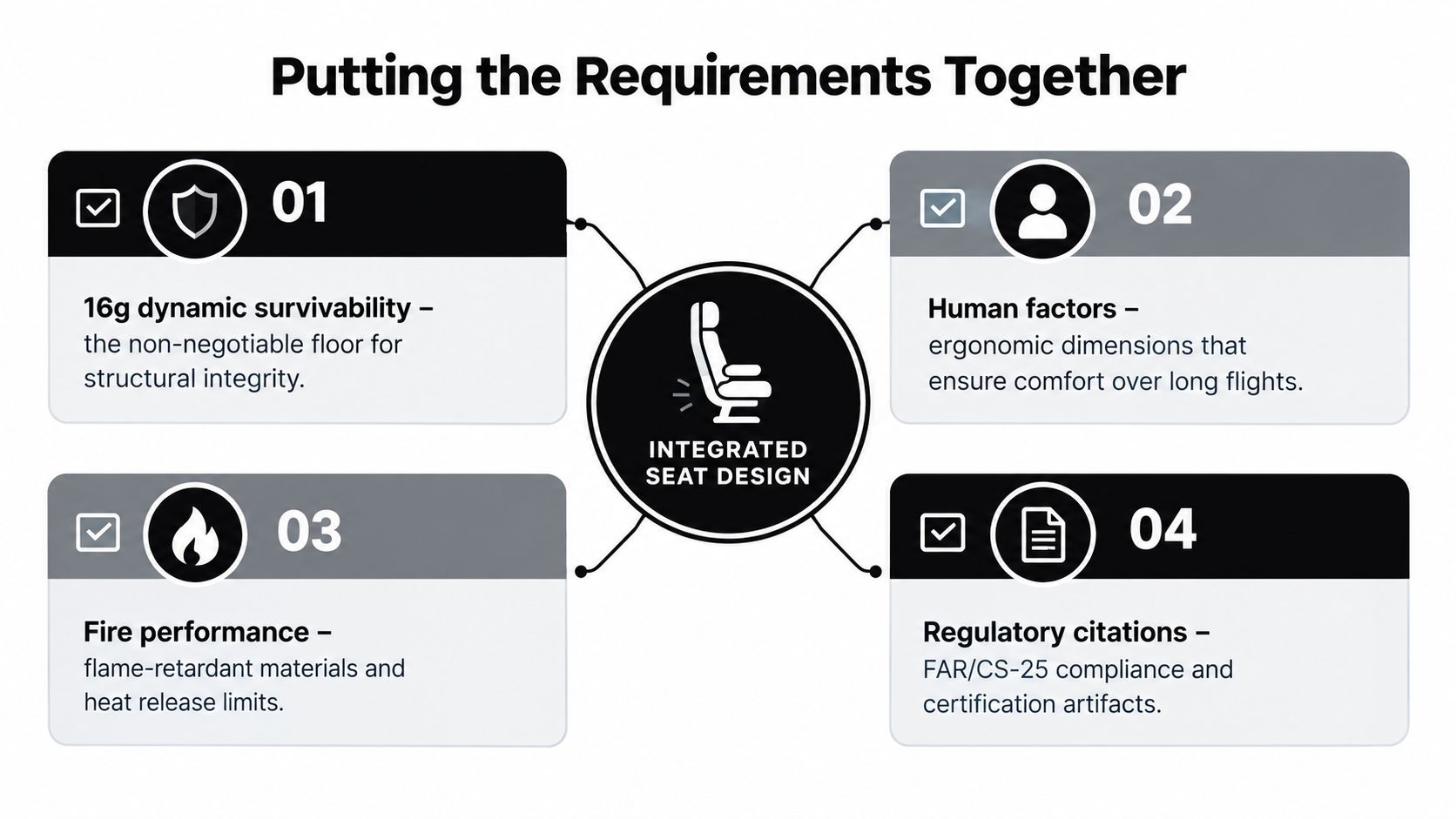
Putting the Requirements Together
16g dynamic survivability is the floor, not the ceiling. It establishes a demanding crashworthiness baseline, but a seat only becomes a viable aircraft installation when structural protection, occupant fit, fire performance, evacuation, and regulatory records support one another.
The integrated view looks like this:
- Crashworthiness: The seat and restraint system manage defined forward and vertical loads while remaining attached.
- Human factors: Dimensions and controls support the declared passenger range and normal use.
- Fire performance: Covers, foam, blocking layers, plastics, and trim meet the applicable flammability and smoke requirements as an assembly.
- Certification control: Drawings, test reports, production specifications, installation data, and modification approvals describe the actual article installed in the aircraft.
A practical review checklist
When specifying, auditing, or retrofitting a seat, ask:
- Which certification basis applies? Identify the aircraft category, operating rules, applicable FAR or CS requirements, and any TSO or STC documentation.
- What exactly was tested? Confirm that the tested seat, restraint, cushions, armrests, nearby interior, and attachment structure match the proposed installation.
- How does the seat fit passengers? Review cushion width, posture, belt reach, head support, child restraint compatibility, and accommodation for larger or reduced-mobility passengers.
- What happens in a fire? Trace the cover, blocking layer, foam, adhesive, and trim qualification rather than reviewing the fabric alone.
- Can people get out? Examine aisle interfaces, armrests, tables, footrests, release mechanisms, exit access, and the effect of the completed cabin layout.
- How will configuration be controlled? Make sure replacement materials, foam specifications, mechanisms, and maintenance treatments remain within the approved design.
Future seat development will likely face pressure from universal-design expectations as well as mechanical performance. Anthropometric diversity, reduced-mobility accommodation, and modular interiors challenge the industry to show not only that a seat survives an impact, but that more passengers can use it safely before, during, and after an emergency.
Haute Jets connects clients with on-demand private aircraft and provides cabin details such as seat counts, dimensions, and seating layouts that help travelers evaluate whether an aircraft suits their needs. If you're comparing private cabin configurations for comfort, mobility, or functional seating requirements, visit Haute Jets to discuss the aircraft and layout for your itinerary.