You're probably looking at the visible parts of a charter flight first. Cabin photos. Wi-Fi. Catering. Whether the seats fully recline. Whether the aircraft is a late-model Gulfstream, Challenger, or Citation.
That's normal. Clients buy time, privacy, and predictability. They expect the cabin to feel polished.
But the safest charter decisions are usually made long before anyone steps onto the ramp. They're made in maintenance tracking systems, inspection sign-offs, records reviews, and the operator's willingness to exceed the legal minimum. That's where the key difference lives.
A discerning passenger rarely asks whether an aircraft is legal. They assume it is. The better question is whether the operator treats legality as the floor or the standard. In private aviation, that distinction matters more than the leather, the cabin finish, or the catering menu. This article appears on Haute Jets Journal because that distinction is exactly what informed charter clients should understand before they book.
Beyond the Leather Seats The Importance of Maintenance
A client can tour two aircraft on paper and see almost identical luxury. Similar range. Similar cabin height. Similar amenities. Both may be available at roughly the same time. Both may be represented as compliant.
Yet one operator may run a highly disciplined maintenance culture, and the other may only meet the minimum required to keep the aircraft in service.
That difference doesn't show up in the champagne selection.
What clients usually see and what matters more
The visible side of private aviation is easy to compare. Year of manufacture. Cabin layout. Pet policy. Lavatory configuration. Entertainment systems. Those details matter for comfort, but they don't tell you how the aircraft is cared for between trips.
The hidden side is where the risk management happens. Maintenance planning, parts traceability, inspection intervals, discrepancy handling, independent quality oversight, and record accuracy all determine whether an operator is merely current or prioritizes safety.
Practical rule: A polished cabin tells you the owner values presentation. A disciplined inspection program tells you the operator values safe dispatch.
Most charter clients never see the maintenance side directly, so they rely on a broker or operator to interpret it accurately. That's why understanding the basics of MRO matters. If you want a straightforward explanation of how maintenance, repair, and overhaul support flight safety, this aviation MRO overview is a useful starting point.
Compliance and care are not the same thing
An aircraft can be legally airworthy and still be managed under very different philosophies. One team fixes issues at the earliest sensible point. Another defers non-critical work whenever regulations allow. One operator invests in stronger internal oversight. Another relies on minimum compliance and tight scheduling.
Those are not equivalent approaches.
When I evaluate charter safety programs, I pay close attention to what happens when no client is watching. Does the operator maintain clean records? Do inspections happen with discipline, not negotiation? Are open items tracked aggressively? Do maintenance leaders have the authority to delay a trip when the answer should be no-go?
That is the standard. Not whether the aircraft looks expensive, but whether the operation behaves responsibly when maintenance decisions get inconvenient.
The Global Rulebook FAA EASA and Aviation Authorities
Aircraft inspection requirements don't come from operator preference alone. They sit inside a larger system of oversight built by aviation authorities. In the United States, that authority is the FAA. In Europe, it's EASA. In the UK, it's the CAA. Other jurisdictions have their own regulators with similar roles.
Think of these authorities the way you'd think about building codes or medical standards. They don't decorate the process. They define the minimum acceptable way critical work must be done so the public isn't exposed to avoidable risk.
What regulators actually do
Regulators set the framework for airworthiness, maintenance, operating rules, training standards, records, and oversight. They decide what inspections are required, who may perform them, how they must be documented, and when an aircraft may or may not return to service.
For passengers, the important point is simple. A charter flight isn't just an airplane and a crew. It's an aircraft operating within a formal compliance environment. That environment governs:
- Who can sign off work: Maintenance release authority isn't casual. Qualified personnel perform and certify specific tasks under regulated standards.
- How records are kept: Logbooks, component histories, and maintenance status aren't administrative extras. They're part of the aircraft's airworthiness story.
- When aircraft get inspected: Intervals are tied to use, aircraft type, and approved maintenance programs.
- How new risks are handled: If a safety issue emerges, authorities can require action through legally enforceable directives.
Why the baseline matters
Good regulators create consistency. A passenger flying in the United States or Europe should expect structured oversight, not improvised maintenance judgment.
That said, regulators are establishing the baseline. They are not promising that every operator applies the same internal rigor above that floor. Two charter companies can both operate legally while producing very different maintenance cultures.
Regulation answers the question, “What must be done?” Safety culture answers, “What will this operator do before they're forced to do it?”
That's where discerning charter buyers need to shift their attention. The rulebook matters. But once the rulebook is satisfied, operator discipline becomes the deciding factor.
Why authority doesn't replace operator judgment
No regulator stands beside every aircraft every day. Oversight works through standards, audits, surveillance, and enforcement. The operator still has to build a system that catches issues early, documents them accurately, and resolves them without pressure from schedule or revenue demands.
A serious maintenance organization doesn't ask, “Can we get away with this until the next required event?” It asks, “What does prudent operation require now?”
That's the difference clients feel, even if they never see it directly. Fewer surprises. Better dispatch integrity. More confidence in the crew and aircraft pairing. And a much clearer answer when they ask how the plane is maintained.
Private Flights vs Commercial Charter Key Differences
The most misunderstood line in private aviation is the line between private use and transportation for hire. Clients often assume that if an aircraft is privately owned and beautifully maintained, it must be comparable to a charter aircraft from a regulatory standpoint. It isn't.
The rules change when people pay to be carried.
Part 91 and Part 135 are not interchangeable
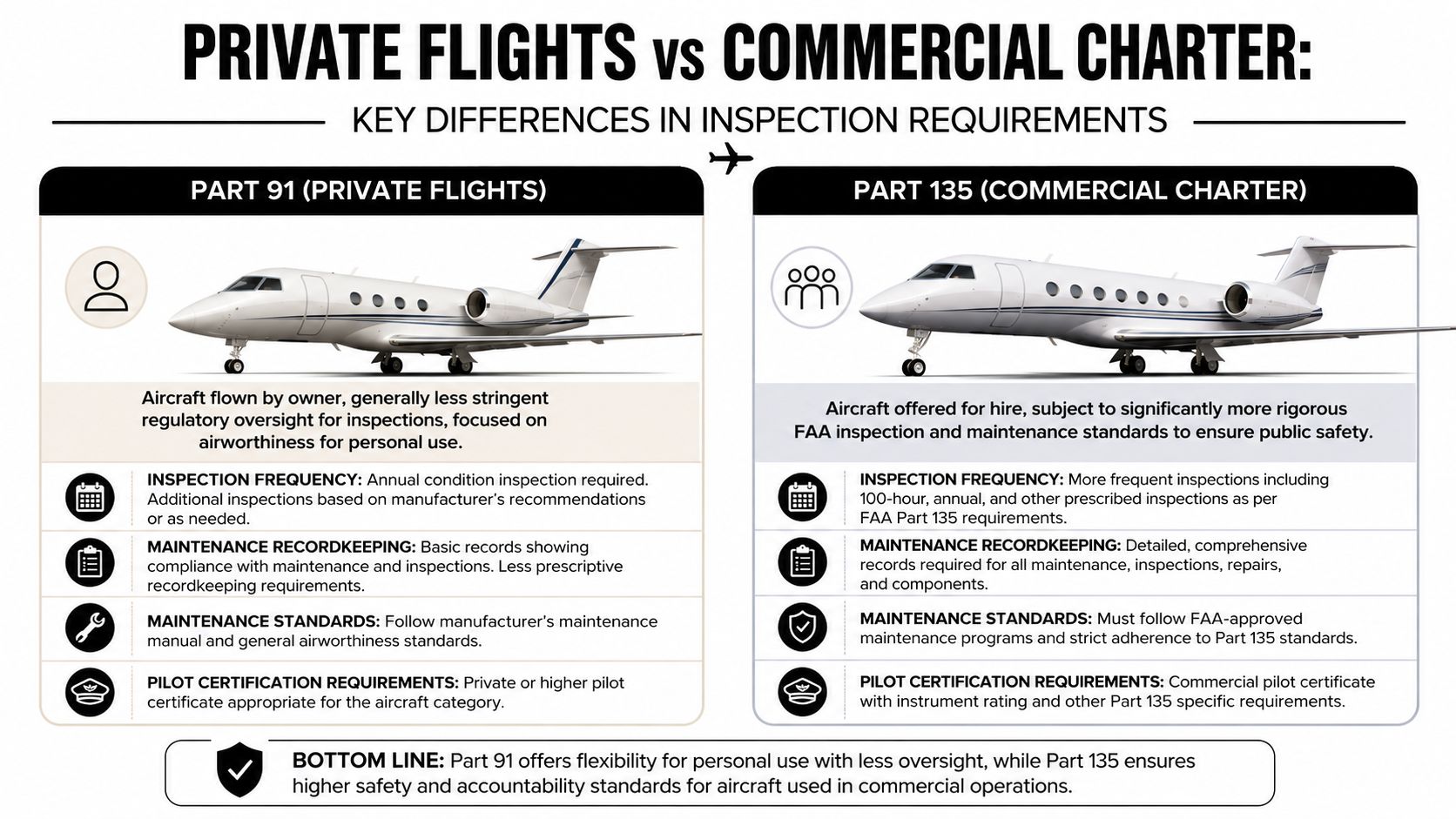
Under Part 91, an aircraft is generally operated for private use. Under Part 135, the aircraft is operated commercially for charter. The passenger experience may look similar at the FBO, but the compliance structure behind the flight is different.
One concrete dividing line is the inspection threshold for aircraft used for hire. For aircraft that carry any person other than a crew member for hire, or provide flight instruction for hire, a 100-hour inspection is legally required, as outlined by the AOPA explanation of aircraft inspections.
That's not a trivial detail. It reflects a broader principle in charter operations. Once paying passengers are involved, the maintenance and operational burden becomes more demanding.
Side-by-side differences that matter to clients
| Area | Private Part 91 flights | Commercial Part 135 charter |
|---|---|---|
| Primary use | Owner or private company use | Transportation for hire |
| Inspection posture | Can align to private-use minimums | Must support commercial carriage standards |
| Maintenance oversight | Varies by owner and management team | More structured and scrutinized |
| Passenger protection | Not designed around charter carriage | Built around paying-passenger operations |
If you've ever compared this to another transport industry, the distinction is similar to the separation between a privately used vehicle and a vehicle carrying paying customers under commercial rules. This guide for trucking company owners is useful because it shows the same logic in a different context. Once the public is paying for transportation, inspection and documentation expectations rise.
What works and what doesn't
What works is simple. Ask who holds operational control, under what certificate the flight is being conducted, and whether the aircraft is maintained inside a charter-compliant program.
What doesn't work is relying on appearance, ownership prestige, or vague assurances like “it's maintained to the highest standards” without specifics.
Here are the practical signs of a stronger answer:
- Clear certificate structure: The operator can explain whether the flight is under Part 135 without hedging.
- Specific maintenance language: They can describe the aircraft's inspection program in plain terms, not marketing language.
- Documented accountability: Crew qualifications, maintenance status, and operator identity are disclosed early enough for review.
A legal charter flight should never feel mysterious. If a provider hesitates to identify the operator, the certificate basis, or the inspection framework, that's not sophistication. That's a transparency problem.
Decoding the Inspection Alphabet A B C D Checks
Aircraft inspection requirements often sound more confusing than they are. The alphabet checks exist because different work belongs at different intervals. You wouldn't treat a routine fluid service the same way you'd treat a complete teardown of a complex machine. Aircraft are no different.
The easiest analogy is car ownership, with one important caveat. In aviation, the documentation and sign-off discipline are far stricter because the consequences are far higher.
The maintenance ladder in plain English
At the lighter end, you have recurring checks that keep the aircraft monitored between major maintenance events. At the heavy end, you have extensive inspections that open up structure, systems, and components for deep review.
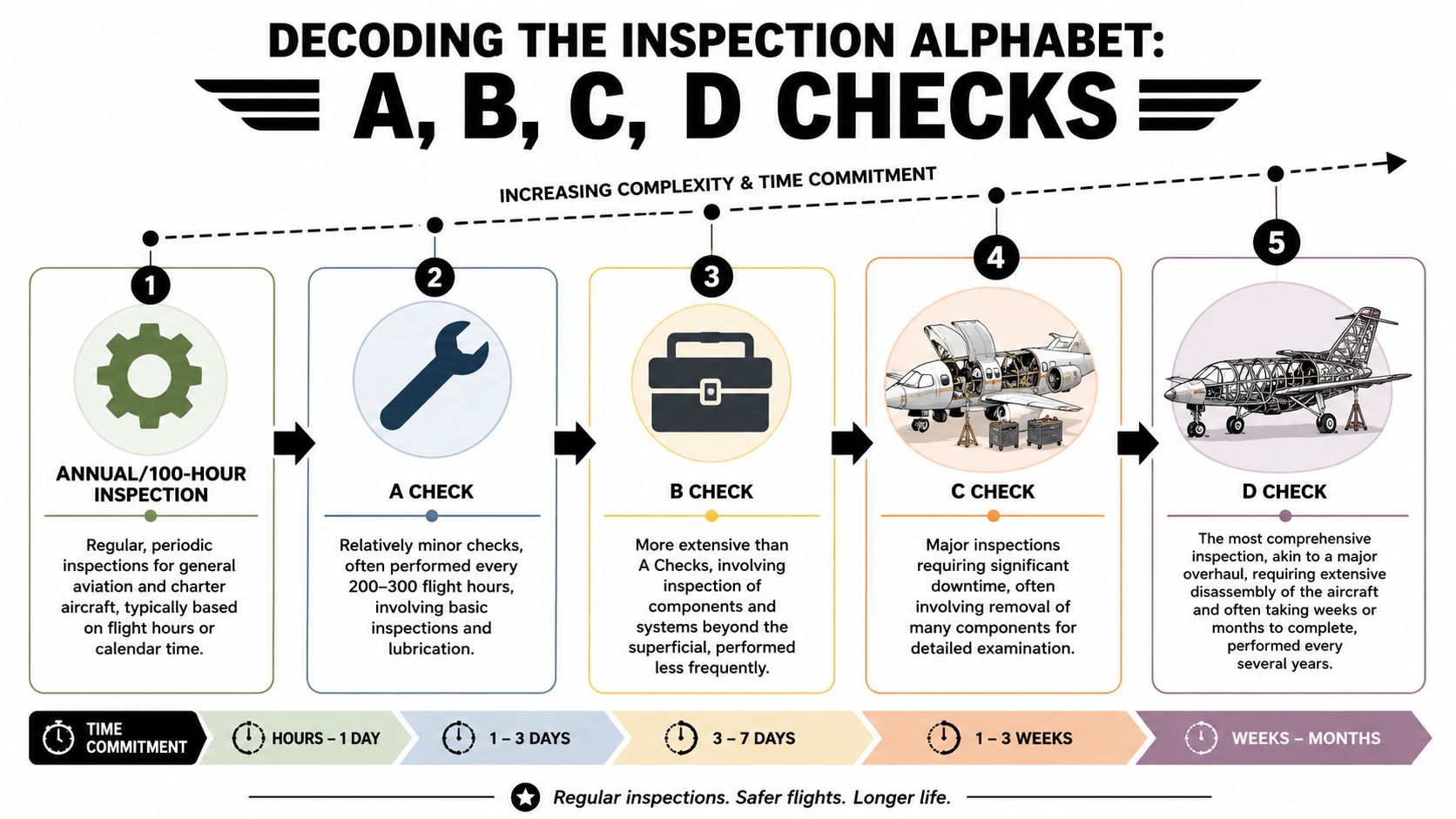
For commercial aviation, the hierarchy is defined in familiar terms. An A-check occurs every 400 to 600 flight hours or 200 to 300 cycles, while a D-check is typically performed every 6 to 8 years or around 20,000 flight hours, according to this overview of A, B, C, and D checks.
A separate reference for private jet maintenance notes that a B inspection is mandated strictly upon the completion of 750 flight hours and includes all A-check items plus operational verifications, servicing, lubrication, and panel integrity, as described by HRD Aero Systems.
To make the progression easier to visualize, this short video is a good companion:
How the checks differ in practice
| Inspection type | Typical trigger | What it feels like operationally |
|---|---|---|
| Annual or 100-hour | Calendar or use-based requirement | Foundational recurring inspection for many aircraft |
| A-check | Every 400 to 600 flight hours or 200 to 300 cycles | Routine line-level or light base maintenance |
| B-check | At 750 flight hours | More involved system verification and servicing |
| C-check | Program-based major inspection | Broader access and deeper examination |
| D-check | Every 6 to 8 years or about 20,000 flight hours | Heavy overhaul with extensive disassembly |
Why clients should care
Passengers don't need to memorize the alphabet, but they should understand what each level signals. A well-run operator isn't waiting for a major check to discover basic housekeeping issues. The lighter checks catch routine wear, fluid conditions, and operational discrepancies. The heavier checks confirm structural and systems integrity at a deeper level.
If an operator talks about maintenance only in broad terms, ask where the aircraft currently sits in its inspection cycle and how upcoming events are managed.
There's another reason this matters. Downtime planning tells you a lot about maintenance culture. Operators who plan major events properly protect dispatch reliability. Operators who squeeze every possible trip in before scheduled maintenance often create avoidable pressure around aircraft availability.
The trap clients fall into
Many passengers hear “fresh paint,” “new interior,” or “recent refurbishment” and assume that means the aircraft is mechanically current. Cosmetic work and maintenance work are not the same thing.
The meaningful questions are narrower:
- Inspection status: Is the aircraft comfortably within its scheduled maintenance windows?
- Record quality: Are maintenance records complete, current, and easy to verify?
- Program discipline: Does the operator treat recurring checks as a planning function, not a last-minute interruption?
Luxury matters. Inspection discipline matters more.
Unscheduled Maintenance ADs SBs and RIIs
Scheduled inspections are only part of the picture. The stronger maintenance programs also respond well when new information appears. That's where unscheduled maintenance requirements become important.
Aircraft don't live in a static environment. Manufacturers learn things in service. Operators report failures. Regulators identify patterns. When that happens, the industry has to react quickly and consistently.
ADs and SBs are not the same
An Airworthiness Directive, or AD, is mandatory. If the FAA issues one, the required inspection, modification, limitation, or repair must be addressed for the aircraft to remain compliant.
A Service Bulletin, or SB, usually starts as manufacturer guidance rather than a universal legal command. But top-tier operators don't dismiss SBs just because they aren't all framed the same way. If the manufacturer flags a reliability or safety concern, prudent maintenance leaders review it carefully and often act early.
That's one of the clearest differences between bare-minimum thinking and safety-minded operation. Minimum thinkers ask whether a bulletin can be deferred. Better operators ask what risk remains if they don't address it.
Why RIIs matter so much
Some maintenance tasks are too critical to rely on the person who performed the work alone. That's where Required Inspection Items, or RIIs, come in.
FAA Required Inspection Items are maintenance tasks that, if performed improperly, could endanger safe operation. These items must be inspected by a qualified and authorized Inspector who was not involved in performing the actual work, according to this RII explanation from SASSofia.
That independence is the point.
One mechanic performs the work. A different authorized inspector verifies it. That separation protects against assumption, fatigue, and simple human error.
What a mature operator does differently
Strong operators build redundancy into the maintenance process instead of treating redundancy as inefficiency.
They typically do three things well:
- Track emerging issues closely: They don't wait for surprises to compound across the fleet.
- Review manufacturer guidance seriously: Even when a bulletin isn't framed as a universal legal mandate, they assess operational relevance quickly.
- Protect inspector independence: They respect the firewall between performing work and signing off critical items.
What doesn't work is an informal culture where technicians “know the airplane,” so cross-checking becomes casual. Familiarity can help with troubleshooting. It can also hide complacency if oversight gets too relaxed.
For a passenger, RIIs are reassuring because they show how aviation handles risk. Not with trust alone, but with deliberate verification.
The Elite Standard Wyvern and ARGUS Audits
A client can book two charter flights on similar aircraft, from similar airports, at similar price points, and still buy two very different levels of maintenance discipline.
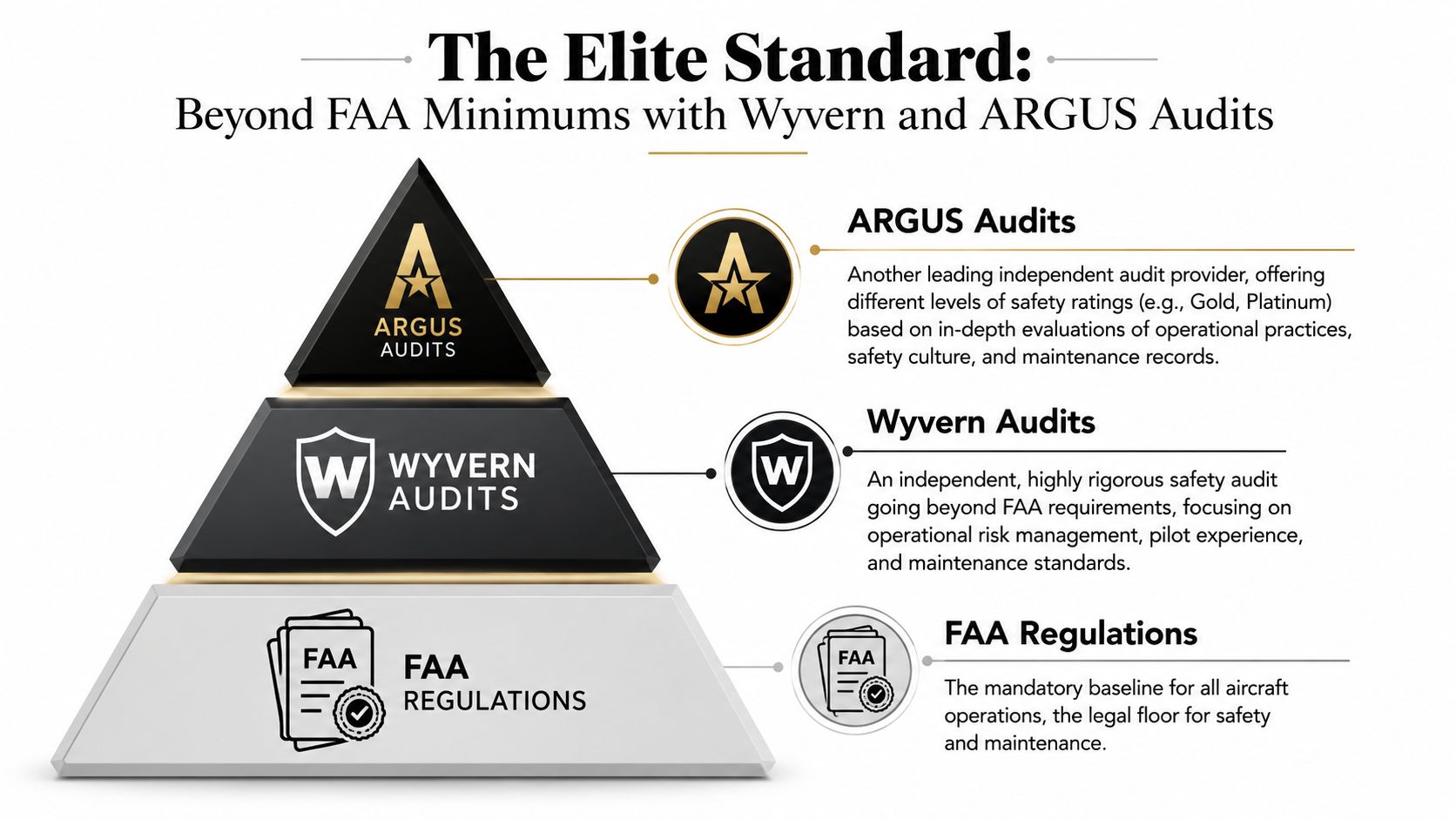
FAA compliance sets the floor. Safety-focused audit programs examine what the operator does above that floor, under pressure, over time, and in the records. That difference matters more than cabin finish, aircraft age, or branding.
Why the gap matters
The most important question in charter safety is not whether an operator is legal. It is how the operator performs once the legal minimum has already been met.
Wyvern and ARGUS audits look at the system behind the airplane. They examine maintenance control, record accuracy, operational oversight, crew qualification tracking, and whether the company follows procedures consistently instead of only when a regulator or customer asks. From a safety director's perspective, that is where weak maintenance cultures usually show themselves.
Clients rarely see this gap on a quote sheet. They see aircraft type, Wi-Fi, seating, and hourly rate. They usually do not see how quickly discrepancies are closed, how clean the logbook trail is, or whether the operator treats recurring defects as isolated events instead of signs of a pattern.
What these audits signal to a client
A Wyvern Wingman or ARGUS Gold or Platinum designation shows that an operator has agreed to outside review in areas that affect day-to-day safety performance. The value of an audit isn't the badge itself, but the operator behavior required to earn it.
That behavior has practical consequences. Shops plan inspections with more discipline. Maintenance controllers keep tighter records. Leadership knows an incomplete file, a loose procedure, or a casual signoff can cost the operator its standing.
If you want a closer look at how those audit frameworks differ, this analysis of Wyvern and ARGUS safety ratings explains the distinctions.
For clients who use audit status as a booking filter, one factual example is Haute Jets, which states that it sources charter options from operators holding Wyvern Wingman or ARGUS Gold or Platinum ratings.
That is a useful signal. It is not a substitute for asking questions, but it is a far better starting point than accepting “fully compliant” at face value.
Your Pre-Flight Safety Verification Checklist
A trip can look settled on paper, then change the moment you ask one simple question: who is operating the aircraft, and under what maintenance standard? That is often where the gap appears between legal minimum compliance and the higher discipline serious charter operators maintain every day.
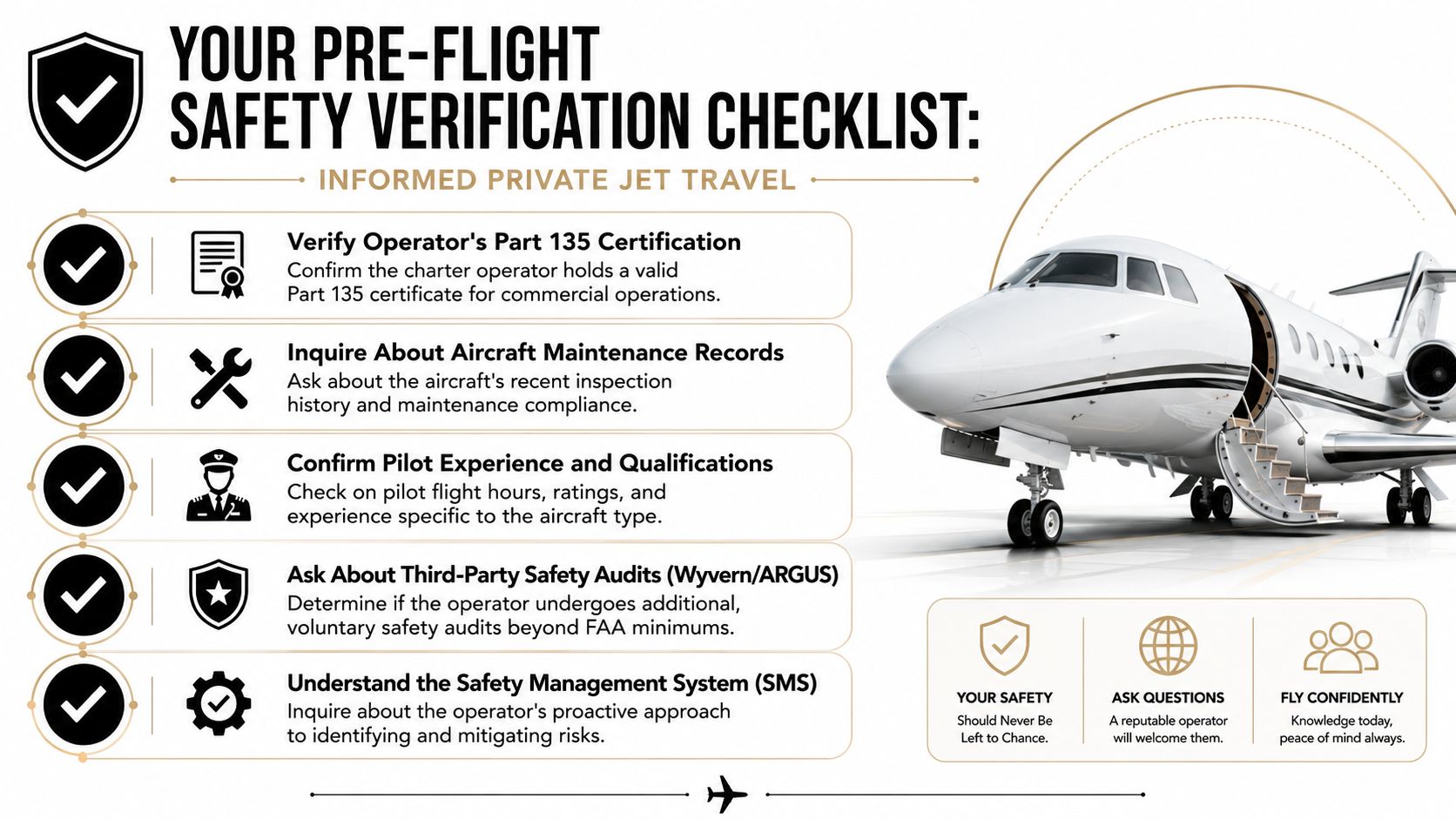
Use this checklist before you approve the itinerary, not the night before departure:
- Confirm the operator certificate: Ask whether the flight will be conducted by a current Part 135 certificate holder, not arranged through one company and operated by another without clear disclosure.
- Request the operator name and tail number: You should know the exact company responsible for the flight and the specific aircraft assigned before the trip is finalized.
- Ask how maintenance is controlled: “FAA compliant” is the floor. Ask whether the aircraft is maintained only to the minimum required schedule or under a tighter manufacturer program, CAMP-style tracking system, or audit-driven maintenance standard.
- Verify current third-party audit status: Ask whether the operator holds an active Wyvern or ARGUS rating and whether that status applies to the aircraft and operation being quoted.
- Ask about recurring discrepancies and open items: A well-run operator should be able to explain how write-ups are tracked, deferred if allowed, and closed without hesitation.
- Clarify aging-aircraft inspection exposure: For older aircraft, ask whether supplemental structural inspections or other age-related maintenance requirements apply and whether those items are current.
- Request the pre-departure packet early: Crew names, operator details, aircraft registration, and basic safety information should arrive with enough time for review. This client guide to private jet pre-flight safety checks is a useful reference for what to expect.
The best answers are specific. An operator with a strong maintenance culture will tell you who operates the flight, what standards govern the aircraft, when the next major inspection is due, and whether any deferred items exist. Vague reassurance usually means you need to keep asking.
If you want charter options where operator quality, aircraft transparency, and third-party safety standards are part of the booking process, review available flights with Haute Jets.