On Haute Jets Journal, aircraft noise reduction matters for a simple reason: modern aviation has grown dramatically while its noise footprint has moved in the opposite direction. From 1975 to 2023, the number of U.S. residents exposed to significant levels of aircraft noise fell by 94 percent, while airline enplanements rose by 365 percent, according to Airlines for America's aircraft noise exposure data.
That single comparison shifts perspectives on the subject. Noise control isn't a side issue. It's one of the clearest signs that aircraft design, airport operations, and certification standards have become significantly more advanced.
For private charter clients, the implications are immediate. A quieter aircraft can mean access to airports with tighter local rules, fewer disruptions from curfews and operating limits, and a more polished experience from arrival to departure. In luxury aviation, silence isn't just comfort. It's capability.
A Quieter Sky The New Standard in Luxury Aviation
Aviation has reduced the number of people seriously affected by aircraft noise even as air travel has grown sharply, as noted earlier. That shift matters in private aviation because quieter aircraft do more than lower decibel readings. They widen your airport options, support more flexible scheduling, and make the entire trip feel more considered from the moment you arrive at the ramp.
For a charter client, noise is not an abstract environmental metric. It is an operating advantage.
Airports near affluent residential areas, resort communities, and major business centers often face strict local pressure to limit aircraft noise. In practical terms, that can influence which aircraft are welcome, which hours are easiest to operate, and how reliably a trip can use the airport closest to your destination. A quieter jet gives operators more room to work within those limits.
That is one reason noise reduction now sits alongside fuel efficiency and emissions in the broader discussion about responsible aviation. The same preference for better-designed, lower-impact aircraft also appears in Haute Jets' analysis of sustainable luxury jet travel.
Why noise matters to a charter client
Aircraft noise affects the trip long before you settle into the cabin. It can influence departure timing, arrival flexibility, and airport choice. If two jets offer similar range and cabin comfort, the quieter one may be the aircraft that gets you closer to your final destination with fewer operating constraints.
A simple comparison helps here. Horsepower in a car tells you something about performance, but refinement tells you how that performance is delivered. Aircraft noise works in a similar way. Lower noise often reflects better engine design, cleaner aerodynamic shaping, and newer certification standards.
A quieter jet often brings three direct benefits:
- Better airport access: Noise-sensitive airports may be more practical for newer, quieter aircraft, especially during high-demand morning and evening periods.
- A calmer travel environment: Reduced exterior noise during takeoff, climb, and approach contributes to a more relaxed cabin atmosphere and a more polished experience on the ground.
- Stronger technical pedigree: Quiet performance usually goes hand in hand with newer engines, improved aerodynamics, and aircraft built to more demanding modern standards.
Quiet aircraft often signal advanced aircraft. The engineering that lowers noise frequently improves efficiency and operating flexibility as well.
Luxury now includes being a good neighbor
Luxury aviation used to be judged mainly by speed, range, and cabin design. Those still matter. Clients now also ask a smarter question: how well does this aircraft fit the airports and communities it serves?
That change is important. The best private charter experience is not only comfortable in the air. It is also easier to operate at premium airports where access is limited and local standards are high. Quieter technology supports that standard. It helps operators choose aircraft that respect community noise limits while still delivering the convenience, discretion, and close-in airport access that define top-tier private travel.
In that sense, aircraft noise reduction is a mark of progress you can feel directly. Less noise can mean less restriction, better airport proximity, and a trip that feels more refined at every stage.
Understanding the Sources of Aircraft Noise
Aircraft noise seems simple from the ground. In practice, it comes from different systems, and each creates sound in a different way. Once you know the basic categories, modern noise-reduction technology becomes much easier to understand.
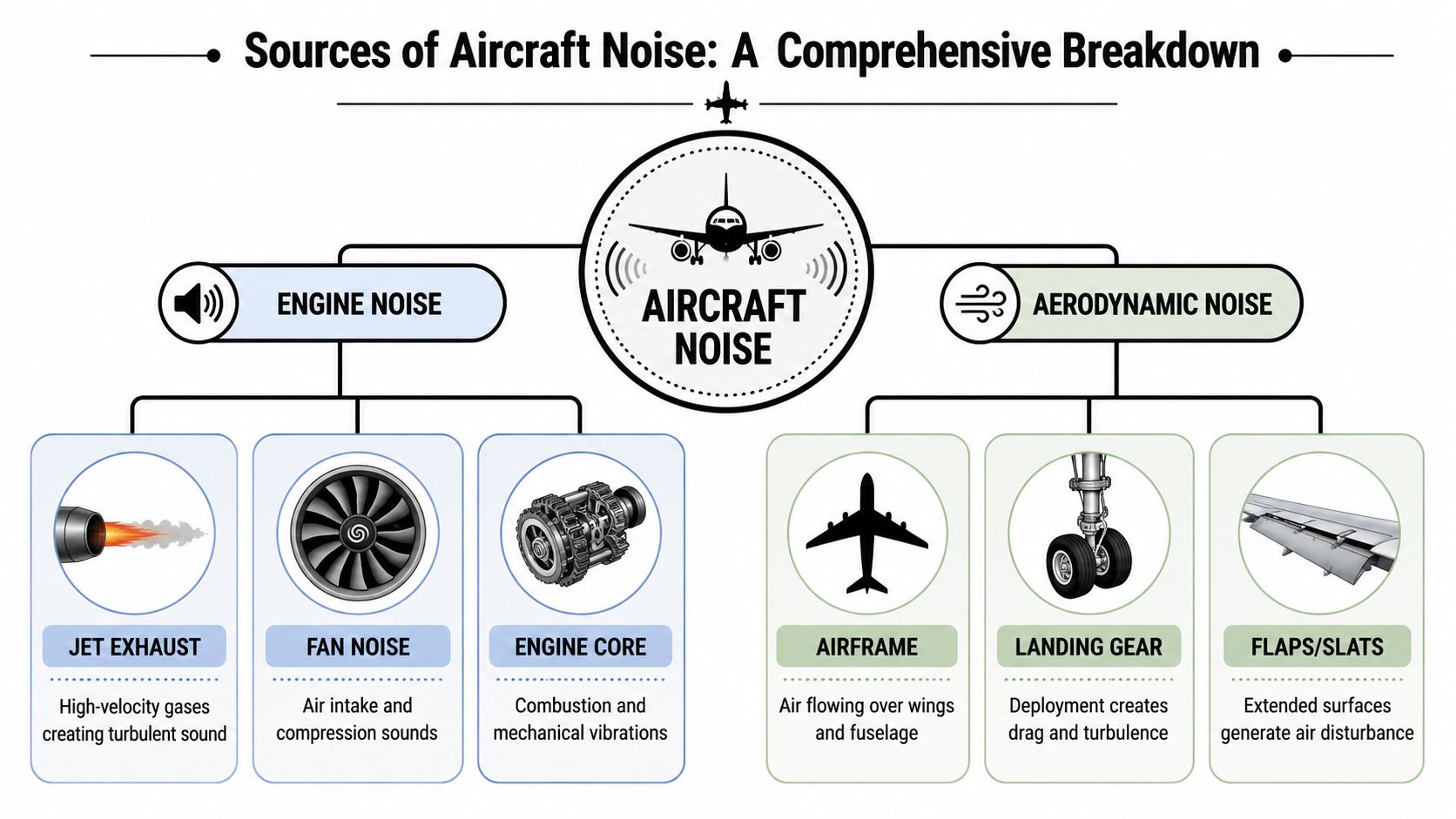
A useful way to think about it is this. One set of sounds comes from propulsion, meaning the engines themselves. The other comes from aerodynamics, meaning the air moving around the aircraft structure. If you've ever wanted a practical comparison point, this private jet noise level overview helps connect technical ideas to what passengers and people on the ground notice.
Propulsion noise
Engine noise is the sound often pictured first. It includes the fan turning at high speed, the engine core where combustion happens, and the exhaust stream leaving the back of the nacelle.
The easiest analogy is a waterfall. A powerful flow of energy creates turbulence, and turbulence creates sound. In a jet engine, fast-moving air and hot exhaust mix violently unless engineers find ways to smooth and control that mixing.
Here's the practical breakdown:
- Fan noise: The large front fan pulls in huge volumes of air. That movement creates tonal and broadband sound.
- Core noise: Deep inside the engine, compression and combustion generate additional noise.
- Jet exhaust noise: Exhaust leaving the engine at high velocity can create a strong roar, especially during takeoff.
Aerodynamic noise
Approach noise often confuses people because the engines may not sound especially loud, yet the aircraft is still very noticeable. That's usually airframe noise.
It's similar to wind whistling around a building corner or across a car window seal. As air flows over wings, flaps, slats, and landing gear, it sheds vortices and pressure fluctuations that become audible.
Practical rule: Takeoff is often dominated by propulsion noise. Approach often highlights aerodynamic noise.
A few common aerodynamic sources stand out:
| Component | Why it gets noisy |
|---|---|
| Wings and fuselage | Airflow around surfaces creates pressure changes and trailing vortices |
| Landing gear | Exposed struts, wheels, and cavities add drag and turbulence |
| Flaps and slats | Extended high-lift devices disturb the airflow and generate a pronounced rushing sound |
Why this distinction matters
Once you separate engine noise from airframe noise, modern design choices make more sense. A quieter takeoff usually points to engine improvements. A quieter arrival often reflects both cleaner aerodynamics and smarter procedures.
That's also why no single invention solves aircraft noise reduction by itself. Engineers have to attack several sound sources at once, each with its own physics and trade-offs.
Engineering Silence How Modern Jets Are Designed to Be Quiet
Modern aircraft don't become quieter by accident. Engineers shape the engine, nacelle, wing, and even the airflow around the aircraft so the loudest sources of turbulence are reduced before they reach the ground.
That design evolution is visible across aviation, including private aircraft design trends explored in this review of the evolution of private jet design. Quiet performance usually comes from many small engineering decisions working together rather than one dramatic breakthrough.
The high-bypass turbofan changed everything
The biggest shift came from the high-bypass turbofan. Instead of relying mainly on a narrow, very fast jet of exhaust, this design moves a large amount of slower air around the engine core. That outer flow acts like a cushion around the hotter, noisier exhaust stream.
According to Airways Magazine's explanation of aircraft noise reduction technology, modern widebody aircraft like the A350 and 787 achieve a 50% reduction in takeoff noise compared to 1960s jets, driven by high-bypass turbofans where slower-moving bypass air envelops hotter core exhaust to damp turbulent mixing. The same source notes that this engineering is reflected in ICAO Chapter 14 standards, which set strict limits on takeoff, sideline, and approach noise.
That's why newer jets tend to sound less harsh. The engine is still producing major thrust, but it's doing so with airflow that is better managed.
Small shapes, big acoustic effects
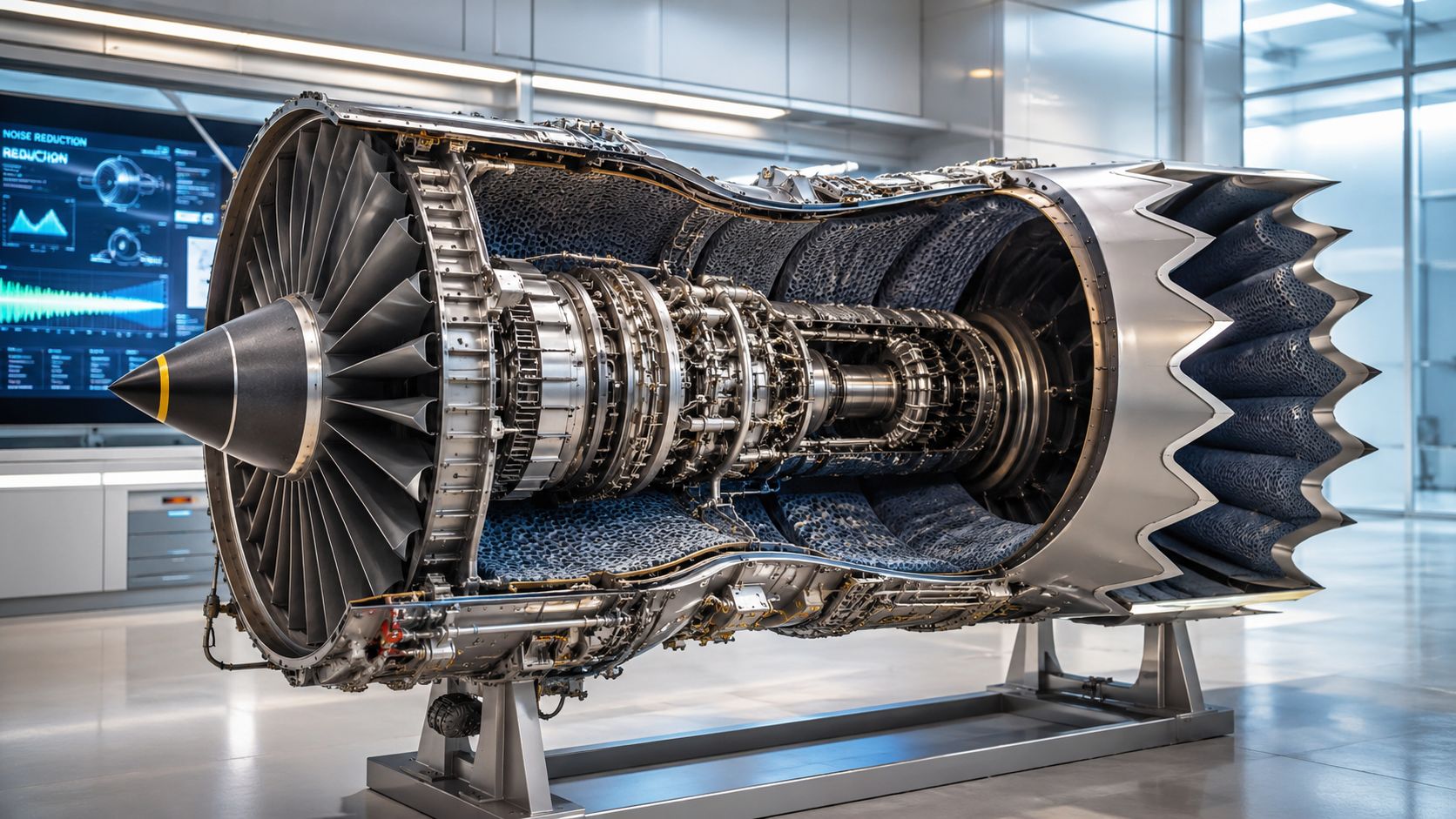
One of the easiest quieting features to spot is the chevron. These are the serrated trailing edges seen on some engine nacelles. They're not decorative. They help blend the different air streams more gradually, reducing the violent mixing that creates noise.
A 2024 assessment of subsonic jet noise technologies found that chevrons and serrated nozzle designs can achieve a 2.5EPNdB decrease in noise output with practical trade-offs for modern airliners.
Other important tools are less visible:
- Acoustic liners: Materials inside the nacelle absorb part of the sound energy before it escapes.
- Cleaner aerodynamics: Smoother surfaces and refined shapes reduce airflow separation and the noise that comes with it.
- Winglets and related devices: These help manage vortices and improve the way air leaves the wing.
This short video gives a clear visual sense of how these concepts work in practice.
Quiet design is always a trade-off
Aircraft engineers don't get noise reduction for free. Every change affects weight, drag, thrust, fuel burn, heat management, or maintenance complexity. That's why good design is about balance.
The quietest practical aircraft is rarely the one with the most extreme single feature. It's the one whose engine, nacelle, wing, and operating profile were designed to work as a system.
That systems view is what makes today's best aircraft so impressive. They don't just mask noise. They reduce it at the source.
Flying Smarter Operational Strategies for Noise Abatement
Aircraft noise reduction isn't only a hardware story. How pilots fly the aircraft can matter just as much, and in some cases more.
That surprises many readers because the public conversation usually centers on quieter engines. Engines matter. But flight timing, climb profiles, and descent techniques can change who hears the aircraft and for how long.
Procedures can outperform hardware changes
The clearest example comes from nighttime operations. Research published in this study on airport noise exposure strategies found that reducing night flights by 50% can cut the population exposed to high noise levels by 77.42%, while swapping to low-noise aircraft in the same scenario may deliver only single-digit percentage reductions.
That doesn't mean aircraft technology is unimportant. It means operations and technology solve different parts of the problem, and scheduling can be especially powerful when communities are most sensitive.
The quiet approach
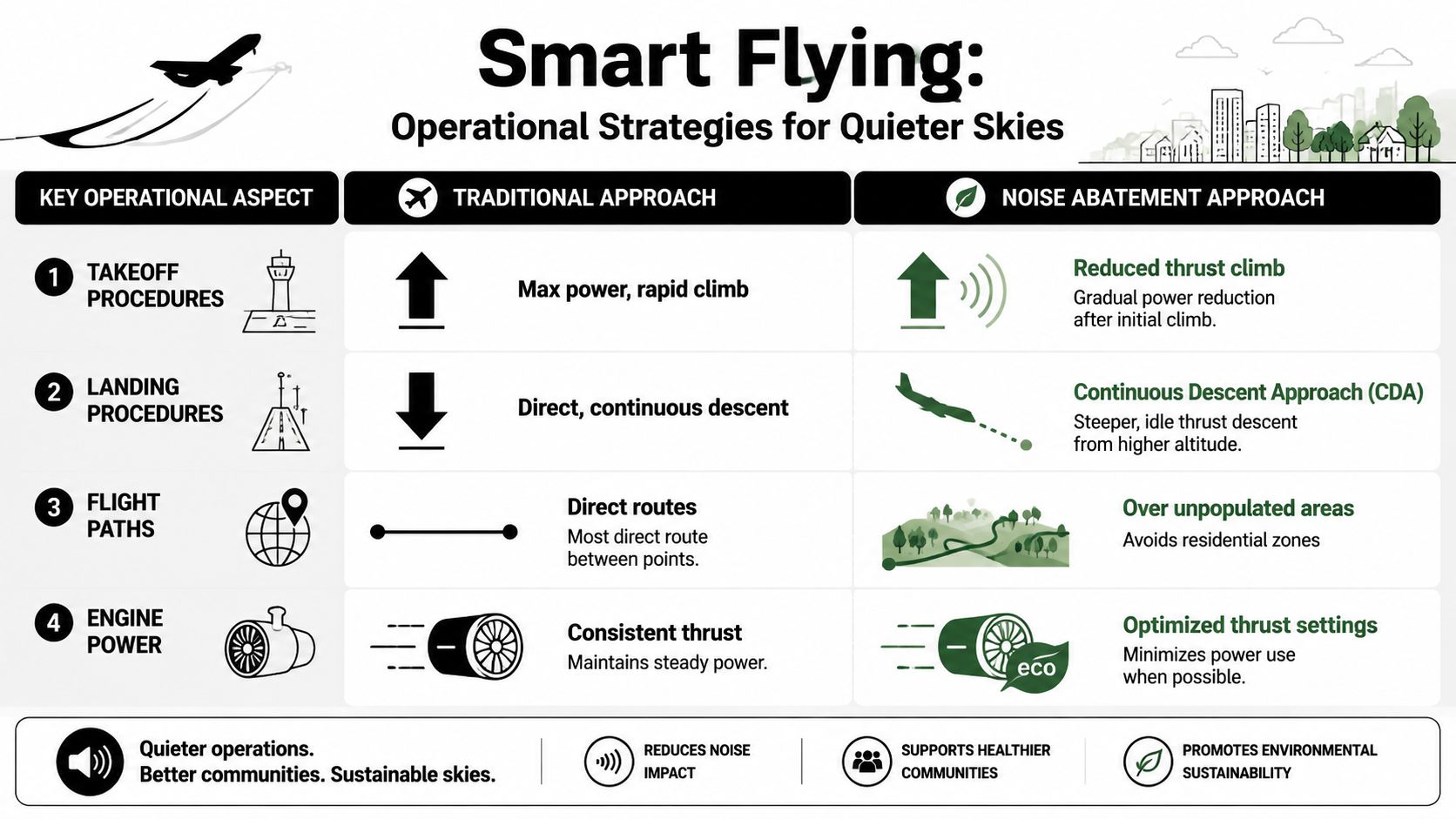
One of the most effective operating techniques is the Continuous Descent Approach, often shortened to CDA. Instead of descending in a series of steps, the aircraft follows a smoother, more gliding path toward the runway.
That matters because each level segment in a traditional descent may require more engine power than a steady, continuous path. Lower power during approach generally means less engine noise, and the smoother profile can also reduce the sound associated with constant configuration changes.
A simple comparison helps:
| Method | What happens | Noise effect |
|---|---|---|
| Traditional step-down descent | Aircraft levels off multiple times | More thrust changes and more time producing noticeable sound |
| Continuous Descent Approach | Aircraft descends more smoothly from higher altitude | Lower power for longer periods and a smaller noise footprint on approach |
Departure matters too
Noise abatement doesn't stop at landing. Pilots and operators also use departure procedures that help aircraft climb more effectively before crossing populated areas.
Some of the most common levers are:
- Reduced-thrust departure when appropriate: Lower power settings can reduce noise while still meeting safety and performance requirements.
- Noise Abatement Departure Procedures: These shape the climb profile to limit impact on nearby neighborhoods.
- Flight path design: Routing over less populated areas can change how noise is distributed on the ground.
Smart noise abatement is good airmanship. It combines the right aircraft with the right procedure at the right airport and time of day.
For travelers, this is a useful reminder. A quiet charter experience depends not only on what you fly, but on how that aircraft is operated.
The Global Framework for Aircraft Noise Reduction
Aircraft noise reduction is guided by more than manufacturer preference. It sits inside a global certification system that sets the baseline for what an aircraft must achieve before it enters service.
The key institution is the International Civil Aviation Organization, or ICAO. Its noise certification chapters create a common framework for takeoff, sideline, and approach noise. Manufacturers design toward those limits because compliance isn't optional if they want broad market access.
Why standards matter
Standards do two things at once. First, they protect communities by forcing minimum acoustic performance. Second, they create a commercial race to do better, because quieter aircraft are easier to operate across a wider range of airports and jurisdictions.
That's one reason noise reduction has become embedded in aircraft economics. A quieter airplane is often a more flexible airplane.
Here's the practical chain:
- Certification rules set the floor
- Airport and local restrictions raise the operating stakes
- Manufacturers respond with quieter engines, nacelles, and procedures
- Operators gain more scheduling and airport options
Progress is real, but the hard part is ahead
Aviation has made major gains, yet the next phase is much tougher than many headlines suggest. The biggest challenge appears when people talk about keeping aircraft noise fully within airport boundaries, especially for future urban air mobility concepts.
A widely cited summary in Wikipedia's overview of aircraft noise pollution notes a critical gap between NASA's projected 20–30 dB noise reduction by 2031 and the 40–50 dB reduction required to keep noise within airport boundaries. The same discussion points to a basic design limitation in current under-wing engine layouts.
That gap is important because it clarifies what today's technology can and can't do.
Current aircraft can be much quieter than the jets they replaced. They are not silent, and existing configurations still impose physical limits.
Why layout matters
Under-wing nacelles are effective, proven, and practical, but they don't offer unlimited noise suppression. More radical layouts, such as over-wing or mid-fuselage engine placement, may offer stronger shielding effects. Those concepts are promising, but they aren't yet the norm in commercial service.
So the global framework does more than regulate the present. It also exposes the distance between current capability and future ambition. That's healthy for the industry. It keeps manufacturers, regulators, and operators focused on continuous improvement rather than marketing slogans.
Quiet on the Tarmac Leading Private Jets in Noise Reduction
Private aviation benefits from the same engineering logic that transformed the airline world. The most desirable modern business jets tend to pair refined aerodynamics with advanced engine technology, which is one reason they're often better suited to noise-sensitive operations than older models.

Aviation's long arc is clear. Airbus reports on aircraft noise reduction that commercial aircraft have become 75% quieter since the first passenger airliners of the 1950s, and that the A321neo has a take-off noise footprint 50% smaller than the A321ceo. The same source also notes that replacing older high-noise aircraft with lower-noise models reduces both the exposed area and the exposed population in studied settings.
Three business jets often associated with quiet modern design
The private market doesn't publish noise data in a perfectly uniform way across every model, so it's better to discuss these aircraft qualitatively rather than force false precision. Still, several names stand out consistently in conversations about refined acoustic performance.
Gulfstream G650ER
The G650ER is known for combining long-range capability with a very polished ride. Its appeal in the noise discussion comes from modern engine integration and a clean overall airframe. It represents the category of aircraft where quiet operation is part of a broader design standard, not an afterthought.
Bombardier Global 7500
The Global 7500 has earned attention for range and cabin comfort, but its aerodynamic refinement matters just as much here. On advanced jets like this, low-noise characteristics often reflect careful shaping of surfaces, efficient lift generation, and engines designed for current certification expectations.
Dassault Falcon 8X
The Falcon 8X is often admired for airport flexibility. That conversation naturally intersects with noise because aircraft that operate efficiently into more constrained airports usually benefit from disciplined aerodynamic and propulsion design.
Why this matters in practice
For charter clients, the quiet-jet story isn't abstract. It can influence access to airports where local communities and regulators watch acoustic performance closely. It can also support a more discreet ground presence and a calmer arrival profile.
A useful way to evaluate a modern private jet is to ask whether its quietness likely comes from the same three pillars seen across the industry:
- Engine sophistication
- Aerodynamic cleanliness
- Operational compatibility with tighter airport rules
Those qualities don't just make an aircraft feel newer. They make it more usable.
What Quieter Aircraft Mean for Your Private Charter Experience
The value of aircraft noise reduction becomes obvious when you translate it from engineering language into travel outcomes. For a private charter client, quieter aircraft create a better trip in ways that are easy to feel even if you never think about nacelles, vortices, or certification chapters.
The first advantage is airport access. Aircraft that meet tougher acoustic expectations are better positioned for use at airports with stricter local sensitivities, especially where surrounding residential areas shape operating rules. In practical terms, that can help bring you closer to your final destination.
The second is comfort. A modern aircraft designed with noise control in mind usually feels more composed during takeoff and arrival. That affects the atmosphere of the trip. Conversations are easier, the cabin feels more settled, and the entire experience reads as more refined.
Three reasons quieter aircraft are the smarter charter choice
- More flexibility: Better acoustic performance can support operations where older jets face more constraints.
- A more polished onboard environment: Quiet design contributes to the sense of calm that defines premium air travel.
- Responsible travel without compromise: Choosing newer technology supports lower community impact while preserving speed and convenience.
The luxury difference is subtle but real
The best private aviation experiences don't announce themselves with one dramatic feature. They're built from layers of quality. Noise control is one of those layers.
A quieter aircraft often gives you something every premium traveler values. More options, fewer frictions, and a smoother experience from curb to cabin.
That's why aircraft noise reduction deserves a place alongside range, cabin size, and safety standards in any serious charter decision. It reflects the maturity of the aircraft, the discipline of the operator, and the likelihood of a more smooth trip.
Haute Jets connects clients to Wyvern and ARGUS-rated private jet charter options across a global network of 3,500+ aircraft in 175 countries, with no memberships or jet cards required. If you want the exact aircraft, transparent sourcing, and a modern charter experience built around safety, flexibility, and refined travel, Haute Jets is the place to start.