
You're standing a few steps from the aircraft, watching bags disappear into the hold while the crew completes final checks. Most passengers see a sleek fuselage, polished paint, and maybe the engines. What they don't see is the logic behind the machine: which parts shape ride quality, which parts matter for shorter runway access, and which parts directly affect cabin quiet, stability, and confidence in the flight.
That's where an aircraft parts diagram becomes useful. Not as a mechanic's worksheet, but as a practical way to read the airplane you're about to board. Many diagrams stop at a basic list of outside parts. That's fine for a classroom. It's less helpful for a private jet client trying to understand why one aircraft feels quieter, why another handles smaller airports better, or why cabin layout can't be separated from the structure around it.
For charter travelers, the most helpful diagram is often the simpler one. It ties the aircraft's major parts to what you'll experience: boarding height, baggage access, wing position, engine placement, cabin shape, and the general character of the flight. If you're comparing aircraft before booking, reviewing a specific model from the Haute Jets fleet becomes much easier once you know what to look at and why it matters.
Decoding the Aircraft on the Tarmac
A private jet reveals a lot before the door even closes.
If you're looking at the airplane from the ramp, start with three practical questions. Where are the engines mounted? How low or high does the cabin sit? How large and swept are the wings? Those details tell you far more than a generic brochure line ever will.
The reason many become confused is simple. Typical aircraft anatomy guides label the fuselage, wing, tail, and landing gear, then stop there. That leaves out the meaning behind those labels. For travelers, the useful question isn't “What is the wing called?” It's “How does this wing shape affect smoothness, speed, and the airport choices available to me?”
A good aircraft parts diagram for a charter client should explain comfort, safety, and mission fit, not just memorize labels.
On a light jet parked beside a large-cabin aircraft, you can often spot the difference immediately. One may sit lower, with a more compact fuselage and simpler gear. The other may have a taller stance, a longer cabin section, and a more substantial wing. Neither is automatically “better.” Each reflects a different mission.
What matters to a passenger
A private aviation client usually benefits most from reading the aircraft in four layers:
- Structure: The fuselage and wing design shape cabin space, baggage arrangement, and ride character.
- Control surfaces: The tail and wing controls help the jet stay stable, especially in climb, descent, and changing air.
- Propulsion: Engine type and placement influence noise, range, and runway performance.
- Ground systems: The landing gear and door arrangement affect boarding ease and airport flexibility.
That's why understanding an aircraft parts diagram isn't just for pilots and technicians. It helps you ask better questions, compare aircraft more intelligently, and board with a clearer sense of what the machine is designed to do.
Anatomy of a Private Jet A Visual Overview
The cleanest way to understand any aircraft parts diagram is to begin with the major assemblies. Training and maintenance materials commonly organize an airplane around the fuselage, wings, cockpit or flight deck, engine, tail assembly, and landing gear, as noted in this overview of airplane parts and major assemblies.
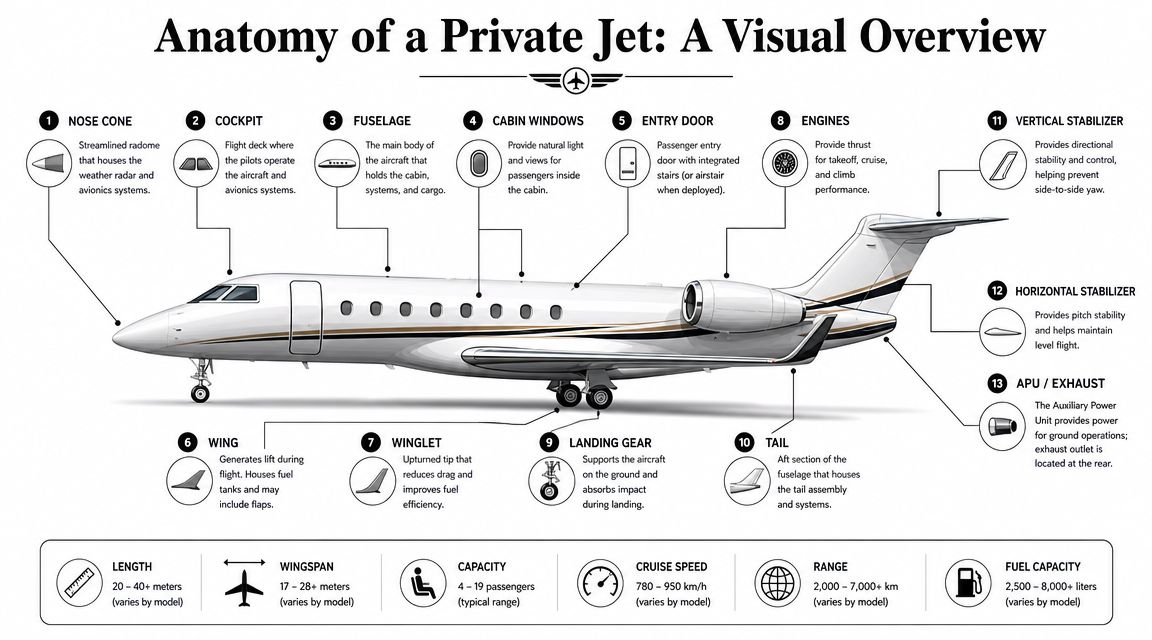
Think of that layout as your master map. Once you can place each assembly, the rest of the aircraft starts to make sense.
The six labels worth knowing
| Major assembly | Plain-language function | What it means for your flight |
|---|---|---|
| Fuselage | The main body of the aircraft | Determines cabin volume, baggage space, and general passenger environment |
| Cockpit | The flight deck at the front | Houses the systems crew use to manage navigation, aircraft status, and flight control |
| Wings | The lifting surfaces | Affect climb, cruise behavior, fuel-carrying structure, and ride character |
| Engines | The power source | Drive thrust, speed, range, and often cabin noise characteristics |
| Tail assembly | The rear stabilizing structure | Keeps the aircraft balanced and controllable in yaw and pitch |
| Landing gear | The takeoff and landing support system | Influences ground handling, airport suitability, and boarding stance |
How to read the diagram without overthinking it
Start at the center. The fuselage is the body of the airplane. It's the section that holds passengers, crew, luggage compartments, and key systems. On many private jets, the cabin experience begins with fuselage decisions long before interiors are installed.
Move out to the wings. These aren't just flat surfaces that hold the aircraft up. They're closely tied to efficiency, climb performance, and how the airplane behaves in different phases of flight.
Then look to the rear. The tail assembly is often broken into smaller parts such as the vertical stabilizer, rudder, horizontal stabilizer, elevator, and static wicks in educational references. You don't need to memorize each one immediately. You only need to know that the tail keeps the aircraft stable and responsive rather than loose or unsettled.
Practical rule: If you can identify the fuselage, wings, engines, tail assembly, and landing gear on a parked jet, you already understand the basic language of any aircraft parts diagram.
The Airframe Wings and Empennage
The private jet's structure does more than hold the cabin together. It shapes the way the aircraft feels from the moment you board to the moment you step off.
The fuselage and cabin experience
The fuselage is the aircraft's body. In practical terms, it defines cabin height, aisle movement, storage layout, window placement, and how spacious or enclosed the interior feels. On private jets, clients often evaluate comfort by upholstery, seating, and finish quality. Those matter, but the fuselage sets the limits for all of them.
A longer or wider fuselage can support more distinct seating zones. A smaller one can still feel refined, but movement will be more constrained and the cabin may feel more intimate than open. Pressurization and insulation also live inside this structural story. Passengers don't need to understand the engineering details to feel the result. They notice whether the cabin feels composed and quiet or tighter and more utilitarian.
What the wings really do
A wing's headline job is simple. It produces lift. But from a traveler's perspective, wings also shape much of the aircraft's personality.
Key wing features often include:
- Flaps: These change the wing's shape for takeoff and landing, helping the aircraft operate at lower speeds when it needs to.
- Ailerons: These help the aircraft roll left or right in a controlled way.
- Spoilers: These disturb lift and help with descent control and speed management.
- Winglets: These are the vertical or angled tips seen on many aircraft, often used to refine aerodynamic behavior.
A large swept wing usually points toward higher-speed cruise and longer-range intent. A smaller wing can suit different mission priorities, including shorter sectors and access to airports where a larger aircraft would be unnecessary.
If two jets look similar in the cabin brochure, the wing often explains why they perform very differently on the same trip.
The empennage and why ride stability feels effortless
The empennage is the tail assembly. It's one of the least appreciated parts of the airplane because, when it works properly, passengers barely notice it.
Its main elements include:
| Tail component | Core role | Passenger effect |
|---|---|---|
| Vertical stabilizer | Supports directional stability | Helps the jet track cleanly rather than feel loose side to side |
| Rudder | Controls yaw | Assists directional control, especially in changing conditions |
| Horizontal stabilizer | Supports pitch stability | Helps keep the aircraft balanced nose-up and nose-down |
| Elevator | Controls pitch movement | Contributes to smooth transitions in climb and descent |
On many private jets, the tail is mounted high relative to the fuselage. That design choice can help package the aircraft efficiently and work well with rear-mounted engines, a common private jet configuration.
Why airframe design matters when choosing a jet
When clients compare aircraft, they often focus first on range, seats, or brand. A sharper way to compare is to ask what the airframe is optimized for.
- Cabin-first design: Some jets prioritize interior volume and comfort for executive travel.
- Speed-focused design: Others use wing and tail geometry that favor faster cruise behavior.
- Airport flexibility: Some configurations support operations into airports that don't suit larger transport-category aircraft as comfortably.
That's why a useful aircraft parts diagram should connect structure to outcomes. Fuselage means cabin. Wing means ride and mission. Tail means stability. Once you see those links, the aircraft stops being a collection of labels and starts reading like a design brief.
Propulsion and Powerplant Systems
Engines are the part of the aircraft most passengers notice first, and the part many understand least. On private jets, they deserve close attention because engine design and placement affect noise, performance, and mission capability all at once.
The turbofan in plain language
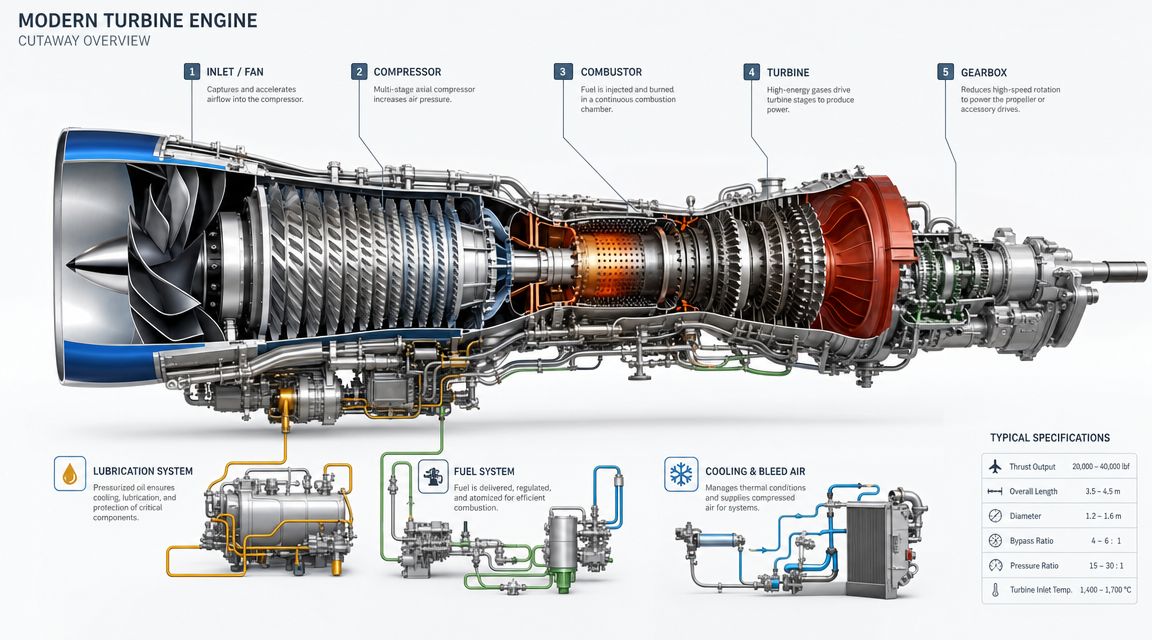
Most private jets use turbofan engines. You can think of a turbofan as a carefully managed flow machine. Air enters the front, the fan and internal compressor stages move and compress that air, fuel is added and burned, and the resulting energy produces thrust.
The outside housing is the nacelle. Inside are components that support airflow, combustion, and exhaust. On some aircraft, you'll also hear about thrust reversers, which help redirect engine output during landing rollout.
You don't need to know every internal stage to compare jets effectively. What matters is this: the engine isn't just there to make the airplane go faster. It influences where the jet can operate, its noise level, and how much payload or comfort you can combine with a given trip.
Why engine placement changes the experience
Private jets often mount engines on the rear fuselage rather than under the wings. That choice changes several things.
- Cabin sound profile: Rear-mounted engines can reduce the sense of engine presence for passengers seated farther forward.
- Wing design freedom: Without large wing-mounted engines, designers can shape the wing differently for the aircraft's mission.
- Ground clearance and airport operations: Engine position can also influence how the aircraft fits operationally at certain airports and ramps.
Wing-mounted engines, more common on airliners, bring their own advantages in other categories of aircraft. But on many business jets, rear-mounted engines are part of the familiar silhouette for good reason.
Client takeaway: When comparing private jets, don't just ask how powerful the engines are. Ask where they sit and what that means for cabin noise, baggage volume, and runway suitability.
What propulsion tells you about mission fit
A client looking at two private jets may hear that both are capable, modern aircraft. That doesn't mean they solve the same problem.
A jet optimized for shorter regional sectors may feel different from one built for longer nonstop missions. Engine size, nacelle shape, and overall integration with the airframe all influence the character of the aircraft. Some feel purpose-built for quick executive hops. Others are designed around long legs, higher cruise intent, and a more insulated cabin environment.
From a passenger's perspective, the engine question boils down to three outcomes:
| Propulsion factor | Why it matters |
|---|---|
| Placement | Affects cabin quiet and aircraft layout |
| Integration with the airframe | Influences efficiency and operational feel |
| Mission match | Helps determine whether the aircraft suits short, medium, or long private trips well |
A strong aircraft parts diagram makes these relationships visible. It shows that engines aren't isolated hardware. They're part of the aircraft's overall promise.
Landing Gear Avionics and Cockpit Systems
You feel this part of the aircraft before takeoff ever begins. As the jet rolls across the ramp, lowers for boarding, turns in a tight taxi lane, and settles onto the runway after landing, you are experiencing the work of the landing gear, the avionics, and the cockpit systems. On a private jet, these are not abstract engineering labels on a diagram. They shape comfort, schedule reliability, airport choice, and the margin of safety behind every trip.
Landing gear and airport access
The landing gear is the aircraft's suspension, braking foundation, and ground interface in one assembly. It supports the jet at rest, absorbs the force of landing, and allows the aircraft to taxi, turn, and stop under control.
For private aviation clients, that has practical consequences. Gear geometry, wheel size, braking capability, and overall stance influence how confidently an aircraft can operate from the airports that matter to your itinerary. A jet designed for business aviation flexibility often sits with that mission written into its proportions. Stable ground handling, predictable boarding height, and compatibility with a wider range of ramps and runways all start here.
Retraction matters as well. Once airborne, the gear folds into the airframe to reduce drag, much like closing a door flush with the body of a car improves airflow. In the diagram, that may look like a simple label. In service, it affects cruise efficiency and overall performance.
The flight deck behind the cabin door
The cockpit, often called the flight deck, is where the aircraft's systems come together into one usable picture for the crew. Passengers usually see only a brief snapshot while boarding, yet this space has a direct effect on how smooth and well-managed the trip feels.
Modern private jets use integrated electronic displays in place of older clusters of separate dials. That does not reduce complexity. It organizes complexity. Pilots can view the aircraft's attitude, route, weather, terrain, systems status, and checklists in a clearer format, which supports faster, more orderly decision-making.
A good way to read this part of an aircraft parts diagram is to group the displays by purpose:
- Primary flight displays: Show attitude, airspeed, altitude, and heading.
- Navigation displays: Present route information, surrounding airspace, terrain, and weather overlays.
- Flight management controls: Help the crew enter the route, performance data, and operating parameters.
- System synoptics: Display the status of fuel, electrical, hydraulic, pressurization, and other onboard systems.
The best avionics are almost invisible from the cabin. You notice the result instead. Fewer abrupt changes, clearer communication from the crew, and a stronger sense that the aircraft is being managed with precision rather than reaction.
Why these systems matter to charter clients
Private jet clients often judge an aircraft by cabin finish, seat comfort, or baggage access first. That is understandable. The less visible systems often determine whether the trip feels calm and well judged from pushback to shutdown.
Landing gear design influences how the aircraft handles real airport conditions, especially at smaller fields used in business aviation. Avionics and cockpit integration affect crew workload, situational awareness, and how well the flight is managed when weather, traffic, or routing become more demanding. If you are comparing aircraft categories, a guide to different private jet types and mission profiles helps explain why these systems are packaged differently from one class to another.
For clients evaluating operators and aircraft choices, the useful questions go beyond cabin aesthetics. Ask how the aircraft fits the airports on your typical routes, how current the flight deck is, and how the operator supports crew training and dispatch standards. Haute Jets states that it sources from owner-operators worldwide and works with operators holding Wyvern Wingman or ARGUS Gold/Platinum ratings.
How Aircraft Parts Differ Across Jet Classes
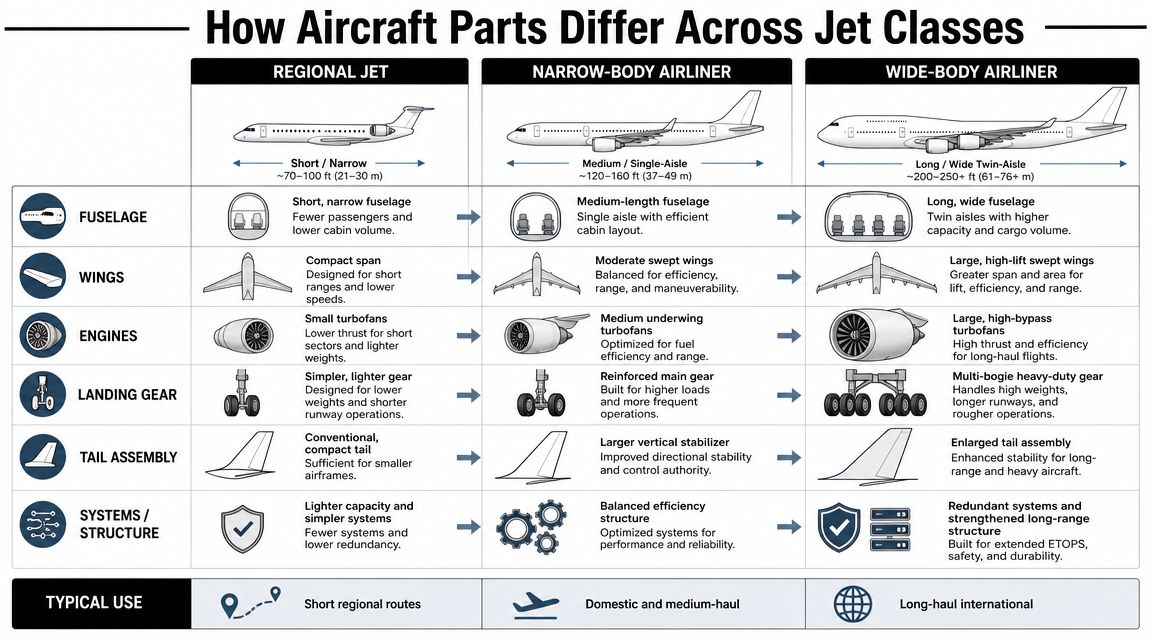
A generic aircraft parts diagram makes every airplane look more alike than they really are. In practice, aircraft anatomy changes meaningfully with mission, cabin expectations, and operating profile. That's especially true when comparing smaller business aircraft with larger long-range jets. NASA's educational framing still centers on conventional major parts, but real-world users often need a more configuration-specific view, which is why understanding private jet types is more useful than memorizing a one-size-fits-all outline.
The same labels, different meanings
A light jet, a midsize jet, and an ultra-long-range jet all have the same major assemblies. Each has a fuselage, wings, engines, tail, cockpit, and landing gear. What changes is how those parts are proportioned and what they're optimized to do.
A smaller aircraft may use a more compact fuselage and simpler systems integration because it's built around shorter missions and airport flexibility. A larger long-range jet usually shows its mission in a longer fuselage, larger wing, and more substantial overall stance.
Side-by-side comparison
| Jet class | Fuselage character | Wing character | Engine impression | Landing gear impression | Passenger takeaway |
|---|---|---|---|---|---|
| Light jet | Compact cabin, efficient footprint | Sized for shorter to medium sectors | Often optimized for shorter business missions | Typically simpler in overall appearance | Fast and practical for regional travel |
| Midsize jet | More room to move, stronger separation between seats and baggage areas | Balanced for speed and comfort | Built for broader trip flexibility | More substantial support for added weight and mission scope | Good balance of comfort and capability |
| Ultra-long-range jet | Long cabin, multiple living or working zones possible | Larger and more obviously cruise-oriented | Designed around long nonstop travel and high-end cabin expectations | More complex and robust overall system presence | Best suited to major stage lengths and premium cabin experience |
What changes you can spot from the ramp
You don't need to read a technical manual to notice class differences.
- Wings grow in significance: Larger and more swept wings usually signal longer-range, higher-speed intent.
- Fuselage length changes the cabin story: More fuselage often means more usable zones, not just more seats.
- Engine integration shifts the noise and mission profile: The aircraft's purpose becomes visible in how the engine and airframe are packaged.
- Landing gear complexity rises with aircraft scale: Bigger mission demands usually require a stronger support system.
Not every traveler needs the most capable jet. Most need the aircraft whose structure matches the trip, the runway, and the onboard expectations.
Why this matters more in private aviation
Private clients often compare aircraft by category name alone: light jet, super-midsize, large-cabin. That's a starting point, not a decision. The better question is how the aircraft's parts support the mission you have.
The content gap in many basic guides is that they don't help readers answer questions like what changes between a private jet and a commercial airliner, or which parts are being rethought in newer aircraft concepts. NASA's beginner-oriented materials point to that broader need for configuration-specific interpretation in aircraft anatomy, especially when users want a decision tool rather than a classroom diagram. For a charter traveler, that means the useful aircraft parts diagram is the one that helps compare real options, not just identify the nose and tail.
Maintenance Insights What Diagrams Mean for Your Safety
An aircraft parts diagram isn't just educational. In real operations, it supports how professionals inspect, identify, and maintain the airplane correctly.
The pilot's walk-around starts with visible structure
Before a flight, pilots conduct exterior inspections that follow the aircraft's actual layout. They move across the fuselage, wings, tail surfaces, landing gear, and engine areas looking for condition issues, leaks, damage, or anything out of place. The value of a diagram here is practical. It creates a disciplined visual sequence, not a casual glance.
Passengers may only see a brief ramp check. What they're really seeing is a structured review of the aircraft's most important external systems before departure.
Identification is not based on looks alone
Maintenance becomes much more exacting once a part needs service or replacement. The key point is that technicians don't identify parts by appearance alone.
The Illustrated Parts Catalog, or IPC, is the primary reference for parts identification because it shows assembly relationships and exact configuration for the aircraft model, as explained in this discussion of IPC use in aircraft parts identification. The IPC is used to identify what the part is. The Aircraft Maintenance Manual is used for removal and installation procedures rather than basic identification.
That distinction matters. Two parts can look similar and still be wrong for the aircraft, wrong for the side of installation, or wrong for the approved configuration.
Safety in maintenance depends on matching the exact part to the exact aircraft configuration, not making a close visual guess.
Why charter clients should care
For a traveler, maintenance paperwork can seem distant from the cabin experience. It shouldn't. The reliability you expect from private aviation is built on controlled identification, correct installation, and traceable configuration management.
That's one reason it makes sense to pay attention to operator standards and maintenance discipline rather than focusing only on amenities. If you want a broader look at how that discipline supports dispatch reliability and client confidence, Haute Jets has a related article on maintaining excellence in private jet safety and reliability.
A trustworthy aircraft parts diagram supports that process by giving professionals a common map. It keeps inspection, maintenance, and configuration aligned around the actual aircraft, not assumptions.
Quick Part Identification Guide and Glossary
You are standing on the ramp beside a private jet just before boarding. The airplane can look like a single polished shape, yet each visible part has a specific job, and each job affects something you will notice as a passenger, from cabin quiet to short-runway access.
Fast reference glossary
| Part | What it does | What it means for your flight |
|---|---|---|
| Fuselage | Forms the aircraft body and contains the cabin | Shapes cabin space, baggage volume, and the overall feel of the interior |
| Cockpit | The crew's control area at the front | Supports disciplined flight management, weather decisions, and route execution |
| Wing | Produces lift and supports key control devices | Influences efficiency, ride quality, and cruise performance |
| Flap | Changes wing shape for slower-speed phases | Helps the aircraft operate from shorter runways and stabilizes takeoff and landing |
| Aileron | Rolls the aircraft left or right | Contributes to handling precision, especially in turns and crosswinds |
| Spoiler | Reduces lift and helps manage descent | Helps control speed on approach and helps the jet settle onto the runway after touchdown |
| Winglet | Refines airflow at the wingtip | Often improves efficiency and can support longer-range missions |
| Empennage | The full tail assembly | Provides stability and keeps the aircraft balanced in flight |
| Vertical stabilizer | Stabilizes the aircraft directionally | Helps the jet hold its heading cleanly |
| Rudder | Controls yaw | Assists directional correction during crosswinds, taxi, and engine-out situations |
| Horizontal stabilizer | Supports pitch stability | Helps keep the ride composed and the aircraft trimmed correctly |
| Elevator | Controls nose-up and nose-down movement | Influences how the aircraft enters climbs, descents, and landing flare |
| Engine | Produces thrust | Affects speed, range, climb capability, and cabin noise character |
| Nacelle | The outer engine housing | Shapes airflow and helps manage insulation, access, and engine integration |
| Thrust reverser | Helps redirect engine output after landing | Supports deceleration after touchdown, especially on shorter runways |
| Landing gear | Supports taxi, takeoff, and landing | Affects ground stance, boarding height, and the airports the aircraft can use |
One maintenance term worth remembering
One term is worth keeping in your vocabulary: part number.
Modern aircraft maintenance depends on exact identification. Industry guidance describes an aircraft part number as a unique alphanumeric identifier assigned by the OEM or a PMA holder, often organized into a prefix, main number, and suffix, as explained in this overview of aircraft part number structure and traceability.
That sounds administrative until you see what it prevents. A suffix may separate one version from another, including left-hand versus right-hand installation. Records can also distinguish a part by its condition, approval history, and service use, including time or cycles where applicable. Two components may appear identical on the ramp and still be different in fit, certification, material, or life limit.
The safest aircraft is maintained through exact identification, traceability, and aircraft-specific documentation.
Use this glossary the same way you would use a legend on a map. It helps you translate the labels in a private jet diagram into plain-language meaning, so terms like empennage, nacelle, or thrust reverser stop feeling abstract and start pointing to something visible, functional, and relevant.