
You're comparing two charter quotes that look nearly identical. The aircraft category matches, the operator certificates appear in order, and the sales teams promise the same departure time. Then you notice one carrier holds an ARGUS Gold rating, while the other has no visible third-party rating at all. That single difference should change your questions before it changes your price.
A regulatory certificate tells you an operator is permitted to fly. An ARGUS rating tells you the company voluntarily submitted its safety systems, records, and operational controls to independent review. Those signals aren't interchangeable, and experienced charter buyers don't treat them that way. The right operator isn't the one with an available aircraft. It's the one whose documented operating discipline matches the demands of your flight.
Why Argus Ratings Matter When You Charter a Jet
The buyer in this situation has two quotes, one from Operator A and one from Operator B. Both appear to hold the required Part 135 certificate, both carry comparable insurance, and both offer a light jet that seems suitable. Operator B costs more, but it also holds ARGUS Gold. Operator A has no published ARGUS status.
The price difference alone doesn't prove that Operator B is safer. It does tell you that the two companies aren't presenting the same procurement profile. ARGUS ratings are a voluntary, third-party audit system for business aviation charter operations, and ARGUS explicitly states that its rated operators “fly safely and fly more often than non-rated operators” on its official ARGUS website. That gives you a useful external filter when two sales sheets look the same.
The regulatory floor isn't the whole picture
A Part 135 certificate establishes the legal foundation for commercial charter activity. It doesn't give a client a simple public score for the operator's training depth, maintenance oversight, emergency response planning, or internal safety-management practices. Those details usually sit behind the certificate and outside a standard booking quote.
ARGUS brings those details into the buying conversation. Gold and Platinum ratings use structured review criteria, including quantitative assessment and, at the higher level, a physical audit of the operation. You're not buying an abstract badge. You're buying evidence that someone beyond the operator has examined how the company manages risk.
Practical rule: Treat Part 135 as permission to operate. Treat ARGUS status as a procurement signal about how the operator runs.
That doesn't mean every unrated operator is unsafe, or that every rated operator is perfect. It means an unrated carrier gives you less independently verified information. If you can choose between otherwise comparable providers, a current ARGUS rating should carry real weight.
The most useful distinction is simple: Gold is a meaningful baseline audit, while Platinum is a deeper operational test. Your job isn't to become an aviation regulator. Your job is to use the rating as a filter, then verify that the quoted flight will be operated by the rated company and aircraft.
Understanding the Argus Rating Hierarchy
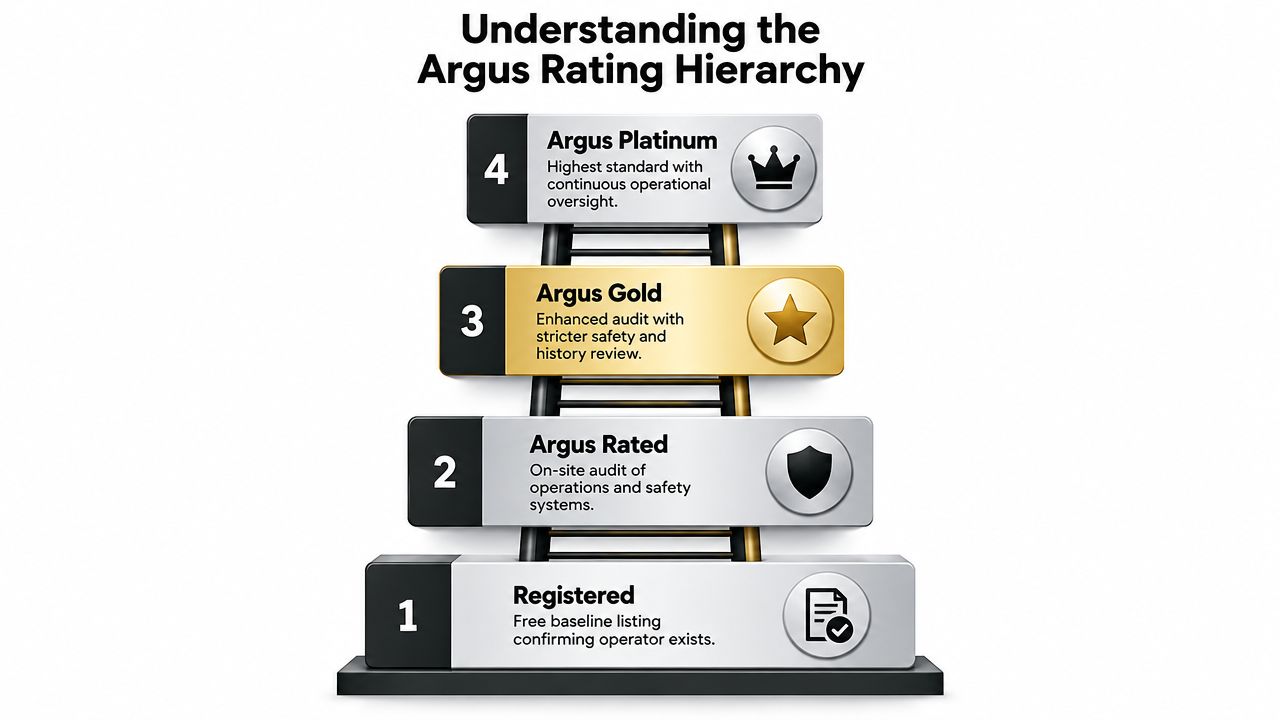
ARGUS status makes more sense when you read it as a ladder rather than a single certification. The public material identifies tiers including ARGUS Registered, ARGUS Gold, and ARGUS Platinum, while other descriptions refer to Gold Certified or Gold Plus within the broader hierarchy. The labels matter because the scrutiny behind them differs.
Start with the listing, then examine the audit
Registered is a registry status, not the same thing as an audited Gold or Platinum designation. It gives the market a way to identify an operator in ARGUS materials, but you shouldn't read registration alone as proof of the highest level of safety-system verification.
Gold is the baseline ARGUS rating. Published descriptions characterize the Gold process as a quantitative review in which an operator's composite result is compared with an aggregate peer group with similar exposure. The operator must meet or exceed the peer-group median to receive Gold, as described in this published account of the ARGUS Gold process.
Gold Certified or Gold Plus appears in some descriptions as a more structured path or enhanced designation within the Gold family. Don't assume that every Gold-related label represents the same audit scope. Ask ARGUS or the operator to identify the current designation and its precise status.
Platinum is the highest ARGUS tier identified in the supplied industry material. It requires a two-day on-site audit, not just a remote document review, and examines safety management, emergency response planning, operational control, training, maintenance, and administrative controls, according to ARGUS's Platinum audit description.
Read the date, not just the badge
A rating has to be current. ARGUS says Platinum must be renewed every two years, which makes it a continuing compliance standard rather than a one-time marketing credential, as explained by ARGUS's official Platinum audit information. A logo on an old brochure tells you much less than an active registry record.
The separate Charter Evaluation and Qualification, or CHEQ, program serves charter brokers, while the supplied material also identifies an Elite rating for Part 91 fractional and whole-aircraft operators. Those labels shouldn't be confused with the charter-operator Gold and Platinum ladder.
When a broker says “ARGUS rated,” ask the next question immediately: which tier, and is it active today?
What the Gold and Platinum Audits Measure
Platinum starts with a two-day, on-site examination by industry-certified auditors. The review covers the operator's safety-management system, emergency response planning, operational control, administrative controls, training, and maintenance programs, according to ARGUS in its Platinum audit materials.
The audit examines how those systems operate inside the company, not only whether the operator can produce the right certificates. A published industry summary describes 24 functional areas, divided into 12 operations areas and 12 maintenance areas, including pilot training, operational control, and inspection programs. That scope makes Platinum a procurement signal for buyers who need evidence of organizational execution, not just documented eligibility. The summary is based on this industry explanation of a Platinum award.
Gold serves a different buying question. It uses a quantitative review of documented safety and operational information, with the operator's composite result assessed against an appropriate benchmark. The published description of the ARGUS Gold methodology explains that the result is compared with an aggregate peer group with similar exposure, and the operator must meet or exceed the median to receive Gold.
For a charter buyer, Gold indicates that the operator has cleared a defined performance threshold. It does not represent the same type of physical examination as Platinum. Treating the two badges as interchangeable can lead to a weak procurement decision, particularly when the itinerary involves complex operations, multiple aircraft, or limited tolerance for disruption.
| Audit Element | Argus Gold | Argus Platinum |
|---|---|---|
| Primary method | Quantitative review | On-site audit |
| Benchmark | Composite score compared with a similar-exposure peer group | Detailed review of operational and maintenance functions |
| Physical visit | Not the defining feature of Gold | Two-day visit by industry-certified auditors |
| Safety systems | Documented review of safety-management basics | Examination of safety management, emergency response, and operational control |
| Maintenance | Records and relevant operational information | Direct review of maintenance programs and inspection controls |
| Renewal | Confirm current status with ARGUS | Renewal required every two years |
Gold answers, “Has this operator met the required quantitative benchmark?” Platinum asks, “Can the operator show that its safety, maintenance, training, and control systems work across the organization?” Before booking, match the tier to the flight rather than accepting “ARGUS rated” as a complete answer. For a straightforward charter, Gold may satisfy the buyer's screening requirement. For a high-consequence or complex itinerary, Platinum provides the stronger verification signal.
Safety Implications for Private Jet Flyers
A Part 135 certificate is necessary. It isn't a complete buying recommendation. The certificate confirms that an operator is legally authorized to conduct the relevant charter activity, but it doesn't give a passenger a comparative view of the company's operational culture or the maturity of every internal control.
ARGUS adds another layer by examining subjects that matter during real flights. Independent descriptions of Gold and Platinum distinguish a desk-based review from the deeper Platinum examination of flight operations, maintenance, and safety-management systems, as outlined by Schubach Aviation's explanation of ARGUS ratings. That distinction matters because a sales representative can make two operators sound identical while their internal processes differ substantially.
What a passenger gains from the rating
A current Gold rating indicates that the operator has cleared a quantitative benchmark and undergone structured review. Platinum adds on-site scrutiny of the systems that support dispatch, training, maintenance, emergency response, and operational control.
The distinction isn't cosmetic. An on-site audit gives the reviewer an opportunity to examine how the organization functions, not merely whether it possesses the right documents. CheckBravo's neutral safety explanation describes Platinum as a real inspection of flight operations, maintenance, and safety-management systems, with the designation intended to reflect sustained compliance over time.
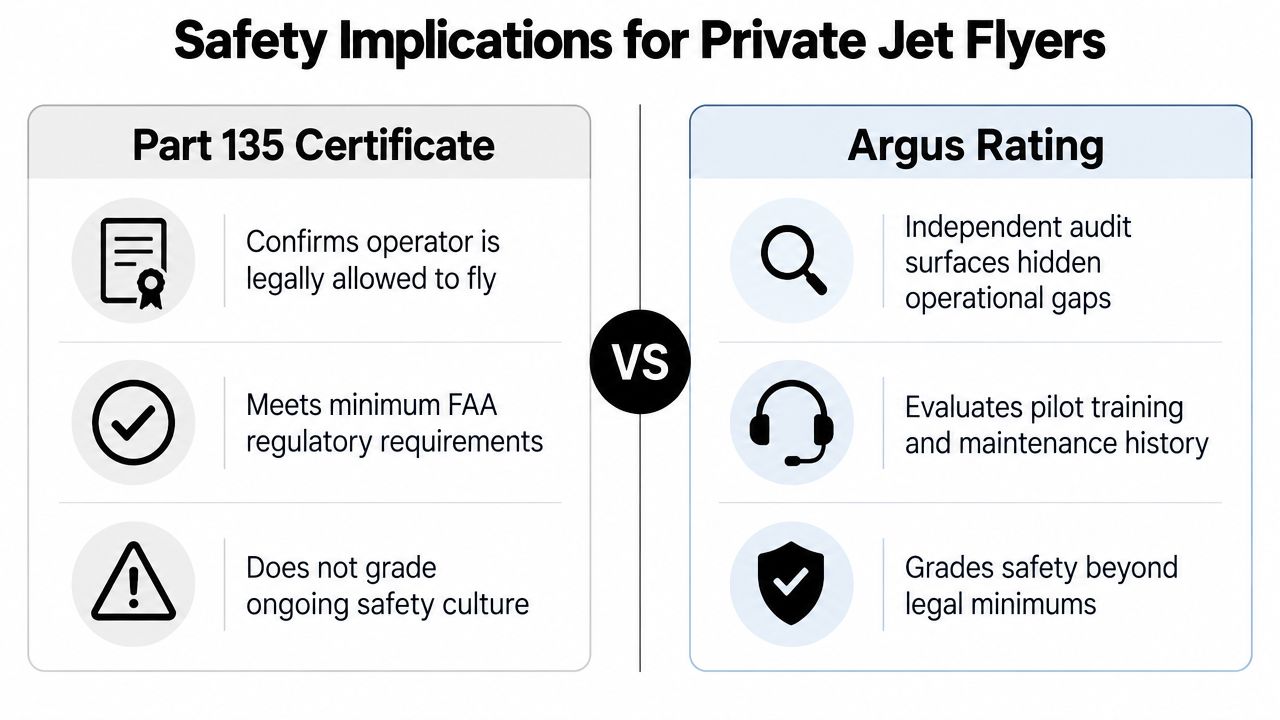
That doesn't make Platinum a guarantee. No audit removes every operational risk. It does give the client an independently examined layer that a regulatory certificate alone doesn't communicate.
The strongest buying decision starts with a legal operator, then adds independent verification of how that operator manages risk.
For a broader overview of passenger-focused safety considerations, review Haute Jets' guide to the safest private jets. The key booking principle remains direct: if two operators appear equal, prefer the one with a current, verifiable rating and ask what company will control your flight.
How to Verify an Operator's Argus Status
Never accept “ARGUS rated” as a complete answer. A logo in a presentation can be outdated, and a broker may quote an aircraft operated by a different company than the one whose rating appears in the sales material.
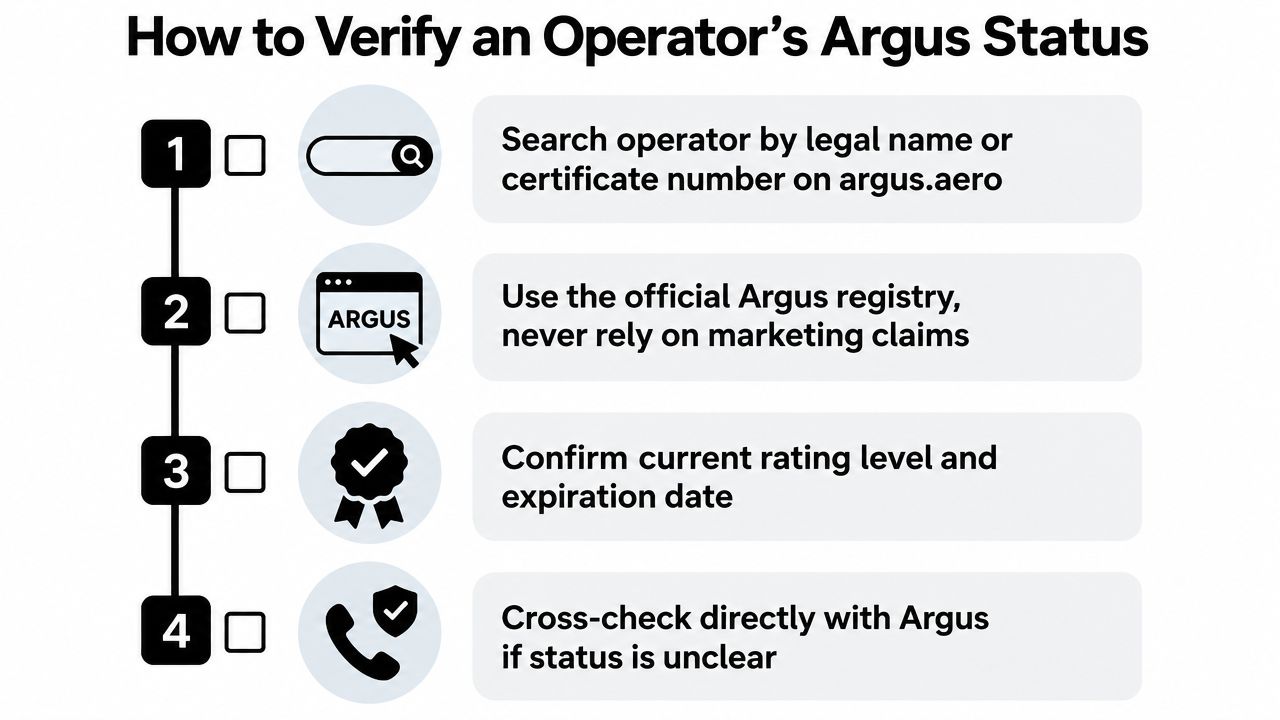
Use the ARGUS operator registry as your starting point. ARGUS maintains publicly listed operator records, including Platinum operators such as AB Jets LLC DBA AB Jets, and the registry provides a direct way to check a company's current status through the official ARGUS operator registry.
Four checks before you send a deposit
Search the legal operator. Use the company's legal name or certificate information, not only its consumer-facing brand. If the name in the quote doesn't match the registry entry, ask the broker to explain the relationship.
Confirm the tier. Gold, Gold Plus, Gold Certified, and Platinum shouldn't be treated as identical labels. Request the exact current designation and ask whether the rating belongs to the operating carrier, the broker, or another entity.
Check currency. Platinum requires renewal every two years, according to ARGUS's Platinum audit documentation. An expired or missing status deserves a direct explanation before you proceed.
Match the aircraft and operator. Confirm that the quoted aircraft, operating certificate, and dispatch provider align with the registry information. A rated company can appear in a proposal while another carrier performs the flight.
A missing listing doesn't automatically prove that the flight is unsafe, but it removes an important independent reference point. If the broker can't provide a clear operator name, current tier, and audit status, stop treating the quote as ready to book. For additional context on the credential itself, see what ARGUS certification means in private aviation.
Argus Ratings Compared to Wyvern Wingman
ARGUS and Wyvern both give charter buyers information beyond the regulatory minimum, but they aren't interchangeable programs. ARGUS offers a tiered ladder that culminates in Platinum and distinguishes between quantitative review and on-site examination. Wyvern Wingman is commonly presented as a more uniform safety designation built around its own operating standard and recurring review process.
The practical difference is procurement clarity. ARGUS lets you ask how far up the ladder the operator has climbed. Wingman gives you a single recognized threshold, although the underlying review still depends on Wyvern's program requirements and current verification.
Two useful signals, different emphasis
The supplied industry material characterizes ARGUS as placing meaningful weight on operational history and quantitative scoring, while Wyvern emphasizes document review, pilot records, database checks, and recurrent audits. I wouldn't call one program universally sufficient for every mission. I would call both current designations materially stronger than an unrated presentation.
Many buyers prefer to see both. Multiple independent reviews reduce the chance that you're relying on one methodology, one database, or one operator narrative. If only one signal is available, my preference is Wyvern Wingman for a consistent threshold, while ARGUS Platinum is especially valuable when you want a deeper organizational and on-site review.
| Dimension | Argus Gold or Platinum | Wyvern Wingman |
|---|---|---|
| Structure | Tiered ladder | Single principal Wingman designation |
| Core distinction | Gold uses quantitative review, Platinum adds an on-site audit | Focuses on a defined Wingman operating standard and recurring review |
| Operator comparison | Gold uses peer-group benchmarking | Uses Wyvern's own evaluation framework |
| On-site scrutiny | Central to Platinum | Included within the broader audit approach |
| Best buyer use | Match audit depth to mission complexity | Apply a consistent third-party safety filter |
| Strongest profile | Current Platinum, ideally with another recognized audit | Current Wingman, ideally alongside ARGUS status |
For a more detailed buyer-focused comparison, read this deep dive into Wyvern and ARGUS private aviation safety ratings. The answer isn't to collect badges. It's to understand what each badge verifies before choosing the operator for your specific trip.
What to Expect When Booking an Argus-Rated Operator
The rating should change the booking conversation from “Do you have a jet?” to “Who operates it, what has been verified, and what happens if the plan changes?” A credible charter process makes those answers visible from the first inquiry.
You should receive the operating carrier's identity, the aircraft details, and the relevant safety credentials early. The quote still needs to answer practical questions about routing, availability, crew, maintenance status, and substitution, but the operator's audited standing gives you a stronger foundation for evaluating those answers.
The booking path should be accountable
At the inquiry stage, ask for the specific aircraft and the legal operator. A rated operator or qualified broker should be able to identify who controls the flight rather than hiding behind a generic fleet category.
The quote should then connect the aircraft to the operating company. If the proposal names an ARGUS Platinum operator but the aircraft will be supplied by an unrelated carrier, the rating may not apply to the actual operation. That's the point where you request the substitute operator's credentials, not where you accept the original badge at face value.
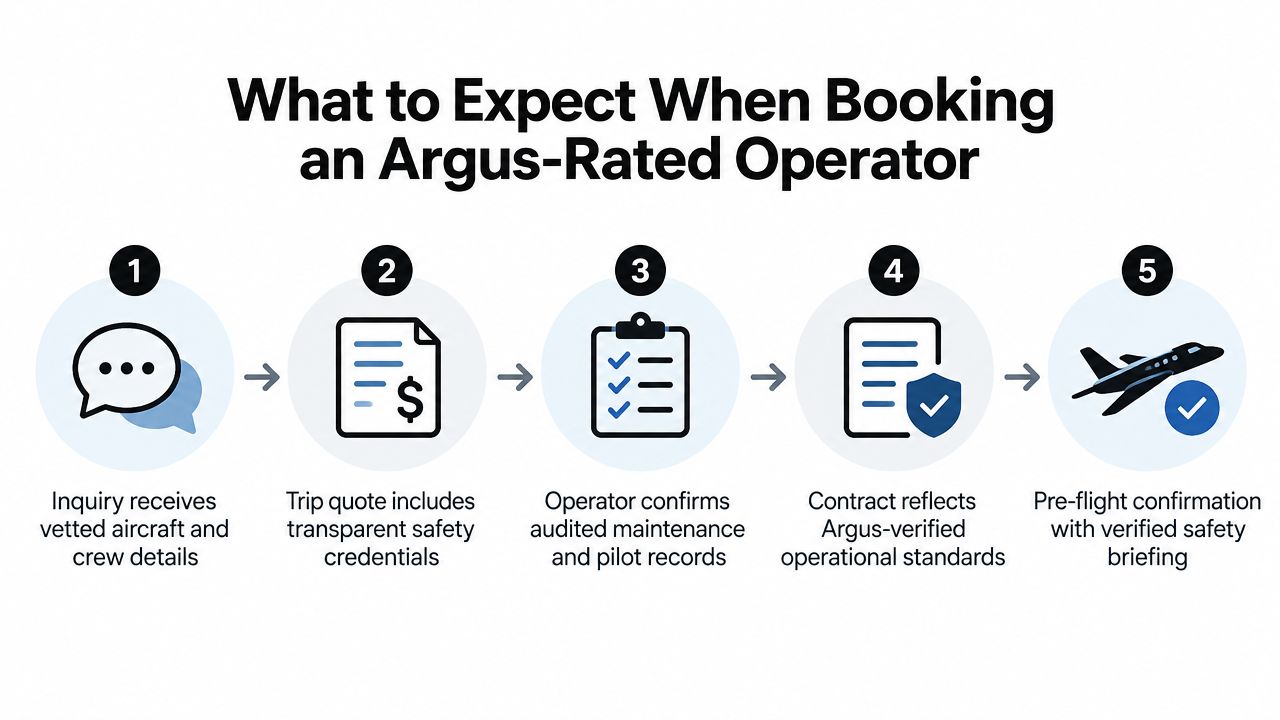
Before signing, read the aircraft-substitution language and the operational responsibilities in the contract. A strong process identifies who handles dispatch, crew communication, maintenance coordination, and irregular operations. ARGUS Platinum's audit scope includes operational control, emergency response planning, training, maintenance, and administrative controls, as described in ARGUS's audit materials, so those functions should have named owners in the booking process.
The pre-flight confirmation is where disciplined operators separate themselves. You want the final aircraft, tail number when available, crew information, departure details, and contingency contacts confirmed before you arrive at the FBO. The rating won't prevent weather, maintenance events, or aircraft substitutions. It should give you confidence that the operator has an established process for managing them.
Booking standard: A rating is useful only when the company operating your flight is the company whose systems were audited.
Haute Jets is one marketplace option that states it arranges charters through ARGUS Gold or Platinum and Wyvern Wingman-rated operators, with aircraft sourcing from owner-operators. Evaluate that model the same way you evaluate any broker. Ask for the actual carrier, the current rating, the specific aircraft, and the substitution terms.
Choosing the Right Rated Operator for Your Flight
The booking decision starts with the mission, not the badge. A straightforward domestic itinerary may suit a current Gold operator with proven experience in the aircraft category and route. A complex international or multi-leg trip warrants closer scrutiny. I would favor ARGUS Platinum, with Wyvern Wingman as a useful second safety signal when available.
Gold and Platinum are procurement signals, not interchangeable labels. The rating establishes a baseline, but it does not answer every question about the flight you are purchasing.
Match scrutiny to exposure
For each quote, confirm:
- Current registry status: Verify the legal operator and active ARGUS tier in the public registry.
- Actual aircraft: Confirm the make, model, tail assignment when available, and the company holding operational control.
- Crew fit: Ask about crew qualifications and relevant experience on the specific airframe type.
- Safety systems: Request a clear explanation of risk assessment, emergency response, and operational-change procedures.
- Maintenance position: Confirm that maintenance status is current and identify who coordinates maintenance decisions.
- Substitution policy: Ask what happens if the quoted aircraft becomes unavailable and whether the replacement operator must meet the same rating standard.
- Second-party verification: Check current Wyvern Wingman status when the trip profile calls for another independent safety signal.
Geography can affect the practical value of a rating. ARGUS describes a broad global network, and ARGUS reported in July 2026 that IRM Private Limited became the first operator in India to achieve Platinum. That announcement places the operator among the upper tier of more than 1,000 air transport and charter operators. For a buyer, the remaining question is supply: whether rated aircraft are available in secondary cities and seasonal-demand locations without repeated repositioning.
Verify the company operating your flight, not only the company arranging it. Before payment, confirm the carrier, aircraft, crew, maintenance position, rating status, and replacement plan in writing.
Haute Jets arranges on-demand private charters through ARGUS Gold, ARGUS Platinum, and Wyvern Wingman-rated operators, with aircraft sourced from owner-operators across its network. Review the itinerary and available aircraft through Haute Jets, then request the operating carrier's current rating and verification details before booking.