
Private aviation looks exclusive from the outside. Inside the operation, it's being shaped by the same hard constraints affecting the rest of the industry. PwC's 2025 review says the market is short more than 4,500 commercial aircraft versus what manufacturers intended before the pandemic, and that only about 760 aircraft were delivered in 2024 in commercial aviation, a gap that continues to tighten capacity across the system (PwC aviation industry review and outlook 2025).
That matters to charter clients more than most realize. When aircraft are late, parts are late, and crews are stretched, the effects show up as fewer options, more pricing pressure, more substitutions, and less margin for operational error. The old way of buying private flights assumed the market would stay deep and flexible enough to absorb those shocks. It won't.
Clients who understand today's aviation industry challenges make better decisions. They ask sharper questions about sourcing, safety oversight, maintenance exposure, crew quality, and contract structure. They stop treating a charter quote as a static retail product and start evaluating it like a live operational arrangement.
The New Reality of Private Air Travel
Private flying still delivers speed, privacy, and control. But the market behind that experience has changed. Operators now face pressure from fleet shortages, labor scarcity, parts delays, volatile input costs, and a sustainability agenda that's moving from marketing language to infrastructure reality.
Why the client experience now depends on system health
A private charter client usually sees only the polished surface. A confirmed itinerary, a tail number, an FBO arrival, a cabin crew greeting. What they don't see is the chain of dependencies behind that trip: aircraft availability, maintenance scheduling, engine support, crew legality, weather coordination, dispatch quality, and ground handling continuity.
When one weak link slips, a “simple” trip becomes expensive or fragile. That's why aviation industry challenges aren't abstract trade headlines. They directly influence whether your aircraft is available on the preferred departure window, whether your quote stays stable, and whether the operator has the depth to recover when something changes on the day of travel.
Practical rule: In today's market, the best charter decision isn't just the best-looking quote. It's the option with the strongest operational backing.
What sophisticated buyers now look for
Experienced clients tend to focus on five things:
- Aircraft access: Is the jet available, or is it being marketed optimistically?
- Maintenance resilience: Can the operator recover if a part issue or inspection item appears?
- Crew quality: Are pilots and operational staff current, rested, and properly supported?
- Price structure: Are you paying for your trip, or for repositioning inefficiency and hidden margin?
- Execution under disruption: Can the booking survive weather, congestion, or a late schedule change?
The rest of this market has become less forgiving. That's the new reality of private air travel.
Operational Hurdles Aircraft and Supply Chain Shortages
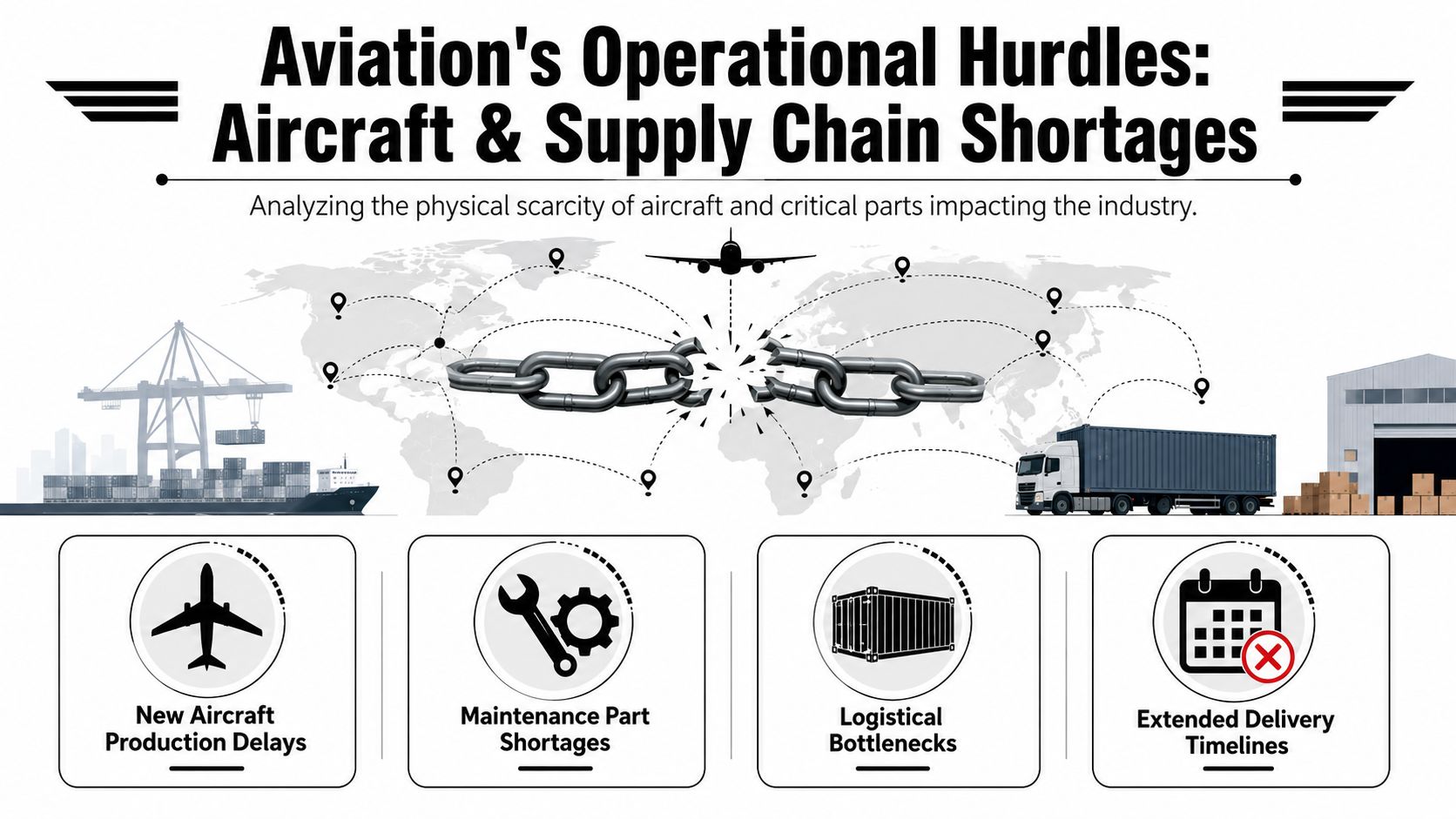
The biggest physical constraint in aviation today is simple. There aren't enough aircraft, and there aren't enough parts moving through the system fast enough.
PwC's 2025 review identifies a shortfall of more than 4,500 commercial aircraft relative to 2019 plans, with manufacturers delivering only about 760 aircraft in 2024 (PwC aviation industry review and outlook 2025). Even though that figure refers to commercial aviation, the effect doesn't stay in the airline lane. It spreads into maintenance capacity, component availability, shop queues, and replacement timelines across the wider aviation ecosystem.
Scarcity changes how charter availability works
In a normal market, an operator can rotate aircraft, pull forward replacements, or absorb a maintenance event with less friction. In a constrained market, every delay compounds. If a new aircraft isn't delivered on time, the older aircraft stays in service longer. If older aircraft stay in service longer, scheduled and unscheduled maintenance pressure rises. If parts aren't available, aircraft sit.
For charter buyers, that can lead to:
- Tighter sourcing windows: Last-minute options narrow faster than they used to.
- More equipment changes: The originally discussed aircraft may no longer be the aircraft that flies.
- Longer maintenance-related downtime: A grounded jet can remain unavailable longer than expected.
- Less pricing softness: Scarcity supports firmer pricing in strong markets.
Parts bottlenecks create hidden reliability risk
Most clients think of shortages in terms of whole aircraft. In practice, parts shortages can be more disruptive. A missing component, an engine-related delay, or a backlog at a maintenance provider can remove an aircraft from service with little notice. That doesn't automatically make private aviation unsafe. It does mean reliability depends heavily on operator discipline, fleet planning, and backup access.
If you want a useful manufacturing perspective on one possible pressure-release valve, this overview of how 3D printing transforms production helps explain why additive manufacturing keeps coming up in supply-chain conversations. It's not a universal fix, but it does show where the industry is trying to shorten certain production bottlenecks.
A charter client should always ask what happens if the assigned aircraft goes down for maintenance the night before departure.
That single question reveals a lot about an operator's real depth.
What actually works
What doesn't work is assuming every published aircraft option is equally dependable. What does work is looking for sourcing discipline, realistic lead times, and evidence that the provider understands maintenance exposure. Clients should also spend time on the operator's safety and reliability posture, not just cabin photos or category labels. A practical reference point is this Haute Jets Journal piece on maintaining excellence in private jet safety and reliability, which outlines why maintenance standards and operator quality matter as much as the aircraft itself.
The Critical Workforce and Skills Gap
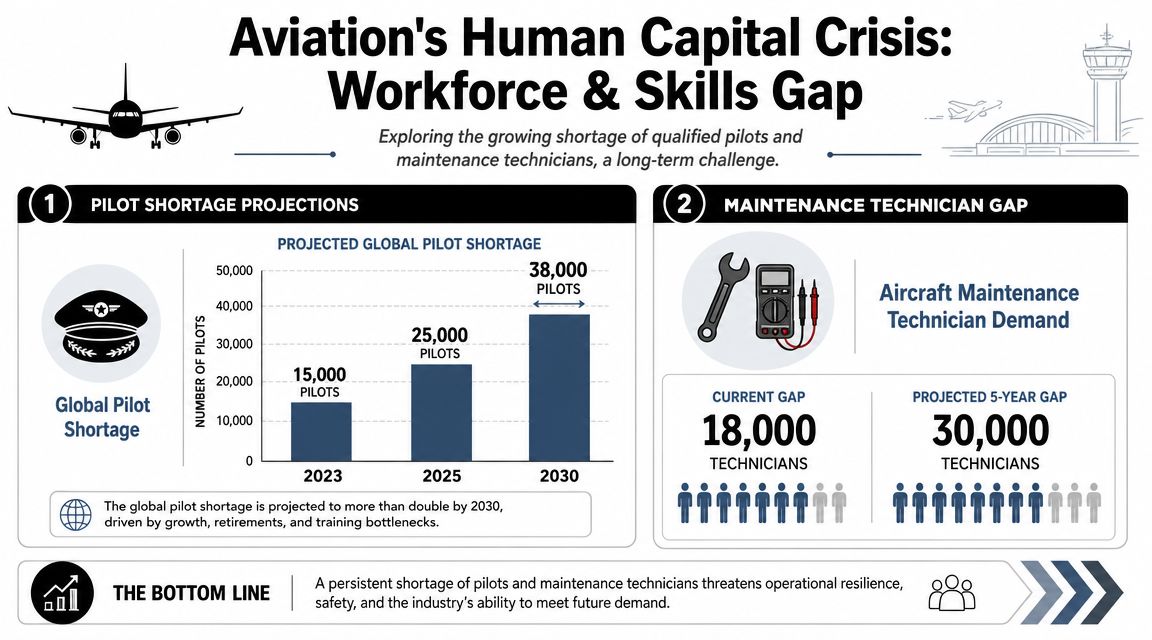
Aviation doesn't run on metal alone. It runs on people who can fly, maintain, dispatch, inspect, and recover operations safely. That's why the labor problem is one of the most serious aviation industry challenges in front of clients right now.
The World Economic Forum says the sector will need 480,000 new technicians and more than 350,000 pilots by 2026 (World Economic Forum Global Aviation Sustainability Outlook 2025). That isn't a short-term staffing annoyance. It's a structural constraint on growth.
Why crew shortages affect charter clients directly
Pilot and technician shortages hit private aviation in practical ways. Operators may have aircraft physically available but still struggle to staff them efficiently. Maintenance teams may be qualified but overloaded. Training pipelines remain long, costly, and heavily regulated, so the market can't hire its way out of the problem overnight.
For the client, this can show up as:
- Less schedule flexibility: A tail may exist, but legal and qualified crew availability can still be tight.
- Pressure on substitutions: If one crew pairing falls out, replacing it isn't always quick.
- Longer service lead times: Particularly around holidays, large events, and heavy business travel periods.
- More importance on third-party oversight: Because not every operator manages hiring, training, and fatigue equally well.
Safety depends on standards, not marketing
Many buyers become distracted. They focus on the aircraft model and forget that execution quality depends on the operator. In a stretched labor market, the only sensible response is stricter vetting.
A serious charter decision should look beyond “experienced crew” language and ask for evidence of external safety auditing, crew training standards, operational control, and fatigue management practices. Logos alone don't guarantee quality, but reputable third-party standards are still a far better filter than self-description.
The right question isn't “Is this operator approved?” It's “Approved by whom, and for what standard?”
What doesn't work in a thin labor market
Cheap promises don't work. Last-minute optimism doesn't work. Assuming every operator has the same recruiting depth, maintenance bench, or dispatch discipline doesn't work.
What does work is choosing providers that treat operational staffing as part of risk management, not a back-office detail. In this environment, discerning clients should value crew quality the same way they value aircraft pedigree.
Navigating Financial and Regulatory Turbulence
Private charter pricing has always moved with market conditions. What's changed is how many variables now sit behind a single quote. Fuel, maintenance friction, insurance conditions, airport access rules, crew constraints, and international compliance all shape the final number.
One cost driver stands above the rest. Fuel typically accounts for 25 to 30% of airline operating costs (analysis of top aviation industry challenges). While private aviation has a different cost structure than the airlines, the same lesson applies. Fuel is a major and volatile input, and any operational inefficiency magnifies it.
The quote is never just about the flight time
Clients often assume they're paying for airborne hours and cabin class. In reality, they may also be paying for positioning, operational padding, routing limitations, and the provider's risk tolerance. That's where the market gets opaque.
A broker can show a competitive headline number while embedding less visible exposure elsewhere. If the aircraft has to come in from another market, repositioning adds cost and complexity. If an operator is dealing with maintenance uncertainty or crew tightness, that risk may already be baked into the offer. If airport or regulatory conditions change, the quote can move again.
Transparency is now part of risk control
The best defense against financial turbulence is simple pricing logic. Clients should ask:
- Where is the aircraft based? If it isn't near the departure point, expect extra cost and less flexibility.
- What assumptions sit behind the quote? Ask whether the price depends on specific crew, airport, or timing conditions.
- What triggers a revision? Weather, schedule changes, deicing, runway limits, and permit issues can all matter.
- What is and isn't included? The cleanest quote is the one that leaves the fewest surprises.
This discipline matters beyond aviation. In other regulated operating environments, leaders use structured policies to reduce preventable risk before disputes begin. A useful example is this guide for SMBs on HR legal defense, which makes the same broader point: ambiguity gets expensive.
Cost intelligence beats cheap headline pricing
A low quote can still be a bad deal if it carries operational fragility. A slightly higher quote can be smarter if the aircraft is local, the operator is stable, and the contract terms are clear.
Clients who want a deeper look at the fuel side of charter economics can review this Haute Jets Journal article on jet fuel costs for private jets. The main takeaway is straightforward. In a volatile operating environment, transparency isn't a nice feature. It's the mechanism that lets you compare offers intelligently.
The Sustainability Imperative Beyond Buzzwords
Aviation sustainability is often discussed as if the only missing ingredient were corporate will. That framing is too shallow. The primary near-term constraint is supply and infrastructure.
The core issue isn't whether Sustainable Aviation Fuel matters. It does. The issue is that SAF production remains far below demand, and infrastructure limitations restrict near-term availability, according to Resources for the Future on sustainable aviation challenges.

Why greener flying is harder than the marketing suggests
Many clients hear “sustainable aviation” and assume that broad low-carbon flying is about to become standard. It isn't. SAF supply remains limited, and alternative propulsion paths such as hydrogen and electric aviation still face safety, storage, infrastructure, and technology constraints in the near term.
That means the practical sustainability question for a charter client is not, “Can this industry talk about decarbonization?” It can. The key question is, “What can be done on my trip today?”
The honest answer is usually operational efficiency.
The immediate lever is avoiding waste
For private aviation, one of the clearest ways to reduce unnecessary fuel burn is to cut avoidable repositioning. Empty non-revenue legs created purely to move an aircraft into place add fuel use without creating passenger value. Reducing those movements is one of the few immediate steps that improves both commercial efficiency and environmental performance at the same time.
Sustainability claims are stronger when they're tied to dispatch decisions, not just brochure language.
That's especially important in charter, where aircraft sourcing logic can either reduce or increase unnecessary movement before the passenger even boards.
A broader view of that topic appears in Haute Jets Journal's discussion of the environmental impact of private jets and sustainable solutions.
What to look for in real sustainability claims
Clients should separate serious operational efforts from vague positioning. Ask questions such as:
- Is the aircraft being sourced efficiently? This affects both cost and fuel burn.
- Is SAF available for this routing and airport set? Availability is still uneven.
- Is the sustainability narrative specific? General promises without operational detail don't tell you much.
- Is the provider reducing avoidable empty movement? That's one of the most credible near-term levers.
Here's a useful explainer on the broader transition challenge:
The market will keep moving toward lower-carbon flying. But for now, the difference between marketing and practice usually comes down to sourcing efficiency, route planning, and honest disclosure about what's available.
The Savvy Client's Playbook for Mitigating Risk
The right charter strategy now starts with one assumption: every trip carries operational risk, and your job is to reduce avoidable exposure before departure. That doesn't require industry jargon. It requires a disciplined buying process.
Five questions that sharpen every charter decision
Start here:
Where is the aircraft coming from?
If the answer is vague, expect pricing and reliability risk.Who is the actual operator?
Don't settle for broker branding. Ask who will fly the trip and what third-party safety standards they meet.What happens if the assigned aircraft becomes unavailable?
Good providers answer this directly and quickly.How stable is the quote?
A clean quote should identify assumptions and likely change points.What operational information arrives before departure?
You want clarity on aircraft, crew, timing, and passenger details with enough lead time to act.
Charter model comparison
| Challenge Area | Traditional Broker / Jet Card | Haute Jets On-Demand Model |
|---|---|---|
| Aircraft availability | May rely on a narrower pool or pre-set program inventory | Sources from a broad network of owner-operated aircraft across many markets |
| Cost transparency | Can obscure repositioning, program structure, or embedded fees | Pay-per-flight structure focused on direct trip pricing |
| Safety verification | Standards vary by provider and program | Uses only Wyvern Wingman or Argus Gold/Platinum-rated operators |
| Operational efficiency | Aircraft may be positioned from farther away | Local sourcing approach reduces unnecessary repositioning |
| Aircraft choice | Often category-based rather than exact tail preference | Client can choose the specific aircraft and cabin configuration |
| Flexibility | Memberships, prepaid hours, or program rules may limit agility | On-demand model allows trip-by-trip decision-making |
The practical buying standard
What separates a smart client from a frustrated one isn't budget alone. It's process. Strong buyers compare charter options the way an operator would compare risk: sourcing, crew, maintenance exposure, pricing logic, and recovery plan.
If a provider can't explain the operational logic behind the quote, the client is taking the hidden risk.
That's the playbook. It's not glamorous, but it works.
Conclusion The Future of Smart Private Aviation
Private aviation is still one of the most effective tools in business and personal travel. But it now sits inside a tighter, less forgiving operating environment. Aircraft shortages reduce flexibility. Workforce pressure raises the value of serious operator standards. Fuel and regulatory volatility reward pricing clarity. Sustainability progress depends less on slogans and more on practical efficiency.
The important shift is this: informed clients no longer buy private flying as a luxury abstraction. They buy it as an operational product. They want the right aircraft, from the right operator, under terms that still make sense when the day doesn't go perfectly.
That's where the future of smart private aviation is headed. Not toward more complexity for the client, but toward better filtering, better sourcing, better vetting, and better transparency. The market will keep changing. The buyers who do best in it will be the ones who understand how the system works.
Choose your charter partner with that standard in mind. In this cycle, sophistication isn't about flying more. It's about flying with fewer surprises.
For travelers who want a more transparent way to book private flights, Haute Jets offers on-demand charter access to 3,500+ owner-operated aircraft across 175 countries, with no memberships or jet cards, locally sourced options that help avoid unnecessary repositioning, and flights operated only by Wyvern Wingman or Argus Gold/Platinum-rated carriers.