

The popular advice is simple: if your company flies often, buy an aircraft or commit to a jet card. That advice is incomplete. Corporate aviation solutions are procurement decisions, not luxury upgrades, and the wrong commitment can leave your finance team paying for idle capacity, repositioning, restrictive terms, or an aircraft that doesn't fit the mission.
The market is active enough to expose that mistake. JETNET's mid-2026 market snapshot reported 1.95 million global business jet departures in the first half of 2026, up 4.0% year over year, with North America up 5.0% and Latin America up 4.6%. New business jet deliveries reached an estimated 466 units, while the combined backlog across top manufacturers reached $58.2 billion in the first quarter. Demand is substantial, but demand alone doesn't tell you which access model makes financial sense.
A CFO should start with trip patterns, not cabin finishes. The right question is whether your company needs ownership, guaranteed access, prepaid capacity, or a well-sourced aircraft for each trip.
The Shift in Corporate Aviation Strategy
Buying a jet isn't automatically a sign of disciplined planning. Neither is purchasing a jet card. Both can be rational, but only when your travel volume, routes, passenger requirements, and scheduling behavior justify the commitment.
The scale of the market makes flexibility more important, not less. Aviation Week's 2026 business aviation outlook projected that the global in-service business aviation fleet would exceed 35,730 aircraft in 2026 and reach more than 40,500 aircraft by the end of 2035, implying a 1.4% compound annual in-service growth rate. The same outlook reported 1,458 aircraft delivered in the first half of 2026, with billings rising 15.5% to $14.3 billion. Companies have access to a mature, broad supply base. They don't need to own every capability they may occasionally require.
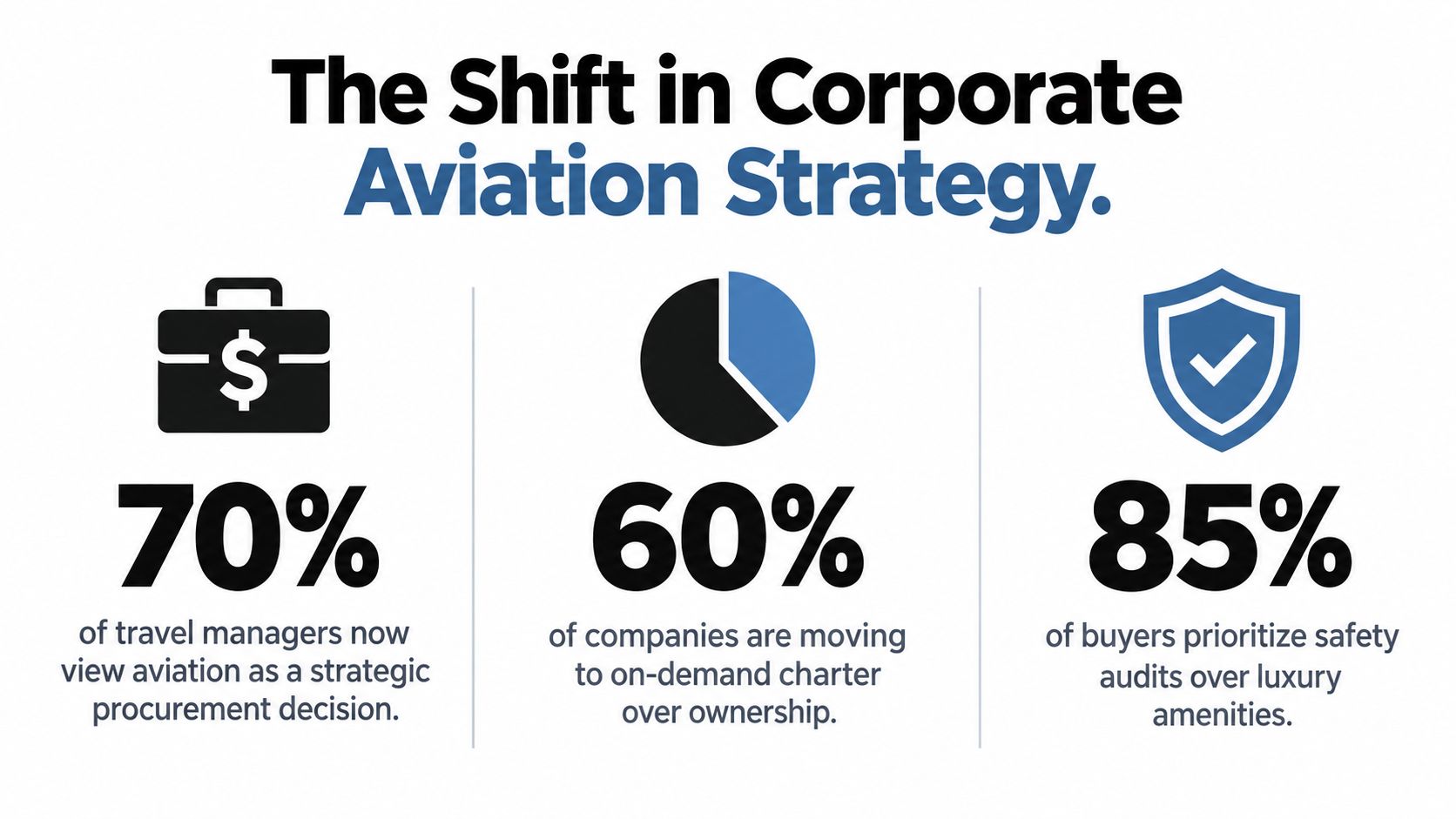
Access matters more than possession
Ownership gives control, but it also creates a fixed operating structure. The company must carry the consequences of crew, maintenance, hangar, insurance, scheduling, and asset management decisions even when business travel slows. Fractional ownership reduces the capital burden, but it still introduces contractual obligations and shared-use constraints.
On-demand charter changes the financial shape. The company buys a trip when it needs one, which suits irregular travel, project work, seasonal demand, and itineraries that change with deals or operating priorities. That flexibility can be more valuable than nominal hourly predictability.
CFO rule: Treat aircraft access as a logistics input first and a prestige benefit second.
A strategic procurement team should also look beyond the aircraft itself. Suppliers supporting aviation manufacturing, maintenance, and component production can provide useful context on how the sector approaches precision and operational reliability. For background on the production side, review American Additive Manufacturing for aerospace.
Safety belongs in the same procurement conversation. A lower price isn't a saving if the provider's audit evidence, operational control, or maintenance oversight doesn't meet your duty-of-care standard. The strongest corporate programs separate the question of how often the company flies from the question of how rigorously every operator must be vetted.
Comparing Access Models and Utilization Thresholds
There isn't one universal annual-hour threshold that makes a model correct for every company. Aircraft category, route density, lead-time requirements, passenger loads, tax treatment, and internal operational capability all change the calculation. Still, the following framework gives a finance team a practical starting point.
| Model | Financial Commitment | Ideal Annual Hours | Flexibility |
|---|---|---|---|
| On-demand charter | Pay per confirmed flight, with no annual fee, prepaid hours, or required membership | Irregular or project-based use | Highest |
| Jet card | Prepaid hours or committed balance, often paired with fixed terms and availability rules | Predictable recurring use | Moderate |
| Fractional ownership | Equity share, management charges, hourly charges, and a multi-year commitment | Consistent recurring use with planned access needs | Limited to moderate |
| Aircraft management | Ongoing management structure for an owned aircraft, including operational administration and compliance | High utilization with a company-controlled asset | Asset-dependent |
On-demand charter
On-demand charter is the default recommendation for companies with uneven demand. The customer receives a quote, reviews the per-flight agreement, and pays for the confirmed trip rather than funding a block of unused hours. That structure is particularly useful for investor roadshows, urgent site visits, acquisitions, and teams whose travel calendar changes every quarter.
The trade-off is variable pricing and availability. Procurement must evaluate each quote carefully, including aircraft location, crew duty limits, airport charges, and cancellation terms. Use this guide to private jet membership cost to compare the commitment structure against membership-based alternatives before signing.
Jet cards
Jet cards can work when routes, aircraft categories, and departure windows are predictable. They offer a defined purchasing framework, but the apparent simplicity can conceal expiry rules, peak-day restrictions, blackout dates, minimum charges, and aircraft substitution provisions. A company shouldn't buy prepaid hours merely because the hourly rate looks easier to budget.
Fractional ownership
Fractional ownership becomes more rational when the company needs recurring access and can tolerate a multi-year agreement. The financial analysis must include the share, management charges, occupied-hour charges, repositioning rules, resale conditions, and the cost of unused capacity. Shared access can provide useful predictability, but it won't eliminate scheduling trade-offs.
Aircraft management
Aircraft management is appropriate only when the company already owns, or is prepared to own, an aircraft and wants professional help with crew, maintenance, regulatory compliance, dispatch, and daily operations. It isn't an access product. It's an operating structure for an asset.
Decision test: If your annual hours fluctuate materially, price the variable cost of charter before accepting a fixed aviation commitment.
Uncovering Hidden Repositioning and Sourcing Costs
The aircraft you choose may not be the aircraft that starts near your departure airport. If an operator must fly empty to collect your passengers, the quote can include a ferry or repositioning charge. That cost has nothing to do with whether you selected a light jet, midsize jet, or large-cabin aircraft. It comes from the aircraft's location and the operator's schedule.
Independent aviation commentary cited by Haute Jets' charter resource describes broker pricing inflation of 20% to 40% from repositioning fees. The commercial consequence is direct: two aircraft in the same category can produce materially different quotes because one is already local and the other must travel empty before the passenger leg begins.
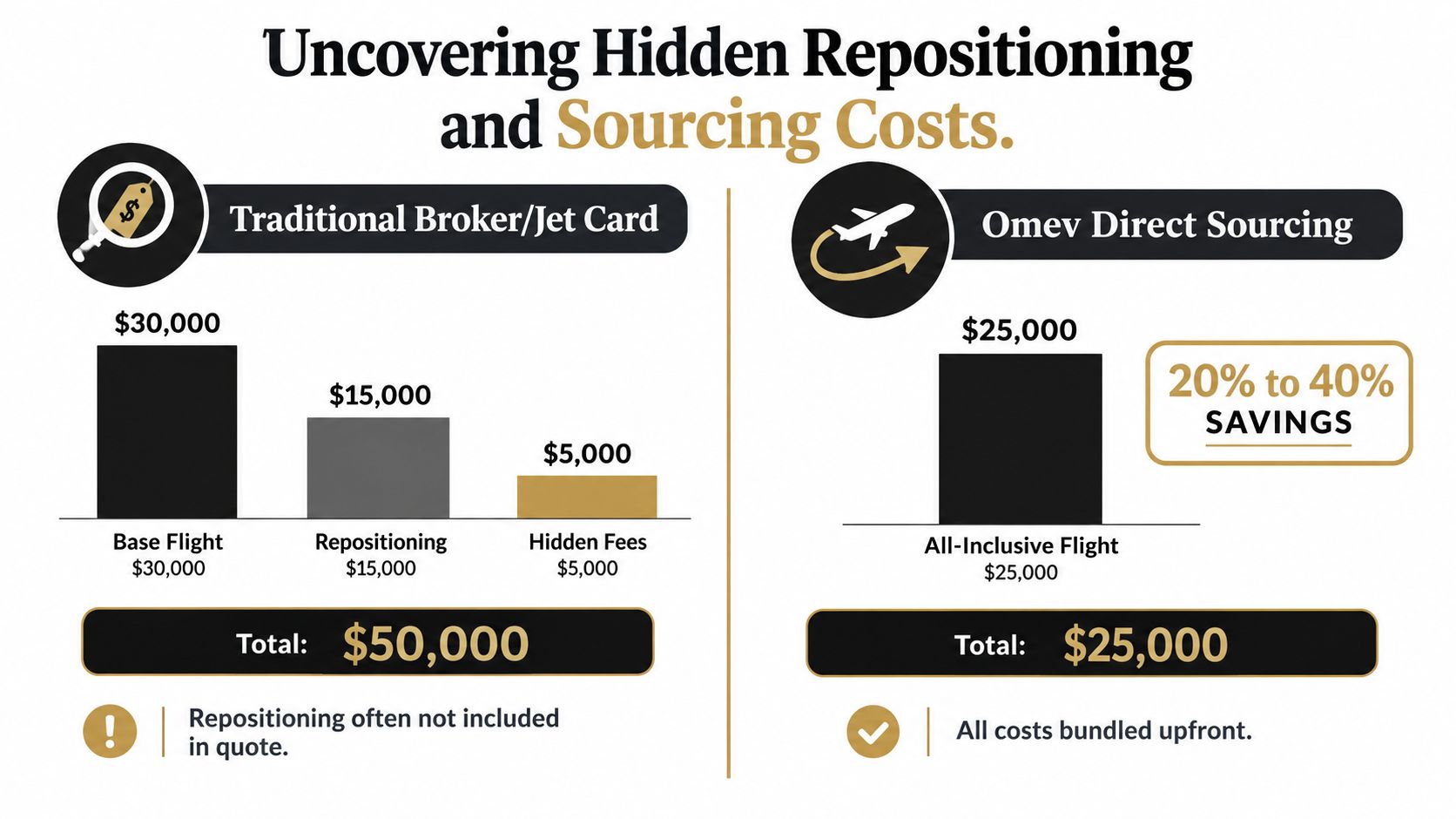
Read the quote as an operating document
A vague quote isn't transparent. Ask the provider to identify:
- Aircraft location: Where is the aircraft before pickup, and where must it go afterward?
- Repositioning treatment: Is ferrying included, separately itemized, or subject to change?
- Empty-leg exposure: Could the aircraft move between quote and confirmation?
- Airport charges: Which landing, handling, parking, and international service fees are included?
- Cancellation rules: What happens if the aircraft or itinerary changes?
- Aircraft substitution: Can the provider replace the selected aircraft with another model?
A direct local sourcing approach can reduce unnecessary empty legs by matching the trip with aircraft already near the origin airport. That doesn't guarantee the lowest quote in every situation, because availability, crew legality, airport constraints, and timing still matter. It does create a cleaner basis for comparison.
Source by location, not only by category
Travel managers often ask for “a midsize jet” and stop there. That instruction leaves the supplier too much room to optimize for its own inventory. Ask for the exact aircraft, its current location, cabin configuration, connectivity, baggage capacity, and operating party.
For a deeper explanation of the cost mechanics, review private jet deadhead cost. Your procurement file should show whether the quote reflects a local aircraft or embeds the cost of bringing one in from elsewhere.
Decoding Safety Audits and Operator Vetting
Safety ratings do not provide a simple pass or fail. They identify a screening framework, and their value depends on the audit tier, inspection depth, renewal schedule, and operational evidence behind the rating. For a CFO, that evidence matters more than an attractive badge because weak vetting can create disruption, substitution risk, and avoidable procurement exposure.
ARGUS and WYVERN are the two major third-party safety auditors used in business aviation. ARGUS and Wyvern safety guidance explains that ARGUS Platinum requires a current on-site audit, a functioning safety management system, and an emergency response plan. Wyvern Wingman reviews safety management, maintenance oversight, crew training, and operational control. Read this Wyvern and Argus safety ratings deep dive before setting the qualification standard for a charter program.
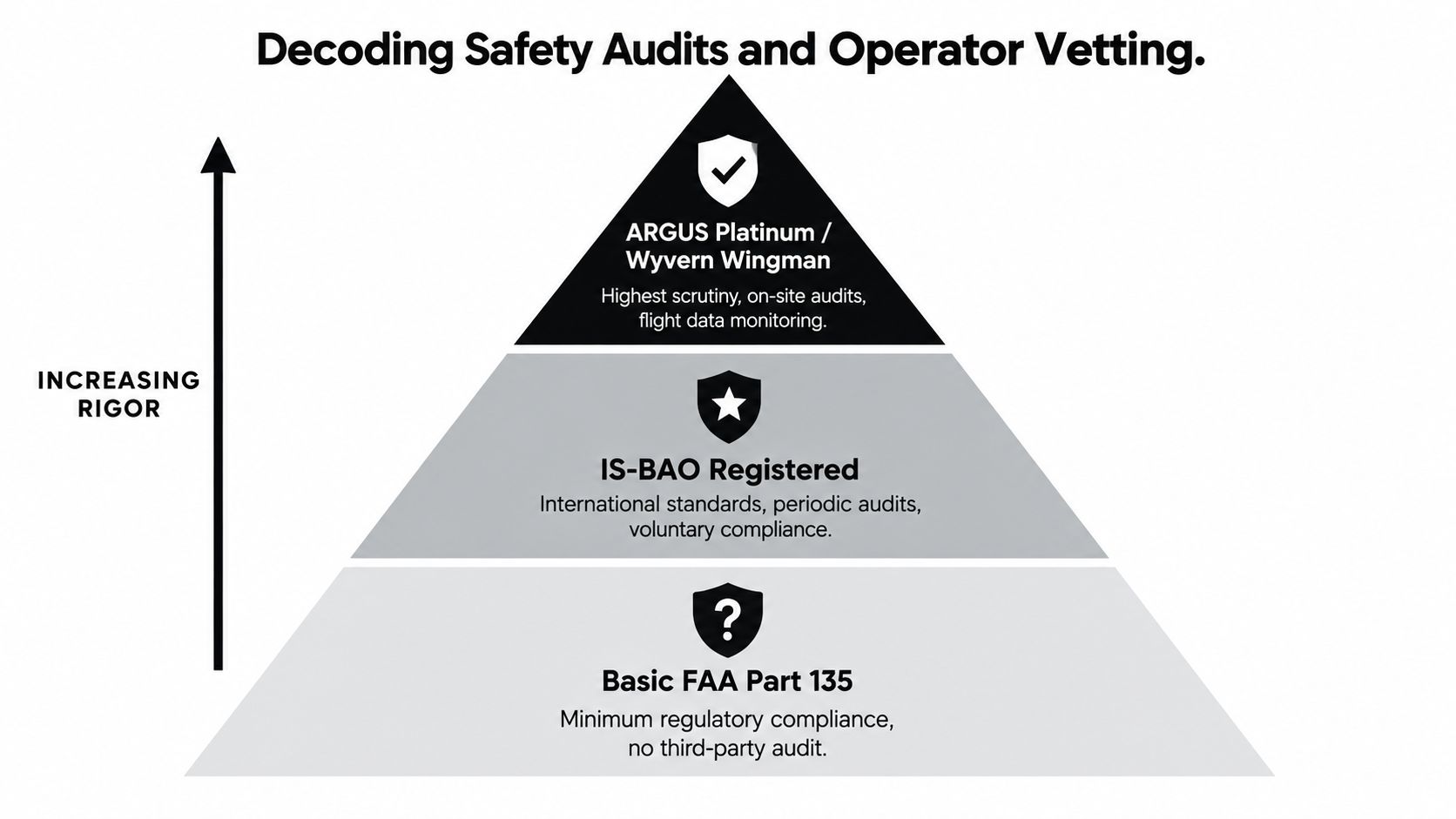
Separate regulatory compliance from independent review
Regulatory compliance is the baseline. The operator still needs the required aviation authority approvals, while a third-party audit provides an independent review of risk controls, procedures, and operating records.
ARGUS audit commentary describes a tiered process covering Registered, Gold, and Platinum. Gold includes structured reviews of operating manuals, training records, maintenance documentation, and flight operations. Platinum includes on-site inspection and recurring review requirements.
Apply the same discipline to WYVERN Wingman. The rating addresses operational control, maintenance oversight, crew training, and safety management. Those are the controls a corporate buyer should verify before approving an operator, not just the name displayed in a presentation.
Build an audit evidence file
Request current documentation and place it in the procurement record. Confirm:
- Rating and currency: Record the exact tier and current status.
- Audit scope: Establish whether the review was remote, on-site, or supported by continuing oversight.
- Operational control: Identify who dispatches, releases, monitors, and manages the flight.
- Maintenance governance: Confirm who controls maintenance records and airworthiness decisions.
- Crew standards: Request relevant qualification and training information.
- Emergency response: Verify a documented response plan.
Procurement standard: “Rated” is not enough. Record the auditor, tier, audit status, and evidence relevant to the specific operator.
ARGUS Platinum is described as renewing annually with semi-annual reviews, while Wyvern Wingman typically renews every two years. Wingman PRO adds quarterly oversight and continuous monitoring. Those schedules affect the confidence you can place in the rating. Active re-validation offers stronger assurance than a one-time document review.
Navigating Sustainable Aviation Fuel Realities
Sustainable aviation fuel is no longer a branding footnote. It has become a procurement and reporting issue, and corporate travel teams need evidence they can defend internally.
The supply constraint remains material. IATA's SAF outlook projected about 2 million tonnes of SAF in 2025, roughly 0.7% of airline fuel use, with expected production of 2.4 million tonnes in 2026. Those figures describe a limited supply base, not an unlimited product that can be added to any itinerary on request.
Europe adds a compliance layer. ReFuelEU Aviation rules require a 2% SAF blend in 2025 and 6% by 2030, with stronger mandates later in the decade, according to the same IATA source. A corporate aviation policy that promises SAF without addressing location, allocation, verification, and records isn't a sustainability policy. It's a marketing statement.
Ask where the fuel exists
SAF access depends on the airport, supplier relationships, operator arrangements, and whether the claim refers to physical uplift or a book-and-claim structure. Those are different procurement outcomes and should be recorded separately.
A travel manager should ask:
- Physical availability: Can the aircraft receive SAF at the departure or arrival airport?
- Allocation method: Is the fuel physically uplifted, or is the environmental attribute allocated elsewhere?
- Documentation: What certificate, receipt, or supplier record supports the claim?
- Accounting treatment: How will the company report the purchase in its ESG system?
- Chain of custody: Which parties handled the fuel or environmental attribute?
- Scope boundaries: Does the record cover the whole flight, a portion of fuel, or an equivalent allocation?
Avoid unverifiable claims
Don't approve language such as “green flight” unless the provider supplies records that define exactly what happened. Your procurement file should connect the itinerary, operator, fuel arrangement, supplier documentation, and reporting method.
ESG rule: If your team can't preserve the audit trail, it can't make a defensible SAF claim.
The practical strategy is to set a documentation standard before booking. Require providers to disclose regional limitations and cost treatment, then report what can be verified. That approach protects the company from overstating its progress while still allowing responsible SAF procurement where supply and records support it.
Matching Flight Patterns to the Right Solution
The right aviation model follows trip geometry. A company flying frequent regional routes on a stable schedule has a different problem from one sending executives across borders for irregular negotiations. Treating both as jet-card customers is lazy procurement.
Start with the variables that drive the mission:
- Frequency: Are trips recurring or event-driven?
- Lead time: Can the team plan weeks ahead, or do itineraries change quickly?
- Passenger profile: Is the aircraft carrying one executive, a leadership group, or a project team?
- Cabin requirement: Does the group need a quiet workspace, sleeping capability, or efficient transport?
- Airport pair: Can the itinerary use smaller airports near facilities and clients?
- Schedule rigidity: Are departure windows fixed, or can the company move when aircraft availability changes?

Use a route-level decision matrix
For frequent short-hop regional travel, prioritize local availability, runway access, quick turnarounds, and a cabin that matches the passenger count. A turboprop or light jet may be more rational than reserving a large aircraft whose capabilities the trip doesn't use.
For irregular transatlantic executive travel, on-demand charter usually deserves first review. The company can choose a large or ultra-long-range aircraft when the route requires it, then use a different category for regional missions. That avoids forcing every trip into the economics of one committed platform.
For recurring executive shuttle routes, a jet card or fractional arrangement can become useful when the schedule is stable and the company values predictable access more than maximum sourcing flexibility. Even then, review peak-period rules, substitutions, minimum charges, and repositioning treatment.
For mixed corporate travel, use a hybrid policy. Commit only the predictable core, then source variable trips individually. This is often more efficient than buying a broad membership and hoping utilization catches up.
Travel director's recommendation: Build the aviation policy around route families, not a single company-wide aircraft preference.
Review the matrix quarterly. Business development cycles change, executives move, facilities open, and deal activity creates temporary spikes. A model that was rational during one planning period can become expensive when the pattern shifts.
Executing a Transparent Charter Procurement Process
A transparent charter process begins before the quote and ends after the passenger manifest is closed. The travel manager's job isn't to find an available aircraft. It's to create a record showing who operates the flight, what aircraft was selected, what the price includes, and how the provider will handle disruption.
Use a controlled booking sequence
First, define the mission in writing. Record departure and arrival airports, preferred windows, passenger count, baggage, pets, catering, Wi-Fi needs, ground transportation, and any confidentiality requirements. A category request such as “heavy jet” is not enough if the team needs a specific cabin layout or connectivity system.
Second, request an itemized proposal. Separate aircraft cost, crew, fuel treatment, repositioning, handling, landing, parking, taxes, catering, ground transport, and cancellation exposure. If the provider won't explain the components, send the quote back for clarification.
Third, verify the operator. Confirm the operating certificate, third-party audit tier, maintenance responsibility, operational control, and emergency contact process. Don't let a broker's brand substitute for the identity of the actual operator.
Fourth, select the aircraft, not just the category. Confirm the tail number when available, year, make, model, cabin plan, Wi-Fi, baggage capacity, catering, pet policy, and any special equipment. Written confirmation matters because “similar aircraft” can mean a materially different passenger experience.
Close the pre-flight file
Before departure, require the details your duty-of-care process needs. Haute Jets' stated process includes receiving the tail number, crew bios, weather briefing, and passenger manifest 24 hours before departure, along with confirmation of aircraft-specific services and policies. Those documents give the executive assistant, security team, and travel manager a common source of truth.
Use this final checklist:
- Identity: Confirm the exact aircraft and operating company.
- People: Receive crew information and the operating contact.
- Conditions: Review the weather briefing and material itinerary risks.
- Services: Reconfirm Wi-Fi, catering, pets, luggage, and ground transport.
- Commercial terms: Match the final confirmation against the approved quote.
- Contingency: Document the escalation path for delays, substitutions, or cancellations.
The strongest corporate aviation solutions preserve flexibility without sacrificing evidence. Pay per trip when utilization is uncertain, commit only where demand is predictable, and make local sourcing and audit depth essential parts of the procurement file.
Haute Jets offers on-demand corporate charter sourced from owner-operators, with exact aircraft selection, Wyvern and ARGUS-rated operators, and pre-flight confirmation of operational details. Visit Haute Jets to request a trip-specific quote built around your routes, passenger needs, sourcing conditions, and compliance requirements.