Booking a private jet often feels simple on the surface. You choose the route, confirm the aircraft, review the timing, and expect the experience to be smooth from curb to cabin. What's easier to miss is that you're also placing a large amount of trust in an operator's judgment, maintenance discipline, crew training, and safety culture.
That trust shouldn't rest on marketing language alone.
For readers of Haute Jets Journal, the core question isn't whether an operator is allowed to fly. The better question is whether that operator has built systems that reduce avoidable risk when weather shifts, schedules compress, maintenance entries need verification, or a pilot faces a high-pressure decision. That's where aviation safety standards stop being abstract regulation and start becoming personal protection.
The Unseen Passenger on Every Private Flight
A client charters a jet for a same-day business trip. The aircraft looks pristine. The itinerary is clean. The operator confirms everything is “fully certified.” Most passengers hear that phrase and assume the safety question has been settled.
It hasn't.
Certification matters, but it's only the floor. The more important issue is how the operator performs when the day stops being routine. A mechanical note appears during preflight. Weather deteriorates near destination. A crew member must decide whether to delay, divert, or continue. Those moments reveal the difference between a company that meets minimum rules and one that manages risk with discipline.
Why pilot judgment matters so much
The most uncomfortable truth in private aviation is also one of the most useful for a client to understand. Over 95% of fatal accidents in private aviation occur due to pilot error, with 78% attributed to decision-making failures during flight, according to Skybrary's referenced safety material.
That doesn't mean passengers should fear private flying. It means they should focus on the factor that matters most. Not glossy interiors. Not cabin snacks. Not whether the app looks polished. Crew quality and operator oversight are where real safety lives.
Practical rule: If a charter provider can describe the airplane in detail but can't clearly explain how it vets crews, audits training records, and reviews operational risk, you still don't know enough.
Minimum compliance versus operational safety
Government approval tells you an operator is legally authorized. It doesn't automatically tell you how seriously that operator handles non-routine events, internal reporting, recurrent training, or line-by-line safety accountability.
That's why discerning clients ask tougher questions:
- Who reviews the operator independently
- How often are records examined
- What standards apply beyond the legal minimum
- How does management respond to risk before an incident occurs
The unseen passenger on every private flight is risk. You can't remove it entirely. You can, however, choose operators that control it with far more rigor than basic certification requires.
What Are Aviation Safety Standards
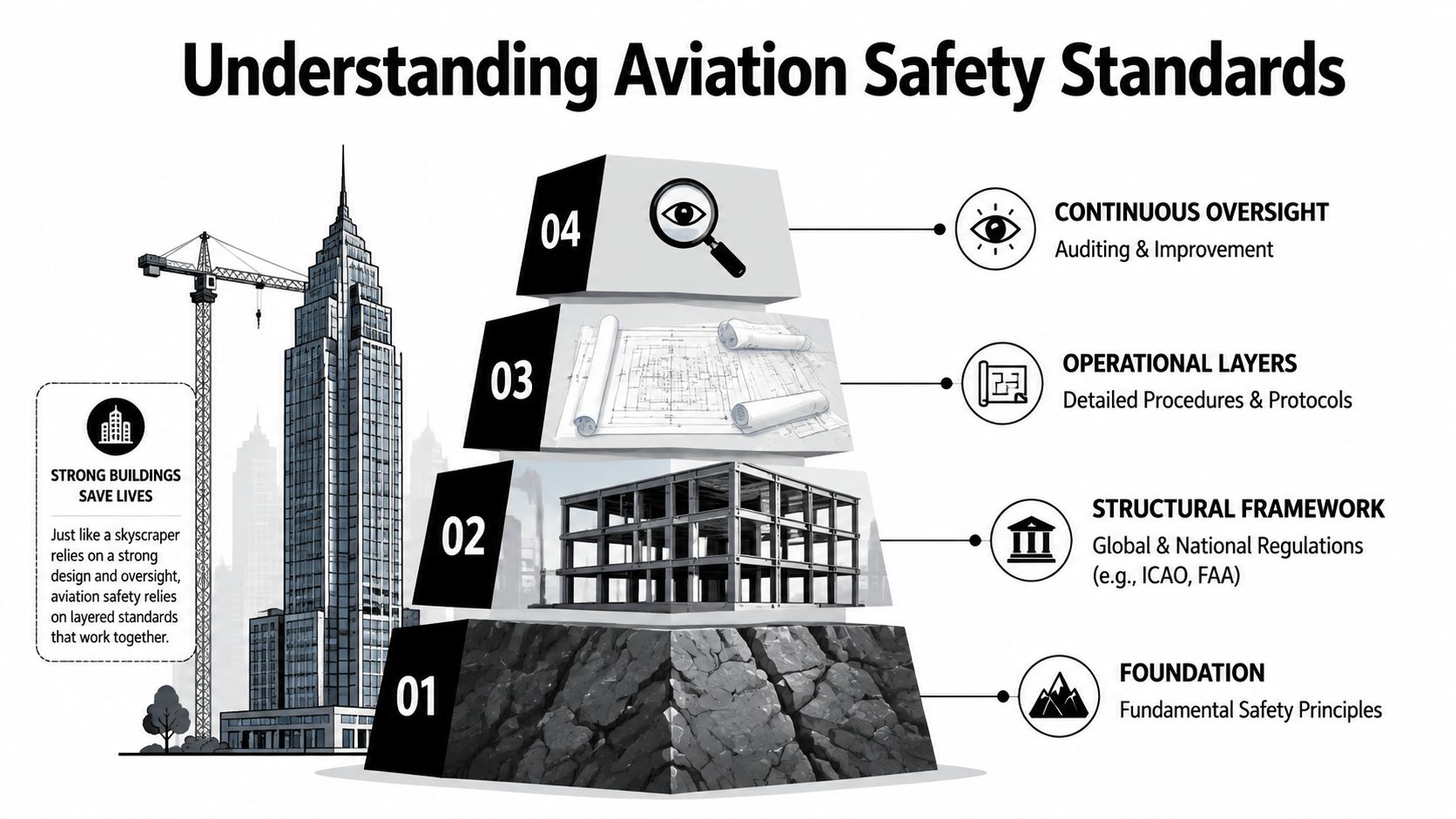
Think of aviation safety standards the way you'd think about building codes for a skyscraper. A tower doesn't stand safely because one inspector approved the lobby. It stands because the foundation, structural frame, electrical systems, fire protection, maintenance routines, and ongoing inspections all work together.
Aviation works the same way.
A layered system, not a single rulebook
When people say aviation safety standards, they're usually referring to several layers of protection at once. Those layers include aircraft design requirements, maintenance rules, pilot qualifications, crew rest limits, dispatch procedures, weather review practices, and post-flight reporting.
A useful way to picture it is this:
| Layer | What it covers | Why it matters to a passenger |
|---|---|---|
| Foundation | Core safety principles | Establishes the non-negotiables |
| Regulatory framework | Global and national rules | Defines what operators must do |
| Operating procedures | Day-to-day checklists and protocols | Reduces inconsistency and shortcuts |
| Oversight | Audits, reviews, corrective action | Verifies that the system actually works |
A strong operator doesn't rely on one layer. It stacks them.
Where clients often get confused
The phrase “meets all safety standards” sounds reassuring, but it can hide an important distinction. An operator may comply with the required rules and still vary widely in documentation quality, internal discipline, and willingness to exceed the minimum.
That's especially relevant in private aviation, where service can feel highly personalized and flexible. Flexibility is valuable, but safety depends on procedures that remain firm even when a client is important, a trip is urgent, or timing is tight.
Security also intersects with safety more than many travelers realize. Ground access control, perimeter protection, and facility oversight all shape the reliability of flight operations. For a useful outside perspective on that side of the equation, see ABCO Security's work on safeguarding critical aviation facilities.
Good aviation safety standards don't slow an operation down for the sake of formality. They prevent rushed decisions from becoming expensive or irreversible ones.
The Global and Regional Safety Framework
Every private charter flight sits inside a chain of oversight that starts globally and narrows down to the operator, the aircraft, and the crew assigned to your trip. Understanding that hierarchy helps clients avoid a common mistake, which is assuming that one certificate answers every safety question.

ICAO sets the global baseline
At the top sits the International Civil Aviation Organization, or ICAO. ICAO doesn't fly your trip or audit your pilot directly. Its role is broader. It creates the international framework that member states use to shape their own aviation rules and oversight systems.
That global role matters because aviation is cross-border by nature. Aircraft, crews, maintenance records, and operating procedures often intersect across jurisdictions. A shared baseline reduces dangerous inconsistency.
ICAO's own safety findings also show why that framework can't be treated as paperwork. In 2024, ICAO identified four high-risk categories that accounted for 25% of all aviation fatalities: controlled flight into terrain, loss of control in flight, mid-air collisions, and runway incursions, as detailed in ICAO's latest aviation safety update.
FAA and EASA turn standards into enforceable rules
Below ICAO are national and regional regulators. In the United States, that's the Federal Aviation Administration. In Europe, it's the European Union Aviation Safety Agency, or EASA.
Their practical job is more direct:
- They certify operators
- They regulate maintenance and flight operations
- They approve training frameworks
- They enforce corrective action when deficiencies appear
The distinction is important. ICAO provides the blueprint. The FAA and EASA apply and enforce within their respective systems.
Why this matters to a private charter client
A passenger doesn't need to become a regulator. But a passenger does need to understand what regulator approval means. It means the operator has cleared the mandatory threshold. It does not mean every approved operator is equal in culture, discipline, transparency, or operational maturity.
A regulator determines whether an operator may operate. A demanding client should still ask whether that operator is one they should trust.
That's the gap many buyers never see. Government oversight is essential, but it was never designed to replace your due diligence. It establishes legal eligibility. It doesn't automatically identify who consistently performs above the minimum.
Why Third-Party Audits Are the Gold Standard
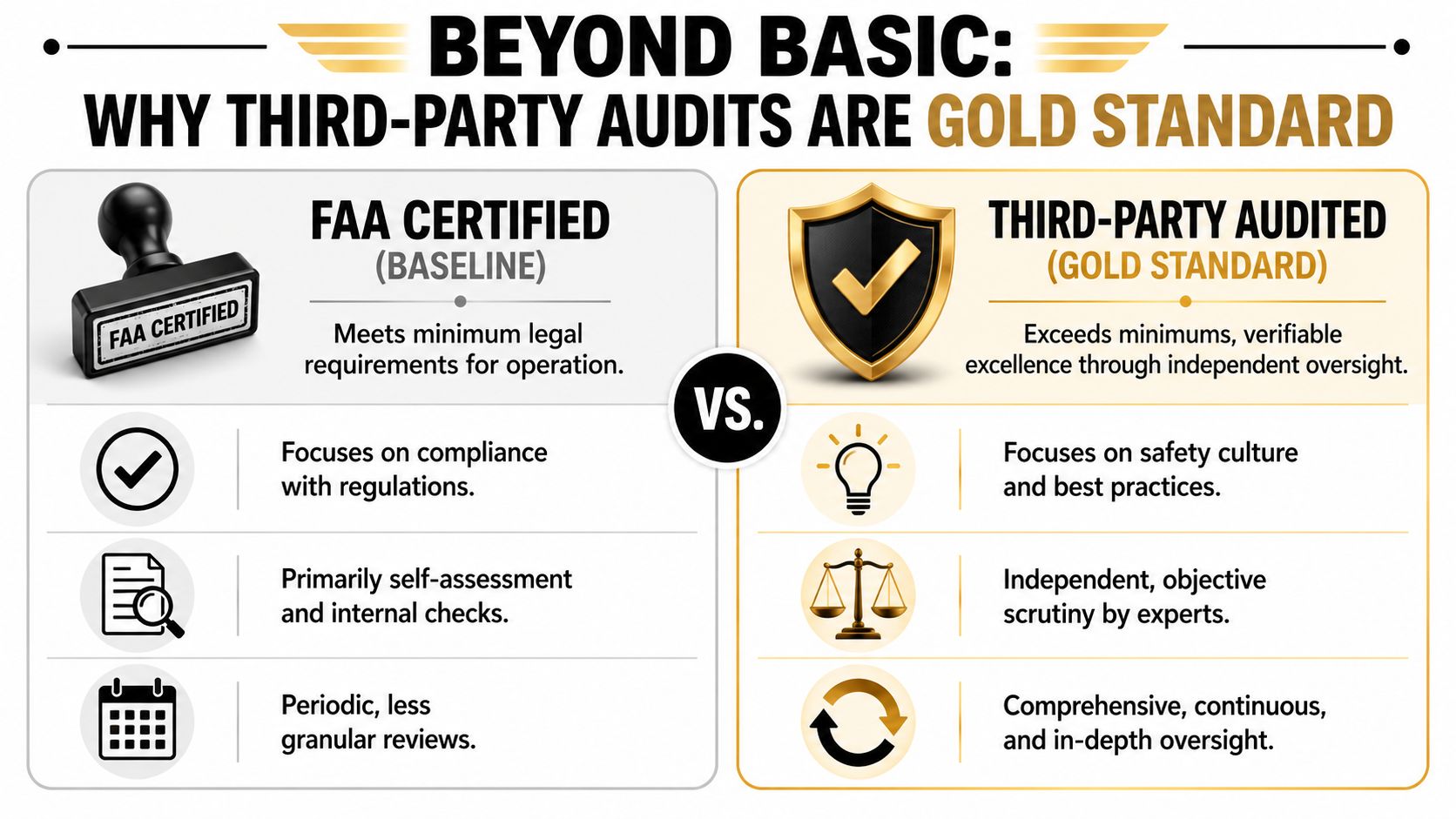
This is the point where many charter buyers make the wrong turn. They hear “FAA certified” and stop asking questions. In reality, that phrase should start the conversation, not end it.
Independent third-party audits matter because they test what basic compliance often doesn't examine thoroughly enough. In private aviation, the names clients should know are Wyvern Wingman, ARGUS Gold or Platinum, and IS-BAO. These aren't decorative seals. They are structured reviews of how an operator manages risk.
What third-party audits examine
A serious audit doesn't just ask whether a company has documents on file. It tests the quality and consistency behind them.
That often includes:
- Pilot records such as experience, recency, training completion, and aircraft-specific proficiency
- Maintenance history including documentation quality, inspection discipline, and discrepancy tracking
- Operational control covering dispatch practices, duty limits, and decision authority
- Safety culture including reporting habits, accountability, and management follow-through
- System integrity that shows whether procedures are being lived, not merely written
That last point is where weaker operators struggle. It's not hard to write a manual. It's much harder to prove that crews, maintenance teams, and leadership use it consistently under pressure.
Why Wyvern and ARGUS change the risk picture
The value of these audits isn't abstract. According to the FAA's 2025 Safety Report, operations certified under rigorous third-party audits like Wyvern and ARGUS show a 32% lower rate of incident-reported events compared to non-certified operators, as cited in the referenced administrative rule material.
For a charter client, that's the practical takeaway. A respected third-party rating is evidence that an operator has subjected itself to scrutiny beyond what the law minimally requires.
The difference between a certificate and a discipline
A certificate says, “We are approved.”
A rigorous third-party audit says, “We are being checked, measured, and held to a higher bar.”
That distinction matters most in edge cases:
- When weather creates pressure to continue
- When crew scheduling becomes tight
- When maintenance paperwork needs exact verification
- When an owner or VIP itinerary tempts people to cut corners
Operators that maintain these ratings are usually operating inside a culture where deviations are harder to hide and standards are harder to dilute.
For a fuller look at what those ratings mean in practice, Haute Jets has a useful explainer on Wyvern and ARGUS private aviation safety ratings.
If you only remember one screening question, make it this one: “Which independent safety audit does this operator maintain right now, and for the specific aircraft being offered?”
Understanding the Safety Management System
The strongest operators don't wait for an incident to teach them what was already knowable. They build a process that spots weak signals early, records them, reviews them, and changes behavior before something goes wrong.
That process is the Safety Management System, usually shortened to SMS.
Think of SMS as an immune system
The easiest way to understand an SMS is to compare it to an immune system inside a healthy organization. A good immune system doesn't wait for a full-blown crisis. It detects small threats, evaluates them, and responds before they spread.
In aviation, those threats can include repeat write-ups, unstable approaches, procedural drift, communication breakdowns, or patterns that suggest crews are taking avoidable risks.
An effective SMS asks four practical questions:
- What hazards are showing up
- How serious is the risk
- What change reduces that risk
- Did the change work
Why regulators care about SMS
This isn't an optional management theory. The FAA's 14 CFR Part 5 rule mandates that organizations with a Safety Management System must identify hazards, assess risk, and continuously measure safety, which creates a proactive culture and supports meaningful reductions in accident rates.
That requirement matters because reactive organizations behave differently from predictive ones.
| Reactive culture | Proactive culture |
|---|---|
| Fixes issues after an event | Hunts for issues before an event |
| Treats reporting as administrative | Treats reporting as operational intelligence |
| Sees compliance as the endpoint | Sees compliance as the starting point |
What a client should listen for
You don't need to read an operator's entire manual to learn a lot. Ask how safety concerns are reported, reviewed, and corrected. Listen to whether the answer sounds operational or rehearsed.
A credible operator will usually describe an ongoing process. A weak one often falls back on vague statements like “we've never had a problem” or “we follow all FAA requirements.” Those answers may sound comforting, but they don't tell you whether the company can detect and manage emerging risk.
The safest organizations aren't the ones claiming nothing ever goes wrong. They're the ones that catch small problems early, document them honestly, and correct them before they become serious.
Your Checklist for Evaluating a Private Jet Operator
Clients often ask what they should do with all this information. The answer is simple. Turn it into a screening checklist and use it every time, especially when a trip is urgent and the temptation is to move quickly.
A good checklist doesn't require technical expertise. It requires discipline.
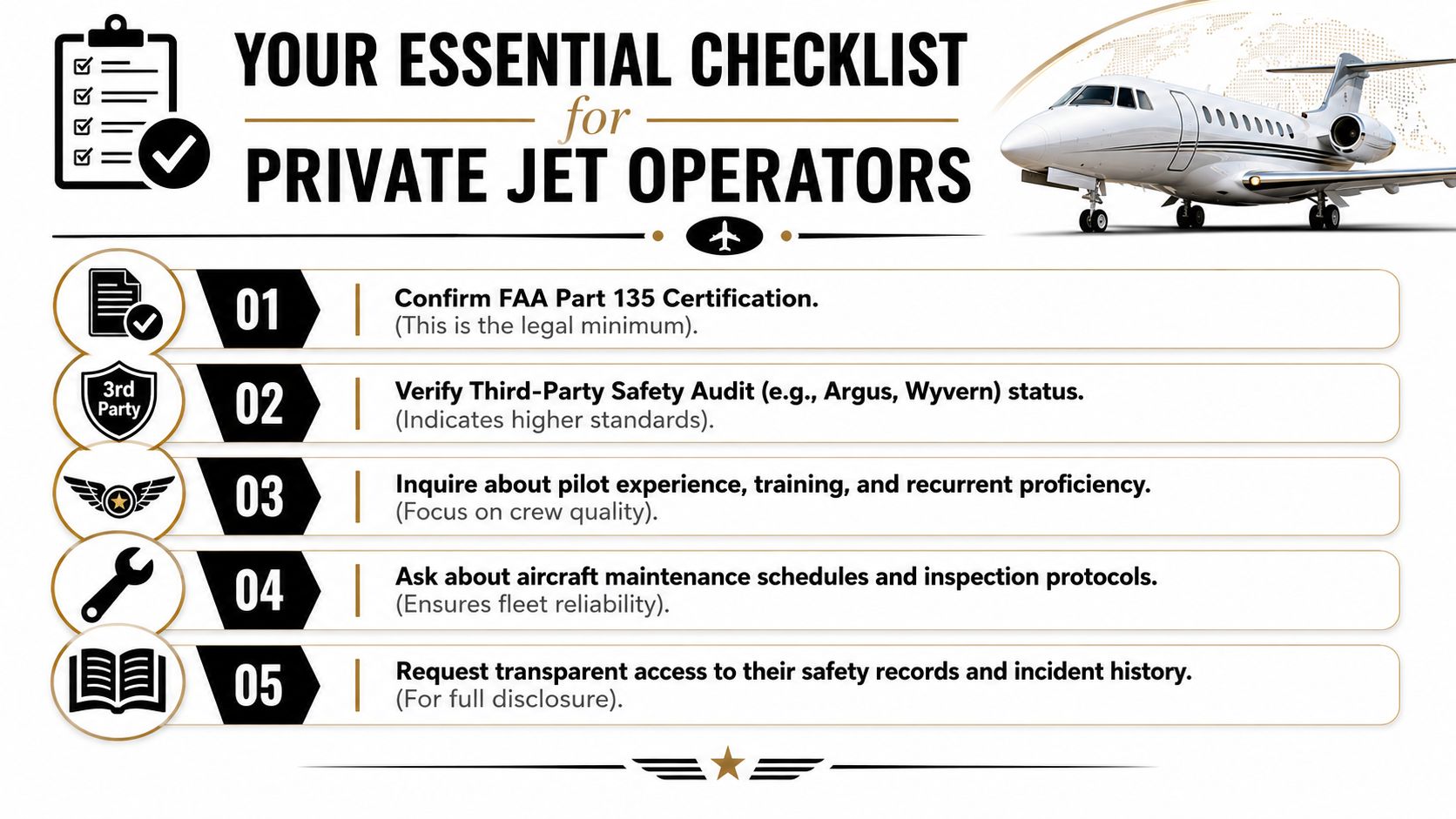
Five questions worth asking every time
Start with legal authority. Confirm the operator holds the required FAA Part 135 certification or the equivalent authority in the relevant jurisdiction. That's the legal baseline, not the final screen.
Verify the independent audit status. Ask whether the operator is Wyvern Wingman or ARGUS Gold or Platinum rated. If the answer is vague, keep digging.
Ask about the assigned crew, not just the company. You want to know that the pilots flying your trip are current, trained, and experienced on that aircraft type.
Review maintenance transparency. Ask how inspections, discrepancies, and documentation are tracked. A careful operator should be comfortable discussing process, not just offering reassurance.
Request safety visibility. Ask what information can be shared about the operator's safety records, procedures, and oversight practices.
A short script you can actually use
Many clients hesitate because they don't want to sound adversarial. You don't need to. Professional operators hear these questions all the time.
Try this:
“Before we confirm, please provide the operator's current third-party audit status, the aircraft tail number, the assigned crew details, and an outline of the operator's maintenance and safety management process.”
That one sentence will tell you a lot. Strong operators answer it calmly and specifically. Weak ones often redirect, generalize, or stall.
If you want a broader operational overview of how providers frame maintenance and reliability standards, Haute Jets also publishes a related piece on ensuring private jet safety and reliability.
Red flags that deserve caution
Not every red flag means you should cancel a trip, but each one should slow the decision down.
- Substituted aircraft with little explanation
- Unclear answers about who is operating the flight
- No independent audit mentioned
- Reluctance to identify the specific crew or tail number
- Sales language that replaces operational detail
A high-end charter experience should feel smooth. It should never feel opaque.
The Haute Jets Standard of Safety
By the time a client has worked through the checklist above, one conclusion becomes obvious. The burden isn't just finding an available aircraft. It's verifying whether the operator behind that aircraft has the records, oversight, and procedural discipline that justify your trust.
That's where screening models matter.
How the checklist applies in practice
A serious booking process should answer the client's key questions before they become friction points.
Third-party audit status. The network standard should require Wyvern Wingman or ARGUS Gold or Platinum participation rather than treating independent audits as optional.
Operator transparency. The buyer should know exactly who is conducting the flight, on what aircraft, and under whose operational control.
Crew and aircraft specificity. Safety isn't a category-level concept. It lives at the level of the actual airplane and the actual cockpit crew assigned to your itinerary.
Documented process. Reliable providers should be able to show that safety oversight isn't improvised by a salesperson on the day of departure.
What the model looks like here
On the publisher side, Haute Jets safety standards are built around operator screening that requires Wyvern Wingman or ARGUS Gold or Platinum ratings, rather than relying on basic certification alone. That approach aligns the booking process with the decision criteria informed clients already use.
It also supports one of the most practical expectations a client can have before departure. Modern safety standards mandate that operators provide full flight details, including tail number, crew bios, weather briefing, and passenger manifest, 24 hours before departure, which helps eliminate uncertainty at the terminal and gives the traveler a clear operational picture before wheels up.
Why that matters to a high-value client
The ultimate luxury in private aviation isn't only privacy, speed, or cabin comfort. It's confidence that the safety work has been done properly before you arrive at the FBO.
That confidence comes from verifiable standards, independent oversight, and operational transparency. Not from slogans. Not from assumptions. And not from confusing legal eligibility with disciplined safety performance.
When clients understand the difference between certified and effectively safe, they make better choices. They ask better questions. And they stop treating safety as a background detail when it should be one of the first filters in every charter decision.
If you want help evaluating charter options through that lens, Haute Jets provides access to on-demand private flights through operators that meet defined third-party safety audit requirements, with aircraft and pre-flight details confirmed before departure.