The primary bombardier challenger 300 cost question isn’t “What does the airplane cost?” It’s “What’s the smartest way to access this airplane without paying for waste?” That distinction matters because a Challenger 300 can be a sensible tool or an expensive vanity asset, depending on how you buy and how you book.
If you’re looking at this aircraft, you’re looking at one of the strongest super midsize platforms ever built. But the sticker price is only one layer. Acquisition, fixed overhead, hourly burn, maintenance exposure, charter structure, and repositioning all shape the final number. Most clients focus on the first number they hear. Experienced buyers focus on the total cost of access.
Understanding the Bombardier Challenger 300
More than two decades after its first flight, the Challenger 300 still sits on serious buyers’ and charter clients’ shortlists. That staying power matters. Aircraft fade fast when the cabin is compromised, the performance falls short, or the operating profile stops making financial sense.
The Challenger 300 earned its position by getting the fundamentals right. It entered service in 2004 after its 2001 first flight, and Bombardier originally brought it to market at a new-aircraft price of US$17.4 million, according to the Bombardier Challenger 300 program history. Today, its relevance comes from utility, not nostalgia.
For a current spec and cabin overview, review the Bombardier Challenger 300 aircraft page. The airplane offers true super midsize capability, including up to 3,100 nautical miles of range and a high-speed cruise of Mach 0.80. That is why it keeps showing up on transcontinental U.S. missions, high-value business trips, and family itineraries where clients want more cabin comfort than a midsize jet can provide without stepping into heavy-jet pricing.
What makes this jet work is balance.
The cabin is large enough for real productivity and comfortable enough for longer legs. The baggage capacity is useful. The platform is well known across charter operators, maintenance teams, and resale buyers, which helps protect demand and keeps the aircraft commercially relevant.
Why sophisticated clients still choose it
The Challenger 300 fits a narrow but valuable part of the market. It gives you a premium cabin experience without forcing you into the acquisition cost and trip economics of a much larger aircraft.
Here is why that matters in practice:
- Cabin comfort: Passengers feel the difference on a longer flight. A good cabin reduces travel fatigue and makes the aircraft more usable for both business and personal trips.
- Mission coverage: The jet can handle many of the city pairs that drive private aviation demand, especially domestic U.S. routes and select near-international missions.
- Strong market recognition: Charter clients ask for this aircraft by name, and that kind of demand supports both resale confidence and steady charter interest.
The Challenger 300 is a tool, not a trophy. That is exactly why it has held value in the market.
The smarter question is access, not admiration
New buyers often fixate on the airplane itself. The better question is how you plan to access it.
If you fly enough to justify full control, ownership can make sense. If you do not, the same aircraft becomes expensive fast because you are paying for crew, hangar, insurance, maintenance exposure, and downtime even when the jet is parked.
My recommendation is simple:
- Own it if you need year-round availability, operational control, and heavy annual utilization.
- Charter it if you want Challenger 300 performance without carrying fixed overhead.
- Compare both based on total annual access cost, including deadhead risk, sourcing strategy, and how your broker prices trips.
That last point gets ignored too often. The Challenger 300 can be a smart aircraft and still be an overpriced way to travel if your access model is wrong.
Challenger 300 Purchase Price A Complete Breakdown
A Challenger 300 can look like a $9 million buy and behave like a far more expensive commitment if the records, programs, and inspection findings are weak. That is how buyers overpay in this market.
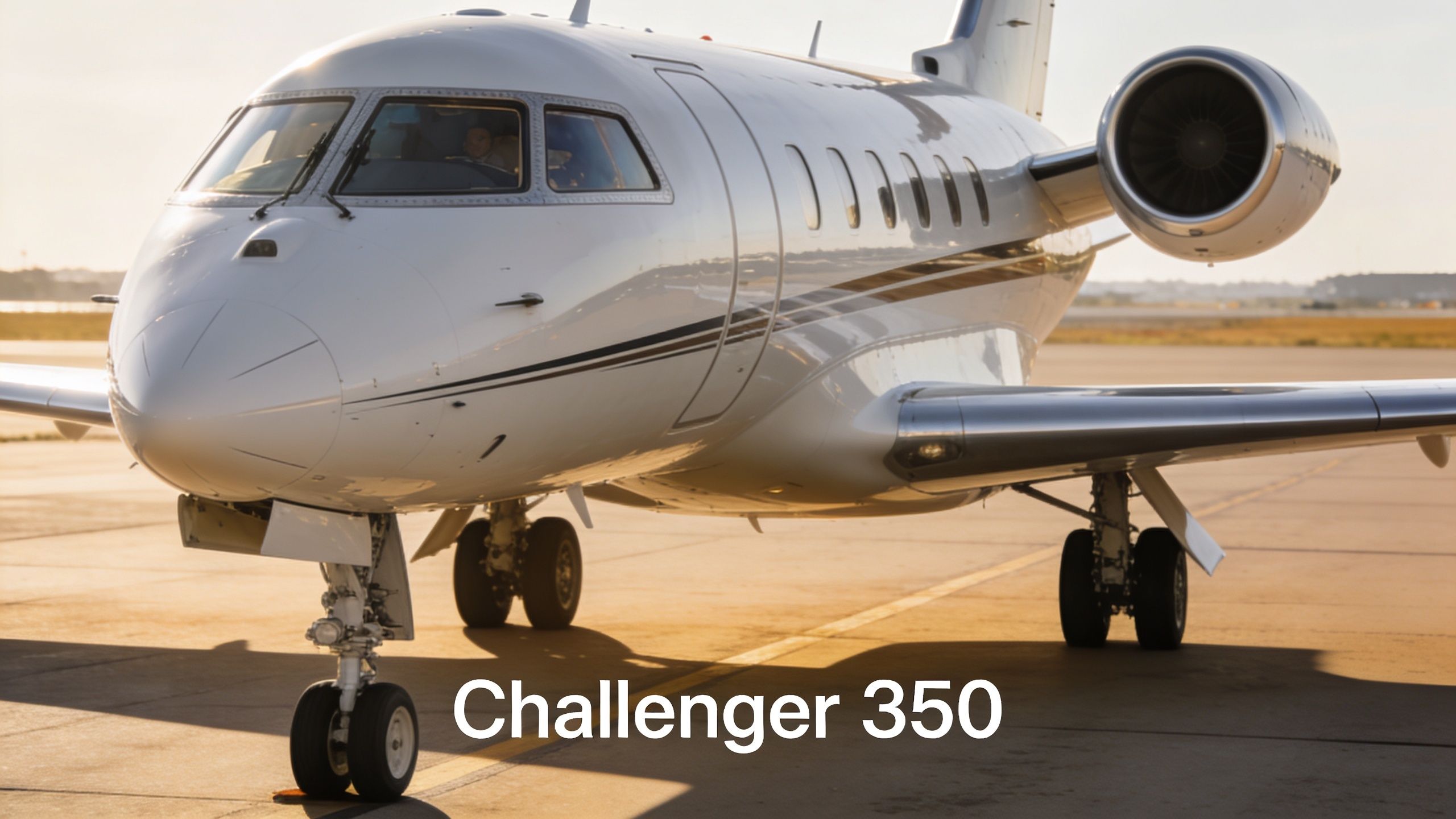
This is a pre-owned aircraft market. Pricing varies widely by year, pedigree, maintenance position, cabin condition, avionics, and enrollment in engine or airframe programs. As noted earlier, the Challenger 300 has held strong market recognition, which supports demand. It also means weaker aircraft often get listed at optimistic numbers.
What changes the purchase number
Start with maintenance history. A clean logbook, current inspections, and strong program coverage matter more than a glossy listing package.
I look at five items first:
- Airframe and engine time: Total time affects maintenance timing, marketability, and future resale.
- Inspection status: A jet approaching major events can require a large cash outlay soon after closing.
- Cabin and cosmetic condition: Interior wear hits value twice. You feel it now, and the next buyer discounts it later.
- Avionics capability: Useful upgrades support safety, dispatch flexibility, and resale. Cosmetic panel appeal does not.
- Program enrollment: Engine programs and maintenance coverage can materially change both value and first-year cash exposure.
A lower asking price often means one of these areas is weak. That does not automatically kill the deal. It changes the actual acquisition cost.
What the asking price leaves out
The wire amount is only the opening number. Serious buyers also pay for pre-buy inspections, records review, legal work, escrow, registration steps, and immediate post-closing corrections that the inspection uncovers.
That is why I tell clients to price the aircraft in two layers. First, the purchase price. Second, the cost to put the jet into service without surprises. The second number is the one that matters.
If you are actively evaluating aircraft, use a disciplined acquisition process such as Haute Jets jet acquisition support. The value is simple. It forces the deal to run on maintenance facts instead of seller presentation.
A short walk-through helps, but serious buyers should also watch a full visual review before narrowing candidates:
Buyer rule: Negotiate from inspection findings, records quality, and maintenance timing. Do not negotiate from the listing sheet.
My recommendation on buying
Buy the cleanest Challenger 300 you can verify, even if it costs more upfront. The cheapest tail number on paper often becomes the most expensive path to access once you fund deferred maintenance, downtime, and early capital events.
And be honest about whether buying is even the right move. If your real goal is Challenger 300 access, not full control of one serial number, compare ownership against charter on total annual spend. A modern local-sourcing charter model often gives you the same cabin class with less capital at risk and better trip-by-trip cost control.
Annual Operating Costs for Owners
A Challenger 300 can burn through well over seven figures a year before you factor in financing, tax strategy, or resale exposure. That is a fundamental ownership test.
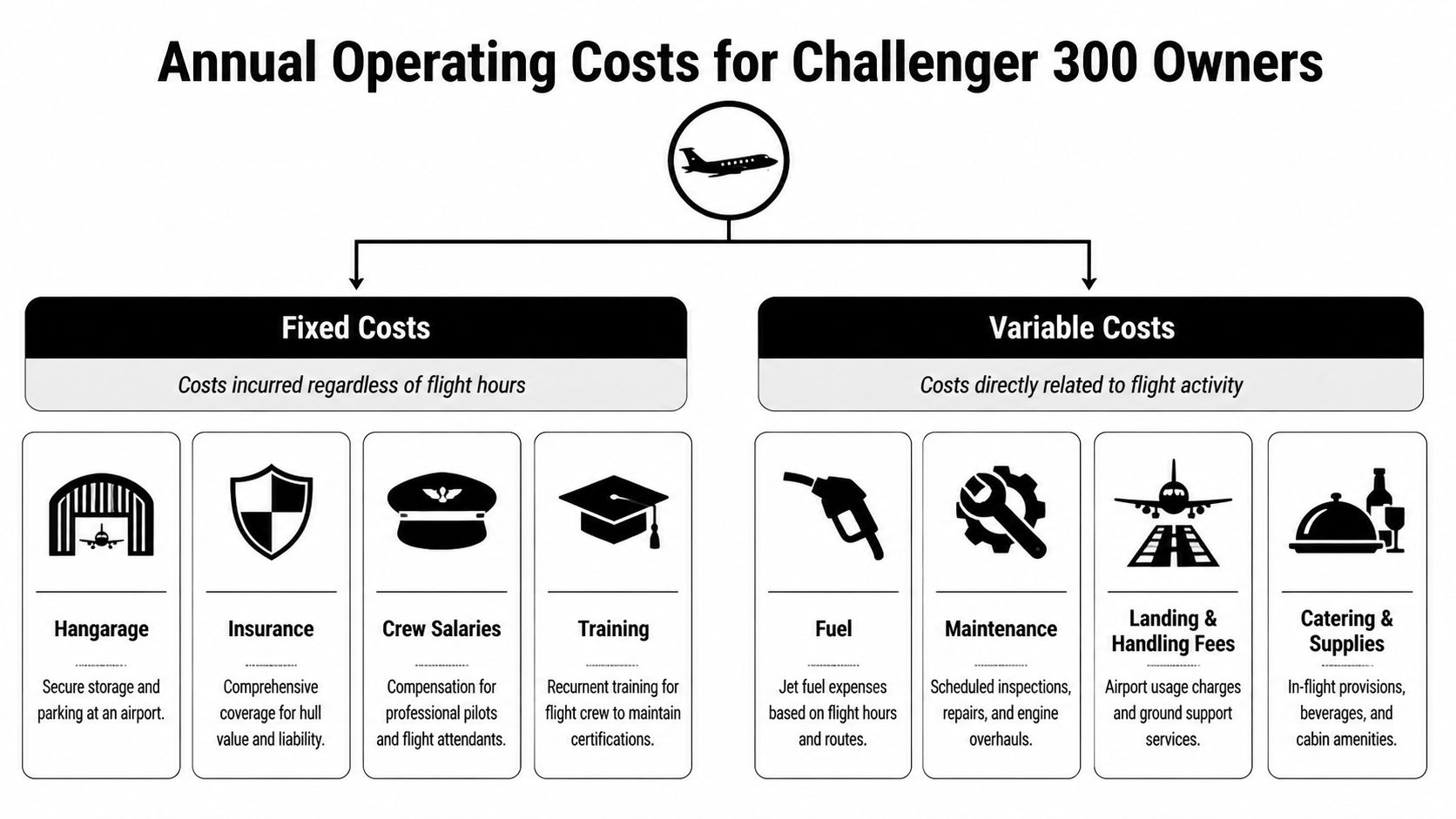
The annual budget has two buckets. Fixed costs hit whether the aircraft flies or not. Variable costs rise with every hour, cycle, and trip. Buyers who focus only on the acquisition price usually miss how quickly the fixed side resets their true cost of access.
According to BJT’s Challenger 300 operating cost addendum, the aircraft carries hourly direct operating costs of about $3,370, including roughly $1,983 in fuel, with annual fixed costs listed at $581,853 and a total annual budget of about $1.99 million at 418 hours.
Fixed costs set your floor
If the airplane leaves the hangar rarely, ownership gets inefficient fast.
Your fixed budget usually includes crew payroll, recurrent training, hangar, insurance, management, subscriptions, and scheduled administrative overhead. These costs do not wait for flying activity. They arrive every month, and they are the reason occasional flyers almost always overpay by owning.
That matters more than many buyers expect. A jet flown lightly can look acceptable on a spreadsheet built around prestige or convenience. It looks much worse when you divide the full annual spend by actual occupied hours.
Variable costs punish casual math
Fuel gets the attention, but it is not the whole picture. Variable spend also includes maintenance reserves, parts wear, engine program exposure, consumables, landing fees, navigation charges, and the operating impact of how the aircraft is flown.
Aircraft Cost Calculator outlines the same pattern in its Challenger 300 operating cost profile. Annual ownership costs rise sharply as utilization increases, even if the cost per hour improves.
That distinction matters. Higher use can make ownership more efficient on a unit basis. It still increases total cash out the door.
What owners should ask instead
Do not ask, “What does this jet cost per hour?” Ask, “What is my total annual cost to get Challenger 300 access, and how often will I use it?”
That is the smarter framework.
If your travel pattern is irregular, concentrated around peak dates, or split across multiple departure cities, ownership usually becomes the expensive answer. You are carrying a full-time asset to solve a part-time access need. For many clients, private jet charter flight cost planning produces a cleaner answer because it ties spend to trips instead of idle time, payroll, and capital tied up in one tail number.
My recommendation on the ownership math
Buy only if you need consistent annual lift, control over aircraft availability, and enough utilization to justify the fixed burn. If you do not meet that profile, keep your capital liquid and buy access trip by trip.
That is the part traditional ownership discussions often avoid. The cheapest way to get Challenger 300 capability is rarely owning one lightly. It is usually sourcing the right aircraft for each mission through a brokerage model that shops locally, limits repositioning waste, and prices the trip around actual market availability instead of forcing you to carry a permanent annual cost base.
On-Demand Challenger 300 Charter Rates
A single Challenger 300 charter can spare you seven figures of capital outlay and a full year of fixed carrying costs. That is the right starting point, because the fundamental question is not what the aircraft costs to own. It is what it costs to access the aircraft only when the trip justifies it.
On-demand charter pricing for a Challenger 300 usually starts in the mid-thousands per flight hour and climbs based on how the aircraft is sourced, where it sits before departure, and how efficiently the itinerary is built. Treat any hourly figure as a screening tool, not a final answer. Clients get into trouble when they compare jets by headline hourly rate and ignore repositioning, minimums, overnight crew expense, peak-day pressure, and airport-specific fees.
What you are actually paying for
A charter quote covers far more than time in the air. You are buying aircraft availability for your schedule, a current crew, operating certificates, insurance, trip planning, and the ability to solve one mission without carrying the fixed burden of a full-time asset.
That is why two Challenger 300 quotes for the same city pair can land far apart.
If one aircraft is already near your departure airport, the price is usually sharper. If the jet has to ferry in from another market, your cost rises fast. Traditional brokers often bury that inefficiency inside a single quote. A better model exposes it and works to remove it.
Practical budgeting examples
Use these ranges for planning only. Final pricing depends on the actual aircraft position and trip structure.
| Route | Flight Time (approx.) | Estimated Cost |
|---|---|---|
| New York to Miami | Approx. 3 hours | Mid-five figures |
| Los Angeles to Las Vegas | Approx. 1 hour | High-four figures to low-five figures |
| New York to London | Approx. 7 hours | Upper-five figures and up |
Those examples show why the Challenger 300 remains such a popular charter aircraft. It gives clients transcontinental capability, a stand-up cabin, strong baggage capacity, and a cabin experience that feels materially better than light-jet travel, without forcing every trip into heavy-jet pricing.
If you want a broader framework for trip pricing, read this guide to private jet charter flight costs.
Where clients overspend
The largest pricing mistake is paying for the wrong sourcing model.
A traditional national broker may quote a Challenger 300 from a distant operator because that is the inventory relationship they already control. You still get the airplane, but you also pay for unnecessary ferry time and weaker market competition. That is avoidable.
The smarter move is local sourcing. Start with operators and aircraft already positioned near your departure point, then compare real options for that exact mission. This cuts deadhead exposure, reduces timing friction, and often produces a better aircraft at a lower total trip price.
My recommendation
Use on-demand charter if your travel pattern changes by month, by city, or by passenger count. That describes many high-net-worth flyers.
Buy access, not a standing cost base, unless you need year-round control of the same aircraft. And when you charter, insist on a brokerage model that sources locally and shows you why one aircraft costs more than another. That is how you reduce Challenger 300 charter spend without sacrificing safety, comfort, or schedule control.
Key Variables That Influence Your Final Cost
The bombadier challenger 300 cost discussion goes wrong when people treat it like a fixed menu. It isn’t. Final cost changes because the mission changes, the aircraft changes, and the booking structure changes.
Aircraft condition and configuration
For buyers, two Challenger 300s can sit in the same advertised market band and still have very different economic profiles. Maintenance status, cabin freshness, records quality, and installed equipment shape both present cost and future resale. A cleaner aircraft usually commands more for a reason.
For charter clients, age and configuration affect appeal. A newer-feeling interior, stronger connectivity, and a cleaner maintenance pedigree often make one aircraft easier to place than another.
Route logic and airport choice
Airport selection matters. A major airport may fit your schedule, but a nearby alternative can improve the trip flow and sometimes reduce friction around handling, timing, and aircraft availability.
Flight time also matters more than straight-line distance. A route that looks simple on a map can quote differently depending on operating conditions, departure timing, and the exact aircraft position before your trip.
Demand timing changes everything
Seasonality shows up fast in private aviation. Holiday periods, event weeks, and destination surges compress availability. The same aircraft category can feel straightforward one week and tight the next.
Clients who book early usually preserve more choice. Clients who stay flexible on departure windows and airport pairings usually obtain more favorable options.
The hidden variable most people miss
The biggest pricing swing in charter is often not the jet itself. It’s whether you’re paying for someone else’s empty movement.
- Repositioning exposure: If the airplane has to come to you, that empty leg usually lands on your invoice.
- Operator location: Locally based aircraft create cleaner economics.
- Broker transparency: If you can’t see how the aircraft is being sourced, you can’t judge whether the quote is efficient.
That’s why experienced clients ask how the aircraft is being placed, not just what the hourly rate is.
How The Haute Jets Model Reduces Charter Costs
Most charter clients overpay in one predictable way. They accept a quote that includes aircraft repositioning they didn’t ask for and often didn’t even realize they were funding.
That’s the problem with the traditional opaque brokerage model. A broker finds an available jet. The jet isn’t local. The jet flies empty to your departure point. You pay for the convenience gap.
According to Haute Jets’ operating model overview, sourcing from a network of local owner-operators eliminates repositioning fees that inflate traditional charter prices by 20 to 40 percent. The same model also supports pet-friendly arrangements and Bitcoin payment options for global flights.
Why local sourcing changes the economics
This is the part clients should care about most. Local sourcing doesn’t just sound efficient. It directly attacks one of the biggest avoidable costs in private aviation.
- Less empty flying: Fewer non-revenue legs means fewer costs passed through to you.
- More pricing clarity: You can evaluate a trip based on the mission, not on a hidden ferry segment.
- Better fit for one-way travel: One-way charters become more rational when the aircraft is already near your departure point.
Why this matters for Challenger 300 bookings
The Challenger 300 is popular enough that access often comes down to sourcing quality, not just category availability. If a broker is grabbing whichever tail is open, you can end up paying a premium for laziness.
A smarter model matches the mission to an aircraft that’s geographically sensible, safety-vetted, and configured for the client’s actual needs. That includes pet travel, cabin preferences, and modern payment flexibility.
Pay for your trip. Don’t pay for avoidable deadhead unless it’s unavoidable and disclosed.
My recommendation is blunt. Before accepting any Challenger 300 quote, ask whether the aircraft is locally based or repositioning in. If the answer is vague, the price probably is too.
Questions to Ask Before Booking Your Challenger 300
A polished quote doesn’t guarantee a clean booking. Ask sharper questions and you’ll avoid most of the expensive surprises.
The checklist I’d use
Is this an all-in quote?
Ask whether the quote is fully inclusive or whether additional operational items may still be added later.What exact aircraft am I getting?
You want the tail number, year, and cabin configuration, not just “Challenger 300 category.”Is the aircraft local or repositioning?
This tells you whether you’re absorbing unnecessary ferry cost.What are the operator’s safety credentials?
Confirm Wyvern or Argus status clearly.What’s the cabin setup and current condition?
Ask about refurbishment status, Wi-Fi availability, baggage practicality, and any cabin-specific limitations.What’s the pet policy?
If you’re flying with animals, confirm it before you commit. Never assume.What payment methods are accepted?
If you want wire flexibility or digital asset payment, ask upfront.
The answer quality matters as much as the answer
A serious provider gives direct answers quickly. If someone dances around the aircraft identity, operator standards, or repositioning logic, move on.
A clean charter process feels precise. If the quote feels slippery, the trip probably will too.
The Challenger 300 remains one of the smartest aircraft in its class. But the smartest decision isn’t always buying one. For many clients, it’s booking the right aircraft, for the right mission, through a model that strips out avoidable cost.
If you want a clear Challenger 300 quote without memberships or prepaid programs, Haute Jets can help you compare the actual cost of access against traditional charter structures and avoid paying for unnecessary repositioning.