
Catering costs per person most often fall between $60 and $200, and the all-in price is driven by service style and staffing as much as by food. If the first quote you've got looks tidy on paper but ugly in the total, that's because you're probably looking at a menu number, not the full event number.
You're likely at the stage where the guest list is close, the venue's locked, and the catering proposal looks reasonable until the fine print starts adding up. That's normal. The mistake is treating catering like a grocery bill when it's really a bundled production cost, with food, labor, rentals, logistics, overhead, and service charges all moving together.
What Drives Catering Costs Per Person
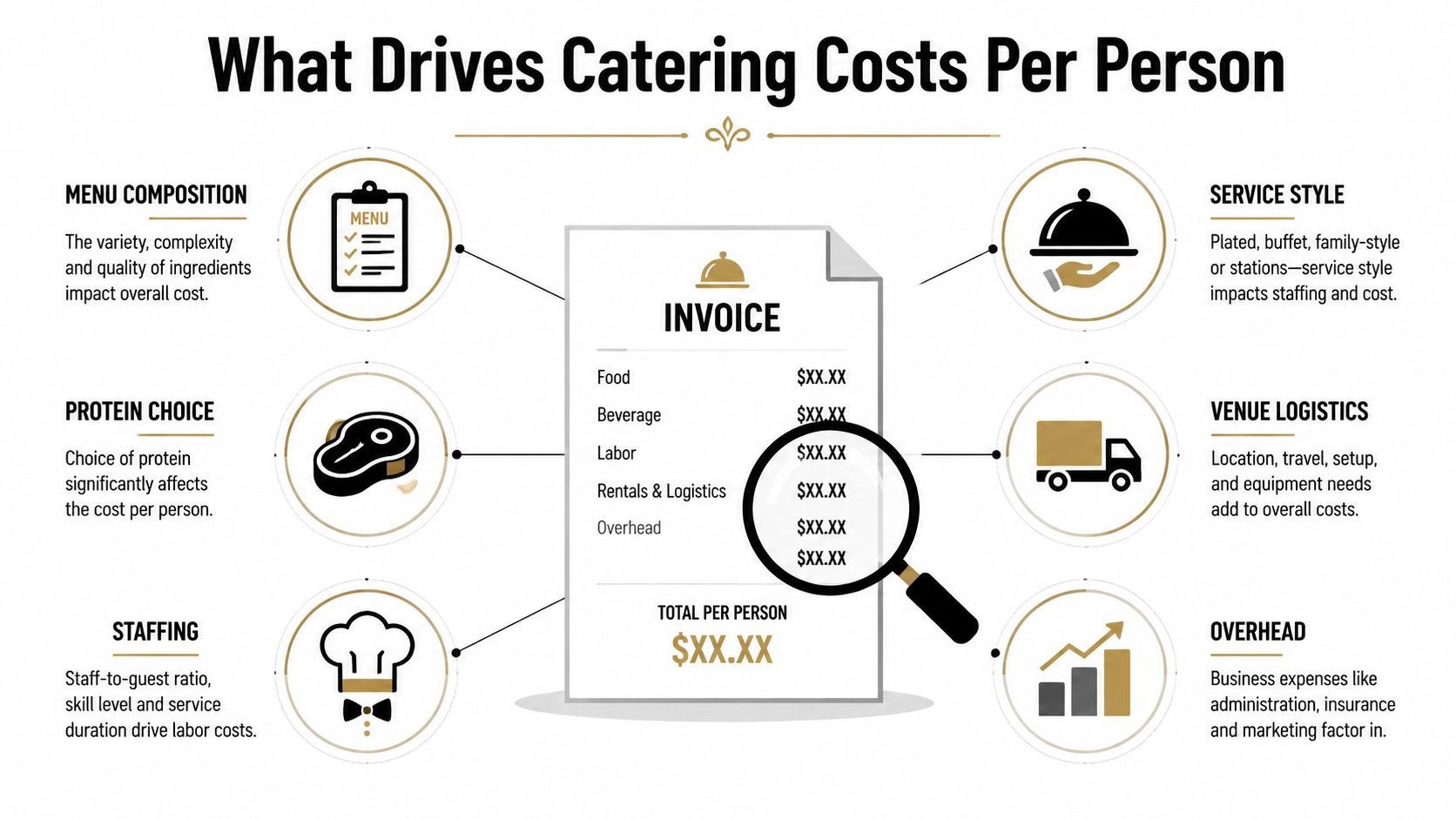
The number you get from a caterer only makes sense if you know what's inside it. I treat catering costs per person as a fully loaded unit rate, meaning the quote should reflect food, packaging, labor, rentals, delivery, overhead, and margin divided by guest count. That is the only way to compare proposals fairly.
Start With the right question
Don't ask whether a quote is “expensive.” Ask what it includes, what it excludes, and what changes the final invoice. A plated dinner with a dedicated team, real china, and venue coordination is a different product from drop-off trays on disposable serviceware. The pricing gap is not random, it's the cost of execution.
The most useful mindset is to think like a producer, not a diner. A guest count helps, but it doesn't tell you how many servers, how much equipment, or how much kitchen time the event needs. That's why two events with the same headcount can land in very different spend bands.
Practical rule: If a caterer won't explain the rate as food plus labor plus rentals plus overhead, you're not getting a real comparison.
For a luxury benchmark outside the usual banquet world, private chef cost French Riviera is a useful point of reference because it shows how service level changes the economics fast.
Read the quote as a production budget
The quote is not just a menu. It's a staffing plan, a logistics plan, and a risk plan. A company that brings in cooks, servers, equipment, and backup for last-minute issues is charging for the ability to keep the night smooth.
That's why the same menu can price differently depending on venue access, event timing, and presentation. A rooftop dinner, a museum buyout, and a hotel ballroom all create different labor profiles. The food may be identical, but the job is not.
The infographic above is the right way to picture it, center invoice, then branch out into the drivers that push the number up or down. Keep that model in mind as you compare service styles, cost drivers, and sample budgets below.
Service Styles and Their Price Ranges
Service style is where catering budgets either stay sane or blow up. The food itself matters, but the delivery format often decides whether you're paying for trays and transport or for a whole production crew. The market data backs that up clearly, with boxed meals at the low end and plated or multi-course service at the top end.
The broad bands
For corporate work, a corporate lunch averages $20 per person, while breakfast averages $17, snacks $16, happy hour $19, dinner $21, and dessert $8 according to a 2025 roundup citing CaterCow data (corporate catering pricing breakdown). That's the practical baseline for working events.
Once you move into service-heavy formats, the numbers climb. Boxed or individual meals run $15 to $25 per person, buffets $25 to $50, food trucks $20 to $40, food stations $30 to $60, and plated sit-down catering $50 to $120 per person in the same roundup (corporate catering pricing breakdown). Thumbtack's 2025 pricing page pushes the formal end even higher, showing a buffet or family-style meal at $25 per person and a formal plated meal at $145 per person (formal and buffet catering costs).
Bark's 2025 guide sits in the same zone, but it is especially useful for premium event planning. It places table service meals at $40 to $200 per head, buffets at $40 to $180 per head, and all-day events with several courses at $160 to $300 per head (premium catering pricing ranges). That's the lane for galas, long-format brand events, and luxury dinners that need more than one culinary moment.
| Service Style | Typical Per-Person Range | Staffing Ratio |
|---|---|---|
| Boxed or individual meals | $15 to $25 | Lower-touch, minimal on-site service |
| Buffet or family-style | $25 to $50 | Moderate staffing, self-service or light support |
| Food stations or interactive service | $30 to $60 | Higher staffing, more setup |
| Plated sit-down service | $50 to $120, and up to $145 in some formal quotes | Highest staffing and coordination |
| All-day or multi-course formats | $160 to $300 | Heavy staffing and extended service hours |
What the spread really means
The gap between a boxed lunch and a plated dinner is not just nicer food. It's the difference between one delivery drop and a staged service operation with timing, sequencing, and more people in the room. Thumbtack's spread from $25 to $145 per person is the clearest proof that service style drives cost at least as much as menu content (formal and buffet catering costs).
For planners, the recommendation is blunt. If your event doesn't need synchronized plating, don't buy it. If it does need that level of presentation, stop pretending it should price like a lunch drop-off. That's not negotiation, it's denial.
Breaking Down the Real Cost Drivers
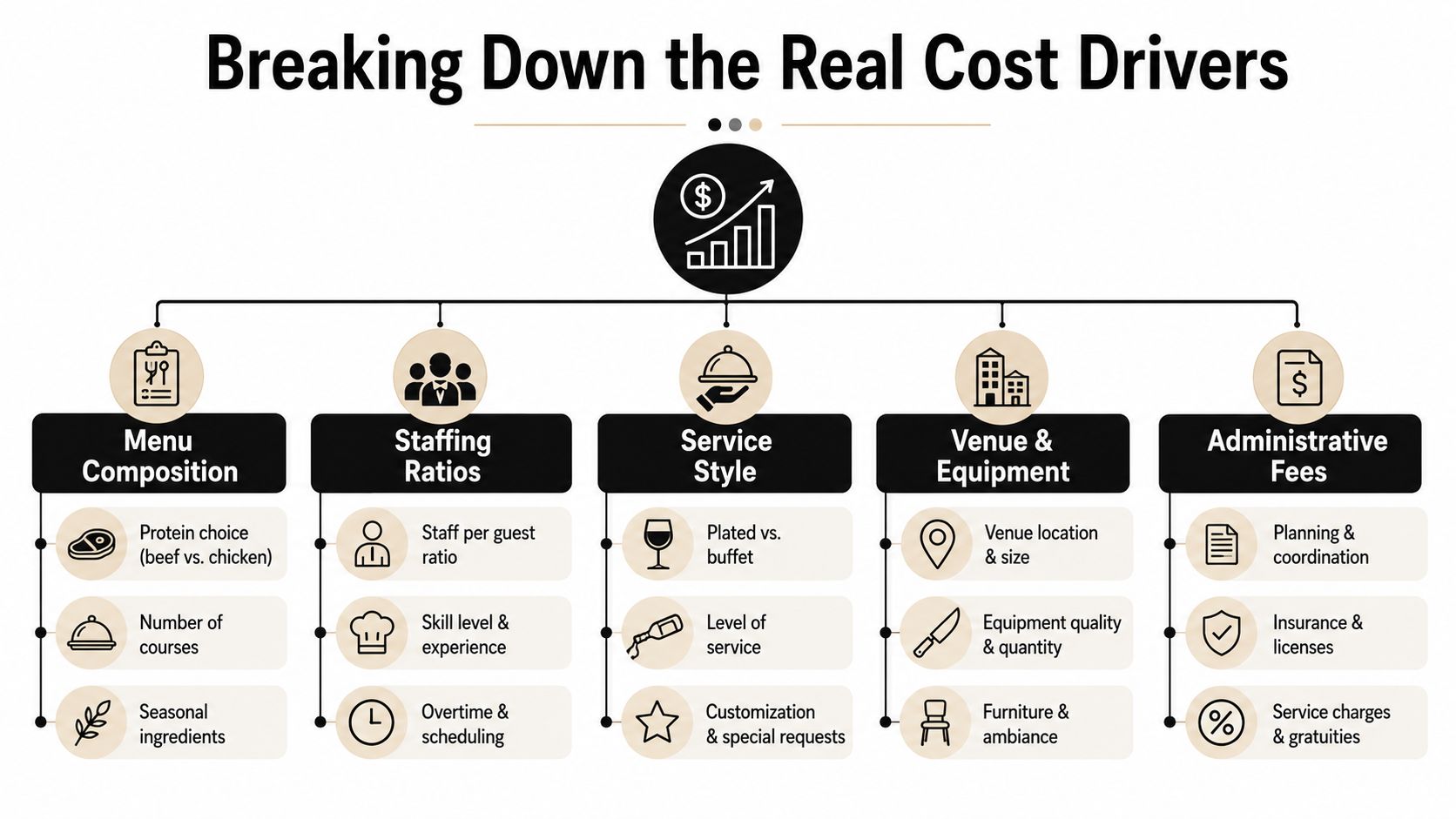
The bill starts with the menu, then gets heavier with labor, rentals, and logistics. A caterer pricing correctly is not guessing at a nice-looking number, they're loading each line item into a unit rate and then dividing by the guest count. Dish Track describes that formula directly as food + packaging + labor + rentals + delivery + overhead ÷ guest count, with a 5% to 10% waste buffer added before the division (catering pricing calculator method).
Menu composition is the first lever
Protein choice is where a lot of proposals jump. If your menu moves from chicken or vegetarian to beef tenderloin, lobster, or specialty seafood, the per-head number rises fast because ingredient cost and prep complexity both increase. That's true in every market I've worked in.
The mistake is building the menu around one prestige item and then acting surprised when the total shifts. A smarter approach is to anchor the menu with one premium element and let the rest of the plate stay disciplined. The food still feels refined, but the quote stays defensible.
Staffing changes the math more than people expect
Service style changes staffing ratios, and staffing changes cost. Plated service needs more hands in the room than buffet service, and all-day formats extend those labor hours further. Dish Cost notes that plated service often runs at roughly 1 server per 10 to 12 guests, while buffet service can be closer to 1 per 20 (catering price calculator guidance).
That difference matters because labor isn't a soft cost. It's a hard cost tied to setup, service pace, cleanup, and overtime risk. If a quote hides staffing detail, ask for it. You're buying people as much as food.
Rentals, venue access, and geography all move the total
Tables, chairs, linens, glassware, flatware, china, and chafers can all be part of the bill if the venue isn't fully equipped. Load-in distance, stair carries, restricted access, and parking also matter because they increase labor. And the same menu can price differently in a market with higher labor and transportation costs.
If you need a practical rental reference, it helps to compare catering equipment rental before you accept a quote that bundles equipment without explanation.
Timing and overhead are never free
Saturday nights cost more than weekday lunches because the kitchen, staff, and delivery window are under more pressure. Administrative fees and margin are also part of the quote, and they should be. The issue isn't that they exist, it's whether they're disclosed clearly.
Bottom line: The fastest way to cut cost is to reduce service complexity, not to nickel-and-dime the food.
Sample Budgets for Common Event Sizes
A useful budget is one you can sanity-check before you ask for proposals. For that, you need a working number for the event size and the service style, not a fantasy menu quote. The right comparison is small private dinner, mid-size corporate function, and large-scale gala or wedding.
A 50-guest private dinner
For a 50-guest event, Thumbtack shows a total catering bill can land between $1,250 and $7,250, depending on whether you're using buffet-style service or formal plated service (formal and buffet catering costs). That range is exactly why the service format has to be locked before anyone takes your money.
A budget-tier version looks like this. Boxed or buffet-style food, limited staffing, minimal rentals, and a simple beverage setup. That keeps the event in working-event territory, which is useful if the room itself does the heavy lifting.
A luxury-tier version is a seated dinner with proper plating, polished rentals, and a bar program that feels intentional. You are no longer paying for food alone, you're paying for sequence, timing, and atmosphere. If the guest list is small but the expectations are high, the per-head number can climb very fast.
A 150-guest corporate reception
Corporate pricing gives the cleanest planning baseline. A working lunch benchmarks around $20 per person, with breakfast, snacks, happy hour, dinner, and dessert all sitting in clearly lower or higher lanes depending on format (corporate catering pricing breakdown). For a 150-person reception, that tells you where the floor sits before you add polish.
The budget version is usually boxed or buffet service, light bar service, and standard setup. That works for product launches, internal celebrations, and client events where the priority is clean execution, not theatrical dining. It's the sensible choice when you need volume and control.
The luxury version is different. Think passed canapés, stations, fuller bar service, more staff, and better rentals. That's where the cost starts to reflect guest experience, not just feeding people. If the event is client-facing, that spend can be justified easily.
A 400-guest gala or wedding
Wedding data gives the clearest market benchmark. The Knot's 2024 internal data puts the average wedding catering cost at $80 per person, down from $85 in 2023, and notes a spread from $62 to $123 per person depending on market and service level (average wedding catering cost). That's a mainstream U.S. baseline, not a luxury outlier.
A 400-guest gala or wedding rarely stays at that average for long if the format becomes formal. Bark's range of $160 to $300 per head for all-day events with several courses shows how quickly a large event can move into premium territory when service is extended (premium catering pricing ranges). If you're planning an elegant seated event, that is the honest ceiling to keep in mind.
For a styling reference on menu presentation and pricing structure, wedding menus with prices guide is a useful companion when you're comparing inclusions across proposals.
The Haute Jets private jet charter cost page is also a good analogy for planners used to buying premium service by the unit, because it treats the total experience as a structured quote rather than a single line item, and that's the same mindset you need here.
Hidden Fees and Contract Traps to Watch For
The quoted per-person rate is often only the first layer. The final invoice gets heavier when service charges, taxes, overtime, rentals, and event-specific surcharges get applied on top. Dish Cost says caterers commonly add 18% to 22% in service charges, then layer tax on top of that structure, which means the menu number is rarely the number you pay (catering price calculator details).
The items that quietly inflate the bill
A few charges deserve your immediate attention.
- Service charge and gratuity: Ask whether it's a company fee, a staff payment, or both. Don't assume it's the same thing as a tip.
- Overtime: If the event runs long, staff time usually keeps billing.
- Cake-cutting and plating: Small on paper, annoying in aggregate.
- Rental markup: Tables, chairs, glassware, and china can be passed through at a premium.
- Venue logistics fees: Long carries, stairs, security rules, and loading limits all affect labor.
- Administrative surcharges: Coordination, planning, and order management often sit here.
The contract language matters more than the marketing deck. If the proposal doesn't clearly state what happens when the guest count changes, the event runs long, or the venue blocks easy access, you're accepting risk without pricing it. That's a bad deal.
What to demand before signing
Ask for the all-in per-person number, not the menu number.
That single request forces the caterer to disclose the structure. It also helps you compare two proposals that may look similar but aren't remotely the same once staffing and rentals are included. A lower food quote with a heavier fee stack can easily cost more than a higher food quote with fewer add-ons.
You should also confirm whether the service charge is calculated before or after rentals, bar service, and labor. That detail changes the final invoice more than many expect. If the caterer can't answer cleanly, keep shopping.
Negotiation Tactics That Actually Work
Good negotiation in catering is about changing the structure, not just pushing the price down. The caterer already knows the cost floor. Your job is to decide which parts of the floor matter and which parts don't.
The first move is to negotiate food-cost logic, not just the menu title. Ask what protein swap, course reduction, or garnish simplification does to the per-head rate. That conversation gets real fast because it forces the planner and the caterer to talk about labor and ingredient cost instead of vague prestige.
The second move is to ask for a staffing ratio breakdown. If plated service requires more people, the caterer should tell you how many and for how long. That's where you can decide whether a buffet or family-style format makes more sense without sacrificing the guest experience.
The third move is bar control. If alcohol is part of the event, ask whether the house will price by package or by consumption. Consumption pricing is often more honest for smaller corporate receptions and private dinners because you're not prepaying for volume you won't use.
The Haute Jets Journal audience already knows this logic from private jet charter for business corporate teams 2026, where service is priced by structure, timing, and operational fit rather than a single headline number.
My rule: Flexibility on date and format buys leverage. Demanding Saturday-night perfection at peak season buys sticker shock.
The last move is to use minimums strategically. If a caterer has a floor, decide whether you can meet it with better bar service, a stronger menu, or a slightly different guest count. That works when you're already close to the threshold. It doesn't work when you're trying to force a small event into a large-event operation.
Pre-Booking Checklist for HNW and Corporate Events
Before you sign anything, make the caterer answer these points in plain language. If they can't, they're not ready for your event.
Your booking checklist
- Define the service style. Plated, buffet, family-style, stations, or drop-off.
- Confirm the staffing ratio. Ask exactly how many servers, bartenders, and kitchen staff are included, and for how many hours.
- Get a detailed quote. Food, bar, staffing, equipment, delivery, rentals, and admin should be separated.
- Verify dietary accommodations. Allergens, religious needs, vegan menus, gluten-free service, and wellness positioning all change the build.
- Review contract terms. Cancellation, overtime, minimums, and guest-count deadlines need to be explicit.
The reason this checklist matters is simple. It keeps the event from drifting into expensive assumptions. A quote that looks elegant but hides rentals or staffing is not elegant at all, it's incomplete.
For corporate or travel-facing planners, the same disciplined approach shows up in private jet catering the ultimate guide to in-flight dining, where service level and presentation drive the per-head number just as strongly as ingredients do.
Use the checklist against the sample budgets above, then test it against the hidden-fee list. If a caterer gives you a clean all-in rate, clear staffing, and a contract that names the overtime rules, you've probably found a real operator. If not, keep moving.
Haute Jets works with clients who expect precise service and no surprises, and that same standard applies when you're planning premium catering for a private dinner, corporate reception, or gala. If you want a team that understands how to coordinate luxury logistics at the same level as the event itself, visit Haute Jets and start the conversation.