
Catering for private jets is already a USD 6.619 billion market in 2024, and it's projected to reach USD 14.08 billion by 2031. For most flights, the core pricing anchor is $300 to $800 per passenger, with short hops lower and long-range luxury service climbing fast depending on the aircraft, the menu, and how custom the order gets.
That's why this topic isn't about pretty food pictures. It's about whether the meal makes it onto the aircraft in the right packaging, at the right temperature, with the right crew briefing, and without a last-minute scramble at the FBO. If you get the logistics wrong, even an expensive order turns into a compromise. If you get them right, the catering disappears into the flight as it should.
Why Catering for Private Jets Is a Real Operational Category
Private jet catering runs on operations, not on inspiration. The market is large enough to prove the point, with one industry estimate placing it at USD 6.619 billion in 2024 and projecting USD 14.08 billion by 2031 with a 13.1% CAGR. That kind of growth is what you see when buyers need a service that works under pressure, not just a prettier tray in the cabin. Source
The price spread is just as telling. One market report puts full meal service on long-range flights at $500 to $800 per passenger, with ultra-luxury requests going beyond $1,200 per person when the order calls for Michelin-trained chefs or heavy customization. The same report also places short-haul meals closer to $300 to $500 per passenger and says special dietary or custom menu work can add 15% to 25% to the base price. Source
What you're really paying for
You are paying for sourcing, timing, packaging, handoff, and food that still makes sense after it has crossed a tight logistics chain. That chain is fragile. The menu can look perfect on paper and still fail if the airport kitchen cannot source the item, the FBO cannot receive it cleanly, or the crew does not get a proper briefing before departure. For a plain explanation of what the FBO does in that handoff, see this guide to FBO meaning in aviation.
Pricing also shifts by region. In the U.S., catering is often treated as an extra cost. In parts of Europe, it is more likely to be bundled into the charter rate, so the same request can look reasonable on one itinerary and expensive on another. If you compare quotes, compare what is included, not just the menu line items.
Practical rule: order early, ask for fewer special substitutions, and keep the menu close to what the airport can source fast. Rushing the order usually creates the bill you did not want.
The work starts long before wheels-up. Passengers give preferences, the menu gets approved, the order gets confirmed with the crew and caterer, then the food goes to the FBO for last-mile handoff before onboard service. That is why the topic matters to operators and to anyone launching a catering venture, because private jet food is a logistics business first and a hospitality business second. 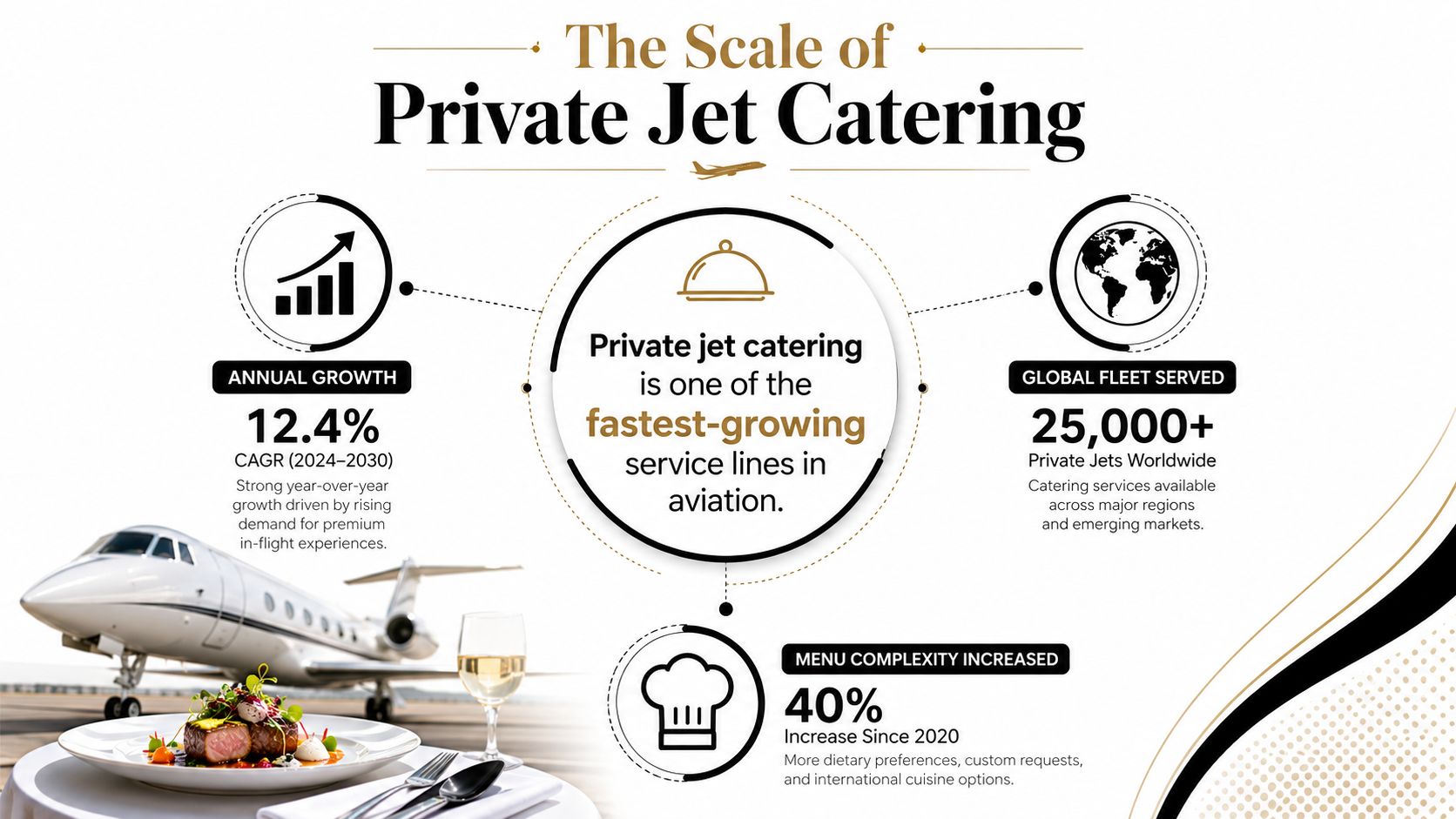
Choosing Where to Source Your Catering
There are three real sourcing paths, and each one solves a different problem. If you pick the wrong one, the menu may be fine on paper and weak in the cabin. The right choice depends on airport infrastructure, flight length, and how much customization you need.
FBO catering is the speed play
FBO in-house catering is the fastest option because the food is already close to the aircraft. It's the cleanest answer for a short-notice domestic hop, especially when the passenger count is stable and the request is straightforward. The downside is obvious, the menu can be limited, and the moment you ask for something unusually specific, the sourcing window tightens.
Local restaurant caterers bring more character
Local restaurant caterers are the better fit when you want regional flavor or a stronger culinary identity. They can usually handle more interesting dishes than an FBO kitchen, and they're often the right choice for departure cities with strong dining scenes. The trade-off is coordination, because the food still has to survive the handoff to the airport and the final run to the aircraft.
Specialist provisioners handle complexity
Specialist onboard provisioners are the right call for special-occasion flights, complex dietary work, and itineraries where presentation matters as much as taste. They live in the detail, which is exactly what you want when a flight involves multiple service points, strict dietary rules, or an international itinerary with tight timing.
If you're comparing the business model behind this niche, launching a catering venture shows how much coordination and planning the sector really demands before a single plate reaches an aircraft.
A professional charter operation should remove the sourcing guesswork before departure. Haute Jets, for example, confirms catering capability during the pre-flight window and checks the other moving parts at the same time, which matters because a great menu is useless if the airport can't support it. For a clear primer on that airport layer, see the FBO guide for private jet travelers.
Pick the source based on mission, not ego. Short-notice hop, go local to the airport. Special event, use a specialist. Regional menu, use a caterer who understands both the city and the aircraft.
When to Order and How Lead Time Affects What You Can Get
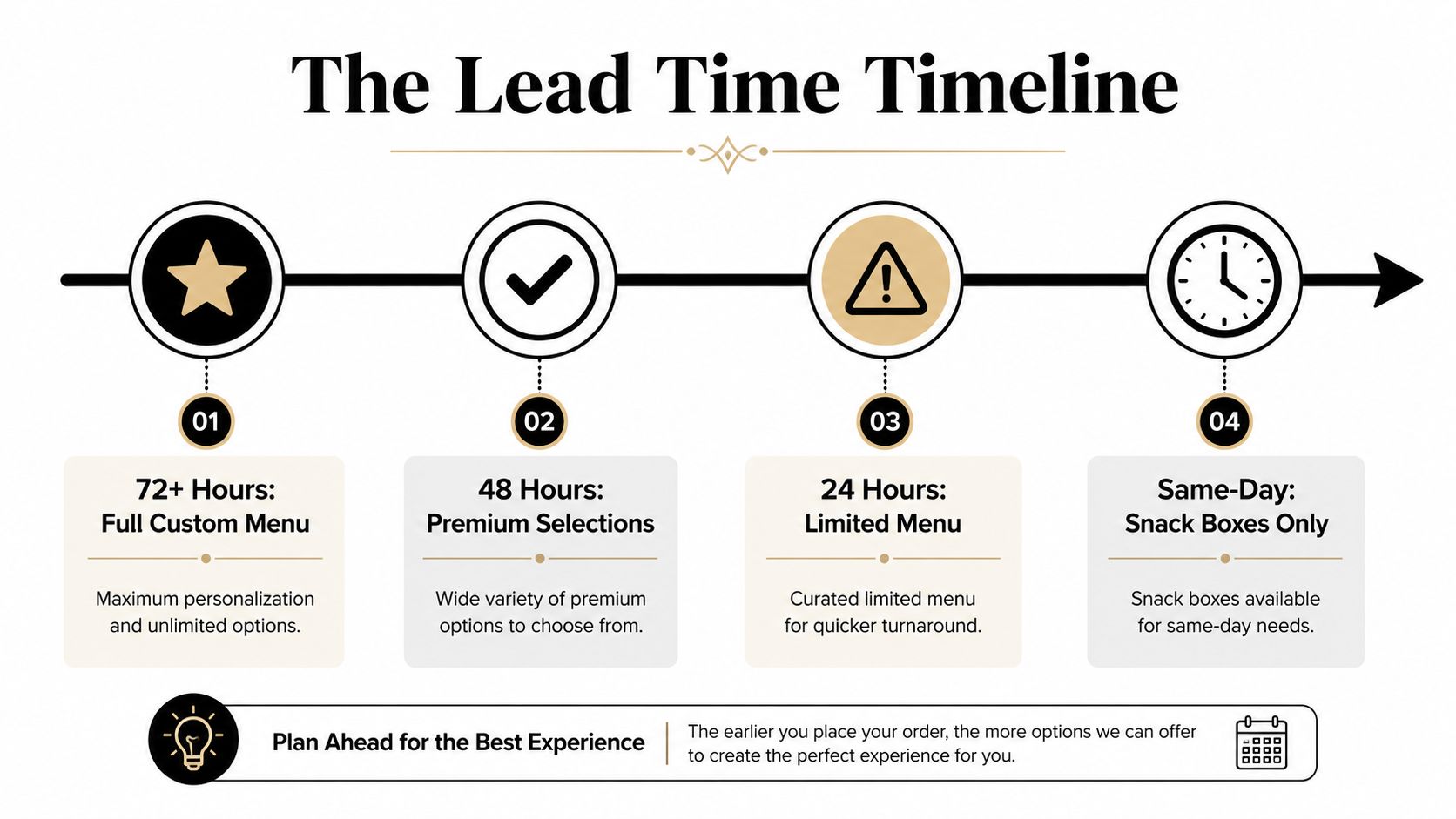
Lead time is where most private jet catering requests succeed or fail. The menu isn't the problem most of the time. The problem is whether anyone can source, prep, plate, and deliver it without compressing the process into something ugly and overpriced. Most premium providers want 24 to 48 hours' notice, and complex requests often need 72 hours to work properly. Source
The timing windows that actually matter
72+ hours opens the door to full custom menus, special-occasion cakes, and more exacting dietary work. It gives the caterer time to source specific ingredients, coordinate plating, and avoid the compromises that come from chasing ingredients at the last minute.
48 hours is the sweet spot for premium selections that still feel personalized without forcing the kitchen into crisis mode.
24 hours usually means a limited menu with fewer substitutions.
Same-day requests usually force snack-style fallback service, because the sourcing and handoff window has already closed.
Operational truth: the closer you get to departure, the more your menu becomes a logistics question instead of a taste question.
Passenger count changes are another common failure point. A charter that grows from four passengers to six, or drops from eight to five, changes plating, portions, packaging, and service setup. Diversions complicate the picture further, because any remote airport can have very different catering quality and FBO support than the original departure point.
The cleanest move is to lock the final catering order early and then verify packaging compatibility with the aircraft. That means checking whether containers are oven-safe, microwave-safe, and suitable for the galley equipment on board. If the aircraft can't heat it properly, the “premium” menu becomes dead weight.
Menu Examples by Flight Length and Occasion
The best private jet menus are simple where they should be simple and ambitious where the flight allows it. That's the standard worth using. Forbes noted that most requests are still straightforward, things like fruit and vegetable spreads, cheese and crackers, smoked salmon, sandwiches, and salads, and that breakfast is the most common service window. Source
Short hops under 90 minutes
For short flights, skip the fantasy of a full dinner service. Order items that can be eaten cleanly and don't depend on elaborate reheating.
- Breakfast hop: pastries, berry cups, yogurt, boiled eggs, and coffee service.
- Daytime hop: smoked salmon, cheese, sliced fruit, and small wraps.
- Late departure: charcuterie, crackers, crudités, and a light dessert.
The point is convenience. Nobody wants a multi-course tray on a 45-minute sector.
Two to four hour flights
A real meal makes sense in this setting. Think salmon with grain salad, chicken with roasted vegetables, or a warm pasta dish that reheats cleanly. If the flight crosses lunch or dinner, you can do proper plating without overcomplicating service.
Long-range and special occasions
Once the flight stretches past six hours, the catering should feel planned, not improvised. A multi-course menu works here, especially if the aircraft has a proper galley and the crew can service plates in stages. Birthday flights, anniversary legs, wedding charters, and team travel all benefit from menus that can be portioned and served without crowding the cabin.
For a flight where food is part of the experience, don't chase novelty. Ask for one strong starter, one main that reheats well, and one dessert that travels cleanly. That's better than trying to force restaurant theater into a cabin.
For more menu examples and service combinations, this private jet food guide is the right reference point.
Managing Dietary Needs and Allergies Like an Operator
Dietary requests are operational requirements. A severe allergy, kosher or halal need, vegan restriction, gluten-free requirement, or medical diet has to be handled like a compliance file, not a casual note buried in an email.
Start with precise instructions. The caterer needs to know exactly who needs what, which items must stay separate, and whether the request changes prep surfaces, packaging, or service order. The cabin crew needs the same briefing, because the kitchen note and the handoff on board are not the same thing. If the aircraft uses flight attendants, the crew still has to work from the same allergy sheet and the same labels, which is why a clear process matters more than a nice menu. learn what flight attendants handle on private jets
The primary risk is cross-contact, not the request itself. A caterer can promise a gluten-free plate or a nut-free dessert, but if the food is packed on the same surface or handled with shared tools, the promise is worthless. In a small galley there is less room, fewer surfaces, and less margin for sloppy handling, so the solution is to ask direct questions. Who packed it, what was used, and how was it kept away from common items?
What to require before takeoff
- Written dietary list: every restriction should be spelled out, not implied.
- Allergy confirmation: ask the caterer how cross-contact is prevented.
- Separate labeling: each tray or box should be clearly marked.
- Crew briefing: cabin staff need the same information the kitchen received.
- Backup option: carry a safe fallback item for passengers with severe restrictions.
Do not accept vague reassurance. If the passenger is medically sensitive, you want the packing details, the handling sequence, and confirmation that the food stayed separate from the rest of the order. That is the difference between a controlled cabin service and an avoidable incident.
A good caterer can execute the order. A professional charter team checks it before the aircraft closes the door. That is how you keep a high-end flight from turning into a risk event.
Onboard Service, Reheating, and Food Safety
The aircraft itself decides how far the catering can go. A smaller jet may only handle cold or room-temperature food cleanly, while a larger aircraft with a real galley can reheat or even cook certain items on board. The question isn't whether the menu sounds good in a restaurant, it's whether the aircraft can serve it properly in the cabin.
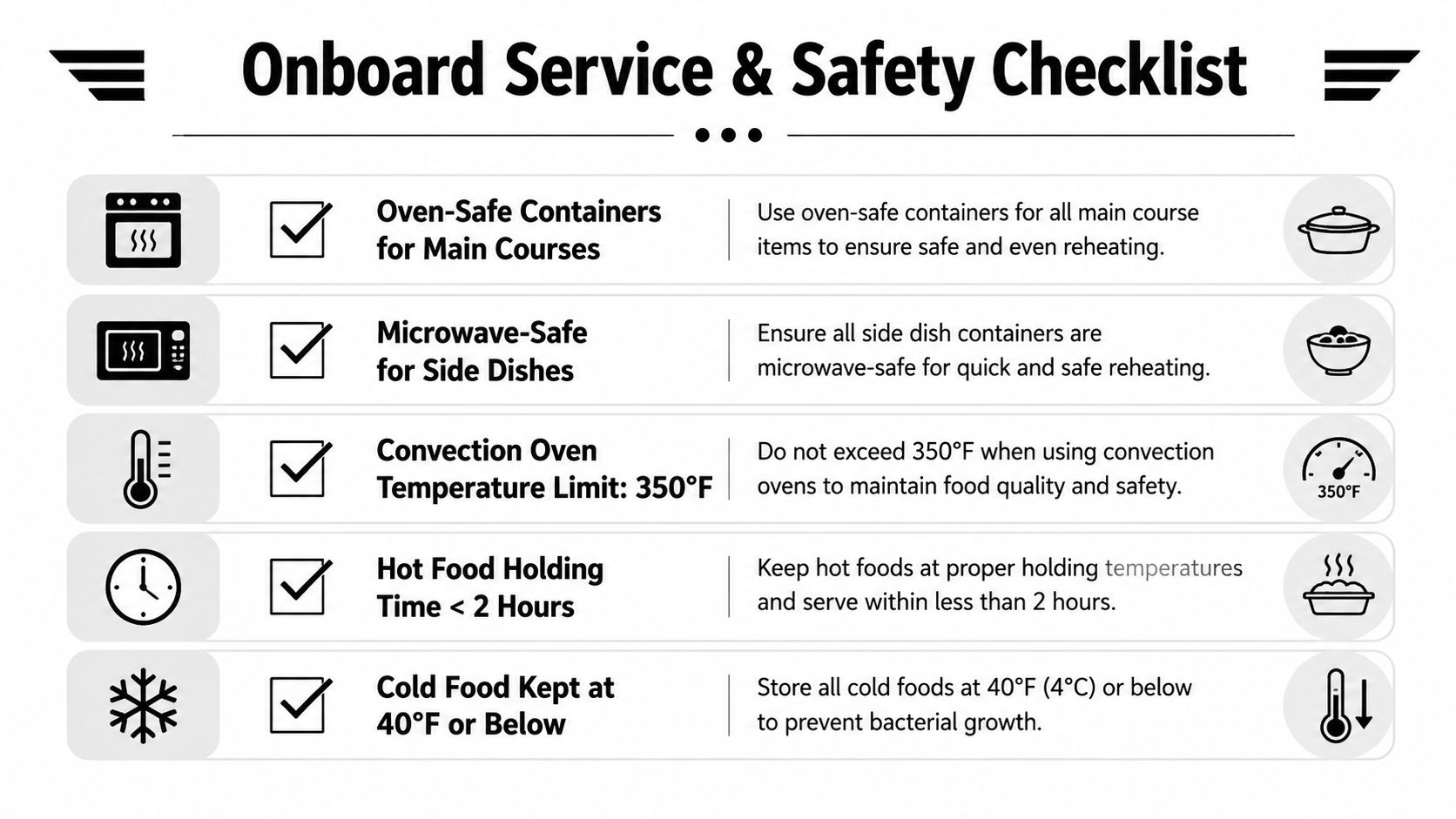
That's why caterers ask about equipment. Oven-safe and microwave-safe containers matter. So does whether the aircraft has a full galley or just warming capability. If the dish can't survive the onboard equipment, it shouldn't be on the order.
The food safety rule that matters most is the temperature band. Food should stay outside the 4.44°C to 62.7°C danger zone, which means cold items need proper refrigeration and hot items need proper holding. Source That temperature discipline is what protects the meal during the run from the FBO to the cabin and through multiple service points on longer flights.
Keep the service simple enough that the crew can execute it cleanly at altitude.
Presentation still matters. A private jet meal should arrive on proper china when the aircraft and service level support it, not just disposable trays dressed up as luxury. Linen service, coordinated plating, and trained cabin crew turn the meal into part of the flight rather than a concession to hunger.
For aircraft that have cabin staff, this flight attendant guide is useful because service quality depends on who is in the cabin. No matter how good the food is, it won't land well if the crew is not briefed on timing and handling.
Pre-Flight Checklist and Tips for High-Stakes Bookings
The best high-stakes catering runs on a checklist, not memory. If the booking involves a celebrity, a sports team, a production schedule, or a traveler who books late on unusual routes, the margins get tighter and the handoff has to be cleaner. One missed detail can derail the whole service.
Lock these items before departure
- Order confirmation and receipt: don't rely on a verbal promise.
- Final passenger count and dietary list: freeze it as early as possible.
- FBO handoff contact: one named person, not a group email.
- Galley equipment compatibility: verify the aircraft can handle the food.
- Service item inventory: check plates, utensils, napkins, and backups.
Haute Jets' 24-hour pre-flight confirmation is the right model for this kind of trip, because it already folds catering, pet policies, Wi-Fi, and ground transport into one review before departure. That matters when the itinerary is busy and no one wants four separate confirmations from four different vendors.
Best practice: if the flight is sensitive, choose fewer menu items and more certainty.
Celebrities need discretion and clean handoff points. Sports teams need repeatable portions and clear labeling. Entertainment crews need food that survives schedule changes. Crypto-forward travelers often book late, so the key is not asking for more, it's asking for what can still be executed well on short notice.
A few practical answers come up all the time. Catering is often extra in the U.S. and more frequently bundled in Europe. Same-day service is possible only for simple requests. Tipping depends on the operator and the service structure, so ask before the flight instead of guessing at the end.
If you want the order handled without friction, book the catering with the flight, lock the final passenger list early, and make the FBO handoff part of the confirmation process. For a charter team that coordinates that chain directly, contact Haute Jets before your next departure.