
You're usually looking at a Cessna 208 interior for one of two reasons. Either a jet won't get you where you need to go, or a jet will get you there but won't carry what you need to bring.
That's where charter clients make expensive mistakes. They ask, “How many seats does it have?” when the better question is, “How is this specific aircraft configured today?” On the Caravan, that difference matters more than on almost any other turboprop.
The Cessna 208 isn't a glamour machine. It's a solution. If you're flying to a remote lodge, an island strip, a ranch, a worksite, or a regional airport with awkward ground logistics, this airplane earns its keep. The interior reflects that. It's built around function first, then comfort where possible. If that matches your mission, it's a smart charter. If you expect midsize-jet refinement, you're shopping the wrong aircraft.
The Unassuming Workhorse of Private Aviation
A client calls with a familiar problem. They've got people, soft bags, camera cases, and a destination that looks straightforward on a map but becomes difficult the moment you check runway conditions and local handling. A light jet sounds appealing until you realize the luggage profile is wrong, the field access is poor, or the trip includes rough, short-hop regional segments where flexibility matters more than speed.
That's the lane where the Caravan keeps winning.
Why the Caravan still matters
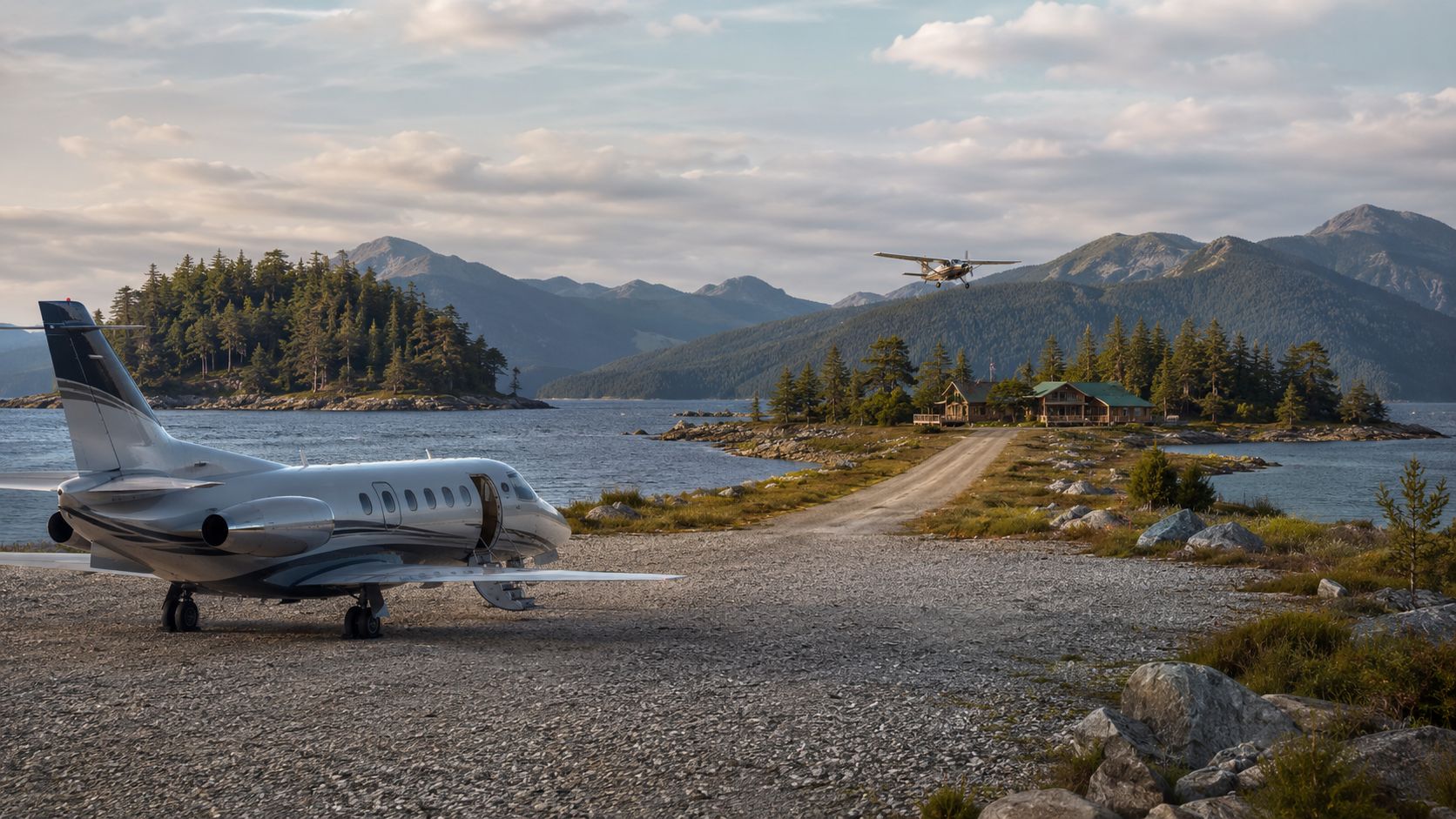
The reason the Cessna 208 interior gets so much attention is simple. The airplane has lasted because the cabin concept works. According to VREF's Cessna Caravan overview, the Cessna 208 has been in continuous production since 1985, with over 3,000 aircraft built. That same source notes the core cabin dimensions have remained consistent at 54 inches high, 64 inches wide, and 17 ft 4 in long, which tells you something important. Operators didn't need a radical rethink of the space. They needed a durable layout that could keep doing real jobs.
That long production life also shaped the market around it. More aircraft in service means more variation in interiors, more mission-specific conversions, and more chances for a charterer to book the wrong setup if nobody asks the right questions.
Practical rule: Don't book a Caravan by model name alone. Book it by actual cabin layout, baggage setup, and mission fit.
What the interior is really designed to do
The Cessna 208 interior isn't trying to imitate a business jet. It's trying to move people and equipment efficiently on short-haul routes with minimal fuss. That's why I like it for clients who care more about getting the job done than arriving in a whisper-quiet cabin.
Here's the honest read:
- Best use case: regional passenger moves, lodge transfers, island flying, utility charters, and mixed passenger-and-gear trips
- Weakest use case: travelers who want a stand-up cabin, enclosed lav comfort, or a polished executive-jet atmosphere
- Smart expectation: think rugged and adaptable, not plush and insulated
If your trip involves unusual baggage, pets, outdoor equipment, or a destination where standard jet assumptions break down, the Caravan stops looking basic and starts looking very well chosen.
Cabin Dimensions and Standard Commuter Layout
The best way to understand the Cessna 208 interior is to stop thinking in marketing language and start thinking in usable space.
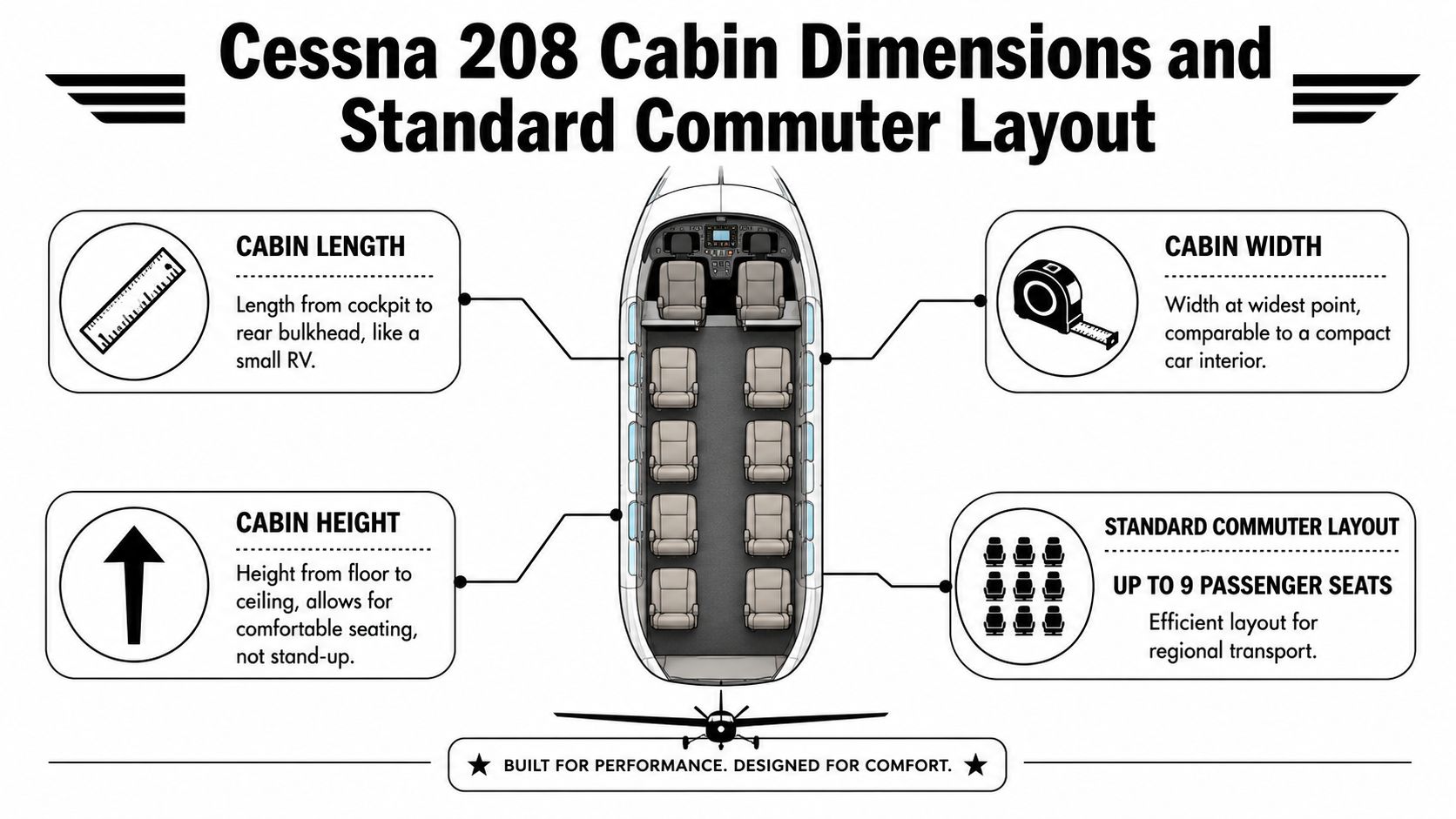
Textron lists the Caravan cabin at 54 inches (1.37 m) high, 64 inches (1.63 m) wide, and 17 ft 4 in (5.28 m) long, with 10 to 14 occupants and 325 lb of baggage capacity in the standard specification on the Textron Aviation Caravan page. In charter service, the layout you'll commonly see is closer to 9 passenger seats, because that setup tends to be more practical for comfort and loading.
How to visualize the space
Don't picture a cabin you can stroll through upright. You can't. The height works for seated comfort, not stand-up movement. The width is useful, but it's still a narrow-body utility turboprop. The length is where the airplane earns its reputation because it gives operators room to arrange seats and cargo intelligently.
Consider it this way:
- Height: enough for seated comfort, not for walking around like you would in a larger cabin aircraft
- Width: more practical than plush. You won't confuse it with a wide executive cabin
- Length: the key asset, because it gives the operator room to balance seating and payload
If you want a quick aircraft overview before comparing operators, Haute Jets has a solid Cessna Caravan aircraft page that helps frame where this aircraft fits in the charter market.
What a standard commuter cabin looks like
Most commuter-configured Caravans are built for efficiency. You board quickly, sit quickly, and get moving. That's why regional operators like them. The cabin is straightforward, easy to maintain, and easy to turn around between flights.
A standard charter layout usually means:
| Cabin trait | What it means for you |
|---|---|
| Nine-seat setup | Better practicality for charter groups than denser commuter layouts |
| Simple seating arrangement | Fast boarding and fewer moving parts |
| Utility-focused trim | Durable materials over decorative finishes |
The standard Caravan cabin works well when the flight is part of the trip, not the event itself.
Clients need to be realistic. If your priority is “How do we get six to nine people and their essential gear into a difficult destination without making the flight complicated?” the standard commuter interior makes sense. If your priority is “How do we hold a polished executive conversation in a quiet cabin?” it probably doesn't.
Executive Oasis and Other Interior Conversions
Not every Cessna 208 interior is a commuter box. Some are surprisingly refined. The problem is that buyers and charterers often assume those nicer interiors are common. They aren't.
The executive version is the exception
An executive Caravan can feel like a different airplane inside. Instead of maximizing seats, the operator gives the cabin room to breathe. You may see club seating, upgraded upholstery, better trim materials, and a more private feel. It's still a Caravan, so don't expect large-cabin-jet luxury, but the atmosphere changes fast when the operator stops chasing commuter density.
The contrast looks like this:
- Commuter interior: more seats, tighter feel, quick-turn utility mission
- Executive interior: fewer seats, more personal space, better finishes
- Special-mission interior: designed around one job, not around passenger comfort at all
If you're trying to picture what an upgraded layout could feel like before you charter, browsing examples from free AI interior design platforms can help you think in terms of seating flow, finish choices, and how small-space design changes affect comfort. That's useful because Caravan cabins vary more than people expect.
Why conversions matter in the real world
This is the section many articles miss. A Caravan's value isn't just that it can be luxurious or utilitarian. It's that different operators build it for different missions, and those decisions directly affect your flight.
A few examples:
- VIP shuttle use: better seats, lower passenger count, cleaner presentation
- Adventure travel use: seats arranged around baggage needs, not aesthetics
- Skydiving or medical conversion: completely different interior priorities
That's why “Cessna 208 interior” is a misleading search term unless you add context. Which interior? For what mission? With what compromise?
Some Caravans are set up to move people comfortably. Others are set up to move whatever the operator needs that week. Those are not the same charter experience.
My advice is blunt. If an operator or broker can't show you the actual seating plan or recent cabin photos, assume nothing. The Caravan's strength is adaptability, but that same adaptability can disappoint you if you expected executive trim and got utility spec.
Luggage Capacity and Cargo Flexibility
In this particular aspect, the Caravan separates itself.
Most aircraft discussions reduce baggage to a lazy question: how many bags can we bring? That's not how you should think about a Cessna 208 interior. The right question is what exactly are you bringing, and how much cabin space are you willing to trade to carry it properly?
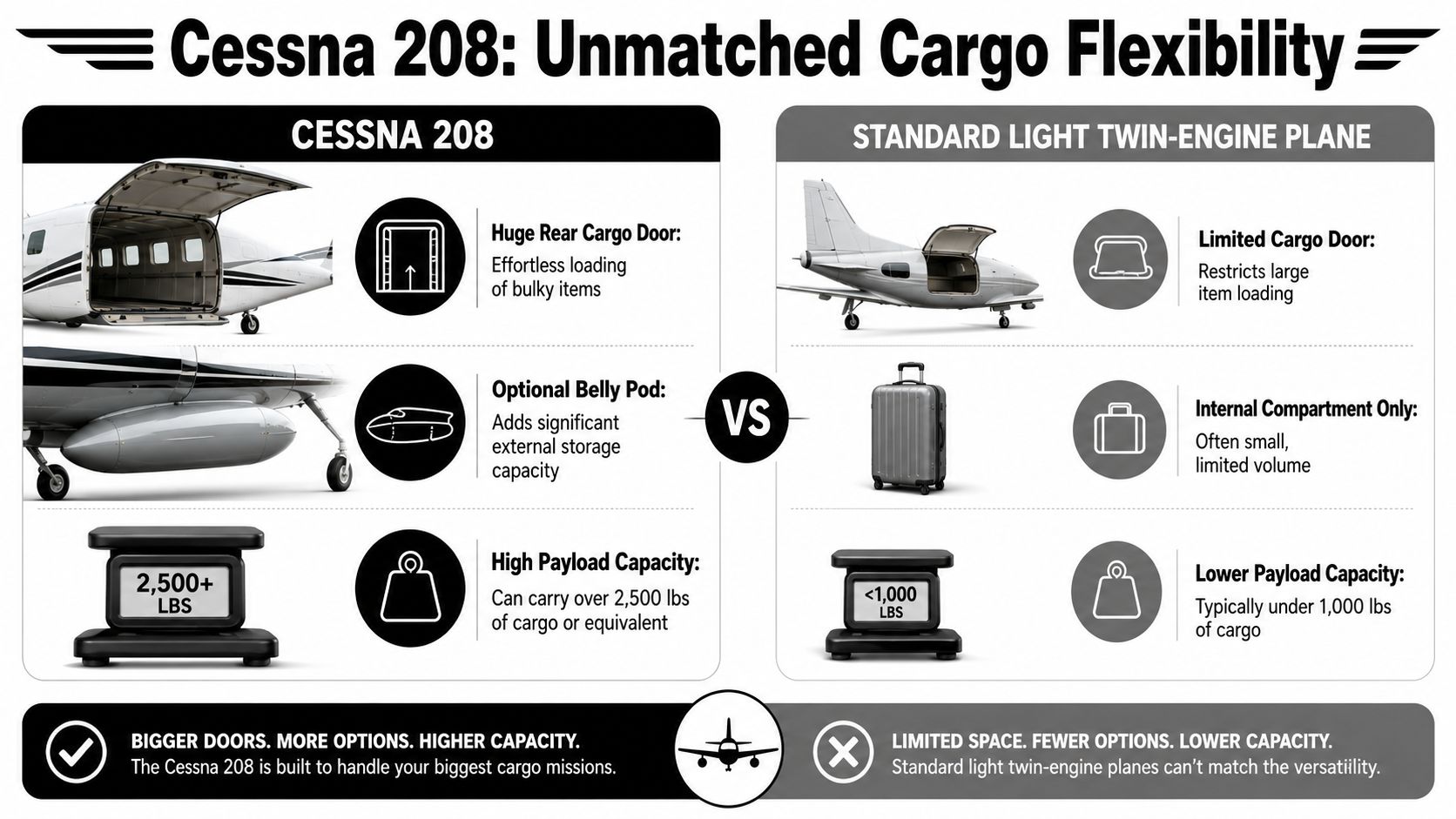
Wikipedia's Cessna 208 entry notes the aircraft's full-length seat tracks and the resulting trade-off between legroom, passenger count, and cargo space in different configurations on the Cessna 208 Caravan page. That's the detail that matters most for charter.
The cabin is modular, not fixed
The smartest way to read the Cessna 208 interior is as a modular working space. Seats aren't just seats. They're a planning choice.
That matters for:
- Families carrying strollers, car seats, and irregular luggage
- Outdoor groups with skis, fishing gear, dive equipment, or coolers
- Production teams bringing cases, stands, and camera equipment
- Work crews who need both people and tools on the same flight
One removed seat row can change the usefulness of the airplane more than any leather upgrade ever will.
The trade-off you need to discuss before booking
A denser passenger layout can limit how comfortably the aircraft handles awkward loads. A lighter passenger count may create room for bulky equipment or make boarding and unloading smoother. That's why I tell clients not to send a generic “8 pax with luggage” request and expect a useful answer.
Send specifics. Good brokers want details.
Use a checklist like this:
- List the people first. Adults, children, pets, and whether anyone needs easier access seating.
- Describe the bags accurately. Hard cases, golf bags, rifles in cases where permitted, dog crates, camera trunks, or soft duffels all load differently.
- Flag the nonstandard items. Strollers, coolers, sports gear, and work equipment change the interior plan.
- Ask whether seats can be removed or repositioned. On this aircraft, that question is central.
If you want a broader planning framework for packing decisions, Haute Jets has a practical luggage and private jet travel guide that's worth reviewing before you finalize a charter.
Bring the awkward item list early. The Caravan can solve a lot of problems, but only if the operator configures the cabin for the mission before departure.
The Caravan is often the right answer for mixed-use flying because it doesn't force a false choice between “passengers only” and “cargo only.” But you still have to choose the exact balance. That's the part many charterers skip, and it's the part that decides whether the flight feels easy or cramped.
Cabin Comfort Noise and Amenities
Here's the straight answer. The Cessna 208 interior is comfortable enough for the missions it serves. It is not a quiet luxury capsule.
Noise is part of the deal
This is a single-engine turboprop. You'll hear it. You'll feel more vibration than you would in a typical business jet. For short regional sectors, many clients accept that trade instantly because the aircraft solves access and loading problems other aircraft don't. For longer legs, the cabin environment becomes a bigger factor.
If you're sensitive to cabin noise, say that upfront. Some operators maintain their interiors better than others, and small differences in seat condition, trim, and insulation can affect the experience.
Amenities are usually basic
The Caravan doesn't usually win on amenities. It wins on usefulness.
Typical expectations should be:
- Lavatory situation: often absent, limited, or not something you'd want to rely on unless specifically confirmed
- Refreshments: usually simple, not a full-service galley setup
- Connectivity: don't assume Wi-Fi
- Cabin service: expect practical support, not a jet-style onboard service routine
That sounds harsh, but it's helpful. Clients are happiest on Caravan charters when they board knowing exactly what the airplane is and what it isn't.
Comfort depends on fit, not branding
A compact cabin puts more pressure on seat choice and personal space. If anyone in your party needs extra room, don't leave that to chance. It can also help to review practical guidance like Seat Belt Extenders' airplane guide if a passenger has seating concerns or wants to understand fit issues before the trip.
The bottom line is simple. If your trip is short, mission-driven, and access-sensitive, the Caravan's comfort level is usually acceptable. If your trip depends on silence, privacy, onboard amenities, or lav reliability, you should be looking at a different category.
Booking a Cessna 208 Charter What to Confirm
Smart charterers differentiate themselves from frustrated ones. Don't book the airplane. Book the exact setup.
The questions that actually matter
Start with the interior itself. Ask for current cabin photos and a seat map for the specific tail you're being offered. Don't accept generic model photos. On a Caravan, a minor layout change can affect comfort, baggage, and boarding more than clients expect.
Confirm these items before you sign off:
- Exact seat configuration: commuter, executive, mixed-use, or partially cargo-biased
- Real baggage plan: internal cabin storage, external pod use if available, and how bulky items will be loaded
- Lavatory status: available, limited, or not onboard
- Pet policy: where the animal rides and what crate or restraint rules apply
- Catering reality: what can be practically boarded and stored sensibly
Match the aircraft to the mission
A Caravan can be ideal for a lodge run, a family island transfer, or a crew movement flight. The same aircraft can be a poor choice for a dressy executive day trip if the interior is bare-bones and the client expected polished cabin presentation.
I'd push every first-time Caravan charterer to answer these five mission questions:
| Question | Why it matters |
|---|---|
| How many people are actually flying? | Passenger count drives configuration options |
| What's the largest item coming onboard? | Bulky gear changes the loading plan |
| How long is the flight? | Short hops tolerate basic amenities better |
| Is anyone expecting jet-level comfort? | That expectation needs resetting early |
| Do you need a specific seating style? | Club seating and commuter rows are very different experiences |
Don't let “it should be fine” run the trip
The Caravan rewards precision. If your broker says the bags “should fit,” that's not good enough. If they say the aircraft is “usually configured” a certain way, that's also not good enough. On this airplane, assumptions create most of the friction.
Ask for specifics in writing. Cabin layout, baggage handling, pet rules, and lav details should never be left to memory.
When the questions are handled properly, the Caravan feels easy. When they aren't, clients end up surprised by seat density, cabin noise, or gear constraints that could have been addressed before departure.
How the Cessna 208 Compares to Other Turboprops
The easiest way to think about the Caravan is this. It's the pickup truck of private aviation. That's a compliment.
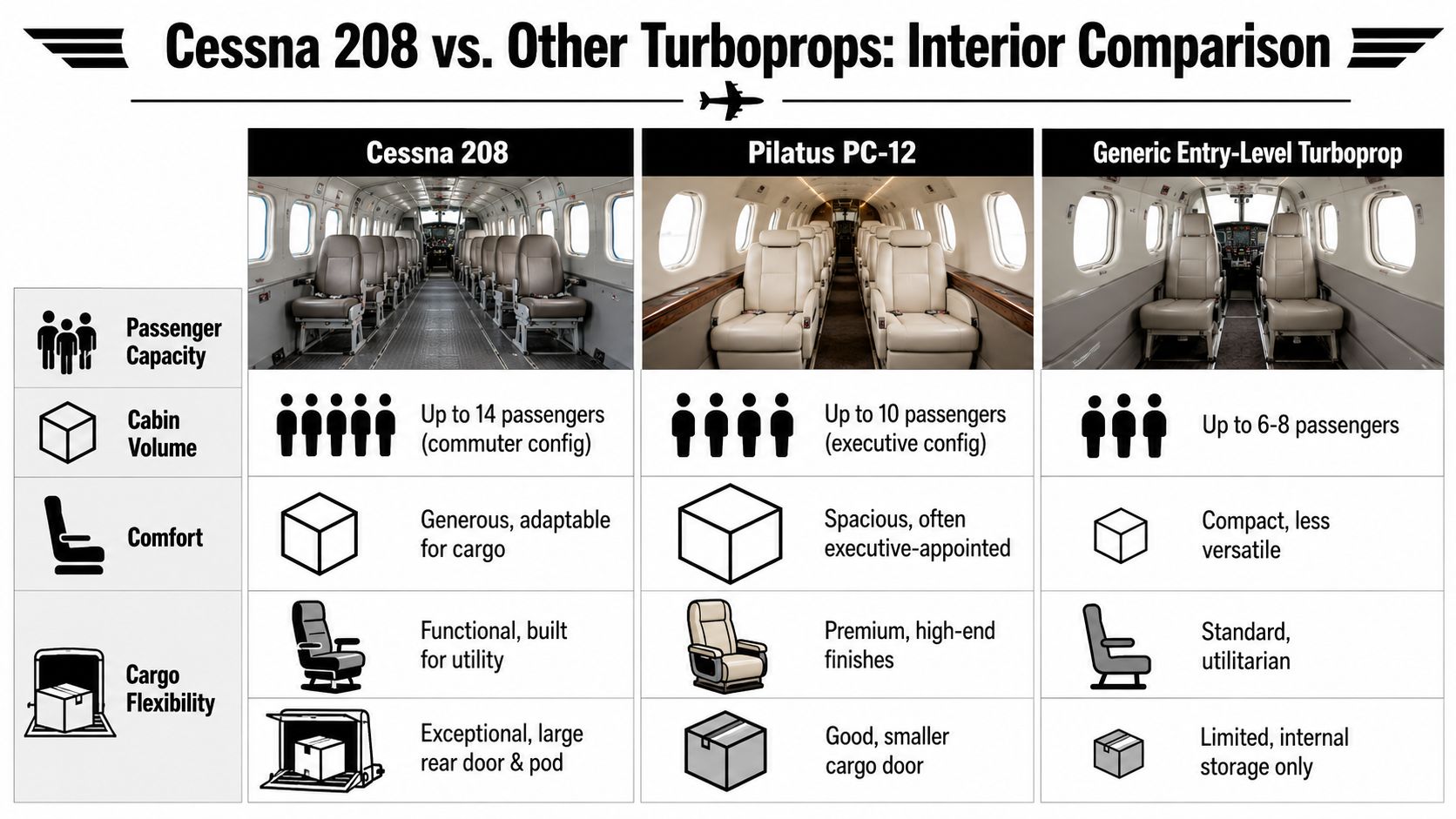
Caravan versus PC-12
The Pilatus PC-12 usually feels more executive. The cabin presentation is often more polished, and many clients instinctively prefer it when comfort is high on the priority list. If you want the single-engine turboprop version of a premium SUV, that's the comparison.
The Caravan wins when utility dominates. More flexible loading logic, a more work-oriented cabin, and less concern about preserving a luxury atmosphere make it better for messy, gear-heavy, destination-driven flying.
Caravan versus King Air
A King Air usually offers a more traditional corporate turboprop experience. Many clients like the twin-engine psychology, the more familiar business layout, and the generally more refined passenger feel.
The Caravan still holds a strong position because it's so purpose-built for practical missions. It's less about impressing the cabin passenger and more about solving the trip.
If you're weighing broader turboprop advantages, Haute Jets has a useful overview on the advantages of a turboprop aircraft.
Which one should you choose
Use this quick lens:
- Choose the Caravan when baggage shape, mission flexibility, and destination practicality are driving the decision.
- Choose the PC-12 when you want a more premium single-engine turboprop cabin experience.
- Choose the King Air when cabin refinement and a more conventional executive feel matter more than maximum utility.
The Cessna 208 interior is rarely the prettiest option in the category. It may be the smartest one.
If you want help choosing the exact Caravan, not just the category, Haute Jets can source the specific aircraft layout that fits your trip, confirm baggage and cabin details in advance, and help you avoid paying for the wrong setup.