
You’re probably looking at the Cessna 421B because you need a real answer, not another spec sheet copied from an old listing. You want to know whether this airplane makes sense for the trip you fly. Maybe that means moving a family for a weekend island hop, maybe it means carrying colleagues on a short business run, or maybe it means avoiding the cost jump that comes with stepping into a jet when a jet isn’t necessary.
That’s the right way to evaluate the cessna 421b specs.
The 421B Golden Eagle is one of those aircraft that still matters because it solves a specific problem well. It gives you a pressurized cabin, genuine twin-engine capability, respectable speed, and useful short-field flexibility without pushing you into light-jet economics. It is not a jet substitute. It is not the right airplane for every mission. But for the right client, it’s one of the smartest charter tools ever built.
A good example is a South Florida departure with a handful of passengers and soft bags heading to the Bahamas for a long weekend. That mission doesn’t need a big cabin jet. It needs a cabin that feels civilized, enough speed to make the trip efficient, and the ability to use smaller airports without drama. The 421B fits that profile far better than people expect.
It also deserves a more honest conversation than it usually gets. Too many articles either romanticize it as a “classic” or dismiss it because it’s a piston twin from the 1970s. Both views miss the point. Clients don’t charter nostalgia. They charter outcomes.

If you want broader context on where it sits in the Cessna lineup, Haute Jets already covered that in this Cessna private plane guide.
Introduction The Cessna 421B Golden Eagle in Modern Charter
The Cessna 421B still earns attention because it delivers a combination most clients care about. It is pressurized, it is fast for a piston twin, and it can carry a meaningful group without feeling like a compromise machine.
That matters in modern charter because not every trip needs a turbine invoice.
Where the 421B makes sense
For the right mission, the 421B is a practical luxury aircraft. It works best when your priorities look like this:
- You want pressurization without jet pricing. The cabin is designed for higher-altitude comfort, which changes the experience on longer regional legs.
- You’re flying short to medium sectors. The airplane’s published standard range and cruise profile fit regional business and leisure flying well.
- You care about airport flexibility. Smaller airports often save more time than a faster airplane with worse runway needs.
- You don’t need a stand-up cabin. If cabin height is the deciding factor, look elsewhere.
My blunt view
I like the 421B for clients who want value and know their mission. I don’t recommend it to people who just want to say they flew on a “private jet.” That is the wrong buying logic and the wrong charter logic.
Practical rule: If your trip is regional, your group is moderate, and you want comfort without paying for unnecessary speed, the 421B deserves a serious look.
The aircraft’s reputation was built on exactly that role. It became popular because it could move executives and families in a pressurized environment while staying cost-conscious compared with aircraft above it in the market.
That doesn’t mean it has no tradeoffs. It has several, and I’ll get into them directly.
Cessna 421B Quick Reference Specification Sheet
A client calls with a simple brief. Four to six passengers, a regional trip, strong comfort, and no appetite for jet-level cost. This is the section where the 421B either qualifies fast or gets ruled out.
Cessna 421B Golden Eagle Key Specifications
| Specification | Value |
|---|---|
| Production years | 1970 to 1975 |
| Engines | 2 x Continental GTSIO-520-H |
| Engine power | 375 horsepower each |
| Maximum gross weight | 7,450 lbs |
| Empty weight | around 4,426 lbs |
| Standard fuel capacity | 175 gallons |
| Alternate listed usable fuel | 206 gallons standard, optional to 262 gallons |
| Top speed | 245 knots |
| Cruise speed | 235 knots |
| Alternate published maximum speed | up to 256 knots at 20,000 feet |
| 75% cruise | 240 knots at 25,000 feet |
| Standard range | 845 nautical miles |
| Alternate listed range | 972 nautical miles in some specs |
| Extended economy range | up to 1,487 nautical miles with optional fuel |
| Rate of climb | 1,850 feet per minute |
| Alternate published rate of climb | 1,940 fpm |
| Single-engine climb | 305 fpm |
| Service ceiling | 31,000 feet |
| Single-engine ceiling | 13,000 feet |
| Takeoff ground roll | 1,860 feet |
| Takeoff over 50-foot obstacle | 2,387 feet |
| Landing ground roll | 720 feet |
| Landing over 50-foot obstacle | 2,178 feet |
| Passenger capacity | up to 8 |
| Cabin length | 11 feet 4 inches |
| Cabin width | 4 feet 5 inches |
| Cabin height | 4 feet 1 inch |
| Cabin volume | 196 cubic feet |
| Baggage volume | 39 cubic feet |
| Pressurization | 5 psi |
| Operating cost | $587 per hour, per Jecobra’s Cessna 421B specification page |
| Engine overhaul interval | 1,200 hours or 12 years |
| Average sale price | around $237,000, per GlobalAir’s Cessna 421B aircraft-for-sale market page |
The baseline performance numbers that matter for charter screening are clear. The Cessna 421B uses two 375 horsepower Continental GTSIO-520-H engines, carries a maximum gross weight of 7,450 pounds, cruises at about 235 knots, reaches a top speed of 245 knots, delivers a standard range of 845 nautical miles, climbs at 1,850 feet per minute, and has a 31,000-foot service ceiling, according to FindAircraft’s Cessna 421 listing.
If you care more about the travel experience than the raw table, focus on four numbers. Cruise speed. Range. Cabin dimensions. Hourly cost.
What those specs mean for a charter client
Cruise in the mid-200-knot range means the 421B is a time-saver on regional routes, not a substitute for a light jet. For a short business hop or a weekend leisure sector, that speed feels efficient. On longer missions, the time penalty versus a jet becomes real.
The published range works well for regional city pairs, but payload and reserves still matter. If you are planning a longer leg with a fuller cabin and baggage, do not book this aircraft based on a best-case brochure number. Book it for the trip you are flying.
The cabin dimensions tell you exactly what kind of comfort to expect. You get a proper seated executive cabin, not stand-up freedom. If your group values privacy, quiet conversation, and a more refined experience than a small unpressurized twin, the airplane does its job. If anyone expects to move around like they would in a midsize jet, they will be disappointed. For broader context on what cabin comfort means across aircraft categories, our private jet interior guide for charter clients is a useful reference.
The hourly operating cost explains why the 421B remains attractive in value-focused private aviation. You are buying pressurized cabin-class capability without stepping into turboprop or jet economics. That is the aircraft’s core argument.
My recommendation from the spec sheet
I would shortlist the 421B for regional trips with a sensible passenger count, realistic baggage, and clients who care about comfort per dollar. I would pass on it for missions that need full-cabin payload over long stages, or for travelers who measure value almost entirely by speed.
Those are the right conclusions to draw from the numbers.
Inside the Cabin Seating Layouts and Passenger Comfort
You are flying four executives from South Florida to a regional business meeting, and you want the cabin to feel private, civilized, and worth the charter rate. The Cessna 421B can do that. It can also feel cramped and noisy if you try to use every advertised seat and pack it like a larger aircraft. That distinction matters more than any brochure number.
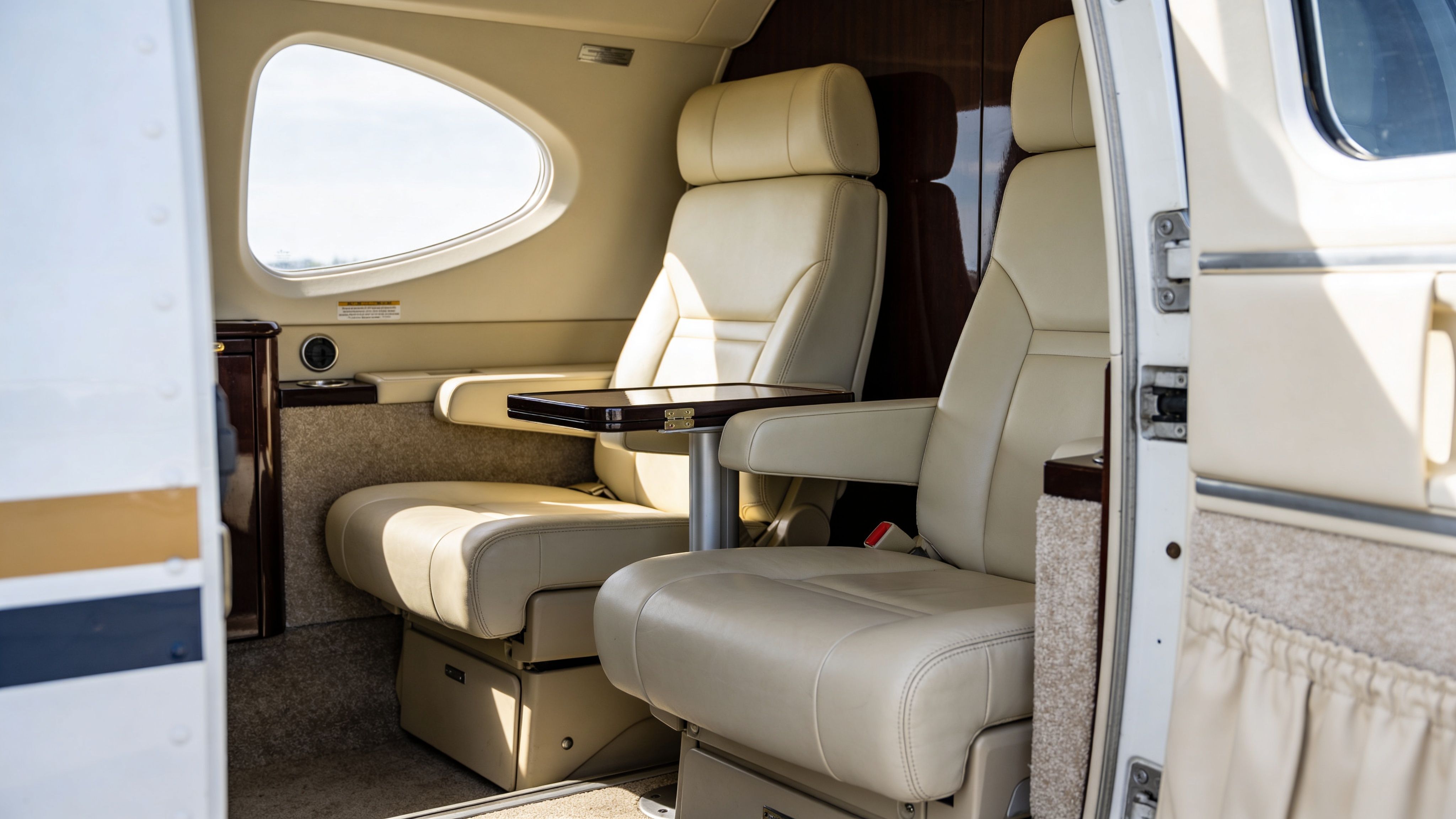
The 421B gives you a true cabin-class piston environment with pressurization, a usable baggage area, and seating that works well for conversation. As noted earlier, published specs point to a cabin that is respectable for this category, with enough room to make short and mid-length trips comfortable if the aircraft is configured well and the passenger count stays sensible.
If you want context on how this compares with other categories of private aircraft, our private jet interior guide for charter clients gives a useful baseline.
What the cabin actually feels like
The right expectation is simple. This is an executive piston twin with a real cabin door, club-style seating on many charter examples, and enough separation from the cockpit to feel more refined than smaller piston aircraft.
It still does not give you stand-up freedom or the open feel of a light jet.
That is why I advise clients to judge this cabin by mission, not by seat map. For a regional trip with a small group, it feels efficient and polished. For a fully occupied cabin, personal space drops quickly, and the experience becomes more about access and value than luxury.
Best seating layouts for charter use
The strongest 421B configuration is the one that leaves room to breathe. Operators may advertise higher seat counts, but the better client experience usually comes from using fewer seats.
My recommendation is straightforward:
- Four passengers is the sweet spot if comfort is the priority.
- Five or six passengers works well for many day trips if baggage is packed carefully.
- Seven or eight passengers is a compromise. Expect tighter legroom, less elbow room, and stricter baggage decisions.
If your group wants to work face to face, hold a normal conversation, and step off the aircraft feeling fresh, do not chase the maximum seating number. Book for comfort, not theoretical capacity.
Why pressurization matters to the client experience
Pressurization is one of the 421B’s strongest selling points because passengers feel the difference even if they never ask about cabin differential. The cabin environment is easier on the body than what you get in smaller unpressurized twins, especially on longer regional legs.
That shows up in practical ways. Conversations are easier. Fatigue is lower. The flight feels more like private air travel and less like a compromise.
I recommend the 421B most often for clients who care about arriving ready for the meeting, not just arriving cheaply.
Noise, baggage, and the tradeoffs you should expect
Be realistic here. The 421B is still a piston aircraft, so the cabin is not as quiet as a turboprop or jet. You will hear the airplane working. For most regional missions, that is acceptable. For travelers who are highly sensitive to noise or expect a near-silent cabin, it is the wrong aircraft.
Baggage capacity is useful, but it rewards discipline. Soft bags work better than hard-sided luggage, and lighter packing gives the crew more flexibility. That matters because cabin comfort and baggage planning are tied together on aircraft in this class.
What I would tell a client before booking
- Noise is reasonable for a cabin-class piston twin, but I would not market it as quiet.
- Seating comfort is good with a modest passenger count and average-sized adults.
- Headroom and movement are limited, so taller passengers should expect to remain seated comfortably rather than move around.
- Baggage is workable for multi-day regional travel if the group packs intelligently.
A cabin video gives a more honest sense of scale than any spec table.
My comfort verdict
The 421B is a smart charter choice for clients who want pressurized cabin comfort, executive-style seating, and lower operating cost than a turboprop or light jet. It is not the aircraft I would choose for clients who judge quality by cabin silence, stand-up room, or the ability to fill every seat without compromise.
Use it for four to six passengers on regional missions, and it delivers strong value. Push it to maximum occupancy, and the limitations become obvious fast.
Performance Deep Dive Speed Altitude and Flight Efficiency
Performance is where the 421B justifies itself.
A lot of piston twins look decent on paper and then disappoint in actual mission capability. The 421B is different. It has enough speed and altitude capability to feel purposeful, and that’s why it stayed relevant.
What the higher-speed figures mean
The stronger published numbers matter because they show this airplane was built to cruise high and move efficiently. With its turbocharged engines, the 421B achieves maximum speeds up to 256 knots at 20,000 feet and a 75% cruise speed of 240 knots at 25,000 feet. This allows the aircraft to climb to high altitudes quickly, often in under 15 minutes to flight levels, maintaining power thanks to a turbo critical altitude near 18,000 feet, according to the Wikipedia entry for the Cessna 421 Golden Eagle.
Those aren’t abstract bragging rights. They affect your trip in three direct ways.
Why altitude matters to a client
- Ride quality improves when the aircraft can climb above a lot of lower-level weather and chop.
- Time efficiency improves when the airplane reaches cruise conditions quickly.
- Mission consistency improves because the pilot has more flexibility in choosing altitude.
Speed in practical terms
A 235-knot cruise profile puts the 421B in a useful middle ground. It is clearly faster than basic piston options. It is also slower than a light jet by enough margin that you should not pretend otherwise.
That said, for many routes, airport convenience beats raw cruise speed.
If the 421B gets you into a closer regional airport while a jet sends you to a bigger airport farther away, the total door-to-door difference can narrow fast. That’s why clients who only compare airborne time often make the wrong aircraft choice.
Efficiency versus glamour
This airplane rewards clients who think operationally.
A 421B flight feels efficient because it reaches useful altitudes quickly, cruises at a serious pace for its category, and avoids some of the cost structure that comes with stepping up. It is not glamorous in the way a light jet is glamorous. It is practical in a way many charter clients end up appreciating more.
Book the 421B when you care about the mission. Book the jet when you care about image, cabin quiet, or longer nonstop reach.
That is the honest distinction.
Mission Planning Range vs Payload Tradeoffs
This is the section most buyers skip and most operators care about most.
The Cessna 421B can be a very capable aircraft. It can also disappoint you if you assume the biggest passenger count and the longest range can happen at the same time. That is not how cabin-class piston twins work.
The number that matters least
“Range” is one of the most abused numbers in charter. Clients hear a published range and assume it applies to their exact trip, with their exact passenger count, bags, conditions, and reserves.
It doesn’t.
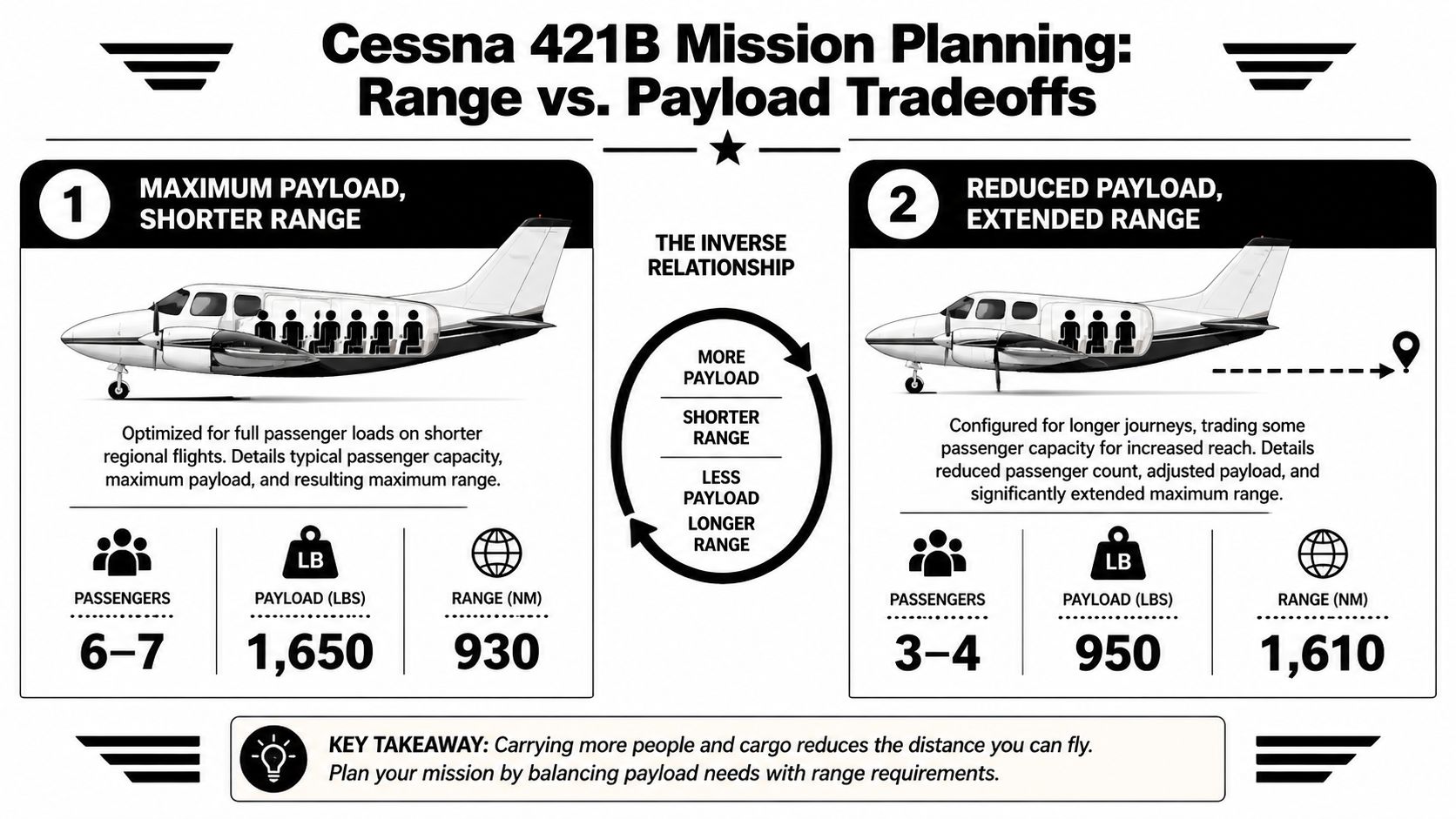
The published figures on the 421B show a broad envelope depending on configuration. Some specs list a standard range in the mid-hundreds of nautical miles. Other listings show longer numbers with different fuel arrangements and economy assumptions. Those numbers are useful only as planning boundaries.
If you want the broader aircraft-selection framework, read this guide on how to choose the right aircraft for short-haul private flights.
The real tradeoff
Every charter advisor should explain this clearly: payload competes with fuel.
Put differently, the more people and bags you carry, the less flexibility you have to launch with maximum fuel. That is not a flaw unique to the 421B. It is reality.
What this means in booking terms
- A lighter cabin gives you more nonstop flexibility. That’s where the airplane feels strongest.
- A fuller cabin narrows your options. You may still complete the trip easily, but the margin gets tighter.
- Luggage discipline matters. Soft bags and realistic packing make these missions work much better.
- Hot weather, shorter runways, and route reserves all matter. Clients often forget those variables. Operators don’t.
How I advise clients
For family trips, golf weekends, and executive regional flying, the 421B works best when the group is sized to the mission, not to the brochure. If your group is large and everyone is bringing hard cases, bulky gear, or expecting a long nonstop leg, then I would advise you to stop trying to force the airplane into the assignment.
That’s not being cautious. That’s being competent.
Best-fit mission profiles
| Mission type | Fit for 421B |
|---|---|
| 4 to 5 travelers with moderate luggage on a regional route | Excellent |
| 6 travelers on a shorter nonstop mission | Good |
| Full cabin with bulky luggage and longer stage length | Marginal |
| Long nonstop travel where schedule certainty matters above all | Poor |
My planning advice
Use the 421B when you have one of these two goals: keep charter cost under control, or use regional airports that make the full itinerary more efficient. If your mission requires both full seats and maximum reach, move up to a different category and stop pretending this is the right tool.
That saves time, money, and awkward day-of-flight surprises.
Airport Access and Runway Performance Advantages
You feel this advantage before the wheels even leave the ground. A client heading to a mountain resort, coastal community, or secondary business market usually cares less about bragging rights in cruise speed and more about avoiding a 90-minute drive from a major airport.
That is why the 421B earns its keep.
Its runway performance gives charter operators access to a much broader set of regional airports than many larger aircraft can use comfortably. As noted earlier in the article, the published runway figures are strong for this class, and that translates into a simpler itinerary for you, not just a better-looking spec sheet.
Why airport access matters more than many clients expect
Private aviation should cut friction out of the day. If the airplane can use the airport that is near your destination, the trip improves in ways passengers notice immediately.
You spend less time in airline-style congestion. You usually taxi less. Ground handling is often quicker. Your car is closer. The day feels tighter and more controlled.
That matters because total travel time is what you experience, not just airborne time.
A light jet may beat a 421B in cruise. If that jet has to use a larger airport farther away, the advantage can disappear fast on a short regional mission. I tell clients this all the time: the faster aircraft is not always the faster trip.
What the 421B does well
The 421B is especially useful for missions where airport choice drives the schedule.
- Secondary-city business trips. You get closer to the meeting and waste less time on the ground.
- Resort access. Smaller airports near ski, golf, coastal, or island destinations often make the itinerary cleaner.
- Estate and remote-area access. If the nearest major airport creates a long drive, the 421B can be the more intelligent charter choice.
- Short regional legs. On these flights, cutting surface time often matters more than adding cruise speed.
The practical limit
Do not read this as a promise that the 421B can use any short strip you want.
Runway length is only part of the decision. Elevation, temperature, runway condition, obstacle environment, passenger load, fuel load, and reserve requirements all affect what is realistic on the day of flight. A prudent operator will plan with margin. That is exactly what you want.
From a client standpoint, the takeaway is simple. The 421B gives you better airport options than many people expect, but it still needs a mission that fits the aircraft.
My recommendation
Choose the 421B when the primary objective is door-to-door efficiency, not raw cruise numbers. It is a smart charter tool for regional trips where using the right airport saves more time than a faster airplane would save in the air.
If your destination sits near a smaller airport and your passenger count and bags are sensible, put the 421B near the top of the list. If the mission demands a full cabin, heavy luggage, hot-and-high conditions, and a restrictive runway, move up to a different aircraft and avoid a planning fight you do not need.
Comparing The 421B to Sister Ships The 421A and 421C
If you’re looking at a 421B, you’ll usually run into the obvious question: why not charter a 421A or 421C instead?
That’s a fair question. These aircraft are closely related, but the differences matter in practical use.
The 421A versus 421B
The 421B was introduced as an evolution of the earlier series, and one reason it matters is that it moved the platform forward in the ways operators care about. Research on the model’s development notes that the 421B added a longer nose for increased baggage capacity, a greater wingspan, and higher operating weights in comparison with earlier variants.
From a client perspective, that means the B-model generally feels like the more mature airplane.
Why I’d choose the B over the A
- Better mission flexibility from the higher operating capability.
- More useful baggage practicality because of the nose changes.
- A more refined charter fit overall.
If both are available in equally strong condition, I’d usually take the B.
The 421B versus 421C
The 421C is the later airplane, and later does not always mean “better for every client.” The 421C developed the series further, but that doesn’t automatically make the B obsolete.
The choice often comes down to the individual aircraft, how it has been maintained, and how it has been updated.
What a passenger actually notices
Passengers don’t care about engineering trivia unless it changes the experience. So keep the comparison grounded.
| Model | What a client is likely to notice |
|---|---|
| 421A | More dated feel overall, usually less attractive if a better B is available |
| 421B | Strong balance of cabin-class comfort, performance, and practicality |
| 421C | Often seen as the more developed version, but condition and refurbishment matter more than the letter |
My opinion on all three
For charter, I would rather fly a well-kept, well-updated 421B than a tired 421C. I would also usually prefer a strong B over an average A.
The B-model sits in a sweet spot. It has the capability improvements that matter, it remains respected by people who know the line well, and it often delivers the best value if the aircraft has been cared for properly.
Maintenance Modernization and Charter Safety
This is the uncomfortable question clients should ask: why would I charter an aircraft built between 1970 and 1975?
The answer is simple. Age matters less than maintenance quality, equipment condition, and operator discipline.
Old airframe, modern standard
A classic airframe is not automatically a risky airframe. A neglected airframe is risky. Those are not the same thing.
Many 421Bs flying today remain relevant because operators have invested in avionics, interiors, systems, and engine work over time. Some current market listings also highlight upgrades such as newer engines and modern avionics, which is exactly what you want to see in an aircraft of this vintage.
What I tell clients to check
- Avionics modernization matters because it improves situational awareness and dispatch confidence.
- Engine status matters because piston twins live or die by disciplined engine management and maintenance.
- Interior condition tells you a lot about how the aircraft has been cared for.
- Logbook quality and operator standards matter more than year of manufacture.
Safety is not about paint and polish
Clients get fooled by cosmetics. A glossy exterior and fresh leather do not prove much. The aircraft that deserves your confidence is the one flown by a disciplined operator with a serious maintenance culture.
That is especially true for piston twins.
A good 421B is one that has been maintained thoughtfully and upgraded intelligently. A bad 421B is one to avoid completely. There is very little middle ground.
My direct advice
Don’t charter this aircraft casually. Charter it selectively.
A 421B can be an excellent tool when it comes from an operator that treats maintenance as a core part of the product, not as a paperwork exercise. That means asking hard questions about avionics, engine status, cabin condition, and operator oversight. It also means valuing safety audits and operator vetting over superficial presentation.
Why modernization matters so much here
An older aircraft with updated systems can feel dramatically better in actual operation than a neglected newer one. That applies to cockpit clarity, dispatch reliability, and passenger confidence.
When people say, “I’d never fly something that old,” they usually mean, “I don’t want to fly something poorly maintained.” That is a smart instinct. Just point it at the right target.
Frequently Asked Questions About Chartering a Cessna 421B
What is the typical hourly cost to charter a Cessna 421B?
The aircraft’s published operating cost averaged $587 per hour in the market data cited earlier from FindAircraft. Charter pricing is not the same as operating cost. Your actual charter quote will depend on operator, routing, repositioning, airport fees, and trip structure. The useful takeaway is that the 421B sits in a cost-conscious part of private aviation relative to more expensive categories.
How many passengers should I realistically plan for?
The aircraft is listed for up to 8 passengers, but that is not always the smartest charter setup. For the best mix of comfort and mission flexibility, I’d usually plan fewer than the maximum unless the route is short and luggage is disciplined.
Is there a restroom on board?
Some 421B aircraft are configured with an aft lavatory area or potty-seat arrangement. You should never assume a full stand-alone lavatory experience. Ask for the exact cabin layout before booking.
Can I bring my pet?
Pet policy depends on the operator, not just the aircraft. Many charter operators can accommodate pets, but you need confirmation in advance on cabin rules, crate expectations, and cleaning requirements.
How much luggage can I bring?
The 421B offers 39 cubic feet of baggage volume in the spec data cited earlier. In practical terms, that can work well for soft luggage on a short getaway or business trip. It works less well when every passenger shows up with hard-shell cases and specialty gear.
Is it a quiet aircraft?
It is reasonably comfortable for its class, but no, it is not as quiet as a light jet. If cabin noise is one of your top priorities, this is probably not the ideal aircraft for you.
Is the 421B good for business travel?
Yes, if the trip is regional and the passenger count is sensible. It offers pressurization, useful speed, and a cabin that feels properly executive for shorter and medium-length routes.
Is it better than a turboprop for short trips?
Sometimes yes, sometimes no. The answer depends on airport access, passenger expectations, baggage, and total charter economics. The 421B can be a very smart choice when the mission fits it. It is not automatically better just because it is a cabin-class twin.
What is the biggest limitation of the aircraft?
Payload and range planning. If you try to push both at once, you’ll hit the edge of the airplane’s sweet spot quickly.
Would I recommend it?
Yes, for the right trip. I would recommend it for regional luxury missions where comfort, airport flexibility, and cost discipline matter more than jet branding. I would not recommend it for clients who need a quiet stand-up cabin, long nonstop reach with a heavy cabin, or jet-level image.
If you want expert guidance on whether a Cessna 421B is the right fit for your route, cabin needs, and budget, contact Haute Jets. We’ll help you compare real aircraft options, vet the operator, and match the mission to the right charter solution without paying for more airplane than you need.