
You're probably staring at a quote request right now, trying to make sense of cessna citation 111 and wondering why the answers keep drifting into generic Citation history instead of telling you what the flight will feel like, what it should cost, and whether the airplane fits your trip. That's the issue with this search term. People aren't shopping for a trivia lesson, they're trying to book a sensible midsize Citation and avoid paying for the wrong aircraft class.
If you typed it because you need a clean, honest charter answer, use this as a working guide. I'm going to treat cessna citation 111 as the naming confusion it usually is, then show you where the Citation III fits, what it does well, where it falls short, and how to book it without getting boxed into a membership product you don't need. For context on the broader Citation lineage, the family overview on Haute Jets Journal's Citation jet family guide is a useful companion read, and if you want a separate background resource on company positioning, about Luxury Homes London is another reference point that sits outside the aviation spec-sheet noise.
Why the Cessna Citation 111 Search Often Leads to the Wrong Aircraft
A first-time flyer types cessna citation 111, expects a clean aircraft page, and gets a jumble of family history, old model labels, and partly useful spec sheets. That happens all the time. The Citation naming is messy, the lineup is broad, and the search phrase usually does not match the aircraft the client needs.
What buyers are really asking for
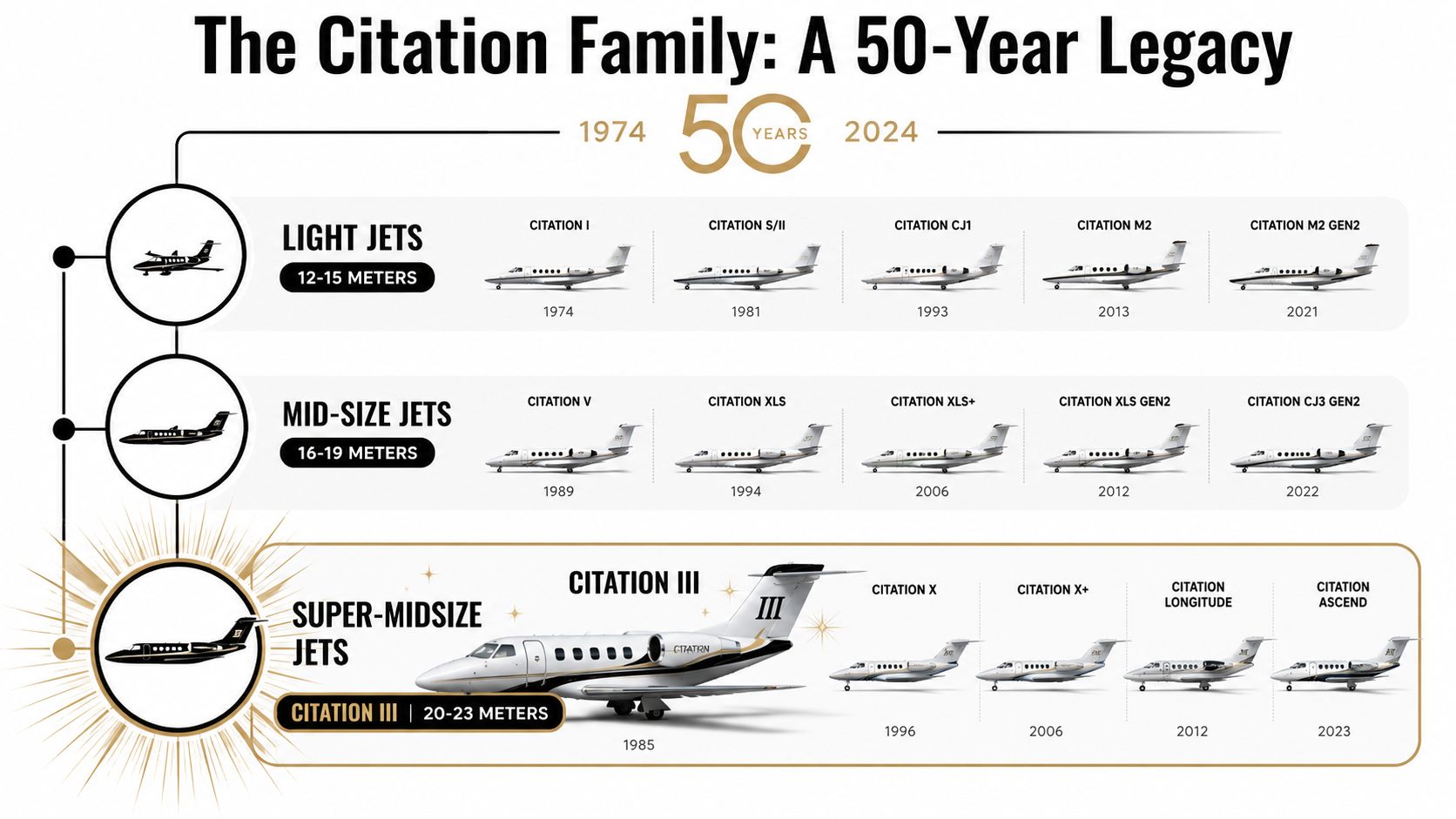
A common request is straightforward. A client wants a mid-size private jet with enough cabin space to feel like a proper upgrade from a light jet, but without drifting into the higher cost profile of a larger cabin aircraft. In charter terms, that usually points to the Citation III rather than a separate “111” aircraft listing. The Citation line itself is a family of twin-engine business jets built by Cessna/Textron Aviation, spanning aircraft roughly 12 to 23 meters long, and it has long been described as one of the most successful aircraft families in its class, alongside the Learjet series (source).
That matters because first-time clients do not buy airplane names, they buy trip outcomes. They want the right cabin, the right baggage room, and the right range for the mission without paying for capability they will never use. A wrong model name pushes them into the wrong pricing band, the wrong comfort expectation, and the wrong aircraft fit.
Practical rule: if your search query is fuzzy, your quote request has to be precise. Otherwise, you get a “Citation” answer instead of a usable aircraft recommendation.
The quickest way to avoid that problem is to ask for the exact year, make, model, and cabin layout, not just “a Citation.” For a clearer view of how the Citation family fits together, the Haute Jets Journal Citation family guide gives a useful model-by-model reference. If you want a separate background resource on company positioning, about Luxury Homes London is another reference point that sits outside the aviation spec-sheet noise.
The Citation Family in Brief and Where the III Fits
The Citation family isn't a niche model, it's a long-running aircraft line that entered service in 1972 and, within 50 years of the type's first flight in 1969, had delivered more than 7,500 Citations worldwide, the largest business jet fleet in the world by that measure (source). That scale is the reason Citations show up so often in charter conversations. There are a lot of them in circulation.
Where the Citation III sits in the lineup
The Citation III is the midsize step that separates the original light-jets from the more refined later Citation cabins. It's the kind of aircraft brokers reach for when a client wants more room than a compact Citation, but doesn't need the footprint of a true super-midsize. That's why a “Citation 111” search often lands here. People are usually looking for a named Citation variant that feels like a meaningful upgrade, not an abstract category.
The brand itself keeps evolving, too. Textron continues to roll out newer models like the Citation Ascend, and retrofit programs such as G5000 avionics for XLS and XLS+ platforms show that Citation buyers now care about current cabin and cockpit condition, not just legacy badges. In other words, the market is still active, and the gap between old and new equipment matters.
For anyone comparing aircraft classes, the III is best understood as the bridge between the practical light-jet world and the roomier midsize charter segment. It's not the answer for every trip, but it is the right answer more often than search results make it look. The class split also explains why articles that lump all Citations together usually miss the booking point entirely.
Citation III Performance Numbers Translated to the Passenger
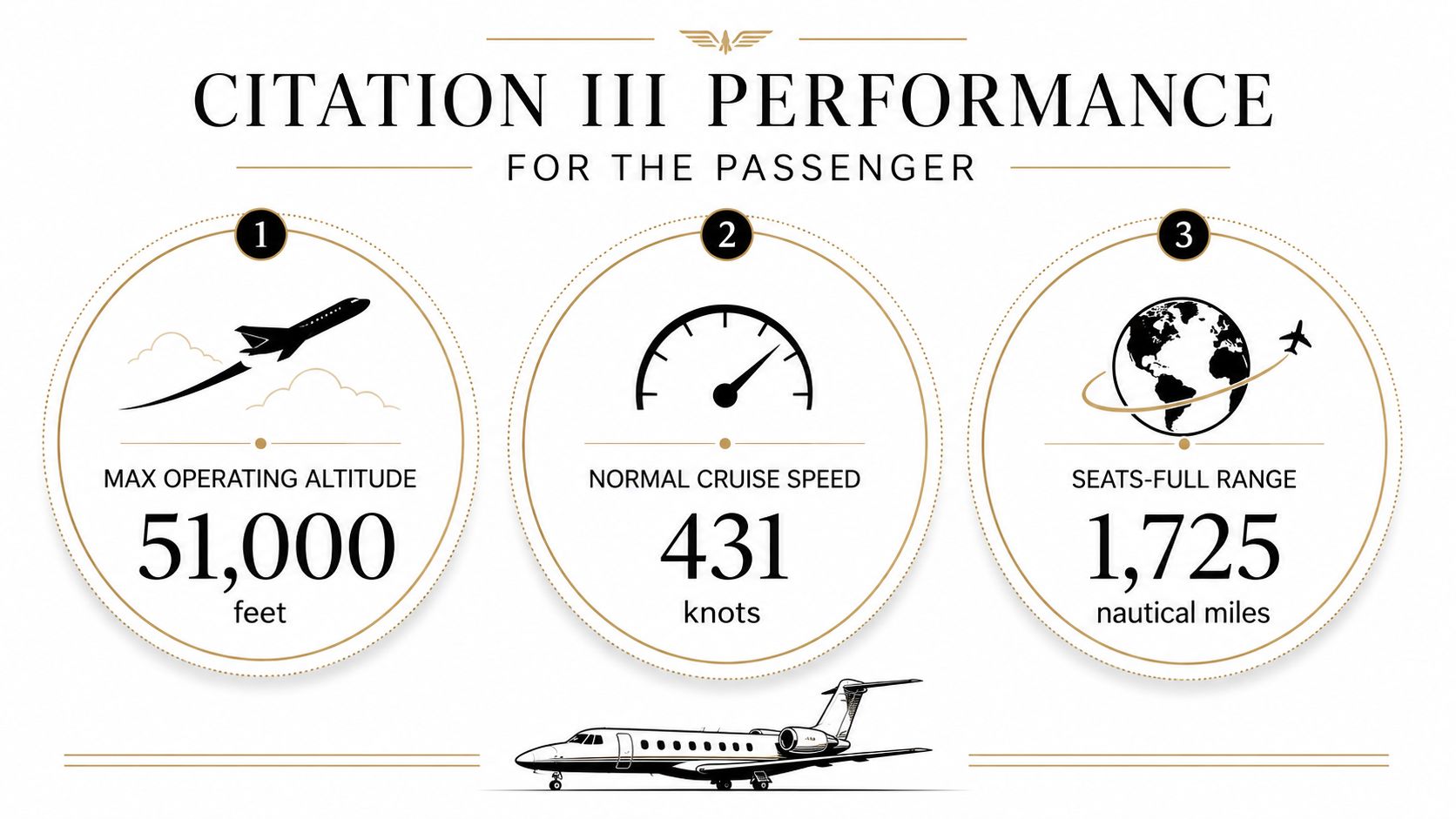
A Citation III looks simple on a spec sheet, but the charter decision is never that simple. Its published maximum operating altitude of 51,000 ft, normal cruise speed of 431 knots, and seats-full range of 1,725 nautical miles are the numbers that matter when you are comparing real trip options, not brochure fantasies. source
What the numbers mean on flight day
A 51,000-foot ceiling gives dispatch more flexibility. It lets the airplane sit above a lot of weather and traffic when conditions cooperate, which can make routing easier and reduce time spent in rougher air. It does not guarantee a smooth ride, but it gives the crew more room to work with.
The 431-knot cruise tells you this is a legitimate midsize jet, not a dressed-up light jet. That speed matters on longer legs, where the Citation III can save real time compared with slower aircraft and keep a business day from getting stretched out by the flight itself. For a charter customer, that is the difference between arriving with usable time and arriving too late to matter.
The range figure is where first-time flyers usually get misled. 1,725 nautical miles seats-full means the cabin is occupied, so the number already assumes a real passenger load rather than an empty airplane with generous conditions. Heavier baggage, stronger winds, routing changes, and reserve requirements all eat into that comfort zone. It is a planning number, not a promise.
That is why a broker should talk plainly about mission fit. A Citation III can handle nonstop missions such as New York to Dallas or Los Angeles to Chicago when payload, weather, and reserves line up well. If you are carrying more people, more bags, or want more margin built into the trip, the smarter answer is usually a larger cabin or a different aircraft.
Broker's read: seats-full range is the number that tells the truth. The smaller the payload, the nicer the brochure range looks, and that is where buyers start making the wrong call.
The Citation III's published Mach 0.851 maximum speed, equal to 492 knots, and cruise speed of 472 knots also help when you are comparing it against other charter options on raw performance. source The takeaway is straightforward. The jet is fast enough to matter, but speed alone does not make it the right answer for every trip.
Inside the Citation III Cabin and Baggage
The Citation III is a midsize jet, and that distinction is obvious once you step inside. This isn't a stretched light jet pretending to be more. It's built for a working group that needs a proper cabin, not just seats.
What feels different inside
A broker's honest version of the cabin is this. The III typically works well for a small business team or a family that wants room to talk, work, and land without feeling squeezed. Club seating gives the cabin a social layout, and the aft lavatory keeps the main seating area from feeling like a commuter van in the sky. That alone makes a difference on anything beyond a short hop.
Baggage is where buyers should slow down and ask better questions. The Citation III can handle regular luggage for a charter group, but the right answer depends on how much room you need for hard cases, golf bags, or bulky winter gear. If the trip involves heavy packing, don't assume every Citation will swallow the same amount of baggage just because the family name sounds familiar. Ask for the actual aircraft tail and cabin configuration.
Amenity expectations should stay grounded. A galley can support hot catering on the right aircraft, Wi-Fi may exist on retrofitted airframes, but it's not guaranteed, and older III airframes won't always feel as polished as newer Citation cabins. Pressurization and comfort also vary more on older examples than casual buyers expect. That's why the badge matters less than the condition of the individual jet.
If you're moving six or eight people with normal luggage, the Citation III can be a sensible fit. If the trip is really about a true transcontinental mission, or you need a full stand-up cabin and more onboard flexibility, step up instead of trying to force the III into a role it wasn't built for. Buyers lose money when they rent the wrong cabin class just to save a category change.
Citation III Against Phenom 300, Latitude, and Challenger 350
A Citation III quote rarely gets judged in isolation. It sits next to the Embraer Phenom 300, the Cessna Citation Latitude, and the Bombardier Challenger 350, because that is how buyers compare charter options, by cabin feel, mission fit, and what the trip will cost once the aircraft shows up on the invoice.
Side-by-side charter fit
| Aircraft | Cabin Class | Cruise Speed | Seats-Full Range | Typical Seats | Best-Fit Mission |
|---|---|---|---|---|---|
| Citation III | Midsize | 431 knots normal cruise, 472 knots cruise (source) | 1,725 nautical miles (source) | Varies by configuration | Regional and some longer nonstop missions when payload is manageable |
| Phenom 300 | Light jet | About 453 knots | About 1,971 nautical miles | Typically 6 to 8 | Shorter trips where speed and a smaller cabin are acceptable |
| Citation Latitude | Midsize | About 442 knots | About 2,700 nautical miles | Typically 8 | Midsize missions where newer systems and a flatter cabin matter |
| Challenger 350 | Super-midsize | About 448 knots | About 3,200 nautical miles | Typically 8 to 10 | Longer-range travel with a larger cabin feel |
How I'd choose among them
The Phenom 300 works when the trip is shorter and the cabin tradeoff is easy to accept. It is a light jet first, so buyers who care about cabin depth, baggage flexibility, or a little more elbow room should not force that comparison. The Citation Latitude is the cleaner modern Citation answer for clients who want a midsize cabin with newer systems and a more refined ride. The Challenger 350 is the step-up when the mission starts to feel like real cross-country private flying and the cabin becomes part of the reason to charter.
For a closer look at why buyers move into the Challenger class for longer trips, the comparison in Haute Jets Journal's Challenger 350 guide is a useful reference.
The Citation III still has a place when the route fits its envelope and the price comes in right. If the aircraft is well kept, the operator is strong, and the trip stays inside its real-world range, it can beat the newer options on value. That matters on routes where a light jet feels too small, but a super-midsize quote feels excessive. For first-time charter buyers, that is the decision point that matters, not the badge on the tail.
Why Operator Ratings and Aircraft Condition Trump Model Name
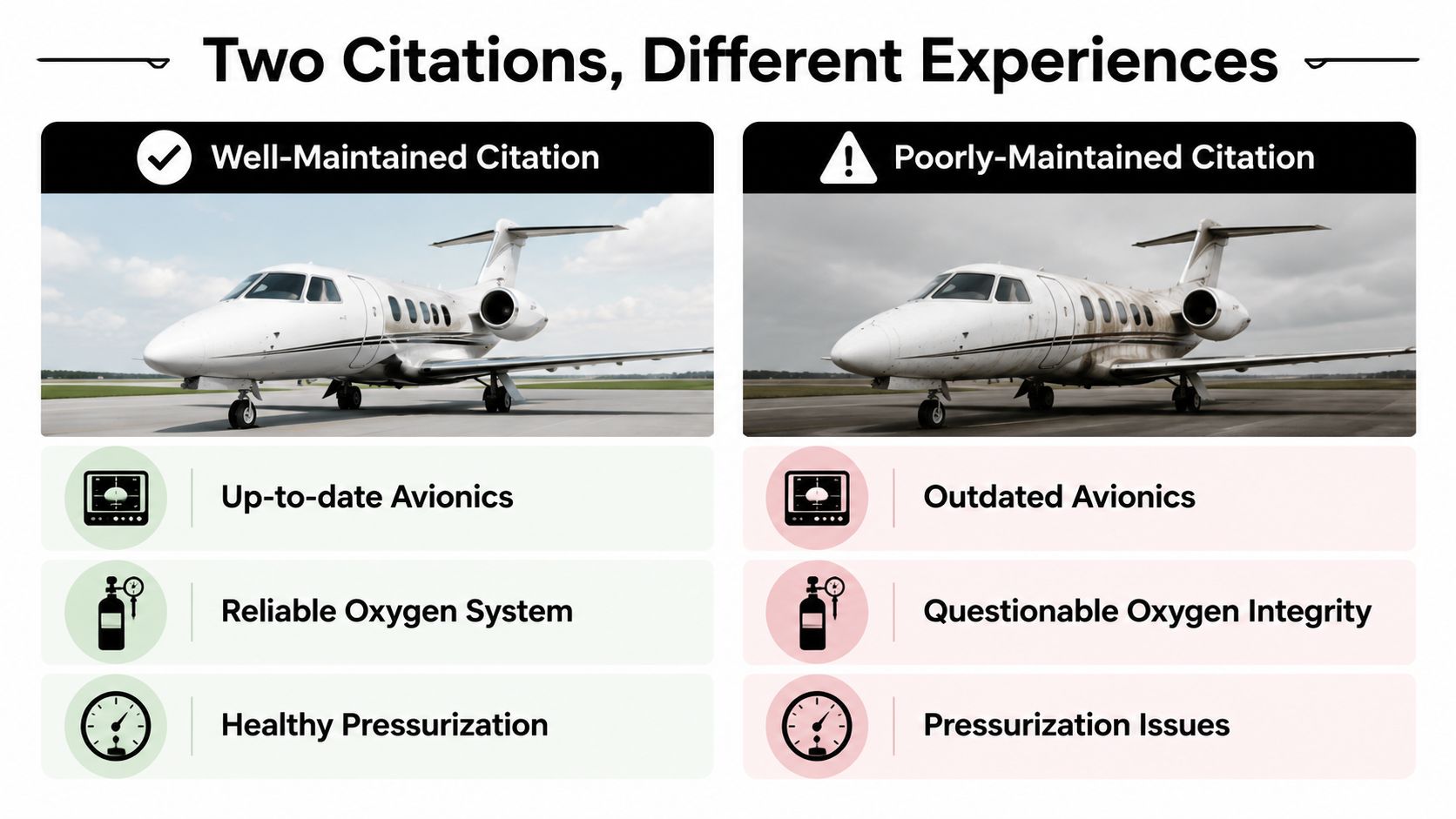
Two Citations with the same model badge can feel completely different. One flies clean, quiet, and confidence-inspiring. The other feels tired, and that gap usually comes down to maintenance, avionics, oxygen systems, pressurization, and how seriously the operator treats day-to-day upkeep.
What to care about before the tail number
Older Citation airframes deserve extra scrutiny because condition changes the risk profile fast. Pressurization and oxygen-system failures have contributed to past Citation incidents, which is why I do not let buyers treat a model name as a safety shortcut. The aircraft's upkeep matters. The maintenance record matters. The condition of the oxygen equipment matters.
Third-party operator ratings matter more than glossy brochure copy. Wyvern Wingman and Argus Gold/Platinum audit the things travelers cannot see from the ramp, crew training, maintenance programs, and operational history. Haute Jets says it filters its network to those two tiers, which is the standard I want a charter buyer to insist on wherever they shop.
A pretty cabin does not tell you whether the aircraft is dispatched well. A clean safety record starts with the operator, not the marketing photo.
Modern retrofit trends matter too. Textron's continued rollout of newer models such as the Citation Ascend and avionics upgrades for XLS and XLS+ platforms show that Citation buyers are not shopping legacy metal alone. They are shopping upkeep, update level, and reliability.
The plain advice is simple. If the operator will not share safety credentials, maintenance clarity, and aircraft details, walk away. A cheap quote is not a bargain if the jet is tired. Buyers who chase only the lowest number usually end up paying twice, once in charter cost and again in frustration. For a clear breakdown of what drives pricing, see Haute Jets' private jet charter cost guide.
What Chartering a Citation III Actually Costs in 2026
Citation III pricing moves with the usual variables, but the quote gets distorted when the aircraft has to be pulled from far away. That's where a lot of first-time buyers get burned. They compare an advertised hourly rate to a real trip quote and can't tell why the final number is higher.
The line items that move the quote
The big variables are departure city, repositioning distance, fuel surcharge, crew overnight, FET, and whether the operator is eating or passing through deadhead legs. Those are the levers that make one Citation III quote look reasonable and another look inflated. If the aircraft is already based near your departure airport, you usually avoid the ugly repositioning math that drives charter prices up.
That's where local sourcing matters. Haute Jets says it sources from 3,500+ owner-operators across 175 countries and prioritizes aircraft near the departure city, which it says can eliminate repositioning fees that inflate charter prices by 20–40% with traditional brokers and jet card programs. If you're comparing quotes, that's the difference between a clean wholesale-style number and a padded one.
The most useful way to think about 2026 pricing is qualitative unless you have a specific route in hand. A Citation III on a domestic route should be priced as a midsize charter, not as a luxury curiosity. Popular one-way city pairs like New York to Miami or Los Angeles to Las Vegas will still move based on aircraft location, timing, and whether the operator has to stage the jet in from somewhere else. If you want a separate framework for how charter quotes are built, the cost guide at Haute Jets' private jet charter cost page is the right place to compare line items.
Budget rule: if your quote looks cheap but includes deadhead, overnight, and fuel extras, it's not cheap. It's just incomplete.
The pricing model that pays per flight at wholesale rates is different from jet card or fractional economics. You're not prepaying hours or subsidizing a network structure you may never use. You're buying the flight you need, on the aircraft that fits the mission.
Booking the Citation III Through Haute Jets Without a Membership
The cleanest way to book a Citation III is to ask for the exact trip, not a category placeholder. Send the departure airport, arrival airport, passenger count, baggage load, and any flexibility on time or date. That lets the team source the specific aircraft instead of tossing you into a generic midsize bucket.
What to confirm before you pay
- Aircraft identity: Ask for the year, make, model, and cabin layout, not just “Citation.”
- Cabin details: Confirm Wi-Fi, catering, pet rules, and ground transport before you lock it in.
- Safety details: Require the operator rating and the actual tail assignment.
- Pre-flight package: Expect the final confirmation with tail number, crew bios, weather briefing, and passenger manifest 24 hours before departure.
That's the right flow for an on-demand charter booking. You don't need a membership, a jet card, or annual fees to get there. You need a quote that's specific enough to judge, then a confirmation process that removes surprises at the terminal.
If an offer is vague about “light jet” or “similar aircraft,” push back. If repositioning charges show up without an explanation, push back harder. If safety ratings are missing, don't book. There's no upside to being polite about a bad quote structure.
A CTA for Haute Jets. If you're ready to stop guessing between a Citation name, a cabin class, and a real charter price, send your route, date, passenger count, and baggage details now, then ask for the exact Citation tail, operator rating, and all-in quote before you commit.