

You're trying to solve a real trip problem, not admire an aircraft spec sheet. A full cabin wants to leave New York, land in Los Angeles without wasting time, and arrive with enough comfort left that the flight didn't feel like a chore. That's where the Cessna Citation Latitude earns attention, because it sits in the sweet spot where range, cabin space, and charter economics all matter at once.
Introduction to the Cessna Citation Latitude
A coast-to-coast charter exposes the Latitude's real value fast. If you're moving executives, family, or clients from New York to Los Angeles with bags, you don't want a jet that only looks good on paper. You want an aircraft that can handle serious mission planning, keep the cabin comfortable, and avoid unnecessary cost creep.
The Cessna Citation Latitude entered service in 2015 and sits in Textron Aviation's Citation family, which first entered service in 1972 (Textron Citation family overview). Textron's product card also describes it as the best-selling midsize business jet, with a flat floor and six-foot stand-up cabin as defining cabin features (Citation Latitude product card).
That combination is why buyers keep coming back to it. It's big enough to feel premium, practical enough to book regularly, and structured well enough that charter clients can use it without overpaying for excess aircraft. Haute Jets Journal should treat this jet as a benchmark for what a super-midsize charter is supposed to do, which is move people efficiently without turning every trip into a compromise.
Model Overview and Performance Specs
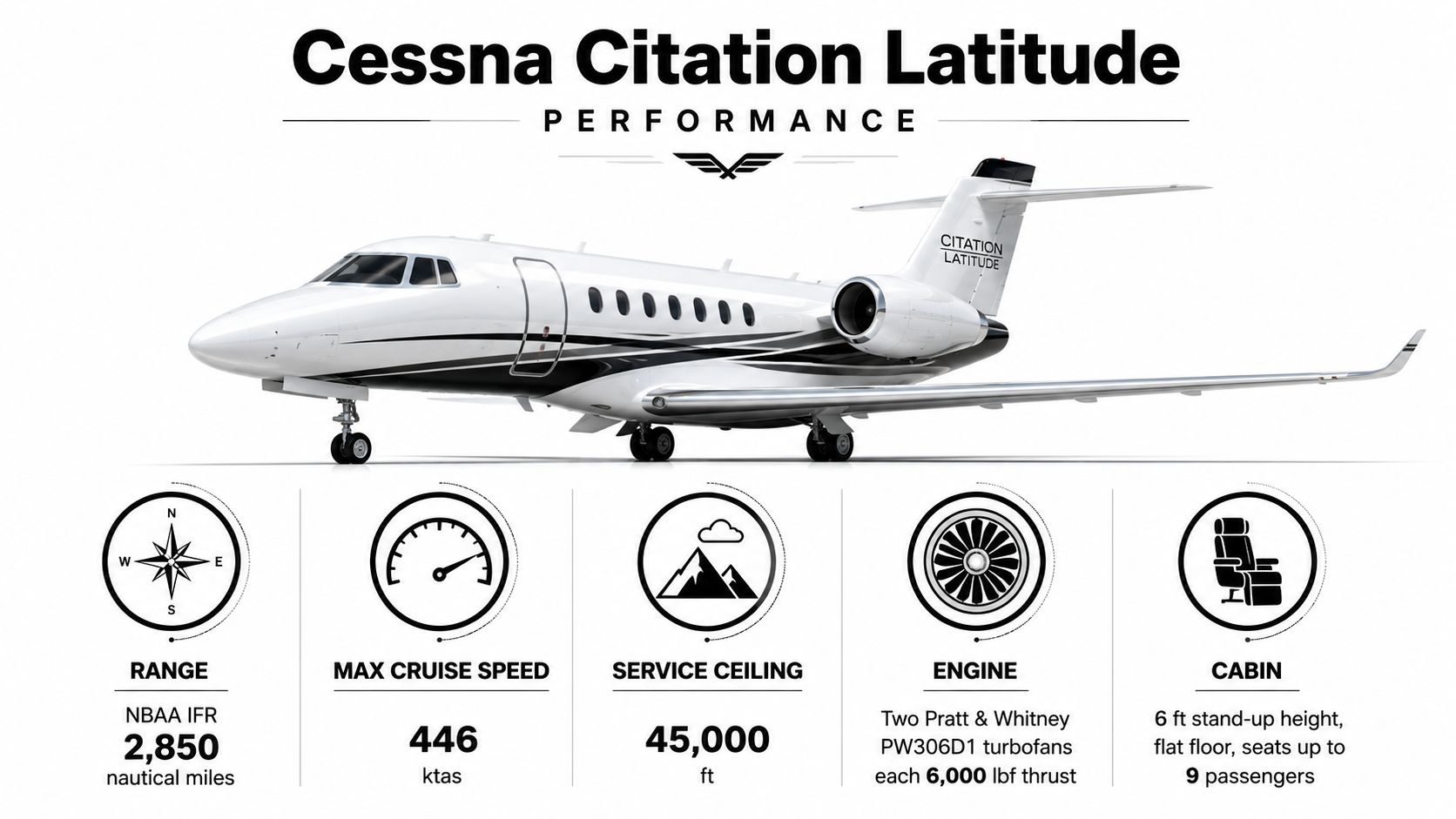
A Latitude works when the mission calls for real reach without stepping up to a larger cabin class. The published NBAA IFR range of 2,850 nautical miles, 446 ktas maximum cruise speed, 45,000-foot service ceiling, and seating for up to nine passengers place it firmly in super-midsize territory (Citation family specs). For charter buyers, that profile matters because it keeps nonstop planning on the table for many domestic trips, while still avoiding the operating burden of a heavier jet.
What those numbers mean in practice
Range only helps if you use it correctly. A jet that lists 2,850 nautical miles still has to clear passenger load, routing, winds, reserves, and weather buffers, so the actual mission plan matters more than the brochure figure (Latitude performance guide). For charter planning, I treat range as a working envelope, not a promise.
Speed is the other number clients fixate on, and it should guide decisions. At 446 ktas, the Latitude shortens long days enough to matter, especially on business itineraries where schedule reliability counts more than bragging rights. You get solid cruise performance without paying for a speed class that forces unnecessary cost.
Cabin capacity and payload trade-offs
Seating for up to nine passengers makes the Latitude a sensible fit for corporate groups and family travel (Citation family specs). Payload still changes the picture. Add people, luggage, catering, and reserve fuel, and usable range drops. That is normal, and it is the first thing to model before you book.
Practical rule: the fuller the cabin, the more your trip should be planned around the route, not the brochure range.
For buyers comparing charter options, the key question is whether the aircraft matches the mission without waste. Start with route structure, then cabin comfort, then price. If you want a wider view of comparable aircraft, review Haute Jets' midsize jet options.
Cabin Features and Layout Options
The Latitude's cabin works because it feels like a real room, not a squeezed-in tube. Textron's card highlights the flat floor and six-foot stand-up cabin, and those are the details passengers notice the moment they step aboard (product card PDF). For a charter client, that means easier movement, better visibility, and less awkward ducking than you get in smaller cabins.

Layout choices that matter
The right cabin setup depends on who is flying and how the trip will be used. A club-style layout suits executives who want to talk face to face. A more open arrangement works better for families or mixed groups that need room to relax. If you are carrying luggage-heavy travelers or a team that values quiet, the Latitude's cabin geometry matters more than a flashy interior finish.
That matters on longer sectors. When passengers can stand up, shift seats, or hold a working conversation without feeling cramped, the flight feels productive instead of draining. For charter buyers, that is the value of the cabin.
Comfort details that shape the trip
Wi-Fi, catering, pet policies, and ground transport still depend on the operator and the exact aircraft configuration. Do not assume those details are standard just because the aircraft is familiar. Ask for the exact cabin layout, then confirm the amenities before you book.
The Latitude's cabin identity is one reason Textron describes it as the best-selling midsize jet in its materials, but the practical advantage is simpler. It gives charter clients a cabin that feels premium without forcing them into the economics of a much larger aircraft.
Charter Costs and Mission Profiles
A Citation Latitude is priced by mission, not by a single hourly quote. Market data puts new pricing at $17.325 million, while other buyer guides place new aircraft closer to $19.5 million and used examples across a wider band, depending on year and condition (GlobalAir specs, Flycraft market data). That spread is the starting point for charter buyers and owners, because age, configuration, and availability drive what you will pay.
Why the range discussion gets messy
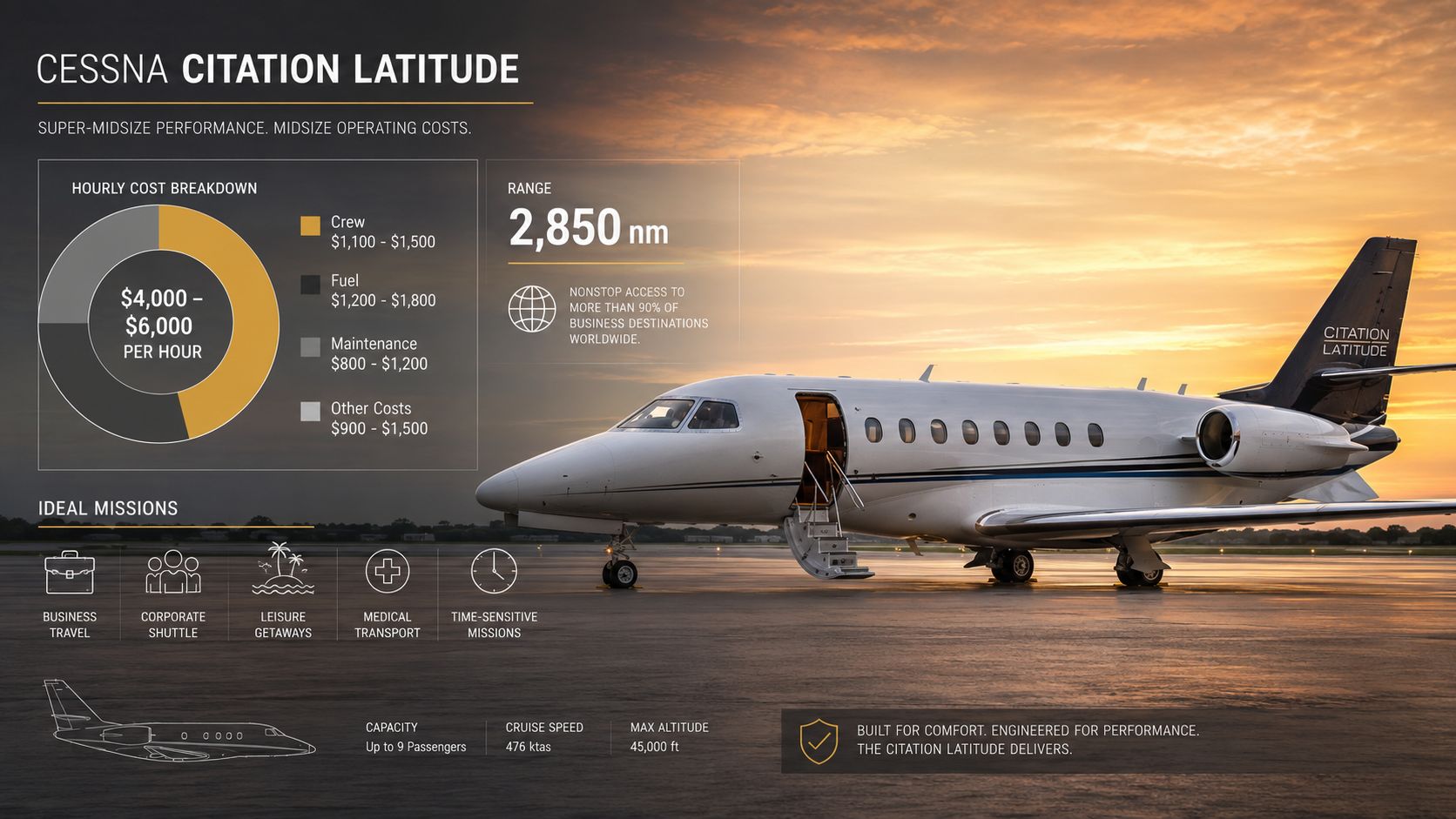
Textron's own Latitude page makes the issue plain. The published 2,700 nm marketing range depends on passenger load, fuel reserves, and standard operating conditions (Textron Latitude page). Buyers get caught when they treat that figure as a guarantee. A jet can look perfect on paper until you add passengers, baggage, weather margin, and a dispatch plan that reflects how flights are really flown.
Use route analysis, not brochure logic. For a coast-to-coast U.S. trip, the Latitude can fit the mission under favorable conditions, and the aircraft's published performance sits in the right band for that kind of planning (performance guide). Caribbean sectors are usually easier because the distances stay comfortably inside the aircraft's envelope. Longer European legs demand a stricter payload check and, in many cases, a fuel stop.
The cost picture you should use
Textron's brochure lists direct operating cost at $2,741 per hour, while independent calculators put variable cost near $4,030 to $4,479 per hour and all-in hourly cost around $6,228 to $7,321, depending on utilization assumptions (aviacost operating calculator). Use those figures as a range, not a promise. The mission, dispatch profile, and ownership structure change the answer.
For charter planning, that means three clear use cases.
- Short-haul charter: the Latitude gives you speed and cabin space, but the per-mile economics can look weak on very short legs.
- Longer U.S. sectors: the aircraft earns its keep on these missions, because you are using range and cabin comfort together.
- Owner use: the numbers improve when the schedule is steady and the aircraft is flown often enough to spread fixed cost sensibly.
The cost picture to use is simple. Ask what the full trip costs after positioning, timing, and cabin requirements are added. That is the number that matters on a quote.
Here is where Haute Jets' local sourcing model matters. If you are comparing a Latitude charter against a close alternative, use this Legacy 500 vs Citation Latitude comparison to judge whether the mission justifies the aircraft choice or whether a different midsize jet delivers better value. That keeps hidden fees in view before the aircraft is confirmed.
Aviation data also show the Latitude market reaching USD 2.14 billion in 2024, with USD 3.68 billion projected by 2033 (Flycraft market data). Read that as a sign of steady demand, not a reason to buy without a route-by-route plan.
Comparisons and Safety Ratings
The Citation Latitude wins on balance, not flash. If you are comparing it with super-midsize options like the Challenger 350 or Gulfstream G280, judge it by how well it fits real missions, not by brand cachet. Its 2,850 nm range, 446 ktas cruise speed, and super-midsize cabin make it a strong charter pick for travelers who value usable space and sensible trip planning over prestige (Citation family specs, Latitude market guide).
| Jet Model | NBAA IFR Range (nm) | Max Cruise Speed (ktas) | Cabin Height (ft) | List Price (USD) |
|---|---|---|---|---|
| Cessna Citation Latitude | 2,850 | 446 | 6 | Around 17.3M to 19.5M |
| Challenger 350 | Range and speed vary by source and operator configuration | Range and speed vary by source and operator configuration | Cabin height varies by configuration | Pricing is quote-based and not consistently published |
| Gulfstream G280 | Range and speed vary by source and operator configuration | Range and speed vary by source and operator configuration | Cabin height varies by configuration | Pricing is quote-based and not consistently published |
That is the right way to compare these aircraft when you are buying charter hours or building a purchase case. The Latitude figures are the anchor. For the Challenger 350 and G280, serious buyers should ask the operator or broker for the exact tail, configuration, and trip profile, then compare the quoted mission cost against the cabin and fuel burn you need. If you want a tighter side-by-side on mission fit, use this Latitude versus Legacy 500 guide and compare the aircraft on route economics instead of brochure language.
Safety audits matter more than marketing names
Operator quality matters as much as the aircraft model. Haute Jets sources from operators with Wyvern Wingman or Argus Gold/Platinum ratings, which are the safety checks that should sit ahead of any shiny cabin photos or empty promises. That is the standard I recommend for every Latitude charter, because a clean dispatch record and a disciplined maintenance culture matter more than a nameplate.
If two quotes are close, choose the operator with the cleaner safety record and the clearer dispatch process.
For a deeper aircraft comparison, use this Latitude versus Legacy 500 guide as a separate decision aid. Compare by mission first. A jet that looks right on paper can still be the wrong aircraft once the route, cabin load, and charter quote are in front of you.
Booking with Haute Jets
Start with the aircraft, not the brochure language. Ask for the exact year, make, model, and cabin layout, then confirm Wi-Fi, catering, pet policy, and ground transport before you lock in the trip. If you skip those details, you buy uncertainty, and uncertainty is where charter quotes get ugly.
Use local sourcing first
Haute Jets works from a network of 3,500+ owner-operators across 175 countries, which matters because local sourcing is how you avoid paying for repositioning aircraft that started somewhere else. That approach is built around matching the aircraft to your departure city rather than chasing the nearest available tail from far away. In practical terms, that's where charter clients reduce waste.
The published market data on Latitude production helps here too. Guardian Jet reports that about 394 Citation Latitude jets had been produced by mid-2025, which gives brokers and operators enough supply depth to source the model across multiple markets (Guardian Jet aircraft brochure). That's not scarcity, it's distribution.
Confirm the flight details before departure
Don't wait until the airport to find out what you booked. Ask for a 24-hour preflight confirmation that includes the tail number, crew bios, weather briefing, and passenger manifest. That process cuts surprises and lets you spot mismatch problems before they become terminal problems.
For booking mechanics, use Haute Jets' booking guide as your process reference. My recommendation is blunt, use on-demand charter when your route changes often, your departure city matters, or you want the exact aircraft rather than a generic category. If the quote includes unnecessary positioning, push back hard.
Conclusion and Next Steps
The Cessna Citation Latitude works because it hits the middle of private aviation where most actual trips live. It has enough range to matter, enough cabin comfort to feel worth paying for, and enough market presence to be sourced without turning every trip into a hunt. That's why it stays relevant for both charter clients and buyers.
The decision comes down to mission honesty. If you need long-legged, flexible super-midsize travel, the Latitude is a strong fit. If the whole trip only makes sense after hidden repositioning and loose cabin assumptions, the quote is wrong, not the aircraft.
Use the route first, then the cabin, then the economics. Ask whether the aircraft can cover the leg with your passenger load, whether the operator is audited properly, and whether the price includes avoidable waste. That's how you stop overpaying for a jet that looks fine in a brochure but misses the job you need done.
Frequently Asked Questions
How many passengers does the Citation Latitude carry in real charter use?
The published seating figure is up to nine passengers (Citation family specs). In practice, the exact comfort level depends on the cabin layout and luggage load. If you're flying with a full group, ask for the seating plan before you commit.
Can I book peak-season trips as an empty leg?
Sometimes, but don't build a trip plan around that hope. Empty legs depend on the operator's repositioning needs and schedule changes, so they're useful when available but unreliable as a core booking strategy. For a mission that has to happen, book the aircraft you need.
Are pets allowed on Latitude charters?
Pet policies vary by operator and aircraft. Confirm the rule before booking, because some crews accept pets under standard conditions while others impose restrictions based on cabin layout, cleaning requirements, or route length. The safest move is to ask for the policy in writing.
Can I pay with digital assets?
Some charter buyers ask for that, but payment options depend on the broker and operator structure. If this matters for your trip, raise it early, before quotes are finalized. That avoids delays at the contract stage.
What's the biggest booking mistake with this jet?
Assuming brochure range equals your exact mission. The Latitude is a strong aircraft, but cabin load, reserves, and routing still change what's practical. Treat the quote as a route-specific calculation, not a generic promise.
If you want a straight answer on whether the Citation Latitude fits your trip, Haute Jets can source the aircraft locally, confirm the exact cabin and operator details, and remove the pricing noise that usually hides in charter quotes. Visit Haute Jets to request a flight plan that matches your route, your passenger count, and your budget without paying for unnecessary repositioning.