You're probably dealing with a charter booking right now, or you've got one coming up fast. A client moved the departure window. The aircraft changed. Catering needs adjusting. Maybe the passenger list shifted again, or a pet has to travel same-day. That's when charter customer service stops being a nice-to-have and becomes the whole product.
In private aviation, the cabin is only half the story. The difference between average and elite support is whether the provider keeps the trip stable when the details change. If the person taking your call can solve the problem without handing you off three times, that's service. If they can't, the jet doesn't matter much.
When the Concierge Call Becomes the Whole Experience
A corporate traveler doesn't remember the brochure language after a bad handoff. They remember the call at 9 p.m., the catering change that never made it to the crew, and the silence when they asked for the tail number. That's the moment charter customer service is judged, not by the aircraft category, but by whether the trip still works when the schedule doesn't.
The best charter teams understand that every booking is a chain of small promises. Confirm the jet. Confirm the operator. Confirm the crew. Confirm the ground side. If any one of those breaks, the traveler feels it immediately. That's why poor service in high-stakes categories drives churn so easily, while strong service supports repeat business, loyalty, and willingness to pay more for reliability, according to a widely cited 2026 industry roundup and a 2025 customer-service compilation on customer service loyalty behavior and retention economics.
The pressure test happens before takeoff
A traveler who books private aviation is paying for certainty. They want the airplane, but they're really buying coordination, discretion, and fast answers when the itinerary shifts. In that sense, service is the product. A smooth ground transfer, a correct manifest, and a crew that already knows about the dietary request are not extras, they're the baseline.
Practical rule: If a provider can't keep the booking clean before departure, don't expect miracles after departure.
That's also why elite travelers are less forgiving than casual buyers. They're evaluating whether the provider behaves like an operator or like a middleman. The difference shows up in the first conversation. One side asks what you need and closes the loop. The other side asks you to repeat yourself until the trip has already become fragile.
A strong concierge call does one more thing well. It removes uncertainty without making the traveler chase details. That's the standard worth holding every charter provider to.
What Charter Customer Service Actually Covers
Charter customer service is the full lifecycle of trip support, not the booking call. It starts with sourcing the right aircraft and confirming the operator's safety credentials, then moves through tail-number confirmation, catering, Wi-Fi, pet policy, and ground transport, before continuing through departure, arrival, and any post-flight issue. If a provider only helps with the quote, they're not really delivering charter service. They're selling access.
The operational model should have four pillars. First, safety verification. Second, pre-flight confirmation. Third, in-trip support. Fourth, post-trip accountability. The buyer who understands those pillars can separate real service from polished language.
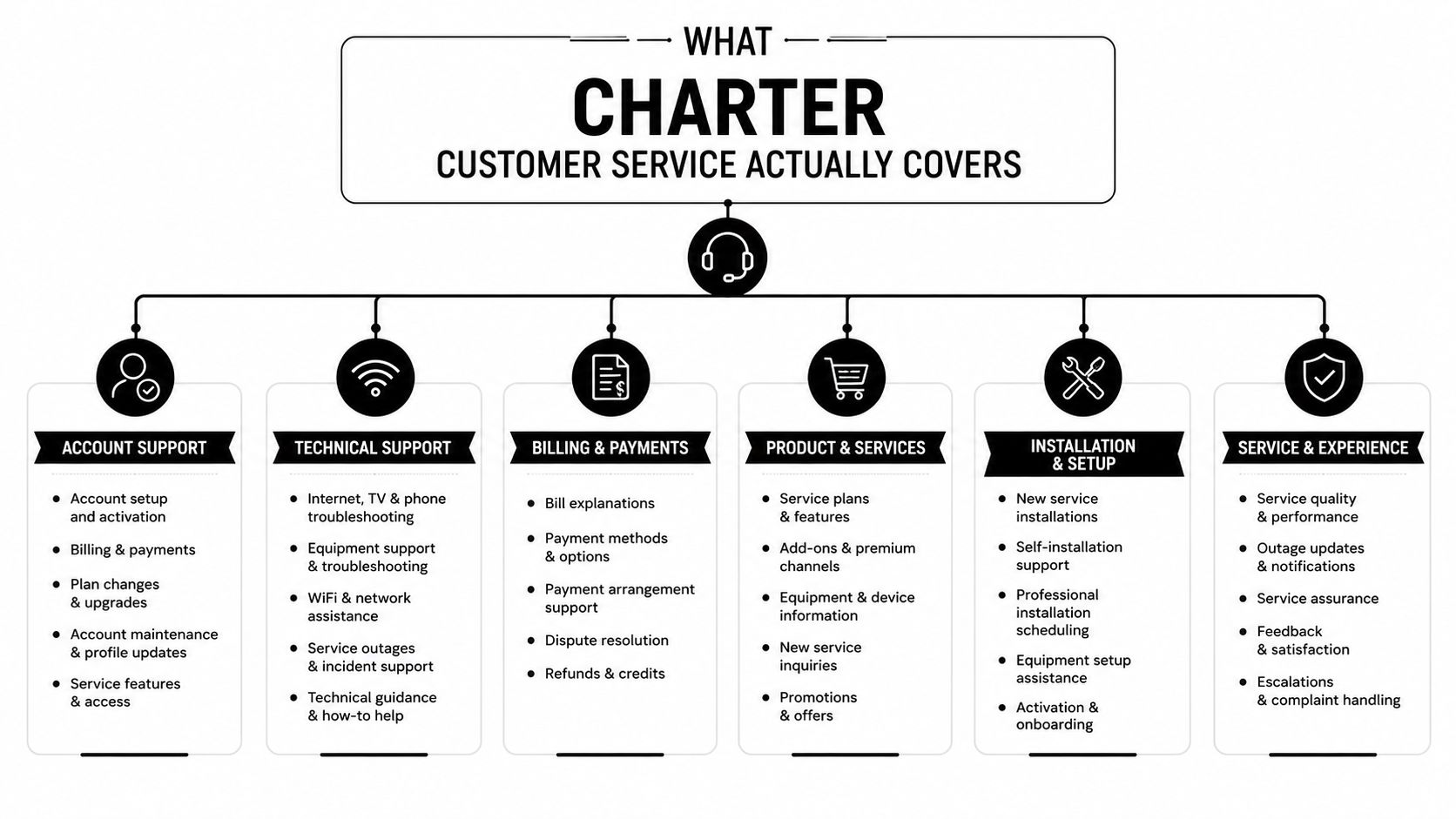
The four pillars that matter
Safety verification is essential. You should know who operates the aircraft, what audit standard they hold, and whether the sourcing model excludes weak operators. Haute Jets uses a Wyvern and Argus-only sourcing model, which is a useful example of a high-floor approach because it limits the operator pool instead of treating every available aircraft as interchangeable. You can review the provider's safety posture at Haute Jets safety standards.
Pre-flight confirmation is where sloppy brokers fall apart. This is the package that should tell you the tail number, crew details, weather picture, and passenger manifest before the flight. If you're still chasing those basics on departure day, the provider has already failed the service test.
In-trip support covers schedule changes, cabin requests, handling questions, and operational updates. The provider should be reachable, responsive, and specific. No vague “we'll check” messages that leave you waiting while the clock runs.
Post-trip accountability matters more than most buyers admit. When something is off, good service logs it, fixes it, and prevents the repeat. Bad service apologizes and disappears.
A complete charter engagement should feel like one coordinated workflow. If it feels like disconnected favors, you're not getting elite service, you're getting fragmentation with a luxury label.
What to expect from a complete charter service model
| Confirmation Element | What to Look For |
|---|---|
| Operator Safety Audit | Wyvern Wingman or Argus Gold/Platinum, not a vague “approved operator” label |
| Aircraft Identification | Exact tail number, not just the aircraft category |
| Crew Details | Names or bios, not a generic “crew assigned” note |
| Weather Briefing | Practical departure-relevant summary, not a copied forecast |
| Passenger Manifest | A checked and corrected manifest before departure |
| Ground Coordination | Pickup timing and location confirmed in writing |
| Special Requests | Catering, Wi-Fi, pets, and luggage handled before travel day |
The best charter companies treat that list as routine. The average ones treat it like a special favor.
Safety Audits and Pre-Flight Confirmation Standards
A charter provider that cannot speak plainly about safety is not a serious option. I do not mean they need to bury you in acronyms. I mean they should explain the third-party standard they use, the aircraft sourcing method behind the booking, and how they verify the flight before wheels-up. If they hedge on any of that, walk.
Wyvern Wingman and Argus ratings matter because they come from outside the provider, not from a sales team inventing its own badge. Haute Jets' operator model is built around those standards, and that is the right direction for high-ticket travel because it sets a real floor under sourcing discipline. A broker that will take almost any aircraft available has a service problem before the booking even starts.
The true test is what happens when the safety file is thin, late, or inconsistent. Weak providers rush the booking through and hope no one asks for the audit record, the operator history, or the safety review behind the scenes. Strong providers slow the process down until the paperwork matches the aircraft and the operator matches the promise. That difference is not cosmetic. It is where risk gets absorbed or pushed onto the passenger.
What a clean confirmation package looks like
A proper confirmation package should show that someone checked the trip instead of just forwarding a reservation. Missing pieces here are not small clerical mistakes. They are usually a sign that the provider is passing information between layers instead of owning the flight from start to finish.
A tight safety file should include the operator audit status, the aircraft identity, the crew assigned, and any trip notes that affect the operation. It should also be written clearly enough that a client can compare it against a private jet concierge service framework from Haute Jets without having to decode sales language. If the file is vague, the process is vague.
The sharpest red flag is a provider that cannot produce the safety record on request or treats that request like a nuisance. That is a bad sign at any price point, and it is a deal-breaker in premium charter. Good teams hand over the facts quickly. Bad teams stall, soften the language, and hope the client stops asking.
A proper safety process should also answer the question of who reviewed the flight and when the review happened. If the provider cannot show that chain, the booking may still happen, but the client is absorbing avoidable uncertainty. That is exactly why travelers should check the provider's safety standards page before they commit.
There is also a wider security mindset that belongs in this part of the process. On the ground, some clients already expect the same level of planning from concierge patrol services Sacramento, because they know visible oversight and clear handoff procedures reduce problems before they start. Charter service should meet that same standard of discipline. The best providers do not just sell access. They document control.
Concierge Touches and Payment Flexibility

The soft side of charter service isn't soft at all. Catering, Wi-Fi, pet policy, and ground transport sound simple until one of them is wrong. Then they become the reason a client thinks the provider doesn't understand premium travel.
A serious concierge process answers those items before they become problems. It should also handle special requests without making the traveler feel difficult. That includes last-minute food preferences, pet handling, baggage quirks, and car timing. If the provider acts inconvenienced by basic trip coordination, they don't belong in this business.
The payment model is part of service
Charter pricing transparency is a service feature, not just a finance issue. Wholesale access to owner-operators, direct sourcing, and a clean per-flight model all reduce friction. No memberships, no jet cards, and no annual fees remove a layer of obligation that many travelers don't need.
That matters because traditional broker and jet card models often build in repositioning costs that inflate what the client sees. Haute Jets says its local sourcing model helps avoid those repositioning fees, and the company positions itself around wholesale access to owner-operators rather than prepaid programs. That's not just a price architecture, it's a service architecture, because fewer layers usually means fewer places where details get distorted.
For readers who think concierge is only about luxury touches, I'd push them to look at security service models for comparison. A resource like concierge patrol services Sacramento shows how good service is usually defined by consistency, visibility, and fast coordination rather than by branding alone. The same logic applies in aviation.
You can also compare how charter concierge language maps to the actual booking workflow at Haute Jets' private jet concierge service page. The right question isn't whether a company sounds polished. It's whether it removes work from the traveler without creating hidden steps.
Elite service is boring in the best way. The details are already settled. The client isn't chasing updates. The team isn't improvising payment terms or cabin requests at the last minute. That's the standard.
How to Compare and Evaluate Charter Providers
Start with the operator floor. If a provider won't tell you whether the aircraft comes from a Wyvern or Argus-rated operator, stop there. Safety isn't a feature to negotiate later, it's the first filter. Charter customer service starts with the quality of the operator network, not the smoothness of the sales script.
Then look at how specific the quote really is. A weak provider sells category language. A strong one can tell you the exact aircraft, the cabin layout, and what's being sourced. That distinction matters because it tells you whether the company has real control over the trip or is just fishing for availability.
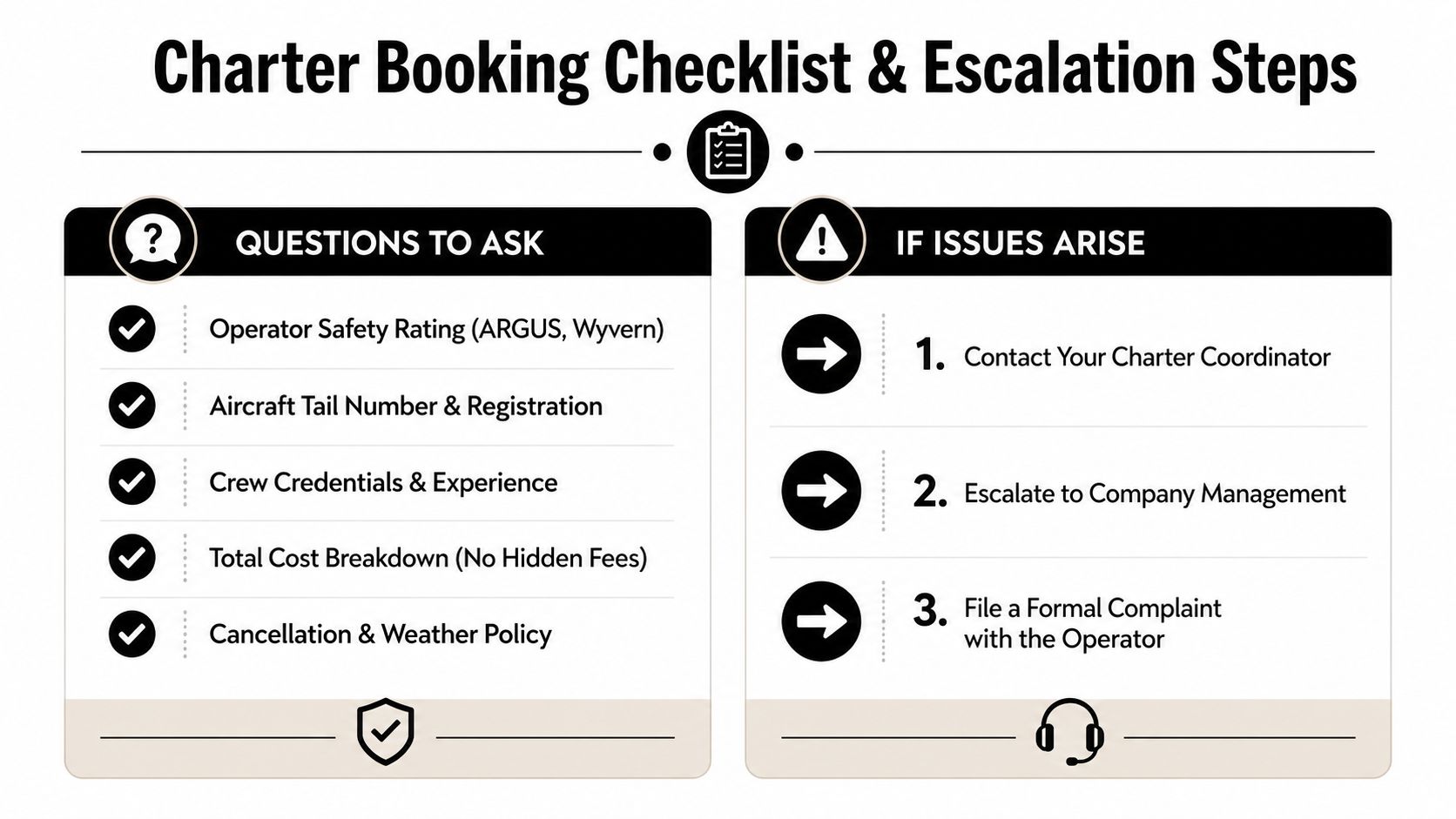
How to rank the quote in front of you
Use this as your buyer filter:
- Operator safety rating, ask for the audit standard and the operator name.
- Aircraft specificity, ask for tail number, not just jet class.
- Sourcing network, ask whether the provider can source locally or will reposition.
- Pricing structure, ask if the quote includes memberships, prepaid hours, or hidden add-ons.
- Pre-flight standard, ask what you receive 24 hours before departure.
- Escalation path, ask who owns the trip if something changes mid-flight.
The answer quality matters as much as the answer itself. A provider that gives clear, written responses is already showing you how they'll behave under pressure. A provider that answers vaguely is telling you where the friction will land later.
There's another point buyers miss. If the provider can't show a single-owner resolution path, you'll be the one stitching together catering, operations, and support when something changes. That's the charter equivalent of a call center with too many handoffs. It looks responsive at first, then gets expensive in time and trust.
For a deeper checklist on the pre-booking side, use this private-jet booking guide before you sign anything. It's the kind of review that saves you from learning the hard way.
What to do when something goes wrong
If the issue is operational, call your charter coordinator first. If it doesn't get resolved quickly, escalate to management and document the exact issue in writing. If the operator caused the problem, make sure it's logged formally so the same failure doesn't repeat.
Don't accept “we're looking into it” as closure. Ask for the next action, the owner of that action, and the time by which you'll hear back. That's not being difficult. That's managing a high-stakes travel product correctly.
Questions to Ask Before You Book and Steps to Escalate
A representative Haute Jets-style booking should feel controlled from the first contact. The provider sources a Wyvern-rated or Argus-rated operator, confirms the aircraft, and handles same-day coordination without forcing the traveler to chase each detail. That's the point of a direct sourcing model with no membership fees and no jet card layer in between.
The right questions are simple, and they should be answered cleanly. If the provider hesitates, you already have your answer.
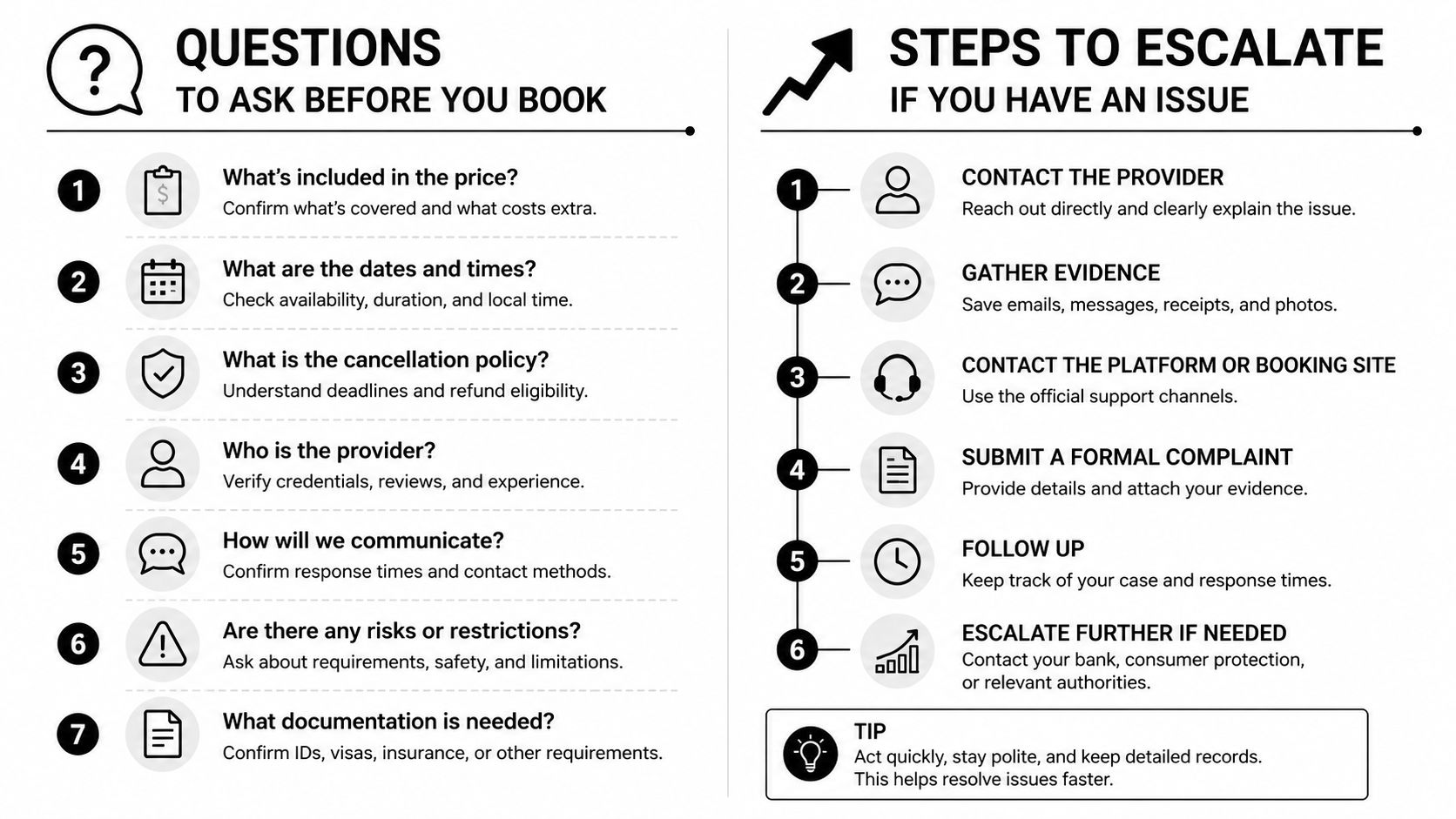
Questions to ask before you book
- What operator safety rating does the aircraft hold?
- What is the exact tail number?
- Who is the crew, and what are their credentials?
- What's included in the total price?
- How are catering, Wi-Fi, pets, and ground transport handled?
- What is the cancellation policy?
- What happens if weather or timing changes close to departure?
Those questions force specificity. They also expose whether the company is running a real support model or just pushing a quote.
Steps to escalate if the trip slips
- Contact your charter coordinator immediately.
- Ask for a direct resolution and a written update.
- Escalate to company management if the response is slow or unclear.
- Request re-protection if the flight can't operate as planned.
- Keep records of the issue, including times, names, and what was promised.
- Confirm the matter is logged for future service improvement.
The best charter providers don't get defensive when you escalate. They get specific. They know that service recovery is part of the job, not a personal insult.
For travelers who book often, this checklist belongs in the travel file. It saves time, reduces friction, and keeps the conversation focused on the details that affect the flight.
What Elite Charter Service Looks Like in Practice
Elite charter service is a system. The provider sources from a controlled operator pool, selects the exact aircraft instead of a vague category, confirms the trip before departure, and stays accountable if plans change. Haute Jets is a clean example of that model because it pairs a 3,500-aircraft, 175-country sourcing network with Wyvern and Argus-only operator standards, local sourcing to reduce repositioning waste, and a 24-hour pre-flight confirmation package.
That combination matters because it turns service into something measurable. You know who is operating, what jet is coming, and what details you should have before departure. You're not buying promises, you're buying process.
A same-day Miami departure for a transcontinental trip is where weak providers usually break down. They either overpromise on aircraft choice or underdeliver on confirmation. A disciplined model avoids that by making the trip legible to the traveler from the start.
What separates the top tier is not the sales language. It's the absence of surprises, the clarity of the sourcing, and the discipline of the handoff. That's what elite charter customer service looks like when it's done properly.
Haute Jets was built for travelers who want charter handled as a real operating system, not a scramble of phone calls and excuses. If you care about exact aircraft selection, third-party safety standards, and clean pre-flight confirmation, visit Haute Jets and compare the workflow to your next quote.