
You've got a high-stakes weekend in Las Vegas, a packed schedule, and no patience for a commercial terminal. The choice is straightforward: accept security lines, fixed departure times, and possible connections, or arrange a charter flight to Las Vegas that leaves when your schedule requires and lands close to the Strip.
Private aviation makes the most sense when time, privacy, and control matter more than the lowest headline fare. The right aircraft and airport can put a group at a private terminal, align arrival with a convention, fight, meeting, or dinner, and avoid the unnecessary friction built into commercial travel. But Vegas charter planning isn't a matter of asking, “How much does a private jet cost?” Origin city, aircraft positioning, event timing, luggage, and FBO capacity all change the answer.
Las Vegas has supported substantial charter activity for years. A Clark County aviation report recorded 3,727,848 passengers on charter and international carriers in 2008, alongside 44,074,707 total enplaned and deplaned passengers, meaning that category represented about 8.5% of total passenger throughput during that period (Clark County's 2008 aviation report). The market remains significant. Harry Reid International Airport handled 58,447,425 passengers in 2024 and 54,989,185 in 2025, with the latter still ranking as the airport's third-highest annual passenger count (Clark County Aviation Performance Summary).
This guide is written for travelers who need route-specific advice, not a generic Vegas sales pitch. It covers the airport decision, aircraft selection, realistic cost ranges, event volatility, and the booking details that prevent expensive surprises. The articles appear on Haute Jets Journal, where the emphasis belongs: practical private aviation guidance for people who value a smooth, well-managed trip.
Why Charter to Las Vegas Makes Sense
A senior executive departing from a secondary market can lose much of the day to airline connections, terminal transfers, and fixed schedules, even when the hotel is only a short drive from the Strip. A private charter changes that sequence. You select a practical departure airport, arrive at the FBO shortly before departure, work or rest in a private cabin, and schedule the flight around the itinerary.
That control carries more weight in Las Vegas because conventions, fights, sporting events, and entertainment schedules create sharp demand peaks. A convention may require a morning arrival, while a dinner or production call can begin soon after landing. During a major event, delaying the booking can mean accepting an inconvenient aircraft, a less suitable departure time, or no practical option at all. Aircraft availability, airport requirements, and weather still apply, but charter planning gives the operator more room than a published airline timetable.
The value is measured in control
Private aviation offers three benefits that matter most on Vegas trips:
- Time control: You select the departure window instead of organizing the day around airline schedules.
- Privacy: A private FBO and cabin provide a discreet setting for executives, celebrities, families, and entertainment groups.
- Schedule alignment: The flight can match meetings, convention access, resort check-in, entertainment, luggage needs, and the return itinerary.
Route economics determine whether those benefits justify the premium. A nearby group sharing a light jet may find charter costs reasonable once connections, ground transfers, and lost work time are included. A solo traveler on a routine route with no timing pressure should compare the complete trip cost with commercial first class. Private aviation does not automatically produce better value.
Las Vegas also sees major surges in private traffic. Industry reporting cited about 1,000 private jets arriving for the 2024 Super Bowl, with some estimates reaching 1,500. That illustrates the airport system's ability to absorb a sharp event-driven increase (Clark County's aviation performance data). It does not guarantee a preferred aircraft at short notice. Clients targeting a major event should request aircraft, crew, parking, and ground arrangements before demand peaks.
Consultant's view: Charter when schedule control is worth the aircraft premium. Book early for conventions, fights, and major sporting events. Wait, or choose commercial first class, when the route is routine, the passenger count is low, and the itinerary can absorb fixed airline times.
The trip's purpose should decide the purchase. A convention group, production team working to a fixed call sheet, or family carrying substantial luggage may gain real value from charter flexibility. A solo traveler without timing pressure should price the full journey before committing.
Choosing Your Las Vegas Airport and FBO
Harry Reid International Airport, identified as LAS and formerly known as McCarran International Airport, is the primary private aviation gateway for the city. It sits about five miles south of the Strip at 5757 Wayne Newton Boulevard, making it the logical choice for travelers whose priority is rapid access to central resorts and convention properties (Harry Reid International Airport charter overview).
LAS is served by Atlantic Aviation and Signature Flight Support. Atlantic Aviation lists nonstop operations, while Signature also serves the airport. Both major FBOs operate around the clock, supporting late-night arrivals and event schedules that commercial terminals handle less conveniently (Atlantic Aviation at LAS, Signature Flight Support information). Confirm ramp access, parking, hangar requirements, customs handling, catering, and vehicle staging before the aircraft is finalized.
Choose the airport around the trip, not the marketing copy
Henderson Executive Airport, generally identified as HND in charter planning, can offer a quieter arrival environment and useful access to Henderson and the southern part of the valley. It's worth considering when discretion, a less congested general aviation setting, or a destination south of the Strip outweighs the convenience of LAS. Ground transport can take longer depending on the hotel, venue, and traffic conditions.
North Las Vegas Airport, commonly used for lighter aircraft and turboprops, can suit a quick regional trip or an itinerary centered away from the Strip. It isn't the default choice for a large-cabin transcontinental aircraft. The operator should verify runway, aircraft performance, parking, and handling suitability rather than selecting it solely because it appears closer on a map.
| Airport | IATA/ICAO | Runway Length | FBO Operators | Best For |
|---|---|---|---|---|
| Harry Reid International | LAS / KLAS | Longest runway listed around 14,510 to 14,515 feet | Atlantic Aviation, Signature Flight Support | Strip access, large-cabin aircraft, international and event travel |
| Henderson Executive | HND / KHND | Confirm aircraft-specific operating limits with the operator | General aviation FBO handling | Discretion, southern valley destinations, selected midsize operations |
| North Las Vegas | VGT / KVGT | Confirm aircraft-specific operating limits with the operator | General aviation FBO handling | Turboprops, light jets, and northern valley access |
LAS has four runways, including a longest runway of approximately 14,500 to 14,835 feet, giving operators broad aircraft flexibility (LAS runway information). In practical terms, airport capability usually isn't the limiting factor for a charter flight to Las Vegas. Payload, cabin size, stage length, and operating economics matter more.
For a large-cabin jet from New York, start with LAS and confirm FBO parking early. For a light jet from Los Angeles, compare LAS with the alternatives based on hotel location and ground movement. Use the Las Vegas FBO guide to prepare the operational questions your broker should answer before you sign.
Matching Aircraft to Your Route and Group Size
Aircraft selection should begin with the passenger manifest and baggage, not the model name. A light jet may be ideal for a small group flying from Los Angeles, but it can become uncomfortable when every passenger carries substantial luggage. A large aircraft can solve the comfort problem, yet over-sizing a short route wastes money and may create unnecessary operating complexity.
The following categories provide a practical starting point. Passenger capacity is an operating guide, not a promise that every seat will be comfortable with full fuel and luggage. The operator must confirm payload, runway performance, weather, and routing for the specific aircraft.
Compare the aircraft classes
| Aircraft Class | Example Models | Passenger Capacity | Range (nm) | Sample Origin Cities |
|---|---|---|---|---|
| Turboprop | King Air 350 | 4 to 8 | Under 500 for suitable regional hops | Phoenix, Southern California regional airports |
| Light jet | Citation CJ3, Phenom 300 | 6 to 8 | Under 900 for appropriate missions | Los Angeles, Phoenix, San Diego |
| Midsize jet | Citation XLS | 8 to 10 | Suitable for medium-range missions | Denver, Dallas, Seattle |
| Super-midsize jet | Challenger 350 | 8 to 10 | Suitable for longer domestic missions | Denver, Dallas, Seattle |
| Heavy or ultra-long-range jet | Gulfstream G550, Falcon 7X | 12 to 16 | Nonstop transcontinental capability | New York, Miami, Boston |
For short hops under 900 nautical miles, light jets such as the Citation CJ3 or Phenom 300 are usually the sensible choice for 6 to 8 passengers, provided the luggage profile fits. Los Angeles, Phoenix, and San Diego are natural examples. A King Air 350 can be a cost-conscious alternative for regional missions under 500 nautical miles, especially when the group values aircraft access over jet speed.
Comfort changes the recommendation
Midsize and super-midsize aircraft become more attractive on routes such as Denver, Dallas, or Seattle. The Citation XLS and Challenger 350 offer more cabin volume and better luggage flexibility for groups of 8 to 10, particularly when the itinerary involves several days in Las Vegas or formal attire for multiple events.
For New York, Miami, or Boston, a heavy or ultra-long-range aircraft such as the Gulfstream G550 or Falcon 7X provides the range and cabin environment expected on a transcontinental mission. These aircraft can accommodate roughly 12 to 16 seats, but the practical comfort level depends on the layout and how many passengers travel.
Aircraft rule: Never choose a jet by seat count alone. Ask for the usable baggage capacity, expected payload, nonstop range under the day's conditions, and exact cabin layout.
A common mistake is putting eight adults and substantial luggage into a small light jet because the published seat count appears to work. The opposite mistake is booking a heavy jet for a short hop when a light or midsize aircraft would meet the mission comfortably. For larger groups, the private jets for large groups guide can help frame the trade-off between capacity and cabin comfort.
Understanding Charter Pricing by Origin City
A charter flight to Las Vegas has no universal price. The route determines flight time, aircraft category, positioning requirements, crew planning, and the likelihood that the operator can use the aircraft efficiently after arrival. The difference between Los Angeles and New York is not a minor adjustment. It changes the aircraft class and the entire cost structure.
Independent pricing data places Los Angeles to Las Vegas at roughly $4,500 to $14,000 one way, depending on the aircraft, while New York to Las Vegas can run approximately $29,000 to $102,500 (route-specific Las Vegas charter pricing). Those ranges demonstrate why “Las Vegas charter cost” is a route question, not a product price.
Short, medium, and transcontinental economics
For Los Angeles, Phoenix, or San Diego, light jets and selected turboprops can handle the mission. The shorter stage length may make a one-way quote comparatively attractive, especially when the aircraft is already positioned near the departure airport or has a favorable follow-on trip.
Denver, Dallas, and Seattle require a more careful aircraft decision. A midsize or super-midsize jet may be the appropriate solution because passengers need greater cabin space, luggage capacity, and performance margin. The total quote rises because the aircraft spends more time in the air and may need a more complex positioning plan.
New York, Miami, and Boston generally call for a heavy or long-range aircraft when the group wants nonstop service and a comfortable cabin. On these routes, private aviation can be financially rational for a large group sharing the aircraft, but it won't compete with a single commercial ticket on headline price.
| Origin City | Flight Time | Recommended Aircraft Class | Estimated One-Way Cost |
|---|---|---|---|
| Los Angeles | Short regional hop | Light jet or turboprop | $4,500 to $14,000 |
| Phoenix | Short regional hop | Turboprop or light jet | Request route-specific quote |
| San Diego | Short regional hop | Turboprop or light jet | Request route-specific quote |
| Denver | Medium-range mission | Light or midsize jet | Request route-specific quote |
| Dallas | Medium-range mission | Midsize or super-midsize jet | Request route-specific quote |
| Seattle | Medium-range mission | Midsize or super-midsize jet | Request route-specific quote |
| New York | Transcontinental mission | Heavy or ultra-long-range jet | $29,000 to $102,500 |
| Miami | Transcontinental mission | Heavy or ultra-long-range jet | Request route-specific quote |
| Boston | Transcontinental mission | Heavy or ultra-long-range jet | Request route-specific quote |
The quote should identify whether fuel, crew expenses, landing fees, FBO handling, catering, ground transport, and aircraft repositioning are included. One-way travel can create repositioning exposure, while a multi-day stay may introduce crew and aircraft parking considerations. Ask the broker to show those elements separately rather than hiding them inside one unexplained total. A detailed private jet charter cost guide is useful when comparing quote structures.
Navigating Event-Driven Demand and Booking Windows
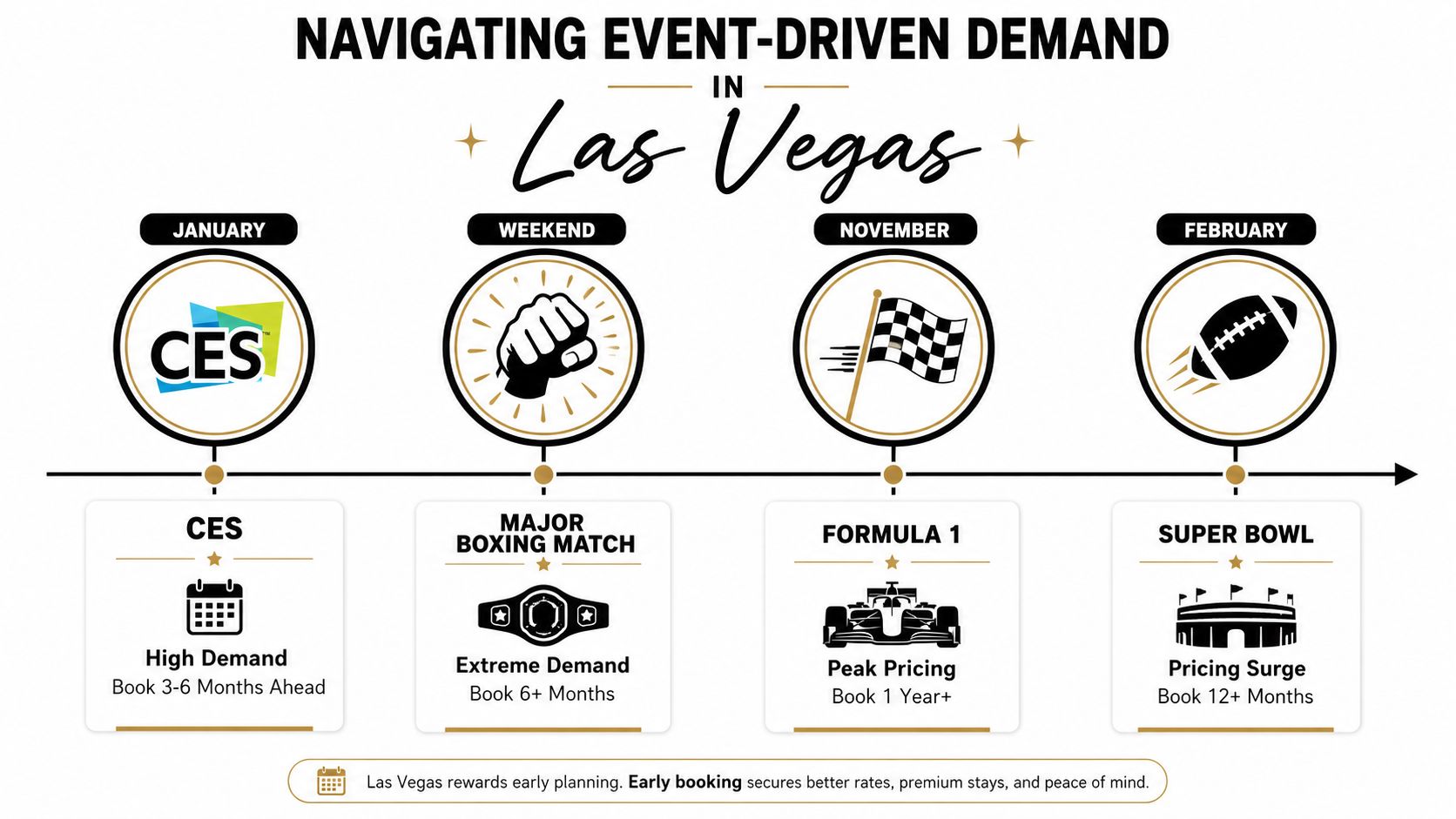
Vegas isn't a market where you should assume a suitable aircraft will appear at the last moment. Demand concentrates around CES in January, March Madness, the Super Bowl when hosted nearby, Formula 1 weekend, New Year's Eve, and major boxing or UFC fights. The city's private aviation infrastructure can handle substantial traffic, but preferred aircraft, ramp positions, hangar space, and drivers become harder to secure as the event approaches.
A 2026 industry summary describes Las Vegas private jet traffic as “almost entirely leisure-driven” and identifies entertainment and convention travel, including the Las Vegas Convention Center, as major demand influences (industry summary of private jet cities). That pattern affects more than the aircraft quote. It affects whether the operator can protect your departure time and keep the same aircraft assigned to your return.
Book by the event, not by habit
For ordinary travel, flexibility can help. You may find a viable aircraft close to departure when the calendar is quiet. That strategy fails for high-demand weekends, when operators reposition aircraft from distant markets and FBO capacity tightens across LAS and Henderson.
Book as early as practical for major events, especially when you need a specific cabin, a particular aircraft model, multiple legs, or a large group manifest. Ask how long the quote is valid, whether the price is floating, what cancellation terms apply, and whether the operator has secured parking at the destination FBO.
Peak-period advice: Treat Formula 1, the Super Bowl, and major fight weekends as capacity problems first and pricing problems second. Secure the aircraft and ramp plan before negotiating minor quote differences.
Event-adjacent travel can include more than headline sports and conventions. Teams attending a specialized gathering may also face concentrated demand, which is why resources such as the multi-track vet conference Passpaw can help travelers identify dates that may affect hotel, ground, and aviation availability.
Don't assume a short route protects you from volatility. A Los Angeles departure can be operationally easy on a quiet weekday and difficult on a major event Friday evening. For a high-value itinerary, the right booking window is the point at which the aircraft, airport, and ground plan are all confirmed, not merely the date when someone sends an attractive estimate.
Your Step-by-Step Booking Checklist
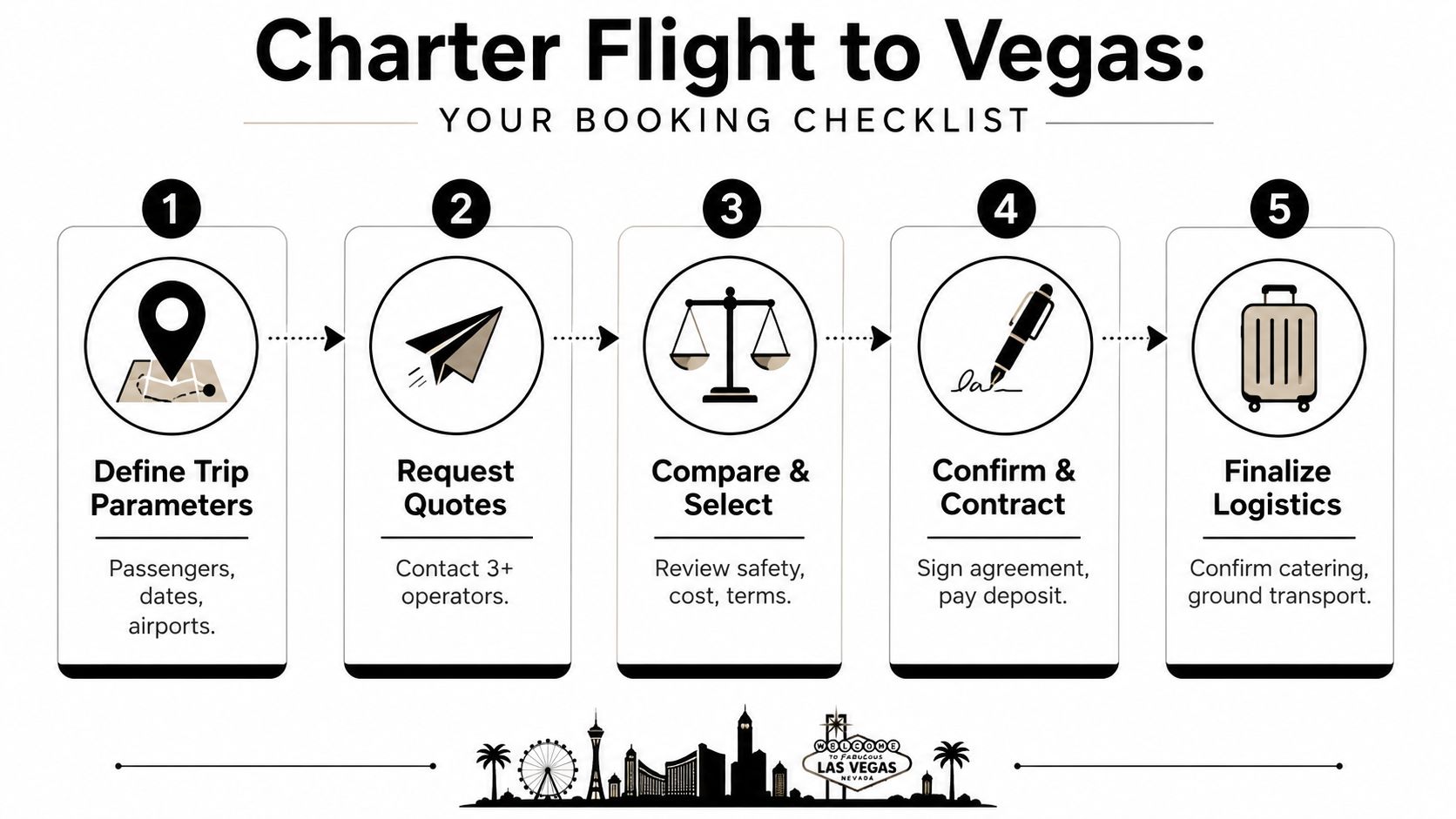
A smooth charter begins with a complete brief. Give the broker enough detail to price the actual mission, then force every operator to quote the same requirements.
1. Define the trip
Prepare the departure city, preferred airport, Las Vegas destination airport, travel dates, departure windows, passenger names or final manifest timing, luggage requirements, pets, special equipment, and ground transportation needs. State whether the return is same-day, next-day, or open-ended. Flexibility can improve the aircraft search, but the broker can't value that flexibility unless you describe it clearly.
2. Request comparable quotes
Request proposals from at least three qualified operators or through a broker with access to multiple operators. Compare more than the total. Require each quote to identify:
- Aircraft: Make, model, year, cabin layout, and confirmed passenger capacity.
- Operating costs: Fuel, crew, landing, handling, parking, and repositioning.
- Services: Catering, Wi-Fi, ground transport, pets, and special requests.
- Timing: Departure window, estimated flight time, and return availability.
A low quote that excludes handling or repositioning isn't a low quote. It's an incomplete quote.
3. Review the contract
Read cancellation terms, aircraft substitution language, payment deadlines, weather provisions, and the process for operational changes. Ask whether the quoted price is locked and what circumstances allow the operator to revise it. If the aircraft model matters, make sure the agreement addresses substitution rather than relying on a sales conversation.
4. Submit passenger information
The operator needs accurate passenger and TSA Secure Flight data before departure. International travelers should provide passport and immigration documentation early, even when the trip includes a domestic segment. Confirm spelling, dates of birth, nationality, and any security or clearance requirements before the final manifest deadline.
5. Confirm the final logistics
At the 48-hour and 24-hour checkpoints, confirm aircraft details, crew, weather, departure FBO, arrival FBO, vehicle staging, catering, luggage, and passenger changes. Ask who owns each action. A named coordinator is more useful than a general promise that “the team is handling it.”
Use the final confirmation to verify the exact terminal entrance and recommended arrival time. Private aviation is faster because the process is controlled, not because passengers can ignore operational deadlines.
This video provides a visual overview of the booking process and the information travelers should have ready before contacting a charter provider.
Final Considerations Before You Fly
Your departure city determines the aircraft economics. Los Angeles or Phoenix may suit a turboprop or light jet when passenger and baggage loads allow it. New York or Miami typically requires a midsize, super-midsize, heavy, or ultra-long-range aircraft, because range, cabin size, and crew planning drive the quote.
Las Vegas events can remove that flexibility quickly. CES, March Madness, the Super Bowl, Formula 1, New Year's Eve, and major fight weekends tighten aircraft and FBO availability. With fixed dates, book early to preserve aircraft choice, arrival timing, parking, and ground transportation. If your schedule is flexible, waiting can create more negotiating room after the peak passes.
Airport choice also changes the experience. LAS keeps passengers close to the Strip and provides round-the-clock private aviation handling through Atlantic Aviation and Signature Flight Support. Henderson often suits discreet missions and southern destinations. North Las Vegas can fit lighter aircraft and itineraries serving the northern valley.
Request quotes using the exact route, passenger list, baggage, departure window, event schedule, catering, and ground transportation requirements. Ask the broker or operator to compare aircraft classes and confirm the FBO plan before demand removes the practical options.
Haute Jets arranges on-demand charter quotes from owner-operators, including route planning for Las Vegas airports and confirmation of aircraft, crew, catering, and ground logistics. Visit Haute Jets with your departure city, dates, passenger count, and preferred schedule to compare suitable aircraft and secure a charter plan.