
A light jet from Los Angeles to Las Vegas starts at a concrete $6,000 one-way baseline in 2026. That figure is a starting point, not a promise, because aircraft positioning, event demand, airport choice, and baggage can move the final invoice sharply.
You're probably not researching charter flights las vegas as a casual exercise. You may have six people flying in before a major convention, a fight weekend itinerary that can't tolerate a missed arrival, or a return flight that needs to leave after the crowd has cleared. The mistake is treating Las Vegas like any other leisure route and comparing only hourly rates.
Las Vegas is an event-driven charter market. The aircraft that looks affordable on a quiet Tuesday may be unavailable, already positioned elsewhere, or priced very differently when a major event compresses the market. My advice is straightforward: confirm availability first, then compare the final invoice, including positioning and airport charges.
Why Charter Flights to Las Vegas Work Differently
A group of six flying from Los Angeles before a major Las Vegas keynote might see a light-jet quote around $6,000 one way, while scheduled airlines could quote $1,200 per main-cabin seat in the same planning scenario. The private aircraft costs more in total, but the group receives one departure plan, private-terminal handling, and a cabin reserved for its own passengers. That convenience matters when everyone needs to arrive together and the schedule is tied to a keynote, match, or production call time.
The catch is that the aircraft may not be sitting in Los Angeles. A jet can need to reposition from Van Nuys, Scottsdale, or Eagle County before collecting the passengers, then ferry elsewhere after the drop-off. Those empty legs are often billed at the aircraft's full hourly rate, which is why a short flight can produce a surprisingly large quote. Independent industry guidance says repositioning commonly adds 30% to 100% to a charter invoice, depending on where the aircraft is based and how the operator must move it (repositioning and deadhead fees explained).
Vegas demand is compressed, not steady
CES, Super Bowl weeks, NAB, Formula 1, and major fight weekends pull different aircraft into the same market at the same time. A convention group may need several light or midsize jets, while an entertainment delegation may require a heavy aircraft with more cabin and baggage capacity. Supply gets tighter because aircraft often remain in Las Vegas for the event instead of completing a quick out-and-back rotation.
Harry Reid International's history reinforces how central private aviation has always been to the city. George Crockett built Alamo Field in 1942 as a refueling stop for private flights between Los Angeles and Salt Lake City, and the airport site later became the region's main airport. What is now Terminal 2 opened in 1991 and was used primarily for charter flights, according to the Las Vegas aviation history account.
Practical rule: For a peak-event trip, the question isn't “What's the hourly rate?” It's “Which aircraft is actually available, where is it based, and what happens if the return schedule changes?”
For anyone considering aviation as a profession rather than just a travel product, a resource on private jet careers by Superstar Nannies offers useful context on the people and roles behind private-flight operations.
The Las Vegas Charter Market at a Glance
A Los Angeles round trip for two travelers does not call for the same aircraft as a trade-show group carrying samples and garment bags. A light jet such as a Citation XLS+ fits short West Coast missions, while a Phenom 300 suits a smaller San Diego group when passenger count and luggage stay controlled. A midsize jet adds cabin and baggage flexibility. A super-midsize or heavy jet fits longer nonstop sectors and larger groups.
Aircraft categories matter because the charter quote covers the entire aircraft, not only the occupied seats. Six passengers with compact luggage may fit comfortably in a light jet. Six passengers bringing golf clubs, garment bags, and trade-show materials may need a larger cabin on the same short route.
Know the airport vocabulary
An FBO, or fixed-base operator, is the private aviation terminal for check-in, waiting, boarding, and ground handling. At Harry Reid, Signature Flight Support and Atlantic Aviation provide 24-hour FBO coverage. The airport also has a 14,510-foot longest runway, U.S. port-of-entry status, and continuous operational availability for private aviation, according to this Harry Reid private aviation overview.
Henderson Executive Airport, or HND, often suits domestic trips when a quieter ramp and potentially lower local charges matter more than the shortest drive to the Strip. Haute Jets describes HND as the primary private aviation hub, 16 miles south of the Strip and about 20 minutes by car. LAS has a Signature Flight Support private terminal.
Airport choice changes the practical value of a quote. Compare the FBO, ground transfer, operating hours, and aircraft location rather than treating every Las Vegas arrival as interchangeable.
Use pricing bands as a screening tool
The bands below use the published Haute Jets pricing framework, including a starting private charter rate of $3,500 per hour and a Los Angeles to Las Vegas example of $6,000 one way. Use them as calibration points, not guaranteed quotes.
| Category | Passengers | Range | Hourly Rate Band |
|---|---|---|---|
| Light jet | Qualitative fit depends on aircraft | Short to regional missions | Starts from $3,500 per hour |
| Midsize jet | More cabin and baggage flexibility | Regional to longer domestic missions | Quote dependent |
| Super-midsize jet | Larger groups and longer domestic missions | Long domestic missions | Quote dependent |
| Heavy jet | Larger groups, staff, and equipment | Long-range domestic and international missions | Quote dependent |
A quote outside a familiar range is not automatically wrong. It may include a repositioning leg, a high-demand date, a different FBO, or a larger aircraft selected for baggage. In Las Vegas, availability and aircraft location often matter more than the headline hourly rate.
Peak Events That Compress Las Vegas Charter Availability
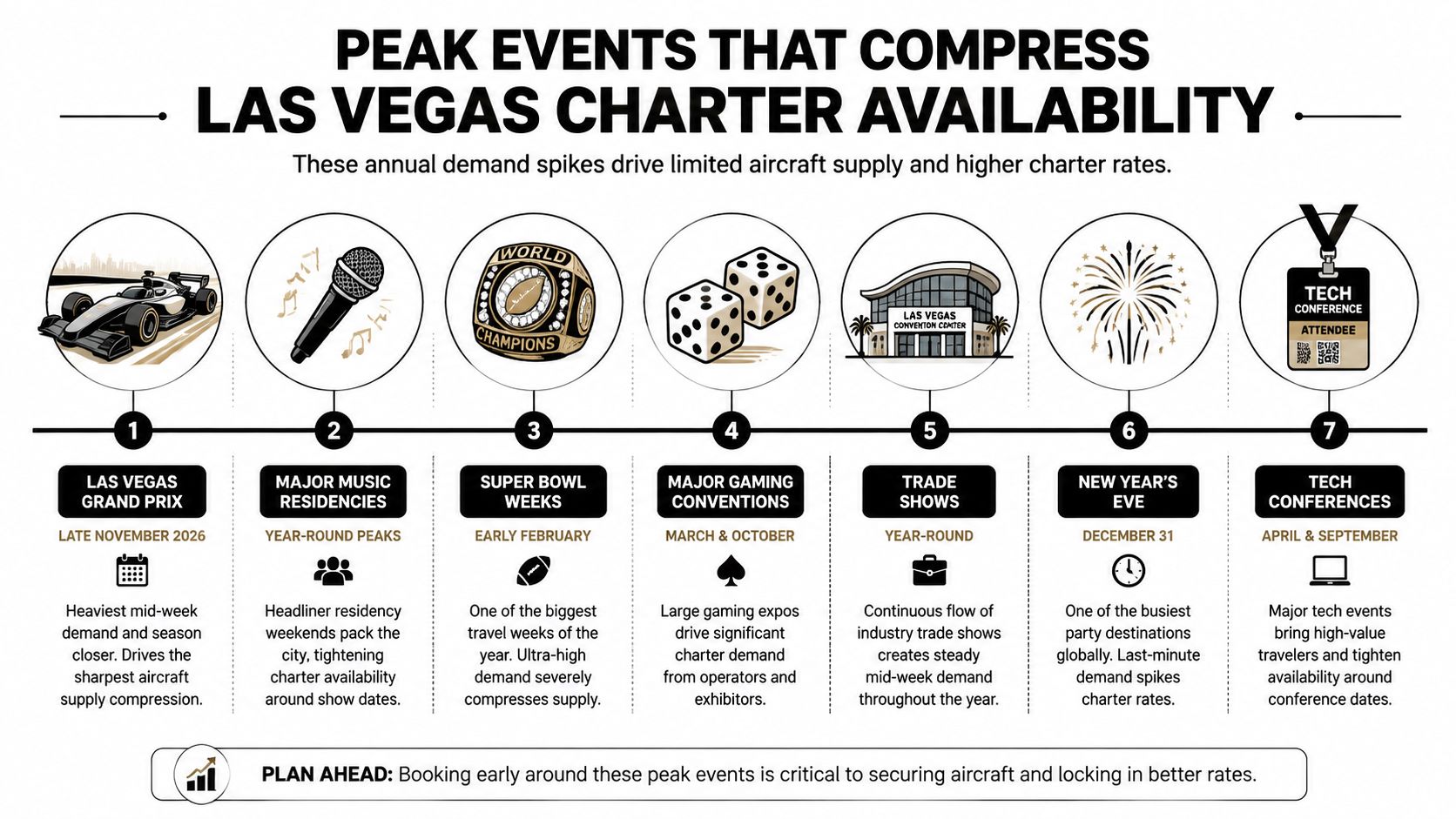
Las Vegas demand doesn't rise evenly. It arrives in bursts, and the timing of each burst changes which aircraft disappear first.
The clearest recent illustration came during the 12 to 14 September 2025 fight weekend, when business-jet movements reached 640, compared with a 2025 weekend average of 419, a 46% increase (Las Vegas empty-leg and event activity analysis). That compression affects more than price. Atlantic Aviation and Signature Flight Support operate 24/7, yet ramp and hangar capacity can come under pressure during major weekends.
Seven demand patterns to watch
Las Vegas Grand Prix: The projected 2026 season closer is expected to create the heaviest demand from Tuesday through Saturday of race week. Owner-pilot traffic and international heavy jets can remain parked for several days, limiting quick-turn availability.
CES: The early-January technology convention pulls corporate groups and West Coast executives toward light and midsize aircraft. Set Jet's published Las Vegas program illustrates the market's repeated daily movement, with up to four daily private charter flights among Las Vegas and West Coast cities and 5,000 members in 2022 (Set Jet charter activity report).
Super Bowl weeks: When the game is awarded to Allegiant Stadium, demand arrives from corporate hospitality groups, production teams, and private travelers. The pressure is concentrated around arrival and departure windows rather than spread evenly across the week.
NAB Show: The April broadcast and media convention favors light and midsize jets carrying executives, crews, and equipment. Baggage requirements can eliminate the cheapest aircraft quickly.
Wrangler National Finals Rodeo: December demand reaches beyond the Strip. Turboprops and regional aircraft can fill from Texas feeder markets, making smaller-aircraft availability the first problem.
Boxing and UFC cards: Fight weekends typically spike on Friday and Saturday. The short compression window makes last-minute repositioning expensive and leaves fewer practical return choices.
INVICTUS Games overlap: When the event calendar overlaps with conventions or major entertainment programming, groups compete for the same aircraft pool and ground-handling capacity.
The published movement data makes one point unavoidable. A normal weekend quote tells you very little about a compressed event weekend, so event dates should trigger an availability check before any aircraft comparison.
Choosing the Right Aircraft for Your Las Vegas Trip
Choose the aircraft from the passenger list outward, not from the cabin photographs inward. A Citation CJ3 can be a sensible choice for four passengers on a Los Angeles hop. It becomes a poor choice when those four passengers add golf clubs, presentation cases, wedding attire, and several days of luggage.
A Phenom 300 can suit six passengers from Dallas when the operator confirms the payload and baggage plan. A Challenger 350 is a better fit for a larger group coming from New York because the cabin, range, and luggage capacity support a longer domestic mission. A Gulfstream G550 earns its place when the group includes entertainment staff, equipment, and a schedule that requires long-range capability.
Match the mission before the model
| Category | Typical Pax | Range | Baggage | Best Las Vegas Use |
|---|---|---|---|---|
| Light jet | Small group | Short to regional | Limited, verify oversized items | Los Angeles, San Diego, Phoenix, and compact luggage |
| Midsize jet | Medium group | Regional to longer domestic | More practical for bags and equipment | Dallas, regional conferences, and extended stays |
| Super-midsize jet | Larger group | Long domestic missions | Stronger capacity for people and gear | New York, coast-to-coast travel, and corporate groups |
| Heavy jet | Large group or staff-heavy itinerary | Long-range domestic and international | Best for substantial luggage and equipment | Productions, delegations, and transcontinental travel |
A useful route rule is qualitative. Light jets cover short regional missions, midsize jets extend comfortably into longer domestic sectors, super-midsize aircraft handle long domestic legs with more reserve and cabin space, and heavy jets are the correct tool when the trip is transcontinental, international, or staff intensive. Don't choose a heavy aircraft merely because the cabin looks impressive. You're paying to move capacity you may not use.
Baggage changes the economics
Las Vegas trips often carry more than clothing. Golf clubs, trade-show displays, camera equipment, musical instruments, and formalwear can overwhelm a small baggage compartment. Send the operator a practical inventory, including the number of golf bags, hard cases, garment bags, and oversized items.
Turboprops deserve a place in the conversation for short regional hops. King Air and Pilatus PC-12 aircraft can undercut jet pricing when passengers accept a slower cruise and the route is short, especially from regional airports. They aren't a compromise if the mission is brief and the baggage fits. They are a bad bargain only when travelers select them without checking payload, access, and timing.
Harry Reid versus Henderson Executive for Private Jet Arrivals
The airport decision comes down to four questions: How much runway and aircraft capability do you need? Which FBO fits the itinerary? Is customs required? How much ground time can the group tolerate?
Harry Reid International is the default choice for international arrivals, larger aircraft, and time-sensitive Strip itineraries. It has a 14,510-foot runway, U.S. port-of-entry status, and 24-hour FBO coverage from Signature Flight Support and Atlantic Aviation (Harry Reid airport and private terminal details). Those capabilities support long-range operations and make LAS practical for domestic and international charter traffic.
When Harry Reid wins
Select LAS when customs and immigration matter, when the aircraft requires the longer runway, or when the group has a tight transfer to a Strip property. Commercial activity can make the airport feel busier, but the infrastructure and private-terminal options are substantial. Signature and Atlantic both operate around the clock, which helps when an international arrival or late return doesn't fit a conventional schedule.
When Henderson makes more sense
HND is the cleaner choice for many domestic trips. It can offer a quieter ramp and a simpler operating environment, particularly for groups staying in Henderson or on the southern end of the Strip. The trade-off is ground time. Haute Jets places HND 16 miles south of the Strip and about 20 minutes by car, so the savings in airport handling can be lost if passengers have a rigid hotel or event arrival time (Las Vegas airport comparison).
Use this decision pattern:
- International itinerary: Choose Harry Reid because port-of-entry capability matters.
- Tight Strip schedule: Choose Harry Reid unless ground traffic or ramp constraints dictate otherwise.
- Domestic group with flexible ground transfer: Compare Henderson.
- Overnight or repositioning operation: Ask both airports for an all-in comparison rather than assuming the lower landing charge creates a lower trip cost.
Airport selection should appear on the quote, not remain an informal assumption.
What Drives the Cost of a Las Vegas Charter
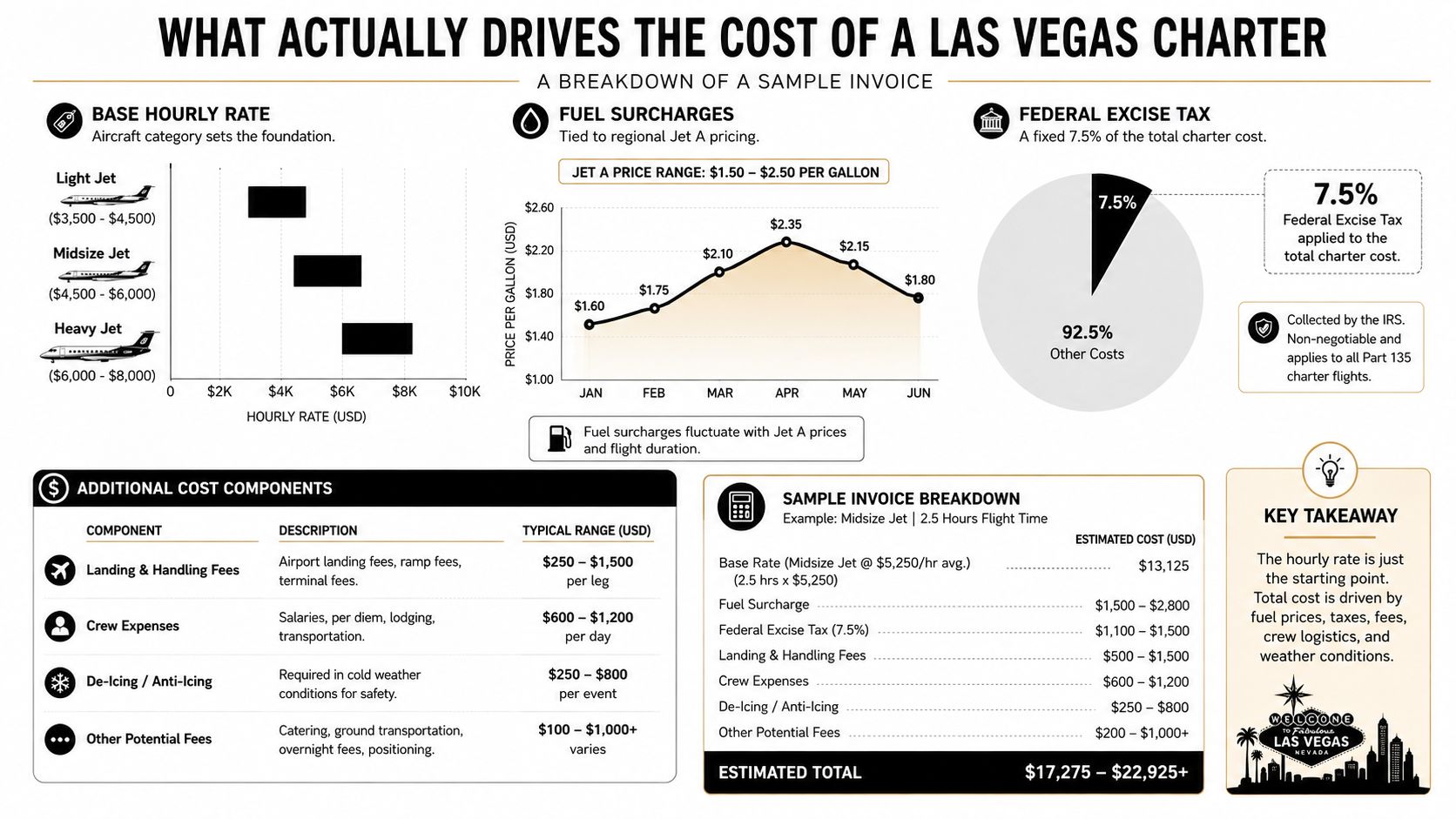
A charter invoice starts with the aircraft and flight time, but Las Vegas pricing is shaped by demand, positioning, and airport logistics. A published hourly figure is only a starting point. Ask what the operator has included before comparing quotes.
Read the invoice line by line
The first charge is the base aircraft charge. It reflects the selected category, minimum billable time, and operated segments. A light jet may suit a Los Angeles trip, yet minimums or positioning can still raise the total if the aircraft starts elsewhere.
Review these items separately:
- Fuel and operational charges: These can vary with routing and the operator's current assumptions.
- Federal Excise Tax: Confirm whether the displayed domestic charter price includes the applicable tax.
- Segment and airport fees: FBO handling, landing charges, parking, and busy airport conditions can change the invoice.
- Crew expenses: A multi-day trade show itinerary may require overnight crew costs when duty limits prevent a same-day return.
- Catering: Basic refreshments and upgraded catering should appear as separate quote items. Specify meals, dietary needs, and return-leg service before departure.
A four-day convention has different economics from a same-day flight. The aircraft may need to remain available, the crew may require accommodation, and additional parking or handling may apply. Event-driven demand can also reduce local availability, making a repositioned aircraft more expensive than its headline hourly rate suggests.
Positioning is where quotes become misleading
Repositioning is the charge travelers misunderstand most often. If a jet must fly empty into Los Angeles to collect passengers, the ferry segment may be billed at the aircraft's hourly rate. The same applies after a Las Vegas drop-off when the aircraft must return to base. On a one-way booking, two empty movements may enter the invoice unless the operator matches the aircraft with another trip.
Request positioning time as a separate line item. That makes operator comparisons clearer and shows whether local sourcing, a round trip, or another airport changes the result. Flexible dates, nearby departure airports, and a coordinated return give you meaningful control over the final cost.
Haute Jets' private jet charter cost guidance also separates aircraft selection from repositioning economics. Use that distinction when reviewing any quote, especially during major Las Vegas events, when availability can matter more than the advertised hourly rate.
Empty Legs, Jet Cards, and Other Pricing Myths
Empty legs can reduce the fare, but they are aircraft repositioning opportunities, not dependable replacements for a fixed itinerary. Published guidance places Los Angeles to Las Vegas empty legs at 25% to 75% below standard charter, with whole-aircraft examples from about $800 to $5,500, depending on aircraft size and timing (empty-leg pricing examples for Las Vegas). The same source gives broader 2026 light-jet guidance for short routes at around $2,000 to $6,500.
Myth one, the discount is guaranteed
An empty leg works only when the aircraft is already moving in the right direction. A departure that is too early, an arrival at the wrong airport, or a change after the original passenger cancels can erase its value. Book one when your schedule can adapt to the aircraft. Do not use it for a fixed meeting, event entry, or return connection.
Schedule control has a price. During major Las Vegas events, a locally sourced aircraft may beat a discounted empty leg once timing, airport access, and repositioning are included.
Myth two, every broker has a different fleet
Brokers often search overlapping operator networks. A lower quote may reflect different assumptions about the FBO, aircraft positioning, taxes, baggage, or included services rather than a cheaper aircraft. Ask for the tail number or specific aircraft details when available. Then compare identical routes, airports, timing, and inclusions.
Myth three, a jet card automatically wins on a peak weekend
Jet cards can simplify planning, but fixed hourly pricing does not remove event-driven pressure. Peak surcharges, aircraft-priority rules, repositioning triggers, prepaid commitments, or blackout conditions can make the final invoice higher than a well-sourced on-demand charter. Occasional Las Vegas travelers should compare the complete trip cost before committing to a product built for frequent use.
Haute Jets' empty-leg flight guide explains the trade-offs. Ask whether the flight meets your timing, airport, baggage, and cancellation requirements. The discount percentage comes second.
A Practical Checklist for Booking Charter Flights to Las Vegas
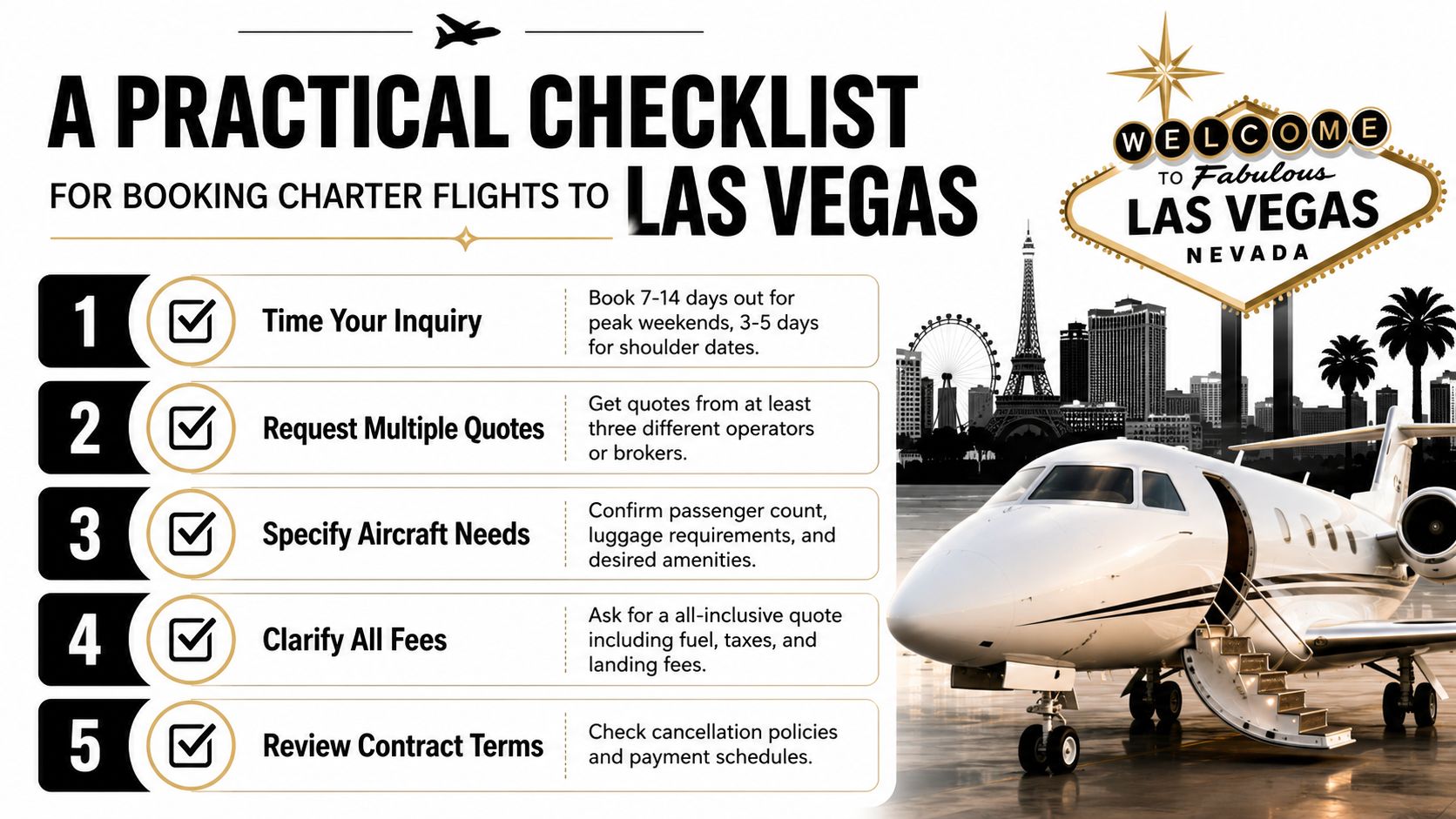
Start with the calendar, not the aircraft. For a peak weekend, begin the inquiry 7 to 14 days ahead. Shoulder dates can sometimes be handled 3 to 5 days ahead, but waiting removes negotiating power when an event is filling the ramp.
Then make the request operationally complete. State passenger count, departure airport, preferred arrival airport, luggage, pets, oversized equipment, desired catering, and whether the aircraft must remain in Las Vegas. A vague request creates a vague quote.
Use this booking sequence
Request multiple quotes: Compare at least three operators or qualified charter providers on the same route, dates, aircraft category, FBO, and inclusions. Don't compare a local light jet against a repositioned midsize jet without normalizing the mission.
Confirm the aircraft: Ask for the tail number or specific aircraft details once the option is available. This helps verify the aircraft's location and prevents a low hourly figure from concealing a long ferry leg.
Choose the FBO deliberately: At Harry Reid, compare Signature Flight Support and Atlantic Aviation based on ground transport, catering, parking, and operational fit. Choose Henderson when a quieter domestic arrival outweighs the additional drive.
Stage the ground plan: Have the vehicle meet the passengers at the selected FBO, not at a generic terminal. Share the arrival estimate with the driver and build the hotel or venue transfer around the airport choice.
Itemize positioning: Ask the operator to show deadhead and ferry costs separately. If a round trip or flexible return allows the aircraft to remain productive, request that scenario beside the one-way quote.
Flag the high-friction dates
Before booking into McCarran, now Harry Reid, between mid-November and mid-January, ask specifically about CES, Super Bowl weeks, the F1 Las Vegas Grand Prix, NAB, SEMA, and New Year's Eve. The calendar can matter more than the route distance.
Also confirm catering for the return leg, cancellation terms, payment timing, customs requirements, and the final passenger manifest. If a provider won't explain the aircraft location and fee structure, keep looking.
Haute Jets arranges on-demand charter options to Las Vegas airports, including Harry Reid International, Henderson Executive, and other private-aviation facilities, with aircraft and operational details matched to the itinerary. Visit Haute Jets to request a quote that separates aircraft, positioning, airport, and service costs before you commit.