

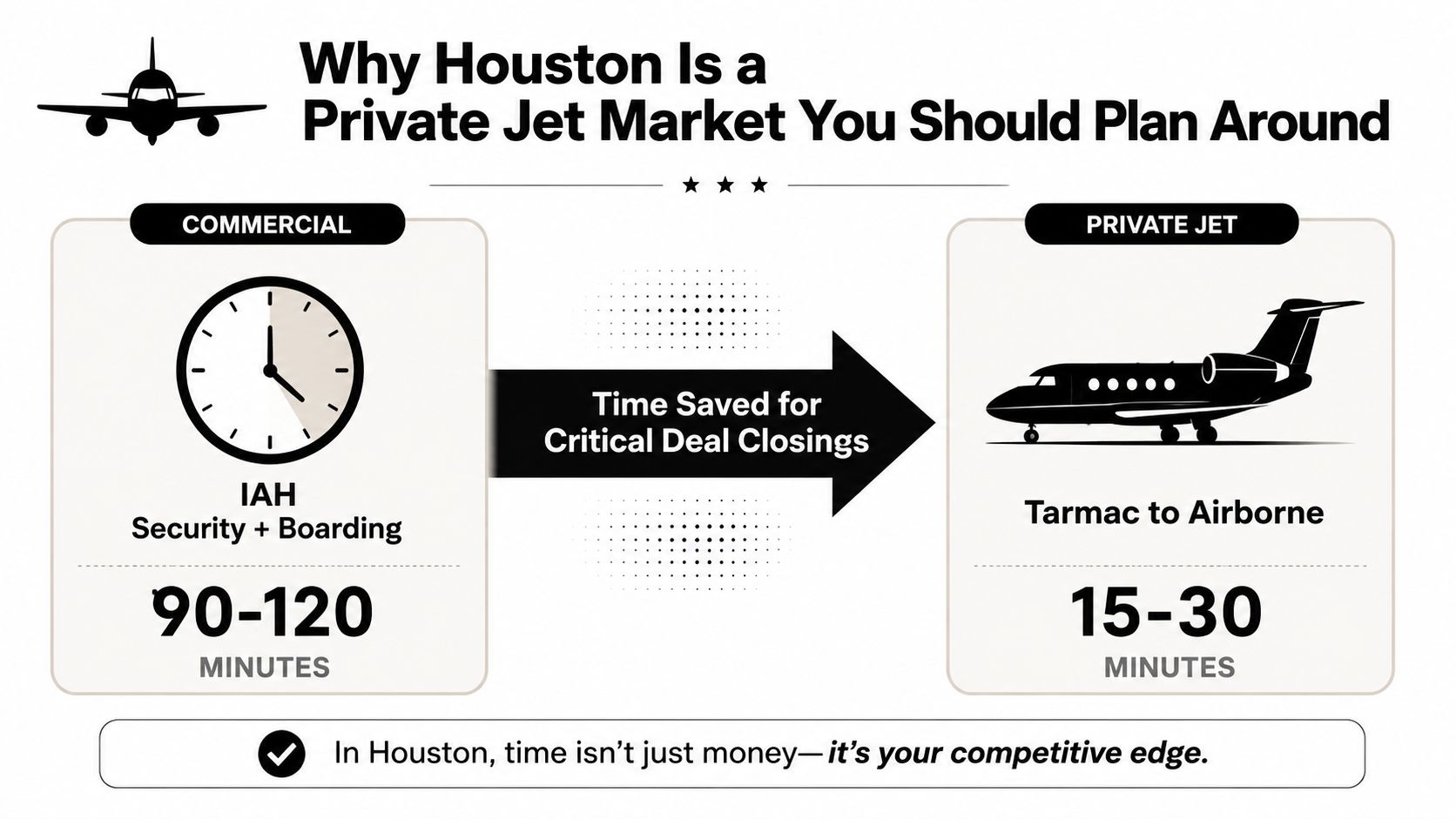
A Woodlands-based energy executive has to be in Midland by 11 a.m. for a deal closing. The commercial option starts with a drive to IAH, a security line, boarding, and the possibility that one delay turns a tightly managed morning into a missed signing. A charter private jet from Houston changes the sequence, but only if the aircraft is sourced intelligently.
The mistake I see most often is treating the hourly aircraft rate as the entire price. In Houston, the larger variable is often repositioning, the cost of bringing an aircraft into the market from Dallas, Austin, or another base. Haute Jets' model is built around sourcing from a 3,500-aircraft network, which can identify aircraft already near Houston and reduce the deadhead burden before the quote reaches the client.
Why Houston Is a Private Jet Market You Should Plan Around
A Houston charter decision often turns on aircraft location before it turns on cabin size or hourly rate. Energy-company travel, medical traffic, executive movements, the I-69 corridor, and several reliever airports create a large but distributed market. That gives travel managers options, provided they source across the region instead of waiting for one airport to supply the aircraft.
KHOU, William P. Hobby Airport, ranked 10th nationally among the busiest U.S. private jet airports, recording 28,019 flights in 2024, compared with 28,243 in the prior period, according to Forbes' 2025 private aviation airport ranking. Texas also recorded 20,377 private jet flights in one annual comparison period, placing Houston within a substantial business-aviation demand pool. That volume supports better access to nearby aircraft, competing operators, and same-day dispatch options, but it also means suitable jets can be committed quickly.
The cost driver many quotes understate is repositioning, the ferry flight required when an aircraft comes from Dallas, Austin, or another base. Haute Jets can search a 3,500-aircraft network for equipment already near Houston, helping reduce the deadhead charge and replace an out-of-base markup with a wholesale aircraft option. For a travel manager, the first sourcing question should be location, not just aircraft type.
The practical conclusion: don't ask only, “What does a jet cost from Houston?” Ask, “Which suitable aircraft is already positioned near my Houston departure airport?”
Demand has continued expanding into 2026. Industry reporting based on WingX data placed global private jet departures at 80,921 in week 13 of 2026, up 11.3% year over year. U.S. departures reached 57,313, up 13%, and Texas departures rose 27% in the cited comparison. The report also estimated the global private aircraft market at $31.9 billion, with a projection of $41.38 billion by 2030, as reported in 2026 private aircraft industry reporting.
That traffic makes local sourcing a pricing decision, not a convenience. If a light or midsize aircraft is already at KHOU, KIAH, KSGR, or KDWH, the client may avoid an unnecessary ferry leg. Houston bookings should therefore compare aircraft positioned across the metro area before accepting a quote built around an aircraft flying in from elsewhere.
Matching Your Mission to the Right Aircraft First
Start with the trip, not the airport and not the brochure. Passenger count, baggage, distance, cabin requirements, and schedule flexibility determine the aircraft category. Choosing an airport first can lead to a jet that fits the map but fails the mission.
A four-passenger conference trip to Destin or Monterrey usually calls for a light jet. A legal team carrying ten people to New York for a deposition needs more cabin volume, baggage capacity, and stand-up space, making a super-midsize or heavy aircraft the more defensible choice.
Use the smallest aircraft that genuinely fits
Light jets, including Mids, Learjets, and Phenoms, suit regional missions of under three hours when the group is small and baggage is moderate. They're often the strongest candidates for local sourcing because Houston supports significant light-jet activity across multiple fields.
Midsize aircraft such as the Citation XLS or Hawker 800 work better when the trip needs additional cabin space or transcontinental short-hop capability. A Citation Sovereign or Challenger 350 is the better fit for coast-to-coast travel with a full passenger load. Gulfstream G-IV and Global Express aircraft belong in the heavy category for international missions or groups of 12 or more passengers, based on the mission categories supplied for this charter brief.
Average Houston executive trips fall under 1,500 nautical miles, according to the supplied Houston charter planning data. That keeps many requests in the light and midsize categories, exactly where aircraft based near Houston can remove the largest repositioning exposure.
| Mission Profile | Passengers | Typical Range | Recommended Category |
|---|---|---|---|
| Regional conference or site visit | 2 to 5 | Under 3 hours | Light jet |
| Transcontinental short hop | 4 to 8 | Medium regional range | Midsize jet |
| Coast-to-coast corporate trip | 6 to 10 | Long domestic range | Super-midsize jet |
| International or large executive group | 12 or more | Long-range | Heavy jet |
A useful aircraft-selection reference is this guide to choosing the right aircraft for short-haul private flights. It reinforces the right sequence: define the mission, shortlist categories, then compare actual aircraft and positioning.
Don't pay for a heavy jet when a light jet meets the range, baggage, and comfort requirements. Conversely, don't force a light jet onto a mission where a larger cabin protects productivity, luggage capacity, or operational margin.
Choosing Between IAH, HOU, and the Reliever Airports
Houston gives charter travelers three airport strategies. IAH wins for heavy and international missions, HOU usually wins for convenient regional departures, and reliever fields often win for routine domestic trips when the traveler lives outside the central corridor.
George Bush Intercontinental has the Houston area's longest published runway, 12,001 to 12,002 feet, compared with 7,602 feet at HOU, 7,009 feet at DWH, and 7,501 feet at CXO, according to Houston runway and airport guidance from EvoJets. That infrastructure makes IAH the logical choice for heavy and ultra-long-range aircraft, especially when international handling or port-of-entry requirements matter.
William P. Hobby is commonly the closest Houston option to downtown and the Texas Medical Center. Its private-side FBO network includes Atlantic Aviation, Million Air, Signature Flight Support, Wilson Air Center, and Jet Aviation. Multiple FBOs create service redundancy, which can help with handling, fueling, catering, and schedule changes.
The airport decision matrix
| Airport | Runway Length | Recommended FBO | Avg Turnaround | Best Aircraft Category |
|---|---|---|---|---|
| IAH | 12,001 to 12,002 feet | Signature Flight Support | Longer due to commercial-airport traffic | Heavy and ultra-long-range |
| HOU | 7,602 feet | Atlantic Aviation, Million Air, Signature Flight Support, Wilson Air Center, or Jet Aviation | Fast private-side handling | Light, midsize, and super-midsize |
| TME | Not specified in verified data | Confirm the assigned local FBO | Reliever-field handling | Light to midsize |
| DWH | 7,009 feet | Confirm the assigned local FBO | Reliever-field handling | Light to midsize |
| SGR | Not specified in verified data | Confirm the assigned local FBO | Reliever-field handling | Light to midsize |
| CXO | 7,501 feet | Confirm the assigned local FBO | Reliever-field handling | Light to midsize |
The airport should match the client's ground location. A Woodlands traveler may prefer DWH or CXO, while a downtown executive may save time through HOU. A client heading abroad should start with IAH if customs and runway requirements point there. George Bush Intercontinental charter guidance is useful when the itinerary requires international handling or a large-cabin aircraft.
Don't choose a nearby airport solely because it appears closest on a map. Confirm runway suitability, FBO services, customs status, and the aircraft's performance requirements. Jet Aviation Houston advertises domestic and international handling, catering, cleaning, and refueling, while Million Air Houston emphasizes quick turns and full-service support at HOU, as reflected in the Houston airport and FBO overview.
What Private Jet Charter Actually Costs in Houston
A Houston charter quote has four principal components: the aircraft's hourly rate, fuel-related charges, repositioning, and FBO or landing fees. The quoted hourly figure can look attractive while the deadhead leg determines the final total.
Haute Jets states that private jet charter pricing is market-based and starts from $3,500 per hour, according to its private jet pricing page. That starting point isn't a universal Houston fare. It is an anchor for understanding why category, aircraft location, dates, and airport selection matter.
| Aircraft Category | Hourly Rate | Deadhead Risk | Sample 4-hr Mission |
|---|---|---|---|
| Light | $3,200 to $4,500 | Lower when locally based | $12,800 to $18,000 before additional charges |
| Midsize | $4,800 to $6,800 | Moderate | $19,200 to $27,200 before additional charges |
| Super-midsize | $7,000 to $9,500 | Moderate to high | $28,000 to $38,000 before additional charges |
| Heavy | $10,000 to $14,000 | Higher when international or repositioning is required | $40,000 to $56,000 before additional charges |
These category bands and the four-hour illustrations are based on the supplied Houston charter pricing data. For broader context on private jet hourly rates, Approved Experiences Traveler provides a useful comparison resource.
Repositioning is the line item to challenge
When an aircraft must ferry into Houston from another base, the supplied pricing guidance identifies a 20% to 40% deadhead markup. That isn't an unavoidable feature of every trip. It is a sourcing problem when a suitable aircraft is available closer to the departure point.
A Houston-to-Dallas round trip illustrates the issue. Start with the selected aircraft's billable flight time, then add the return-sector requirements, FBO charges, fuel-related items, and any repositioning leg. If the aircraft is already positioned at KHOU or KIAH, the quote can avoid a ferry into Houston. If it's coming from another Texas base, that extra movement can become the largest avoidable cost.
Haute Jets also lists pricing from $1,495 per leg for empty-leg and short-hop missions, subject to aircraft availability and trip conditions, on its private jet charter cost information. The point isn't that every Houston trip will reach that price. The point is that a network covering 3,500 aircraft can search for a jet already at KHOU, KIAH, KSGR, or KDWH instead of accepting the first repositioned option.
Request an itemized quote. If hourly rate and repositioning appear as one blended number, you can't tell whether the broker has solved the main cost problem.
The Booking Timeline From Inquiry to Wheels Up
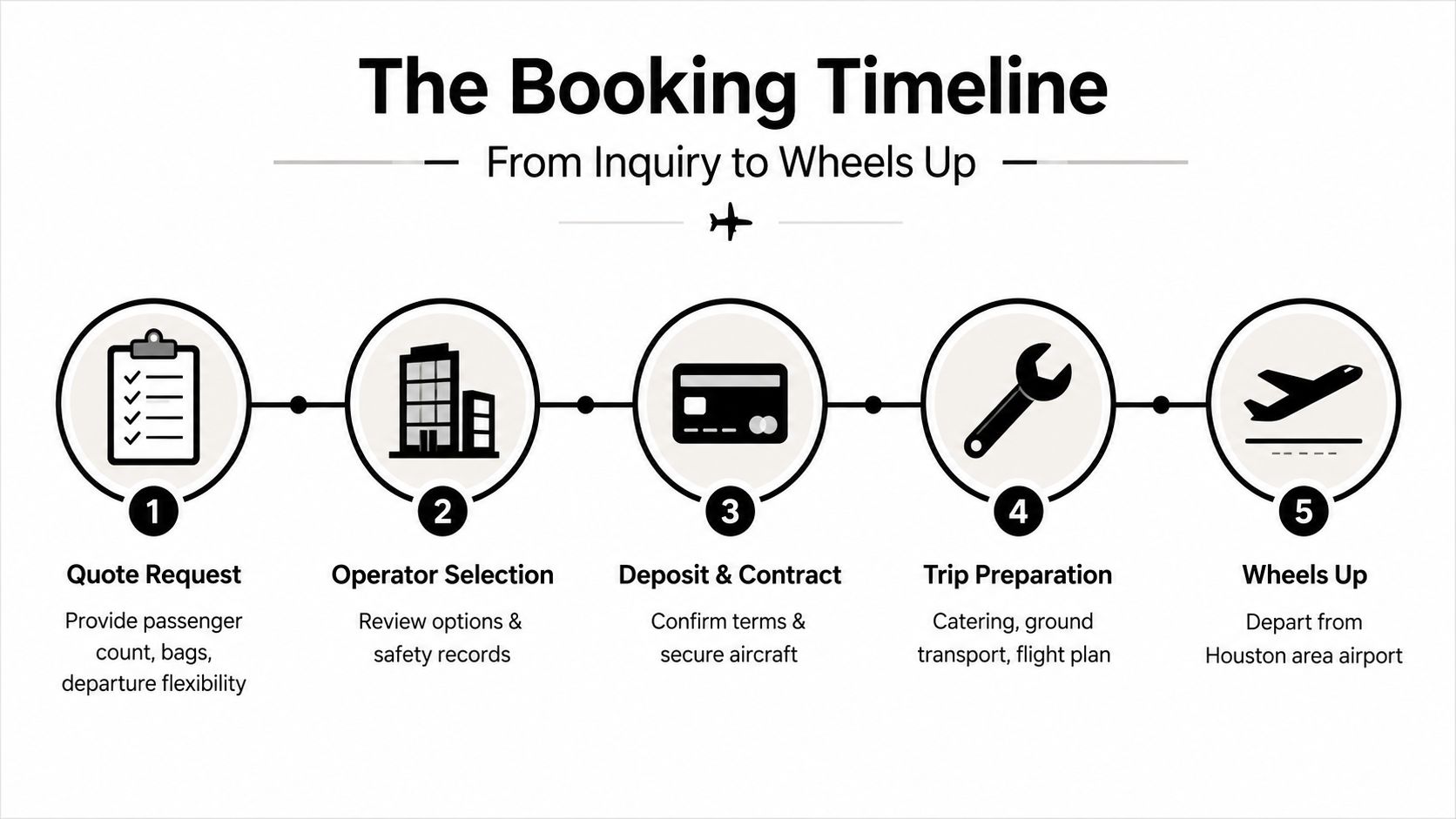
A well-run charter desk doesn't begin with a generic aircraft request. It starts by collecting the details that determine aircraft fit and positioning: passenger count, baggage, departure flexibility, route, preferred airport radius, and mission requirements.
The operator search then considers aircraft location, category, and safety credentials. Once the desk identifies a viable option, ask for a provisional hold, trip sheet, operator identity, and the terms required to secure the aircraft.
The practical sequence
- Quote request: Provide passenger names or counts as required, baggage details, schedule flexibility, pets, catering needs, and ground transportation preferences.
- Operator selection: Review the proposed aircraft, operator, aircraft position, safety rating, and airport pairing.
- Hold and contract: Examine the trip sheet, contract, insurance documentation, cancellation terms, and payment requirements before releasing the deposit.
- Trip preparation: Lock the manifest, catering, ground vehicles, flight plan requirements, and FBO slot.
- Final confirmation: The operator should provide the tail number, crew contact, final itinerary, and ground coordination before departure.
The supplied Houston booking guidance identifies lead times ranging from four to six hours for a light jet and 12 to 24 hours for super-midsize and larger aircraft, depending on availability. International planning may require more time. Houston guides also cite domestic recommendations from 24 to 48 hours, international recommendations of three to five days, and some same-day departures requiring only two to six hours, all subject to aircraft and operator availability, as summarized in the 2026 AIN FBO Survey.
Have government identification for every passenger ready. Bring passports for international travel and pet vaccination records when applicable. Local sourcing can compress the timeline because the aircraft doesn't need a long ferry leg before the passenger itinerary begins.
Cabin Details Worth Confirming Before You Fly
The aircraft category on a quote doesn't tell you whether the cabin will support the work, luggage, pets, or catering plan. A travel manager should treat those details as part of aircraft selection, not as optional extras after the contract is signed.
Connectivity and cabin configuration
Confirm the exact aircraft and its installed connectivity. Ka-band service is common on many super-midsize and larger jets, while light jets may have limited or no Wi-Fi. A Houston-to-Washington trip with executives expecting to stream, join video meetings, or transfer large files requires a direct answer about bandwidth and service limitations.
Cabin layout matters just as much. Ask whether the seats are club arrangements, whether the aircraft has a stand-up cabin, how many passengers can travel with full baggage, and whether the listed capacity assumes compromises that don't suit your group.
Pets, food, and luggage
Pet policies vary by operator and aircraft. Some turboprops may restrict pets in the cabin, while many midsize and larger jets can accommodate them with advance notice. Disclose the animal's size, carrier, and documentation requirements before the operator assigns the aircraft.
Catering can range from cold service and beverages to a bespoke menu sourced from a Houston restaurant. Specify pickup timing and location, including whether the order will be collected through the assigned FBO at KHOU or KIAH. The same applies to baggage. Bulky samples, trade-show cases, golf equipment, and medical equipment can change the aircraft recommendation.
Ground transportation deserves equal attention. Request a black-car vehicle matched to the passenger count, luggage, and destination. Confirm whether the car meets the aircraft on arrival or waits at the FBO entrance.
Confirm every comfort detail during the final confirmation window, not when you arrive at the terminal.
Smoking should not be treated as a negotiable cabin feature with a reputable charter arrangement. Reputable operators prohibit smoking, and the travel manager should document that policy in the trip file.
Safety verification is non-negotiable
Price never overrides operator verification. Ask for the current Wyvern PASS report, ARGUS rating verification, FAA Part 135 air carrier certificate, pilot hours and type ratings, maintenance records, and incident history.
| Rating | Audit Frequency | What It Verifies | Best For |
|---|---|---|---|
| Wyvern Wingman | Confirm current status with the operator | Independent safety and operational review | Corporate and executive travel |
| ARGUS Gold | Confirm current status with the operator | Operator safety and compliance review | Routine business charter |
| ARGUS Platinum | Confirm current status with the operator | Higher-level operational oversight | Complex, international, or high-value missions |
The ratings don't replace judgment. An older aircraft, opaque ownership, broker-only quote, or pressure to skip a verification call should stop the booking until the operator answers clearly.
Haute Jets vets operators against these standards before presenting options, which can remove much of the verification burden from the client while preserving the client's right to review the operator and aircraft.
Smart Ways to Lower Your Houston Charter Bill
Jet cards and fractional ownership aren't automatically the cheapest choices for Houston travelers. For one-off and occasional missions, the price usually moves more through aircraft positioning, schedule flexibility, and trip structure than through a membership label.
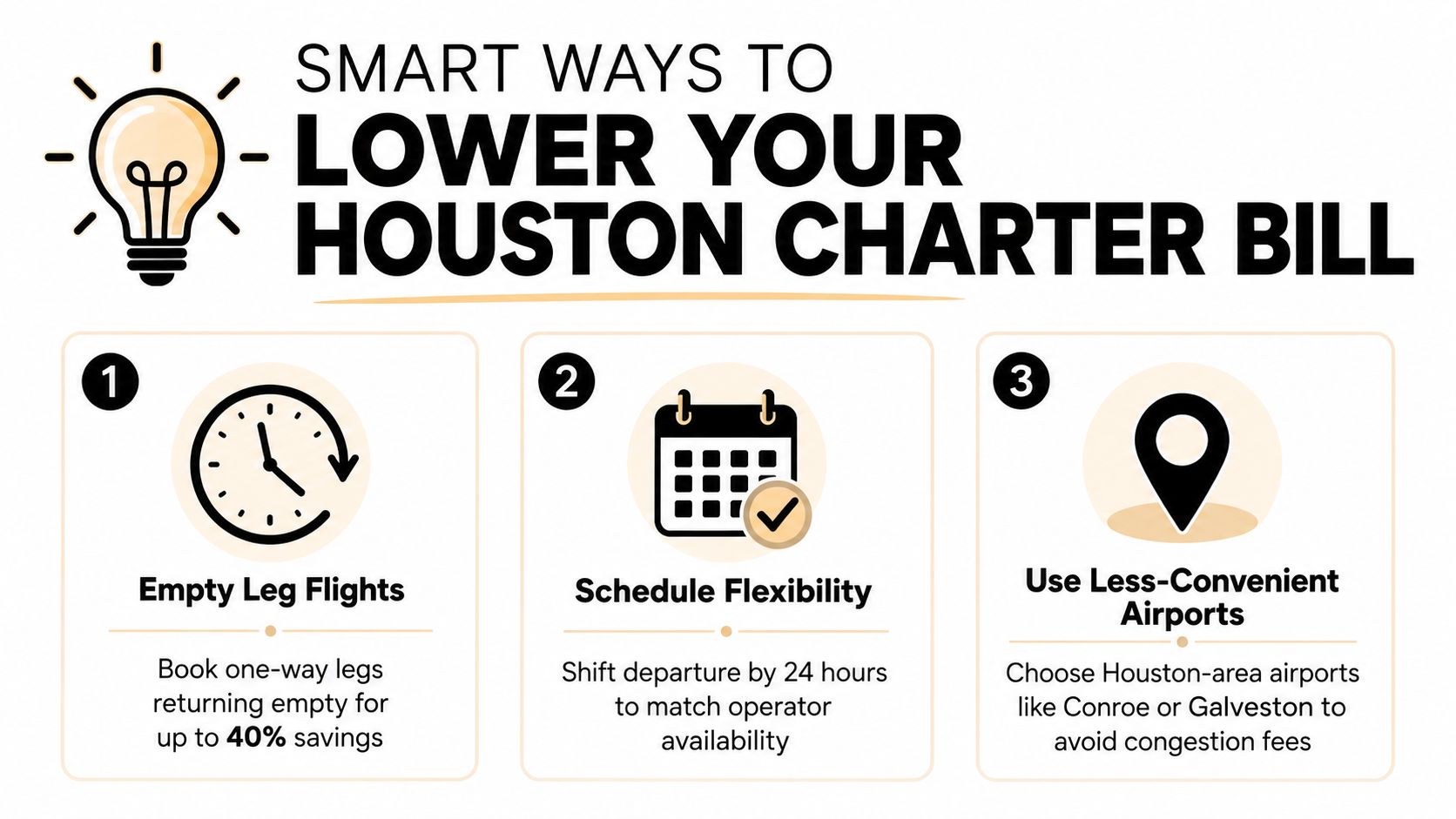
Three levers change the quote
Empty legs can produce meaningful savings when a one-way repositioning flight aligns with your route. The supplied Houston savings guidance describes empty-leg discounts of 50% to 75% off retail hourly rates in suitable cases, while the provided savings infographic uses an example of up to 40% savings. These are availability-driven opportunities, not guaranteed prices. You trade schedule flexibility for a lower cost.
Departure flexibility helps the charter desk match your trip to an aircraft already in the area. The supplied guidance identifies early-morning and weekend departures at HOU and IAH as potential opportunities for 10% to 20% lower pricing, while shifting a departure by 24 hours can help match operator availability. Ask for two or three schedule options rather than one rigid time.
Same-day round trips can cost less than separate one-way bookings when the aircraft waits for the passengers. Leaving the aircraft overnight can add another daily repositioning or crew-related cost, so a tightly planned same-day return often wins for business travel.
Solve local positioning before negotiating discounts
A Houston-to-Aspen itinerary may look expensive because the client is paying for the aircraft's flight time, fuel, handling, and the aircraft's return requirements. The first question should be whether a suitable jet is already positioned in Houston or nearby. If it isn't, the quote may include a ferry leg before any empty-leg or schedule concession is applied.
That is why local sourcing should come first. A broad network can compare aircraft near Houston rather than forcing the client into the inventory of one membership program or one broker relationship. Once positioning is solved, ask for empty-leg, off-peak, and same-day round-trip alternatives.
Don't negotiate the hourly rate before you know whether you're paying for someone else's deadhead.
A checklist for today's booking call
- Define the mission: Give passenger count, bags, range, destinations, and schedule flexibility.
- Shortlist the category: Compare light, midsize, super-midsize, and heavy aircraft against the actual cabin requirement.
- Choose the airport: Decide among IAH, HOU, or a reliever field based on ground access, FBO handling, runway suitability, and customs needs.
- Verify the operator: Request current Wyvern Wingman or ARGUS Gold or Platinum status.
- Demand an itemized quote: Separate hourly aircraft cost, repositioning, fuel-related charges, FBO fees, and applicable taxes.
- Ask for alternatives: Request empty-leg, off-peak, and same-day round-trip options.
- Confirm the cabin: Document Wi-Fi, catering, baggage, pet policy, smoking rules, and ground transport.
- Place the trip early: Put the request with Haute Jets Journal for advance positioning when the schedule allows.
For occasional Houston travel, local broker sourcing is the more rational starting point than a jet card or membership program. It lets you pay for the trip you need without committing to prepaid hours or accepting a program's aircraft-positioning economics, while the largest avoidable cost, the out-of-base repositioning leg, is addressed first.
Haute Jets arranges on-demand Houston charter options through a network of 3,500 aircraft, with operator vetting, aircraft-positioning analysis, and support for airports including HOU, IAH, Sugar Land, and Houston Executive. Visit Haute Jets to request an itemized quote and have an aviation advisor compare a locally positioned aircraft with the repositioned alternatives.