

You've found the right aircraft, the departure time works, and the quote looks attractive. Then someone asks whether the aircraft needs repositioning, whether London has accepted the landing request, and whether customs has the correct passenger manifest. Suddenly, the hourly rate is the least important part of the trip.
A successful charter private jet international booking is a coordinated operating plan, not a larger version of a domestic flight. Aircraft location, operator safety oversight, permits, airport slots, customs, crew duty limits, and ground handling all affect what you pay and whether the aircraft departs as promised. This is the briefing I'd give a first-time international charter client before approving a deposit.
What an International Private Jet Charter Actually Involves
The process starts when you send a route, date, passenger count, baggage details, and timing requirements to a broker or operator. The first response should not be a single hourly number. It should identify a suitable aircraft, the operating carrier, the departure and arrival airports, the likely positioning plan, and the regulatory work required to make the trip legal and practical.
International charter is governed by four control points.
Aircraft sourcing comes first
Aircraft category follows the mission. A heavy or ultra-long-range jet may be appropriate for a transatlantic route, while a super-midsize aircraft can suit many regional international sectors. The important question is not only whether the model can fly the distance. Ask where the exact aircraft is based.
If the aircraft must fly empty to collect you, the operator may add a repositioning leg. Industry pricing guidance says that empty repositioning can add about 20% to 40% to the charter price, depending on the mission and aircraft location (Haute Jets' explanation of private jet charter cost). A lower hourly rate can therefore produce a higher total quote if the aircraft starts far from your departure airport.
Crew planning determines feasibility
The operator checks crew qualifications, passports, visas, international experience, and duty-time limits. A long mission may require relief crew or a planned crew change. That decision affects aircraft capacity, hotel arrangements, routing, and the return schedule.
Permissions run on separate tracks
Overflight permissions, landing permits, and airport slots aren't interchangeable. A valid overflight authorization doesn't guarantee a landing approval, and a landing permit doesn't secure a timed arrival window at a congested airport. The operator must coordinate each item with the relevant authority, handler, or slot coordinator.
Ground handling controls the passenger experience
The origin and destination FBOs arrange fuel, baggage, catering, customs, immigration, crew facilities, and ground transport. An efficient handler can keep the aircraft moving through the ramp and customs process. A weak choice can create delays that never appear in the initial aircraft quote.
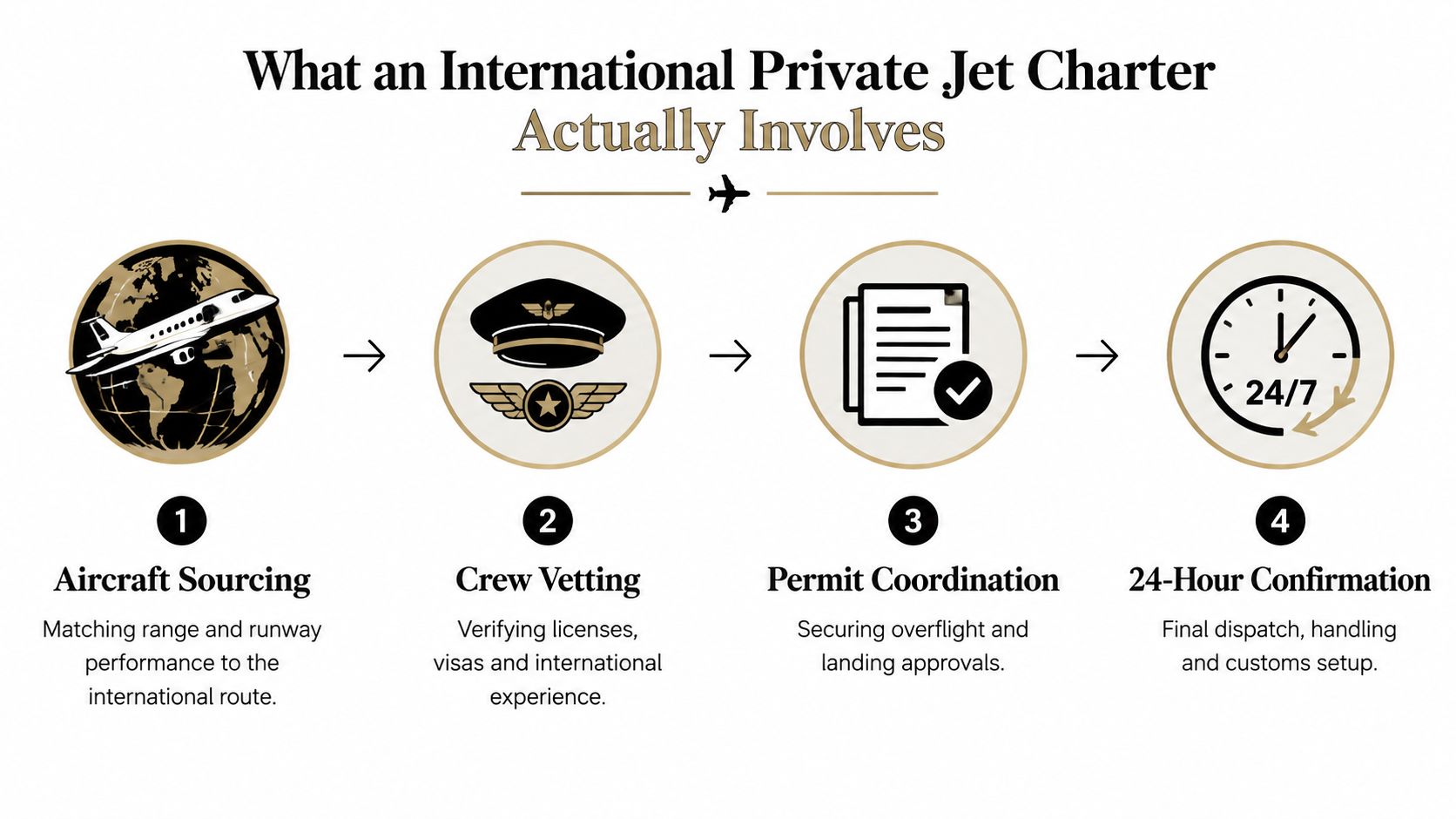
Operational rule: Treat the quote as a logistics plan wearing a price tag. If the proposal doesn't explain the aircraft's location, operator, permits, handling, and final confirmation process, it isn't ready for approval.
For broader travel planning context, these travel advisor flight booking insights can help you evaluate schedule flexibility and airport choices before the charter team builds the mission.
Verifying Operator Safety Before You Book
An aircraft model isn't the safety provider. The operating carrier, crew, maintenance program, and safety-management infrastructure determine how the flight is conducted. That distinction matters when a broker presents a familiar aircraft name alongside a certification logo.
ARGUS and Wyvern are independent audit systems, but their tiers aren't interchangeable. ARGUS Gold, Gold Plus, and Platinum involve different levels of review. Wyvern programs also distinguish between basic verification and higher-level operational oversight. The strongest widely cited tiers require active systems, not paperwork alone. ARGUS Platinum is described as requiring a functioning safety management system and emergency response plan, while Wyvern Wingman includes an on-site audit covering operational procedures, training, and safety-management systems (ARGUS and Wyvern safety rating guidance).
| Audit Program | Tiers | What It Verifies |
|---|---|---|
| ARGUS | Gold, Gold Plus, Platinum | Operator procedures, crew qualifications, maintenance oversight, safety management, and the depth of audit review |
| Wyvern | PASS, Registered, Wingman | Pilot credentials, training records, maintenance information, operational monitoring, and on-site operational standards |
| IS-BAO | Stage-based registration | A structured safety-management framework, with depth depending on the operator's implementation and registration stage |
Ask for documents, not logos
A website badge is only a starting point. Request the operator's current certificate letter, the audit summary, recent aircraft inspection information, and the minimum named crew assigned to the mission. You should also confirm the operating certificate jurisdiction and whether the certificate authorizes the planned international operation.
Safety audits can become stale. Guidance on business aviation safety ratings notes that ARGUS and Wyvern audits are commonly valid for 12 to 24 months, which makes the audit date important rather than decorative (business aviation safety rating guidance).
Use the Haute Jets guide to Wyvern and ARGUS safety ratings to understand what each program examines, then ask your provider for the documents behind its claimed tier.
Before wiring a deposit, request the audit summary letter and cross-check the exact tail number's operating history with the operator. If the broker won't identify the carrier, provide a current audit document, or explain who will fly the aircraft, move to another option.
Securing Overflight Permits, Landing Permits, and Airport Slots
Permit planning fails when clients treat all approvals as one administrative task. International operators manage at least three separate requirements, each with different authorities and timing.
Overflight permits authorize the route through airspace
An overflight permit allows the aircraft to cross a country's controlled airspace. The operator or its handler files with the relevant civil aviation authority for each country on the route. Certain regions require specialized handlers, and some authorities move more slowly than others.
The practical point is simple. Your aircraft can be legal to operate and still be unable to use the planned route if one country hasn't issued its approval. The operator should identify the countries involved, the filing status, and any separate airspace charges.
Landing permits cover the airport operation
A landing permit applies to the destination and may also be required for a technical fuel stop. Authorities can require confirmation from the local ground handler before issuing approval. That means the aircraft, airport, handler, customs arrangements, and parking plan must align.
Don't assume a landing permit automatically confirms parking or passenger processing. Those are separate operational questions, especially at busy international airports.
Slots control the clock
An airport slot is a timed arrival or departure window. Airports such as London Heathrow, Paris Le Bourget, and Geneva can have limited capacity, and a slot coordinator may refuse a request even when the aircraft holds a valid landing permit.
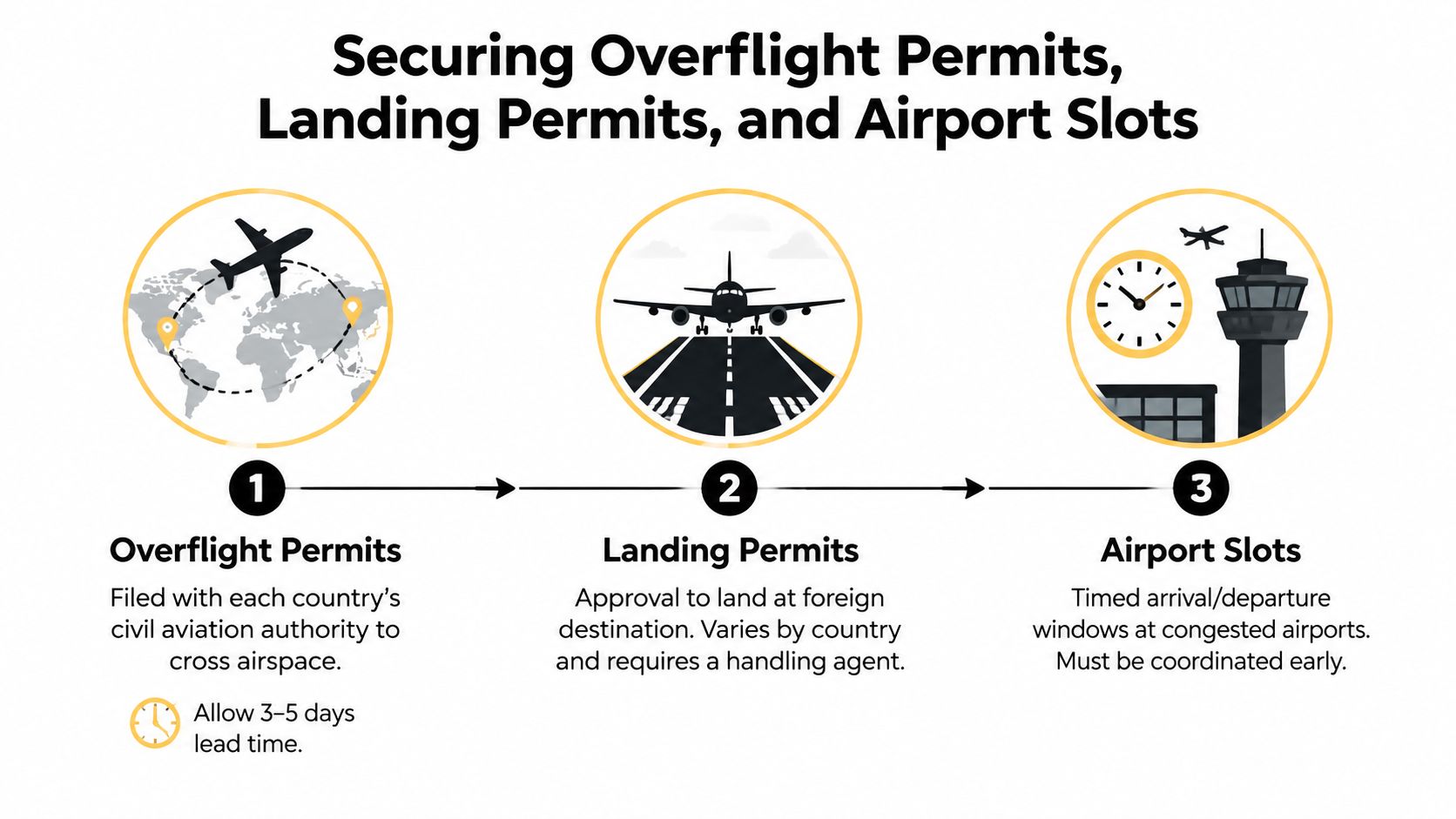
Ask for written confirmation of the permit and slot status 48 to 72 hours before departure. For busy destinations, operators should begin coordination weeks ahead, then re-check the complete trip file 24 hours before flight, as international charter planning guidance recommends (international charter planning guidance).
Never assume Russian or Chinese airspace fees are included in a headline quote. Ask whether those charges are bundled, passed through, or excluded. For a focused explanation of the first part of this process, review the Haute Jets resource on private jet overflight permits.
Customs, Immigration, and Handling at the FBO
Private aviation doesn't eliminate border controls. It changes where and how the process takes place. Your operator must coordinate customs, immigration, passenger manifests, crew documents, and the aircraft declaration for each international leg.
Start with accurate passenger information
Passports and visas must match the destination rules and the traveler's nationality. The operator or handler submits passenger information through the required aviation systems, often before the aircraft reaches the airport. A misspelled name, incorrect passport detail, or late passenger change can create a delay even when the aircraft and permits are ready.
Ask who is responsible for the manifest and when the final passenger information is due. Don't send a casual passenger list and assume the handler will correct it later.
Choose the FBO for its clearance capability
An FBO with its own customs and immigration arrangement can keep passengers away from the main commercial terminal and reduce unnecessary taxiing between facilities. The handler also coordinates baggage, ramp access, fuel, catering, crew rest, and onward transportation.
The right questions are operational:
- Customs location: Is clearance performed inside the FBO or at another terminal?
- Baggage capability: Can the ramp team handle golf bags, skis, cases, medical equipment, or other oversized items?
- Catering timing: Will the requested meals be loaded before the scheduled departure?
- Fuel planning: Is the fuel order confirmed, and are airport-specific charges identified?
- Crew facilities: Does the ground time support crew rest and duty-time requirements?
- Declarations: Has the private aircraft declaration been prepared for each leg?
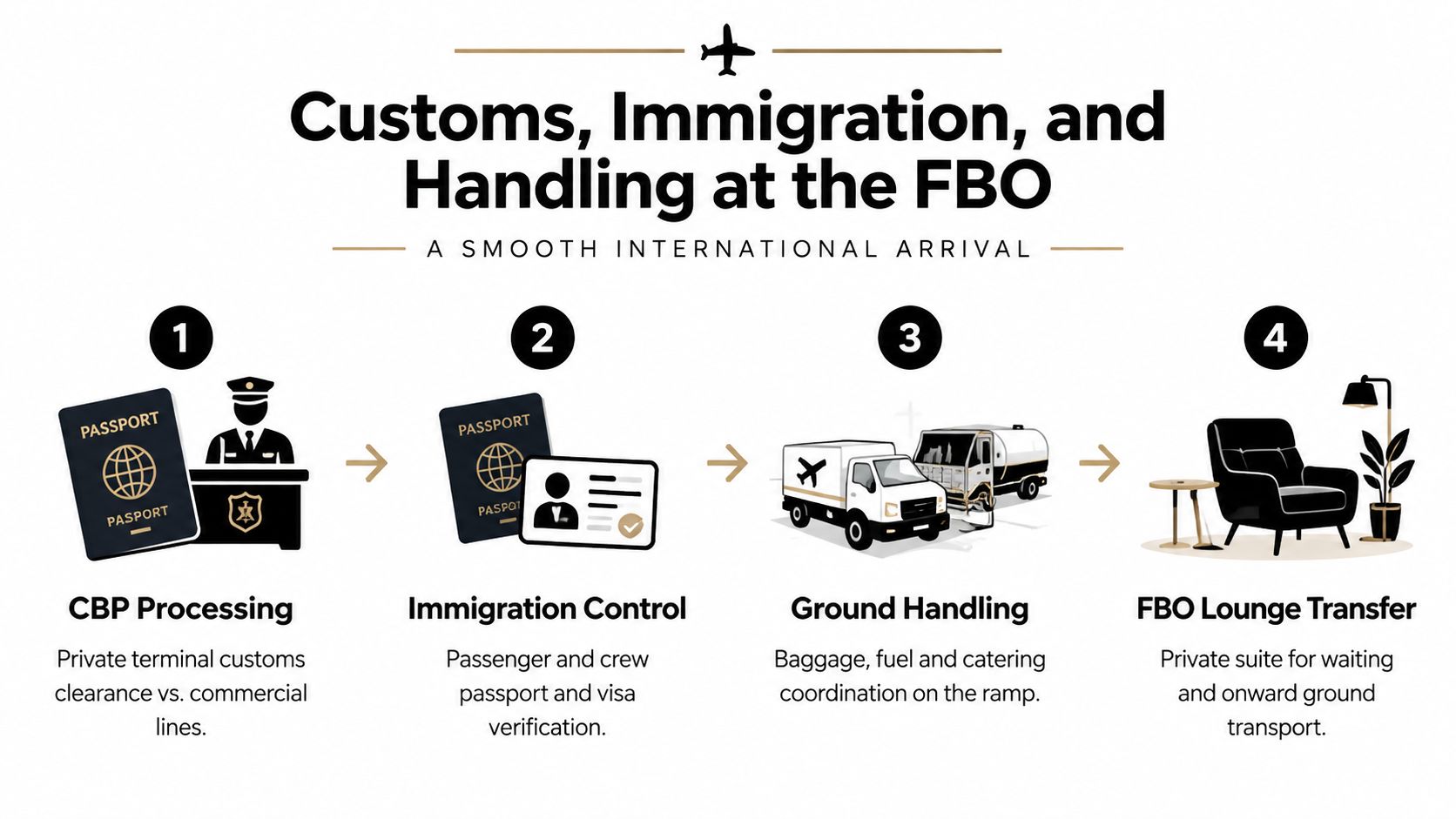
A dedicated handler matters because the handler is the person coordinating the aircraft while passengers move through the facility. If baggage arrives late, catering changes, or customs requests clarification, the handler must solve the issue without disrupting the departure plan.
For a practical document and process reference, use this private jet customs guide before submitting passenger details. It won't replace destination-specific advice, but it will help you identify the information the operator needs.
Understanding the True Cost of an International Charter
If an aircraft must be repositioned, a low hourly rate can become an expensive trip. Judge an international charter by its total door-to-door cost, not the advertised aircraft rate. A clear proposal should show every material charge that can change the final amount.
| Line Item | Typical Bundled | Typical Add-On |
|---|---|---|
| Aircraft and flight time | Passenger flight on the selected aircraft | Additional flight time caused by routing or itinerary changes |
| Repositioning | Included when the aircraft is already near departure | Empty ferry legs when the aircraft must move to collect passengers |
| Permits and slots | Included in an all-in proposal | Authority charges, special handling, or excluded airspace fees |
| FBO handling | Basic handling at agreed airports | Additional services, extended ground time, or airport-specific charges |
| Crew expenses | Included for the planned duty schedule | Overnight stays, per diem, relief crew, or schedule extensions |
| Catering and ground transport | Included when listed in the proposal | Special menus, extra services, or separate vehicle arrangements |
| Fuel and seasonal operations | Included under the quoted assumptions | Fuel surcharge, de-icing, or changes to fuel requirements |
Repositioning is where attractive quotes often break
If the aircraft is not near your departure city, you may pay for it to reach you before boarding. Independent pricing guidance identifies repositioning or deadhead charges as a major international cost driver, with cited fees ranging from $2,000 to $20,000 or more, and international overflight fees from $2,000 to $8,000 for some missions (international private jet pricing guide).
The aircraft's location, route, availability, and operating plan determine the actual amount. Local aircraft sourcing can reduce ferry costs and simplify crew and permit planning. Ask whether the quoted aircraft is already positioned near departure, and confirm that the proposed tail number can operate the route without an avoidable technical stop.
Compare like with like. Use the same aircraft mission, airports, passenger assumptions, and included services before deciding which quote costs less.
Use one written comparison rule
Ask every provider to answer these questions in writing:
- Is the quote one-way or round trip?
- Is the aircraft already positioned near departure?
- Are overflight, landing, and slot costs included?
- Are handling, customs, and catering included?
- Are crew hotels, per diem, and repositioning included?
- What happens if the tail number changes?
- Which charges can be passed through after booking?
International handling and customs may add €400 to €2,500 per stop, according to the same independent pricing guidance. Treat that range as context, not a guaranteed benchmark. Airport, handler, aircraft, and itinerary choices can change the amount.
The cheapest-looking quote often isn't the cheapest trip. Compare total door-to-door cost, not the aircraft's advertised hourly number.
On-demand charter is generally structured as pay-per-flight, without annual membership fees, jet-card deposits, or recurring commitments (on-demand charter FAQ). That structure suits irregular travel, but it does not remove the need to inspect permits, repositioning, handling, crew, fuel, and every pass-through charge before booking.
A Real-World International Charter Scenario
A client needs a one-way flight from Teterboro to London Luton, with the return scheduled three days later. The client wants a heavy jet, a quiet cabin for work, reliable baggage space, and a private arrival process that avoids the main commercial terminal.
The broker receives the request and finds a Global Express already positioned in Newark. That local sourcing decision removes the need to bring an aircraft from a distant base before the passengers reach Teterboro. The broker then confirms the operating carrier, crew credentials, aircraft configuration, baggage capacity, and whether the exact tail number can meet the route without an unnecessary technical stop.
The regulatory file moves alongside the aircraft file
The landing and overflight applications are filed with the relevant authorities, while the Luton handler confirms parking, customs coordination, catering, fuel, and onward ground transport. The team doesn't treat “permit submitted” as “permit complete.” Each approval is tracked until the operating file contains confirmation.
The passengers provide accurate passport information, visa details where applicable, baggage notes, and the return itinerary. The handler uses that information to prepare the required manifests and private aircraft declarations for both legs.
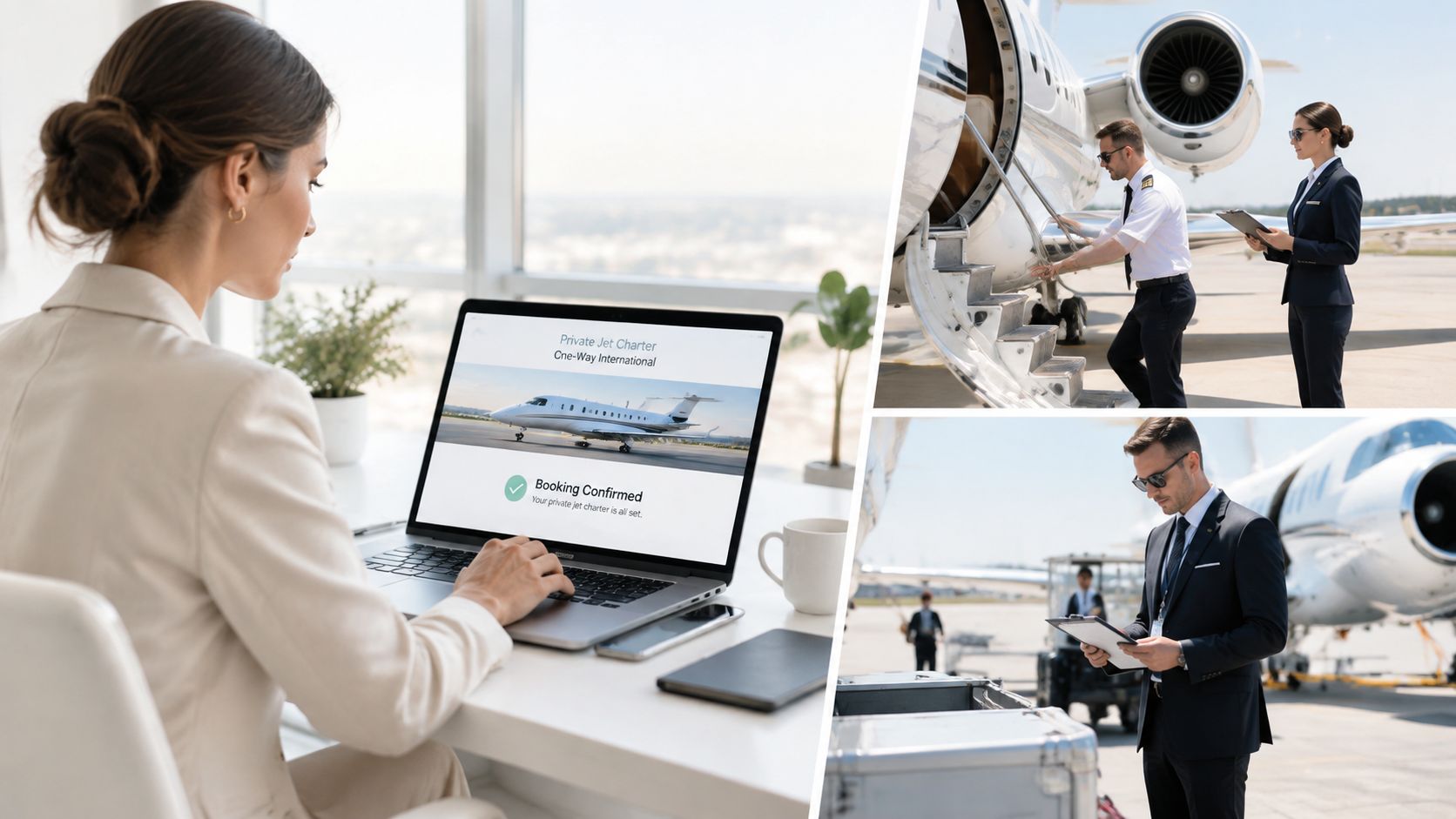
The 24-hour call is where the plan becomes real
One day before departure, the trip coordinator conducts a final review. The team checks weather along the route, reviews NOTAMs, confirms the crew's duty-time position, verifies the tail number, and rechecks permits and handling arrangements. Catering, baggage requirements, customs information, and the car waiting at Luton are confirmed rather than assumed.
The passengers arrive at the agreed FBO with the correct documents. The crew and handler already have the passenger manifest, catering, fuel plan, and customs process aligned. The aircraft departs from the planned airport, and the Luton FBO receives the passengers through its coordinated private aviation process.
Three days later, the return leg uses the same control discipline. The coordinator confirms the aircraft location, crew availability, departure slot, passenger details, and ground transport before the passengers leave London. A smooth handoff doesn't depend on luck. It comes from one team owning the details from booking through arrival.
Pre-Departure Checklist and Final Tips
Use this checklist before approving any international charter. If the provider can't answer these points clearly, the quote isn't operationally mature.
Safety and aircraft
- Audit confirmation: Obtain the current ARGUS or Wyvern documentation and confirm the tier, audit date, and operating carrier.
- Exact tail number: Ask when the tail number will be confirmed and whether authorities require it for the permit file.
- Crew assignment: Confirm the named crew, international qualifications, duty-time plan, and relief arrangements.
- Aircraft configuration: Verify the actual year, model, cabin layout, baggage capacity, Wi-Fi, lavatory, and catering setup.
Permits and border processing
- Permit numbers: Request written status for overflight and landing approvals, not just a verbal assurance that they're “in process.”
- Slot confirmation: Identify the airport slot time and the person responsible for protecting it.
- Manifest accuracy: Submit passport details exactly as shown on the travel documents and report changes immediately.
- FBO clearance: Confirm which FBO handles customs and immigration at both ends, including any technical stop.
Financial control
- Itemized quote: Require aircraft, repositioning, permits, handling, fuel, catering, ground transport, crew expenses, and taxes to appear as separate lines.
- Payment terms: Review the deposit schedule, cancellation rules, substitution language, and pass-through charges before transferring funds.
- Return assumptions: Confirm whether the aircraft remains with the trip, repositions elsewhere, or requires a new sourcing plan for the return.
- Change exposure: Ask what happens if weather, maintenance, airport restrictions, or a permit delay changes the itinerary.
The cheapest quote often hides repositioning or overnight crew expenses that appear only on the final invoice. Local aircraft sourcing can help, but only when the provider also verifies the operator, crew, permits, and handling plan.
Schedule a 24-hour pre-departure call with the operator or trip coordinator. Confirm the slot time, tail number, weather briefing, NOTAM review, crew duty status, catering loaded, customs-friendly provisions, passenger manifest, and ground transportation. Ask for a direct phone number that reaches a person with authority to manage the trip, not a generic inbox.
For repeat travel, build a shortlist of two or three vetted operators in each region you use. Keep their audit documents, aircraft preferences, FBO contacts, and billing terms on file. That preparation removes the safety and sourcing ramp-up from future bookings without forcing you into a membership or jet-card commitment.
Haute Jets arranges on-demand international charter through a network of 3,500+ owner-operators across 175 countries, with aircraft sourcing near the departure city and operator screening through Wyvern and ARGUS ratings. For a route-specific quote that shows the aircraft, repositioning plan, permits, and total trip cost, visit Haute Jets.