
Most advice about private jets in Miami starts in the wrong place. It starts with glamour, memberships, and vague promises about convenience. That’s how first-time charter clients end up paying for an aircraft that wasn’t local, wasn’t their first choice, and wasn’t priced with much transparency.
Miami is one of the few markets where a smart buyer can do much better. South Florida is a major private aviation center, with five of the top 25 busiest executive airports in the U.S., and the region logged 73,000 private jet movements in 2022, up 11% from the prior year, according to this South Florida private jet hub report. In a market with that much lift, availability is not the actual problem. Quote structure is.
If you’re chartering private jets in Miami for the first time, the single biggest mistake is assuming every quote reflects the same aircraft economics. It doesn’t. One broker may price a local jet. Another may price an aircraft that has to fly in empty before you ever step onboard. That difference often decides whether you’re getting a clean market rate or absorbing hidden repositioning costs.
The practical version of private flying is simple. Choose the right airport, source the right aircraft close to your departure point, confirm the exact tail, and make sure the operator meets real third-party safety standards. If you do that, private aviation stops feeling opaque and starts behaving like a controlled logistics decision.
Beyond the Velvet Rope: Chartering Private Jets in Miami
Private flying in Miami gets overpriced the moment the conversation centers on luxury first. Sourcing is the key decision. If the aircraft is not already in South Florida, your quote can absorb a 20 to 40 percent repositioning premium before you even discuss cabin size, catering, or departure time.

That is why experienced buyers ask a different first question. They do not start with, “What’s available?” They ask, “Which aircraft are already close, and who controls them?” In Miami, that distinction matters more than almost anywhere else because the local charter market is active enough to give you real options if the trip is sourced correctly.
A traditional broker can shop broad inventory and still hand you an aircraft that needs to fly in empty from another city. The quote may look normal on the surface, but the structure is doing the damage. A direct-to-owner sourcing model changes that. It lets you start with local operators and local tails, which is the simplest way to cut out unnecessary ferry cost and tighten price without cutting safety or service.
Practical rule: Ask where the aircraft is based, who operates it, and whether your quote includes any empty repositioning time.
That is the part many first-time clients never see. Two quotes for the same Miami route can describe the same aircraft category and still be priced very differently because one jet is sitting at a nearby field and the other is not. The cheaper-looking offer on paper is not always the lower total cost once positioning, airport fit, crew duty limits, and minimums are factored in.
Private aviation still delivers clear advantages in control, schedule flexibility, and access to airports the airlines do not serve well. Broad consumer pieces, including this overview of the benefits of flying private, cover that part well. The money-saving side is less visible. In Miami, value comes from getting specific about the exact aircraft, the exact operator, and the exact pickup point before you accept a quote.
Choosing Your Gateway: A Comparison of Miami's Private Airports
The wrong airport can add thousands to a quote before you ever discuss the aircraft.
That is why experienced buyers start with the pickup point, not the cabin category. In Miami, airport choice affects local aircraft availability, crew time, runway fit, customs handling, ground transfer time, and the odds that your quote includes expensive empty repositioning. If you want to avoid the 20 to 40 percent cost creep that shows up in poorly built charter quotes, choose the airport first and source from operators already positioned there.
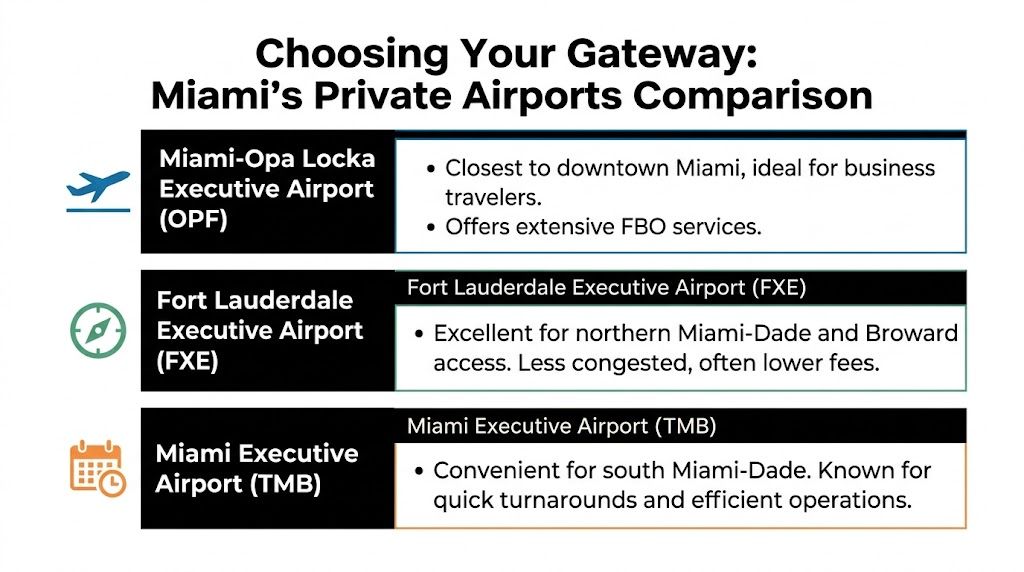
Opa-Locka for most charters
For a large share of Miami departures, Opa-locka Executive Airport (OPF) is the strongest starting point. It has the deepest concentration of charter activity and based aircraft in the area, which matters for one simple reason. The more local tails you can source against, the better your chance of avoiding a paid ferry leg.
That is the part many first-time clients miss. They ask for a Miami departure, get a quote from whichever airport the broker picked, and assume the number reflects the market. It may only reflect where that specific aircraft happens to be sitting. A direct-to-owner process usually starts at OPF because it gives you more local operator options before anyone adds repositioning cost.
For travelers staying in Miami Beach, Brickell, Aventura, or the Design District, OPF often gives the best balance of access and charter depth. For more detail on the airport itself, including the fixed-base operators on the field, see this guide to flying privately into Miami through Opa-locka and its premier FBOs.
MIA for specific international missions
Miami International Airport (MIA) earns its place on the list for a narrower set of trips. If you are flying a heavy jet internationally, carrying a full passenger load, or need major-airport customs infrastructure, MIA can be the right call.
It is usually not the lowest-friction option for a domestic charter. The field is busier, the operating environment is more complex, and you should expect less flexibility than at an executive airport. Still, for certain long-range departures and some international arrivals, those trade-offs are justified by runway capability and customs convenience.
A practical rule is simple. If your mission does not need MIA’s international setup, ask why the quote is built there instead of at OPF or another executive field.
FXE and TMB for location-driven trips
Fort Lauderdale Executive (FXE) and Miami Executive (TMB) both work well in the right case, but neither should be treated as a default.
FXE makes sense when the client is based in Broward, northern Miami-Dade, or along the coast north of Miami Beach. Saving thirty to sixty minutes in a car can matter more than shaving a small amount off an airport fee. The trade-off is aircraft depth. Depending on the day and the mission, you may have fewer nearby charter options than you would at OPF, which can push the quote up.
TMB is often the practical answer for clients in Coral Gables, Kendall, Pinecrest, and the south side of the county. It is especially useful for shorter regional flights where convenience on the ground matters as much as airborne time. The limitation is similar. The local charter pool is not always as deep, so the best-priced aircraft may still come from another field.
A practical comparison
| Airport | Best use | Main advantage | Watch-out |
|---|---|---|---|
| OPF | Most Miami-area private charters | Strong local operator base, better odds of sourcing a nearby aircraft | Not every international or heavy-jet mission belongs here |
| MIA | Long-range international trips | Major-airport runway and customs infrastructure | More complex operating environment, often less efficient for domestic flying |
| FXE | Broward and northern access | Better ground convenience for north-based travelers | Smaller local charter pool on some missions |
| TMB | South Miami-Dade departures | Strong geographic fit for south-county travelers | Fewer based aircraft than OPF in many categories |
The airport questions that save money
Before you approve a quote, ask these:
- Which airport has the best local aircraft availability for my route? This is how you reduce empty repositioning time.
- Is the aircraft based on this field, or is it coming in from somewhere else? A short ferry can still be expensive.
- Does my mission require MIA? International customs and long-range performance are real reasons. Habit is not.
- How much am I saving, or losing, in ground transfer time? The wrong airport can turn a short private flight into a long travel day.
- What is the fallback if weather, congestion, or runway limits change the plan? Good sourcing includes the backup, not just the first quote.
In Miami, the cheapest charter is often the one built around the right airport and the right local operator from the start. That is how you avoid paying for someone else’s repositioning problem.
From Aircraft Category to Exact Tail Number: Selecting Your Jet
Many first-time clients start by saying they want a light jet, a midsize, or a heavy. That’s a reasonable start, but it’s not where the decision should end. Category gives you a rough shape. It doesn’t tell you which aircraft you’re boarding, how the cabin is configured, or whether the operator quality meets the standard you should require.

Match the mission before the brand
A short Caribbean hop and a longer domestic flight shouldn’t be sourced the same way. At Opa-Locka Executive, the 8,002-foot runway supports a wide range of aircraft, from light jets such as the Hawker 400XP to ultra-long-range aircraft such as the Gulfstream GV, according to Paramount Business Jets’ OPF runway overview. That gives charter clients in Miami meaningful flexibility.
A practical way to think about categories:
- Light jets work well when the trip is short, the passenger count is low, and baggage is controlled.
- Midsize and super-midsize jets tend to be the most versatile domestic sweet spot for travelers who want more cabin comfort without jumping to a large-cabin quote.
- Heavy and ultra-long-range jets make sense when range, cabin volume, or international routing drives the decision.
If you want a broader breakdown, this guide to understanding private jet types is helpful, but the key point is simple. Category narrows the search. The exact aircraft closes it.
Why exact tail number matters
Two aircraft with the same model name can feel very different in practice. Cabin refurbishment, Wi-Fi reliability, seating layout, baggage access, galley setup, and pet policy all vary at the individual aircraft level.
When a client says, “I just need a midsize jet,” that usually means they haven’t been shown the actual variables yet. The smarter request is: show me the specific year, make, model, and tail number, then confirm the details that affect this trip.
Non-negotiable: Don’t wire funds on a category alone if the exact aircraft hasn’t been identified.
This matters even more for families, executives working in flight, and travelers with specific service expectations. “Wi-Fi available” can mean very different things depending on the aircraft and operator. So can “pet-friendly.”
Safety standards are the first filter
The right cabin means nothing if the operator quality is soft. Before discussing finishes, ask whether the operator is Wyvern Wingman or Argus Gold/Platinum rated. Those are the only standards I’d want in the conversation for on-demand charter sourcing in a market like Miami.
Haute Jets is one example of a sourcing model built around that requirement. It works from a network of 3,500+ owner-operators across 175 countries, uses Wyvern Wingman or Argus Gold/Platinum-rated operators only, and confirms the exact aircraft with a 24-hour pre-flight confirmation rather than selling a generic category promise.
A better aircraft selection checklist
- Start with route logic. Miami to Nassau is not Miami to Los Angeles.
- Set the actual passenger and baggage count. Understating either creates bad aircraft matches.
- Ask for specific aircraft options. Tail number first, lifestyle language second.
- Verify onboard needs. Wi-Fi, pets, catering style, and baggage shape all matter.
- Vet the operator. Safety rating isn’t an add-on. It’s the gatekeeper.
The Real Cost of Charter: How to Save Up to 40% on Your Miami Flight
A charter quote looks simple until you read it like an operator instead of a passenger. Most clients focus on the aircraft name and the total price. The smarter move is to ask which parts of the quote are fixed, which are trip-specific, and which costs appeared only because the aircraft wasn’t local.
What you’re actually paying for
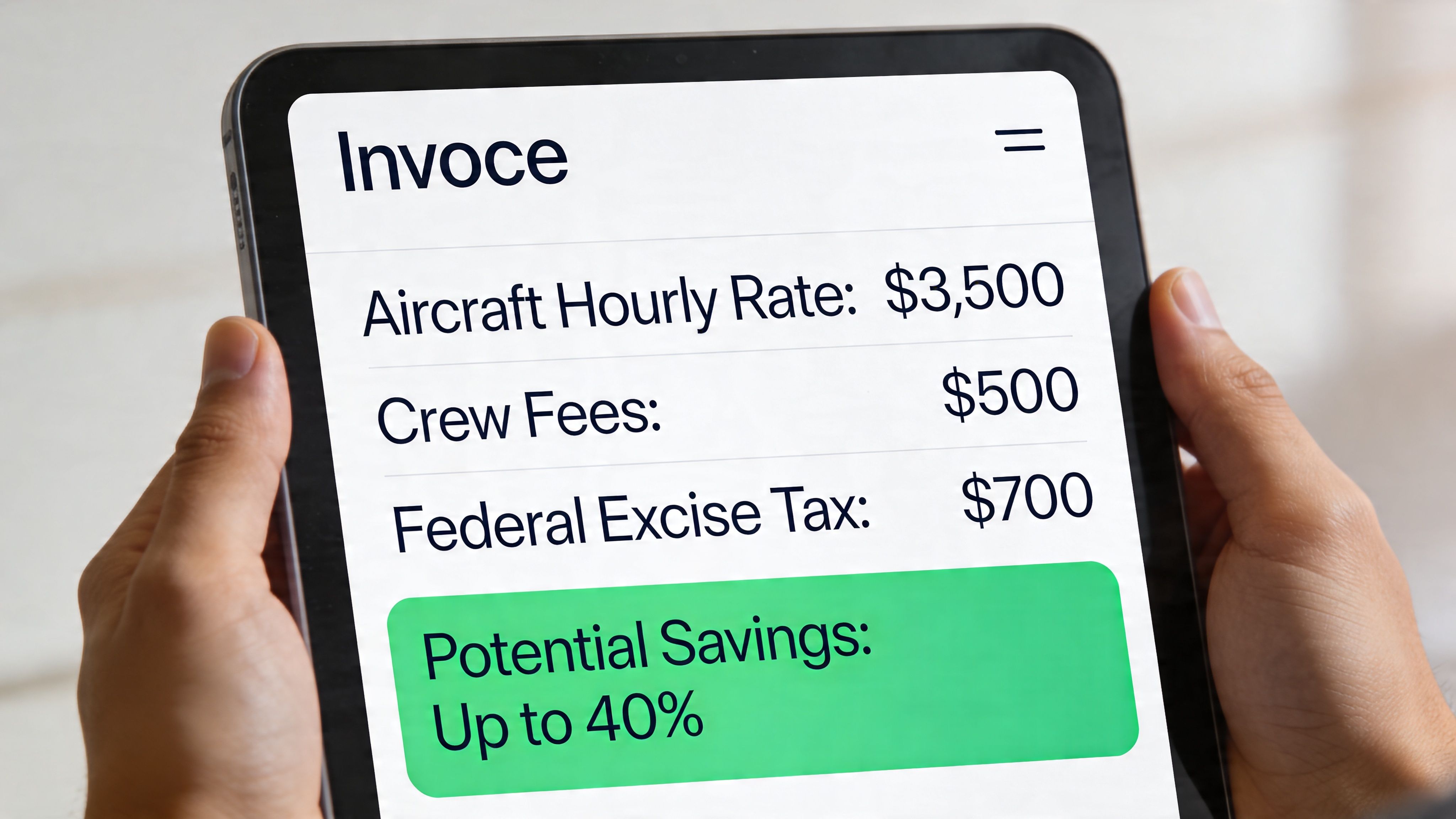
Most private charter pricing includes several layers. The exact line items vary by trip and operator, but the quote usually reflects the aircraft’s flight time, crew-related operating needs, airport handling, and passenger-specific requests such as catering or ground coordination.
That’s normal. What isn’t always shown clearly is the aircraft positioning logic.
The most expensive part of many Miami charter quotes isn’t the flight you want. It’s the empty flying required to get the aircraft into place.
That’s where repositioning enters the picture. In this market, repositioning can inflate a charter by 20% to 40%, based on the sourcing model and publisher guidance provided for this article. If a broker grabs the first acceptable airplane instead of the nearest suitable airplane, you often pay for that convenience.
The hidden fee most first-time clients miss
Repositioning is straightforward. If your jet isn’t already near your departure airport, someone pays to move it to you. On a quote, that cost may be blended into the total rather than labeled in plain English.
That’s why direct-to-owner sourcing matters so much in private jets in Miami. This region has deep private aviation traffic, which means a disciplined broker should be trying to match your route with a jet that’s already based nearby.
A good quote conversation sounds like this:
- Where is the aircraft now
- Is this plane based at OPF, MIA, FXE, or elsewhere nearby
- Am I paying for a ferry segment
- Would a different airport reduce the positioning burden
A weak quote conversation skips those questions and shifts your attention to cabin photos.
Local sourcing beats generic availability
The most practical cost-saving strategy in Miami is not a trick. It’s local sourcing. Instead of starting with a category and expanding outward, start with the airport and look for suitable aircraft already in that local orbit.
That approach does two things. First, it cuts the empty flying that drives inflated pricing. Second, it reduces the chance that your schedule depends on a plane arriving from somewhere else before your own trip can begin.
Here’s where many traditional brokers get lazy. They quote broad network availability because it’s fast. But broad availability and efficient sourcing aren’t the same thing.
Empty legs are real, but they’re not a plan
Empty leg flights can produce legitimate savings, and they merit discussion. According to Sky Access’s Miami to Nassau empty leg overview, a one-way light jet empty leg from Miami can run $3,000 to $4,500 versus a standard $10,000+ charter, and 70% of those flights are booked within 48 hours.
Those numbers tell you two things at once. The savings can be substantial. The reliability is limited.
If your dates, airport, passenger count, and tolerance for change are all flexible, empty legs are worth monitoring. If you need the exact plane, predictable timing, or firm service details, they’re often the wrong foundation for the trip.
A practical way to use empty legs:
- Treat them as opportunistic. Great for flexible one-way leisure travel.
- Don’t build critical business travel around them. They can shift or disappear.
- Check the aircraft details carefully. Service assumptions are riskier on a distressed inventory listing.
- Use them as a benchmark. Even if you don’t book one, they help you understand where value exists in the market.
This video gives a useful visual overview of private jet charter pricing dynamics and what travelers often miss in the buying process.
What works and what doesn’t
| Works | Doesn’t work |
|---|---|
| Choosing the departure airport before sourcing the jet | Asking for “any jet in Miami” and hoping the quote is efficient |
| Confirming whether the aircraft is local | Assuming the total price already reflects the best routing |
| Using empty legs when your schedule is flexible | Expecting empty leg pricing on fixed-time travel |
| Requesting the exact aircraft details | Comparing quotes only by headline total |
A transparent charter quote should explain the aircraft’s location, not just the aircraft’s leather.
The Seamless Experience: Booking, Payments, and Pre-Flight Logistics
Private charter feels easy on departure day only if the work was done properly before you arrive at the FBO. In Miami, that usually comes down to three things. Confirming the exact aircraft, clearing payment without delays, and closing every operating detail before the crew is dispatched.
First-time clients are often surprised by what creates problems. It is rarely the flight itself. It is a vague quote, an operator swap, an unconfirmed pet request, or a late wiring instruction that holds the aircraft.
How the booking flow should work
A good booking process starts with a quote that shows what is available, not just a category and a price. I prefer to show clients the exact aircraft option, where it is coming from, who operates it, and whether the routing includes unnecessary repositioning. That last point matters in Miami because a cheap-looking quote can turn expensive fast if the aircraft has to be brought in from another market.
You should see the trade-off clearly. A local aircraft may have a slightly higher hourly rate but a lower total trip cost. A non-local aircraft may look competitive until the ferry segment is added. Traditional brokers often bury that in the final number. A direct-to-owner sourcing model makes it easier to spot and remove those avoidable costs before you sign.
Once you approve the option, the paperwork should lock the itinerary, passenger manifest, baggage notes, catering, and any special handling requests. Before departure, you should have the tail number, operator name, departure terminal, crew contact path, and final schedule in writing.
Before funds are sent, clients should know which aircraft is flying, where it is positioned, who operates it, and whether the quote includes any deadhead cost.
That matters even more for families, executives on fixed schedules, and anyone connecting to yachts, resorts, or international legs.
International arrivals and customs planning
For international trips, airport handling needs to be settled early, but there is no reason to repeat the airport comparison work from earlier in this guide. The practical point is simpler. The wrong airport choice can add ground delays, extra transfers, or handling friction that you could have avoided at booking.
Ask direct questions. Where will customs be cleared. Will the aircraft arrive and depart from the same facility. Is there any reason this routing creates extra waiting time on arrival. A broker who cannot answer those points clearly is still guessing.
This is also where exact tail number confirmation helps. Different operators have different procedures, and those differences show up fastest on international missions.
Payment and service details that should be settled early
Payment should be straightforward and timed correctly. Wire transfer is still the standard on many charter bookings because it is clean and fast to reconcile. Card payments are common on smaller trips, though processing limits or fees can apply. Some clients ask about crypto, but acceptance depends on the seller, not just the broker.
The key issue is release timing. An aircraft is not fully secured because a client said yes. It is secured when the contract is executed and funds are received under the operator’s terms. In busy Miami periods, that timing matters. Wait too long, and the aircraft can be sold to another trip or repositioned.
Service requests should be treated the same way. Confirm them on the specific aircraft and operator, not as a general assumption:
- Catering, including dietary restrictions and alcohol requests
- Pets, with explicit approval before departure day
- Ground transportation to and from the FBO
- Cabin Wi-Fi, power, and connectivity if work will continue in flight
- Baggage fit, especially for golf clubs, garment bags, strollers, or oversized cases
I have seen more last-minute issues caused by baggage and pet assumptions than by weather. A light jet with a perfect price is the wrong aircraft if the luggage load does not fit without repacking on the ramp.
What departure day should look like
Departure day should be quiet. You arrive at the FBO, show ID if required, confirm the passenger count, and board. There should be no surprise aircraft change, no confusion about catering, and no scramble over payment clearance.
That outcome is not luck. It comes from getting the booking details right early, sourcing from aircraft that are already positioned sensibly, and confirming the exact operating terms instead of relying on a polished quote. That is also how clients avoid the 20 to 40 percent repositioning costs that inflate many Miami charter prices.
If you want a quote structured around local aircraft availability, exact tail number confirmation, and Wyvern or Argus-rated operators only, Haute Jets is one Miami-based option to consider for on-demand charter planning.