
You’re in Manhattan, your calendar blows up, and a London meeting moves from “important” to “critical” overnight. Commercial won’t do it. The airline schedule is wrong, the airport experience is worse, and you can’t afford a missed connection, a canceled departure, or a seat that turns the next day into recovery time instead of deal time.
That’s when most first-time charter clients make the same mistake. They think the hard part is finding a jet. It isn’t. The hard part is knowing whether the quote is clean, whether the aircraft is suitable for the mission, and whether you’re paying for someone else’s operational inefficiency.
Private jets nyc is a market where speed and access matter, but transparency matters more. In New York, the wrong airport, the wrong aircraft category, or the wrong broker model can turn a seemingly straightforward trip into an overpriced, overcomplicated booking. If you want value, you need to understand what drives price, what creates risk, and where the hidden fees creep in.
Navigating the World of Private Jets in NYC
A discerning traveler usually comes to private aviation for one reason first. Control.
When a senior executive needs to leave New York with less than a day’s notice, private aviation isn’t a luxury add-on. It’s a scheduling tool. You skip the airline timetable, avoid the commercial terminal, and choose an aircraft around the actual mission instead of forcing the mission into whatever the airlines happen to sell that day.

New York sits at the center of that world. New York City is the busiest private jet hub globally, with 16,630 departures recorded, which is why the city constantly attracts charter demand from executives, family offices, and high-net-worth travelers who need time-sensitive access to domestic and international markets, according to private aviation statistics on NYC departures.
What first-time charter clients usually get wrong
It is often assumed a private charter quote is simple. Aircraft, route, done. It rarely works that way.
A quote can look competitive and still be bloated by positioning costs, airport congestion, or a mismatch between the aircraft and the trip. You might ask for a “midsize” and get a category label instead of a clear aircraft commitment. You might book from the most famous airport instead of the most efficient one. You might also discover too late that the lowest quote came from an operator with weaker standards or less operational depth than you expected.
Practical rule: If you can’t see why an aircraft is at your departure airport, why it fits your route, and who is operating it, you don’t have a complete quote.
What smart clients focus on
The clients who book well focus on three things.
- Mission fit: They choose the aircraft for range, baggage, runway access, and onboard workability.
- Airport strategy: They don’t assume the closest airport is the smartest departure point.
- Quote transparency: They ask what costs are tied to the trip itself and what costs exist only because the aircraft has to move into position.
That’s the lens you should use for every charter decision in NYC. Not glamour. Not the biggest cabin. Not the first quote that lands in your inbox.
Selecting the Right NYC Airport for Your Mission
In New York, airport choice shapes the flight almost as much as aircraft choice. If you book private jets nyc the way tourists think about New York, you’ll gravitate to the name you know. If you book like an experienced charter client, you’ll choose the airport that best supports your exact mission.

The main airports most clients consider
Teterboro (TEB) gets most of the attention for a reason. It’s the best-known private aviation airport in the region and a standard choice for Manhattan departures. If proximity and familiarity matter most, it often leads the list.
Westchester (HPN) can make more sense for travelers based in northern suburbs, Westchester, or Connecticut. It’s often the practical play when your ground movement matters as much as your airtime.
Republic (FRG) is a logical Long Island access point. If your meeting, estate, or family office activity sits east of the city, FRG can simplify the day.
Those airports are valid choices. They’re just not always the smartest ones.
Why the obvious airport can be the expensive airport
The market overvalues prestige airports and undervalues operational convenience. That’s where many charter costs start to swell.
That matters more than first-time clients realize. Congestion affects more than your wheels-up time. It can affect crew logistics, aircraft availability, handling flow, and the total cost of moving the aircraft in and out.
The airport with the strongest brand name isn’t automatically the airport that gives you the cleanest operation.
When secondary airports are the smarter move
If I were advising a first-time but discerning client, I’d say this plainly. You should look at secondary airports first whenever schedule reliability and cost discipline matter more than social signaling.
Consider ISP if you need easier access to eastern parts of the metro area or want to avoid the pressure points that build at marquee private terminals.
Consider SWF if you value lower congestion and a smoother operating environment. The drive may be longer for some travelers, but on the right trip that trade can be worth it.
A sensible airport selection process looks like this:
- Start with your real origin point. Don’t default to Manhattan if you’re sleeping in Westchester or heading to Long Island after landing.
- Ask where the aircraft is already based. Local sourcing matters. If the jet is already near your departure field, your quote usually gets cleaner.
- Compare ground time against airside friction. A slightly longer drive can be worth it if the airport is easier to operate through.
- Use the prestige airport only when it improves the mission. Sometimes it does. Often it doesn’t.
For a broader look at airport strategy in major markets, review this guide to the best private jet airports in Miami, New York, and Los Angeles.
A broker’s blunt recommendation
If your trip is highly time-sensitive, don’t ask only, “What’s closest to me?” Ask, “What airport gives me the highest chance of an on-time, low-friction departure on the right aircraft?”
That question gives you a more accurate quote. It also prevents bad surprises.
From Short Hops to Transatlantic Flights
You leave Manhattan at 6 p.m. for a next-morning meeting in London. The quote looks polished. The aircraft sounds impressive. Then the trip picks up a fuel stop, your bags become a weight problem, or the operator swaps the jet because the original aircraft was never a clean fit for the mission. That is how first-time charter clients in NYC overpay and still get the wrong airplane.
The right aircraft does two things. It covers the mission cleanly, and it does it without forcing hidden costs into the quote.
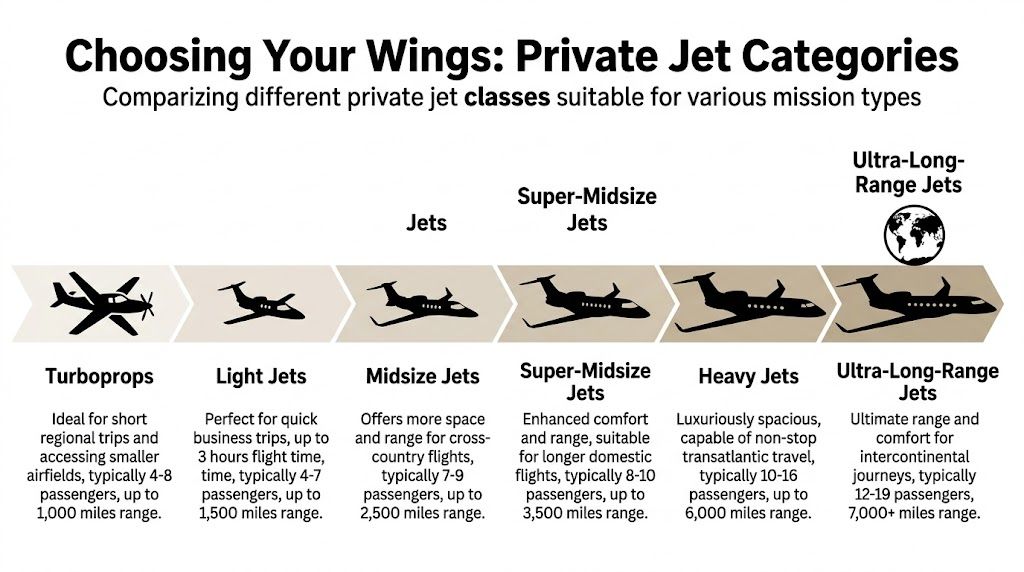
How to think about jet categories
Aircraft categories serve different jobs.
A turboprop is built for short regional flying, especially where runway flexibility matters more than outright speed. A light jet works for quick business sectors with a small passenger count and limited baggage.
A midsize jet gives you more cabin comfort and a more usable luggage hold. A super-midsize jet is often the smartest domestic choice out of New York because it balances speed, stand-up cabin comfort, and operating economics.
A heavy jet adds cabin volume, baggage capacity, and stronger long-range capability. An ultra-long-range jet is the category you start with for serious international missions from NYC. If nonstop across the Atlantic matters, start there and work backward only if the payload and routing still make sense.
What each category is actually good for
Here is the practical filter clients should use.
- Turboprops: Short sectors, smaller airports, and trips where efficiency matters more than speed.
- Light jets: Short business hops with a lean passenger count and soft bags.
- Midsize jets: Domestic missions where passengers want enough room to work, not just sit.
- Super-midsize jets: Longer U.S. routes such as Florida, Texas, or the Mountain West, where comfort starts to matter.
- Heavy jets: Larger groups, more luggage, and routes where cabin service and space are part of the value.
- Ultra-long-range jets: True intercontinental flying, especially when you want nonstop capability with fewer compromises.
The domestic sweet spot from NYC
For New York to Miami, many clients land in the wrong category for the wrong reason. They either book too small and accept a tighter cabin than they need, or they jump into a heavy jet because the name sounds safer.
A Challenger 605 is a strong fit on this route. It offers transcontinental capability, a wide stand-up cabin, and the kind of luggage capacity that works for business travelers and family groups alike. Charter market listings and operator pricing published by Paramount Business Jets on the Challenger 605 place this aircraft in the segment that commonly serves high-demand domestic missions such as New York to South Florida.
That matters because the primary decision is not just aircraft category. It is whether the aircraft is available locally enough to avoid unnecessary ferry time. In NYC charter, a well-matched super-midsize jet often gives you the cleanest result on Florida routes because it handles the mission comfortably without dragging in the extra operating cost of a larger cabin class.
When international nonstop really matters
For New York to London, stop shopping by label and start shopping by mission capability. A Gulfstream G550 is built for long-range international flying, with a published range of 6,750 nautical miles and seating for up to 19 passengers, according to Gulfstream’s G550 specifications.
The point is not that a jet can make the trip on paper. The point is whether it can do it with your passenger load, your bags, real weather, and the reserve profile an experienced operator wants on an overnight Atlantic crossing.
A jet that only works under ideal conditions is a poor NYC to London solution.
For readers comparing cabin size, range, and mission fit across longer-haul aircraft, this guide to top private jets for international travel is useful context.
Private Jet Categories at a Glance
| Aircraft Category | Typical Pax | Max Range (NM) | Example NYC Itinerary |
|---|---|---|---|
| Turboprop | 4-8 | Up to 1,000 miles | NYC to a short regional getaway |
| Light Jet | 4-7 | Up to 1,500 miles | NYC to a quick Northeast business trip |
| Midsize Jet | 7-9 | Up to 2,500 miles | NYC to a longer domestic meeting run |
| Super-Midsize Jet | 8-10 | Up to 3,500 miles | NYC to Miami |
| Heavy Jet | 10-16 | Up to 6,000 miles | NYC to a long domestic or some transatlantic missions |
| Ultra-Long-Range Jet | 12-19 | 7,000+ miles | NYC to London |
A clean way to choose
Use four filters.
Trip length. Short sectors do not need excess cabin. Long-haul sectors punish undersized aircraft.
Real headcount. Count passengers, bags, pets, staff, and anything else that affects payload.
Nonstop requirement. If nonstop matters, choose the aircraft that can do it with margin. Do not buy a technical possibility.
Onboard use. If the flight is part of the workday, cabin height, noise level, and seating layout matter more than brochure language.
Aircraft selection is where many hidden charter costs begin. Pick the wrong category and you often pay for it twice. First in the quote, then again in operational compromises.
Deconstructing the Price of a Private Flight
Most charter quotes look simpler than they are. That’s by design.
A polished quote can make a flight appear to cost one thing when, in reality, you’re paying for several moving parts bundled together. Some are legitimate trip costs. Some are avoidable. If you don’t separate those two buckets, you won’t know whether the quote is competitive.
What you’re usually paying for
At a high level, a private charter quote typically includes the aircraft itself, crew time, fuel exposure, airport handling, taxes, and any trip-specific services like catering or ground transportation. Those are normal cost drivers.
The problem isn’t that charter has multiple cost components. The problem is that many first-time clients never get a clean explanation of which line items are tied to their mission and which exist because the aircraft wasn’t in the right place to begin with.
That’s where repositioning fees become the issue.
The hidden cost most clients miss
Repositioning is simple. You’re paying for the aircraft to travel empty before it can fly you.
Imagine ordering a car in Manhattan but paying extra because the driver has to come from another city just to start your ride. You’re not buying better service. You’re absorbing someone else’s setup cost.
That’s why repositioning is the fee I tell clients to interrogate first. In NYC, where airport congestion and aircraft availability vary by airport and day, repositioning can subtly distort a quote even when the base rate looks reasonable.
If the aircraft is not already near your departure point, the quote may be solving the operator’s problem more than yours.
What to ask when you review a quote
A serious client should ask direct questions. Not because they’re difficult, but because such questions uncover real savings.
- Where is the aircraft based right now? If the answer is vague, push.
- Is the quote built around a specific tail or just a category? Category-only selling often hides substitutions.
- Which charges are trip-essential and which are positioning-related? You want that separated clearly.
- Does a different airport reduce movement costs? In New York, that question matters.
For a more detailed breakdown of how charter pricing works, this guide to private jet charter pricing and cost components is worth reviewing.
A broker’s opinion on “cheap” quotes
The cheapest quote in your inbox is often the least transparent one.
A strong quote does three things. It identifies the aircraft clearly, it matches the aircraft cleanly to the mission, and it avoids charging you for unnecessary movement. If one of those is missing, the number on the first page doesn’t tell you much.
That’s why experienced charter buyers don’t shop by headline price alone. They shop by all-in logic.
The Charter Booking Timeline From Request to Takeoff
Booking a charter isn’t complicated, but it is sequence-sensitive. If you rush the wrong step, you can end up with the wrong aircraft, weak paperwork, or safety standards that don’t match the price you’re paying.

Step one, submit a precise request
A good charter request is specific. Give your departure airport options, destination, preferred wheels-up window, passenger count, luggage profile, and any essential requirements such as Wi-Fi, pet carriage, or cabin size.
Don’t say “sometime in the afternoon” if you mean “after lunch but before a dinner in Mayfair.” Precision gets you better aircraft matches and cleaner quotes.
Step two, compare aircraft, not just pricing
When quotes come back, compare the actual aircraft and operator details. That means make, model, airport positioning, and whether the quote is attached to a real aircraft or just a category placeholder.
Many first-time clients often lose discipline. They compare price without comparing operational quality. That’s backwards.
Step three, vet the operator properly
Safety vetting is not optional. In private aviation, Wyvern Wingman and ARGUS Gold or Platinum are the third-party standards serious clients should look for when reviewing operators.
If an operator doesn’t hold recognized third-party credentials, I’d pass. There are too many quality options in the market to lower your threshold just to shave a quote.
A useful rule is simple:
- Verify the operator identity
- Confirm the rating
- Review the aircraft details
- Check the crew and trip paperwork before departure
Don’t confuse a polished sales process with a strong operating standard. They are not the same thing.
Step four, review the charter agreement
Before you sign, read the agreement like a buyer, not a passenger.
Look for the aircraft listed, cancellation terms, what triggers substitutions, and how delays or operational changes are handled. If the contract gives broad leeway to swap aircraft categories without your approval, slow down and ask why.
Step five, expect a final pre-flight package
A proper booking process ends with operational clarity. You should receive a final itinerary and flight details before departure, not vague reassurances.
Watch this quick overview to understand the booking flow from a client perspective.
The strongest pre-flight packets typically confirm the tail number, crew, schedule, terminal details, and passenger manifest. If the information comes late or arrives incomplete, that’s a signal about the discipline behind the booking.
The timeline I recommend
For a straightforward trip, this is the cleanest process:
- Initial request: Submit complete trip details early
- Quote review: Compare mission fit, not only price
- Safety check: Confirm operator credentials before money moves
- Contract review: Read substitution and cancellation language carefully
- Pre-flight confirmation: Make sure final details arrive in time to catch errors
If you handle those steps in order, you remove most of the avoidable risk that frustrates first-time charter clients.
How Haute Jets Reduces Cost and Risk
You request a Teterboro departure for tomorrow morning, get a quote that looks reasonable, and only later learn you were paying to move the aircraft in from another market. That is the mistake I see most often in NYC charter. The headline rate looks fine. The total trip cost does not.
Haute Jets addresses that problem the right way. It sources from a broad network of vetted operators and tries to match your trip with an aircraft already close to your departure point. It also limits charter options to Wyvern Wingman, ARGUS Gold/Platinum, or IS-BAO rated operators and provides a 24-hour pre-flight confirmation with tail number, crew details, and manifest review.
That combination matters more in New York than in many other markets.
NYC charter pricing gets distorted fast when the aircraft is not local. Repositioning charges can inflate a quote, especially on popular routes to Florida and other high-demand leisure markets. A broker who starts with nearby lift has a better chance of giving you a price tied to your mission, not to somebody else’s empty leg problem.
The risk side is just as important. First-time charter clients often focus on cabin photos and departure time, then miss the parts that provide protection. You want the exact aircraft identified early, the operator standards confirmed, and final operating details delivered with enough time to catch errors before wheels up. Haute Jets builds that into the process instead of treating it like an afterthought.
The model I’d recommend
If you care about value and control, book trip by trip and insist on aircraft-level visibility. Prepaid programs and category-based access can work, but they often blur the actual economics. You may not see the tail until late. You may not know how much of the quote is actual flight time versus repositioning. That is not a smart way to buy charter in New York.
A better model includes:
- Exact aircraft visibility: You know the make, model, and planned aircraft before funds are committed.
- Local sourcing discipline: Better odds of avoiding unnecessary repositioning cost.
- Independent operator standards: Wyvern, ARGUS, and IS-BAO screening should be built into the quote process.
- Clear pre-flight confirmation: Tail number, crew details, schedule, and manifest review should arrive before departure.
- No forced membership commitment: You keep flexibility and avoid tying up capital in a program that may not fit every mission.
What to question before you book
Be skeptical of any provider that sells convenience first and specifics later. If the sales pitch centers on guaranteed access but stays vague on operator, tail number, substitution terms, or positioning, press harder.
In NYC, transparency is not a bonus. It is how you control cost and reduce operational risk. If your charter provider can show you exactly what you are buying, who is operating it, and whether the aircraft is already in market, you are dealing with the right booking model.
Common Questions About NYC Private Jet Charters
Can I pay for a charter with cryptocurrency
Some charter arrangements accommodate crypto payment. The important issue isn’t novelty. It’s process.
Ask early whether the provider accepts digital assets, how the payment is converted, and when the charter is considered funded. If timing matters, you don’t want a booking held up by avoidable payment friction.
Is bringing pets on a private jet difficult
Usually, no. Private aviation is often the simplest way to travel with pets because the experience is more controlled and the environment is less stressful than a commercial terminal.
Still, don’t assume. Confirm the pet policy for the specific aircraft and operator before you sign. Crate expectations, cleaning requirements, and documentation can vary.
Is on-demand charter better than a jet card
For many clients, yes. On-demand charter usually makes more sense if you want flexibility and don’t want to prepay for hours you may not use on the aircraft you want.
Jet cards appeal to people who prefer a packaged structure. The tradeoff is that category-based access can reduce transparency around the exact aircraft and may not always produce the cleanest economics on a given route. If you care about mission-by-mission optimization, on-demand is often the sharper tool.
How far in advance should I book
As early as your schedule allows. More lead time usually means more aircraft options and a better chance to align the right jet with the right airport.
That said, private charter is built for urgency. If your travel need appears suddenly, the key is to submit a complete request and move fast on operator and contract review.
What’s the biggest mistake first-time NYC charter clients make
They focus on the visible luxury and ignore the invisible logistics.
The airport, the aircraft position, the operator quality, and the contract details matter more than the cabin photos. If you get those four right, the rest of the experience usually follows.
If you want a clean quote on private jets nyc without paying for unnecessary repositioning or guessing about aircraft quality, Haute Jets offers on-demand charter access to specific aircraft through Wyvern, ARGUS, or IS-BAO rated operators, with no membership requirement.