
You've got the passenger count, the departure city, and the arrival deadline locked in. Then you open three different rankings of the top ten private jets, and each one points you toward a different aircraft. That's normal, because some lists measure real flight activity, some track sales, some chase speed, and some sell cabin luxury. The right answer depends on the mission, not the marketing.
For a charter traveler, that distinction matters immediately. A jet that wins on sales volume may not be the best fit for your route. A speed leader may be overkill for a short hop, while a luxury flagship may be unnecessary if you need a clean, reliable cabin and a firm arrival time. The practical way to read these rankings is to match each lens to the trip you're flying, then book the exact aircraft that can do the job.
1. International Council on Clean Transportation
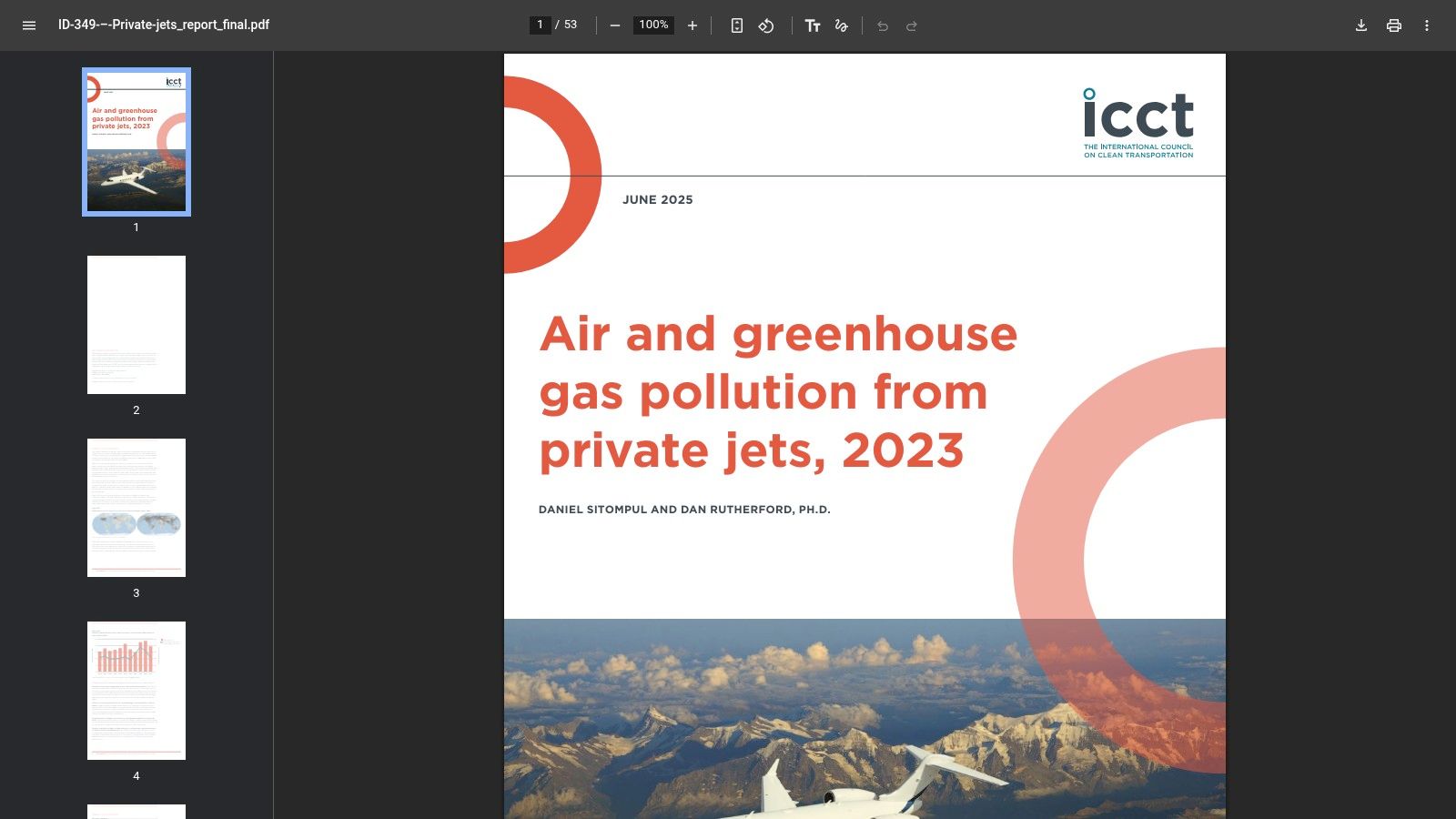
The International Council on Clean Transportation is the best place to start when you want a ranking grounded in real-world usage, not brand prestige. Its private-jet report uses flight activity tables, country breakouts, and methodology notes, so it's built for readers who want to know which aircraft are being flown the most. That makes it especially useful for sustainability angles and market-usage analysis, not for pure cabin fantasy. The ICCT report is the most analytical lens in this group.
Why charter buyers should care
If you want to understand whether a jet is common enough to source quickly, usage data matters more than glossy cabin photos. Aircraft that show up frequently in flight counts are generally easier to place into charter workflows, especially across busy international markets. That's valuable when you need short notice and can't afford to wait on a rare tail number.
Practical rule: Use this ranking when you need a reality check on aircraft presence, not when you're shopping for the most luxurious cabin.
The ICCT's value is also what it leaves out. It doesn't try to crown the prettiest interior or the fastest jet, so it won't satisfy someone who wants a purely aspirational list. For that reason, it works best as the factual backbone under a broader charter decision, and it pairs well with a sustainability discussion on what sustainable aviation fuel means for private flying. Haute Jets Journal should treat this kind of usage-based source as the first filter, then move to mission fit and operator quality.
2. General Aviation News
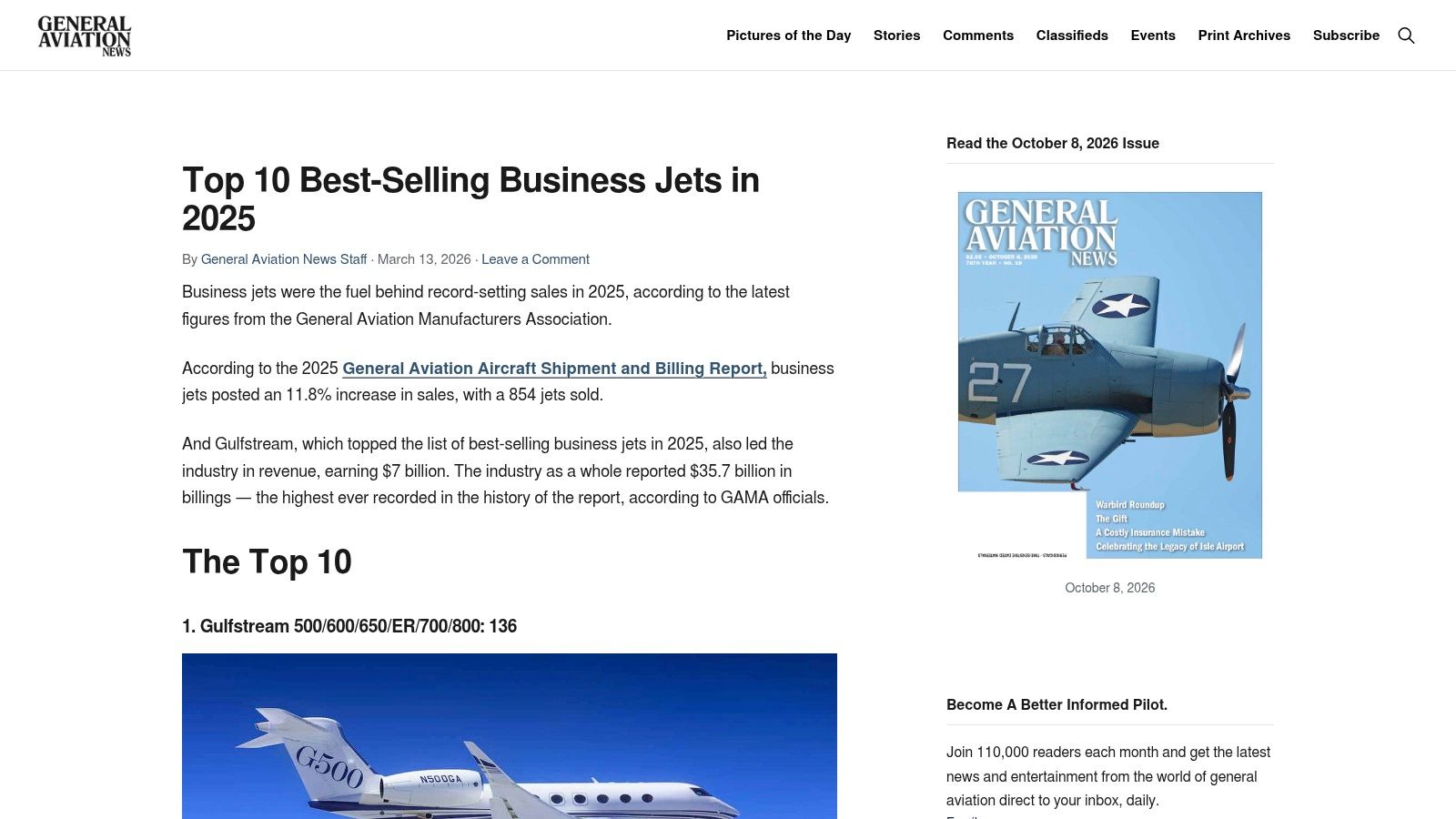
General Aviation News is the strongest lens for recent buying behavior. Its 2026-posted roundup of the best-selling business jets for 2025 focuses on deliveries and sales, which tells you what operators and buyers were choosing recently. That's a different question from “what flies the most” or “what looks best in a brochure.” General Aviation News gives you a market-demand snapshot.
What sales rankings actually tell you
Sales leaders usually reflect confidence in a model's support network, cabin appeal, and operator familiarity. That matters for charter because widely bought aircraft are often easier to source, maintain, and replace when another tail is unavailable. The result is not glamour, it's practical availability.
A sales-based ranking also helps you gauge freshness. Newer deliveries usually mean newer interiors, modern avionics, and a higher chance of finding an aircraft that feels current. That doesn't automatically make a jet better for every route, but it does make the pool more useful for travelers who want a contemporary cabin and predictable sourcing.
For a charter advisor, the point is simple. If a client wants the safest bet on availability across the market, sales volume deserves attention. If the client wants a specific nonstop mission or a statement cabin, sales rank alone isn't enough. Use this lens to see what the market is buying now, then cross-check the mission with other sources before you commit.
3. AeroTime
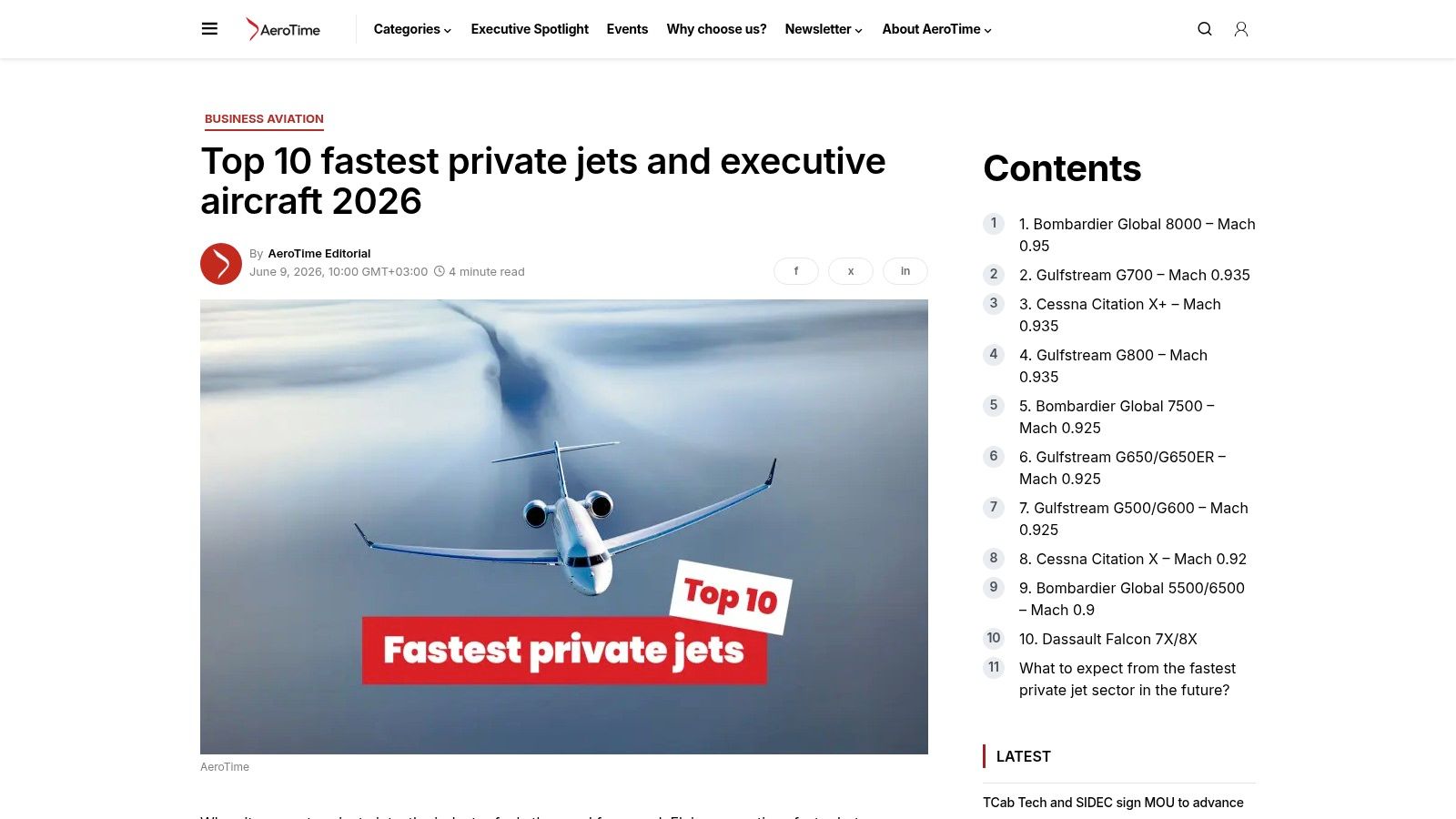
AeroTime is the right source when speed is the decision driver. Its ranking of the fastest private jets and business aircraft is built around published top speeds, which makes it easy to compare aircraft on a hard metric instead of style. AeroTime's fastest private jets guide is the cleanest speed-first list in this set.
Speed matters, but only on the right mission
If the trip is time-critical, speed can matter more than cabin theatrics. A faster aircraft can tighten schedules on long city pairs and reduce the margin for delay, especially when the client's arrival window is fixed. But speed by itself doesn't guarantee a better charter, because route length, payload, and available aircraft still decide whether the jet is the right fit.
Direct advice: Don't pay for top speed on a trip that doesn't need it. Match the aircraft to the route first, then decide whether speed is worth the premium.
AeroTime's value is that it gives you a quantitative comparison point. It's ideal when a client asks for the fastest option available, or when you need to explain why two jets with similar cabins produce different trip outcomes. For deeper aircraft-matching context, Haute Jets Journal's top private aircraft guide works as a useful companion piece, because speed should always be judged alongside range and practical sourcing.
4. ACC Aviation
ACC Aviation is the best source for travelers who care most about cabin feel, brand cachet, and guest experience. Its roundup of the world's most luxurious private jets is built around comfort and prestige, so it speaks directly to people booking for executives, celebrities, or high-touch leisure travel. ACC Aviation's luxury jet roundup is less about raw performance and more about how the cabin lands with the people inside it.

Luxury is a cabin decision, not a ranking trophy
The problem with luxury-only lists is that they can blur ownership prestige and charter practicality. A jet can look elite on paper and still be the wrong aircraft for a real itinerary. The client still needs the right range, the right airport access, and an operator that can deliver the aircraft on time.
That said, this lens is valuable when the cabin is part of the brief. If the client's expectation is a polished arrival, a quiet interior, or a prestige-heavy guest experience, then luxury rankings help shape the shortlist. They are especially useful for weddings, entertainment travel, and executive hosting, where the cabin itself is part of the service.
Use ACC Aviation as the style filter, not the final answer. It tells you what a traveler will feel on board, but it doesn't replace mission planning or operator vetting. Haute Jets should use this type of source to shape cabin expectations, then confirm the exact aircraft layout before any booking is locked.
5. AeroCorner
AeroCorner takes the most useful advisory angle for real charter buyers, because it frames “best” around mission and aircraft size. That matters more than a generic ranking when the trip is a short regional hop, a midsize business run, or an intercontinental leg. AeroCorner's guide is less about crown-jewels and more about fit.

Mission fit beats brand bias
A mission-based guide helps eliminate the most common charter mistake, choosing a jet because it sounds impressive instead of because it matches the route. A smaller aircraft near the departure city can beat a larger jet that needs repositioning. That's the kind of trade-off serious charter planning needs to make visible.
AeroCorner also works well for readers who don't yet know the difference between VLJ, light, midsize, and long-range categories. It gives the search process structure without forcing every trip into the same hierarchy. That makes it especially useful for travel managers and advisors who need to translate a route into an aircraft category quickly.
For Haute Jets Journal, this is the cleanest educational lens. It supports the idea that the “best” aircraft depends on who's flying, how far, and from where. Once the category is right, the exact tail number and cabin layout become the next decision.
6. Elysium Jet
Elysium Jet is useful because it speaks directly to ultra-high-net-worth charter demand. Its 2026-framed list mixes purpose-built business jets with VIP airliner conversions, which mirrors how top-tier clients often think about cabin space, range, and status in one conversation. Elysium Jet's 2026 private jet list is a competitor source, but it's still relevant for charter strategy.

VIP airliners belong in a separate conversation
This type of list is strongest when the mission calls for a much larger cabin than a standard business jet can deliver. For delegations, large family travel, or official-style movement, a VIP airliner can make sense in a way that a conventional jet cannot. The trade-off is obvious, these aircraft are not the same as the nimble, high-flexibility jets used for most on-demand trips.
Elysium Jet also reflects how charter marketers talk to UHNW clients. They emphasize density of comfort, prestige, and cabin scope, because those are the cues this audience notices first. That's useful intelligence for Haute Jets, even if the source itself is promotional.
Treat this lens as a signal of what high-end buyers expect to see in a shortlist. Then verify the aircraft against the route, the airport, and the exact headcount before you offer it to a client.
7. Private Flights
Private Flights is the most useful source for amenities. Its luxury-jet guide focuses on features clients ask about, including beds, showers, and high-end connectivity, which makes it practical for concierge-style selling. Private Flights' luxury private jets guide helps you talk about comfort in concrete terms.
Amenities only matter when they match the trip
A shower is impressive, but it's not the deciding factor on every route. On short trips, the traveler may care more about departure timing, baggage handling, or quiet seating than about a full suite-style interior. On overnight or multi-zone missions, though, amenities become a genuine differentiator.
That's why this source works well for guest-facing bookings. It gives advisors language for comfort, connectivity, and onboard functionality without forcing every aircraft into the same mold. It also helps set expectations before departure, which is exactly where many charter complaints begin.
For Haute Jets, this lens is especially valuable because it translates directly into client conversations. If a client mentions sleeping space, work zones, or premium cabin features, the shortlist should come from this kind of amenity-first analysis. Then the final selection should be matched to the exact tail number, since cabin layout can vary even within the same model.
7-Source Comparison: Top Private Jets
| Source | Implementation complexity | Resource requirements | Expected outcomes | Ideal use cases | Key advantages |
|---|---|---|---|---|---|
| International Council on Clean Transportation (ICCT) | Low, structured report and tables ready to cite | Low, download PDF; data extraction for charts | Authoritative usage rankings and emissions context | Sustainability analysis, data-driven rankings, regional comparisons | Citable methodology; country & per‑capita breakouts; emissions context |
| General Aviation News | Low, short trade article, easy to excerpt | Very low, link and brief ranking | Recent sales/delivery snapshot reflecting market demand | Market-demand stories, sales-focused ranking content | Current (2025 deliveries), business‑aviation specific |
| AeroTime | Low, editorial ranking by published top speeds | Low, article with manufacturer speed data | Quantitative speed comparisons (Mach/top‑speed profiles) | Performance‑oriented features, speed comparisons | Clear Mach metrics; reputable aviation outlet |
| ACC Aviation | Low, editorial luxury roundup | Low, content focused on cabin features and prestige | Luxury-focused model list emphasizing cabin experience | High‑net‑worth traveler guidance, amenity-led selection | Strong cabin/brand framing; credible operator voice |
| AeroCorner | Moderate, mission-based categorization requires alignment | Moderate, may need OEM/spec verification for specifics | Educational guidance across size/mission categories | Buyer guidance, route‑/mission-based aircraft selection | Practical “best by mission” structure; easy to repurpose |
| Elysium Jet | Low, vendor Top‑10 with charter focus | Low, operator content but likely promotional | Charter‑suitability list tailored to UHNW clients (2026) | UHNW charter planning, competitive benchmarking | Charter‑centric; 2026 time‑stamped; mixes bizjets and bizliners |
| Private Flights (operator) | Low, vendor blog with defined luxury criteria | Low, amenity lists and consumer‑friendly language | Amenity‑focused talking points and luxury definitions | Client materials, concierge copy, amenity comparisons | Clear luxury criteria; easy to adapt for client communications |
Turning a Ranking Into Your Next Confirmed Booking
The smartest way to read the top ten private jets is to combine the lenses, not pick one and ignore the rest. Use usage data to see which models are flown often, sales data to gauge market momentum, speed data for time-critical itineraries, and luxury rankings to understand what guests will actually feel in the cabin. Then use mission-fit sources to decide whether the route belongs to a light jet, a super-midsize cabin, an ultra-long-range aircraft, or a VIP airliner conversion.
Safety belongs in the same decision, because the aircraft model alone doesn't tell you how the flight will be run. In the U.S., charter operators must meet FAA Part 135 requirements, while third-party audits such as ARGUS and Wyvern add another layer of screening, not a replacement for certification. The right question isn't just which jet looks best, it's which operator is flying that specific aircraft, with what maintenance standards, crew qualifications, and go or no-go authority.
Haute Jets is built for that final step. Define the route, passenger count, and cabin needs, then request the exact year, make, model, and layout through Haute Jets, which sources from Wyvern- and Argus-rated owner-operators and confirms flight details 24 hours before departure. That's the point where rankings stop being theory and become a confirmed itinerary.
If you need a charter recommendation built around your exact route, Haute Jets can match the aircraft to the mission instead of forcing you into a generic category. Visit Haute Jets to request the year, make, model, and cabin layout that fits your trip, then fly with the operator and aircraft details confirmed before departure.